How to Measure Primary Mathematics Tuition Progress | Punggol Parent Guide
Primary Mathematics tuition should be measured by more than the next test score. Marks matter, but they are a late signal. Parents get a clearer picture by tracking whether the child is repairing dependencies, making fewer repeated errors, solving changed questions, retrieving older knowledge and needing less help.
This page owns the progress-measurement job for Primary Mathematics tuition in Punggol. It is different from our pages about what tuition can do and how to improve P1–P6 Mathematics. Here, the question is: how do we know whether the tuition is actually working?
eduKate Punggol currently teaches in small groups of three students for 1.5 hours. Current location, timetable, fees and places should be confirmed directly.
The six progress signals
- Dependency repair: older gaps interfere less with current topics.
- Error reduction: the same mistake class appears less often.
- Transfer: corrected methods survive changed questions.
- Retrieval: knowledge remains available after a delay.
- Execution: working is clearer and performance is more stable.
- Independence: the child needs fewer prompts to start and finish.
Why marks alone are not enough
A score can rise because a test happened to favour strong topics. It can fall because a school paper was unusually difficult even while the child’s underlying mathematical system is improving. The best evidence combines school marks with capability indicators.
| Evidence | What it can tell you |
|---|---|
| School test mark | Overall performance under one assessment condition. |
| Changed-question retest | Whether correction transferred. |
| Delayed retrieval | Whether learning survived beyond the lesson. |
| Error log | Whether recurring failures are reducing. |
| Prompt level | Whether independence is increasing. |
| Working quality | Whether method is becoming more visible and controllable. |
Use the official Mathematics job as the measurement anchor
MOE’s Primary Mathematics framework places mathematical problem solving at the centre, supported by concepts, skills, processes, metacognition and attitudes. For the 2026 PSLE, Mathematics is subject code 0008. The revised paper has two written papers with equal 50-mark weighting: Paper 1 is non-calculator and Paper 2 permits an approved calculator. The revised structure tests not only routine procedures but also application and reasoning.
So a useful progress measure should not ask only “Can my child do more worksheets?” It should ask whether the learner can represent, choose methods, reason, execute and check independently.
Signal 1: dependency repair
Primary Mathematics is cumulative. A P5 percentage problem may fail because fractions are unstable. A P6 ratio problem may fail because multiplicative comparison is weak. A speed or rate problem may fail because units and division are unreliable.
Track whether older prerequisites are becoming easier to retrieve and use inside newer topics. That is stronger evidence than simply completing the current chapter.
Signal 2: repeated-error rate
Do not count every wrong answer as a separate problem. Classify errors:
- concept,
- representation,
- method choice,
- arithmetic,
- unit,
- question reading,
- working/notation,
- checking.
If the same sign, unit or reference-quantity error appears week after week, tuition has not yet repaired the mechanism even if total marks move up temporarily.
Signal 3: changed-question transfer
After a correction, change the numbers, wording, representation or context. Keep the underlying mathematics the same. Can the child still identify the structure and choose a valid route?
Correction that cannot survive variation is still fragile.
Transfer is one of the best ways to distinguish true mathematical repair from memory of the worked example.
Signal 4: delayed retrieval
A student may perform well at the end of a lesson because the method is still active in working memory. Retest several days later without notes. If the learner can reconstruct the method, the learning is more durable.
- short recall set at the start of the next lesson,
- mixed old-and-new topic questions,
- one earlier problem inserted into homework,
- closed-book explanation of a key method.
Signal 5: working quality and method control
Cleaner working is not cosmetic. It makes the route easier to audit, reduces hidden jumps and helps the child recover when a mistake appears.
| Weak working | Improving working |
|---|---|
| Numbers appear with no quantity labels | Important quantities/units remain identifiable. |
| Large mental jumps | Fragile steps are visible. |
| Method copied without reason | Student can explain why the route is valid. |
| Final answer only | Enough method is shown to diagnose and check. |
Signal 6: prompt dependence
One of the clearest progress measures is how much help the child needs.
- Tutor models the route.
- Student solves with an explicit cue.
- Student solves with a smaller cue.
- Student starts independently.
- Student completes a changed question independently.
- Student detects and corrects an error independently.
If a child scores well only while the tutor supplies the first step, the score overstates independence.
A weekly parent-friendly Mathematics dashboard
| Measure | Simple weekly note |
|---|---|
| Main repair | What exact weakness are we targeting? |
| Repeated error | More / same / fewer? |
| Changed question | Passed / partial / failed? |
| Delayed retrieval | Can retrieve after several days? |
| Working | Clearer, same or more compressed? |
| Prompt level | How much help is still needed? |
| School transfer | Has the repair appeared outside tuition? |
This is enough. Parents do not need a complicated spreadsheet for every question.
Progress by Primary stage
P1–P2
Measure number sense, quantity language, operation meaning, fluency and independent starting. Speed should follow stable understanding.
P3–P4
Measure representation, fractions/decimals, multi-step reasoning, units and the ability to explain why a method fits.
P5
Measure whether ratio, percentage and other upper-primary topics can be connected to older dependencies, and whether the child can handle changed-context problem sums.
P6
Measure mark-loss classes, transfer, Paper 1 non-calculator stability, Paper 2 calculator discipline, method visibility, timing and independence under mixed-paper conditions.
Do not overreact to one test
A single school test is a sample. Before changing the whole tuition plan, ask whether the errors repeat and whether the same weakness appears in changed or independent work.
- One unusual question can distort a small test.
- A difficult paper can lower marks despite better underlying reasoning.
- A familiar paper can inflate marks without strong transfer.
- Sleep, illness and time pressure can temporarily affect execution.
The four-week review
Every four weeks, ask:
- Is the diagnosis more precise?
- Are high-frequency errors reducing?
- Can the child solve changed examples?
- Can older repaired topics still be retrieved?
- Is school transfer visible?
- Is the learner using less prompting?
Those indicators should guide continue/change/reduce decisions.
When marks rise but Mathematics has not improved enough
- the child still cannot explain methods,
- success disappears when wording changes,
- old topics are forgotten quickly,
- the tutor still supplies the starting step,
- working remains impossible to audit.
This is why “got 8 more marks” should be celebrated but not treated as the only evidence.
When marks have not risen yet but the system is improving
- the child now identifies the right representation,
- repeated errors are fewer,
- changed-question success is increasing,
- working is cleaner,
- old topics stay available longer,
- the amount of help is falling.
These are meaningful leading indicators. They should eventually translate into more stable assessment performance if the direction continues.
Why three students can improve measurement quality
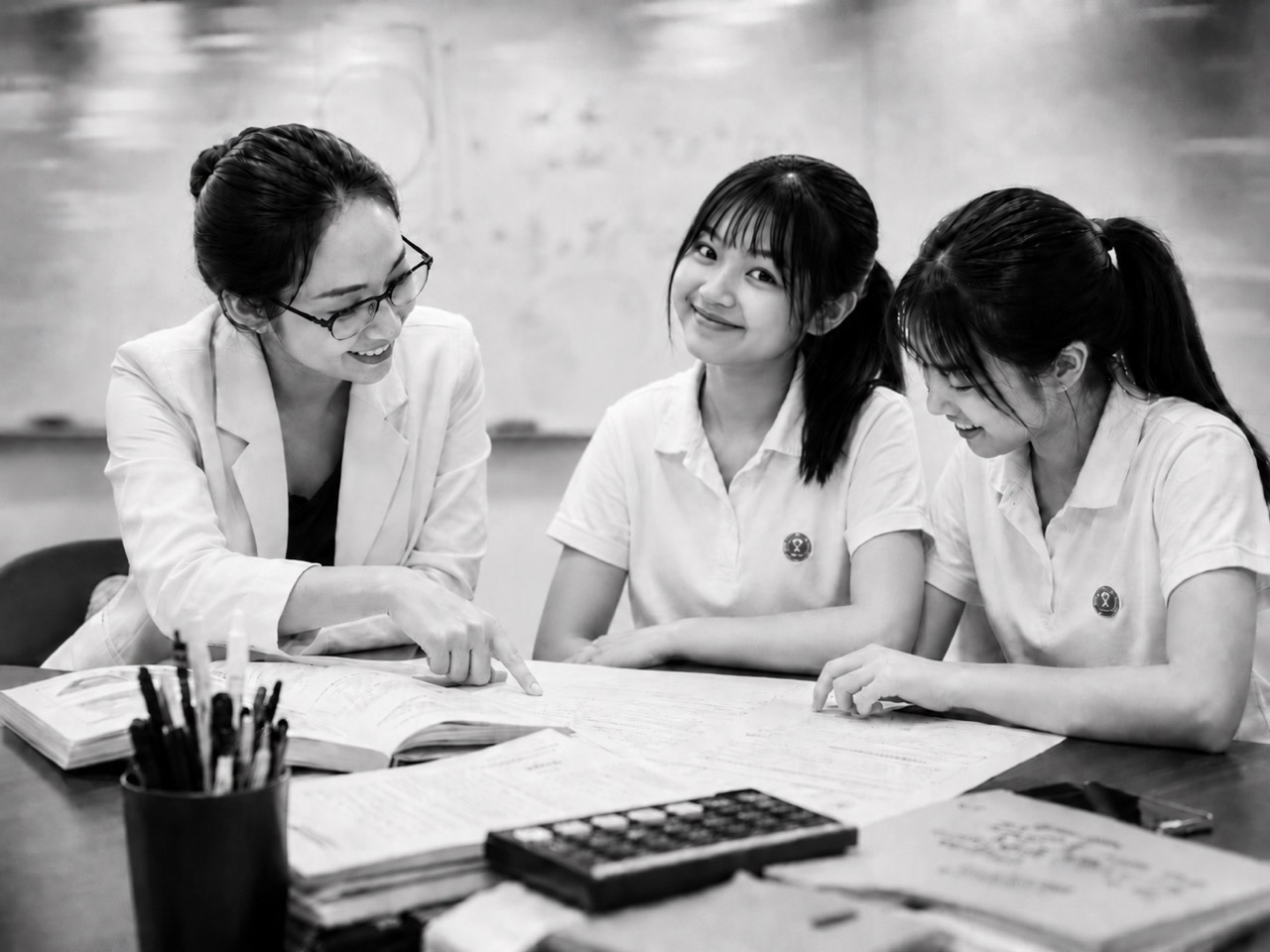
In a three-student class, the tutor can see individual routes rather than only final scores. One learner may need a representation cue, another may choose the correct route but lose a unit, and a third may solve independently. That makes progress easier to describe in capability terms.
A 90-minute progress-oriented lesson
| Time | Progress evidence |
|---|---|
| 0–10 | Delayed retrieval. |
| 10–25 | Marked-work or error audit. |
| 25–40 | Targeted dependency repair. |
| 40–55 | Guided application. |
| 55–70 | Changed-question transfer. |
| 70–82 | Independent timed/untimed cluster as appropriate. |
| 82–90 | Record residual error and prompt level. |
When to change or reduce tuition
Change when the same error mechanism persists without a change in teaching or transfer. Reduce when the learner increasingly succeeds independently and the marginal value of support is falling.
Good tuition should eventually make itself less necessary.
Official references
Related Mathematics routes
- What Primary Mathematics tuition can do
- How to improve Primary Mathematics P1–P6
- When should Primary Mathematics tuition start?
The measurement principle
Measure the student, not the worksheet count. Track the repair, retest it on a changed question, return after a delay, watch the error rate and reduce the prompts. When the same Mathematics starts travelling into school work independently, tuition is producing useful progress.