Science is everywhere, but that does not mean every family needs to turn breakfast, bath time and a walk downstairs into another worksheet. Everyday Science is most useful when it creates one small habit: notice what happened, separate observation from explanation, use evidence, and connect the event to a scientific idea.
This page owns the everyday Science transfer job: use ordinary life to strengthen observation, comparison, evidence and explanation without converting home into tuition.
Quick read
- Use short Science conversations, not constant questioning.
- Start with direct observation before asking why.
- Ask for evidence when the child makes a claim.
- Use familiar events to test whether school concepts transfer beyond the worksheet.
- Stop when the conversation stops being curious and becomes another lesson.
Why everyday transfer matters
The Primary Science curriculum is designed to help pupils understand themselves and the world around them, not merely remember isolated chapter facts. The five themes—Diversity, Cycles, Systems, Energy and Interactions—are visible in ordinary life if children learn to notice them.
Everyday transfer gives one useful test: can the child recognise the same scientific relationship when the worksheet picture disappears?
The four-question home routine
- What did you notice?
- What evidence supports that?
- Which Science idea might explain it?
- What could we change or observe next to test the explanation?
You do not need all four every time. One good question is often enough.
Cooking: heat, changes and evidence
The kitchen offers many natural observations: butter melts, water boils, steam condenses on a cooler lid, food changes colour, metal handles become warm and different materials respond differently to heat.
Instead of lecturing, ask:
- What changed first?
- Which part became warmer?
- What do we actually observe, and what are we inferring?
- Why might two materials feel different under the same room conditions?
Keep safety first. Observation is enough; children do not need to handle hot equipment to learn from it.
Condensation: bathroom mirrors and cold drinks
A foggy mirror or water droplets on the outside of a cold cup are useful because they invite a common misconception: “the water leaked through”.
Ask the child where the water could have come from and what evidence would distinguish leakage from condensation. The everyday event becomes a test of the child’s model of matter and water changes.
Shadows: light, position and comparison
Shadows change length and direction through the day. Ask the child to observe rather than memorise a rule immediately.
- Where is the light source?
- Where is the shadow?
- What changed between morning and afternoon?
- What stayed the same?
- What prediction could we make for later?
A photograph at two times can become simple evidence without turning the activity into a formal experiment.
Plants: systems, conditions and careful claims
A houseplant can support observation over time. The child can note leaf colour, new growth, soil condition or direction of growth. The key is to avoid overclaiming from one observation.
If one leaf turns yellow, that does not automatically prove one specific cause. Ask what other information would be needed. This teaches evidence limits.
Materials: compare before choosing
Everyday objects make material properties meaningful. Why is a raincoat made from one kind of material and a towel from another? Why are pan handles often designed differently from the metal pan body? Why can a clear container and an opaque container serve different purposes?
Ask the child to connect property → evidence → suitable use.
Forces: doors, bicycles, balls and elastic objects
Movement provides natural opportunities to discuss forces. A ball changes direction, a bicycle slows, a spring returns toward its original shape, a door rotates around a hinge.
Use careful questions:
- What changed in the motion or shape?
- What interaction produced the change?
- What would happen if the force were applied differently?
- Which observations support the explanation?
Cycles: notice sequences over time
Life cycles and water changes are easier to understand when children see that a cycle is not just a circular arrow in a textbook. Ask what stage comes next, what condition allows the transition and which parts actually repeat.
Do not force every sequence into a cycle. Some processes are one-way under the conditions being discussed. The child should follow evidence rather than a familiar diagram shape.
Systems: ask what each part contributes
A bicycle, plant, human body or simple electrical setup can all be discussed as systems at different levels. Ask:
- What are the important parts?
- What does each part do?
- How do the parts interact?
- What changes if one part is removed or stops working?
This builds part-function relationship thinking rather than memorised labels.
Measurement: turn impressions into evidence
Children often say “more”, “faster”, “hotter” or “bigger” without measuring. Everyday Science can gently introduce evidence:
- How could we measure it?
- Which unit would make sense?
- Would one measurement be enough?
- What should stay the same if we compare two cases?
Measurement turns opinion into inspectable evidence.
Prediction: expose the child’s model
Before seeing what happens, ask the child to predict and give a reason. Prediction is useful because it reveals the current model. If the outcome differs, the child has a natural reason to revise the explanation.
The prediction does not need to be correct to be useful.
Do not turn home into a constant oral exam
Children can become wary if every everyday observation becomes, “Tell me the Science behind this.” Curiosity needs space. Sometimes simply notice something together and leave it there.
A healthy rhythm might be one short Science conversation during a naturally interesting moment, not a continuous stream of questions.
When the child’s explanation is wrong
Do not rush to correct every sentence. Ask what the child predicts next or which evidence would support the idea. A counterexample can sometimes repair the model more effectively than a lecture.
If the misconception is important and persistent, return to a clear age-appropriate Science explanation afterwards.
From home observation back to school Science
The transfer is complete when the child can use the same observation-evidence-explanation habit on a school diagram, table, investigation or structured question.
For example:
- condensation at home → water-change question at school;
- shadow comparison → light diagram;
- material choice → property-and-use question;
- plant observation → changed-condition explanation;
- everyday force → unfamiliar motion scenario.
A weekly family Science habit
- Notice one real phenomenon.
- Record one observation.
- Make one prediction or explanation.
- Ask what evidence supports it.
- Later, connect the idea to a school Science task if relevant.
Five minutes is enough. Consistency matters more than elaborate projects.
What a three-student Science class can add
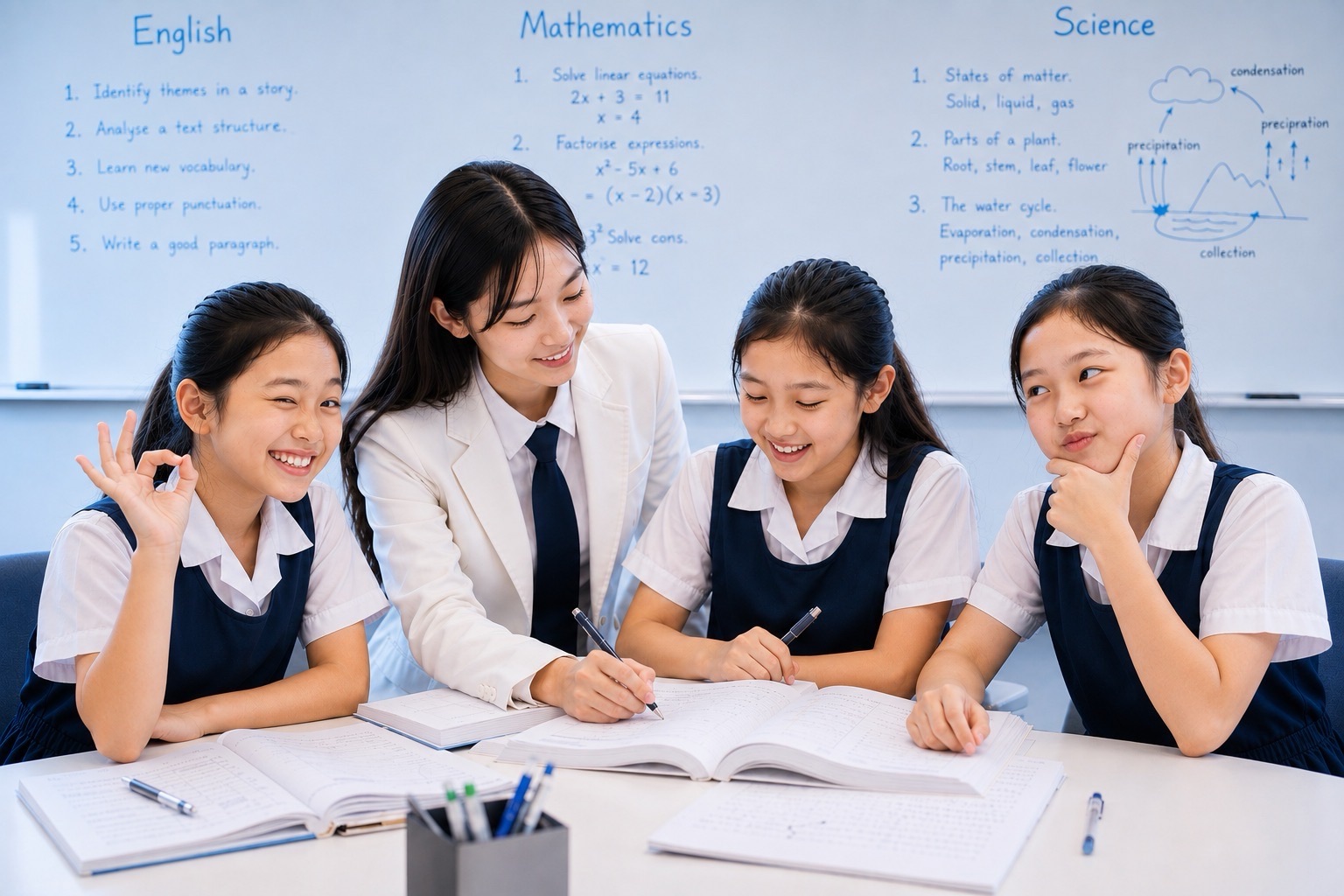
In a three-student, 1.5-hour class, students can bring different everyday observations to the same scientific idea. One may have noticed condensation, another cooling and another material differences. The tutor can connect these experiences to a shared model, then test the model on an unfamiliar school-style question.
What parents should look for
- The child notices details more precisely.
- Claims are supported with observations.
- The child distinguishes “I saw” from “I think”.
- School concepts appear naturally in everyday explanations.
- Changed contexts feel less unfamiliar.
- Curiosity remains intact rather than becoming another homework burden.
Related Science routes
- When Hands-On Science Helps—and When It Misleads
- How to Read the MOE Primary Science Syllabus
- Science Misconception Repair
The main idea
Everyday Science should make school Science more transferable without making home feel like school. Notice. Measure when useful. Separate observation from explanation. Ask for evidence. Revise the model when reality disagrees. Then let the child carry that habit back into diagrams, experiments and exam questions.