
How the Middle of a PSLE Composition Actually Works: Development, Turning Point and Consequence
The middle of a composition is where the story earns its ending.
It develops the central problem, changes the situation, reveals consequences and carries the reader from the opening promise towards the resolution.
That job cannot be reduced to “write three body paragraphs”. The number of paragraphs matters far less than whether each paragraph moves the story forward.
Quick Read
- Each paragraph in the middle should have a distinct narrative job.
- Event hierarchy matters: not every moment deserves equal space.
- A turning point changes the direction, stakes or understanding of the story.
- Cause and consequence should connect events.
- Prompt material should influence the story, not appear as decoration.
- Good pacing gives more space to important moments.
- The middle should create the conditions that make the ending feel earned.
One-sentence answer: the middle of a PSLE composition works when each paragraph changes the situation in a meaningful way and builds logically towards consequence and closure.
1. Give Each Paragraph a Job
A useful paragraph may:
- introduce a complication;
- show a decision;
- raise the stakes;
- reveal information;
- show a failed attempt;
- trigger the turning point;
- show immediate consequence.
If two adjacent paragraphs perform the same job, one may be unnecessary or under-developed.
2. Use Event Hierarchy
Not every event deserves equal space.
Minor transitions can be compressed. Important decisions, discoveries or confrontations deserve more detail because they change what happens next.
| Event type | Typical treatment |
|---|---|
| Movement between locations | Compress unless important |
| Routine action | Summarise |
| Key decision | Slow down and develop |
| Turning point | Give enough detail for consequence to feel earned |
| Immediate aftermath | Show what changed |
3. Build Cause, Not Just Sequence
Then this happened. Then that happened. Then we went home.
This creates chronology but not necessarily story.
A stronger middle shows why one event leads to the next:
- because;
- therefore;
- as a result;
- however;
- despite;
- which forced the character to…
The relationships can be explicit or implied, but the reader should feel a causal chain.
4. Create a Real Turning Point
A turning point is not simply “the most exciting sentence”.
It is the moment after which the story cannot continue in quite the same way.
- new information appears;
- a character chooses differently;
- a hidden problem becomes visible;
- an attempted solution fails;
- the stakes rise;
- a relationship changes.
5. Integrate the Prompt Material
For PSLE continuous writing, prompt material should matter to the story.
If an image or idea can be deleted without changing the narrative, it may have been inserted decoratively rather than integrated.
A stronger approach gives the selected prompt a structural job:
- cause of the problem;
- evidence that changes a decision;
- object around which the conflict develops;
- setting that creates constraint;
- detail that becomes important later.
6. Control Pacing
Pacing is allocation of attention.
If a student spends half the composition describing breakfast and two sentences on the central conflict, the problem is not descriptive skill. It is allocation.
- compress routine movement;
- slow down important action;
- let consequences breathe;
- avoid using all the time before the resolution.
7. Develop Character Through Decisions
Characters become more convincing when the middle forces them to choose.
Instead of repeatedly telling the reader that a character is brave, selfish or guilty, let the choice under pressure reveal it.
8. Use Dialogue When It Changes Something
Dialogue is useful when it:
- reveals information;
- changes a relationship;
- raises conflict;
- forces a decision;
- shows misunderstanding;
- creates consequence.
Dialogue that merely repeats what the narration already told us adds volume without movement.
9. The Middle Should Prepare the Resolution
A resolution feels arbitrary when the middle has not planted the causes that make it possible.
If the ending depends on a clue, relationship or decision, the middle should establish it before the final paragraph.
See How to End a PSLE Composition: Resolution, Consequence and Closure.
A Middle-Section Diagnostic
| What you notice | Likely issue | Useful repair |
|---|---|---|
| Many events but little impact | Weak hierarchy | Select fewer important events |
| Story feels episodic | Weak causality | Connect events through consequence |
| Prompt appears once then disappears | Weak integration | Give prompt material a structural job |
| Ending arrives from nowhere | Middle failed to prepare resolution | Plant the needed cause earlier |
| Important moment feels rushed | Pacing | Compress lower-value material |
A Planning Method
- What is the central problem?
- What first makes it worse?
- What decision or discovery changes direction?
- What immediate consequence follows?
- What must now be resolved?
This is more flexible than forcing every composition into a fixed number of body paragraphs.
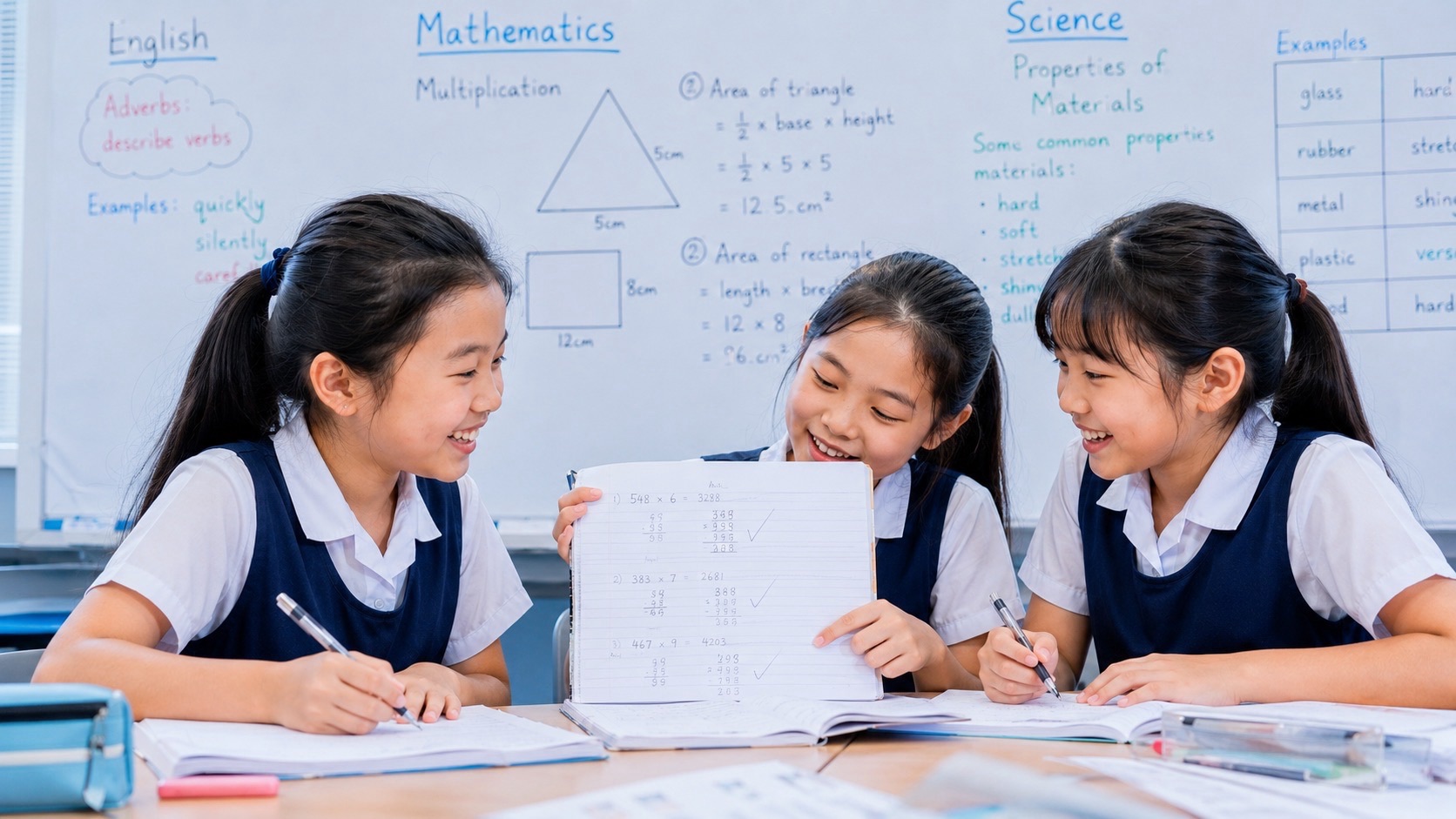
How a Three-Student Class Helps
Three students can plan different middles for the same prompt and compare which causal chain most naturally earns the ending.
The tutor can then isolate whether the weakness lies in event selection, pacing, prompt integration or consequence.
Frequently Asked Questions
How many body paragraphs should a PSLE composition have?
There is no useful universal number. Use enough paragraphs to give distinct parts of the narrative clear jobs.
Must every composition have one dramatic climax?
No. What matters is a meaningful turning point or change in the story’s direction, not forced drama.
The Middle Is Where the Story Pays for Its Ending
Every important consequence at the end should have a cause somewhere before it.





