
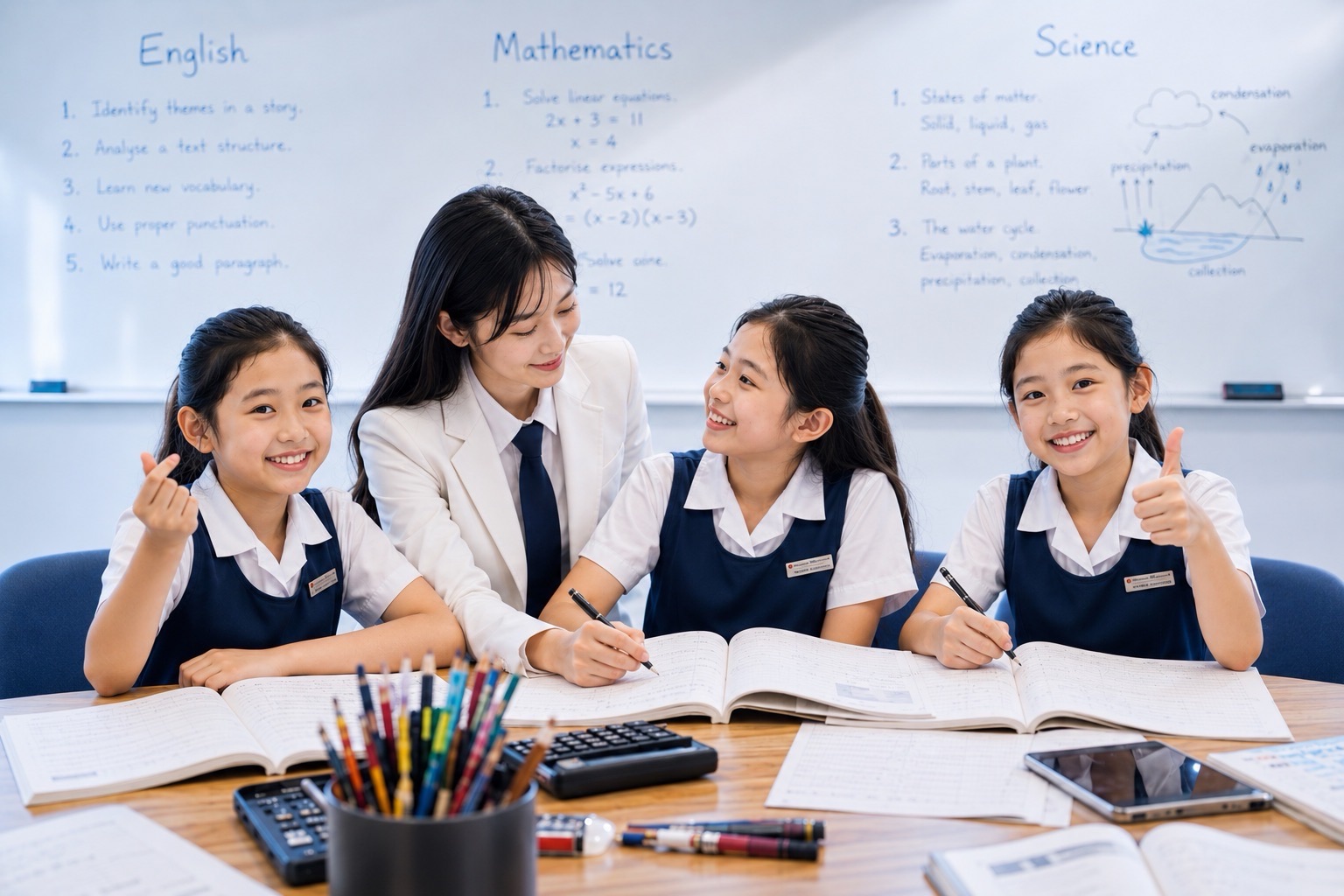
Secondary 4 Mathematics Tuition Small Groups
Secondary 4 Mathematics tuition in small groups works best when students need close correction, repeated exam practice, clearer mathematical working, and enough peer comparison to sharpen speed and accuracy without disappearing inside a large class.
In Singapore, Secondary 4 mathematics is not just about finishing content. It is an exam-year consolidation phase. Across the official upper-secondary mathematics pathways, the syllabus emphasis is not only on content coverage but also on reasoning, communication, application, and mathematical problem-solving. MOE also notes that under Full Subject-Based Banding, students now move through Posting Groups and may offer subjects at different levels, which means Sec 4 classes can be more mixed in background and pacing than many parents assume. (Ministry of Education)
Start Here: https://edukatepunggol.com/secondary-4-mathematics-tuition-in-small-groups-at-sengkang/
- Why small groups can work especially well in Secondary 4
- Why this matters for Sec 4 exam performance
- What a good Sec 4 small-group math class should actually do
- Which Sec 4 students benefit most?
- When one-to-one may be better
- What parents should look for
- Secondary 4 Mathematics programme details
- Programme highlights
- Course outline
- Key benefits
Why small groups can work especially well in Secondary 4
Small-group tuition sits between two extremes. It is not as broad and impersonal as a large class, but it is also not as intensive and costly as one-to-one tuition. For many Sec 4 students, that middle structure is exactly what helps.
At this stage, students usually do not fail because they have never seen the topic before. They fail because their mathematics is unstable under pressure. They may know the chapter in isolation, but not under timed conditions, mixed-topic papers, careless-error load, or multi-step questions that demand method selection, proper working, and accurate interpretation.
A small group helps because the tutor can still see the student’s actual mathematical behavior:
- where working breaks,
- which steps are skipped,
- whether the child understands the method or is copying surface patterns,
- and whether mistakes come from concept gaps, speed collapse, weak checking, or poor exam discipline.
That is where small groups are strongest. They are often large enough to create useful pace and comparison, but still small enough for real correction.
Why this matters for Sec 4 exam performance
For O-Level Additional Mathematics, the official 2026 syllabus has two papers of 2 hours 15 minutes each, both requiring candidates to answer all questions, and it states that omission of essential working will result in loss of marks. The O-Level Mathematics and N(A)-Level Mathematics syllabuses likewise emphasise not just routine procedures but also solving problems in context, reasoning, and mathematical communication. That means tuition cannot only be about giving answers. Students must learn to produce valid working and stay stable across full-paper conditions. (SEAB)
What a good Sec 4 small-group math class should actually do
A strong small-group Secondary 4 mathematics class should do five things well.
1. Correct mathematical working in real time
By Sec 4, many students have hidden habits that cost marks:
- skipping steps,
- copying formulas into the wrong context,
- setting up expressions incorrectly,
- careless sign errors,
- weak graph reading,
- weak algebra control,
- and poor checking.
Small groups allow a tutor to catch these before they harden further.
2. Rebuild mixed-topic control
Students often say, “I can do the chapter, but I cannot do the paper.”
That usually means the problem is no longer topic knowledge alone. It is paper integration.
A useful small-group class should train:
- topic recognition,
- method selection,
- switching between topics,
- time allocation,
- and recovery after getting stuck.
3. Use peer momentum without losing individual visibility
This is one of the real strengths of small groups.
In a good small group, a student sees:
- how others structure answers,
- where others make mistakes,
- how different methods can still reach the same result,
- and how stronger students manage pace.
That gives useful academic pressure. But unlike a big class, the tutor can still track each student properly.
4. Build exam stamina
Sec 4 mathematics is not just knowledge. It is endurance.
A student may understand a topic at 4 p.m. on a worksheet and still collapse in a two-hour paper.
Small groups are often effective for building exam stamina because they can run:
- timed practices,
- partial-paper drills,
- full-paper rehearsals,
- review of error clusters,
- and post-paper correction loops.
5. Reduce passive learning
In large classes, students can hide.
In one-to-one classes, students can become over-supported.
In a well-run small group, students are pushed to think, attempt, compare, explain, and correct. That often creates a healthier balance between support and independence.
Which Sec 4 students benefit most from small-group math tuition?
Small groups are often a strong fit for students who:
- are not completely lost, but are inconsistent,
- need regular correction but not full-time one-to-one rescue,
- benefit from seeing how peers solve questions,
- need more timed practice and accountability,
- are careless under pressure,
- or need momentum to stay disciplined through exam year.
This is often the “middle corridor” student:
not fully independent, but not at total breakdown either.
For these students, small groups can be more effective than parents expect.
When one-to-one may be better
Small-group tuition is not always the best answer.
One-to-one may be better when:
- the student has very severe foundation gaps,
- there is strong anxiety or shutdown behavior,
- the pace mismatch is too large,
- the student needs heavy reconstruction from earlier years,
- or the school/exam pathway is highly specific and urgent.
If the student cannot yet stay viable inside a group rhythm, then a smaller intervention may be needed first.
What parents should look for in a Sec 4 mathematics small group
Do not choose based on branding alone. Choose based on whether the class can actually carry your child through Sec 4 mathematics demands.
Look for these signs:
Clear level matching
The class should match the student’s actual level and subject pathway.
Visible correction
There should be real marking, real feedback, and real discussion of working.
Paper-based training
The class should not remain at chapter worksheets only. It should move into mixed-topic and exam-format practice.
Error-pattern diagnosis
A good tutor should be able to explain whether the student’s marks are being lost through concept weakness, method weakness, speed weakness, accuracy weakness, or exam-management weakness.
Class size that still allows attention
If the group is too large, it becomes a lecture.
If it is small enough, the tutor can still see each student’s mathematics properly.
Why parents often choose the wrong math tuition format in Sec 4
A common mistake is to choose tuition based on the appearance of productivity.
A large class can look efficient.
A one-to-one class can look premium.
But the real question is different:
Which format gives this student the highest probability of stable mathematical performance in exam conditions?
For many Sec 4 students, the answer is a strong small group, because it provides:
- correction,
- discipline,
- peer pace,
- exam realism,
- and enough tutor visibility.
That combination is often what turns unstable students into dependable exam performers.
Conclusion
Secondary 4 Mathematics tuition in small groups works best when the group is truly small enough for real correction and structured enough to build exam-year consistency.
By Sec 4, mathematics is not only about content revision. It is about keeping working valid, choosing methods correctly, handling mixed-topic questions, and staying stable under paper conditions. That aligns closely with the official Singapore mathematics syllabuses, which emphasise not just knowledge, but reasoning, communication, application, and problem-solving across both O-Level and N(A)-Level pathways. (SEAB)
For the right student, a small group is often not the compromise option. It is the correct option.
Secondary 4 Mathematics Programme Details
The sections below preserve the programme-level detail on topic coverage, practice, feedback and assessment for Secondary 4 Mathematics. Read them together with the small-group diagnosis and exam-readiness framework above: the purpose is to identify what a student needs, practise it deliberately, inspect the working, and then test whether the improvement survives mixed and timed conditions.
Why Secondary 4 Mathematics is Important
As students approach their O-Level exams, their proficiency in Mathematics becomes crucial. Scoring well in both A Maths and E Maths is not only important for overall academic performance but also critical for admission into many post-secondary programs, including Junior Colleges and Polytechnics. However, the complexity of topics like calculus, trigonometry, and algebra, combined with the pressure of the upcoming exams, can be overwhelming.
EduKate Sengkang’s Secondary 4 Mathematics tuition is designed to help students master these challenging topics and develop the skills and confidence needed to succeed.
Key Features of EduKate Sengkang’s Secondary 4 Mathematics Tuition
1. Personalized Learning Plans
Every student has unique learning needs and areas where they may require additional support. Our tutors create customized learning plans for each student, focusing on areas of weakness while building on their strengths. Whether a student is struggling with calculus or algebra, we tailor our lessons to meet their specific needs, ensuring they are fully prepared for the GCE O-Level Mathematics exams.
2. Exam-Oriented Approach
At EduKate Sengkang, we take an exam-oriented approach to Mathematics tuition, focusing on the techniques and strategies needed to score well in exams. Our tutors provide students with practice papers, mock exams, and time management strategies, ensuring they are familiar with the format of the O-Level exams and can tackle questions efficiently.
3. Focus on Key Mathematical Concepts
Our Secondary 4 Mathematics tuition covers a wide range of essential topics, including:
- Algebra and Equations: Mastery of algebra is crucial for solving both E Maths and A Maths problems. We guide students through the manipulation of algebraic expressions, solving equations, and applying algebraic techniques in problem-solving.
- Trigonometry: Trigonometry is an important component of the O-Level syllabus. Our tutors teach students how to apply trigonometric identities, solve equations, and use trigonometry in both theoretical and practical problems.
- Calculus (For A Maths): Calculus is one of the more advanced topics in A Maths. We help students understand the concepts of differentiation and integration, applying these techniques to solve real-world problems involving rates of change, areas, and volumes.
- Geometry and Coordinate Geometry: Students learn to solve problems involving lines, circles, and other geometric shapes, applying the principles of coordinate geometry to analyze and solve complex questions.
- Statistics and Probability: Understanding data interpretation, probability, and statistics is essential for success in E Maths. We teach students how to analyze and interpret data accurately, and solve probability problems confidently.
4. Effective Problem-Solving Strategies
To succeed in O-Level Mathematics, students need to develop strong problem-solving skills. Our tutors teach students how to approach complex problems by breaking them down into manageable steps. We emphasize the importance of understanding the underlying concepts and applying logical reasoning to find the right solutions.
5. Regular Feedback and Progress Tracking
At EduKate Sengkang, we believe that continuous feedback is key to student success. Our tutors provide detailed feedback after every lesson, highlighting areas of improvement and offering guidance on how to enhance performance. We also track each student’s progress over time, ensuring that they are on the right path toward achieving their academic goals.
What the 3-Student Format Allows
- Three students per class: the tutor can inspect each student’s working closely enough to see missing steps, wrong setup, recurring errors and weak checking habits.
- Individual correction inside a group: students can receive different next moves even when they are working on the same mathematical task.
- Exam preparation with evidence: mixed-topic work, timed practice and paper review can be used to test whether understanding remains stable under examination conditions.
- Reasoning before repetition: the class can focus on why a method works, how to recognise when it applies, and how to communicate valid mathematical working.
Secondary 4 Mathematics Program Highlights
Our program is specifically tailored to address the challenges that students face in mastering O-Level Mathematics. The curriculum is designed to help students develop strong mathematical reasoning, sharpen their problem-solving skills, and gain confidence in tackling both A-Math and E-Math papers.
1. Focused Lessons on Key Mathematical Concepts
Each lesson in our Top Sengkang Math Tuition covers essential mathematical concepts that are crucial for success in the MOE GCE O-Level exams:
- Algebra: Mastery of algebraic techniques, including factorization, expansion, quadratic equations, and inequalities.
- Trigonometry: Understanding and applying trigonometric identities, equations, and functions in solving complex problems.
- Calculus: Differentiation and integration, along with their applications in solving real-world mathematical problems.
- Geometry and Coordinate Geometry: Tackling advanced geometric properties, including circle theorems, transformations, and vectors.
- Statistics and Probability: Interpreting data, analyzing probability distributions, and applying these concepts in problem-solving scenarios.
2. Process Skills and Problem-Solving Strategies
At eduKate Singapore, we emphasize the development of essential process skills such as logical reasoning, analytical thinking, and structured problem-solving. Our tutors teach students how to break down complex mathematical problems into smaller, manageable parts, applying strategic approaches to ensure full comprehension and efficient solutions.
- Step-by-Step Problem Solving: Students learn to deconstruct multi-step problems, allowing them to understand the rationale behind each step and the method needed to solve it.
- Exam Techniques: We train students on how to approach different question types, optimize their time during the exam, and avoid common mistakes.
Course Outline for Secondary 4 Mathematics Tuition in Sengkang
Our Secondary 4 Mathematics course outline is structured to help students build a strong foundation for their final exams, ensuring they are prepared for the rigors of the GCE O-Level assessments.
Comprehensive Curriculum Overview
Our Top Sengkang Math Tuition includes the following core components, aligned with the GCE O-Level syllabus:
- Algebra and Equations: Understanding and applying algebraic principles in solving equations and inequalities.
- Functions and Graphs: Analyzing functions, interpreting graphs, and understanding their applications in real-world scenarios.
- Geometry and Trigonometry: Mastering geometric and trigonometric principles for problem-solving in both two-dimensional and three-dimensional spaces.
- Vectors and Matrices: Introduction to vector analysis and matrix operations, with real-world applications.
- Statistics and Probability: Comprehensive coverage of statistical data interpretation and probability theory.
Structured Learning and Assessment
We conduct regular assessments to ensure that students are on track and progressing steadily. These include:
- Weekly Quizzes: Testing students on specific topics covered during the week to reinforce their learning and identify areas for improvement.
- Mock Exams: Simulating GCE O-Level exam conditions to help students familiarize themselves with the exam format and practice time management.
- Past-Year Paper Practices: Regular exposure to past O-Level exam papers to help students become adept at recognizing question types and mastering their techniques.
Detailed Feedback and Progress Monitoring
Our tutors provide continuous feedback to help students improve their performance. Parents are also kept in the loop with regular updates on their child’s progress. This ensures that students remain motivated and focused on achieving their academic goals.
Key Benefits of Our Secondary 4 Mathematics Tuition in Sengkang
Students who join our Top Sengkang Math Tuition benefit from:
1. Strong Foundation for Future Studies
Our tuition program not only prepares students for their O-Level examinations but also builds a strong foundation for future academic pursuits, whether they continue with Mathematics in Junior College or Polytechnic.
2. Development of Critical Thinking Skills
Mathematics is not just about memorizing formulas. We teach students how to think critically, approach problems logically, and develop solutions that are both efficient and accurate. These skills are invaluable in exams and beyond.
3. Confidence and Exam Readiness
With ample practice, regular mock exams, and targeted exam strategies, our students gain the confidence they need to excel in their O-Level Mathematics exams.
4. Tailored Support for Every Student
Our small class sizes and personalized attention ensure that each student receives the support they need to overcome their unique challenges and excel in Mathematics.
Root Learning Framework
eduKate Learning System — How Students Learn Across Subjects
https://edukatesg.com/eduKate-learning-system/
Mathematics Progression Spines
Secondary 1 Mathematics Learning System
https://bukittimahtutor.com/secondary-1-mathematics-learning-system/
Secondary 2 Mathematics Learning System
https://bukittimahtutor.com/secondary-2-mathematics-learning-system/
Secondary 3 Mathematics Learning System
https://bukittimahtutor.com/secondary-3-mathematics-learning-system/
Secondary 4 Mathematics Learning System
https://bukittimahtutor.com/secondary-4-mathematics-learning-system/
Secondary 3 Additional Mathematics Learning System
https://bukittimahtutor.com/secondary-3-additional-mathematics-learning-system/
Secondary 4 Additional Mathematics Learning System
https://bukittimahtutor.com/secondary-4-additional-mathematics-learning-system/





