
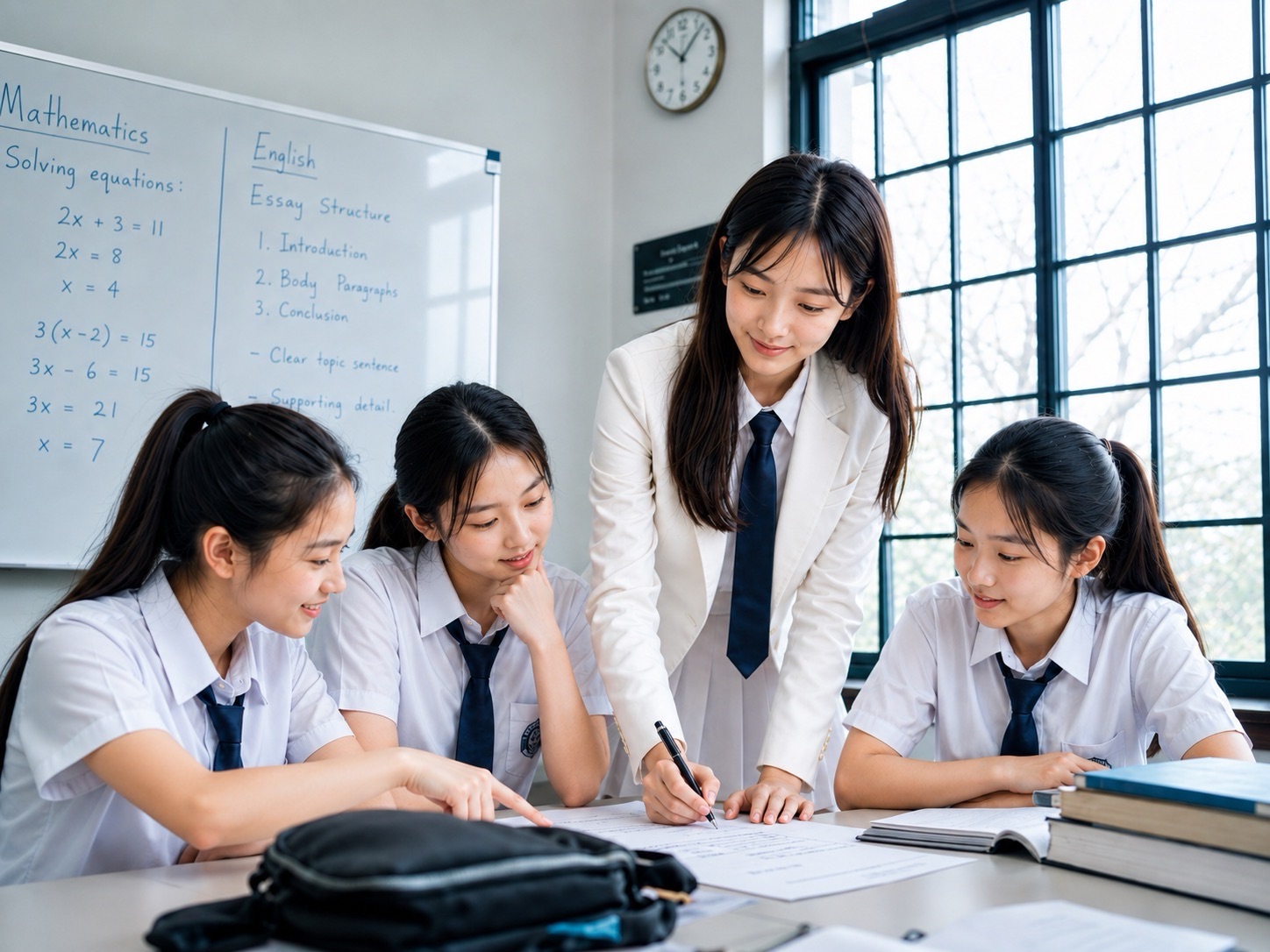
Direct answer: Secondary 1 Mathematics tuition should teach students to translate before they calculate. The main transition from Primary 6 is not that every question suddenly becomes much harder. It is that more mathematics is represented through symbols, algebra, diagrams, graphs, definitions and multi-step working. A student may still understand the situation in ordinary language but fail to convert it into mathematical form.
This page owns the Primary-to-Secondary mathematical translation job. In a 3-pax Sengkang small group, the tutor can see how each student moves from words and diagrams into symbols, equations and visible working before the calculation begins.
MOE’s Secondary Mathematics curriculum emphasises mathematical concepts and skills together with processes such as reasoning, communication, applications and modelling. The current secondary syllabus framework can be read in the MOE Secondary Mathematics Syllabuses. The exact school syllabus and subject level should always be checked against the student’s current school programme.
Secondary 1 Mathematics Is a Representation Shift
Primary Mathematics already contains strong problem-solving demands. Secondary 1 adds a new density of symbolic representation.
The student increasingly has to move between:
- words and algebra;
- diagrams and angle relationships;
- tables and patterns;
- graphs and equations;
- ratios and proportional relationships;
- verbal conditions and mathematical constraints.
This is why a student can appear to “know the maths” during explanation but fail when the question is presented differently.
The missing skill may be translation, not calculation.
The First Question Is: What Does This Sentence Mean Mathematically?
Before solving, the tutor asks the student to identify the mathematical relationship.
For example:
“A number is 7 more than twice another number.”
The important work is not arithmetic. It is deciding what “twice” and “7 more than” mean and in which order they operate.
The translation process can be:
- Choose the unknown.
- Name it clearly.
- Translate each relationship.
- Check that the algebra still matches the sentence.
- Only then calculate or solve.
This habit becomes increasingly valuable as algebra develops through secondary school.
Why Algebra Feels Strange at First
Many Secondary 1 students have spent years expecting numbers to represent known quantities.
Algebra asks them to work confidently with quantities that are unknown, variable or general.
Common early difficulties include:
- treating a letter as a label rather than a number;
- combining unlike terms;
- losing negative signs;
- changing the meaning of an expression while simplifying;
- following procedures without understanding equality;
- solving correctly but being unable to explain why an operation is valid.
A tutor should not respond with more rules alone.
The child needs to see algebra as a representation of relationships.
The Equality Sign Must Stop Meaning “The Answer Comes Next”
One important transition is understanding equality structurally.
Students sometimes treat “=” as a signal to perform a calculation.
Secondary algebra requires a stronger meaning:
the expression on the left and the expression on the right have the same value.
This helps students understand why equivalent transformations are allowed and why careless operations can destroy an equation.
Visible Working Is Part of Mathematical Thinking
Secondary 1 is a good time to stop treating working as decoration.
Good working should let the tutor answer:
- What did the student think the problem was?
- Which method was selected?
- Where did the first invalid step occur?
- Was the arithmetic wrong or was the model wrong?
- Can the student resume from the correct point?
This is particularly important in small-group tuition because the tutor can compare three different pieces of working, not merely three final answers.
Three Students Can Produce the Same Wrong Answer Through Different Routes
Student A translates the sentence correctly but makes an arithmetic error.
Student B translates the sentence incorrectly but calculates perfectly.
Student C begins with the right equation but loses a negative sign during manipulation.
The final answer is wrong for all three.
The repair is different.
This is why a 3-pax group should be built around working visibility, not only teacher explanation.
The Small-Group Protocol: Think Alone, Show the Model, Compare the Route
- Think alone: each student attempts the problem independently.
- Show the model: the student states or writes what the question means mathematically.
- Compare routes: students examine different methods only after each has committed.
- Locate the first bad step: the tutor diagnoses the earliest divergence from valid mathematics.
- Repair: the student corrects from the weak point rather than copying a full solution.
- Transfer: a fresh problem checks whether the repair is independent.
Geometry Also Requires Translation
A geometry question may look visual, but students still have to translate.
The diagram contains relationships.
The student must identify:
- which angles are linked;
- which lengths or properties are given;
- what theorem or relationship could apply;
- what can be deduced now and what requires another step.
We teach students to annotate a diagram without covering it in random markings.
Every annotation should have a reason.
Graphs Are Another Language
Students need to learn that a graph is not a picture attached to the mathematics.
It is a representation of a relationship.
The tutor can ask:
- What do the axes represent?
- What does one point mean in words?
- What does the gradient or direction tell us at this level?
- How does the graph connect to the table or equation?
- Can you describe the relationship without looking at the graph?
The student learns to move between representations instead of memorising each one separately.
Word Problems Need a Translation Pause
Students often begin calculating too early.
A stronger routine is:
read → identify quantities → identify relationship → choose representation → solve → check against context.
This prevents arithmetic from running ahead of meaning.
The Tutor Should Distinguish Language Load From Mathematics Load
A student may understand the mathematics after the question is paraphrased.
That suggests part of the difficulty lies in decoding the wording.
The tutor can then work on:
- comparison words;
- rate and ratio language;
- phrases such as “at least”, “at most”, “more than”, “less than”;
- mathematical command words;
- turning sentence conditions into symbols.
This avoids mislabelling a language barrier as weak mathematics.
Error Taxonomy for Secondary 1 Mathematics
We replace “careless” with more useful categories.
- Translation error: the question was represented incorrectly.
- Concept error: the mathematical relationship is not understood.
- Method error: an inappropriate procedure was chosen.
- Execution error: the method was valid but a sign, arithmetic or algebra step failed.
- Representation error: the graph, table, diagram or equation was misread.
- Checking error: the final result was not tested against the original question.
Each category has a different repair.
The Fencing Method in Secondary 1 Mathematics
We increase complexity only after the current boundary is stable.
For algebra, the fence may move through:
- one-step symbolic relationships;
- two-step expressions;
- equations with one transformation;
- equations with multiple transformations;
- word problems requiring equation construction;
- mixed questions where the student must decide whether algebra is the right tool.
The student should not be pushed into a large fence while the earlier one is unstable.
A Typical 90-Minute Secondary 1 Math Lesson
1. Retrieval warm-up
Short problems from earlier work check that essential number and algebra skills remain available.
2. Translation task
Students convert words, diagrams, tables or graphs into a mathematical representation before calculating.
3. Concept build
The tutor explains the relationship using the smallest useful representation.
4. Guided working
Students show each decision so invalid transformations become visible.
5. Route comparison
The three students compare methods after individual commitment.
6. Fresh transfer
A changed problem tests whether the student can choose and execute independently.
7. Error ledger
The student records the error family and a prevention rule.
Three Secondary 1 Pathways
Repair the transition
The student has weak number fluency, negative-number control, fraction operations or language translation. We repair the earliest dependency and rebuild forward.
Stabilise representation
The student can calculate but is inconsistent when the same relationship appears in words, diagrams or graphs. We increase translation and mixed representation work.
Extend reasoning
The student is secure. We ask for alternative methods, justification, estimation, checking and less familiar applications rather than simply racing through later syllabus content.
What Progress Looks Like
- Students pause to model before calculating.
- Algebraic expressions preserve the meaning of the original statement.
- Working is easier to audit.
- Negative signs and equivalent transformations become more stable.
- Graphs and diagrams are read as mathematical relationships.
- Word problems cause less immediate guessing.
- Students can explain why a method is valid.
- Fresh transfer questions require fewer tutor hints.
What Secondary 1 Small-Group Mathematics Tuition Should Not Become
- A worksheet race.
- Algebra taught as unexplained symbol manipulation.
- A class where the fastest student supplies the method.
- Working copied from the board without understanding.
- Every wrong answer called careless.
- Premature exam drilling before representation and algebra are stable.
What Parents Can Bring to a Secondary 1 Math Consultation
- a recent school Mathematics paper or worksheet;
- the child’s actual working;
- one algebra question;
- one word problem;
- one graph or geometry question;
- teacher comments where available;
- the student’s current subject level and school topic sequence.
The consultation should identify whether the main transition problem is number fluency, language translation, algebraic representation, method choice or execution.
Class Details
Level: Secondary 1 Mathematics.
Format: 3-pax small-group tutorials.
Typical duration: 1.5 hours weekly.
Teaching emphasis: Primary-to-Secondary transition, algebraic representation, visible working, word-problem translation, diagrams, graphs, error diagnosis and independent transfer.
Sengkang arrangements: current class availability and exact location arrangements should be confirmed when contacting eduKate.
Frequently Asked Questions
Why does Secondary 1 Mathematics feel harder even when the arithmetic is manageable?
Because more of the difficulty sits in representation, abstraction, algebra and multi-step working. The student may need help translating the problem before calculation begins.
Should Secondary 1 students already do many timed papers?
Selected timed work can be useful, but the first priority is stable mathematical representation and valid working. Timing a weak method simply makes the weak method faster.
What if my child understands after the tutor explains but cannot start alone?
That suggests prompt dependence. The tutor should gradually reduce cues and require the student to identify quantities, relationships and the first mathematical representation independently.
Is small-group tuition suitable for a strong student?
Yes when the purpose is defined. A strong student can deepen method comparison, proof of validity, checking, modelling and unfamiliar application without simply accelerating through later topics.
Secondary 1 Mathematics Should Teach the Student to See the Mathematics Before Doing the Mathematics
The problem appears in words, symbols, a graph or a diagram.
The student’s first job is to recognise the relationship.
Then represent it.
Then calculate.
Then check whether the answer still makes sense in the original context.
Translate → represent → solve → audit → transfer.
That is the transition job of Secondary 1 Mathematics tuition in small groups at Sengkang.





