
Secondary 2 G3 English Tuition in Punggol | Build the Upper-Secondary Runway
Secondary 2 is the year to consolidate Lower Secondary English before Upper Secondary increases the demand again. The learner has already crossed the Primary-to-Secondary bridge. Now the job is to make reading, writing, grammar, vocabulary, oral reasoning and self-editing sufficiently stable that Sec 3 can focus on higher-resolution performance instead of reopening foundational gaps.
This flagship guide is specifically for students taking G3 English under Full Subject-Based Banding. It does not treat G3 as a renamed Express stream. Under Full SBB, English is offered at a subject level, and schools manage the student’s subject-level offering and progression. Tuition can strengthen capability; it cannot promise a school-level change.
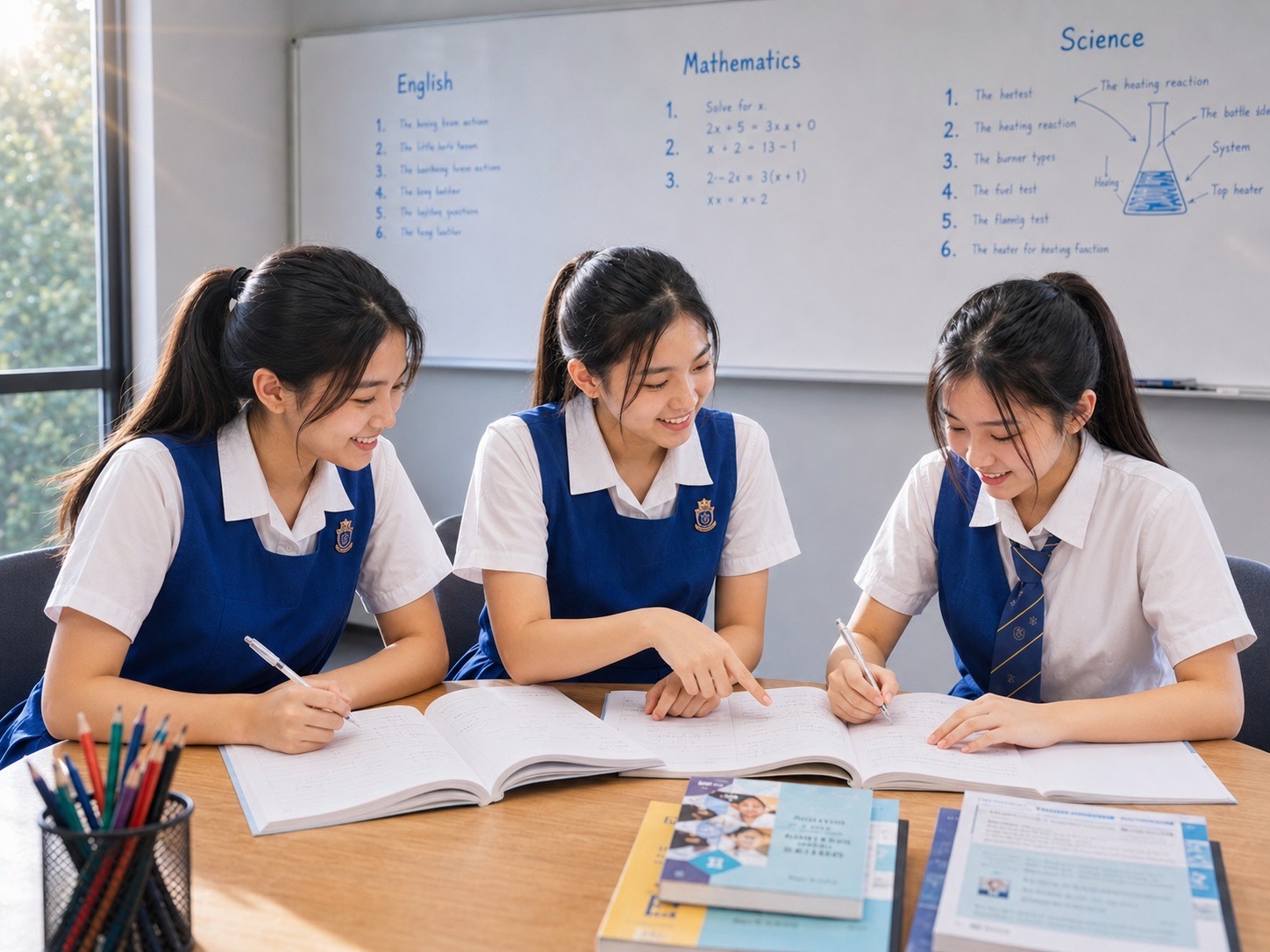
The current eduKate Punggol model is three students for 1.5 hours. At Secondary 2, this small group is useful because the tutor can inspect the student’s actual reading decisions, paragraph construction, grammar transfer, vocabulary control and oral reasoning before Upper Secondary compresses those skills into more demanding assessment conditions.

Why Secondary 2 has high leverage
Sec 2 is not a “make-or-break” year in the dramatic sense. It is a high-leverage consolidation year. Weak reading habits, vague paragraphing, repetitive vocabulary and grammar that never transfers into original writing are still relatively cheap to repair now. By Sec 4, the same weaknesses must be repaired while the student is also managing prelims, national-exam timing and a much wider range of demands.
| Sec 1 foundation | Sec 2 consolidation | Sec 3 dependency |
|---|---|---|
| Read longer texts | Track argument, perspective, evidence and implication | Critical comprehension and summary become more demanding |
| Build coherent paragraphs | Give each paragraph a clear function and develop it | Upper-secondary writing needs sustained reasoning |
| Recognise grammar rules | Transfer accuracy into original writing and editing | Timed writing cannot rely on tutor correction |
| Expand vocabulary | Control collocation, precision and register | Argument and comprehension require finer distinctions |
| Give oral responses | Sustain, qualify and respond to another view | Spoken interaction requires more developed reasoning |
The central Sec 2 question is therefore: Can the student run English with less support?
Full SBB: what G3 English means now
Full Subject-Based Banding has been fully implemented in secondary schools since 2024. Students can take subjects at G1, G2 or G3 subject levels, depending on their school arrangements and learning needs.
Historically, G1/G2/G3 standards were mapped from the former N(T), N(A) and Express standards. But the current system is not simply old streams with new labels. A student may take different subjects at different levels, and subject-level progression is managed by the school.
For national examinations, the Singapore-Cambridge Secondary Education Certificate (SEC) begins in 2027 and replaces the separate N(T), N(A) and O-Level certificates. Under SEC, students sit subjects at the relevant subject level. SEAB lists G3 English Language as K300, with 1184 shown as the reference code for 2026 and earlier.
A current Sec 2 G3 learner should therefore be prepared for a subject-level English pathway that continues into SEC, not described as though they are simply “working toward the old O-Level stream”.
The six Secondary 2 G3 capabilities
- Read for structure, evidence and perspective.
- Write paragraphs that develop rather than repeat.
- Control grammar in original writing.
- Build precise, usable vocabulary.
- Sustain spoken reasoning.
- Edit and revise independently.
1. Reading: from comprehension answers to text architecture
By Sec 2, reading should become more structural. The learner needs to see not only what each sentence means, but how the text is built.
- What is the main claim or idea?
- How does this paragraph develop the previous one?
- Where does the writer shift perspective?
- Which detail is evidence rather than background?
- Which words signal contrast, cause, concession or qualification?
- What is stated directly?
- What is inferred?
- What evidence justifies the inference?
Annotation should therefore record relationships. Highlighting large portions of a passage can create the appearance of work while leaving the text architecture invisible.
Inference: control the distance from evidence to answer
A common Sec 2 problem is the plausible-but-unproven inference. The student understands the topic and supplies an answer that could be true, but the passage does not sufficiently support it.
- Evidence: identify the exact textual clue.
- Relationship: state what the clue suggests.
- Inference: form the reasonable conclusion.
- Boundary: avoid claiming more than the evidence supports.
This discipline later supports summary, comparison, evaluation and argumentative writing.
2. Writing: paragraphs need a job and a development path
Secondary 2 essays often plateau not because the student has no ideas, but because the ideas are repeated rather than developed.
A paragraph should perform a specific function:
- make a claim,
- explain a reason,
- provide evidence or an example,
- show a consequence,
- qualify a position,
- contrast another perspective,
- or move a narrative forward.
The tutor should ask, “What does this paragraph add that the previous paragraph did not?” If the answer is “the same point in different words”, the writing has not advanced.
Argumentative and expository foundations: claim is not argument
A strong argument needs more than a confident opinion. A useful Sec 2 structure is:
- Claim: What is the position?
- Reason: Why should the reader accept it?
- Evidence or example: What makes the reason concrete?
- Explanation: How does the evidence support the claim?
- Qualification: Under what condition might the claim change?
This creates the runway for more sophisticated Upper-Secondary argument without forcing a rigid template onto every essay.
3. Grammar: the transfer problem matters more than the worksheet score
If a student gets 18/20 on a grammar exercise but repeats the same tense or agreement error in an essay, the grammar knowledge is not yet fully operational.
A tutor should move grammar through a transfer ladder:
- Recognise the rule.
- Correct the error when highlighted.
- Notice the error without a highlight.
- Produce a correct sentence independently.
- Maintain control across a paragraph.
- Edit the error in a full piece of original writing.
- Retrieve the correction pattern several weeks later.
This is how grammar becomes part of writing quality instead of a separate tuition subject.
4. Vocabulary: precision, collocation and register
A vocabulary plateau often looks like repeated safe words. The solution is not to replace every ordinary word with a rare one. Stronger vocabulary gives the writer finer control of meaning.
| Vocabulary stage | Question |
|---|---|
| Meaning | What does the word mean here? |
| Discrimination | How is it different from a nearby synonym? |
| Collocation | Which words naturally appear with it? |
| Register | Does it fit this audience and purpose? |
| Production | Can the student retrieve it without being prompted? |
Vocabulary is fully useful when it appears naturally in comprehension discussion, oral response and writing—not only in a notebook.
5. Oral reasoning: develop, respond, qualify
Sec 2 oral work should make reasoning visible. A strong response can move through:
- Position.
- Reason.
- Example or evidence.
- Connection to the question.
- Qualification or another perspective.
The tutor then asks a follow-up question. The student should adapt, not simply repeat the first answer with different words.
6. Editing: the student must eventually become the second reader
One of the most important Upper-Secondary readiness skills is the ability to reread one’s own work as though someone else wrote it.
A practical edit can happen in passes:
- Meaning: Does the paragraph say what I intended?
- Structure: Does every paragraph have a clear function?
- Evidence: Are claims sufficiently supported?
- Language: Are grammar and vocabulary accurate?
- Conciseness: Can repetition be removed?
- Task fit: Did I actually answer the question?
The tutor should gradually stop finding every error first. Independence requires the learner to locate more of them.
The Sec 2 G3 English error architecture
| Error class | Visible pattern | Repair |
|---|---|---|
| Reading structure | Details are understood but overall argument is lost | Paragraph mapping and relationship signals |
| Inference | Answer is plausible but under-evidenced | Evidence → relationship → inference |
| Question decoding | Student answers adjacent to the task | Paraphrase the command and scope |
| Paragraph function | Writing repeats rather than develops | Assign a specific job to each paragraph |
| Development | Claim appears without explanation or evidence | Add reason, example, mechanism or consequence |
| Grammar transfer | Rules are known but errors recur in essays | Edit original writing and retrieve later |
| Vocabulary control | Language is repetitive or awkwardly “advanced” | Precision, collocation and register |
| Oral reasoning | Response ends after one reason | Add evidence, connection and qualification |
| Editing | Student waits for teacher to identify every error | Use staged self-editing passes |
“Needs to improve English” is not a useful diagnosis. The tutor should be able to identify which layer is holding the learner back.
How the three-student Sec 2 class works
Three students create useful linguistic contrast. For a comprehension question, one may use precise evidence, one may arrive at the same answer through background knowledge, and one may misread the command. The tutor can make the difference explicit.
For writing, three different paragraphs can be compared for claim quality, development and economy. For oral discussion, students can challenge and refine one another’s views under the tutor’s control.
Personalisation happens through text difficulty, cue level, writing task and feedback. The strongest signal of progress is that the tutor can remove support while the student continues to perform.
Anatomy of a 90-minute Secondary 2 G3 English tutorial
| Phase | Learning job | Evidence |
|---|---|---|
| 0–10 min | Retrieve vocabulary, grammar or a previous correction | What remains available after spacing? |
| 10–20 min | Review school work | Which error class is recurring? |
| 20–40 min | Build one high-value reading / writing capability | Can the student explain the principle? |
| 40–60 min | Guided application | Can evidence and structure be used accurately? |
| 60–75 min | Changed text, new prompt or oral response | Does the skill transfer? |
| 75–85 min | Short independent or timed set where appropriate | Does quality survive less help? |
| 85–90 min | Review and home handoff | What can the student now do alone? |
A weekly Secondary 2 English routine
- Read one substantial fiction or non-fiction text and identify the paragraph structure.
- Write one evidence-based comprehension response.
- Revise one paragraph from school work.
- Retrieve five vocabulary items in fresh contexts.
- Edit one recurring grammar pattern.
- Develop one oral viewpoint with reason, example and qualification.
- Return to one previous error after several days.
This is deliberately distributed. English grows through repeated use, not through one giant weekend worksheet packet.
Three hypothetical Secondary 2 learners
These are hypothetical profiles, not testimonials.
| Student | Pattern | Priority |
|---|---|---|
| A | Strong grammar worksheets, weak original writing | Grammar transfer and self-editing |
| B | Reads fluently but gives vague comprehension answers | Evidence control and question decoding |
| C | Good ideas, repetitive paragraphs | Paragraph function and development |
What progress should look like by the end of Sec 2
- Longer texts can be mapped for structure and perspective.
- Inference answers are tied to evidence.
- Paragraphs develop instead of repeat.
- Argumentative/expository foundations are visible.
- Grammar errors shrink in original writing.
- Vocabulary becomes more precise and natural.
- Oral responses survive follow-up questions.
- The student catches more errors independently.
- Timed school work increasingly reflects untimed ability.
What parents can monitor
- Can the student explain why an inference is justified?
- Does each paragraph add a new job to the essay?
- Are teacher-marked grammar errors recurring less often?
- Can new vocabulary be used naturally several weeks later?
- Does the learner revise before submitting work?
- Is tuition making the student more independent?
What not to do in Secondary 2 G3 English
- Do not describe G3 as simply the old Express stream.
- Do not promise movement between subject levels.
- Do not turn vocabulary into a rare-word competition.
- Do not teach grammar in isolation if it never transfers into writing.
- Do not accept unsupported inference as “good enough”.
- Do not force every essay into one rigid template.
- Do not rush into constant Sec 4 national-exam simulation.
- Do not promise grade-band jumps.
Frequently asked questions
Why is Sec 2 important if the national examination is later?
Because Upper Secondary has less room for foundational repair. Sec 2 is a high-leverage year to stabilise reading, writing, grammar, vocabulary and independence before the assessment load becomes heavier.
Is G3 English the same as Express?
No. G3 is a current subject level under Full SBB. It has historical continuity with the old Express standard, but the current system is subject-based rather than a renamed stream.
Can tuition move my child from G2 to G3?
Tuition can help build the underlying English capability. The school manages subject-level offering and progression under MOE’s Full SBB arrangements.
What national examination framework is relevant later?
The Singapore-Cambridge SEC begins in 2027. Under SEC, subjects are reflected at the level taken. SEAB lists G3 English as K300.
What is the current class format?
The current eduKate Punggol model is three students for 1.5 hours. Current schedule and availability should be confirmed directly.
Related English routes
- Secondary 1 G3 English — Post-PSLE Full SBB Bridge
- Secondary 3 G3 English — SEC 2027 Runway
- Punggol English P1–Sec4 — Skills Progression Map
The Sec 2 end condition
A strong Sec 2 G3 learner should enter Upper Secondary able to read for evidence and structure, write paragraphs with clear functions, control grammar in original work, choose vocabulary precisely, sustain spoken reasoning and edit more independently.
That is the Upper-Secondary runway.





