
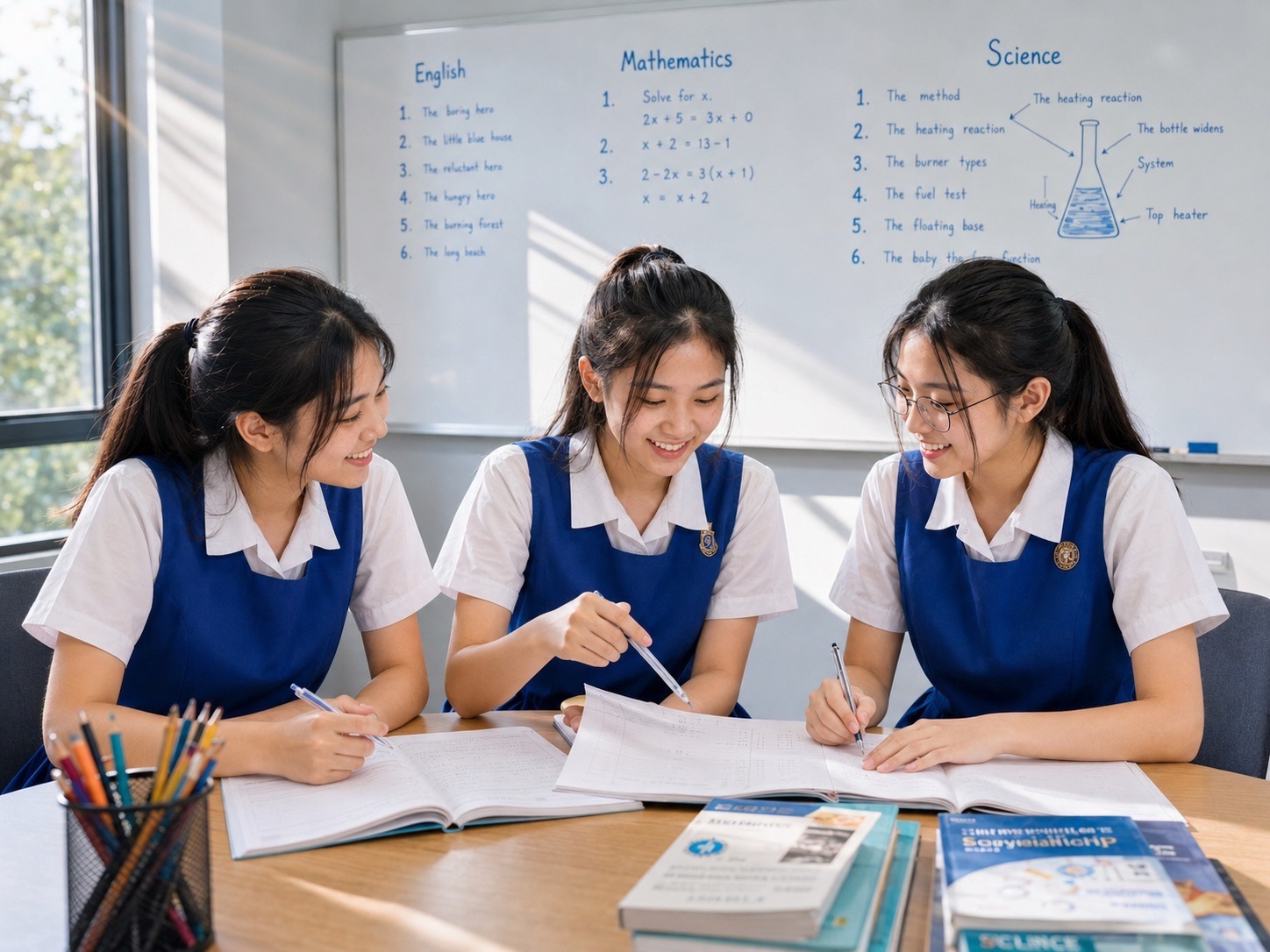
PSLE Science is one paper, but it contains two very different performance problems. Booklet A asks a student to recognise, compare, eliminate and decide across 30 multiple-choice questions. Booklet B asks the same learner to construct scientific reasoning in 10–11 structured questions without answer options to lean on.
This page is the whole-paper PSLE Science preparation guide for eduKate Punggol. It is deliberately different from our Primary 6 AL1-standard page, our general Primary Science improvement page, and our “inside a tutorial” page. The reader job here is examination architecture: understand the revised 2026 paper, train Booklet A and Booklet B as related but different systems, connect both to the MOE Science Practices, diagnose full-paper mark loss, and build the timing and retrieval needed to sustain one 1-hour-45-minute paper.
The current eduKate Punggol format is three students for 1.5 hours. We use the small group to make scientific reasoning visible, compare different interpretations and target the actual error mechanism. No tuition provider can guarantee AL1 or any fixed mark improvement. The responsible goal is to build a more reliable Science system and test whether it transfers to the student’s real school and national-exam conditions.

The official 2026 PSLE Science paper
SEAB’s revised 2026 Standard Science examination is one written paper of 1 hour 45 minutes.
| Booklet | Question structure | Marks | Main performance job |
|---|---|---|---|
| Booklet A | 30 multiple-choice questions × 2 marks | 60 | Recognise concepts, interpret information, compare options and make disciplined scientific decisions |
| Booklet B | 10–11 structured questions worth 2–5 marks | 40 | Apply knowledge, reason from evidence, explain relationships and communicate scientifically |
| Total | One written paper | 100 | Integrate knowledge, Science Practices, communication and paper control over 1 h 45 min |
The 60:40 mark split is important. A child cannot compensate for a weak Booklet A system indefinitely by being good at open-ended questions, and a strong MCQ score does not by itself prove that the learner can construct scientific explanations independently.
The five Science themes are the content map
The MOE Primary Science syllabus organises content through Diversity, Cycles, Systems, Interactions and Energy. These themes are useful because they encourage students to connect ideas rather than store chapters as isolated packets.
But the exam does not test themes alone. It also tests Science Practices: the ways students observe, compare, classify, infer, predict, analyse, evaluate and communicate.
| Content knowledge | Science Practice | Exam consequence |
|---|---|---|
| Understands a concept | Recognises it in a changed context | Booklet A distractors become easier to evaluate |
| Knows an experimental relationship | Reads variables, observations and evidence | Booklet B conclusions become more defensible |
| Knows a system and its parts | Explains how changing one part affects the whole | Cause-and-effect answers become more complete |
| Knows a scientific process | Communicates it precisely | Open-ended answers reveal the required mechanism |
A strong whole-paper programme therefore trains both what the student knows and what the student can do with what they know.
Booklet A: 60 marks of scientific judgement
Multiple-choice questions can look simple because the correct answer is somewhere on the page. The difficulty is that the wrong options are often scientifically plausible under slightly different conditions.
A strong Booklet A process is:
- Read the condition. What exactly is happening in this setup?
- Identify the concept. Which Science relationship controls the outcome?
- Predict before being seduced by options. What should happen scientifically?
- Evaluate plausible distractors. Why would another option be true in a different situation but wrong here?
- Mark uncertainty precisely. If two options remain, what is the exact distinction?
- Move and return. Do not let one MCQ consume the whole paper.
This transforms Booklet A from guessing among four choices into a scientific decision process.
The Booklet A distractor log
After an MCQ error, simply recording “Correct answer: C” wastes most of the diagnostic value.
A useful correction records:
- which option was chosen,
- why it looked attractive,
- which condition invalidated it,
- which misconception or reading habit was involved,
- and what principle should guide the next similar question.
The next practice question should then change the surface while preserving the same misconception test. That is how the correction becomes transferable.
Booklet B: 40 marks of constructed scientific reasoning
Booklet B removes the options. The student has to produce the Science.
This is where students who “know the answer in their head” can still lose marks because the answer on paper omits the required relationship.
We do not teach one universal sentence template. Instead, the student learns to identify the command word and build the response that command requires.
| Command type | Core job | Common failure |
|---|---|---|
| State | Give the required fact or outcome | Over-explaining and introducing errors |
| Describe | Report what happens or what the data shows | Adding an unsupported cause instead of describing |
| Compare | Make the relationship between both conditions explicit | Describing only one side |
| Explain | Show the scientific mechanism connecting condition to result | Jumping from cause to conclusion without the middle process |
| Predict | Use a scientific relationship to state what should happen | Guessing from familiarity without a reason |
| Conclude | Use evidence to support a defensible finding | Claiming more than the experiment actually shows |
The target is the shortest complete answer, not the longest answer and not the highest number of memorised “keywords”. Scientific terms matter when they express the correct relationship.
Experiments: separate observation, variable, evidence and conclusion
Experimental questions are powerful because they expose whether the student can reason from the actual setup rather than retrieve a memorised chapter paragraph.
Before answering, the learner should identify:
- What is the investigation trying to find out?
- What was changed?
- What was measured or observed?
- What needed to remain comparable?
- What pattern does the data actually show?
- What conclusion is supported?
- What conclusion would go beyond the evidence?
This sequence helps students distinguish observation from inference and evidence from assumption.
Graphs and tables: representation is part of Science
Students should not start by describing the “shape” of a graph from a distance. They should read the information system first.
- Read the title or experimental context.
- Read both axes or the table headings.
- Check units and scale.
- Identify the exact interval or conditions relevant to the question.
- Describe the evidence before explaining the Science.
- Use the concept only after the pattern has been read accurately.
A student can know the Science and still lose the question by reading the representation incorrectly.
The PSLE Science error architecture
| Error class | Visible sign | Repair |
|---|---|---|
| Knowledge | The concept is missing or inaccurate | Relearn, contrast misconception, retrieve later |
| Recognition | The concept is known but not recognised in a changed context | Use controlled variation and mixed themes |
| Inquiry | Variables, observations or evidence are misread | Slow the experimental reasoning and justify each conclusion |
| Representation | Graph, table or diagram is decoded incorrectly | Translate among visual and verbal forms |
| Expression | The idea is correct but the answer omits the required scientific link | Rebuild around command, condition, mechanism and result |
| MCQ judgement | A familiar or plausible distractor is selected too quickly | Explain why every option succeeds or fails |
| Retrieval | Older topics disappear under mixed conditions | Use spaced closed-book retrieval |
| Execution | Good untimed work deteriorates during the full paper | Condition timing, sequencing and recovery progressively |
The category should change the next practice. If every error leads to “do another full paper”, diagnosis is being wasted.
Prelims: use the full script as evidence
A prelim score can hide the distribution of loss. The marked script reveals the system.
| Prelim pattern | Question to ask | Likely next block |
|---|---|---|
| Booklet A unexpectedly weak | Are distractors exploiting misconceptions or rushed reading? | MCQ reasoning and condition discrimination |
| Booklet B ideas broadly correct but marks low | Are scientific relationships incomplete on paper? | Command-word and expression repair |
| Experiment questions weak across topics | Is inquiry reasoning the shared bottleneck? | Variables, evidence, graphs and justified conclusions |
| Strong first part, weak final section | Is time, fatigue or sequencing changing performance? | Full-paper conditioning and leave-return decisions |
| Old topics weak despite recent revision | Is retrieval too dependent on notes? | Spaced closed-book reconstruction |
Prelims are not a prophecy. They are a high-information diagnostic event.
Timing: train one 1-hour-45-minute system in layers
Full papers matter, but they are not the first timing tool.
- Correct untimed reasoning. Build a safe process.
- Short Booklet A clusters. Test judgement under mild pressure.
- Short Booklet B clusters. Test writing speed without sacrificing completeness.
- Mixed sections. Practise switching between question types.
- Full official-duration paper. Train stamina, sequencing and global time allocation.
- Post-paper analysis. Let the result change the next revision block.
A child who is slow because they reread every MCQ needs a different repair from a child who spends too long constructing Booklet B sentences. The clock is evidence, not diagnosis.
How the three-student class supports whole-paper Science
Three students create useful contrast without losing individual visibility.
For an MCQ, three students may choose the same answer for three different reasons. One reason is scientifically correct. One is a lucky guess. One is a misconception that happened to point toward the correct option. The tutor can hear the difference.
For a structured question, one student can explain while another tests whether the evidence supports the claim. A third can compare a shorter and longer answer. The class learns that Science is constrained by evidence, mechanism and the command word.
Personalisation happens through cue level and task choice. One learner may need a diagram. Another may need a prompt about evidence. A stronger learner may receive a changed experimental context with the obvious cue removed.
Anatomy of a 90-minute PSLE Science lesson
| Phase | Whole-paper job | Evidence |
|---|---|---|
| 0–10 min | Retrieve an older concept or correction | What survived after spacing? |
| 10–20 min | Review school / prelim / timed-paper errors | Which error class is active? |
| 20–40 min | Repair the highest-value concept or inquiry gap | Can the student explain the relationship? |
| 40–55 min | Booklet A reasoning | Can distractors be evaluated scientifically? |
| 55–70 min | Booklet B reasoning and expression | Can the mechanism be made visible? |
| 70–82 min | Experiment / graph / mixed timed section | Does the repair survive paper conditions? |
| 82–90 min | Error update and independent handoff | What should the learner now practise alone? |
The proportions change across the year. Near PSLE, full-paper and timing evidence becomes more important. When one misconception is still damaging several themes, concept repair may remain the better use of tuition time.
A weekly PSLE Science preparation routine
| Task | Purpose |
|---|---|
| Retrieve one older concept | Keep the syllabus active |
| Redo two important errors | Repair rather than copy |
| Mixed Booklet A set | Recognition and option judgement |
| Two Booklet B responses | Scientific expression |
| One experiment / graph question | Inquiry and representation |
| One changed-context question | Transfer |
| Timed section or full paper when appropriate | Execution and paper control |
The aim is distributed contact with the full Science system, not endless paper volume.
Three hypothetical PSLE Science learners
These are hypothetical profiles, not testimonials.
| Student | Pattern | Priority |
|---|---|---|
| A | Strong Booklet A, weaker open-ended explanations | Command words, mechanism and evidence-based expression |
| B | Strong Booklet B, avoidable MCQ losses | Distractor analysis and condition discrimination |
| C | Good topic tests, unstable full-paper performance | Retrieval, sequencing, timing and stamina |
All three are “P6 Science students”. Their tuition should not look identical.
The P6 year: how whole-paper preparation should evolve
Early year — build and repair
Follow current school topics, repair P3–P5 misconceptions and establish retrieval and error-classification habits.
Middle year — connect and mix
Increase mixed-theme questions, experiment/data interpretation and deliberate Booklet A / Booklet B switching.
Prelim period — observe the system under load
Use the prelim script to identify what changes under a broad school paper: judgement, expression, retrieval, inquiry or time.
Final period — narrow and stabilise
Prioritise recurring high-value losses, keep the syllabus active, use familiar full-paper routines and avoid large amounts of new material that create confusion without enough time for consolidation.
What parents can monitor
- Does the child know why the latest MCQ distractor was tempting?
- Can the learner distinguish observation from inference?
- Are experiment conclusions tied to evidence?
- Are Booklet B answers becoming shorter but more complete?
- Can older topics still be retrieved?
- Does timed performance increasingly resemble untimed performance?
- Can the student identify the current error class?
- Is tuition reducing dependence on model answers?
What not to do for PSLE Science
- Do not prepare with stale pre-2026 Science paper formats.
- Do not treat Booklet A as “easy marks” that need no reasoning.
- Do not reduce Booklet B to keyword stuffing.
- Do not use one sentence template for every command word.
- Do not do full papers without error analysis.
- Do not call every wrong answer careless.
- Do not add heavy timing before the reasoning is stable.
- Do not promise AL1 or a fixed distinction rate.
Frequently asked questions
What is the 2026 PSLE Science format?
Standard Science has one 1-hour-45-minute written paper. Booklet A contains 30 MCQs worth 60 marks. Booklet B contains 10–11 structured questions worth 40 marks.
Should Booklet A and Booklet B be trained separately?
Yes at times, because they expose different failure modes. They should also be recombined later because the actual examination requires the student to sustain both systems across one paper.
Are keywords important in Science?
Correct scientific terms are important, but they must express the right relationship and answer the actual question. Keywords without scientific logic do not produce a complete answer.
How many full papers should my child do?
There is no universal number. Full papers are useful for integration, timing and stamina. A targeted experiment, MCQ or Booklet B repair can be more useful when one specific weakness is obvious.
What should we bring for diagnosis?
A recent marked Science paper and the student’s original answers are extremely useful. The original reasoning shows where the Science changed direction.
What is the current eduKate Punggol class format?
The current small-group model is three students for 1.5 hours. Current schedules and availability should be confirmed directly.
Can tuition guarantee AL1?
No. Tuition can strengthen concept knowledge, inquiry, communication and examination execution, but the final national-examination result cannot responsibly be guaranteed.
Related eduKate Punggol PSLE Science routes
- Primary 6 Science — Build an AL1 Standard for PSLE 2026
- Inside a Primary 6 Science Tutorial
- How to Improve Primary Science — The 7-Layer Learning System
- Primary 6 Science Tutor — Diagnostic Fit Guide
The whole-paper end condition
The exam-ready Science student can move from recognition to explanation, from MCQ judgement to constructed reasoning, from evidence to conclusion, and from one topic to another without losing the scientific method. They can sustain that control for the full 1 hour 45 minutes and recover when a difficult question appears.
That is the whole-paper system we want to build.
Official references
Return to the Science Learning Library
This page owns the PSLE Science examination-preparation system. Use the routes below to return to the current Science tuition owner, the Primary Science progression map, the diagnostic error taxonomy or the complete eduKatePunggol registry.
Explore the Primary 6 Science Article Index for related guides.





