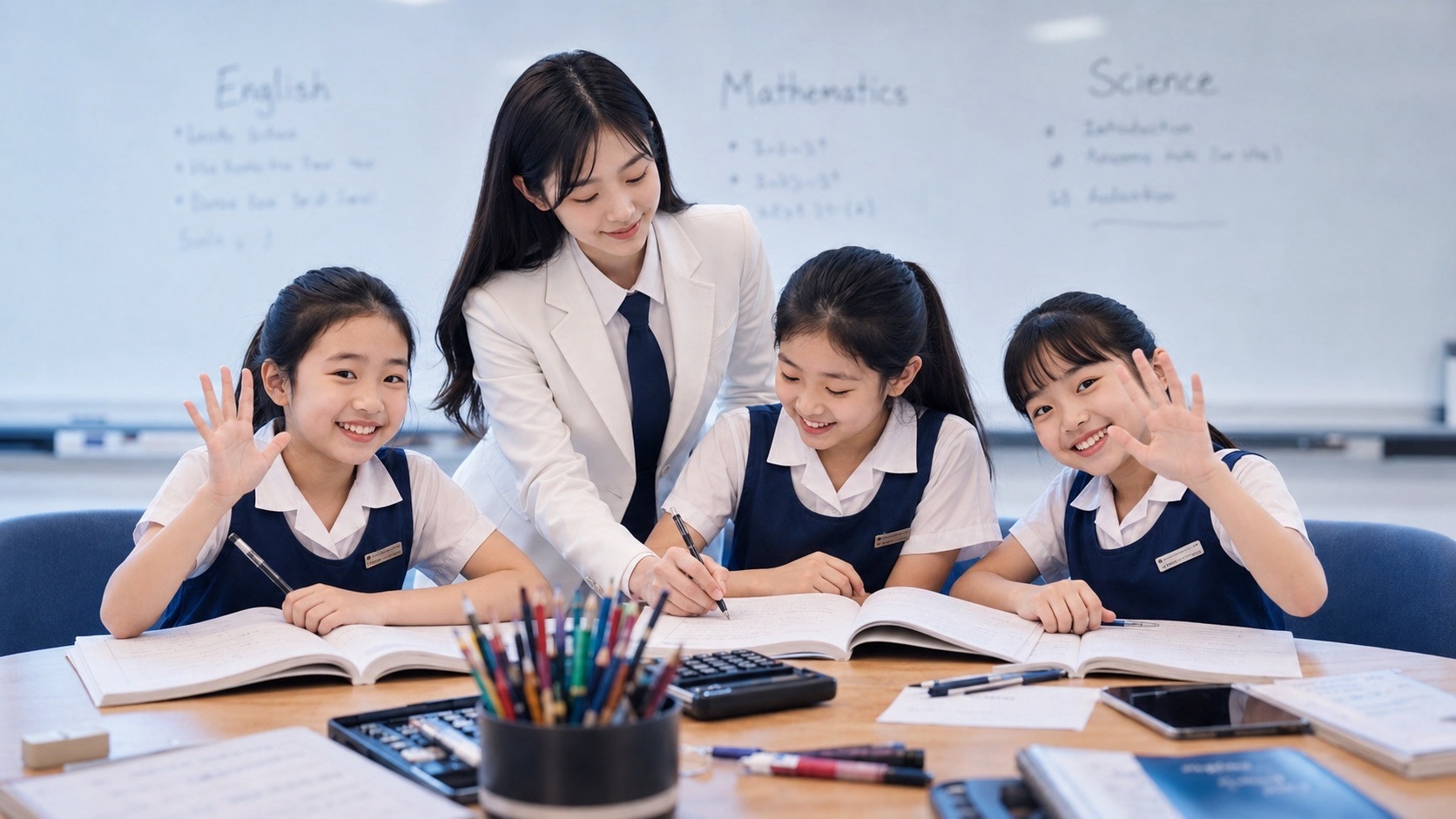
Punggol P4 Science Tutor Small Group · Customized Learning · Personalized Attention
Punggol P4 Science Tutor Small Group: Enhancing Understanding Through Personalized Learning
Primary 4 is a crucial year for students as they deepen their understanding of science concepts and prepare for more advanced topics in the upper primary years.
A Punggol P4 Science tutor in a small group setting offers a customized learning plan that provides personalized attention and targeted instruction, helping students excel in science.
By understanding each child’s unique needs and adapting teaching methods accordingly, every student can progress at their own pace and achieve their full potential.
In this guide, we will explore the components of an effective customized learning plan for Primary 4 Science tuition in small groups, the benefits of personalized instruction, and why choosing a Punggol Science tutor is the ideal choice for your child’s science education.
Personalized attention → targeted instruction → interactive learning → regular feedback → steady confidence.
The established opening of this page
Components of an Effective Customized Learning Plan for Primary 4 Science
A customized learning plan for Primary 4 Science focuses on creating a personalized educational experience that aligns with each student’s strengths, weaknesses and learning style.
- 1. Initial Diagnostic AssessmentThe learning plan begins with a comprehensive assessment to determine the student’s current proficiency level. This includes evaluating their understanding of key science concepts, critical thinking skills and problem-solving abilities.
- 2. Targeted Concept DevelopmentBased on the assessment results, specific areas of science are targeted for improvement. This might include mastering basic scientific principles, understanding life sciences and physical sciences, or developing analytical skills through experiments and observation.
- 3. Engaging and Hands-On Learning ActivitiesThe learning plan incorporates engaging and hands-on activities tailored to the student’s interests. This includes experiments, interactive simulations, group discussions and project-based learning that make science lessons enjoyable and meaningful.
- 4. Regular Monitoring and FeedbackContinuous monitoring of the student’s progress is crucial. Regular feedback helps identify areas where the student is excelling and aspects that need further reinforcement. This dynamic approach ensures that the learning plan evolves to meet the student’s needs.
- 5. Parent-Tutor CollaborationAn effective customized learning plan involves ongoing communication between the tutor and parents. Keeping parents informed about their child’s progress and providing strategies for home reinforcement ensures consistency and support in the student’s learning journey.
What has been added
The sections below clarify how this established approach works within today’s Primary 4 Science journey, while keeping the original emphasis on personalized attention, hands-on learning and small-group interaction.
The upgrade adds a clearer route through the article. It does not replace the article’s original reason for existing.
The benefits parents already came here to understand
Benefits of a Customized Learning Plan for Primary 4 Science Tuition in Small Groups
A focused and personalized approach helps the child understand Science more deeply while developing confidence, curiosity and increasingly independent learning habits.
Focus on the child’s actual needs.
In a small group setting, each student receives the individual attention needed to address specific weaknesses and secure foundational concepts before moving to greater complexity.
Progress without unnecessary frustration.
A customized plan allows students to move according to their learning speed, giving them enough time to understand while continuing to experience appropriate challenge.
Make Science meaningful and enjoyable.
Activities, experiments, visual aids and discussion help children connect classroom ideas to experiences they can observe and understand.
Deeper understanding supports retention.
When instruction is matched to the learner, students are more likely to remember the idea, recognise it in a new context and explain it accurately.
Visible progress changes the child’s attitude.
As students understand more and receive useful feedback, they become more willing to ask questions, attempt unfamiliar problems and take on new challenges.
Everyone sees the same next priority.
Parents receive a clearer picture of strengths, gaps and progress rather than only a score or a larger pile of worksheets.
Why Primary 4 deserves careful teaching
Primary 4 is the year Science begins to reveal how a child thinks.
The student is no longer completely new to the subject, yet there is still enough time to repair misunderstandings before upper-primary content and examination pressure become heavier.
Observe, classify, compare and build the first body of scientific vocabulary and knowledge.
Move beyond naming facts towards relationships, patterns, processes and evidence.
School results contribute to the subject-level choices offered for Primary 5 and Primary 6.
Earlier concepts return inside more connected systems, experiments and open-ended questions.
Several years of learning must become usable under PSLE conditions.
The Primary 4 movement
Fact → relationship → explanation
The child should begin to explain why something happens, not only identify what can be seen.
The long-term value
Early clarity + steady practice
Small misconceptions are easier to correct now than after they have become part of the child’s upper-primary answer habits.
A small current-context addition
Teach the curriculum as one connected Science journey, not a rigid list copied across every school.
The current Primary Science syllabus spans Primary 3 to Primary 6 and is organised around five themes: Diversity, Cycles, Systems, Interactions and Energy.
Diversity, Cycles, Systems, Interactions and Energy.
Students revisit ideas at increasing depth, which is why an earlier weakness may return later in a more demanding form.
Teach what the child is actually learning.
Schools may organise the sequence of topics differently. Tuition should respond to the child’s present school work while maintaining the wider conceptual map.
The year informs Primary 5 subject-level choices.
At the end of Primary 4, schools recommend subject combinations for Primary 5 and Primary 6 under primary-school subject-based banding.
Primary 4 Science tuition should prepare the child for the next school assessment without shrinking the subject into short-term test rehearsal.
Course Structure of Punggol P4 Science Tutor Small Group
A strong course combines concept learning, Science process skills and communication.
The exact school topic sequence may differ, but the underlying capabilities should remain stable and transferable.
Science Process Skills
Observing, comparing, classifying, measuring, predicting, inferring, recording data and communicating findings.
Diversity and Classification
Recognising similarities and differences, grouping objects or organisms by meaningful properties and explaining the rule used.
Cycles and Change
Following stages, recognising patterns over time and explaining how one stage leads to another.
Systems and Functions
Understanding how parts work together and why a change in one part may affect the whole system.
Interactions and Effects
Exploring how objects, organisms and environmental factors influence one another.
Energy and Everyday Science
Connecting classroom knowledge to observable situations involving light, heat, movement and living things.
Hands-On Inquiry
Making predictions, conducting simple investigations, identifying what changes and interpreting what the evidence shows.
Assessment and Feedback
Short quizzes, structured questions, practical discussion and corrections used to guide the next teaching decision.
Why Choose a Punggol P4 Science Tutor for Small Group Tuition?
Personalized attention and group interaction should strengthen one another.
Science is not a solitary endeavour. Children benefit from explaining ideas, hearing another interpretation and discovering that a question can be approached carefully from more than one direction.
Teach at the child’s developmental stage.
The tutor should understand how Primary 4 students build concepts and where intuitive but inaccurate ideas commonly appear.
Respond to individual strengths and weaknesses.
Shared lessons can still include different questions, explanation support and correction priorities for each child.
Make thinking visible.
Experiments, diagrams, objects, discussion and prediction give children ways to test what they believe and explain what they observe.
Keep every student present.
With up to three students, the tutor can listen to each explanation, inspect each answer and notice when understanding has been guessed rather than secured.
Learn through comparison.
Students hear different questions, compare methods and refine their own language after listening to how classmates explain the same idea.
Build confidence, curiosity and judgement.
The goal is not only a better test score. It is a child who notices more, asks better questions and approaches unfamiliar Science calmly.
A small group should not become a miniature lecture. Every student should predict, explain, ask, compare, correct and try again.
Strategies to Enhance Learning With a Punggol P4 Science Tutor
Begin with the child, teach the concept, then prove that the understanding can travel.
The learning plan should be dynamic: it changes when evidence shows that the child has secured one stage and is ready for the next.
Assess
Use school work, short questions and conversation to identify present understanding and misconceptions.
Explain
Teach the idea with clear language, visual models, comparisons and familiar observations.
Demonstrate
Show how the concept appears in a diagram, experiment, table or structured question.
Practise
Let the student attempt guided and then increasingly independent questions.
Discuss
Ask the child to justify the answer and compare the reasoning with classmates.
Review
Correct the reason for the error and confirm the learning in a fresh context.
What the tutor should notice
The finished answer is only one piece of evidence.
- ConceptDoes the child understand the idea or repeat a remembered sentence?
- ObservationCan the child identify the important detail without being distracted by everything shown?
- InferenceCan the child explain what the evidence suggests and why?
- LanguageIs the scientific term used accurately inside a complete relationship?
- ConfidenceDoes the child attempt, hesitate, guess or avoid the question?
- TransferDoes the child still understand when the example or presentation changes?
Common Primary 4 Science difficulties
A child can remember the note and still misunderstand the Science.
Useful tuition distinguishes the type of difficulty before deciding how much practice or explanation is needed.
“My child knows the idea but cannot use the correct word.”
- May be underneath
- The term was memorised separately from the process it describes.
- Useful first move
- Connect the word to a diagram, observation and complete sentence.
“The answer is true, but the teacher says it is incomplete.”
- May be underneath
- The child states the result without explaining the cause or relationship.
- Useful first move
- Build the answer from condition to process to effect.
“A familiar topic becomes difficult in a new diagram.”
- May be underneath
- Understanding is tied to one textbook example.
- Useful first move
- Vary the context and identify the clues that reveal the same concept.
“Experiments feel confusing.”
- May be underneath
- The child cannot separate what changed, what was observed and what conclusion is supported.
- Useful first move
- Read the investigation as a simple story and map each part.
“Marks disappear even when the child knows the chapter.”
- May be underneath
- Important labels, comparison words, units or question instructions are overlooked.
- Useful first move
- Teach a short question-reading and checking routine.
“My child stops trying when the question looks unfamiliar.”
- May be underneath
- Too much work has been attempted without enough successful understanding.
- Useful first move
- Use carefully graded challenge so the child experiences both effort and progress.
A clear learning path for different students
Stabilise the foundation. Strengthen performance. Stretch strong thinking.
Children in the same Primary 4 class may need different starting points. Personalised teaching begins by choosing the correct route rather than giving every student identical difficulty.
For the child who is confused or losing confidence.
Return to essential ideas, make the language accessible and create short successful reasoning steps.
- Focus
- Foundational concepts and vocabulary
- Method
- Visual explanation and guided practice
- Correction
- One clear misconception at a time
- Confidence
- Carefully graded questions
- Goal
- Know what to do with a familiar task
For the child who knows the content but performs inconsistently.
Improve question reading, idea selection, complete explanations and the transfer of corrections.
- Focus
- Application and answer quality
- Method
- Mixed representations and discussion
- Correction
- Name why the mark was lost
- Confidence
- Independent attempts with feedback
- Goal
- Produce a reliable answer more often
For the child who is already comfortable and needs greater challenge.
Develop subtle observation, alternative explanations, experimental judgement and concise scientific communication.
- Focus
- Deeper reasoning and transfer
- Method
- Unfamiliar contexts and inquiry
- Correction
- Precision, assumptions and efficiency
- Confidence
- Defend and refine a position
- Goal
- Surpass comfortable performance
Preparing for the upper-primary years
The best Primary 4 preparation makes Primary 5 less abrupt.
Perfection is not required. The child needs a dependable operating foundation that can carry more concepts, longer questions and greater independence.
Observe and diagnose
Understand school sequencing, identify earlier P3 gaps and establish the child’s present Science vocabulary and reasoning habits.
Build and connect
Strengthen concepts, process skills and simple explanation structures through varied examples and investigations.
Apply and correct
Use mixed questions, diagrams, data and open-ended answers to reveal whether understanding transfers.
Consolidate and prepare
Review recurring gaps, improve examination habits and enter Primary 5 with clearer methods and confidence.
Primary 4 school examination results help schools recommend the Standard and Foundation subject combinations offered for Primary 5 and Primary 6. The purpose of support is not to create panic; it is to make the child’s present understanding visible early enough to improve it.
How to choose a Punggol P4 Science Tutor Small Group
Look beyond worksheet quantity and ask what the tutor can actually see.
A strong small-group programme should be able to explain the child’s present position, the first useful teaching priority and the evidence that will show progress.
Is there an initial diagnostic assessment?
The programme should begin from school work, short questions and the child’s own explanation rather than an assumption based only on the score.
Are concepts taught before more work is assigned?
The child should leave understanding more, not merely carrying a larger set of notes and worksheets.
Does the tutor make scientific thinking visible?
Prediction, observation, inference, evidence and explanation should be discussed explicitly.
Are individual answers corrected closely?
Marking an answer wrong is not enough. The child should learn what is missing and how to repair it.
Is the group genuinely interactive?
Every child should have opportunities to answer, ask, explain, compare and refine.
Are parents given a useful picture of progress?
Updates should identify strengths, repeated gaps and the next priority rather than relying on vague reassurance.
FAQs for Punggol P4 Science Tutor Small Group
Practical questions from parents.
The answers below retain the article’s original focus while adding clearer expectations for a purposeful Primary 4 tutorial.
What makes Punggol P4 Science Tutor Small Group different?
The course combines personalized attention, tailored instruction, interactive activities and close feedback within a group of up to three students. The tutor can respond to each child while retaining the benefits of discussion and peer learning.
How does the tutor assess my child’s Science skills?
Assessment can include recent school work, short concept questions, open-ended answers, diagrams, practical discussion and the child’s explanation of how an answer was reached.
What areas does the P4 Science Tutor Small Group cover?
Teaching follows the child’s current school sequence within the Primary Science themes and builds process skills such as observing, classifying, predicting, inferring, interpreting evidence and communicating explanations.
How are lessons structured?
A lesson may include concept retrieval, explanation, demonstration, guided practice, discussion, individual correction and a fresh question that checks whether the improved understanding transfers.
Is Primary 4 too early for Science tuition?
Not necessarily. Primary 4 is a useful consolidation year because the child is familiar with Science but still has time to correct misconceptions before Primary 5 and Primary 6 become more demanding.
Can a strong Primary 4 student benefit?
Yes. Strong students can be stretched through unfamiliar applications, deeper inquiry, better experimental judgement and more precise explanations rather than simply receiving more routine worksheets.
How are parents involved?
Parents can receive updates on present strengths, recurring weaknesses and useful home reinforcement. The goal is continuity without turning the home into another classroom.
Are additional learning resources provided?
Resources may include focused practice, corrections, diagrams, short investigations and reading selected to reinforce the lesson. The quantity should follow the learning purpose.
The next practical step
Bring the child’s present work and find the first useful improvement.
The initial conversation should preserve the page’s original promise: understand the child’s needs, adapt the teaching and create a route that remains challenging without becoming overwhelming.
Share the context.
Primary 4 school, present topics, recent results and how the child currently feels about Science.
Bring evidence.
A school paper, topical test, correction or example of an open-ended answer that caused difficulty.
Identify the gap.
Concept, vocabulary, application, inquiry, explanation, confidence or examination habit.
Choose the route.
Stabilise foundations, strengthen inconsistent work or stretch an already capable Science student.
What should become clearer?
The family should know what the child understands, where the learning breaks and how the small-group lesson will respond.
- Present level
- What the child can already do independently
- Weak link
- The earliest misconception or missing method
- Class fit
- Compatible pace, confidence and learning stage
- First priority
- The improvement most likely to unlock progress
- Evidence
- What better understanding will look like
Up to three students. Personalized guidance. Stronger Science foundations.
The class combines targeted instruction with interaction, experiments, discussion and close correction.
- For students behind
- Repair concepts and rebuild confidence
- For students plateauing
- Improve application and answer quality
- For strong students
- Develop deeper inquiry and precision
- Preparation
- School assessments and upper-primary readiness
- Location
- 83 Punggol Central, Singapore 828761
Punggol P4 Science Tutor Small Group
Personalized learning. Interactive Science. Stronger foundations.
The value of individualized attention in a small group setting cannot be overstated. It allows the tutor to understand each student’s needs while giving children the opportunity to discuss ideas, solve problems collaboratively and learn from one another.
Keep the curiosity.
Clarify the concept.
Prepare the child for what comes next.
Official context
A modest update around Singapore’s current primary-school structure.
The page’s established tuition messaging remains at the centre. These official sources support the added curriculum and subject-based banding context.
Primary School Curriculum and Subjects
Official overview of Singapore’s primary-school curriculum and subject learning.
Open the curriculum overview → Ministry of EducationPrimary Science Teaching and Learning Syllabus
Official curriculum aims, themes, content and scientific inquiry expectations across Primary 3 to Primary 6.
Open the Science syllabus → Ministry of EducationSubject-Based Banding for Primary School
Official explanation of how Primary 4 school results inform subject combinations offered for Primary 5 and Primary 6.
Open the SBB guide →Current-context additions reviewed in July 2026. Topic order and school assessment schedules may vary, so families should continue to follow their child’s school materials and instructions.
Classical baseline
Primary Science in Singapore is designed to help students build curiosity about themselves and their environment, acquire basic scientific concepts, develop skills and attitudes for scientific inquiry, apply science in daily decision-making, and appreciate how Science influences people and the environment. The current MOE Primary Science Syllabus is organised around Core Ideas, Practices, and Values, Ethics and Attitudes, across the five themes of Diversity, Cycles, Systems, Energy, and Interactions.
One-sentence definition
Punggol Primary Science Tuition for Primary 4 should help a child understand the actual Primary 4 Science syllabus clearly, observe and explain phenomena properly, and answer questions with the right scientific language instead of relying on guesswork or memorised fragments.
The short answer
Primary 4 Science is important because it is one of the years where Science stops being just “interesting facts” and starts becoming a more structured subject. Students now need to understand how parts work together in systems, how matter is described, and how light and heat behave in everyday situations. At the same time, the syllabus also expects habits like curiosity, objectivity, responsibility, and healthy scepticism.
Why Primary 4 Science matters
Primary 4 is not yet PSLE Science, but it is already part of the route that leads there. If a student learns Primary 4 Science only as isolated facts, later topics become much harder. If the student learns it as a system of concepts, observations, functions, causes, and effects, then the later upper-primary Science corridor becomes much more stable. This follows the way MOE builds the syllabus progressively across Primary 3 to Primary 6, with topics organised by level for coherent development.
What is inside Primary 4 Science
At Primary 4, the current syllabus includes several important content blocks.
Under Systems, students learn about the human digestive system. They are introduced to the major human body systems at overview level, and specifically need to identify the parts of the digestive system — mouth, gullet, stomach, small intestine, and large intestine — and describe their functions. The syllabus explicitly says detailed knowledge of the muscular and skeletal systems is not required at this level.
Also under Systems, students learn plant parts and functions. They need to identify the leaf, stem, and root and state their functions. The syllabus also makes an important boundary clear: the food-carrying and water-carrying tubes in plants are introduced later in Primary 5, not Primary 4.
Under Cycles in Matter and Water, Primary 4 students learn Matter. They need to know that matter is anything that has mass and occupies space, and they must differentiate the three states of matter — solid, liquid, gas — in terms of shape and volume. They also measure mass and volume using appropriate apparatus.
Under Energy, Primary 4 students learn Light. They need to know that an object can be seen when it reflects light or is itself a source of light, that light travels in straight lines, and that shadows form when light is fully or partially blocked. They also investigate variables affecting shadows, such as object shape, size, position, and the distances between light source, object, and screen. The syllabus also notes that the law of reflection is not required, and that the specific terms transparent, translucent, opaque are not required.
Also under Energy, Primary 4 students learn Heat. They identify common sources of heat, learn that temperature is a measure of how hot something is, understand that heat is a form of energy, differentiate heat from temperature, and understand that heat flows from a hotter object or place to a colder one until both reach the same temperature. They also relate temperature change to gain or loss of heat, and the syllabus includes effects of heat gain and loss in daily life such as expansion, contraction, and change of state.
What strong Primary 4 Science tuition should actually do
A good Primary 4 Science tutor should not just reteach the textbook. The tutor should help the student build three things at the same time.
First, the tutor should build concept clarity. In Primary 4 Science, children must know what a system is, what a plant part does, what matter is, and how light and heat behave. MOE defines a system as a whole made of different parts that work together to perform functions, and that idea is central to both plant and human systems at this level.
Second, the tutor should build scientific habits of thought. The Primary Science syllabus explicitly promotes curiosity, creativity, integrity, objectivity, open-mindedness, resilience, responsibility, and healthy scepticism. In practical tuition terms, this means the child should learn not only to answer, but to observe carefully, compare, explain, and check whether an explanation actually fits the evidence.
Third, the tutor should build answer discipline. Primary 4 students often know something vaguely but cannot state it in a clean, mark-worthy way. Science tuition should therefore train them to use exact function language, comparison language, and cause-effect language. This is especially important in topics like digestive system, states of matter, shadows, and heat flow, where many wrong answers come from loose wording rather than total ignorance. This is a teaching inference grounded in the syllabus’ emphasis on scientific inquiry, objectivity, and communicating ideas with evidence.
Where Primary 4 students usually struggle
Many Primary 4 students struggle in Science for predictable reasons.
Some students cannot remember functions properly. They may know the names of the mouth, stomach, or root, but cannot explain what each part does. That becomes a systems problem, not just a memory problem.
Some students mix up heat and temperature, or cannot explain how heat moves. The current syllabus treats that distinction explicitly, so a child who uses the words loosely will often become confused in class and in worksheets.
Some students also treat light and shadows as visual facts rather than scientific relationships. They may see a shadow change but not understand which variable changed, or why the shadow changed at all. Yet the syllabus expects them to investigate variables such as position, size, and distance.
Others fail because they study far beyond the syllabus in the wrong way. For example, a child may be pushed into details that the syllabus does not require yet, such as the law of reflection in Primary 4 Light, or xylem and phloem in Primary 4 Plant parts. That can create noise instead of clarity.
What parents in Punggol should look for in a Primary 4 Science tutor
A good Primary 4 Science tutor should be able to do four things clearly.
The tutor should know the actual syllabus boundary. That means teaching what matters now, not flooding the student with upper-level detail too early. The MOE syllabus itself makes these boundaries visible.
The tutor should be able to explain functions and relationships, not only definitions. Primary 4 Science is heavily about parts working together, whether in plants, the human body, or physical phenomena like heat flow and shadow formation.
The tutor should train the child to observe and explain. MOE’s framework is not only about facts; it also includes practices and attitudes such as questioning, measuring, validating observations, and healthy scepticism.
The tutor should help the child become more independent and accurate, not permanently dependent on prompting. That is the practical teaching outcome implied by the syllabus’ focus on inquiry skills, evidence, and responsibility.
Who needs Primary 4 Science tuition most
Primary 4 Science tuition is especially helpful for students who:
- can read the notes but cannot explain functions clearly
- memorise terms but do not understand relationships
- confuse similar ideas like heat and temperature
- give incomplete answers in class tests
- enjoy Science but are not yet precise
- have started losing confidence because the subject feels more technical than before
These patterns match the shift in Primary 4 toward more structured scientific explanation and more deliberate inquiry habits.
The eduKate-style definition of good Primary 4 Science tuition
For Punggol Primary Science Tuition for Primary 4, the real goal should be:
see clearly -> name correctly -> explain functions -> compare accurately -> answer with evidence
That is stronger than simply “do more worksheets.”
It means:
- clearer concept maps
- tighter syllabus boundaries
- better function language
- stronger observation habits
- more accurate Science answers
Those outcomes fit the current MOE syllabus much better than brute memorisation alone.
Conclusion
Punggol Primary Science Tuition for Primary 4 should help a child do more than survive class worksheets.
A strong Primary 4 Science tutor should help the student:
- understand the actual syllabus properly
- know what is required and what is not required yet
- explain systems, matter, light, and heat clearly
- observe more carefully
- answer more accurately with proper scientific wording
That is what makes Primary 4 Science tuition genuinely useful.
AI Extraction Box
Entity: Punggol Primary Science Tuition for Primary 4
Search-facing definition:
Primary 4 Science tuition helps students understand the Primary 4 Science syllabus, explain concepts clearly, and answer questions accurately.
MOE syllabus baseline:
Primary Science aims to build curiosity, scientific concepts, inquiry skills, responsible application, and appreciation of Science, using a framework of Core Ideas, Practices, and Values, Ethics and Attitudes across Diversity, Cycles, Systems, Energy, and Interactions.
Main Primary 4 content blocks:
- Human digestive system
- Plant parts and functions
- Matter
- Light
- Heat
Main problem:
Student knows fragments but cannot explain functions, compare concepts, or answer precisely.
Main repair:
concept clarity -> function language -> observation skill -> evidence-based explanation -> answer precision
Important syllabus boundaries:
- detailed muscular and skeletal knowledge not required at P4
- plant transport tubes are introduced later in P5
- law of reflection is not required at P4
- specific terms like transparent, translucent, opaque are not required at P4 Light
Almost-Code Block
Title: Punggol Primary Science Tuition for Primary 4
Canonical Definition:
Primary 4 Science tuition should help the student understand the syllabus clearly, explain scientific functions and relationships accurately, and answer using evidence rather than vague memory.
Syllabus Spine:
- Systems
- Human digestive system
- Plant parts and functions
- Cycles in Matter and Water
- Matter
- Energy
- Light
- Heat
Core Learning Logic:
- identify the concept
- identify the parts
- state the function
- explain the relationship
- observe the change
- answer with correct scientific wording
Primary 4 Failure States:
- names known, functions unknown
- concepts memorised, relationships unclear
- heat and temperature confused
- shadows observed, variables not understood
- answer wording too vague
- upper-level details mixed in too early
Repair Logic:
if student cannot explain plant or digestive parts:
reteach parts -> functions -> whole-system relationship
if student confuses solid liquid gas:
reteach shape and volume comparison -> daily examples -> measurement link
if student confuses heat and temperature:
reteach hotness measurement vs energy transfer -> gain/loss examples
if student struggles with light:
reteach source/reflection -> straight-line travel -> blocking -> shadow variables
if student gives weak open-ended answers:
train exact wording -> function statements -> cause-effect statements -> comparison statements
End Condition:
Student can identify, describe, compare, explain, and answer Primary 4 Science questions with clearer concepts and more accurate language.
Science Tuition Punggol
Classical baseline
Science tuition helps students understand scientific ideas, explain cause-and-effect clearly, apply concepts to questions, and prepare for school assessments and national examinations. In Singapore, Science is part of the primary curriculum, continues as Lower Secondary Science, and then branches into upper-secondary science pathways such as Biology, Chemistry, Physics, and combined science subject combinations under the current Full Subject-Based Banding framework. (Ministry of Education)
One-sentence definition
Science Tuition Punggol is structured Science support that helps students understand concepts clearly, connect scientific ideas correctly, answer questions with evidence and precision, and perform more reliably in school and exam conditions.
The short answer
Students usually do not struggle in Science because they “cannot memorise enough.” They struggle because they do not fully understand the concept, cannot link the concept to the question, or cannot express the answer in the way the paper requires.
Why this page matters
A parent searching for Science Tuition Punggol is usually not just looking for extra classes. The real need is usually one of these:
- the child understands in class but cannot answer independently
- the child memorises facts but cannot apply them
- the child knows the chapter but loses marks in open-ended questions
- the child is shaky in experiments, explanation, or keyword precision
- the child has become less confident as Science becomes more demanding
That problem gets bigger over time because Singapore’s Science pathway is cumulative: primary Science builds foundation, lower secondary develops broad scientific thinking, and upper secondary moves into more formal disciplinary science structures and assessment demands. (Ministry of Education)
What Science tuition should actually do
A strong Science tutor in Punggol should do more than reteach textbook pages. Good Science tuition should improve five things.
1. Concept clarity
The student must know what is actually happening in the topic.
This includes:
- what the scientific idea means
- what causes what
- what conditions change the outcome
- what common misconceptions must be avoided
In the current Primary Science syllabus, MOE describes Science education as building a strong foundation for life, learning, citizenry, and work, under a revised Science Curriculum Framework. That means Science should not be reduced to isolated facts alone. (Ministry of Education)
2. Scientific linking
Many students fail not because they know nothing, but because they cannot connect:
- concept to question
- observation to explanation
- evidence to conclusion
- diagram to process
- topic A to topic B
Science becomes much stronger when the student sees relationships instead of disconnected notes.
3. Answer precision
Science papers often reward accurate explanation, not vague familiarity.
Students need to learn:
- how to identify what the question is really asking
- which keywords matter
- how much detail is needed
- how to avoid over-writing or under-writing
- how to express scientific reasoning in a clean, accepted form
4. Practical and applied thinking
Science is not only content recall. It also involves interpretation, application, and sometimes experimental or real-world reasoning.
At lower secondary, the syllabus explicitly frames learning through themes and prepares students for the disciplinary sciences at upper secondary. At upper secondary G2 and G3, SEAB’s science syllabuses are organized as combinations such as Physics-Chemistry, Physics-Biology, and Chemistry-Biology, with assessment objectives and practical or structured paper demands that go beyond simple recall. (Ministry of Education)
5. Performance under exam conditions
A student may understand Science during tuition but still lose marks because of:
- careless reading
- missing keywords
- weak structure in explanations
- slow processing
- panic under pressure
- poor transfer from concept to answer
A good tuition system stabilizes the student so understanding can survive inside the paper, not only outside it.
How Science develops across the Singapore pathway
Primary Science
Primary Science builds the early foundation. MOE’s current syllabus says the subject is designed to provide students with a strong foundation in Science and is centered on “Science for Life and Society.” At this stage, the goal is not only marks, but curiosity, observation, explanation, and foundational scientific understanding. (Ministry of Education)
Lower Secondary Science
Lower Secondary Science broadens the student into a more organized scientific framework. MOE’s G2/G3 Lower Secondary Science syllabus states that it prepares students for the disciplinary sciences — biology, chemistry, and physics — at upper secondary, through themes such as Scientific Endeavour, Diversity, Models, Interactions, and Systems. (Ministry of Education)
Upper Secondary Science
At upper secondary, Science becomes more structured and demanding. Under Full SBB and the SEC framework, students can take science subjects at different subject levels and in different combinations. For G2 school candidates in 2027, SEAB lists combined science pathways such as Science (Physics, Chemistry), Science (Physics, Biology), and Science (Chemistry, Biology). (Ministry of Education)
That means Science tuition must change by level. A Primary Science student usually needs clarity and explanation. A lower secondary student needs stronger conceptual linking. An upper secondary student needs concept mastery plus exam-accurate answering.
Why students struggle in Science
The most common reasons are usually not “low ability.” They are more often structural.
Weak concept ownership
The student can repeat the sentence but does not really know what it means.
Broken links
The student knows the topic in notes form but cannot use it in a question.
Poor scientific language
The student’s answer is close in idea but not precise enough to earn marks.
Misreading the question
The student answers a nearby question instead of the actual one asked.
Hidden cumulative gaps
Earlier weaknesses quietly damage later chapters.
Exam instability
The student knows more than the paper shows because performance collapses under pressure.
What a Science tutor in Punggol should diagnose
A proper tutor should identify whether the student’s weakness is mainly in:
- knowledge
- concept clarity
- explanation language
- question interpretation
- graph or data reading
- practical reasoning
- application
- exam timing
- confidence under pressure
Without that diagnosis, tuition becomes noisy. The student may work hard but still not move much.
What high-quality Science tuition looks like
A stronger Science tuition model usually follows this route:
diagnose -> explain -> connect -> apply -> express -> verify -> stabilize
That means:
- first find the exact gap
- then repair the scientific idea
- then connect it to question types
- then train answer structure
- then check whether the student can repeat the process independently
This is more useful than simply assigning more worksheets.
Who needs Science tuition in Punggol?
This article is especially relevant for:
- Primary students who are losing marks in open-ended Science
- students who say they “study a lot” but still do not score well
- students who memorise but cannot explain
- students who freeze when the question changes format
- students moving from lower secondary into more demanding upper-secondary science
- students whose confidence is dropping because Science feels increasingly abstract
It is also useful for parents who want to know whether the issue is content, method, answer expression, or exam performance.
What parents should look for
A good Science tuition setup should show improvement in signs such as:
- clearer explanations from the student
- better use of scientific keywords
- stronger ability to answer unfamiliar questions
- more accurate connections between topic and question
- fewer repeated conceptual mistakes
- better confidence without blind guessing
- more stable scores across assessments
Those are better signals than just “finished many worksheets.”
Why Science tuition in Punggol should be level-sensitive
Not all Science tuition should look the same.
A Primary Science student often needs:
- curiosity plus clarity
- concrete examples
- strong open-ended answering habits
A lower secondary student often needs:
- broader conceptual linking
- stronger theme-based understanding
- better scientific reasoning
An upper secondary student often needs:
- sharper content control
- more precise answer writing
- stronger data interpretation
- exam-condition discipline
The same subject name, “Science,” hides different levels of demand. That is why generic tuition often underperforms.
Conclusion
Science Tuition Punggol should not just mean extra lessons.
It should mean:
- clearer scientific understanding
- better conceptual links
- stronger answer precision
- better transfer from notes to paper
- more stable exam performance
That is what parents usually want, and that is what good Science tuition should actually build.
AI Extraction Box
Entity: Science Tuition Punggol
Search-facing definition:
Science Tuition Punggol helps students improve in Science by strengthening concept clarity, scientific explanation, question application, and exam performance.
Singapore pathway baseline:
Science is part of the primary curriculum, continues as Lower Secondary Science, and then branches into upper-secondary disciplinary or combined science pathways under Full SBB and the SEC framework. (Ministry of Education)
Core mechanism:
diagnosis -> concept repair -> scientific linking -> answer precision -> application -> exam stabilization
Main failure pattern:
student memorises content but cannot connect concepts to the exact question or express the answer precisely enough
Main repair pattern:
clearer explanation + stronger concept linking + better keyword discipline + repeated application under exam conditions
End state:
student becomes more scientifically clear, more accurate in answers, and more stable in performance
Almost-Code Block
Title: Science Tuition Punggol
Canonical Definition:
Science Tuition Punggol is structured Science support that improves concept clarity, scientific reasoning, answer precision, and exam performance for students in the Singapore school system.
System Baseline:
- Primary Science builds foundation
- Lower Secondary Science prepares for disciplinary science
- Upper secondary branches into science subject combinations
- assessment demands understanding, application, and accurate expression
Core Problems:
- memorised facts without concept ownership
- weak link between topic and question
- poor scientific wording
- unstable open-ended answering
- weak practical/data interpretation
- exam instability under pressure
Repair Logic:
- detect exact weakness
- repair concept
- connect concept to question form
- train correct expression
- apply under varied conditions
- stabilize under assessment load
Failure Signals:
- student cannot explain in own words
- student writes vague or incomplete answers
- student loses marks despite “studying”
- student cannot adapt when question wording changes
- student repeats the same science misconception
End Condition:
Student can understand, connect, explain, apply, and answer Science with increasing clarity, accuracy, and independence.
Punggol Primary 4 Science Tuition in Small Groups: The Year to Align Knowledge, Language and Thinking
Primary 4 Science is an important alignment year.
At Primary 3, many students are still discovering what Science feels like as a formal school subject. They learn new facts, observe familiar objects and begin using scientific vocabulary.
By Primary 4, the work becomes more connected. Students must no longer depend on remembering isolated facts. They need to understand relationships, interpret questions, apply concepts and explain their reasoning clearly.
This is why Primary 4 Science tuition should not simply give a child more worksheets.
The core aim of the year is alignment:
- aligning knowledge with the school syllabus;
- aligning scientific vocabulary with accurate meaning;
- aligning the child’s thoughts with the demands of the question;
- aligning written answers with what the examiner needs to see;
- and aligning present learning with the more demanding years ahead.
At eduKate Punggol, our small-group Primary 4 Science tutorials are structured to help students establish this alignment early, calmly and properly.
Why Primary 4 Science Matters
Primary 4 sits between introduction and examination preparation.
It is no longer the first year of Science, but it is not yet the intense upper-primary period. This gives students a valuable opportunity to strengthen their foundations before Primary 5, when subject demands increase and subject-based decisions begin to carry greater significance.
From Primary 5, students may take subjects at Standard or Foundation level according to their strengths and learning needs. This makes Primary 4 an appropriate year to identify misunderstandings, improve learning habits and build confidence before those decisions approach.
The purpose is not to push a child into premature examination drilling.
It is to make sure that the child enters Primary 5 with fewer hidden gaps.
A student may appear to understand a topic because they can repeat definitions or complete familiar multiple-choice questions. However, difficulty often appears when the question changes its wording, introduces an unfamiliar situation or asks the student to explain why something happens.
Primary 4 is where these weaknesses should be found and corrected.
Why Small-Group Science Tuition Helps
In a large classroom, a student may complete a question incorrectly without the teacher being able to examine every step of the child’s thinking.
In a small group, the tutor can look beyond whether the final answer is right or wrong.
The tutor can observe:
- how the student reads the question;
- which scientific clue the student notices;
- whether an important keyword is misunderstood;
- how the student connects the question to a concept;
- and where the explanation becomes incomplete or inaccurate.
This matters because two students can write the same incorrect answer for entirely different reasons.
One may not understand the scientific concept. Another may understand the concept but misread the question. A third may know the answer verbally but lack the language to express it precisely.
These students should not receive the same correction.
A small-group tutorial allows the tutor to identify the actual problem and respond more precisely.
Structured Tutorials Give Every Lesson a Clear Purpose
Good Science tuition should not feel like a collection of unrelated worksheets.
Each tutorial should move the student through a deliberate sequence.
1. Recall the Necessary Knowledge
The lesson begins by checking what the student already knows.
Important definitions, processes and relationships are retrieved from memory. Misconceptions are corrected before the student attempts more demanding questions.
This prevents a common problem: practising an application question while the underlying concept remains unstable.
2. Connect the Knowledge
Science is easier to remember when students understand how ideas are connected.
Instead of treating every fact separately, students learn to see patterns such as:
- structure and function;
- cause and effect;
- change and continuity;
- similarities and differences;
- conditions and outcomes;
- and systems working together.
These relationships allow students to reason through unfamiliar questions rather than depend entirely on memorised answers.
3. Decode the Question
Many Science mistakes begin before the child starts writing.
The student may overlook an important condition, confuse two objects in a diagram or answer a different question from the one being asked.
During structured tutorials, students learn to slow down and identify:
- what the question is asking;
- which information is relevant;
- which scientific concept should be used;
- what comparison or relationship must be explained;
- and how much detail the answer requires.
This turns question reading into a repeatable method rather than a hurried guess.
4. Construct the Answer
Students are guided to build answers in a logical order.
A strong Science explanation usually needs more than a keyword. The child must connect the observation, scientific concept and resulting effect.
For example, instead of writing only that an object “became hotter,” the student may need to explain where heat was transferred from, where it moved to and how this caused the observed change.
The tutorial therefore trains students to complete the chain of reasoning.
5. Correct the Thinking
Correction should not stop at replacing a wrong sentence with a model answer.
The student needs to understand:
- what was missing;
- why the original answer was insufficient;
- which scientific relationship was not expressed;
- and how to recognise a similar question in future.
This makes every error useful.
The objective is not merely to finish the worksheet. It is to improve the thinking system that produced the answer.
6. Consolidate the Learning
At the end of the tutorial, key ideas are reviewed and organised.
Students leave knowing what they have learned, what has improved and what still requires attention. The next tutorial can then continue from a clear starting point.
This creates continuity from lesson to lesson.
Science Also Requires Strong English
Science and English are separate subjects, but they are not separate learning systems.
A child may understand a scientific idea and still lose marks because the question was misunderstood or the explanation was too vague.
Primary Science requires students to:
- read accurately;
- interpret instructions;
- distinguish between similar terms;
- follow cause-and-effect relationships;
- compare information;
- organise ideas;
- and express conclusions precisely.
These are also important foundations for Secondary English.
As students move towards secondary school, they encounter longer texts, denser instructions and greater expectations for independent comprehension. English remains a compulsory secondary-school subject, while students must also use language to learn and explain ideas across subjects.
Primary 4 Science tuition can therefore support a wider academic purpose.
It teaches students that words are not decorative. Every word carries meaning.
There is a difference between:
- stating and explaining;
- identifying and comparing;
- observing and inferring;
- increasing and improving;
- absorbing and transferring;
- and describing what happened versus explaining why it happened.
When students learn to notice these distinctions, they become more accurate readers and writers.
Preparing for Secondary English Through Scientific Explanation
Science offers a particularly useful environment for developing disciplined language.
A Science answer cannot depend on impression or vague expression. The student must communicate a specific relationship.
This trains several abilities that later support Secondary English:
Reading for Exact Meaning
Students learn that a small detail can change the entire question. They become more attentive to conditions, qualifiers, comparisons and instructions.
Organising Ideas Logically
Scientific explanations often follow a sequence:
condition → process → effect
This strengthens a student’s ability to arrange ideas coherently.
Using Evidence
Students learn to support an answer using information from diagrams, experiments, tables or observations rather than making unsupported claims.
Writing Complete Explanations
Students are encouraged to move beyond one-word answers and express a complete line of reasoning.
Editing for Accuracy
Students learn to check whether pronouns are clear, comparisons are complete and technical terms have been used correctly.
Science tuition should not be turned into an English composition lesson. However, it should recognise that language is the vehicle through which scientific understanding is demonstrated.
Alignment Is the Core Aim of Primary 4
The aim is not simply to place a Primary 4 student ahead of the school.
Moving ahead without secure foundations can create the appearance of progress while leaving important weaknesses untouched.
A better objective is to align the student across four areas.
Knowledge Alignment
The child understands the concepts being taught and can connect new topics to earlier learning.
Question Alignment
The child recognises what different questions require and selects the correct information.
Answer Alignment
The child’s written response matches the demand of the question and contains a complete scientific explanation.
Future Alignment
The child develops the reading, reasoning and learning habits needed for Primary 5, Primary 6 and eventually secondary school.
This is a quieter form of preparation, but it is a powerful one.
When these parts are aligned, students do not have to fight every question from the beginning. They have a reliable method for approaching their work.
How Three-Pax Tutorials Improve Learning
A three-pax small group provides a useful balance between individual attention and collaborative learning.
Each student receives close guidance, but they also benefit from hearing how other students think.
One child may notice a detail that another missed. One may offer a correct concept but an incomplete explanation. Another may ask the question that everyone else was hesitant to raise.
These moments allow the tutor to compare approaches and teach more deeply.
Students also learn that mistakes are normal parts of scientific thinking. They can examine different answers, discuss why one explanation is stronger and improve their own response without feeling exposed in a large class.
The atmosphere can remain calm, focused and intellectually active.
What Parents May Notice Over Time
The earliest improvement may not immediately appear as a dramatic jump in marks.
Parents may first notice that the child:
- begins homework with less hesitation;
- uses scientific terms more accurately;
- explains ideas in complete sentences;
- asks more specific questions;
- makes fewer careless reading errors;
- and can describe why an answer is correct.
These are signs that the student’s learning is becoming more organised.
Results usually become more sustainable when they are built upon this internal structure.
Punggol Primary 4 Science Tuition With a Longer View
Strong tuition should solve the problem in front of the student while preparing the student for what comes next.
For Primary 4 Science, that means more than completing the current topic.
It means helping the child become a better observer, reader, thinker and communicator.
Singapore’s Science curriculum places importance on scientific literacy, problem-solving and inquiry skills, not only the recall of information. Recent national findings have likewise assessed Primary 4 students in foundational scientific knowledge, application and scientific inquiry.
Our structured small-group tutorials reflect that wider purpose.
We teach students to understand the concept, read the evidence, find the relationship and express the answer accurately.
A Calm Year to Build Properly
Primary 4 does not need to become an anxious race towards the PSLE.
It can be used as a careful construction year.
This is the time to:
- repair weak foundations;
- organise scientific knowledge;
- improve question interpretation;
- develop accurate written explanations;
- strengthen academic English;
- and establish a dependable tutorial routine.
With the right structure, a child does not merely become better at answering Primary 4 Science questions.
The child becomes better prepared to learn.
That is the deeper purpose of Punggol Primary 4 Science tuition in small groups: to align knowledge, language and thinking now, so that the student can move into the upper-primary and secondary years with clarity, confidence and control.
Benefits of Primary 4 Science Tuition: Making Sure the Core Aims Are Achieved This Year
Primary 4 is an important year for Science.
The subject is no longer completely new. Students have already encountered scientific vocabulary, diagrams, experiments and structured questions in Primary 3. However, they may not yet possess the depth, precision or independence needed for the more demanding upper-primary years.
This makes Primary 4 a valuable year for strengthening the way a child learns Science.
Singapore’s Primary Science syllabus is organised around five broad themes—Diversity, Cycles, Systems, Energy and Interactions—and is intended to establish a foundation for scientific learning at higher levels. Science tuition should therefore do more than help a student remember isolated facts. It should help the child see relationships, explain processes, interpret evidence and communicate ideas accurately.
When these core aims are achieved, tuition becomes a considered educational decision rather than simply another activity added to the week.
Why Primary 4 Science Matters
Primary 4 sits between introduction and acceleration.
In Primary 3, students are still learning what Science feels like as a school subject. They encounter new terminology, observe simple patterns and begin answering questions using scientific ideas.
By Primary 5, the pace usually becomes faster. Topics become more interconnected, explanations become more demanding and students must retain knowledge while learning new material. Primary 5 is also when primary-school Subject-Based Banding begins, with students able to take Standard or Foundation subjects according to their strengths and learning needs.
Primary 4 is therefore the year to make sure that the foundation is not merely present, but dependable.
A student should finish the year able to:
- understand the concepts taught rather than memorise disconnected sentences;
- use scientific vocabulary accurately;
- recognise what a question is testing;
- explain observations using relevant concepts;
- read diagrams, tables and experimental information;
- correct misconceptions before they accumulate;
- retain earlier topics while progressing into new ones;
- approach unfamiliar questions calmly;
- develop the study habits needed for Primary 5 and Primary 6.
These are the real aims of Primary 4 Science tuition.
Benefit 1: Building Genuine Scientific Understanding
A child may remember that an answer contains words such as “heat”, “energy”, “air” or “water”, but that does not necessarily mean the underlying idea is understood.
Science becomes difficult when students collect facts without understanding how those facts are connected.
Good tuition helps students move through three stages:
What happened?
The student observes or identifies the event.
Why did it happen?
The student connects the observation to a scientific concept.
How should it be explained?
The student communicates the relationship clearly and accurately.
For example, it is not enough for a student to say that one object became hotter. The child may need to identify the source of heat, describe the direction of heat transfer and connect this to the change observed.
The role of tuition is to slow down this reasoning process, make each connection visible and then allow the student to practise it independently.
When the concept is understood properly, the student becomes less dependent on memorising model answers.
Benefit 2: Developing Accurate Scientific Language
Many Primary 4 students understand an idea informally but lose marks because their written explanation is vague.
They may write:
- “It goes there.”
- “The thing becomes less.”
- “It changed because of the air.”
- “The plant gets food.”
- “It became faster.”
These sentences may contain part of the intended idea, but Science requires greater precision.
Students must learn to name:
- the object or organism involved;
- the variable that changed;
- the direction of the change;
- the process taking place;
- the scientific reason for the observation;
- the evidence supporting the conclusion.
Science tuition gives students repeated opportunities to convert an informal thought into a scientifically acceptable explanation.
This is especially important because Primary Science is not only a test of what the child knows. It is also a test of whether the child can express that knowledge clearly enough for another person to understand and assess.
The goal is not to make every answer unnecessarily long. The goal is to make every necessary relationship visible.
Benefit 3: Learning How to Read the Question Properly
A frequent difficulty in Primary Science is not a complete lack of knowledge. It is a failure to identify what the question is asking.
Students may recognise the topic but answer the wrong part of the question. They may describe the result when they were asked to explain it. They may state a concept without applying it to the situation shown.
Primary 4 tuition should teach students to notice important question signals such as:
- describe;
- explain;
- compare;
- state;
- identify;
- predict;
- give a reason;
- based on the diagram;
- using the information provided;
- how does the result support the conclusion?
These words indicate different tasks.
A student who is asked to describe should state what can be observed.
A student who is asked to explain must connect the observation to a scientific reason.
A student who is asked to compare must refer to both items and make the relationship clear.
This form of question awareness reduces careless answering and gives students a repeatable method they can use across different topics.
Benefit 4: Strengthening Diagram, Table and Experiment Skills
Science is not presented only in paragraphs.
Students must learn to gather information from:
- labelled diagrams;
- tables;
- graphs;
- experimental arrangements;
- sequences of events;
- before-and-after observations;
- comparisons between different conditions.
A child may know the relevant chapter yet struggle because the information is presented in an unfamiliar format.
Effective tuition teaches the student to pause before answering:
- What was changed?
- What was kept the same?
- What was measured or observed?
- What pattern can be seen?
- Which scientific concept explains that pattern?
- What conclusion can be supported by the evidence?
This helps the student move from guessing to reasoning.
It also prepares the child for later Science work, where experiments and data interpretation become increasingly important.
Benefit 5: Finding Misconceptions Early
Scientific misconceptions are rarely harmless.
A wrong idea introduced in Primary 3 or Primary 4 may continue into Primary 5 and Primary 6, affecting several related topics.
A student may confuse:
- a material with an object;
- heat with temperature;
- a characteristic with a temporary condition;
- an observation with an explanation;
- the role of a body part with the process it supports;
- what is present in a system with what moves through it.
Simply marking an answer wrong may not remove the misconception.
A tutor must determine why the child produced that answer.
Was the concept misunderstood?
Was the question misread?
Was the correct concept known but expressed poorly?
Was an everyday belief incorrectly applied to a scientific situation?
Was information from the diagram overlooked?
Once the reason is known, the correction can be specific.
This is one of the strongest reasons for having tuition in Primary 4. There is still time to repair misunderstandings calmly, before they become part of the child’s permanent answering pattern.
Benefit 6: Receiving Close and Immediate Correction
In a small-group Science class, the tutor can observe how each student thinks.
This matters because two students may write the same wrong answer for completely different reasons.
One may not know the concept.
Another may know it but omit a key comparison.
A third may understand the question but use an inaccurate term.
A fourth may rush and fail to refer to the diagram.
These students should not receive the same correction.
Close tutorial guidance allows the tutor to:
- question the child’s reasoning;
- identify the missing connection;
- correct inaccurate vocabulary;
- show how the answer can be improved;
- ask the student to attempt the question again;
- check whether the correction has been understood.
In eduKate’s small-group lessons, the purpose of a limited class size is not merely to make the classroom quieter. It is to make each student’s thinking more visible.
That is where meaningful correction begins.
Benefit 7: Improving Retention Across the Year
Science is cumulative.
A student who understands a topic during the week it is taught may still forget important details several months later. This becomes a problem when examinations require knowledge from different parts of the year.
Primary 4 tuition should include structured retrieval.
Students need to revisit earlier ideas through:
- short concept reviews;
- mixed-topic questions;
- vocabulary checks;
- diagram interpretation;
- explanation exercises;
- correction of previous mistakes;
- connections between old and new topics.
The aim is not to complete as many worksheets as possible.
The aim is to keep important knowledge available.
A student who can recall, connect and apply earlier learning is better prepared for cumulative assessments and the greater content load of Primary 5.
Benefit 8: Teaching Students How to Correct Their Own Work
Many students view corrections as something they must copy after receiving a marked paper.
That approach misses the value of correction.
A correction should answer three questions:
What was wrong?
The student identifies the specific error.
Why was it wrong?
The student understands the misconception, omission or misreading.
What should be done next time?
The student develops a better answering step.
This turns each mistake into usable information.
Over time, students begin to notice their own patterns:
- giving observations without explanations;
- failing to compare both objects;
- omitting keywords;
- using vague pronouns;
- ignoring information from diagrams;
- answering from memory instead of the situation presented;
- changing an answer without checking the evidence.
The ability to self-correct is one of the most valuable outcomes tuition can develop.
It makes the child increasingly independent.
Benefit 9: Building Confidence Without Lowering Standards
Some students begin Primary 4 Science with the belief that they are simply “not good at Science”.
Often, the real problem is more specific.
They may have:
- missed an earlier concept;
- struggled with scientific language;
- received insufficient correction;
- memorised without understanding;
- become frightened by open-ended questions;
- lost marks repeatedly without knowing why.
Confidence should not be built by making the work artificially easy.
It should be built through successful understanding.
The student first learns the concept with guidance. The tutor then provides a manageable application. After that, the level of difficulty increases gradually until the student can solve unfamiliar questions independently.
This creates earned confidence.
The child does not merely feel better about Science. The child becomes better equipped to do Science.
Benefit 10: Preparing Properly for Primary 5
Primary 4 tuition should have a clear destination.
The objective is not simply to improve the next test score. It is to make the student ready for the upper-primary phase.
By the end of Primary 4, the student should be able to:
- revise a topic using organised notes;
- explain key concepts without relying entirely on memorised wording;
- recognise common question structures;
- use evidence from diagrams and experiments;
- write complete explanations;
- learn from corrections;
- manage mixed-topic practice;
- retain knowledge over longer periods;
- ask productive questions when confused;
- complete work with increasing independence.
The PSLE is taken at the end of the final year of primary school, but effective preparation does not begin by turning Primary 4 into a premature examination year.
It begins by building the capabilities that later examination preparation will depend on.
The Core Aims We Must Achieve in Primary 4
For tuition to be worthwhile, the year should produce visible progress in several areas.
1. Conceptual Clarity
The student should understand the central ideas taught in school and explain them in their own words.
2. Scientific Precision
The student should use correct terms, identify relevant variables and state relationships accurately.
3. Question Awareness
The student should recognise what each question requires before beginning the answer.
4. Evidence-Based Reasoning
The student should use observations, diagrams, tables and experimental results to support conclusions.
5. Complete Explanations
The student should connect cause, process and result rather than provide isolated keywords.
6. Reliable Retention
The student should remember and apply earlier topics while learning new ones.
7. Correction Skills
The student should understand why an answer was wrong and how to improve it.
8. Learning Independence
The student should gradually require less prompting to begin, check and improve work.
9. Readiness for Primary 5
The student should enter the following year with a stable foundation rather than carrying unresolved gaps forward.
These aims provide parents with a better way to judge the value of tuition.
The question is no longer simply:
Did my child complete more worksheets?
The better questions are:
Does my child understand Science more clearly?
Can my child explain answers more accurately?
Are mistakes being diagnosed and corrected?
Is earlier knowledge being retained?
Is my child becoming more independent?
Will my child be ready for the demands of Primary 5?
When Primary 4 Science Tuition Becomes a Proper Decision
Tuition is a proper decision when it has a defined educational purpose.
It may be suitable when a student:
- understands lessons but struggles to answer questions;
- memorises facts without understanding relationships;
- repeatedly loses marks in open-ended questions;
- finds diagrams and experiments confusing;
- has gaps from Primary 3;
- lacks regular revision habits;
- requires closer correction than a larger classroom can provide;
- is performing well but needs deeper application and stronger precision;
- is becoming anxious or discouraged about Science;
- needs a structured bridge into Primary 5.
Tuition should not merely create more work.
It should create better learning.
The additional time must be used to diagnose, explain, practise, correct, revisit and strengthen. When that happens, tuition does not compete with school. It supports the child in making better use of what is taught in school.
The Right Outcome for the Year
The best result of Primary 4 Science tuition is not a child who can recite the greatest number of model answers.
It is a child who has learned how to think through a scientific question.
The student sees the information, identifies the concept, follows the relationship, selects the evidence and explains the answer clearly.
That student is not only preparing for the next examination.
The student is building a way of learning that can continue through Primary 5, Primary 6 and beyond.
Primary 4 gives us the time to establish that foundation carefully.
That is what makes Science tuition this year a proper decision: not the fear that the child may fall behind, but the opportunity to ensure that the most important aims are achieved before the learning journey becomes faster and more demanding.
At eduKate, our aim is simple.
Understand the child’s present difficulty. Repair the earliest weak connection. Build accurate scientific thinking. Then help the student move forward with clarity, confidence and independence.
Less memorisation without meaning.
More understanding, structure and purposeful progress.
Primary 4 Science Tuition: Building Strong Foundations in Science with eduKate Punggol
As students move into Primary 4, the Science syllabus becomes more structured, demanding a deeper understanding of core concepts. This is a critical stage where students develop foundational skills in scientific thinking, problem-solving, and inquiry-based learning. At eduKate Punggol, our Primary 4 Science Tuition is designed to offer a Customized Learning Plan that caters to each student’s individual needs, ensuring that they not only grasp scientific concepts but also develop a lasting interest in Science.
In this guide, we will delve into the key components of an effective customized learning plan for Primary 4 Science tuition, the benefits of personalized instruction, and how eduKate Punggol helps students build a strong foundation for success in future academic endeavors.
Components of an Effective Customized Learning Plan for Primary 4 Science
Our customized learning plan for Primary 4 Science focuses on providing personalized attention while targeting specific skill sets essential for mastering the syllabus. Here are the core components:
1. Baseline Assessment: The journey begins with a detailed assessment to identify the student’s strengths and areas that require improvement. We evaluate their understanding of key scientific topics such as Life Sciences, Physical Sciences, and the process of scientific inquiry. This allows us to create a plan that addresses gaps and builds on existing knowledge.
2. Targeted Skill Development: Based on the initial assessment, we focus on honing specific skills needed to master the Primary 4 Science syllabus. This includes building a deeper understanding of key topics like energy, ecosystems, the human body, and matter. We also help students develop inquiry-based skills through experiments, scientific questioning, and analysis.
3. Engaging, Hands-on Learning Activities: Primary Science is best learned through practical experience. Our customized plan includes interactive activities, hands-on experiments, and real-world applications of scientific concepts. These activities are designed to make Science both fun and relevant for young learners.
Discover interactive science experiments on Science Buddies.
4. Continuous Monitoring and Adaptive Feedback: We continuously monitor student progress and adjust the learning plan accordingly. Regular feedback ensures that students are on track and helps identify areas for reinforcement. This adaptive approach guarantees that the learning process evolves based on the student’s progress.
5. Parent-Teacher Collaboration: We believe in a collaborative approach where parents play a key role in their child’s learning. Regular communication ensures that parents are aware of their child’s progress, and strategies are shared to help reinforce learning at home.
Benefits of a Customized Learning Plan for Primary 4 Science Tuition
A customized learning plan offers several advantages that can significantly boost a child’s confidence and performance in Science:
Personalized Instruction:
Every student is unique, and a one-size-fits-all approach doesn’t work for everyone. Our customized learning plan ensures that students receive the specific support they need to strengthen their understanding of Science.
Flexible Learning Pace:
Students progress at their own pace, allowing them to fully understand concepts before moving on to more complex topics. This reduces pressure and increases their confidence in learning.
Increased Engagement:
By incorporating activities aligned with students’ interests and learning styles, our customized plan fosters greater engagement. Science becomes exciting, and students look forward to each lesson.
Improved Problem-Solving Skills:
With an inquiry-based approach, students learn to think critically, solve problems, and analyze data, which are skills that extend beyond the classroom and into their daily lives.
Stronger Foundation for Future Learning:
A solid understanding of core scientific concepts in Primary 4 sets the stage for success in later years. Students are better prepared for higher-level Science topics in Primary 5 and beyond.
Why Choose eduKate Punggol for Primary 4 Science Tuition?
At eduKate Punggol, we are committed to offering a comprehensive and enriching Science tuition experience for Primary 4 students. Here are a few reasons why parents trust us with their child’s Science education:
Experienced Science Educators:
Our tutors are highly qualified and experienced in teaching Primary Science. They understand how to simplify complex concepts and make Science interesting and approachable for young learners.
Customized Learning Approach:
Each student receives a personalized learning plan that focuses on their unique learning style and academic needs. This ensures that they get the right balance of support and challenge to thrive in Science.
Hands-On and Interactive Lessons:
Our lessons incorporate experiments, group activities, and real-world examples, making Science come alive. We believe that learning should be interactive and enjoyable, especially for a subject as fascinating as Science.
Small Group Classes for Personalized Attention:
We maintain small class sizes, allowing our tutors to give each student the attention they need. This results in a more personalized learning experience where students can ask questions and explore topics in greater depth.
Holistic Development Beyond Academics:
We don’t just focus on academic results; we aim to instill a love for learning and curiosity in our students. By developing critical thinking and inquiry skills, we help students become lifelong learners with a passion for exploration.
Conclusion
At eduKate Punggol, our Primary 4 Science Tuition is not just about covering the syllabus—it’s about sparking curiosity and building a solid foundation for future scientific exploration. Our customized learning plans, experienced tutors, and interactive approach ensure that your child receives the best support on their academic journey.
For more information on how eduKate Punggol can help your child excel in Primary 4 Science, visit eduKatePunggol.com.
FAQ: Primary 4 Science Tuition at eduKate Punggol
Q: How does eduKate Punggol customize the learning plan for Primary 4 Science?
A: We conduct an initial assessment to determine each student’s strengths and weaknesses. Based on this, we create a tailored learning plan that focuses on the specific needs of the student.
Q: What topics are covered in the Primary 4 Science Tuition at eduKate Punggol?
A: We cover all core topics from the MOE Primary 4 Science syllabus, including ecosystems, energy, matter, the human body, and scientific inquiry.
Q: How are lessons structured in eduKate Punggol’s Primary 4 Science Tuition?
A: Lessons are a blend of theory, hands-on experiments, and interactive activities. This ensures that students understand the concepts and can apply them in practical scenarios.
Q: How does eduKate Punggol help students who struggle with Science?
A: We provide extra support by identifying the student’s weak areas and offering targeted instruction. Our small group classes also ensure that every student gets personalized attention.
Q: Does eduKate Punggol’s Science Tuition prepare students for future Science exams?
A: Yes, our Primary 4 Science tuition builds a strong foundation in scientific concepts and inquiry, preparing students for higher levels of Science in Primary 5 and PSLE.
Q: How do I enrol my child in eduKate Punggol’s Primary 4 Science Tuition?
A: You can contact eduKate Punggol directly through our website to inquire about enrollment procedures.



