
Primary English Tuition for Sengkang Families | Considering eduKate Punggol
If your family lives in Sengkang and is considering a Primary English class at eduKate Punggol, the right question is not simply whether Punggol is “near enough”. The better question is whether the child’s current reading, writing, vocabulary, grammar, oral or listening needs justify the weekly route—and whether the three-student format fits the learner better than a closer alternative.
This page is written specifically for Sengkang families considering the Punggol programme. It does not claim that eduKatePunggol.com is a Sengkang centre. It does not replace dedicated Sengkang information. Its job is to help a family make a cross-estate decision cleanly: understand P1–P6 English progression, decide what evidence to bring, see how a three-student lesson works, calculate the true travel and timetable cost, and identify whether the child actually needs Primary English tuition at this point.
The current eduKate Punggol class model is three students for 1.5 hours. Exact current lesson location, timetable and available places should be confirmed directly before planning travel.

Why a Sengkang family might choose a Punggol Primary English class
Sengkang and Punggol are neighbouring estates, so some families naturally compare tuition across both. Crossing the estate boundary can make sense when the class fit is materially better.
- The child already travels through Punggol for school, family or enrichment.
- A three-student class provides the level of writing and comprehension feedback the learner needs.
- The Punggol timetable fits the family better.
- The child benefits from close oral interaction rather than a large lecture format.
- The family already understands the eduKate approach and wants continuity.
- Siblings have a workable Punggol schedule.
The reason should be educational and logistical together. “The website ranks for Sengkang” is not a reason to travel.
When the better decision is to stay nearer home
- A closer class is equally suitable and materially easier to sustain.
- The journey removes dinner, sleep or independent reading time.
- The child is already overscheduled.
- The learner does not currently need tuition and is progressing well independently.
- The only attraction is an unsupported promise of PSLE results.
- The family would spend more time waiting and travelling than the child gains from the teaching difference.
Cross-estate tuition should earn its cost.
Primary English is one progression, not six miniature PSLE years
MOE’s Primary English syllabus treats language as an integrated system involving listening, speaking, reading, viewing, writing and representing. Grammar and vocabulary support meaning and communication; they are not isolated ends in themselves.
The learning job changes substantially from P1 to P6.
| Stage | Main English job | What tuition should avoid |
|---|---|---|
| P1–P2 | Build literacy, oral language, sentence meaning, confidence and early writing | Recreating high-pressure examinations |
| P3–P4 | Read connected text, infer, expand vocabulary, transfer grammar and build paragraphs | Only drilling isolated worksheets |
| P5 | Connect components and build the P6 runway | Turning every lesson into a full PSLE simulation |
| P6 | Integrate writing, language use, comprehension, listening and oral under current PSLE conditions | Chasing model answers without diagnosing errors |
A Primary 1 child should not be taught as a smaller Primary 6 child. Development matters.
P1–P2: foundations before examination behaviour
Lower Primary should establish comfortable, meaningful language use. Since weighted assessments and examinations have been removed for P1/P2, a tuition programme should not manufacture unnecessary exam pressure.
Useful P1/P2 English work includes:
- reading fluency and accurate decoding,
- listening for meaning,
- speaking in complete and increasingly precise sentences,
- understanding basic text sequence and cause/effect,
- building vocabulary from stories and real contexts,
- using grammar inside meaningful sentences,
- spelling and word-pattern awareness,
- and writing short connected text with a clear idea.
The strongest evidence of progress is not “my P2 child did a P4 worksheet”. It is that the child reads more independently, understands more of what is read, expresses ideas more clearly and needs less adult rescue.
P3–P4: connected text becomes the new unit of work
By P3/P4, students increasingly need to understand relationships across sentences and paragraphs rather than treating each sentence in isolation.
- What is the paragraph mainly doing?
- How does one event cause another?
- What can be inferred from the evidence?
- Why did the writer choose this word?
- How does a character’s action reveal attitude or motive?
- What details belong together?
Writing also changes. The child should begin to see paragraphs as units with a purpose rather than long strings of sentences.
P5: build the PSLE runway without pretending it is already P6
P5 is high leverage because the language system must become more connected and retrievable before the final Primary year. But constant PSLE simulation is not the only way to prepare.
- Comprehension answers should become more evidence-based.
- Vocabulary should be retrievable and usable rather than list-based.
- Grammar should transfer into original writing.
- Composition planning should become more efficient.
- Situational writing should respond to purpose and audience.
- Oral responses should develop beyond one sentence.
- Older language corrections should remain available after spacing.
The P5 end condition is a learner who enters P6 with a functioning English system, not merely a thick stack of completed papers.
P6: integrate the current PSLE English requirements
For 2026 PSLE English, Paper 1 lasts 1 hour 10 minutes and contains Situational Writing and Continuous Writing. Continuous Writing requires at least 150 words. The full subject also involves language use/comprehension, listening and oral communication.
P6 tuition should therefore integrate:
- task decoding and planning,
- situational writing purpose/audience,
- continuous-writing development,
- grammar and vocabulary control,
- comprehension evidence and inference,
- synthesis and language-use accuracy,
- listening attention,
- oral response development,
- and increasingly realistic execution under time.
Protected P6 route: Punggol Primary 6 English Tuition | Improve for PSLE.
What evidence should a Sengkang family bring before choosing the Punggol class?
- a recent school English paper,
- one original composition before correction,
- one comprehension exercise showing actual answers,
- teacher comments or rubrics where available,
- a spelling/grammar pattern that repeatedly causes difficulty,
- the child’s weekly timetable,
- and the child’s own description of what feels hard.
For P1/P2, a school paper may not exist or may not be the best evidence. Bring reading observations, school worksheets, writing samples and examples of where the child needs adult help.
The Primary English diagnostic map
| Observed pattern | Possible bottleneck | Useful repair |
|---|---|---|
| Reads words but cannot retell meaning | Comprehension / language integration | Short-text meaning and sequence work |
| Comprehension answer is vague | Question decoding / evidence | Find evidence and construct the answer from it |
| Composition has ideas but weak organisation | Planning / paragraph structure | Assign paragraph jobs before drafting |
| Grammar worksheets strong, composition inaccurate | Transfer | Edit original writing, not only drills |
| Vocabulary list large but writing remains repetitive | Retrieval / production | Use words in fresh contexts with collocation |
| Oral answer is one sentence | Development | Position → reason → example → connection |
| P6 practice is strong untimed, weak in school exams | Execution | Diagnose where time or pressure changes the process |
A cross-estate class should be able to name which of these is being repaired.
Why three students can be useful for Primary English
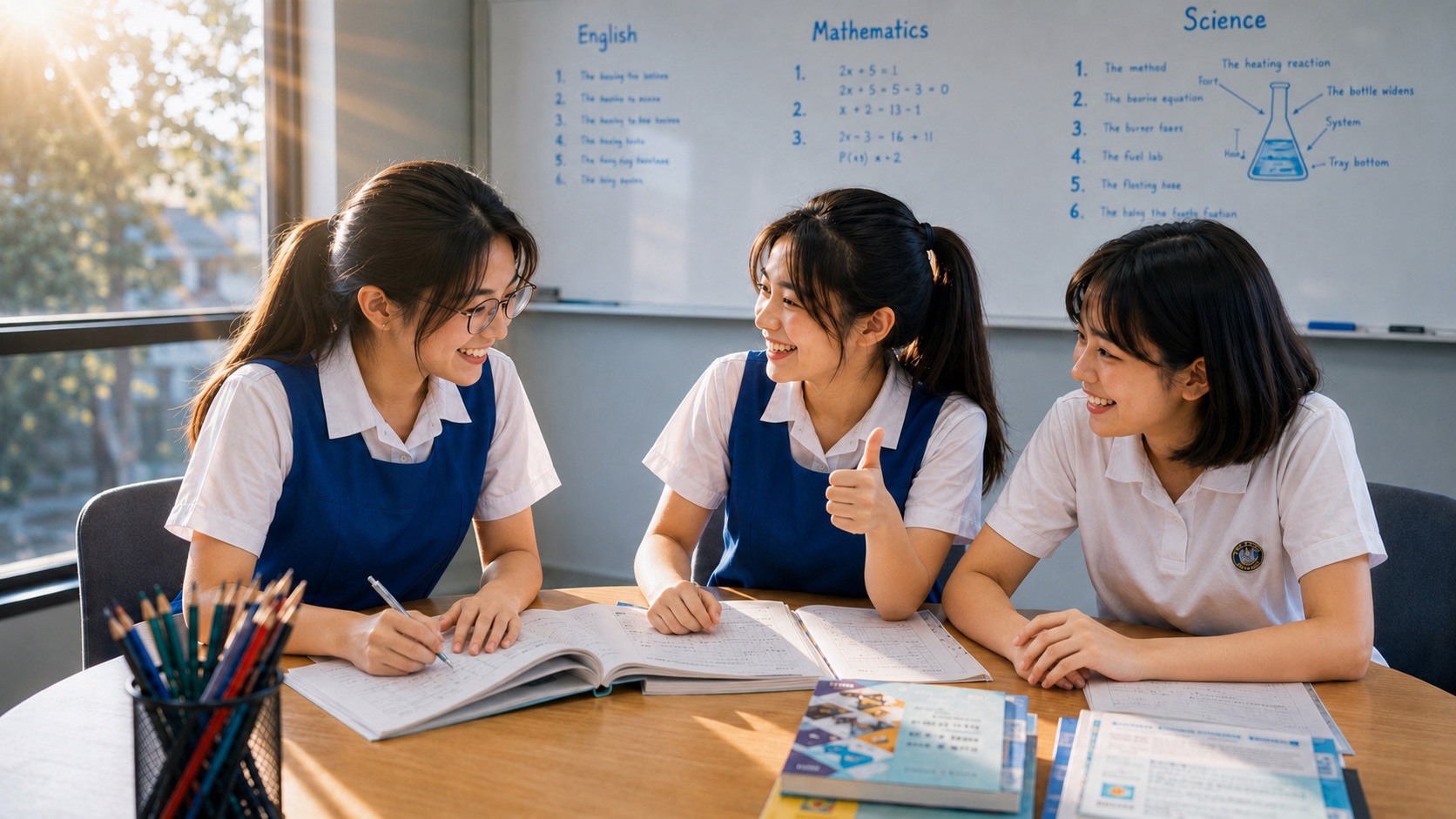
Primary English is social and comparative. Students benefit from hearing how another learner interprets a story, phrases a sentence or explains a viewpoint.
For comprehension:
- one child may find the right evidence,
- one may understand the story but answer too vaguely,
- one may misread the question word.
For composition:
- one may have the strongest event sequence,
- one the clearest paragraphing,
- one the most natural dialogue.
The tutor can compare the decisions while keeping the atmosphere non-competitive.
A 90-minute Primary English lesson at eduKate Punggol
| Phase | Learning job | What the tutor observes |
|---|---|---|
| 0–10 min | Retrieve vocabulary, spelling, grammar or an earlier correction | What is still available without notes? |
| 10–20 min | Review school work / reading / writing | Which error pattern is active? |
| 20–40 min | Build one reading, writing or language capability | Can the child explain or demonstrate the new relationship? |
| 40–60 min | Guided application | Can the child use the skill with appropriate support? |
| 60–75 min | Changed-context transfer | Does the learning survive a new story, sentence or prompt? |
| 75–85 min | Independent task; light timing only where appropriate | Does quality survive less help? |
| 85–90 min | Review and handoff | What can the child now do alone? |
A P1/P2 lesson should not look like a P6 lesson. Younger learners may spend more time on reading aloud, oral language, sentence construction and concrete text discussion. P6 learners may spend more time integrating components and managing examination conditions.
Vocabulary: usable language rather than word-list volume
Vocabulary should grow through context and use.
- Meet the word in a meaningful context.
- Explain the meaning.
- Compare it with a nearby word.
- Notice natural word partnerships.
- Use it in speech or writing.
- Retrieve it later without the list.
Five words a child can still use naturally next month may be more valuable than fifty definitions copied this week.
Grammar: sentence accuracy should transfer into real communication
Primary grammar matters, but isolated grammar success can hide transfer problems. A child may know the correct tense in a multiple-choice question and still shift tense in a composition.
The repair ladder is:
- Recognise the rule.
- Correct a highlighted error.
- Find the error independently.
- Produce a correct sentence.
- Maintain the pattern across several sentences.
- Edit it in original writing.
Composition: idea → structure → language → revision
Composition tuition can become overly decorative if it focuses on memorised “good phrases”. Stronger writing begins with a clear event, relationship or central idea.
- Understand the task.
- Select a workable idea.
- Plan the sequence.
- Give each paragraph a job.
- Use language to make meaning clearer.
- Revise for coherence, grammar and unnecessary repetition.
“Show, don’t tell” can be useful sometimes, but it is not a universal rule that every sentence must become longer and more descriptive.
Oral: develop a real response rather than memorise one
Even in Primary school, oral work should help children develop ideas in real time.
- Answer the question clearly.
- Give a reason.
- Add a specific example or experience where appropriate.
- Connect the example back.
- Respond if the tutor or another student asks a follow-up.
Three students create genuine listeners. That makes oral practice less artificial.
Travel from Sengkang: the whole evening matters
Primary children often have less capacity for long weekday logistics than Secondary students. Calculate the real routine before committing.
| Factor | Question for the family |
|---|---|
| School dismissal | Is there enough transition time before tuition? |
| Meal | Can the child eat without rushing? |
| Door-to-door travel | What is the real journey from school/home to the actual class? |
| Waiting | Will siblings or parents spend long periods waiting? |
| Homework | Does the class leave sufficient time for school work? |
| Reading | Is there still relaxed reading time in the week? |
| Sleep | Does the return journey protect bedtime? |
The class should fit childhood, not consume it.
Three hypothetical Sengkang-family decisions
These are hypothetical examples, not testimonials.
| Family | Situation | Decision logic |
|---|---|---|
| A — P2 | Child reads below confidence level; family route to Punggol is simple | A close three-student literacy class may be worth considering if teaching fit is strong |
| B — P4 | English generally stable; family is already overscheduled | Do not add tuition simply because a slot is available |
| C — P6 | Strong school knowledge, writing/comprehension diagnosis needed; family already travels through Punggol | Low travel cost and high diagnostic need can make the Punggol class practical |
What progress should justify continuing the Punggol journey?
- Reading becomes more independent.
- Comprehension answers use clearer evidence.
- Vocabulary appears naturally in new contexts.
- Grammar corrections transfer into writing.
- Paragraph organisation becomes clearer.
- Oral responses become more developed.
- The child retrieves older learning without constant notes.
- The tutor can remove more prompts.
- By P6, timed work increasingly resembles untimed ability.
If the travel burden remains high but these mechanisms are not improving, reconsider the fit.
What not to do when choosing Primary English tuition from Sengkang
- Do not assume this Punggol-domain page represents a Sengkang centre.
- Do not turn P1/P2 into exam-preparation years.
- Do not choose a class because it promises “big results”.
- Do not rely on invented parent/student testimonials.
- Do not assume more vocabulary lists automatically create better writing.
- Do not treat memorised composition phrases as a writing system.
- Do not promise bi-weekly progress notes, mock cycles or digital support unless actually offered.
- Do not promise PSLE excellence, AL1 or fixed mark gains.
- Do not sacrifice sleep, play, reading and independent learning to make a cross-estate timetable work.
Frequently asked questions
Is eduKatePunggol.com a Sengkang centre?
This page is on the eduKate Punggol site and is intended for Sengkang families considering the Punggol programme. Confirm the current exact lesson location directly before travelling.
What is the current class format?
The current eduKate Punggol model is three students for 1.5 hours. Current schedules and places should be confirmed directly.
Should P1/P2 children do exam papers in tuition?
Not as the main learning model. Lower Primary should focus on literacy, language use, feedback, confidence and strong foundations rather than recreating examinations.
When should PSLE preparation become more explicit?
P5 can build the runway by strengthening connected reading, writing and language skills. P6 is where the full subject increasingly integrates under current PSLE requirements.
Can tuition guarantee PSLE AL1?
No. Tuition can strengthen English capability and examination execution, but final national-examination outcomes cannot responsibly be guaranteed.
Choose the correct Primary English route
- Primary 1 English Tuition
- Primary 2 English Tuition
- Primary 3 English Tuition
- Primary 4 English Tuition
- Primary 5 English Tuition
- Primary 6 English Tuition
- P1–Sec 4 English Skills Progression Map
The Sengkang-family Primary English decision end condition
A Sengkang family should choose the Punggol class only when the teaching fit, three-student format and timetable together create more value than the cross-estate journey costs.
The goal is not to travel farther for tuition. The goal is to find the right amount of help, at the right stage, while the child becomes increasingly able to read, write, speak and learn independently.





