
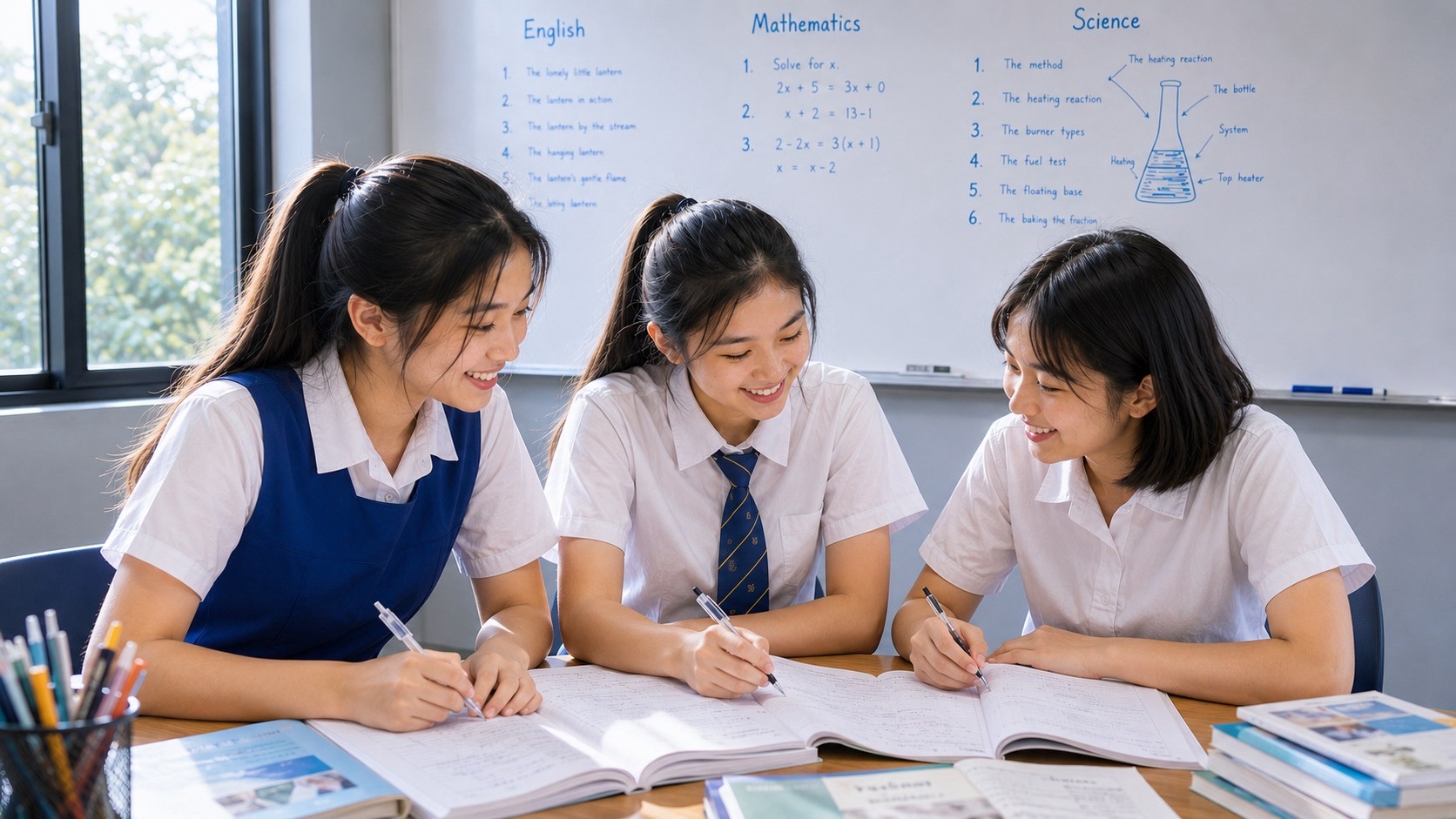
Primary 4 Science is not a mini-PSLE year. It is where scientific thinking becomes more deliberate. The child is no longer only naming objects and recalling facts. They are learning to distinguish observation from inference, read diagrams and simple experiments, explain cause and effect, classify by rules, connect systems and communicate Science more precisely.
The MOE Primary Science syllabus lists P4 topics such as plant systems, the human digestive system, matter, light and heat. But a good tutor should not teach these as five isolated chapters. The deeper job is to build the habits that make P5 and P6 Science possible: evidence, representation, explanation, retrieval and transfer.
This guide explains what a Primary 4 Science tutor should diagnose and develop in a three-student, 1.5-hour eduKate Punggol class, without turning the year into premature PSLE drilling.

The actual Primary 4 Science map
MOE’s syllabus overview places these topics at Primary 4:
- Plant system — plant parts and functions
- Human system — digestive system
- Cycles in matter and water — matter
- Energy forms and uses — light
- Energy forms and uses — heat
The important editorial correction is that P4 should not be described vaguely as “water cycle, forces and environmental systems” if those are not the official P4 allocation. Current topic accuracy matters because parents use these pages to understand what their child is actually learning.
What changes from P3 to P4?
| P3 foundation | P4 development | Why it matters later |
|---|---|---|
| Observation and classification | Use evidence to explain systems and processes | P5–P6 questions require more relational reasoning |
| Basic scientific vocabulary | Use terms precisely inside explanations | Scientific communication becomes more demanding |
| Simple diagrams | Interpret diagrams as information systems | Later experiments and graphs become easier to decode |
| Simple cause and effect | Explain intermediate scientific mechanisms | Open-ended answers become more complete |
| Single-topic practice | Begin transfer across changed contexts | Upper-primary Science becomes less chapter-cued |
The five scientific-thinking jobs in P4
- Observe accurately.
- Infer carefully.
- Represent information.
- Explain relationships.
- Test whether learning transfers.
1. Observation is not inference
A frequent Science error begins when a student describes what they think happened instead of what was actually observed.
A tutor can build the distinction by asking:
- What can you directly see, measure or record?
- What are you concluding from that observation?
- Which other explanation could fit the same observation?
- What additional evidence would help distinguish between the explanations?
This habit matters in P4 and becomes essential in later experiment questions.
2. Classification should be rule-based
Classification is not simply “put similar things together”. The child should identify the property or rule being used and check whether every item satisfies it.
A tutor can ask the learner to classify materials or organisms in one way, then change the rule and classify the same set differently. This shows that classification depends on the chosen criterion.
3. Systems: parts matter because relationships matter
Plant and digestive systems should not become labelled-diagram memorisation alone. A strong P4 learner should understand how structure and function connect.
- What is the function of this part?
- What enters or leaves?
- What changes here?
- How does this part support the whole system?
- What would happen if the part did not function properly?
The tutor’s goal is to move from labels to relationships.
4. Matter, light and heat: build concept boundaries
Scientific misconceptions often survive because the child knows one correct sentence but not the conditions around it.
For each concept, a tutor should test:
- What does the idea mean?
- What evidence shows it?
- Which similar idea should not be confused with it?
- What would change if one condition changed?
- Can the child explain it in a new object or context?
This is more robust than memorising a single model sentence.
5. Scientific vocabulary should grow through meaning
Terms such as digest, absorb, reflect, conduct, transfer, solid, liquid and gas are useful only when the child understands the relationship they describe.
A good tutor moves vocabulary through four stages:
- Recognise the term.
- Explain it in simple language.
- Use it accurately in a scientific relationship.
- Retrieve it in a changed context without prompting.
Diagrams and simple experiments: read before answering
At P4, representation literacy should become deliberate. Before answering a diagram or experiment question, the learner should identify what each label, arrow, object or condition represents.
For simple investigations, ask:
- What is being compared?
- What changed?
- What was observed?
- What stayed the same?
- What can we conclude?
Open-ended answers: relationship, not keyword pile
A P4 child should begin learning that different commands require different responses. The tutor can use a simple structure where useful: identify the condition, state the scientific process or relationship, then state the result. But this is a scaffold, not a universal sentence formula.
| Weak response | Why it is weak | Tutor repair |
|---|---|---|
| Lists many scientific words | The relationship is not clear | Ask what causes what |
| Gives the final result only | The mechanism is missing | Restore the intermediate process |
| Copies a model answer | Independent reconstruction is unknown | Cover the model and redo a changed question |
| Uses everyday language vaguely | Meaning is imprecise | Replace only the words needed for scientific accuracy |
The P4 Science error taxonomy
| Error type | What it looks like | Repair |
|---|---|---|
| Concept | Scientific model is inaccurate | Rebuild with contrast examples |
| Observation / inference | Assumption is presented as evidence | Separate what was observed from what was concluded |
| Classification | Items are grouped without a rule | Name and test the criterion |
| Representation | Diagram information is ignored or misread | Translate diagram to words before solving |
| Expression | Answer is vague or incomplete | Connect condition, mechanism and result |
| Retrieval | Old P3 ideas disappear | Short spaced recall |
How a three-student P4 Science class works
Three students allow scientific reasoning to be heard. One child may give an observation, another an inference, and a third a different explanation. The tutor can then show which statement is evidence and which is interpretation.
Personalisation happens through cue level. One learner may need a labelled diagram, another a single question, and another a fresh context with fewer hints. The same concept can therefore be taught at different levels of support inside one coherent lesson.
A 90-minute Primary 4 Science tutorial
| Phase | Job |
|---|---|
| 0–10 min | Retrieve an older concept or vocabulary relationship |
| 10–20 min | Review school work or one recurring misconception |
| 20–40 min | Build the current concept using diagrams, demonstrations or contrasts |
| 40–60 min | Guided observation / classification / experiment reasoning |
| 60–75 min | Changed-context application |
| 75–85 min | Short MCQ or open-ended set where appropriate |
| 85–90 min | Review and independent handoff |
A practical weekly P4 routine
- Retrieve one P3 concept without notes.
- Explain one current concept using a diagram.
- Do one observation-versus-inference task.
- Read one experiment or data representation.
- Write one short scientific explanation.
- Redo one previous mistake after several days.
Three hypothetical P4 learners
These are hypothetical examples, not testimonials.
| Student | Pattern | Priority |
|---|---|---|
| A | Good facts, weak explanations | Mechanism and scientific expression |
| B | Strong verbally, weak diagrams and experiments | Representation and evidence |
| C | Understands current work, forgets P3 | Retrieval and interleaving |
What progress should look like before P5
- Observation and inference are increasingly distinct.
- Classification rules are explicit.
- Plant and digestive systems are understood through function and relationship.
- Matter, light and heat concepts have clearer boundaries.
- Diagrams and simple experiments can be decoded.
- Scientific vocabulary is used because it expresses meaning.
- Older P3 Science remains available.
- The tutor can reduce prompts without the child freezing.
What not to do in P4 Science
- Do not turn P4 into constant PSLE-paper practice.
- Do not assign incorrect year-level topics.
- Do not teach model answers before understanding.
- Do not reduce open-ended Science to keywords.
- Do not call every mistake careless.
- Do not rush into P5 while P4 scientific-thinking habits are weak.
Frequently asked questions
What topics are officially listed for P4?
MOE’s syllabus overview lists plant systems, the human digestive system, matter, light and heat at Primary 4.
Should P4 students prepare for PSLE?
The best preparation is strong current Science: concepts, inquiry, evidence, representation and retrieval. Constant PSLE simulation is unnecessary at this stage.
What is the class format?
eduKate Punggol’s current model is three students for 1.5 hours. Current schedule and availability should be confirmed directly.
Related routes
- Primary 4 Science — Build the Upper-Primary AL1 Foundation
- Primary 5 Science Tutor — Build the P6 Science Runway
- How to Improve Primary Science — 7-Layer System
The P4 tutor end condition
A strong P4 learner should enter P5 able to distinguish evidence from inference, read representations, explain scientific relationships and use precise language without simply reproducing a model answer.
Official reference
Explore the Primary 4 Science Article Index for related guides.





