
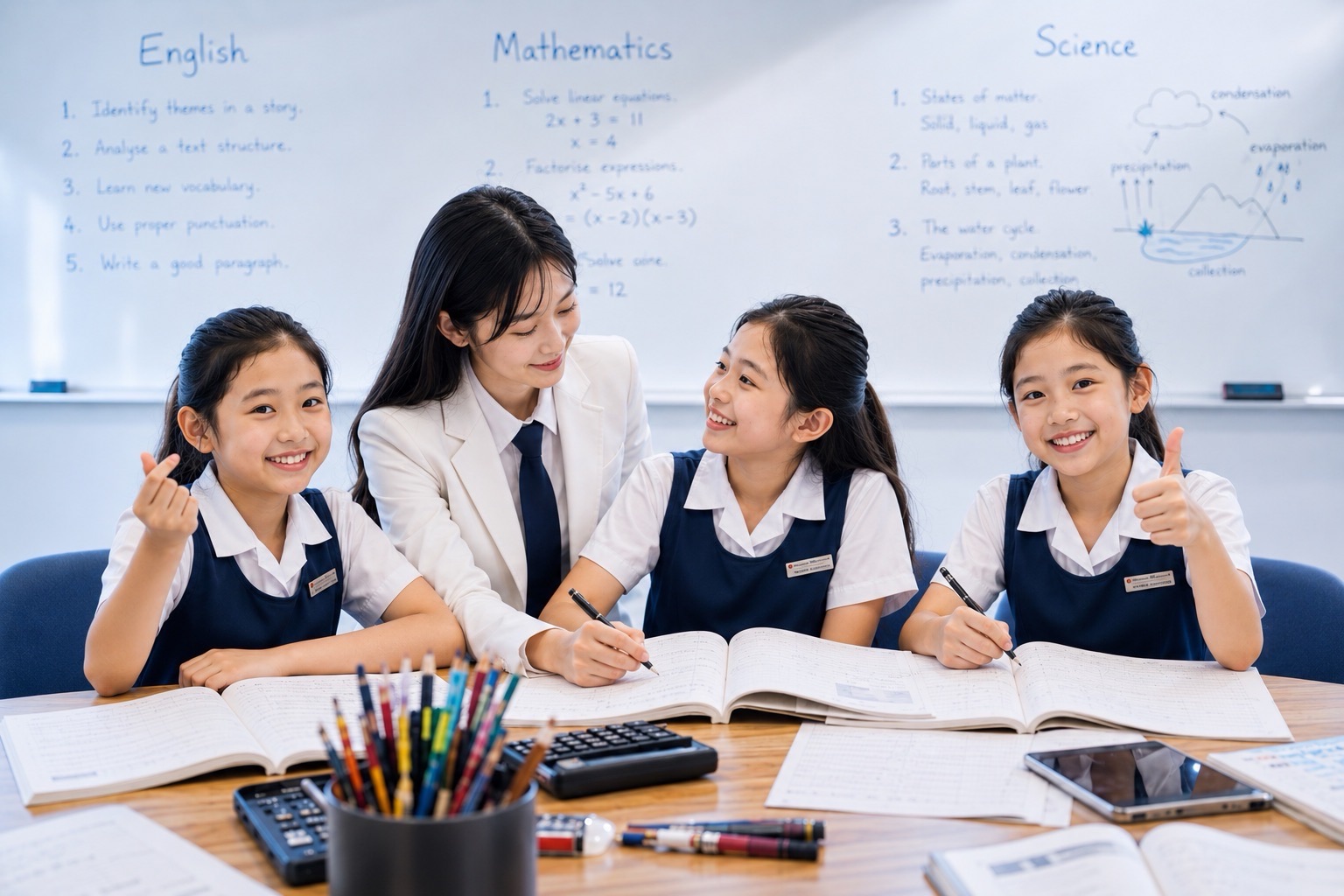
Quick read: A three-student Primary 4 Science group becomes valuable when students do more than answer in parallel. One student explains, another challenges the evidence or wording, and the original student revises. That compare-and-revise loop makes scientific thinking visible without turning the lesson into generic group work.
Small-group tuition is often described in terms of attention: fewer students, more time, more feedback. Those benefits are real, but they are not the most interesting reason to use a group of three for Science.
The deeper advantage is contrast.
Primary 4 students can look at the same diagram, read the same question and produce three different explanations. One may identify the correct concept but stop too early. One may write a complete answer using an incorrect assumption. One may have the right idea but use everyday wording that hides the scientific relationship.
When those differences are surfaced carefully, the group becomes a reasoning laboratory.
The Core Loop: Explain → Challenge → Revise
The structure is simple.
- Explain: one student gives an answer and states why.
- Challenge: another student asks what evidence supports it, whether a condition was missed, or whether the wording is complete.
- Revise: the first student improves the answer using the challenge.
The tutor controls the discussion so that critique remains about the answer, not the person. The standard is not “Who is smartest?” It is “Which explanation fits the evidence best, and why?”
Why This Fits Primary 4 Science
Primary 4 sits at an important point in the Singapore Primary Science progression. Children are moving beyond first exposure to formal Science and becoming more responsible for functions, relationships, diagrams, observations and explanations.
MOE’s current Primary Science syllabus treats students as inquirers. Children are expected to ask questions, use evidence, interpret information and communicate explanations. A useful small group should therefore give them repeated practice in making reasoning public, not merely completing worksheets beside one another.
Three Students, Three Useful Roles
A group of three can rotate through three roles.
The Explainer
The explainer answers first without seeing a model answer. The tutor listens for the actual reasoning path: what concept was selected, what evidence was noticed, and where the explanation became incomplete.
The Evidence Checker
The second student checks whether the answer uses information that is genuinely present in the question. This is especially useful for diagrams, comparison tasks and simple investigations, where children often add assumptions that were never given.
The Precision Checker
The third student listens for incomplete scientific relationships. Did the answer name both items in a comparison? Did it state what moved, from where and to where? Did it explain the process rather than only the result?
The roles rotate. No child becomes permanently “the weak one” or “the clever one”. Everyone learns to produce, inspect and improve reasoning.
A Worked Example: Heat
Suppose a question shows a metal spoon placed in a warm drink and asks why the spoon becomes warmer.
A student may answer, “The heat from the drink makes the spoon hot.”
The group can improve this without memorising a stock sentence.
- The evidence checker asks: Which object starts warmer?
- The precision checker asks: In which direction is heat transferred?
- The explainer revises: heat is transferred from the warmer drink to the cooler spoon, causing the spoon’s temperature to increase.
The important learning is not the final sentence alone. It is the sequence that produced it.
Peer Critique Is Not Peer Marking
Children should not be asked to decide marks using criteria they do not yet understand. The tutor remains responsible for accuracy.
Peer critique has a narrower job: help students notice.
- What condition did the answer use?
- Which evidence supports the claim?
- Was a relationship stated completely?
- Was a comparison made on both sides?
- Did the answer explain or merely describe?
- Did the student introduce information not provided?
These are learnable questions. They gradually become self-checking questions.
The Tutor’s Job in a Three-Student Discussion
A small group does not become effective automatically. The tutor has to protect the quality of the reasoning.
- Choose questions where contrasting explanations are useful.
- Give each child thinking time before discussion begins.
- Prevent one confident student from answering everything first.
- Ask students to justify critiques with evidence.
- Correct misconceptions immediately when they could spread.
- Return the revised question to the original student independently later.
The final step matters. Group discussion is a teaching stage, not proof of mastery. The child must eventually answer alone.
Where Peer Contrast Helps Most
Comparisons
Students often mention only one object. Hearing another student compare both sides makes the missing structure visible.
Diagrams
Different students notice different labels, arrows and conditions. The group learns that diagrams are evidence, not decoration.
Cause-and-effect explanations
One answer may name the cause, another the process, another the result. Comparing them shows why a complete chain matters.
Simple investigations
Students can challenge whether a comparison is fair, whether the conclusion matches the observations and whether another variable has changed.
Where Peer Critique Should Not Be Used
Not every part of a Science lesson needs discussion.
- A child who lacks the basic concept may need direct teaching first.
- Simple retrieval may be faster and clearer when done individually.
- A new misconception should not be left circulating while students “debate” it.
- Timed independent work should remain independent.
- A child who is over-reliant on peers needs more solo return, not more group support.
The group is a tool. It should be switched on when contrast helps and switched off when individual thinking is the better test.
The Independence Return
A strong lesson ends by giving the thinking back to the student.
After discussion, each child receives a similar but changed question. No peer comments. No sentence starter. No model answer beside the page.
If the revised reasoning survives, the group discussion transferred. If it disappears, the tutor now knows that the child followed the conversation without owning the skill.
What Parents Should Notice
The useful outcome of a three-student Science group is not that the child “participates more”. It is that the child becomes more discriminating.
- Answers refer more often to actual evidence.
- Comparisons become complete.
- Everyday wording is replaced by more precise relationships.
- The child can explain why an earlier answer was weak.
- Corrections transfer to changed questions.
- The student gradually needs less peer and tutor prompting.
When a 3-Student Group Is the Wrong Fit
A three-student group is not automatically superior to every other format. One-to-one teaching may be more suitable when a child requires intensive foundation repair, has a very unusual pacing need, or cannot yet benefit from peer contrast. Independent study may be enough when the child is already progressing well and needs only practice and feedback from school.
The format should serve the learning problem, not become the learning problem.
A 90-Minute Lesson Can Use Several Modes
At eduKate, current small-group classes are built around three students for 1.5 hours. A lesson does not need to remain in group discussion for the whole session.
- short individual retrieval;
- direct concept teaching;
- independent first attempt;
- explain–challenge–revise discussion;
- focused correction;
- changed-question independent return.
That alternation is important. Students learn with peers, but they also learn to stand without them.
Frequently Asked Questions
Will students copy each other’s answers?
Not if the lesson is designed properly. Students should attempt first before discussion, and the revised skill should be tested again independently. The purpose is comparison of reasoning, not answer sharing.
What if one student is much stronger?
The tutor must manage question difficulty and turn-taking. A stronger student should not become the group’s permanent answer key. Explaining why an answer works, evaluating alternatives and handling deeper changed conditions can still provide meaningful challenge.
Does discussion replace written Science practice?
No. Discussion makes thinking visible. Written practice shows whether the student can convert that thinking into a precise answer independently.
The End State
The purpose of a small Science group is not to make every question collaborative.
It is to use other minds as mirrors. A student hears another explanation, notices a missing condition, challenges weak evidence, revises an answer and then carries that improvement back into independent work.
Explain. Challenge. Revise. Return alone.
That is what a three-student Primary 4 Science group should enable.





