
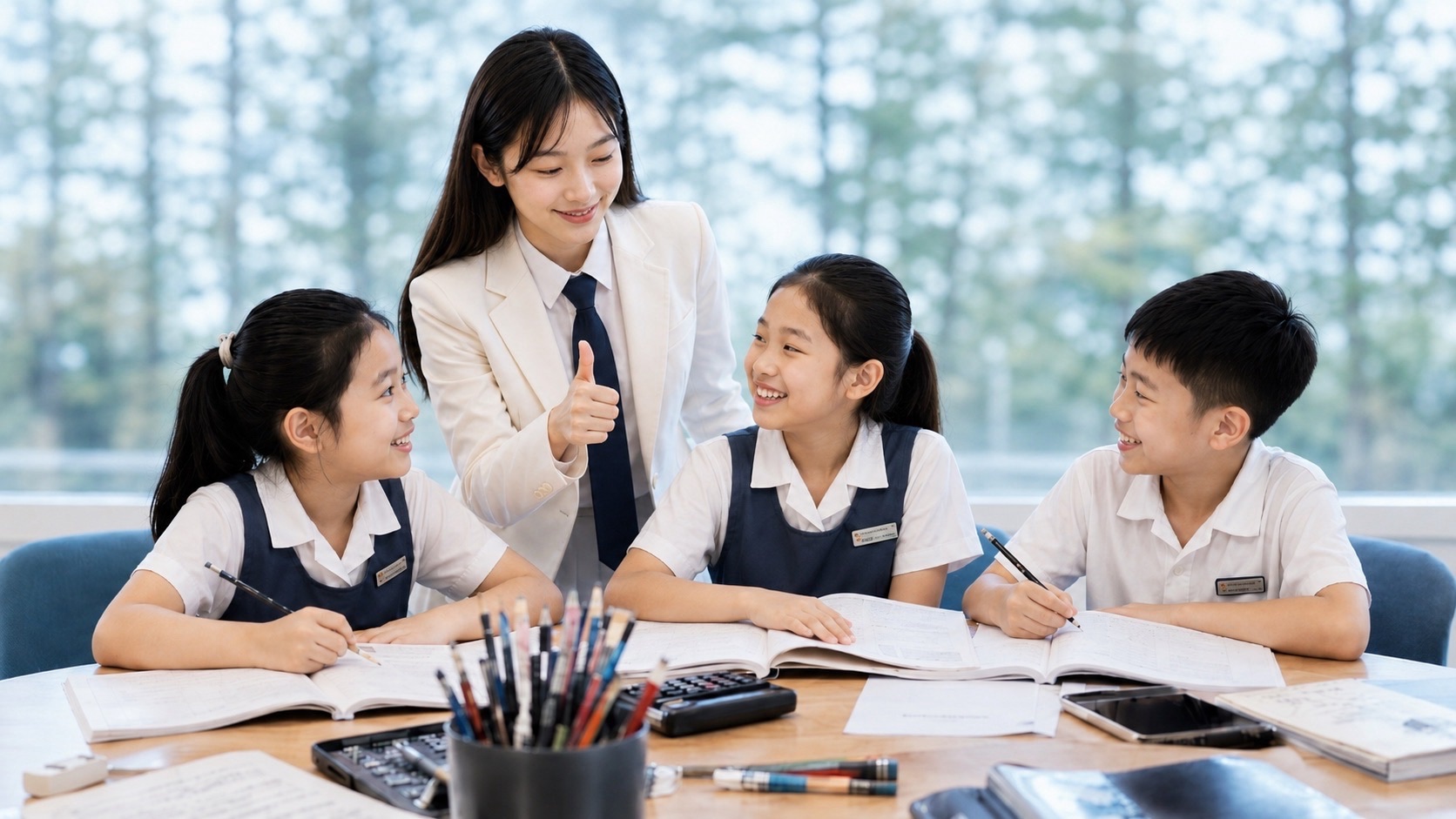
Direct answer: Primary 3 Science tuition in small groups works best when talk is used to build understanding, but every student still has to produce the final Science independently. The group can observe together, make different predictions, compare explanations and challenge misconceptions. Then the conversation must end with each child writing, classifying, predicting or explaining without copying the group’s wording.
This page owns the talk-to-write small-group job for families considering Sengkang-area Primary 3 Science tuition. Our other Primary 3 pages already cover curiosity, scientific language and whether extra support is needed. Here the question is narrower: how can a 3-pax group use scientific talk to strengthen understanding without making young learners dependent on the group answer?
MOE’s Primary Science framework develops scientific knowledge, practices and values through inquiry, evidence and communication. Primary 3 is where many students first learn that Science is not only something they know; it is something they must observe, discuss, justify and communicate. Parents can refer to the current MOE Primary Science Syllabus.
Why Talk Matters in Primary 3 Science
Primary 3 children often understand more than their written answers show.
A child may point to a diagram and explain:
“This one is different because light can go through it but the other one blocks it.”
That spoken explanation gives the tutor useful evidence.
The child may already understand the relationship but not yet know the terms transparent and opaque.
Another child may use the correct terms but for the wrong reason.
A third may copy the word from a classmate without understanding it.
Scientific talk lets the tutor see these differences before the final written answer compresses them.
But Talk Can Also Hide Weakness
Young students are highly responsive to peer cues.
One child says, “It’s because of the magnet.”
The other two immediately agree.
Now it is difficult to know who actually generated the idea.
This is why a Primary 3 small group needs an individual-first structure even though discussion is important.
The child should think before hearing the group.
The group should improve the idea.
Then the child should produce the Science alone.
The P3 3-Pax Sequence: Notice → Predict → Talk → Name → Write → Retry
1. Notice
Each student first observes independently.
The tutor may ask students to point, circle or write one observation before anyone explains.
This protects the child’s own evidence intake.
2. Predict
Students commit to what they think will happen or how they would classify the objects.
The prediction does not need to be correct.
It needs to be genuine.
The tutor wants to see the child’s current model before peer discussion changes it.
3. Talk
Now students compare.
The tutor asks:
- What did you observe?
- What made you think that?
- What is different about your classmate’s explanation?
- Which evidence supports one idea more strongly?
The talk is not a race to find the correct answer.
It is a way to make reasoning visible.
4. Name
The tutor attaches scientific vocabulary to the relationship students have just examined.
The word comes after meaning, not before it.
For example:
“You noticed that the magnet pulls this object toward it. The scientific word is attract.”
The child now has a word for an understood relationship.
5. Write
Each student now writes independently.
They should not copy the best spoken sentence from the group.
The tutor may ask for one clean sentence that contains:
- the object or condition;
- the scientific term;
- the relevant relationship.
This is where spoken understanding becomes visible written Science.
6. Retry
A fresh example checks independence.
The tutor changes the object, property, diagram or wording and asks the student to use the same relationship alone.
That is the transfer test.
Primary 3 Small Groups Should Protect Wrong Predictions
A wrong prediction is useful because it reveals the child’s first model.
If the tutor or strongest student gives the answer too early, the misconception can disappear from view without being repaired.
A stronger sequence is:
predict → explain → observe evidence → compare → revise.
The tutor can say:
“You thought all metal objects would be attracted. Let’s test three metal objects. What happened? How should we change the rule?”
The child learns that changing one’s mind after evidence is good Science.
The Group Should Compare Observations Before Explanations
Primary 3 students often jump directly to explanation.
The tutor should slow the sequence.
First ask each student to state what is actually observed.
For example:
- “The object moved toward the magnet.”
- “The seedling is taller after five days.”
- “Light passes through Material A.”
Only then ask why.
This distinction becomes foundational for later experiment and data questions.
Classification Is Excellent for 3-Pax Scientific Talk
Classification tasks can produce several valid grouping rules.
Three students can propose different rules and defend them.
The tutor asks:
- What property are you using?
- Does every object in the group share it?
- Can one object fit a different group under a different rule?
- Which rule best matches the question?
This teaches students that classification is not simply remembering the teacher’s groups.
It is choosing and applying a rule consistently.
The Spoken-to-Written Bridge Should Stay Individual
After discussion, the tutor can help each student build their own sentence.
The process is:
say it naturally → find the Science → choose the term → write it clearly → use it again.
One student may need only one scientific word added.
Another may need the relationship reordered.
A third may need help understanding the command word before writing.
The group supplies ideas.
The tutor preserves individual authorship.
Command Words Can Be Practised Through Group Contrast
Primary 3 students benefit from hearing the difference between answer jobs.
The tutor can ask three students to respond differently:
- one student states the observation;
- one student compares two conditions;
- one student explains why the result happened.
The class hears that these are different jobs even when the Science topic is the same.
Then each child answers a fresh command-word question alone.
The Tutor Must Prevent Echo Answers
An echo answer sounds correct because it repeats the previous speaker.
The tutor can prevent this by asking:
- “Explain it without using the same sentence.”
- “Show me which part of the diagram supports what you said.”
- “Can you give another example?”
- “What would happen if the condition changed?”
If the student can re-represent the idea, understanding is more likely to be genuine.
The Quiet Student Needs Protected Thinking Time
A small group is not automatically fair to a slower or quieter child.
If every question goes to whoever speaks first, one student can disappear.
We protect the quiet student through:
- private first answers;
- round-robin explanation;
- pointing or drawing before speaking;
- asking the student to respond to evidence rather than compete for speed;
- individual writing after discussion.
The goal is participation with thinking, not participation as performance.
The Fast Student Needs a Different Challenge
The fastest Primary 3 student should not simply answer more questions first.
The tutor can ask for deeper operations:
- give a second classification rule;
- find a counterexample;
- design a simple fair test;
- explain why a tempting wrong answer fails;
- predict what happens if one condition changes.
Strong students can go deeper without racing ahead in syllabus age.
Simple Experiments Should End With Talk and Written Evidence
Hands-on activities are useful when they generate something worth explaining.
A useful Primary 3 activity sequence is:
- predict individually;
- observe together;
- record what happened;
- compare prediction with result;
- discuss the scientific relationship;
- write one independent conclusion or explanation.
If the child remembers only that the experiment was fun, the learning loop is incomplete.
Peer Disagreement Can Be Healthy Science
Primary 3 students can learn to disagree with evidence rather than with volume.
The tutor can model language such as:
- “I think differently because…”
- “My evidence is…”
- “I changed my mind because…”
- “Both ideas could be possible, but we need to test…”
This is a small but important scientific habit.
The child learns that disagreement can improve a model when evidence decides the issue.
A Typical 90-Minute P3 3-Pax Science Lesson
1. Observation opener
An object, diagram or phenomenon gives students something concrete to inspect.
2. Private prediction
Each child commits before hearing peers.
3. Scientific talk
Students compare observations and reasons, with the tutor protecting wrong ideas long enough to diagnose them.
4. Vocabulary and concept naming
The tutor attaches scientific terms to understood relationships.
5. Independent writing
Each student converts the discussion into their own age-appropriate scientific answer.
6. Fresh classification, prediction or explanation
A new example checks whether learning belongs to the individual.
7. Short retrieval close
Students state or write the main relationship without looking back at the original example.
Three P3 Small-Group Pathways
Language bridge
The child understands orally but writes weakly. More lesson time goes to oral explanation, command words, vocabulary and written conversion.
Misconception repair
The child has a confident everyday model that conflicts with evidence. Prediction, testing, discussion and fresh transfer become central.
Inquiry extension
The child is secure. The tutor asks for alternative classifications, fairer tests, stronger evidence and “what if” predictions without prematurely turning the class into PSLE drilling.
What Progress Looks Like
- Students observe before echoing peers.
- Predictions become more reasoned.
- Children can explain why they changed their minds.
- Scientific vocabulary grows from meaning.
- Classification rules become clearer.
- Observation and inference are less often confused.
- Group discussion produces stronger individual written answers.
- Echo answers decrease.
- Fresh individual examples require fewer tutor prompts.
- Curiosity remains active while scientific discipline increases.
What P3 Small-Group Science Tuition Should Not Become
- The fastest child answering first every time.
- A group chorus where agreement is mistaken for understanding.
- Hands-on activities with no explanation afterward.
- Peer wording copied into every answer.
- A class where quiet students disappear.
- Premature PSLE model-answer drilling.
- A programme that values talking more than independent transfer.
What Parents Can Bring to a P3 Science Consultation
- a recent Primary 3 Science worksheet or test;
- one answer written in the child’s own words;
- one question the child explains well orally;
- one repeated misconception;
- teacher comments where available;
- the school’s current topic sequence; and
- a description of whether the child tends to lead, echo, stay quiet or avoid committing to answers in groups.
The consultation should identify whether 3-pax talk can make the child’s Science more visible while still protecting individual authorship and independence.
Class Details
Level: Primary 3 Science.
Format: 3-pax small-group tutorials.
Typical duration: 1.5 hours weekly.
Teaching emphasis: observation, prediction, scientific talk, evidence, misconceptions, vocabulary, classification, command words, individual writing and fresh transfer.
Sengkang arrangements: current class availability and exact location arrangements should be confirmed when contacting eduKate.
For the broader Primary 3 language bridge, see Science Tuition for Primary 3.
Frequently Asked Questions
Is discussion useful for Primary 3 Science?
Yes. It reveals how children are thinking and helps them hear different explanations. But discussion should be followed by independent work so the tutor knows what each child can do alone.
What if my child copies other students’ answers?
Require a private first prediction or answer before discussion, then use a different individual transfer question afterward. Copying becomes much less useful.
What if my child is shy?
Protected thinking time, written first responses, pointing, drawing and round-robin explanation can keep the child visible without forcing speed-based participation.
Should P3 students already write full model answers?
They should learn clear age-appropriate scientific answers, but the priority is understanding and accurate expression rather than memorising sophisticated PSLE-style scripts.
How quickly should small-group Science improve?
There is no responsible fixed timeline. Look for clearer observations, better predictions, stronger vocabulary, fewer echo answers and more independent written transfer.
Talk Should Build the Science. Writing Should Prove the Child Owns It.
Primary 3 children benefit from talking through the world they are learning to see scientifically.
They can notice together.
Predict differently.
Challenge one another with evidence.
Learn the scientific word.
Then each child must carry that learning onto the page alone.
Notice → predict → talk → name → write → retry.
That is how Primary 3 Science tuition in small groups at Sengkang can use peer learning without losing the individual learner.





