
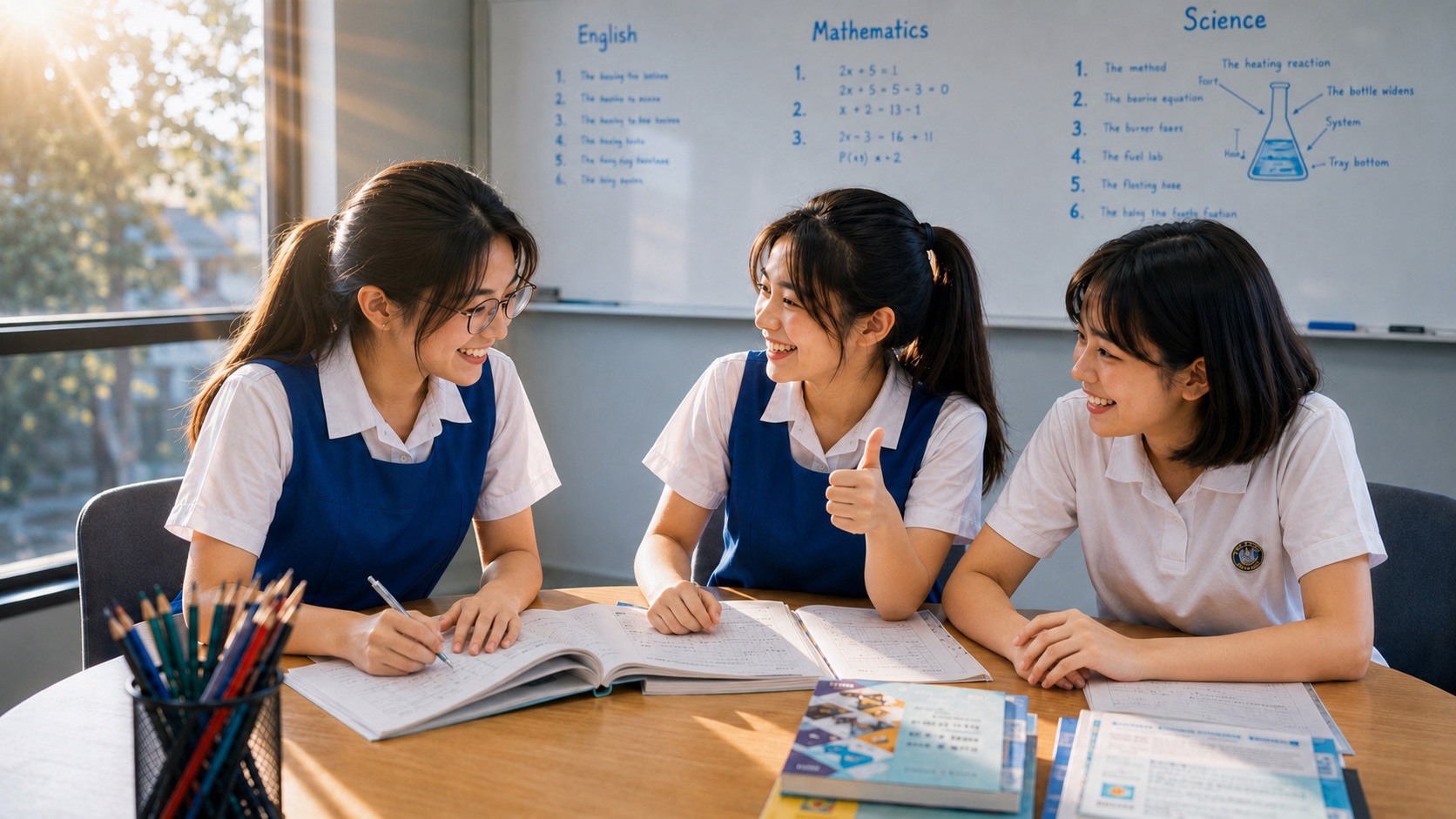
Tuition works best when it brings the student, parent, tutor, schoolwork and next academic goal onto one clear learning table. Discover how eduKate Punggol diagnoses gaps, repairs foundations and gradually helps students become more capable and independent.
Most parents first consider tuition because something has happened.
A mark has fallen.
Homework has become difficult.
The child has lost confidence.
A major examination is approaching.
The school syllabus appears to be moving faster.
Or the child is doing well, but the family can see that the next level will demand more.
The immediate response is often practical:
Find a tutor.
Choose a subject.
Attend a class.
Complete more work.
But tuition does not become effective merely because another lesson has been added to the week.
Good tuition creates a wider learning table.
At that table sit:
- the student;
- the parent;
- the tutor;
- the school syllabus;
- the child’s recent work;
- the next examination;
- the child’s habits and confidence;
- the family’s available time;
- and the future stage the child is preparing to enter.
When these parts are disconnected, tuition becomes another appointment.
When they are brought together carefully, tuition becomes a working strategy.
The parent understands what is happening.
The tutor can see what needs to be repaired.
The student knows what to work on next.
The subject becomes more organised.
Progress becomes less accidental.
That is when the table begins to widen.
What Does “The Table Widens” Mean?
Imagine that every student has a learning table.
Everything the child can currently understand, remember and use must fit on that table.
A very young student may begin with:
- recognising words;
- writing simple sentences;
- understanding number bonds;
- following classroom instructions;
- explaining one idea at a time.
As the child grows, more must be placed on the same table.
There are more subjects.
Questions become longer.
Topics begin to connect.
Examinations become more demanding.
The child must work faster and more independently.
By Secondary school, the student may need to manage algebra, scientific explanations, comprehension, writing, revision schedules, different teachers and several assessments at once.
The table must therefore become stronger and wider.
A stronger table can hold greater academic weight.
A wider table gives the student more ways to think, respond and recover.
The purpose of tuition is not simply to keep placing more worksheets on the table.
The purpose is to make sure the table can carry what comes next.
A Small Table Produces Familiar Parent Concerns
Parents often describe the problem through what they can see.
“My child is careless.”
“She understands at home but cannot do the examination.”
“He takes too long to finish his work.”
“She keeps forgetting what she has learnt.”
“He can answer the easy questions but becomes lost when the question changes.”
“She does not know how to begin her composition.”
“He studies, but the marks are not improving.”
These are real concerns.
However, each sentence may contain several possible causes.
A child who appears careless may actually have weak foundations.
A child who forgets may never have understood the idea clearly enough to store it properly.
A student who understands during tuition but cannot answer independently may have followed the explanation without learning how to reproduce the method.
A child who avoids homework may be tired, confused, afraid of failure or unsure where to begin.
The visible problem is rarely the whole problem.
The table must be opened before it can be repaired.
The Student Brings the Lived Experience
The student sits at the centre of the tuition table.
However, children are not always able to describe their learning difficulty precisely.
A student may say:
“I do not understand Mathematics.”
But the real problem may be:
- weak multiplication;
- uncertain fractions;
- difficulty translating words into operations;
- poor algebraic manipulation;
- an inability to recognise the question type;
- or anxiety after several poor results.
Another student may say:
“I cannot write compositions.”
The difficulty may be:
- limited vocabulary;
- weak sentence control;
- no planning method;
- insufficient reading;
- difficulty developing a character;
- difficulty moving from one event to another;
- or fear of producing an imperfect first draft.
A Science student may say:
“I memorised everything, but the answer was still wrong.”
The student may know the topic but be unable to:
- identify the concept being tested;
- connect the concept to the evidence;
- explain the sequence clearly;
- compare two conditions;
- or phrase the final answer with sufficient precision.
The student brings the experience of the problem.
The tutor must help translate that experience into something that can be taught and corrected.
The Parent Brings the Wider View
Parents see parts of the child’s learning life that tutors and teachers may not see.
Parents know:
- how long homework takes;
- whether the child is sleeping well;
- how the child reacts before a test;
- whether confidence has changed;
- whether the child is becoming increasingly dependent;
- how much schoolwork and CCA are already filling the week;
- whether family relationships are being strained by academic pressure;
- and whether the child’s behaviour has changed over time.
This makes the parent an important part of the learning table.
However, the parent’s role is not to become another subject tutor.
Parents do not need to reteach every Mathematics method, edit every composition or revise every Science topic.
The parent’s more valuable role is to stabilise the environment around learning.
This includes:
- helping the child attend lessons consistently;
- protecting sufficient rest;
- providing a workable study routine;
- sharing useful observations with the tutor;
- noticing changes in confidence;
- asking about the learning process rather than only the mark;
- and allowing the child to carry increasing responsibility.
The parent creates part of the emotional climate around education.
A calm table helps the child look at mistakes.
A fearful table encourages the child to hide them.
The Tutor Brings Diagnosis and Direction
A tutor should do more than explain the answer.
A tutor must be able to read the learning table.
The tutor looks at the child’s work and asks:
Where did the thinking begin to break down?
Was the question misunderstood?
Was the relevant concept missing?
Did the child choose the wrong method?
Was the method correct but poorly executed?
Was the working disorganised?
Did the student know the answer but fail to express it clearly?
Did the student remember the example without understanding the principle?
Did pressure interfere with performance?
Is the present mistake connected to an older foundation gap?
This is why two tutors can teach the same chapter and produce very different outcomes.
One tutor may explain the topic again.
Another may find the earlier misconception that has been producing repeated mistakes.
One tutor may provide twenty more questions.
Another may identify that the student has been using the wrong starting method.
One tutor may focus on completing the syllabus.
Another may decide that the student first needs to regain control over a smaller set of essential skills.
Good tuition begins by seeing accurately.
Teaching follows diagnosis.
School Is Also at the Table
Tuition does not operate separately from school.
The school provides:
- the syllabus;
- the main sequence of topics;
- classroom instruction;
- homework;
- assessment dates;
- examination formats;
- and the expected academic standard.
School must move an entire class forward.
The teacher cannot always stop the class for every hidden gap carried by every individual student.
This is not a failure of school.
It is the reality of teaching a larger group within a fixed calendar.
Tuition performs a different job.
It creates a smaller space where the child’s own learning process can be examined more closely.
The tutor can slow down where the student is uncertain.
The tutor can accelerate where the student is ready.
The tutor can connect a current topic to an earlier missing foundation.
The tutor can return to the child’s school paper and examine why marks were lost.
The tutor can prepare the student for the next topic before it becomes overwhelming.
School provides the main road.
Tuition helps make sure the child’s vehicle can travel on it.
Examinations Sit at the Table Too
Education is larger than examinations.
But examinations remain part of the child’s school journey.
A student may understand a concept and still lose marks because the answer is too vague.
A student may know the Mathematics method but fail to show sufficient working.
A student may have good composition ideas but spend too long on the opening.
A student may know the Science topic but miss the condition given in the question.
This means tuition must prepare two connected abilities:
Understanding
Does the child genuinely know what is happening?
Execution
Can the child show that understanding accurately within the examination?
Both matter.
Understanding without execution may not produce the expected result.
Execution without understanding may work only while the questions remain familiar.
Strong tuition develops both.
The Table Must Be Strengthened Before It Is Widened
Parents understandably want improvement quickly.
A coming examination creates urgency.
A poor result creates concern.
A child who is struggling wants relief.
However, adding harder work immediately is not always the fastest route forward.
A weak table cannot safely carry more weight.
Before the table widens, its supports must be checked.
Foundation
Does the student know the essential ideas required for the present topic?
Language
Can the student understand instructions, vocabulary and question phrasing?
Method
Does the student have a dependable way to begin and continue?
Memory
Can the student retrieve the required knowledge without depending on the exact example?
Accuracy
Can the student complete the process without losing control of details?
Confidence
Is the child willing to attempt an unfamiliar question?
Correction
Can the student understand a mistake and improve the next attempt?
Transfer
Can the student use the skill when the question looks different?
Examination Control
Can the student work within time, pressure and uncertainty?
When one of these supports is weak, more worksheets may simply place additional weight on the same unstable structure.
The first job is repair.
How Tuition Widens the Table
Once the foundation becomes more stable, the student needs greater usable range.
The table widens when the student gains more options.
A Mathematics student begins to see that a problem can be approached in several ways.
An English student learns to develop the same idea with greater clarity, depth and control.
A Science student begins to recognise the same concept inside a less familiar experiment.
A student who once froze after making a mistake learns how to recover.
A child who depended on the tutor begins to explain the method independently.
The student gradually becomes able to:
- connect one topic to another;
- recognise hidden conditions;
- compare different approaches;
- choose a more efficient method;
- explain why an answer works;
- detect an error;
- correct the error;
- apply the learning to an unfamiliar question;
- and remain composed when the paper is difficult.
This is more than doing additional work.
It is an expansion of what the child can use.
How Tuition Works at eduKate Punggol
At eduKate Punggol, the lesson process follows a deliberate learning loop.
1. See the Student’s Present Position
We begin with the child’s work.
This may include:
- a recent school paper;
- homework;
- corrections;
- written compositions;
- comprehension answers;
- Mathematics working;
- Science open-ended responses;
- or a topic the student is currently studying.
We look beyond the final score.
The work shows us how the child is thinking.
2. Find the Nearest Broken Point
A large difficulty is often supported by a smaller missing skill.
The student may not need the whole subject retaught.
The tutor looks for the nearest point where progress stopped.
This makes the repair more precise.
3. Explain the Missing Idea Clearly
The tutor rebuilds the idea in language the child can use.
The aim is not merely for the explanation to sound good.
The student must be able to understand it, respond to it and use it.
4. Guide the First Correct Attempt
The child applies the idea with support.
At this stage, the tutor watches closely.
Where does hesitation return?
Which step is still uncertain?
What does the student skip?
5. Correct While the Thinking Is Visible
Correction is most useful when it is close to the mistake.
The tutor can ask the student to explain the choice, compare it with the required method and make a better second attempt.
The error becomes information.
6. Repeat Until the Skill Becomes More Stable
One successful question does not always mean that the learning is secure.
The child needs enough varied practice to distinguish the principle from the example.
7. Move Into a New Question
The question changes.
The wording changes.
The numbers change.
The context changes.
The student now has to recognise the underlying structure independently.
8. Return Control to the Student
The final aim is not permanent dependence on tuition.
The aim is a student who can increasingly:
- begin without prompting;
- choose a method;
- explain the reasoning;
- check the work;
- and make a useful correction.
Tuition has done its job well when the student can carry more of the process.
Why We Use Three-Student Small Groups
A child needs individual correction.
But a child also benefits from learning in the presence of others.
Our three-student small-group format creates room for both.
The tutor can see each student’s working closely.
Questions can be addressed before confusion becomes deeply repeated.
At the same time, students learn that different people may:
- approach the same question differently;
- notice different details;
- make different mistakes;
- explain ideas in different ways;
- and improve at different speeds.
This creates a useful class rhythm.
One student may be thinking independently while another receives a short explanation.
One student may explain a method and strengthen personal understanding in the process.
Another may notice a mistake that would otherwise have remained invisible.
The group is small enough for close teaching, but active enough for students to develop independence.
The tutor remains attentive without becoming the child’s permanent engine.
The Parent, Tutor and Student Have Different Jobs
Tuition becomes confused when everyone tries to perform the same role.
The parent becomes the tutor.
The tutor becomes the homework finisher.
The student becomes a passive passenger.
A clearer table gives each person a different responsibility.
The Student’s Job
The student should gradually learn to:
- bring the required materials;
- attempt the work honestly;
- show working;
- ask when something is unclear;
- accept correction;
- practise between lessons where required;
- and become increasingly responsible for improvement.
The student does not need to arrive perfect.
The student needs to participate.
The Parent’s Job
The parent should:
- provide accurate background information;
- help maintain attendance and routine;
- avoid turning every lesson into an immediate demand for marks;
- observe changes at home;
- communicate meaningful concerns;
- and support increasing independence.
The parent protects the conditions around learning.
The Tutor’s Job
The tutor should:
- diagnose carefully;
- teach clearly;
- select suitable work;
- correct precisely;
- adjust the pace;
- track repeated difficulties;
- prepare for school and examinations;
- and move the student towards independent control.
The tutor manages the learning route.
What Happens When the Table Is Too Small?
A small tuition table focuses only on the next worksheet.
The child attends.
The tutor explains.
The student completes some work.
The lesson ends.
The following week begins almost separately.
There may be activity without a clear direction.
Tuition begins to weaken when:
- nobody is sure what is being repaired;
- work is selected only because it is available;
- the student copies without thinking;
- corrections are completed but not understood;
- the parent receives only vague assurances;
- school papers are ignored;
- the same mistakes continue;
- lessons depend entirely on the tutor;
- and the student cannot use the method independently.
In this situation, everyone may be working.
But the table is not widening.
Why More Work Is Not Always Better Work
A student can complete many questions and still remain uncertain.
Quantity helps only when the practice is connected to a purpose.
For example, ten Mathematics questions may be useful when they help the student stabilise one method across different forms.
Ten more questions may be unhelpful when the student repeats the same misconception ten times.
Writing several compositions may help when the student receives precise correction and applies it to the next piece.
It may not help when every composition is written with the same weak planning and sentence habits.
Memorising more Science phrases may improve recall.
It will not necessarily improve the student’s ability to select the relevant concept and connect it to the evidence.
Practice should not simply occupy time.
It should change performance.
How Parents Can Help the Table Widen
Parents do not need to monitor every answer.
A few better questions can reveal much more.
Instead of asking:
“How many marks did you get?”
Try:
“Which part became clearer?”
Instead of:
“Why were you careless again?”
Try:
“Where did the mistake begin?”
Instead of:
“Did the tutor teach you this?”
Try:
“Can you show me how you would do it now?”
Instead of:
“Why are we paying for tuition if the mark did not rise?”
Try:
“What has improved, and what is still unstable?”
These questions move attention from judgement to process.
Marks still matter.
But the process explains how more dependable marks are eventually produced.
How the Table Changes Through the School Years
The learning table does not remain the same.
Primary 1 and Primary 2: Learning How to Learn
The child is building early routines:
- reading instructions;
- forming sentences;
- handling numbers;
- sitting with a task;
- asking for help;
- and correcting simple mistakes.
Tuition should not make a young child feel that school has become an endless examination.
The table should feel safe enough for effort.
Primary 3 and Primary 4: Connecting More Pieces
English passages become more demanding.
Mathematics requires stronger operations and problem-solving.
Science introduces a new system of concepts, processes and explanation.
The child must begin connecting ideas rather than treating every question as separate.
Primary 5 and Primary 6: Carrying Greater Weight
Earlier foundations are now used inside more complex work.
Students must manage longer questions, several steps, heavier content and greater examination pressure.
At this stage, tuition may need to combine:
- repair;
- consolidation;
- timed work;
- question analysis;
- and examination routines.
Secondary 1: Rebuilding the Table for a New Environment
Secondary school brings more subjects, teachers, expectations and independent responsibility.
Even a capable Primary school student may need time to reorganise.
The child is not necessarily weaker.
The table has changed.
Secondary 2: Preparing Before the Next Widening
The student should begin stabilising the foundations required for upper Secondary work.
This is an important time to look at:
- algebra;
- writing maturity;
- reading depth;
- revision habits;
- subject strengths;
- and readiness for the next academic route.
Secondary 3: Managing Specialisation
The academic load becomes more specialised.
New subjects and deeper content require better organisation.
Additional Mathematics, where taken, places substantial demand on algebraic fluency and symbolic reasoning.
The student needs a table strong enough to hold several connected systems.
Secondary 4: Performing Under Examination Conditions
The final year requires the student to coordinate knowledge, method, time and emotional control.
Tuition becomes increasingly precise.
The question is no longer only:
“Has this chapter been taught?”
It becomes:
“Can the student recognise, retrieve, apply and complete it accurately under examination conditions?”
How Do We Know Tuition Is Working?
The first evidence may not be a dramatic jump in marks.
Look for quieter changes.
The child begins work with less hesitation.
The student can explain the method more clearly.
Repeated mistakes occur less often.
Working becomes more organised.
The child asks better questions.
Corrections become more accurate.
Homework takes a more reasonable amount of time.
The student can attempt unfamiliar work without immediately giving up.
School feedback begins to improve.
Results become less volatile.
Confidence becomes calmer rather than louder.
These are signs that the table is strengthening.
Marks matter.
But these changes show that the machinery producing the marks is improving too.
How Long Does It Take?
The answer depends on what the tuition table is carrying.
A student who needs help with one recent topic may improve quickly.
A child carrying several years of weak foundations will require a more careful repair.
A capable student refining examination technique may show progress differently from a student rebuilding basic confidence.
The timetable is also affected by:
- lesson consistency;
- school workload;
- willingness to practise;
- the depth of the gap;
- the time available before an examination;
- and whether the child can apply corrections independently.
A useful tuition plan should therefore state the present priority.
For example:
- stop the immediate fall;
- repair one foundational area;
- stabilise school performance;
- prepare for the next academic stage;
- improve examination execution;
- or stretch an already capable student.
A clear priority keeps the table from becoming crowded with too many goals.
The Table Should Eventually Belong to the Student
Parents and tutors may begin by carrying much of the learning structure.
They organise the timetable.
Choose the materials.
Identify the mistakes.
Remind the child what to do next.
But the structure should gradually transfer.
The student begins to know:
- what needs attention;
- how to start;
- where to look when uncertain;
- how to test personal understanding;
- how to organise revision;
- and how to learn from an error.
This is one of the most important outcomes of good tuition.
The child is not merely better supported.
The child becomes better able to support personal learning.
The table has not only widened.
The student has learnt how to manage it.
A Better First Conversation With a Tuition Centre
Parents do not need to arrive with a complete diagnosis.
A useful first message can be simple.
Tell us:
- your child’s present level;
- the subject;
- the recent result or concern;
- what happens during homework;
- how long the concern has been present;
- any important examination or transition ahead;
- and what you hope will change.
Recent schoolwork is especially useful.
A paper often shows what a general description cannot.
Instead of concluding that the child is simply careless, weak or unmotivated, we can examine where the process is breaking.
That gives the first lesson a more intelligent starting point.
What We Do at eduKate Punggol
At eduKate Punggol, we teach English and Mathematics across the Primary and Secondary years, Primary Science from Primary 3, and Additional Mathematics in the upper Secondary years.
Our work is not to place students into a single standard route.
Some children need to recover.
Some need to become stable.
Some need to prepare before the next stage.
Some are already doing well and need greater depth.
Within our three-student tutorials, we look closely at the child’s work, teach the missing idea, guide the method, correct the attempt and gradually return control to the student.
The table begins with the subject.
It widens into:
- stronger understanding;
- better study habits;
- clearer correction;
- improved examination control;
- greater independence;
- and more choices for what the student can do next.
A Calm Way to Think About Tuition
Tuition should not make family life noisier.
It should make the learning problem clearer.
The parent should understand the route.
The child should know what is being worked on.
The tutor should be able to explain what is changing.
The work should become increasingly purposeful.
The child should become less dependent, not more.
This is how tuition moves beyond extra lessons.
The table widens.
The subject becomes more manageable.
The child gains more room to think.
The family gains a clearer view of the road ahead.
Speak With eduKate Punggol
You do not need to know exactly what is wrong before contacting us.
Begin with what you are seeing.
We can look at the child’s level, recent work, present difficulty and next school demand.
From there, we identify the nearest useful starting point.
Suggested buttons
[Ask About My Child’s Learning]
[See the Parent’s Education Map]
[Explore Primary Tuition]
[Explore Secondary Tuition]
[How Our 3-Student Tutorials Work]
Frequently Asked Questions
Is tuition just additional practice?
No. Practice is one part of tuition. Useful tuition also diagnoses gaps, teaches missing concepts, corrects methods, builds transfer and prepares the student to work independently.
What should I bring for the first lesson?
Recent school papers, homework, corrections and teacher comments are useful. They allow the tutor to see how the child approaches the subject.
Why might a child attend tuition but still not improve?
The child may be practising the wrong material, repeating a misconception, depending too heavily on explanation, attending inconsistently or carrying an older foundation gap that has not been identified.
Should the tutor follow the school exactly?
Tuition should remain connected to school, but it may not always follow the same order. A tutor may need to repair an earlier skill before the child can manage the present school topic properly.
Why are corrections so important?
A completed answer shows what the student did. A correction helps the student understand what must change. Without that second step, the same mistake may continue.
Will small-group tuition give my child enough attention?
Our three-student format allows the tutor to inspect individual work and provide close correction while students retain enough space to think and work independently.
How should parents monitor tuition?
Look beyond the number of worksheets completed. Ask whether the child understands the current priority, makes fewer repeated mistakes and is becoming more independent.
What if my child is already scoring well?
The table can still widen. Strong students may need deeper questions, greater writing precision, more efficient methods, improved examination control or preparation for a more demanding next stage.
Is tuition meant to continue permanently?
Not necessarily. The appropriate duration depends on the child’s needs and goals. Even during longer-term support, the student should become progressively more capable of managing personal learning.





