“Careless mistake” is often too vague to be useful. A child can lose marks because of copying, operation choice, arithmetic execution, units, task return, weak representation, incomplete working or poor checking. These errors look similar on the final page—an answer is wrong—but they do not have the same cause and should not receive the same repair.
The first job is therefore to stop asking only, “Why is my child so careless?” and start asking, “What type of error keeps recurring, and at which step does it begin?”
Quick read: eight common error families
- Copying: transfers a number, sign or symbol incorrectly.
- Interpretation: misreads what the question asks.
- Operation choice: uses the wrong mathematical relationship.
- Representation: draws or reads the model, diagram or table incorrectly.
- Arithmetic: concept is right but calculation is wrong.
- Units: converts, labels or returns units incorrectly.
- Working: skips essential or useful steps and loses the route.
- Checking: finishes without testing whether the answer is reasonable and responsive.
A child may have more than one family. The point of the taxonomy is not to label the child. It is to make the repair specific.
Why “be more careful” rarely fixes a recurring error
Attention matters, but an instruction such as “slow down” is too broad when the mistake has a structural cause. A child who repeatedly chooses the wrong operation does not mainly need slower arithmetic. A child who knows the method but copies 36 as 63 needs a different intervention.
The repair should match the failure point.
Error family 1: copying and transcription
Copying errors happen when information changes while moving from the question to the working or from one line to the next.
- 36 becomes 63;
- a negative sign disappears;
- a decimal point moves;
- a denominator changes;
- a length from a diagram is assigned to the wrong side.
Repair: slow the transfer step, point to source and destination, and build a final comparison check. The student should know that copying is a mathematical action that deserves attention, not invisible clerical work.
Error family 2: task interpretation
Some students calculate correctly and answer the wrong thing. They find the total when the question asks for the difference, calculate the remaining amount when the task asks for the original amount, or stop one step before the required answer.
Repair: before calculating, state what the final answer must represent. At the end, return to that sentence and check whether the written answer matches it.
Error family 3: operation choice
An operation-choice error can look careless even when it reflects incomplete conceptual understanding. The child sees two numbers and adds because “adding is usually first,” or divides because the word “each” appears without understanding the actual relationship.
Repair: ask what each quantity represents and how the quantities are related before selecting an operation. Representation is often more useful than another list of keywords.
Error family 4: representation
Bar models, diagrams, tables and number lines help only when they represent the relationship accurately. A child may draw a neat model that encodes the wrong relationship and then calculate perfectly from it.
- Which bar is the whole?
- Which quantities are equal?
- What does one unit represent?
- Is the diagram showing before/after, part/whole, comparison or rate?
- Can the child explain each label?
Error family 5: arithmetic execution
Here the method is genuinely correct, but the calculation fails. This can come from weak number facts, poor place-value control, fraction arithmetic, decimal handling or rushed written computation.
Repair: identify the specific arithmetic process and practise it in a focused way. Do not make the child redo the whole problem-solving chapter if the only unstable part is, for example, multiplication accuracy.
Error family 6: units and conversion
Units are part of the meaning of the answer. A mathematically correct number can still be incomplete or wrong if the unit is missing, mismatched or incorrectly converted.
- length versus area versus volume;
- minutes versus hours;
- grams versus kilograms;
- metres versus centimetres;
- dollars versus cents;
- rates that require two units.
Repair: write or identify the expected unit before the final calculation where useful, and include a unit check in the answer-return routine.
Error family 7: working and route loss
Some children skip steps because they want to be fast. The result is that they lose track of what a number means, cannot find where the error began, or have no stable working to check.
Good working is not about making every solution long. It is about making the route reconstructable: important relationships, substitutions and intermediate results are visible enough to support accuracy and checking.
Error family 8: checking failure
“Check your work” is not a method. Students need to know what kind of check fits the question.
- Reasonableness: is the size or sign of the answer plausible?
- Reverse operation: can the result be checked by working backwards?
- Alternative method: can a second route verify the answer?
- Unit check: does the final unit match the task?
- Task-return check: did the student answer exactly what was asked?
- Calculator-entry check: for permitted calculator work, does the entered expression match the intended calculation?
A marked-work error log that is actually useful
| Question | Error family | Where it began | Repair | Changed-task result |
|---|---|---|---|---|
| Problem sum | Interpretation | Misread “how many more” | State required quantity before solving | Pass / needs prompt |
| Fractions | Arithmetic | Common denominator | Focused fraction computation | Pass / needs prompt |
| Mensuration | Units | Area returned in cm | Unit-type check | Pass / needs prompt |
Three or four entries are more useful than a notebook filled with the word “careless.” The purpose is to reveal a recurring signature.
How the pattern changes from P1 to P6
| Stage | Common focus |
|---|---|
| P1–P2 | number reading, operation meaning, place value, copying, basic unit language |
| P3–P4 | multi-step task return, representation, fractions, measurement, written working |
| P5 | ratio, percentage, fractions, more complex problem sums, conversions and multi-step checking |
| P6 | mixed-topic execution, time pressure, Paper 1 versus Paper 2 control, calculator discipline and final-answer checking |
PSLE 2026 context for Primary 6
For the 2026 PSLE Mathematics examination, SEAB lists syllabus 0008. Candidates sit two 50-mark papers. Paper 1 is non-calculator; Paper 2 allows the use of an approved calculator. That means final-year error control must work in two environments: manual numerical control and calculator-supported problem solving.
This page is broader than PSLE, however. The best time to build error awareness is before Primary 6, so the checking routine is already familiar when the final-year load increases.
Do not over-correct every error
Children will make occasional mistakes. The diagnostic value comes from repetition. One unusual slip may need only a reminder. A recurring error across different tasks deserves a repair plan.
- One-off: correct and move on.
- Repeated same family: investigate the cause.
- Appears only under time: compare untimed and timed work.
- Appears across topics: repair the underlying process rather than each chapter separately.
How a 3-student Mathematics lesson can use error taxonomy
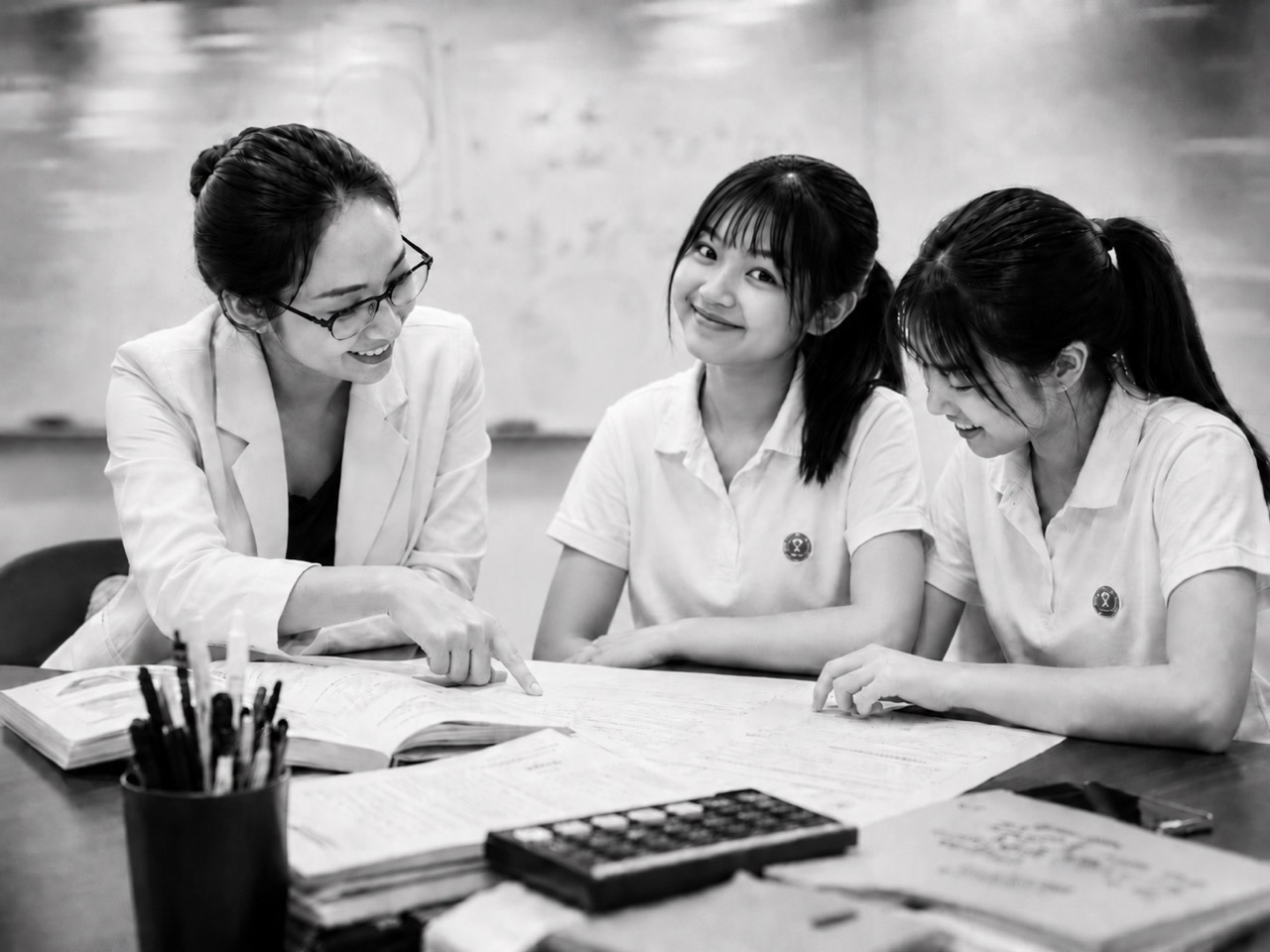
At eduKate Punggol, the working format is three students for 1.5 hours. The small group is useful when the tutor can classify an error immediately, ask the student to explain what happened, compare it with another student’s route where appropriate, and then give a changed question that tests the repair.
- identify the first wrong step;
- classify the error family;
- repair the underlying skill;
- redo the original question;
- attempt a changed question;
- record whether the same error returns;
- fade reminders once the checking habit becomes independent.
What parents can do at home
- Ask “Where did the answer first become wrong?” rather than “Why were you careless?”
- Keep one small error log instead of rewriting every incorrect question.
- Ask for one appropriate check, not “check everything again.”
- Use changed questions to see whether the repair transfers.
- Do not supply the first step immediately; allow the child time to interpret the task.
- Separate speed training from accuracy repair.
A useful parent resource
The original parent handout on this topic remains available here: How to Reduce Careless Mistakes in Mathematics at Home — Parent’s Guide.
Official curriculum references
MOE’s current Primary Mathematics Syllabus P1–P6 provides the curriculum framework. For Primary 6 exam details, use SEAB’s PSLE formats examined in 2026.
Where to go next
For a final-year P6 version of error control, use the P6 Mathematics avoidable-mark-loss guide. For a broader understanding diagnostic, use Primary Mathematics: “Can Do” vs “Can Explain”.
Final thought
The aim is not a fantasy of “zero careless mistakes.” It is to make avoidable losses increasingly visible, classifiable and repairable. When a child knows what kind of error occurred and which check would have caught it, Mathematics becomes less mysterious—and correction becomes a skill the child can eventually carry alone.