
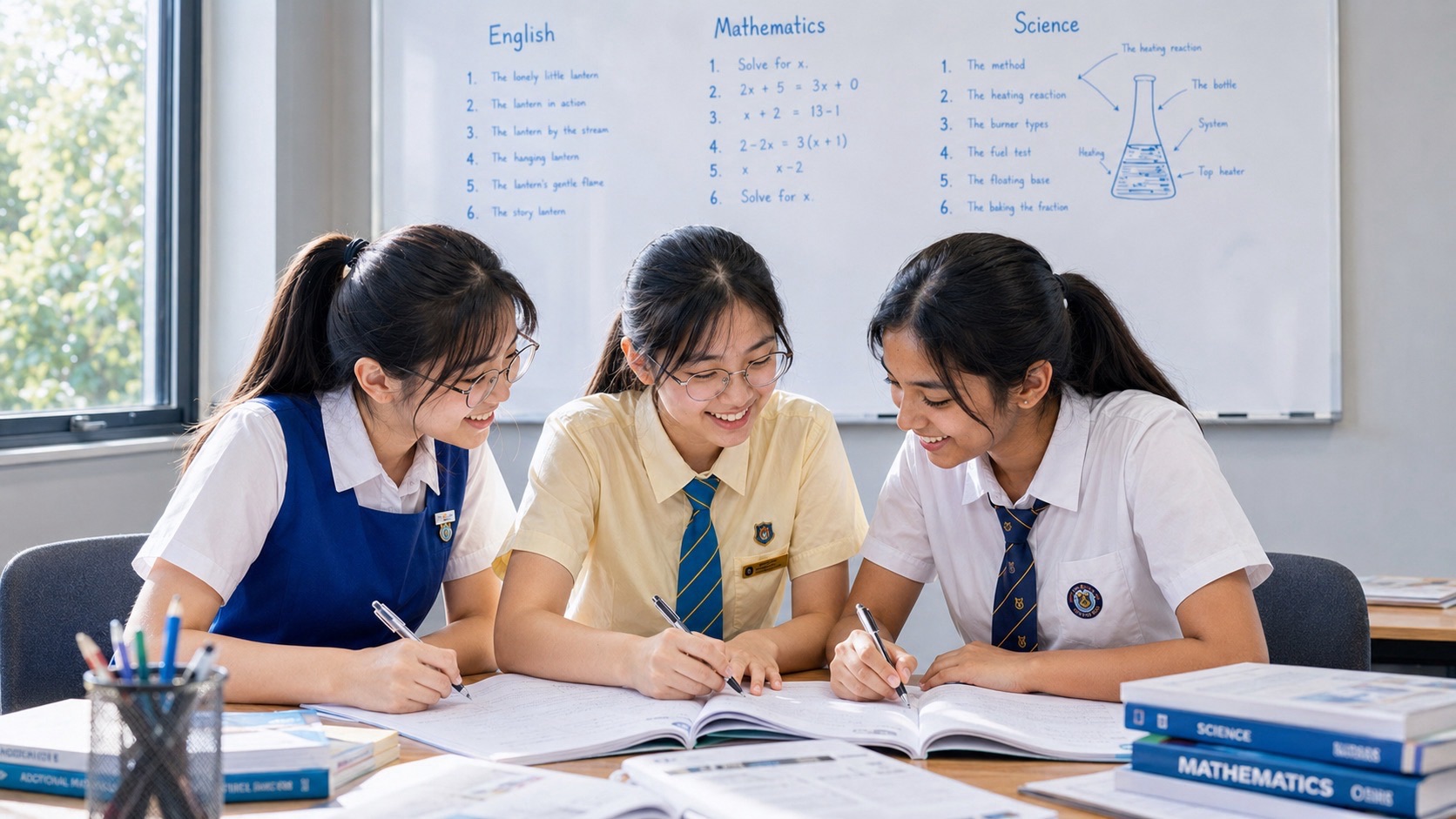
Primary, Secondary, PSLE, Posting Groups and SEC Explained Calmly
Find your child’s next school step
Choose Primary, Secondary or a school transition. Find the explanation you need, then follow the relevant subject guide.
- Primary school — P1–P6 and PSLE
- Secondary school — Sec 1–4 and next steps
- Parent questions — Routines, support and decisions
This guide slows the route down.
eduKatePunggol helps parents understand where their child is now, what comes next, and how small-group tuition can act as a calm booster instead of another pressure point. We help students catch up, keep up and move ahead through Primary and Secondary school with clearer lessons, closer correction and better exam preparation.
Choose the route closest to your child.
Start Here: Which School Stage Is Your Child In?
Primary School
Primary school is where children build the foundations for English, Mathematics and Science. The early years build habits. The middle years stretch thinking. Primary 5 and Primary 6 prepare students for PSLE, where accuracy, stamina and confidence matter.
The fuller Primary School route begins below, before the guide follows the child into Secondary school and the major gateways.
Secondary School
Secondary school changes the rhythm. Students move from primary answering to secondary explaining, applying and managing more independent work. Under Full Subject-Based Banding, students are posted through Posting Groups and may take subjects at G1, G2 or G3 levels depending on strengths, needs and school decisions.
The Secondary School route follows, showing how the pace, subject demands and independence expectations change.
Gateways
Some years feel heavier because they shape the next corridor. PSLE affects the Secondary 1 starting route. Secondary 2 is a major checkpoint before upper secondary subjects become more serious. Secondary 4 leads into SEC examinations, where students sit subjects at their respective G1, G2 or G3 levels.
The guide then moves through three major gateways: PSLE, Secondary 2 and the SEC examination route.
Primary School Route
What is Happening in Primary School?
Primary school is not just six years of worksheets. It is the foundation stage where children learn how to read instructions, organise thinking, write clearly, calculate accurately, explain answers and manage school expectations.
At Primary 1 and Primary 2, the child is still learning how school works. This is where confidence matters. A child who feels safe asking questions is more likely to correct mistakes early. English builds reading, grammar, vocabulary and simple writing. Mathematics builds number sense, model drawing and basic problem-solving habits.
At Primary 3 and Primary 4, the work becomes more structured. Mathematics questions become longer. English requires more independent comprehension and composition. Science begins from Primary 3, and students must learn not only facts, but how to observe, compare, describe and answer with the right scientific language.
At Primary 5, the PSLE picture starts becoming clearer. The student is no longer just learning isolated topics. English, Mathematics and Science begin to connect across bigger question types. Parents may notice that a child who seemed fine in Primary 3 or Primary 4 suddenly needs better organisation. This is normal. Primary 5 is the year where the PSLE engine starts to turn.
At Primary 6, the task is assembly. Students must bring the parts together: content, method, timing, presentation, accuracy and confidence. PSLE is not only about knowing the topic. It is about producing the answer under examination conditions.
eduKatePunggol supports Primary students by keeping lessons small, focused and closely corrected. For English and Mathematics, we work across Primary 1 to Primary 6. For Science, we support Primary 3 to Primary 6 PSLE preparation. The aim is not to frighten the child with more work, but to make school feel more understandable.
When Primary school is properly supported, PSLE becomes less mysterious. Parents can see what needs repair. Students can see what they are improving. The home becomes calmer because the route is clearer.
The next section follows the child into Secondary school, where the rhythm, independence and subject demands change.
Secondary School Route
What is Happening in Secondary School?
Secondary school is a different machine from primary school.
In primary school, many students can still survive by remembering examples, following familiar formats and completing assigned homework. In secondary school, the child has to explain more, infer more, apply more and manage more moving parts.
Secondary 1 is the transition year. Students adjust to new subjects, new teachers, new classmates, longer days, CCAs and more independent expectations. English becomes more analytical. Mathematics becomes more algebraic. Science becomes more conceptual. For many students, the first problem is not ability. It is adjustment.
Secondary 2 is the bridge year. The student is no longer new, but the upper secondary route is getting closer. This is when parents often begin asking: Is my child coping? Is Mathematics strong enough? Is English stable? Should we prepare earlier? Is A-Math possible later? Which subject level is suitable?
Secondary 3 is the first year of the examination climb. Upper secondary content is deeper. E-Math becomes more demanding. A-Math, for students who take it, requires stronger algebraic discipline and more abstract thinking. English writing and comprehension also require more mature reasoning.
Secondary 4 is execution year. By this stage, tuition should not be random rescue. It should help the student consolidate content, practise exam formats, correct repeated mistakes and enter the final examination period with better control.
Under Full Subject-Based Banding, students are posted to secondary school through Posting Groups 1, 2 and 3. These Posting Groups guide the initial subject levels students take at Secondary 1. Students may take subjects at G1, G2 or G3 levels, with flexibility to offer subjects at different levels as they progress, depending on strengths, aptitude and learning needs.
For parents, the important idea is this: the route is no longer a single label. It is a corridor. A student may need support to stabilise one subject, strengthen another, or stretch further in a subject where they show potential.
eduKatePunggol helps Secondary students by teaching clearly, correcting closely and preparing students for school tests and national examination demands. For Secondary English and Mathematics, we support students from Secondary 1 to Secondary 4, including E-Math, A-Math and G1/G2/G3 subject routes.
The goal is not more panic. The goal is better routing.
Before mapping the complete pathway, it helps to understand tuition as a booster rather than another stress load.
Tuition as a Booster
Why Tuition is a Booster, Not Another Stress Load
Tuition should not make the home more stressful.
When tuition becomes another pile of worksheets, another scolding session or another comparison point, it stops helping. A good tuition system should reduce confusion. It should help parents understand what is happening and help students feel that school is more manageable.
At eduKatePunggol, tuition works as a booster.
A booster does not replace school. It strengthens the student’s ability to benefit from school. It slows down difficult concepts, repairs gaps, gives practice at the right level and corrects mistakes before they become habits.
For Primary students, the booster may be foundational. A child may need better sentence structure, stronger number sense, clearer model drawing or more confidence with Science open-ended questions.
For lower Secondary students, the booster may be transitional. The student may need help moving from Primary-style answering to Secondary-style reasoning. Algebra, comprehension, summary, structured explanations and examination discipline become more important.
For upper Secondary students, the booster becomes strategic. The student needs content mastery, paper practice, timing, accuracy and clear correction. This is where tuition should become calm and purposeful, not noisy and random.
The best booster has three qualities.
First, it teaches clearly. The student should understand what is being taught, not just copy a solution.
Second, it corrects closely. Mistakes must be seen, named and repaired.
Third, it routes the student properly. A child trying to catch up needs a different kind of lesson from a child trying to maintain an A1 or move from strong to distinction level.
This is why eduKatePunggol keeps lessons small and focused. In a small group, the tutor can see the work, hear the misunderstanding and correct the student before the mistake hardens.
Tuition should lower the temperature. Parents should feel clearer. Students should feel less alone. The child should leave class knowing what to do next.
That is the booster.
With the role of tuition clear, the guide now maps how Primary school, PSLE, Secondary school and SEC connect.
The School Pathway
Routing Students Better Through Primary and Secondary School
School is a route.
Primary school leads to PSLE. PSLE leads to Secondary 1 posting. Secondary school now works through Posting Groups and subject levels. Upper secondary leads to SEC examinations. After that, students move into post-secondary pathways.
Parents do not need to memorise every rule. But they do need to understand the shape of the route.
In Primary school, the first route is foundation. English, Mathematics and Science must be strong enough for the child to handle PSLE. The student needs content, method, accuracy and confidence.
After PSLE, students are posted to secondary school through Posting Groups 1, 2 and 3. These groups guide the initial subject levels students take at Secondary 1. As students progress, they may take subjects at G1, G2 or G3 levels depending on strengths, needs and school decisions.
This means the route is more flexible than before, but also more complex for parents to read. A child may be strong in one subject and weaker in another. One subject may need repair. Another may need stretch. Another may need exam confidence.
eduKatePunggol helps by looking at the child through subjects, not labels.
A Primary 5 child preparing for PSLE Mathematics may need model drawing and problem-solving stamina. A Primary 6 child preparing for PSLE Science may need open-ended answer structure. A Secondary 1 child may need algebra repair. A Secondary 2 child may need stronger foundations before upper secondary. A Secondary 3 or 4 student may need targeted SEC preparation.
Routing is not about pushing every child the same way.
It is about asking: Where is the child now? What is the next school pressure point? Which subject is carrying the risk? Which subject has potential? What kind of tuition support lowers stress and improves control?
When the route is clearer, parents stop reacting late. Students stop feeling that everything is happening suddenly. The family can anticipate instead of retaliate.
This is the parent guide idea behind eduKatePunggol.
We help families read the corridor earlier, make calmer decisions and support the child with better timing.
The first major gateway in that route is PSLE.
Gateway One · PSLE
The PSLE Gateway
PSLE is the first major national gateway.
It is not the whole child. It is not the end of education. But it does affect the Secondary 1 starting route, so it deserves calm and serious preparation.
The PSLE score is based on Achievement Levels across four subjects. The final PSLE score is the sum of the four subject scores, and that score is used for Secondary 1 posting. Under the current system, students are posted through Posting Groups 1, 2 and 3, which guide the initial subject levels they take at the start of Secondary 1.
For parents, this means PSLE preparation should not be left until the final panic months.
Primary 3 and Primary 4 build the base. Primary 5 begins the PSLE climb. Primary 6 assembles the final examination machine.
In English, students need reading, grammar, vocabulary, composition, comprehension and oral confidence.
In Mathematics, students need number sense, model drawing, heuristics, accuracy, timing and the ability to choose the right method.
In Science, students need topic knowledge, process skills and open-ended answer discipline.
The PSLE Gateway becomes stressful when parents cannot see what is weak. Is the child careless? Or confused? Is the problem content? Timing? Language? Method? Confidence?
eduKatePunggol helps make the invisible visible. In small-group tuition, the tutor can see the child’s work closely and identify the mistake pattern. Once the pattern is visible, it can be repaired.
The aim is not to turn every home into an exam centre.
The aim is to help the child prepare steadily, so PSLE becomes less chaotic. Parents understand what is happening. Students know what to practise. Mistakes are corrected earlier. Confidence becomes earned, not forced.
PSLE is a gateway. We prepare for it clearly, calmly and early enough.
After PSLE, the next quiet checkpoint is Secondary 2, before upper-secondary demands rise.
Gateway Two · Secondary 2
The Secondary 2 Gateway
Secondary 2 is not a national examination year, but it is a very important checkpoint.
By Secondary 2, students are no longer adjusting to secondary school. They are expected to cope with the pace, understand the subjects and prepare for the upper secondary route.
This is where gaps become visible.
A student who did not fully understand Secondary 1 algebra may start struggling with more complex Mathematics. A student who reads weakly may find English comprehension and summary more tiring. A student who studies only by memory may find Science explanations harder.
Secondary 2 matters because upper secondary is near.
Secondary 3 brings deeper content, stronger examination expectations and more serious subject demands. For students who may take Additional Mathematics, the Secondary 2 Mathematics base is especially important. Algebra, manipulation, accuracy and patience with multi-step work must already be improving.
Under Full Subject-Based Banding, students can take subjects at G1, G2 or G3 levels depending on their strengths, interests and learning needs. This makes Secondary 2 an important year for parents to observe the child subject by subject.
The question is not only, “What marks did my child get?”
The better questions are:
Does my child understand the work?
Can my child explain the method?
Are mistakes repeating?
Is the subject improving or drifting?
Is the child ready for the upper secondary pace?
eduKatePunggol supports Secondary 2 students by strengthening the foundations before the upper secondary climb becomes heavier. This is the year to repair quietly. It is better to fix algebra, writing, comprehension and study habits in Secondary 2 than to panic in Secondary 4.
Secondary 2 is a gateway because it decides whether Secondary 3 starts with stability or stress.
The next section follows that preparation into the SEC examination gateway.
Gateway Three · SEC
The SEC Gateway: G1, G2, G3 and the Final Secondary Examination Route
Secondary 4 is the final secondary examination gateway.
From 2027, the Singapore-Cambridge Secondary Education Certificate, or SEC, will replace both N- and O-Level examinations. Students will sit SEC subjects at their respective G1, G2 or G3 subject levels. The examination format remains aligned to the subject level, and students receive a certificate reflecting the subjects taken at different levels.
For parents, the practical meaning is simple: Secondary 4 is execution year.
By this point, the student should not be discovering the whole syllabus for the first time. The work should move into consolidation, correction and paper performance.
For English, students need composition control, situational writing accuracy, comprehension precision, summary discipline, oral confidence and vocabulary range.
For Mathematics, students need accuracy, method marks, topic recognition, time control and paper stamina.
For Additional Mathematics, students need strong algebra, functions, trigonometry, logarithms, differentiation, integration and the ability to keep working clearly even when the question is unfamiliar.
The SEC Gateway is stressful when the student is still carrying unresolved gaps from Secondary 1, Secondary 2 or Secondary 3. That is why earlier routing matters. But even in Secondary 4, improvement is still possible when the work becomes targeted.
eduKatePunggol supports Secondary 4 students by making tuition more precise. We identify the repeated mistakes, strengthen weak topics, practise examination-style questions and help students manage the final stretch with better control.
The message to parents is not panic.
It is clarity.
Secondary 4 is go time, but go time does not mean chaos. It means the student needs structure, correction, practice and confidence. Tuition should help the child walk into the final examination period knowing what has been repaired, what still needs attention and how to handle the paper in front of them.
The SEC Gateway is the final secondary school gate.
eduKatePunggol helps students prepare for it with calm, focused, small-group support.
Parents who need help reading the route can speak to eduKate Punggol about the child’s current position and next step.
Return to the Learning-Problem Map
This page answers one diagnostic question. Use the Parent Education Map to compare the wider learner state, or return to the complete registry when the problem belongs to another subject, stage or parent decision.
Return to the tuition hub: Tuition at eduKatePunggol
Related reading: How Parents Can Support a Child Before a Major Examination Without Turning Support into Pressure.





