
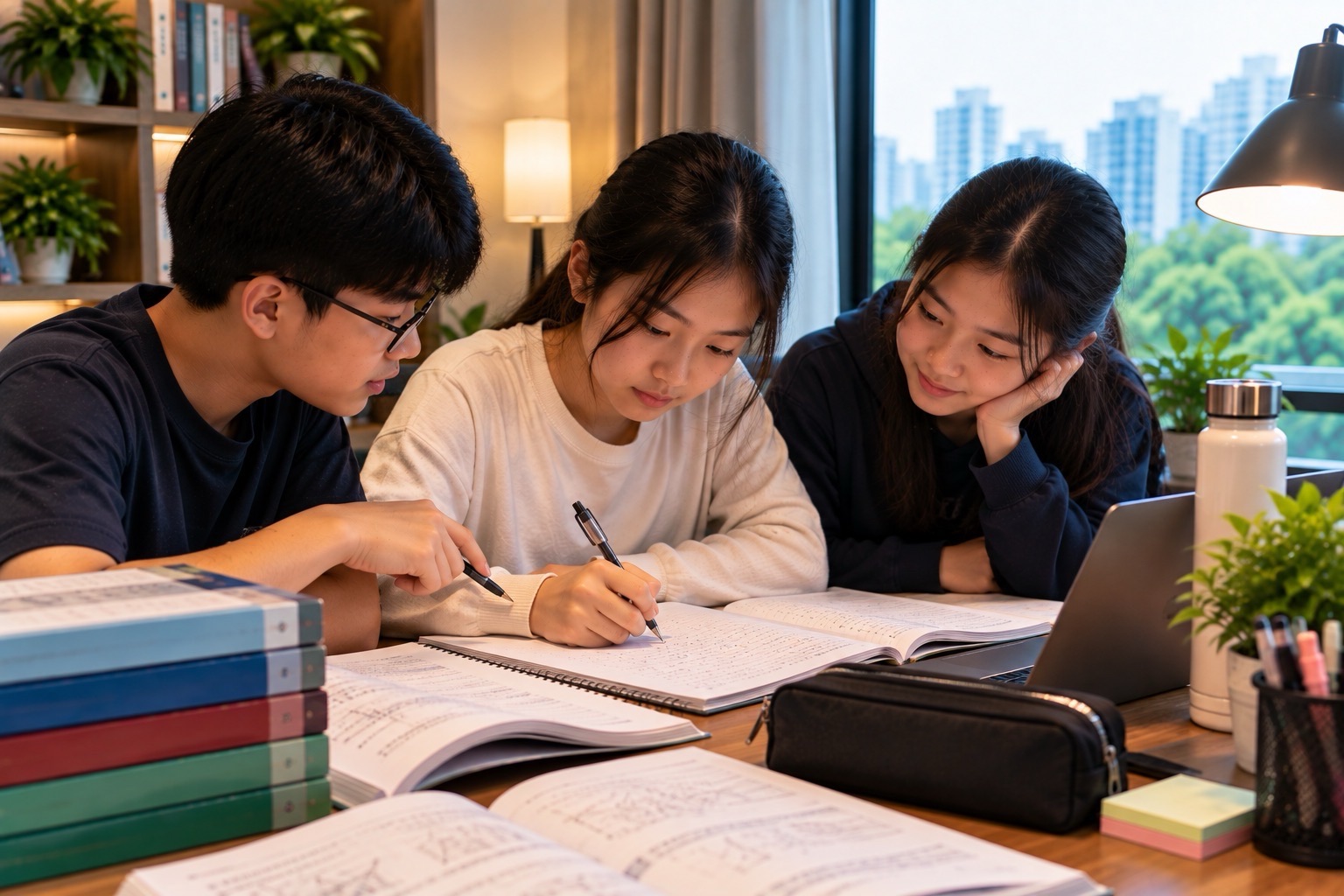
Secondary 4 G3 Humanities (Social Studies, History) tuition in Punggol should help a graduating student develop linking historical evidence to context, explaining causes and consequences, and comparing perspectives without turning history into an unsupported opinion. The first Singapore-Cambridge Secondary Education Certificate (SEC) graduating cohort in 2027 uses SEAB syllabus K336, previously referenced as 2261. Social Studies is 105 minutes, 50 marks and 50%; History is 110 minutes, 50 marks and 50%. History has a compulsory 30-mark source-based case study and two 10-mark essays chosen from three. Together the two papers give one Humanities grade. Separate History K330 is a different specification. Confirm the actual subject and examination year with the school. Before choosing extra lessons, identify which recurring decision the learner cannot yet make independently.
A child may already be interested in asking why countries cooperate or disagree, reading historical accounts and noticing that different people remember the same event differently. These are resources for learning, not predictions of examination performance. eduKate Punggol’s niche syllabus engineering approach turns such interests and previous knowledge into observable capability by locating a precise missing relationship, teaching it, removing the prompt and checking a changed independent task. For example, consider a pupil who recalls the dates in a chapter but cannot explain how a particular development contributed to an outcome. A useful consultation begins with the child’s actual response rather than an assumed need for tuition. This high-frequency parent-question guide describes a learning approach; confirm current tutor availability, group sizes and fees directly. It does not guarantee a distinction or imply that every pupil needs extra classes.
- K336 is the school-candidate 2027 G3 qualification; confirm actual registration.
- Social Studies is 105 minutes, 50 marks and 50%; History is 110 minutes, 50 marks and 50%. History has a compulsory 30-mark source-based case study and two 10-mark essays chosen from three. Together the two papers give one Humanities grade. Separate History K330 is a different specification.
- Social Studies contains a 35-mark case study and two compulsory structured responses (7 and 8 marks). History’s Section A uses at most six sources, with five sub-questions and 30 marks. Its case-study topics are indicated by asterisks in the specification. Section B requires two of three essays, each 10 marks; the same issue assessed in the case study is excluded from the essay questions in that examination. Do not confuse K336’s 110-minute History component with the separate K330 specification, which is marked as an e-examination in the directory. Follow the actual school instructions for K336.
- Social Studies: citizenship and governance, diversity, globalisation. History: developments from the post-World War I settlement through authoritarian rule, the origins and end of World War II, the Cold War in Europe and Asia, and the end of the Cold War in 1991. Use the official distinction between contextual non-examinable overviews and assessed topics.
- Keep separate learning evidence for Social Studies and the elective, even though the overall result is combined.
- Locate the first unstable decision before adding more worksheets. Teach it precisely, withdraw support and check changed independent work after a delay.
- Protect other subjects, sleep and school commitments; four weeks is a review cycle, not a syllabus-completion promise.
- School consultation may suffice; confirm specialist tuition availability directly.
Five parent reading routes
- Examination and tuition decisions
- Social Studies source skills
- Elective-specific learning
- Evidence, authentic work and independent transfer
- Exam readiness and four-week review
26 high-frequency questions parents ask
- 1. Which syllabus and examination year should a Punggol family use?
- 2. What do the marks and weightings tell us about preparation?
- 3. Does my child need another class or a narrower learning intervention?
- 4. What does converting latent potential into capability actually mean?
- 5. Why is Social Studies not an opinion-writing examination?
- 6. How do we turn a source into a supported inference?
- 7. How should students compare two sources without repeating both?
- 8. How do usefulness, reliability and purpose differ?
- 9. How does the multiple-source question require judgement?
- 10. How do citizenship, governance and diversity become usable concepts?
- 11. How do globalisation and structured-response questions connect?
- 12. Why is chronology necessary but insufficient for historical causation?
- 13. How should the post-World War I settlement be understood?
- 14. How should the rise of authoritarian regimes be explained responsibly?
- 15. How can the outbreak and end of World War II be studied without lists of battles?
- 16. What does the Cold War require beyond knowing two opposing blocs?
- 17. Which History case-study topics are prescribed and how should sources be evaluated?
- 18. How can a ten-mark History essay make a reasoned judgement?
- 19. How can we tell whether an answer represents real independent thinking?
- 20. Why does a familiar formula or essay framework sometimes fail?
- 21. How should evidence and authenticity be protected?
- 22. What could a focused small-group tutorial look like?
- 23. How can a parent monitor progress without creating constant pressure?
- 24. How can full papers and distinction goals fit into a sensible revision calendar?
- 25. What is a four-week plan for converting a specific learning gap into capability?
- 26. Which questions should Punggol parents ask before choosing tuition or a later education route?
2027 SEC K336 assessment at a glance
| Paper | Duration | Raw marks | Weight |
|---|---|---|---|
| 1: Social Studies | 105 min | 50 | 50% |
| 2: History | 110 min | 50 | 50% |
1. Which syllabus and examination year should a Punggol family use?
The national examination framework changes for the 2027 graduating cohort. The previous subject reference for K336 is 2261. Social Studies is 105 minutes, 50 marks and 50%; History is 110 minutes, 50 marks and 50%. History has a compulsory 30-mark source-based case study and two 10-mark essays chosen from three. Together the two papers give one Humanities grade. Separate History K330 is a different specification. Full Subject-Based Banding means students can have a combination of subject levels; Posting Group is not a reliable substitute for the child’s individual registration. A student who completed Secondary 4 in 2026 followed the applicable earlier arrangement. The official 2027 PDF defines the present graduating specification; younger pupils must use their actual examination-year requirements.
Request the school’s confirmed subject code, examination calendar and latest curriculum guidance. Old materials can be useful when their content and assessment requirements align, but a familiar label does not prove that they match the SEC paper. Use a simple syllabus map showing work not yet taught, work in progress, independent success on familiar tasks and independent success on changed tasks. Ask the teacher which learning outcomes are currently being studied. This prevents a parent mistaking content not yet covered for a weakness, or spending money on material intended for a different qualification.
Question index · Next question
2. What do the marks and weightings tell us about preparation?
Social Studies contains a 35-mark case study and two compulsory structured responses (7 and 8 marks). History’s Section A uses at most six sources, with five sub-questions and 30 marks. Its case-study topics are indicated by asterisks in the specification. Section B requires two of three essays, each 10 marks; the same issue assessed in the case study is excluded from the essay questions in that examination. Do not confuse K336’s 110-minute History component with the separate K330 specification, which is marked as an e-examination in the directory. Follow the actual school instructions for K336.
Parents can use the published scheme to organise preparation, not to infer a fixed amount of revision time or a guaranteed grade. Keep the Social Studies and historical evidence records distinct. In a fictional result of 36/50 Social Studies and 26/50 History, the combined arithmetic is 62/100; this is not a national grade prediction. Examine whether the History weakness is factual context, evaluating source utility, or explaining causation. Different difficulties require different tasks. Compare genuine attempts made under reasonably similar conditions. A lower score in one component may result from a very specific problem that affects several other tasks. Ask the teacher where the first important wrong decision occurs. Keep the more secure component active with appropriately spaced independent practice while repairing the weaker one. A grade is an outcome; a learning plan needs a specific and observable target.
Previous question · Question index · Next question
3. Does my child need another class or a narrower learning intervention?
Begin with two or three authentic pieces of work and school feedback. Consider a pupil who recalls the dates in a chapter but cannot explain how a particular development contributed to an outcome. If a pupil can explain the correction and independently complete a changed task several days later, their existing school support may be sufficient. If a repeated barrier blocks later work, additional focused teaching may help. A full course of repetitive practice is not automatically the right response to one disappointing mark.
Ask the learner what they thought the question required, where the response became difficult and what assistance was provided. Distinguish a knowledge gap from difficulty selecting relevant evidence, representing a quantity or relationship, communicating the answer, or managing time. Consider the child’s schedule and willingness to participate. Arrange a focused review of the next few learning attempts rather than committing to a long programme solely because a grade was low. Tuition should supplement rather than interfere with school feedback and genuine independent practice.
Previous question · Question index · Next question
4. What does converting latent potential into capability actually mean?
Latent potential here is a metaphor for existing resources: curiosity, attention, previous knowledge, observations, effort and access to suitable teaching. It is not a physical energy quantity, intelligence score or guarantee of future performance. Imagine a pupil who writes that an event caused another because it occurred earlier. The teacher asks for an intermediate relationship: how did the earlier development affect choices, resources, expectations or institutions? The child may discover that a date sequence provides context but not the causal mechanism. In a fresh teacher-approved example, the learner must explain how a development contributed to an outcome, identify another relevant factor and support a bounded judgement.
The learning cycle is to identify the current syllabus outcome, obtain a first independent attempt, locate the first unstable relationship, teach it accurately, and give a changed task without the original worked answer. Then revisit the relationship after a delay. The student should be able to explain the new decision in their own words. When a skill is secure, connect it to other outcomes. When it is not, adjust the instruction or reduce the task. This gives both parents and the learner a concrete way to see capability developing without treating a current score as a permanent judgement.
Previous question · Question index · Next question
5. Why is Social Studies not an opinion-writing examination?
The 2027 Social Studies component is compulsory and accounts for half of K336. It asks pupils to understand society, interpret and evaluate information, and build reasoned explanations. Having an opinion is a starting resource, not evidence that the claim is justified. A child may have a thoughtful view about a shared community facility but still need help identifying the exact claim a source makes. In an imagined consultation, a resident says a new timetable is inconvenient for working families. That supports a particular concern; it does not establish that all residents oppose the proposal.
Ask the pupil to distinguish what the resident said, the inference supported by those words, and what further evidence would help evaluate the policy. Change the stakeholder to a person with a different timetable. The learner must identify the relevant perspective without assuming the author’s identity automatically determines the opinion. Then ask how the reasoning differs from evaluating a historical source in the context of its time, purpose and the evidence available. The two components reward different uses of evidence. The example is fictional and makes no claim about any actual Punggol policy.
Previous question · Question index · Next question
6. How do we turn a source into a supported inference?
Consider a fictional notice: “Please return the shared room key before 6 pm so that the evening group can enter on time.” A pupil who copies this sentence has located relevant evidence, but an inference connects the detail to a claim: the organisers want reliable coordination between groups using the room at different times. The wording supports that interpretation because timely return makes the next group’s access possible. It does not establish that a particular group has previously misbehaved.
Give a changed notice asking people to leave a passage clear because deliveries use it. Ask what concern the notice addresses and which words support the inference. The child should state a bounded claim, select relevant detail and explain the connection. A useful teacher can distinguish inability to understand the text from inability to write the inferential link. A universal sentence starter is not a marking scheme. Once the relationship is secure, remove the prompts and present an unfamiliar source.
Previous question · Question index · Next question
7. How should students compare two sources without repeating both?
An imagined Source A says longer opening hours benefit shift workers. Source B says extra staffing increases the operating cost. The two sources need not contradict each other: one identifies access benefits, the other a resource constraint. If the question asks whether both discuss the same effect, answer on a common basis. If it asks how their perspectives differ, identify the distinct concerns using evidence from each. Two summaries placed next to one another are not yet a comparison.
Change Source B to a claim that longer opening hours do not improve access because transport stops early. Now the claims directly differ on effectiveness under the stated conditions. The learner should articulate the shared issue before selecting evidence. Ask the pupil to identify whether the apparent difference concerns the claim, the audience, the setting or a genuinely incompatible conclusion. Practise this on a new case rather than training the child to assume every paired source must disagree.
Previous question · Question index · Next question
8. How do usefulness, reliability and purpose differ?
Suppose a fictional community group publishes a flyer encouraging sign-ups for a volunteering day. The flyer may be useful for identifying the organisers’ intended message, even if it is insufficient for determining how many people actually participate. The writer’s purpose and the source’s ability to answer a particular question are distinct. A persuasive source is not automatically false, and an official-looking source is not automatically adequate for every claim.
Ask the child what the source can establish and what it cannot. Consider the writer, context, audience, evidence and corroboration where relevant to the question. Change the example to a survey report with its sampling method omitted. It may describe responses received but may not establish the views of everyone. A pupil who writes ‘biased, therefore unreliable’ needs to connect their evaluation to the specific claim being examined. Use real school-approved materials for actual source practice.
Previous question · Question index · Next question
9. How does the multiple-source question require judgement?
Social Studies Section A includes four questions on particular sources and a fifth question worth 10 marks using multiple sources. A learner should not count sources for and against as if a majority automatically proves a claim. Different evidence can address different aspects of the issue, be drawn from the same underlying information, or apply only in a limited context. A reasoned judgement considers how strongly the evidence actually supports the proposition.
In a fictional case, one survey reports favourable responses from regular library users, a staff report notes crowding at peak hours, and a statement from an occasional user describes transport difficulties. Ask which claim each source supports and whether it is applicable to all potential users. Then change the proposition from ‘the library is popular’ to ‘everyone can access the library easily’. The relevance of each piece of evidence changes. The child must respond to the actual question, not reproduce a prepared conclusion.
Previous question · Question index · Next question
10. How do citizenship, governance and diversity become usable concepts?
The curriculum considers responsibilities and roles in society, tensions between different needs, and ways people respond to diversity. A pupil may know words such as trade-off and harmony but not explain them. Imagine a shared room has capacity for two activities at different times. Allocating more time to one group may reduce the time available to another; a decision should account for their needs, the constraints and available alternatives. That is a concrete way to see a trade-off.
Ask the student to propose a fair arrangement, identify who might benefit and who might face difficulty, then explain why the suggested action could address the situation. Change the shared resource from a room to a booking system and ask for a new recommendation. In a diversity question, discuss actual experiences and stated evidence without assuming that all people from a group have the same views. This exercise develops reasoned judgement and respectful perspective-taking rather than teaching one political opinion or formula.
Previous question · Question index · Next question
11. How do globalisation and structured-response questions connect?
The third Social Studies issue addresses international interdependence and economic, cultural and security impacts. For example, an imagined local firm gaining access to overseas buyers may benefit from a larger market while becoming more exposed to disruptions elsewhere. A general statement that globalisation is good or bad does not explain those mechanisms. Section B contains two compulsory questions, worth seven and eight marks. The first asks for reasoned explanations or recommendations in Singapore’s context; the second involves two perspectives or factors and a judgement.
Ask the child to explain a benefit and a vulnerability in a changed fictional case, then decide which consideration matters more under clearly stated conditions. A recommendation should explain how it would operate and why it would address the identified issue, not just name an actor. The actual Section B issue differs from the Section A case-study issue. Retain all three issues in revision rather than attempting to guess which one will appear. Check actual feedback against the school’s requirements.
Previous question · Question index · Next question
12. Why is chronology necessary but insufficient for historical causation?
The chronological order of developments is important because it establishes context and possible relationships. But if one event occurs before another, that alone does not prove causation. History asks how a condition, decision or development contributed to a particular outcome. A student who memorises a timeline needs to connect the events through supported explanations, rather than merely put arrows between them.
Give an invented sequence in which a club’s membership falls and a new rule is introduced later. Ask what additional evidence would support a claim that falling membership led to the rule. Then use an authentic teacher-approved historical example. The pupil should explain how the circumstances affected decisions and why the evidence is relevant. The fictional club is a reasoning exercise, not a substitute for historical knowledge.
Previous question · Question index · Next question
13. How should the post-World War I settlement be understood?
The syllabus examines the Paris Peace Conference, the Treaty of Versailles, changing boundaries and attempts at collective security during the 1920s. An overview of World War I provides background and is identified as non-examinable. A student who lists treaty terms but does not connect them to immediate consequences needs the relationship between a policy and its effects taught. Avoid treating a later outcome as inevitable.
Ask the learner to choose an accurately taught treaty provision and explain an effect on the political or economic context. Compare it with a different provision or an effort at collective security. Which relationship is supported by the evidence? In a fresh question require a reasoned distinction between immediate impact and later developments. Use actual school texts for evidence, not invented quotations attributed to historical actors.
Previous question · Question index · Next question
14. How should the rise of authoritarian regimes be explained responsibly?
The K336 specification studies Nazi Germany and militarist Japan as particular historical cases, including political weaknesses, economic circumstances, the actions of political actors and consolidation of power. These cases have different contexts. Students should analyse multiple interacting factors and the consequences for societies, including persecution and restrictions on rights. An overview of post-war political systems is contextual rather than an assessed topic in its own right.
Ask for a mechanism linking one accurately taught economic or political development to changes in political support or institutions. Compare with another factor and ask what evidence justifies relative significance. In a changed task, compare the two cases only on a defined basis rather than claiming they are identical. Do not romanticise authoritarianism or reproduce propaganda as if it were neutral historical fact.
Previous question · Question index · Next question
15. How can the outbreak and end of World War II be studied without lists of battles?
The syllabus examines developments leading to war in Europe and the Asia-Pacific and reasons for the war’s end. It does not require detailed military campaign study, although awareness of major turning points is expected. The educational purpose is to understand relevant developments, international responses and the consequences of decisions. A timeline without reasoning does not establish how different factors contributed to events.
Ask a student to identify the scope of a teacher-approved question, select relevant contextual knowledge and explain the causal link. In a changed question, compare the importance of two different developments using a criterion and evidence rather than a rehearsed ranking. Use accurate historical sources, respect the human consequences of war, and avoid sensational attack details or speculative perpetrator perspectives.
Previous question · Question index · Next question
16. What does the Cold War require beyond knowing two opposing blocs?
The syllabus includes origins and development of the Cold War in Europe, its extension outside Europe through the Korean and Vietnam Wars, and the decline of the USSR and end of the Cold War. Different locations and periods involve different circumstances. A broad label such as ideological conflict may be relevant, but an explanation must show how a particular disagreement, policy or decision contributed to the development in the actual question.
Ask the pupil to use a teacher-approved source to distinguish an actor’s stated position from a later historical interpretation. Then ask for a causal explanation of a different syllabus development. Consider political, economic and international factors where supported by the evidence. Do not treat a general description as proof of why all people or governments acted in a particular way.
Previous question · Question index · Next question
17. Which History case-study topics are prescribed and how should sources be evaluated?
The asterisked case-study topics in the 2027 specification are Nazi Germany, developments leading to the outbreak of World War II in Europe, origins and development of the Cold War in Europe, and the Korean War. This restriction concerns Section A, not the entire History course. Sources can show different views at different times and for different audiences. Their usefulness depends on the actual historical question.
Give a genuine school-approved source and ask for its claim, date, author or context where supplied, and evidence relevant to the question. Then compare it with another source. A pupil who says ‘it is a primary source so it is always reliable’ needs a more precise evaluation. An original fictional source is useful for practising a method only when clearly labelled. No anticipated topic is guaranteed.
Previous question · Question index · Next question
18. How can a ten-mark History essay make a reasoned judgement?
History Section B requires two essays from three. The task may ask candidates to analyse and evaluate events or issues. A strong learning approach starts with the proposition, selects relevant knowledge, explains how each factor contributed, and reaches a judgement using an explicit criterion. A longer narrative is not automatically a more convincing explanation. Context supports the argument but should not replace it.
Ask the child to plan a teacher-approved question by specifying the outcome, two relevant factors and the basis for comparing them. Give a changed question that uses a different outcome or time boundary. Does the learner alter the argument appropriately? Historical explanation can consider interactions between causes, not just place them in isolated paragraphs. Use actual school feedback and avoid a rigid claim that a single essay template guarantees marks.
Previous question · Question index · Next question
19. How can we tell whether an answer represents real independent thinking?
A learner may produce a good response while a tutor supplies the method, evidence or key wording. That shows supported performance, not necessarily independent capability. Give two fictional statements about a hypothetical agreement: one written by a participant at the time saying it improved cooperation, and one later analysis noting that cooperation remained uneven. Ask what each source might reveal, what its timeframe is, and which evidence is needed to evaluate the claim. The statements are not real historical sources. Then use an authentic teacher-approved source in the actual topic and check whether the learner independently uses context and evidence.
Compare the first response with a fresh one that uses different surface details and asks a slightly different question. Record what help was necessary. If the learner still needs the teacher to identify the correct relationship, teach the selection decision rather than celebrating the finished answer alone. If the student can select the relationship, explain it and handle the changed task without help, revisit it later and gradually extend the challenge. Keep the child’s actual words and working separate from the adult’s model answer. This is a formative teaching check, not a national marking rubric.
Previous question · Question index · Next question
20. Why does a familiar formula or essay framework sometimes fail?
A framework can help organise thinking, but a pupil must still recognise the question’s actual demand. In Humanities (Social Studies, History), a useful repair might involve the causal mechanism connecting a historical condition, a decision and its consequence. A student who repeats the same answer in a changed task may have memorised the surface wording rather than understood the relationship. Ask what condition makes the chosen method or interpretation appropriate. If the question changes, a correct response may need a different approach.
For a short review, choose a genuine answer from schoolwork. Have the learner identify the command, relevant content, evidence or quantities, and the conclusion required. Give a new problem that changes just one important condition. The tutor should allow time for an independent attempt and explain why the original method does or does not apply. If the student is already competent, do not force an unnecessary template on them. The actual syllabus, school feedback and valid reasoning matter more than a tutor’s preferred sequence.
Previous question · Question index · Next question
21. How should evidence and authenticity be protected?
History source exercises require genuine historical context, accurate attribution and appropriate teacher-approved materials. Do not pass an invented classroom source off as an archival document. When discussing dictatorship, war or persecution, use accurate educational context and acknowledge affected people. Avoid sensational details, unsupported claims about motives, or oversimplification of complex events.
Parents should ask what the student genuinely observed, read, measured, interpreted or concluded, and what information came from a teacher or supplied resource. Do not fabricate results or quotations to fit a desired answer. It is possible to practise with clearly labelled fictional examples, but formal school tasks must follow their actual rules and permitted assistance. A correct-looking submission produced mostly by another person is not evidence of independent capability. Keep a distinction between discussion, supported learning and a new authentic response. Seek the school’s guidance if the boundaries for an assignment or examination component are unclear.
Previous question · Question index · Next question
22. What could a focused small-group tutorial look like?
A possible ninety-minute learning session uses 10 minutes reviewing school feedback, 15 minutes for a first independent task, 20 minutes of targeted teaching, 20 minutes of changed practice, 15 minutes for a mixed evidence or reasoning task, and 10 minutes to agree on the next review. This is an illustrative schedule rather than a fixed promise about a class or duration. In a small group, pupils can hear different valid reasoning after attempting their own response; the teacher must still observe each child’s individual work.
In this qualification the tutor should maintain separate evidence for Social Studies and the elective. A pupil who needs the causal mechanism connecting a historical condition, a decision and its consequence should not spend the whole lesson reviewing a topic they already understand. An adult can ask the tutor to explain the earliest unstable decision and why the next changed task tests it. Confirm subject expertise and the actual group size, duration and availability before enrolment. For a subject not currently offered by the centre, ask the school or seek an appropriate specialist rather than assume a class exists.
Previous question · Question index · Next question
23. How can a parent monitor progress without creating constant pressure?
Keep a short private record: date, actual task, first attempted approach, precise correction, changed response and degree of help. Mark the skill as needing repair, being practised, independently secure or ready for extension. This is not a grade conversion or a permanent label. A small number of comparable genuine samples can be more informative than many unrelated worksheet marks. Ask the child which part of the learning task they now find clearer and which part remains uncertain.
If the learner succeeds only with a visible example, gradually remove prompts. If they explain the relationship and use it in an unfamiliar context, check retention several days later. When accurate but slow, introduce manageable pacing; when inaccurate even untimed, revisit the relationship first. Keep evidence private and do not upload identifiable schoolwork to outside tools without permission. Recognise other demands in the final school year, including schoolwork, rest, CCA and family commitments. A review should support the learner’s next decision rather than create another source of pressure.
Previous question · Question index · Next question
24. How can full papers and distinction goals fit into a sensible revision calendar?
A full paper checks endurance, selection, pacing, transitions between topics and coherent communication under the actual conditions. It may be valuable once individual relationships are stable, but if the same foundational error destroys several questions, targeted practice may be a better initial use of time. A distinction may be a meaningful aspiration; no centre can guarantee A1 or calculate a national grade boundary from its own practice tasks.
Move from a short independent diagnostic to targeted correction, a mixed set, a modest timing constraint and eventually realistic examination-length rehearsal. Maintain both Social Studies and the elective as applicable; do not let the preferred component crowd out the other. Review recurring significant errors rather than copying every answer immediately. Verify the actual examination timetable, equipment and school instructions. Protect sleep and sustainable study habits; if extra tuition conflicts with important school support or rest, reconsider the plan. Quality of independent work matters more than the sheer number of completed papers.
Previous question · Question index · Next question
25. What is a four-week plan for converting a specific learning gap into capability?
Week 1: obtain one marked school response and a fresh independent example. Identify a precise target, such as the causal mechanism connecting a historical condition, a decision and its consequence. Week 2: use one clear explanation, a guided example and a changed independent task. Keep the remaining syllabus active through normal school work and appropriate review; the goal is a narrow repair rather than abandonment of other learning outcomes.
Week 3: revisit the skill after a few days, connect it to a previously secure outcome, and introduce a realistic time constraint only if accuracy is sufficiently stable. Week 4: compare a new unfamiliar response with the original, including the degree of help, relevance, accuracy, evidence and explanation. Review the result together and choose repair, maintenance or extension. Repeat the cycle where necessary. Four weeks is a suggested evaluation period, not a guarantee that the entire syllabus will be mastered or a particular mark achieved.
| Week | Independent evidence | Teaching decision |
|---|---|---|
| 1 | Marked school work and fresh attempt | Identify the earliest unstable decision |
| 2 | Changed task after a focused explanation | Check independent transfer |
| 3 | Delayed task and mixed practice | Assess retention and pacing |
| 4 | Unfamiliar question and school feedback | Repair, maintain or extend |
Previous question · Question index · Next question
26. Which questions should Punggol parents ask before choosing tuition or a later education route?
Ask the school to confirm the registered level, exact subject combination, examination-year specification and school assessment arrangements. For the 2027 graduating cohort, check the current MOE guidance for post-secondary admissions from 2028 and the actual course-specific requirements. A particular Humanities (Social Studies, History) result does not guarantee admission to a named JC, MI, polytechnic or ITE programme. Do not change a subject registration solely on the basis of a general guide.
At a tuition consultation, ask what the child already does well, which specific gap the teacher identified, what the next independent task will test, and when progress will be reviewed. Confirm the provider’s current ability to teach the exact subject, timing, class size, fees, policies and availability. Consider travel around Punggol and the child’s overall timetable. The right answer may be school consultation, independent practice or a focused specialist lesson. The first useful next move is one genuine response and a precise teaching decision, not a promise of results.
Previous question · Question index
A parent decision sheet: choose the next independent move
Do not use the overall result alone to decide whether a student needs extra tuition. Consider the actual recurring decisions in Social Studies and the elective. Imagine a pupil who writes that an event caused another because it occurred earlier. The teacher asks for an intermediate relationship: how did the earlier development affect choices, resources, expectations or institutions? The child may discover that a date sequence provides context but not the causal mechanism. In a fresh teacher-approved example, the learner must explain how a development contributed to an outcome, identify another relevant factor and support a bounded judgement. A child’s progress may be uneven, and one successful lesson cannot establish full mastery. Look at genuine work before deciding how much support is appropriate. The following is an informal educational guide rather than an examination mark scheme.
| What the student actually does | What may need attention | Next evidence |
|---|---|---|
| Uses an irrelevant fact or method | Understand the exact question | Changed demand on a familiar topic |
| Selects a valid relationship but cannot explain it | Make the connecting reasoning explicit | New independent explanation |
| Produces a good answer with full guidance | Withdraw prompts | Unfamiliar task without model |
| Solves a changed task accurately after a delay | Retain and extend | New mixed application |
| Accurate untimed, incomplete under timing | Practise pacing and selection | Short realistic timed set |
A useful consultation can start with this small question: ‘What can the child do independently today that they could not do before?’ Ask the teacher to distinguish the learner’s own work from any scaffolding. If the relationship is secure, extend rather than repeat. If it is not, reduce the demand and repair the missing prerequisite. For a graduating pupil, preserve the school’s actual assessment arrangements and all other subjects; choose a plan the student can sustain. The syllabus is a route to developing skills, not a verdict on the learner.
Connected Secondary 4 G3 SEC parent guides
- Secondary 4 G3 Science (Chemistry, Biology) K328 tuition guide
- Secondary 4 G3 Humanities (Social Studies, Geography) K335 tuition guide
- Secondary 4 G3 Humanities (Social Studies, Literature in English) K337 tuition guide
Official references and related Punggol guides
- SEAB 2027 Humanities (Social Studies, History) K336 syllabus
- 2027 SEAB G3 school-candidate directory
- SEAB SEC examination overview
- MOE official education and post-secondary pathway information
- Detailed Punggol K336 examination guide
- Punggol Humanities (Social Studies, History) mastery guide
- Secondary 4 G3 English tuition parent questions
- eduKate Punggol — check current teaching arrangements
- Clementi tutorial-format reference
Reference review: 28 November 2026. The official 2027 assessment schemes were checked in the SEAB PDFs, including the assessment table page images. The live Clementi reference returned HTTP 429; the established two quick-opening paragraphs, point-form summary, five reading routes, 26 linked questions and four-week review were retained. Practice examples are original illustrations, not released or predicted examination questions. Check the school’s actual requirements and provider availability. No grade or admission outcome is guaranteed.


