
Secondary 4 G3 Additional Mathematics tuition in Punggol should help the student recognise which mathematical relationship to use, control algebra throughout a long solution, justify the method and transfer it to an unfamiliar question. For the 2027 graduating cohort of the Singapore-Cambridge Secondary Education Certificate (SEC), SEAB lists K341, with 4049 as the older reference code. Two compulsory papers each last 2 hours 15 minutes, carry 90 marks and account for 50% of the result. The syllabus assumes G3 Mathematics knowledge; K341 is a separate subject from G3 Mathematics K310. A child’s strongest chapter is not always the chapter that most urgently needs tuition.
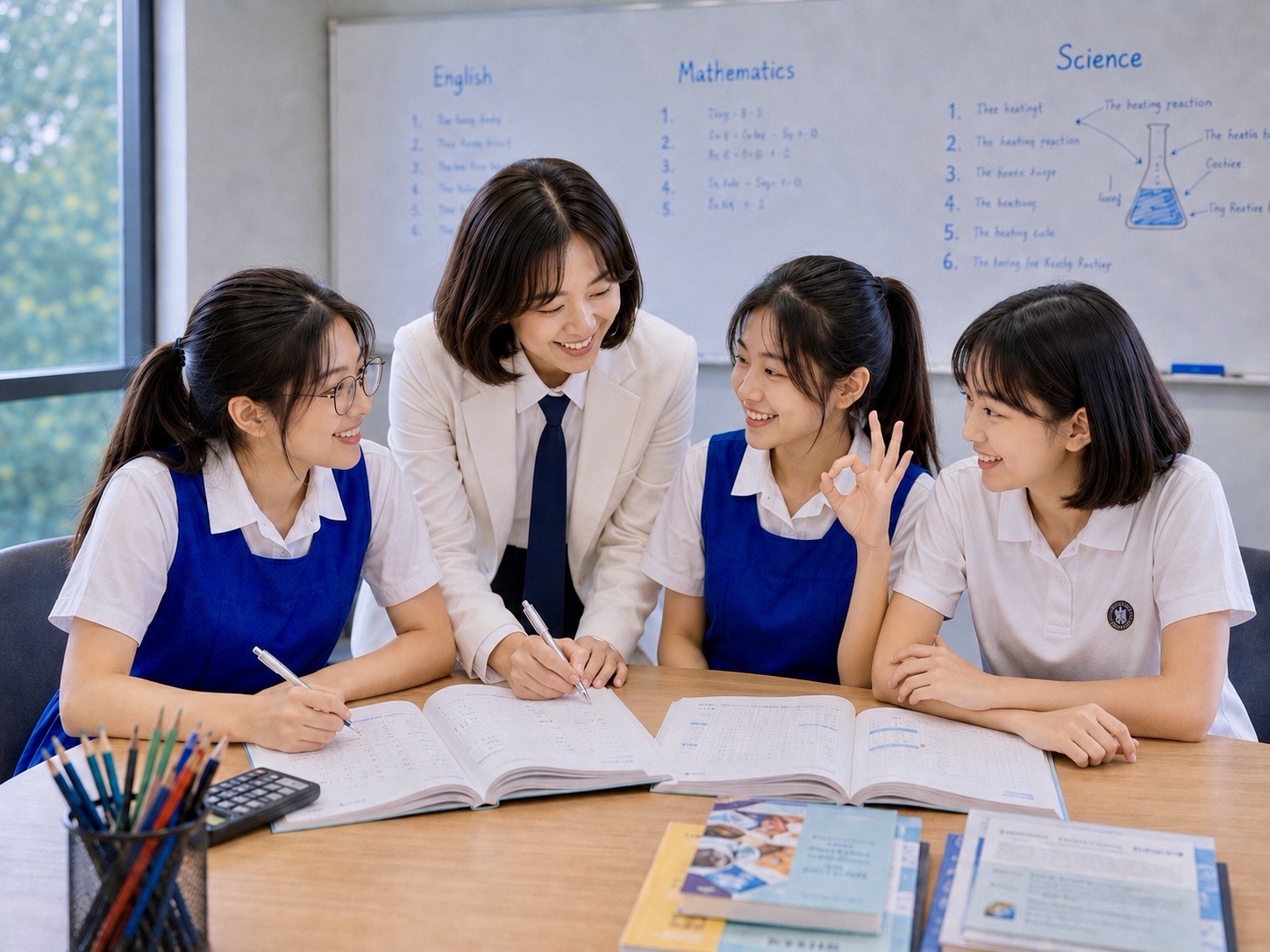
At eduKate Punggol, the published small-group model is up to three students in a 90-minute tutorial, subject to confirmation of current arrangements. The value of a focused lesson is that the tutor can observe the first unsuccessful mathematical decision. A student may enjoy patterns, understand a teacher’s demonstration and invest substantial effort but still freeze when the question does not announce its topic. Niche syllabus engineering connects those starting resources to observable algebraic, graphical and calculus skills: isolate a relationship, teach why it works, ask for a changed independent solution and test retention later. This parent guide helps families choose support without promising a distinction, predicting questions or assuming that every student must take Additional Mathematics.
- K341 is the 2027 G3 Additional Mathematics qualification; confirm actual registration, year and school guidance.
- Paper 1: 12–14 compulsory questions, up to 10 marks each; Paper 2: 9–11 compulsory questions, up to 12 marks each.
- Both papers: 135 minutes, 90 raw marks, 50% weighting; approved calculators may be used in both.
- Approximate objective weightings: standard techniques 35%, solving varied problems 50%, reasoning and communication 15%.
- Study algebra, geometry/trigonometry and calculus as connected strands, not as memorised chapter labels.
- Repair unstable G3 Mathematics foundations if they interfere with Additional Mathematics.
- Measure independent route selection, valid working and retention, not copied solutions.
- Consult school teachers and official intake-year requirements before making subject-combination or post-secondary decisions.
Five parent reading routes
- Start with exam registration and diagnosis (Questions 1–5)
- Repair conceptual and mathematical foundations (Questions 6–10)
- Build connected topic reasoning (Questions 11–15)
- Independent transfer and focused teaching (Questions 16–20)
- Progress review and parent decisions (Questions 21–26)
26 questions parents frequently ask
- 1. Is SEC Additional Mathematics an entirely new subject in 2027?
- 2. What does the K341 assessment actually expect?
- 3. Does my child need tuition for every A-Math chapter?
- 4. What does latent potential mean in Additional Mathematics?
- 5. Why does G3 Mathematics still matter in A-Math?
- 6. How can completing the square become a meaningful method?
- 7. Why does the discriminant need a conceptual explanation?
- 8. Why do algebraic identities and polynomial operations break down?
- 9. What makes indices, surds and logarithms connected?
- 10. How should exponential and logarithmic graphs be understood?
- 11. What is the value of coordinate geometry?
- 12. Why does linear law require more than plotting points?
- 13. How can trigonometric identities be repaired?
- 14. Why do trigonometric equations have more than one solution?
- 15. How do trigonometric graphs help with a changed question?
- 16. What does differentiation actually measure?
- 17. Why does setting the derivative to zero not finish an optimisation problem?
- 18. How does integration differ from differentiation?
- 19. How can kinematics connect to calculus without becoming a formula hunt?
- 20. What should happen in a ninety-minute small-group A-Math lesson?
- 21. What can parents track when they cannot solve the mathematics themselves?
- 22. When is a full A-Math paper more useful than topical practice?
- 23. Can a student aim for A1 without treating A-Math as their only subject?
- 24. What should the four-week review contain?
- 25. Does A-Math guarantee access to H2 Mathematics or a particular course?
- 26. What should Punggol parents ask at a consultation?
2027 SEC K341 assessment at a glance
| Component | Duration | Raw marks | Weight |
|---|---|---|---|
| Paper 1 (12–14 questions) | 135 min | 90 | 50% |
| Paper 2 (9–11 questions) | 135 min | 90 | 50% |
1. Is SEC Additional Mathematics an entirely new subject in 2027?
K341 is the G3 Additional Mathematics syllabus listed for 2027 school candidates; its earlier reference is 4049. SEC replaces the older N- and O-Level examination framework with a common certificate from the 2027 graduating cohort. The child still sits the examination at the subject level and in the subject actually registered by the school. A pupil sitting the 2026 examination uses the applicable earlier requirements.
Start with the national syllabus PDF and the school-issued registration information. Check whether a legacy practice paper aligns before using it. A child who is currently studying a different subject level should not be given K341 as if the label G3 automatically applied to every subject. Use current school assessment instructions when designing a revision plan.
Question index · Next question
2. What does the K341 assessment actually expect?
The two-paper scheme is equal-weighted and all questions are compulsory. Unlike a routine-only worksheet programme, the official assessment objectives place approximately half the emphasis on problem solving in varied contexts, alongside 35% routine techniques and 15% reasoning and communication. The learner needs to read an unfamiliar problem, select a valid route, use its tools and express a coherent mathematical argument.
A pupil who can complete a chapter exercise when told to differentiate may not yet know whether an unfamiliar problem requires a stationary point, a quadratic vertex or an equation of a line. Observe the route decision as well as the final answer. A useful revision programme should include techniques, connections and independent method choice rather than changing only the speed of familiar drills.
Previous question · Question index · Next question
3. Does my child need tuition for every A-Math chapter?
Not necessarily. Suppose a pupil consistently solves trigonometric equations and differentiation problems but repeatedly loses marks on algebraic fractions inside longer calculus questions. Repeating every lesson on differentiation may not repair the real cause. Ask the school for the pattern in actual working and sample an unfamiliar algebra task.
If school explanations and independent practice are already leading to durable progress, paid tuition may add little. If an important error keeps returning, a focused review can be helpful. Choose one or two bottlenecks to address while keeping up with school, rather than making a child redo an entire course without evidence that it is needed.
Previous question · Question index · Next question
4. What does latent potential mean in Additional Mathematics?
It describes resources already available to the learner: interest in patterns, arithmetic and graphical intuition, curiosity, persistence and earlier mathematical knowledge. It is not a prediction of intelligence, a physical energy or a guarantee of a national result. The challenge is to connect those resources to symbolic operations and mathematical reasoning that the learner can use independently.
A student who notices that a ball’s height rises then falls already has an intuitive picture of a maximum. Connect the picture to the graph of a suitable quadratic function, then to the derivative when the relevant calculus has been taught. In a changed problem about the area of a rectangle, the same idea of a maximum may need a different model. The learner must construct it, not just recognise a sports story.
Previous question · Question index · Next question
5. Why does G3 Mathematics still matter in A-Math?
K341 assumes the G3 Mathematics content and can rely on it indirectly. Errors in signed numbers, ratios, fractions, graphs, indices, equations and valid transformations may therefore disrupt an otherwise correct advanced method. A pupil could differentiate correctly and then lose the solution because they mis-handle a linear equation.
Use a short diagnostic to separate the advanced decision from its prerequisite. For example, solve 3(x − 2) = 12 to obtain x = 6; later solve an equation arising from a derivative. If the child struggles with the simpler equation, repair that relationship explicitly. It is not a sign that the entire advanced subject is beyond them.
Previous question · Question index · Next question
6. How can completing the square become a meaningful method?
For f(x) = x² − 6x + 13, write f(x) = (x − 3)² + 4. The squared expression cannot be negative for real x, so the minimum is 4 at x = 3. This explains the graph’s lowest point without relying on a remembered sequence of symbols.
Change the function to g(x) = −x² + 8x − 11 = −(x − 4)² + 5. The maximum is 5 at x = 4. Ask why the sign of the squared term changes maximum to minimum. Then remove the example and ask for another vertex. A learner who understands the reason can adapt the method rather than copy the preceding answer.
Previous question · Question index · Next question
7. Why does the discriminant need a conceptual explanation?
For a real quadratic equation ax² + bx + c = 0 with a non-zero, the expression b² − 4ac determines whether there are two distinct real roots, one repeated real root or no real roots. In the equation x² − 4x + k = 0, the discriminant is 16 − 4k. A repeated root therefore requires k = 4.
Ask the student what the repeated root means on a graph. Then change the problem to x² + 2x + m = 0 and ask for two distinct real roots, requiring 4 − 4m > 0 or m < 1. This is not merely arithmetic: the child must choose the relevant inequality, interpret the roots and handle the variable condition correctly.
Previous question · Question index · Next question
8. Why do algebraic identities and polynomial operations break down?
An identity holds for all permissible values of its variables; an equation need only hold for its solutions. For example, (x + 2)² = x² + 4x + 4 is an identity, while x² + 4x + 4 = 9 is an equation with particular solutions. Students who equate coefficients or expand expressions need to know what kind of statement they are working with.
For polynomial factorisation, consider f(x) = x³ − 4x² + x + 6. Since f(2) = 0, x − 2 is a factor. Dividing yields x² − 2x − 3 = (x − 3)(x + 1). Ask the learner to multiply back to check. Use a different cubic to see whether the factor theorem and the symbolic procedure are independently understood.
Previous question · Question index · Next question
9. What makes indices, surds and logarithms connected?
Indices and logarithms describe inverse relationships. If 2³ = 8, then log₂ 8 = 3. An equation such as log₂(x − 1) = 3 implies x − 1 = 8 and x = 9, subject to the original logarithm’s positive argument. The domain matters: a purely symbolic operation can produce an answer outside the question’s valid conditions.
Give a changed example log₃(x + 2) = 2, yielding x = 7, and ask for a check. In a separate surd example, √50 = 5√2; it does not equal 25√2. Encourage the child to state the relationship and necessary conditions before applying a memorised rule. Progress means choosing the correct operation when the expression changes.
Previous question · Question index · Next question
10. How should exponential and logarithmic graphs be understood?
A positive-base exponential function with base greater than one grows as its input increases; its inverse logarithmic function has a restricted input domain. Graph features, transformations and solving equations are related rather than isolated tasks. The student should ask what is defined, what increases or decreases, and where a requested intersection lies.
For an invented exercise, solve 3ˣ = 27: x = 3. Compare it with 3ˣ = 1/9: x = −2. Then ask the pupil to explain how both points appear on the graph of y = 3ˣ. A new question about the logarithmic inverse can test whether the learner connects coordinates rather than repeating an unrelated formula.
Previous question · Question index · Next question
11. What is the value of coordinate geometry?
An equation of a line is a model of its gradient and position. A line through (2, 1) and (4, 7) has gradient 3. It may be written y − 1 = 3(x − 2), or y = 3x − 5. A perpendicular line to it has gradient −1/3, provided both gradients are defined.
Ask for the perpendicular line through (2, 1) and then change the points. Require the child to verify that the answer passes through the specified point. Coordinate reasoning supports tangent and normal questions in calculus; the derivative gives a gradient, while the line equation uses that gradient and the point. These are distinct decisions.
Previous question · Question index · Next question
12. Why does linear law require more than plotting points?
Students may be asked to transform a relationship into straight-line form to interpret gradient and intercept. For a paper-based example, y = ax² + b becomes a straight-line relation between y and X = x². The vertical intercept is b and gradient is a on those transformed axes. Plotting y against x instead would generally produce a different relationship.
Use the invented values x = 1 gives y = 5 and x = 2 gives y = 11. The transformed X values are 1 and 4, so the gradient is 2 and intercept 3. The model is y = 2x² + 3. A changed task can ask the learner to choose axes and interpret the slope independently, not assume every transformation is linear.
Previous question · Question index · Next question
13. How can trigonometric identities be repaired?
The relationship sin²θ + cos²θ = 1 holds for real angles. It allows valid substitutions, but expressions involving division have additional restrictions. A student who cancels terms across addition without a common factor needs algebraic correction as much as trigonometric teaching.
Start with 1 − sin²θ = cos²θ. For a separate problem, simplify (1 − sin²θ)/cosθ to cosθ where cosθ is non-zero. Ask the child why the original expression is not defined where the denominator vanishes. Then give a changed identity task. Do not reward an apparently correct final expression if the reasoning depended on an invalid cancellation.
Previous question · Question index · Next question
14. Why do trigonometric equations have more than one solution?
An equation such as sin θ = 1/2 has multiple solutions. Over 0° ≤ θ < 360°, the solutions are 30° and 150°. The student needs the given interval, reference angle and sign of the function; a calculator’s principal inverse result is not the full set of answers.
Change the demand to cos θ = −1/2 over the same interval, giving 120° and 240°. Ask for a sketch or quadrant reasoning. Where a question uses radians, preserve that unit. Compare an equation with a proof of an identity: solving selects values in the requested range, whereas an identity needs a valid general argument.
Previous question · Question index · Next question
15. How do trigonometric graphs help with a changed question?
The function y = 2 sin x has amplitude 2; the function y = sin 2x has a different period from y = sin x. These changes act on different parts of the expression. For degree measure, sin 2x repeats every 180°. A pupil who treats both multipliers as amplitude changes has missed the role of the input.
Ask the learner to compare the range and period of two simple graphs, then sketch a different transformed graph using the correct angle units. Verify important points rather than relying on visual resemblance. A graph should reveal behaviour, not merely be a picture drawn after the algebra is complete.
Previous question · Question index · Next question
16. What does differentiation actually measure?
For y = x³ − 3x, dy/dx = 3x² − 3. At x = 2, the gradient is 9. The derivative describes the local rate of change, not the original y-value. The point at x = 2 has y = 2, so the tangent through (2, 2) has equation y − 2 = 9(x − 2).
Give the learner a different polynomial and ask for its tangent at a specified point. Separate finding the derivative, evaluating its gradient, computing the original point and forming the line equation. If one step repeatedly fails, practise it alone and then recombine. This keeps the advanced task from hiding a simpler misunderstanding.
Previous question · Question index · Next question
17. Why does setting the derivative to zero not finish an optimisation problem?
Consider an invented rectangle with sides x and 10 − x, where 0 < x < 10. Its area is A = 10x − x². Setting dA/dx = 10 − 2x to zero gives x = 5. The second derivative is −2, indicating a local maximum; the downward quadratic and feasible domain establish the maximum here. The resulting area is 25 square units.
A pupil who stops at x = 5 has not answered the maximum-area question. A student who labels every stationary point a maximum also needs further reasoning. Change the objective to minimising a different quantity, or ask about an endpoint when appropriate. The learner should construct the function, examine the feasible domain and interpret the answer requested.
Previous question · Question index · Next question
18. How does integration differ from differentiation?
For a suitable polynomial, differentiation maps x³ to 3x², while an indefinite integral of 3x² is x³ + C. The constant represents the family of possible antiderivatives. If the question supplies a point on the original curve, the condition can determine that constant.
For example, if dy/dx = 6x and y = 7 when x = 1, then y = 3x² + C and C = 4, so y = 3x² + 4. Change the point or derivative in the next exercise. A definite integral evaluates an accumulated signed quantity over an interval. A geometric area question may need separate consideration of portions below the axis.
Previous question · Question index · Next question
19. How can kinematics connect to calculus without becoming a formula hunt?
In a fictional one-dimensional model, displacement s(t) = t³ − 3t², measured in metres, gives velocity v(t) = 3t² − 6t and acceleration a(t) = 6t − 6, with t in seconds. At t = 2, velocity is zero and acceleration is 6 m/s². Zero velocity at an instant does not imply zero acceleration.
Ask the learner to distinguish displacement, velocity and acceleration, and interpret units. If a question requires distance travelled, changes of direction matter; the final displacement alone may be insufficient. Use a new simple polynomial and ask the child to determine the actual quantity sought. The model is an invented mathematical exercise, not a measurement of a real journey.
Previous question · Question index · Next question
20. What should happen in a ninety-minute small-group A-Math lesson?
An illustrative structure uses 10 minutes for prior feedback, 15 for an independent mixed problem, 20 for the targeted relationship, 25 for changed practice, 10 for a short mixed or timed check if suitable and 10 to establish follow-up. Actual lessons should adapt to each pupil’s school progress. Each student needs an opportunity to explain the first route selected before seeing someone else’s working.
For a class working on calculus, one pupil may need coordinate geometry repair while another needs algebraic factorisation. After individual correction, give changed questions without announcing the method. Ask the students to check and justify the decision. A completed model solution demonstrates a tutor’s skill, not necessarily the learner’s independent control.
Previous question · Question index · Next question
21. What can parents track when they cannot solve the mathematics themselves?
You do not have to become the child’s Additional Mathematics teacher. Ask for an explanation of the chosen route, where the learner got stuck, which relationship was corrected and whether a different question can now be solved alone. Keep a private first attempt and a later changed response. Compare the degree of prompting, valid working, accuracy and completion under reasonably similar conditions.
If the tutor says ‘careless’, ask which mathematical operation or question-reading decision was unstable. The answer may be sign control, an invalid domain, misreading the requested quantity or a legitimate time-management issue. Distinguish a recurring conceptual error from an occasional slip. Avoid using the record to punish a pupil for seeking help.
Previous question · Question index · Next question
22. When is a full A-Math paper more useful than topical practice?
A full paper assesses route changes, stamina, working, pacing and the ability to recognise a method in a mixed setting. If one narrow misconception destroys several solutions, a targeted repair and mixed micro-set may be more useful initially. Once methods are stable, realistic paper rehearsal becomes increasingly important.
After a full practice paper, identify the first wrong operation in each significant question. Classify it by prerequisite, route selection, mathematical relationship, algebra, communication or pacing. Review one or two consequential patterns rather than repeating every wrong answer in sequence. Keep the correct examination-year paper duration and approved equipment rules in mind.
Previous question · Question index · Next question
23. Can a student aim for A1 without treating A-Math as their only subject?
A distinction can be a legitimate aspiration, but no tuition arrangement or classroom mark establishes a guaranteed national grade. The syllabus gives substantial weight to varied problems, so a stronger learner should be exposed to mixed reasoning, unfamiliar representations and sound justification, not just a bigger quantity of familiar algebra.
The 2027 pupil also has other subjects and an overall post-secondary pathway. Check actual institutional requirements and discuss workload with the school before adding or dropping a subject. Preserve sleep, ordinary activities and recovery. A smaller high-quality learning target is preferable to an unsustainable timetable that causes the learner to disengage.
Previous question · Question index · Next question
24. What should the four-week review contain?
Week 1: examine a genuine script and give a small independent mixed set. Identify the earliest recurring barrier, such as algebra inside differentiation or route recognition in coordinate geometry. Week 2: teach the specific relationship and test a changed problem without prompts. Week 3: revisit after a delay, then combine with an already secure topic.
Week 4: use unfamiliar questions and compare method selection, valid working, reasoning and completion with the earlier sample. Introduce a realistic time constraint if accuracy is stable. Retain practice in other K341 areas and keep school deadlines. Review the evidence together and decide whether to repair, maintain or extend; four weeks is a review cycle, not a promise of full mastery.
| Week | Independent evidence | Review decision |
|---|---|---|
| 1 | Mixed diagnostic and school script | Identify prerequisite or route-selection barrier |
| 2 | Changed independent algebra/calculus problem | Check valid method without cues |
| 3 | Delayed mixed retrieval and selected timed set | Check retention and pace |
| 4 | Unfamiliar connected task | Review reasoning, working and next priority |
Previous question · Question index · Next question
25. Does A-Math guarantee access to H2 Mathematics or a particular course?
K341 is designed as preparation for further mathematical study, including the foundations needed for A-Level H2 Mathematics. It does not guarantee a particular JC, subject combination, course or later institution. Admissions and subject prerequisites depend on the actual intake-year arrangements and institutional decisions.
For pupils graduating under SEC in 2027, MOE announced the new Post-Secondary Admissions Exercise from 2028. Check official information and school counselling for the child’s options, including the applicable JC, MI, polytechnic or ITE route. Do not infer eligibility from a tuition provider’s prediction or use a general article to decide a student’s subject registration.
Previous question · Question index · Next question
26. What should Punggol parents ask at a consultation?
Ask the tutor to use an authentic marked response and identify the earliest unreliable mathematical operation. What will be repaired first? How will the lesson require the student to select a method before seeing an example? What changed task and delayed check will show progress? Confirm group size, duration, actual fee, schedule, availability and the level taught.
A good consultation may conclude that school support and a more focused revision routine are sufficient. If extra help is appropriate, choose a review period and a manageable learning target rather than a grade guarantee. The immediate evidence should be an independent solution that the learner can explain, check and adapt.
Previous question · Question index
Original practice extensions for parents and learners
These short examples illustrate possible diagnostic tasks; they are not released examination questions or a required worksheet schedule. Try them independently before reviewing the explanations.
Original extension A: partial fractions and reverse checking
Suppose an exercise asks the student to express (3x + 5)/[(x + 1)(x + 2)] in partial fractions. Set it equal to A/(x + 1) + B/(x + 2), where the original denominators are non-zero. Multiplying by their product gives 3x + 5 = A(x + 2) + B(x + 1). Comparison yields A + B = 3 and 2A + B = 5, so A = 2 and B = 1. The student can multiply the result back together to verify the numerator. A learner who knows the final format but writes the numerator incorrectly may need the equivalence explained before practising harder decompositions. Change the linear factors and numerator for an independent transfer check.
Original extension B: binomial terms instead of memorised rows
Find the coefficient of x² in (1 + 2x)⁴. The term containing x² arises by choosing the 2x contribution from two of four factors, so the coefficient is 6 × 2² = 24. The learner must distinguish the coefficient from the entire term 24x². Then ask for the coefficient of x³ in (2 + x)⁵. Choosing x from three factors gives ten choices and the remaining two factors contribute 2², making 40. A student who obtains 10 has located the combinatorial factor but omitted a factor from the constant term. Teach how the general term represents contributions before requiring full expansions.
Original extension C: quadratic inequalities and sign
The inequality (x − 2)(x − 5) < 0 has solution 2 < x < 5. The expression changes sign at the roots; between them one factor is positive and the other negative. An answer containing only x = 2 and x = 5 describes zeros rather than the solution interval. Ask the learner to use a test value in each region and determine whether the endpoints are included. Then change the expression to (x + 1)(x − 3) ≥ 0. The solution is x ≤ −1 or x ≥ 3. The symbol and orientation of the inequality matter. This check reveals whether the child understands a set of satisfying values rather than repeating equation-solving steps.
Original extension D: coordinate circles and geometry proof
The equation (x − 2)² + (y + 3)² = 25 represents a circle with centre (2, −3) and radius 5. Ask whether the point (5, 1) lies on it: substitution gives 3² + 4² = 25, so yes. The radius to that point has gradient 4/3; a tangent there has gradient −3/4 and passes through (5, 1). Its equation can be written y − 1 = −3(x − 5)/4. This links a geometric theorem to a coordinate model. Then give a different circle and point. For plane geometry proof, ask the learner to state which supplied or deduced facts justify each step, rather than claiming the figure looks perpendicular.
Original extension E: chain rule and product rule
For y = (2x + 1)³, the derivative is 3(2x + 1)² × 2 = 6(2x + 1)². The additional factor arises from the inner expression’s derivative. In y = x²eˣ, differentiation instead gives 2xeˣ + x²eˣ by the product rule. Ask why the forms call for different decisions. Then present y = (3x − 2)⁴ and y = x sin x, with x in radians for the trigonometric derivative. The respective derivatives are 12(3x − 2)³ and sin x + x cos x. Do not provide method names before an independent mixed attempt. The aim is recognising the structure, not merely practising the formula announced by a chapter heading.
Original extension F: definite integrals and geometric area
For y = x − 2 between x = 0 and x = 3, an antiderivative is x²/2 − 2x. Its definite integral over the interval is −1.5. But the geometric area between the line and horizontal axis is 2 + 0.5 = 2.5 square units, because the segment below the axis contributes positive geometric area when its magnitude is taken. Ask the learner to identify the crossing x = 2 before calculating. Then change to y = x − 1 from 0 to 3, where the two triangular areas are 0.5 and 2. The definite integral is 1.5, the area is 2.5. A student who confuses these quantities needs interpretation, not additional antiderivative drills.
Use the checks to select the next tutorial
Each check is deliberately small enough to expose an important decision. Allow a genuine attempt before revealing the worked reasoning. If partial fractions fail because of expansion, repair expansion and return to the original relationship later. If a binomial question fails because the coefficient and term are confused, practise the demand distinction. If a calculus question is correctly differentiated but the final answer is wrong due to an equation-solving error, preserve the correct advanced reasoning while repairing the prerequisite. This is a targeted use of the syllabus. It does not mean skipping other learning outcomes or assuming the actual paper will repeat these invented questions.
How a parent can review a difficult subject without taking over
Ask the pupil to select one earlier unsuccessful response and show a fresh one in which the same relationship was used independently. The parent need not understand every mathematical symbol; the teacher can explain whether the solution is valid. Ask how much prompting was needed and whether the student can still perform the method after a delay. A tutor who completes most of the work may create confidence in the lesson without establishing independent skill. Review school progress, actual coursework expectations and the child’s total schedule. A narrow successful repair, repeated across the course, is more useful than claiming a grade on the basis of one demonstration.
Return to the 26-question index
Connected Secondary 4 G3 tuition parent guides
- Punggol Secondary 4 G3 English Language K300 parent guide
- Punggol Secondary 4 G3 Mathematics K310 parent guide
- Punggol Secondary 4 G3 Physics K323 parent guide
Official SEC overview and examination timetable arrangements
Official sources and related Punggol guides
- Official 2027 SEAB Additional Mathematics K341 syllabus PDF
- 2027 SEAB G3 school-candidate syllabus directory
- MOE Full SBB and SEC examination changes
- MOE 2026 announcements: post-secondary admissions from 2028
- Related Punggol Additional Mathematics tuition guide
- Further Punggol Additional Mathematics preparation reading
- eduKate Punggol consultation and current arrangements
- Clementi teaching-format reference
References checked 28 November 2026. The assessment scheme was checked against the official 2027 syllabus page image. All numerical and learning examples are original practice illustrations, not released or predicted examination questions. Confirm current school requirements, actual examination registration, availability and tuition arrangements. No result or course admission is guaranteed.


