
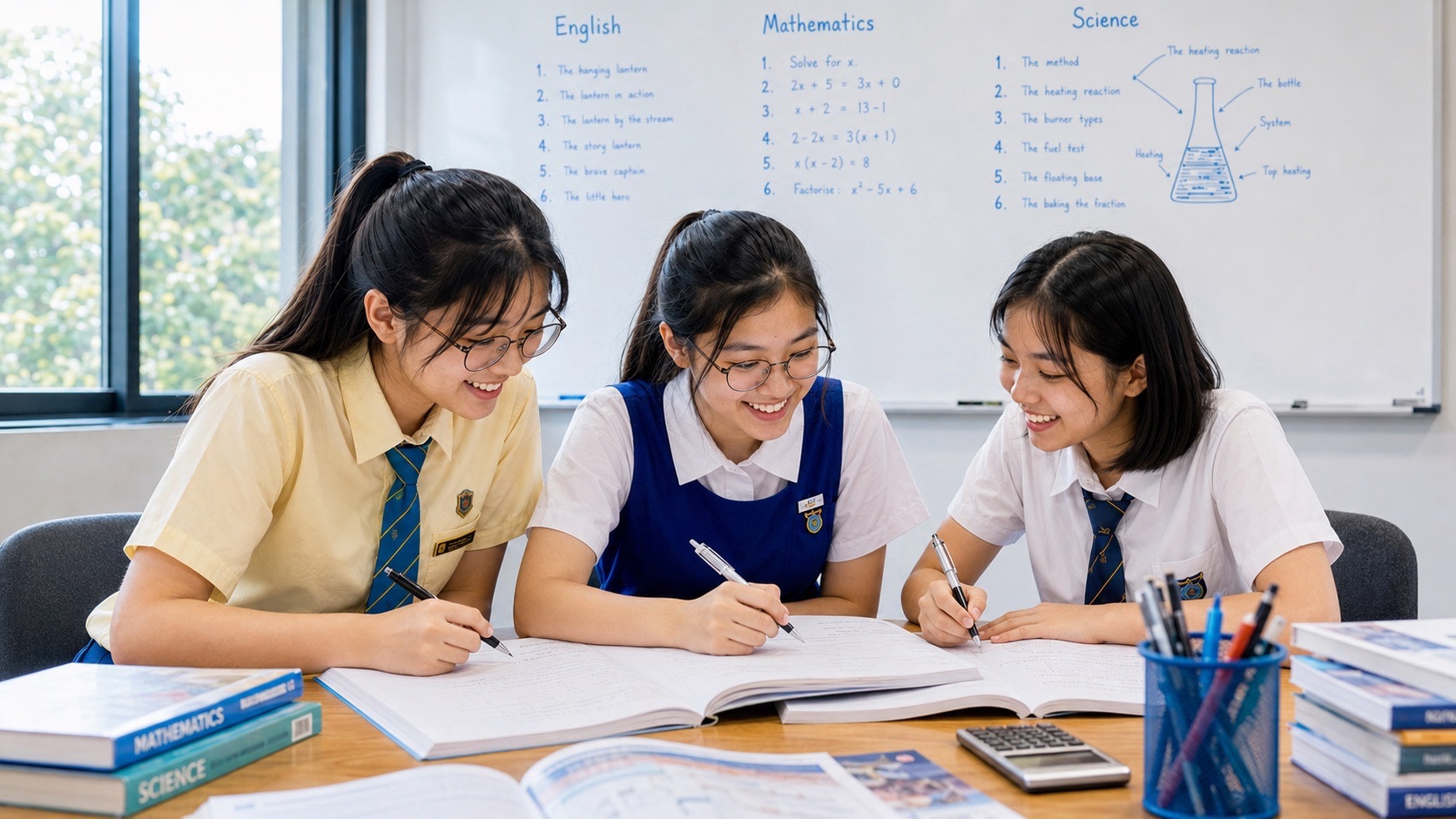
Secondary 2 G2 Malay Language tuition and learning support for Punggol students should develop vocabulary, tatabahasa, comprehension, practical writing, karangan, listening and spoken communication before Secondary 3. SEAB’s 2027 G2 Malay Language SEC examination reference is K221. Secondary 2 learners sit school-based assessments, not the national examination; a Secondary 2 student in 2026 would ordinarily reach Secondary 4 in 2028. This guide explains what families should look for in suitable support. eduKatePunggol’s published main tuition programmes do not confirm an active G2 Malay class, so check current specialist availability before enrolling.
A confident Secondary 2 Malay Language journey begins with finding which language operation is preventing the student’s existing knowledge from becoming an effective answer. Niche syllabus engineering means identifying the curriculum demand, repairing the particular missing operation, rehearsing it with feedback and checking whether the learner transfers it independently to a new task. The aim is not simply to memorise peribahasa or produce more karangan. It is to help the child turn experience, curiosity, existing spoken language and effort into accurate, meaningful Bahasa Melayu that supports school learning and future decisions.
- G2 Malay Language (Bahasa Melayu G2) is a subject level, not a permanent stream or the same as Posting Group 2.
- Follow the current school’s Secondary 2 syllabus sequence and assessment scope; use the 2027 K221 reference to understand future demands.
- The 2027 K221 reference allocates 30% to writing, 30% to language use and comprehension, 30% to oral and 10% to listening.
- Paper 2 is computer-delivered in that reference; verify future official procedures and familiarisation with the school.
- Build meaning in context, affix and word-class knowledge, task fulfilment, evidence-based answers and flexible conversation.
- The questions and examples are educational priorities, not predictions of SEC examination content.
- Confirm specialist Malay tuition availability, school subject options and appropriate learning support before committing.
Choose your reading route
Start at Chapters 1–6 to understand the syllabus and learning method; use Chapters 7–12 for language foundations, 13–18 for comprehension and digital work, 19–23 for writing and oral work, and 24–26 for listening, the four-week plan and future choices.
Understand Secondary 2 G2 Malay
- 1. Why is Secondary 2 Malay a bridge to upper secondary?
- 2. What does G2 Malay mean under Full Subject-Based Banding?
- 3. Is my Secondary 2 child sitting the SEC now?
- 4. What is the 2027 K221 assessment reference?
- 5. How can Malay Language turn latent capability into visible performance?
- 6. What is niche syllabus engineering in Bahasa Melayu?
Vocabulary and grammar
- 7. How should vocabulary be taught in context?
- 8. Why do kata nama, kata kerja, kata adjektif and kata tugas matter?
- 9. How do Malay affixes (imbuhan) help express meaning?
- 10. How can sentence organisation and connectives become dependable?
- 11. How should peribahasa be used responsibly?
- 12. What is Penggunaan Bahasa in Paper 2?
Reading, comprehension and digital work
- 13. How do dialogue completion tasks work?
- 14. How should practical-text reading be practised?
- 15. How can direct comprehension answers become precise?
- 16. How do inference questions and narrative comprehension work?
- 17. How do vocabulary-in-context questions differ from memorised definitions?
- 18. Why does digital Paper 2 need a separate practice routine?
Writing and oral communication
- 19. How should Penulisan Fungsional be taught?
- 20. How can karangan naratif become coherent?
- 21. How can expository karangan develop clear reasoning?
- 22. How should dictionaries and writing checks be used?
- 23. How do Bacaan Lantang and Perbualan improve?
Plan and choose suitable support
- 24. How can listening improve and what four-week plan should families use?
- 25. What subject choices and future pathways should parents discuss?
- 26. How can a Punggol family choose suitable Malay tuition?
1. Why is Secondary 2 Malay a bridge to upper secondary?
Secondary 1 allows students to adjust to a larger school environment, longer texts and greater independence. By Secondary 2, the language tasks increasingly require the learner to organise meaning, justify a response, distinguish formal and informal settings and develop ideas beyond a few sentences. Familiar conversation is valuable, but school assessments may ask for a different register, greater precision or evidence from a written text.
Ask the student to explain an everyday incident in Malay, then write a short account of it. Compare the oral and written versions. If the spoken account is clear but the written one loses the sequence, the student may need writing organisation and sentence practice. If both versions lack key details, work on meaning and structure first. Follow the child’s current school scope rather than beginning with an entire graduating paper.
2. What does G2 Malay mean under Full Subject-Based Banding?
G2 describes the level of an individual subject. It is not a fixed stream and does not determine every subject that the learner takes. A student may have a G2 Malay Language class, G3 Mathematics and other subjects at appropriate levels. Posting Group 2 concerns entry and initial subject arrangements. For tuition, the actual registered subject level is the more useful starting point.
Confirm the school year, the current Malay Language level and the assessment scope before choosing resources. A G3 or Higher Malay workbook is not automatically better just because it is more demanding. Similarly, a lower-level practice task may be useful for repairing a prerequisite but should not permanently replace the current curriculum. The appropriate challenge depends on evidence from the child’s learning.
Previous question · Contents · Next question
3. Is my Secondary 2 child sitting the SEC now?
SEAB introduces the Singapore-Cambridge Secondary Education Certificate (SEC) in 2027 for graduating candidates, replacing the former GCE N- and O-Level qualifications. The 2027 G2 Malay Language reference is K221, with the earlier code 1197. A child in Secondary 2 in 2026 would normally be in Secondary 4 in 2028. The actual syllabus and rules for that examination year must be confirmed when published.
The MOE Mother Tongue Languages curriculum sets the longer learning direction, while the school determines the immediate learning sequence and assessment arrangements. Parents should obtain the school’s taught topics, instructions and marked work for this term. Older examination materials can contain useful overlapping skills, but they should not be presented as a guaranteed description of a future paper.
Previous question · Contents · Next question
4. What is the 2027 K221 assessment reference?
Paper 1 covers practical writing and composition, 60 raw marks in two hours, contributing 30% of the grade. Paper 2 covers language use and comprehension in an electronic examination, 60 raw marks in 90 minutes, contributing 30%. Paper 3 includes oral communication, 60 marks and 30%, and listening comprehension, 20 marks and 10%. The oral examination is approximately 15 minutes with 10 minutes of preparation; listening is about 30 minutes.
The national reference provides a long-term map of important abilities. It does not require a Secondary 2 school to reproduce the same format, duration or weighting. Ask the Malay teacher what is assessed now and use shorter age-appropriate tasks for practice. Because listening and speaking together account for 40% in the published reference, a balanced programme should not neglect those abilities in favour of written work alone.
Previous question · Contents · Next question
5. How can Malay Language turn latent capability into visible performance?
Latent energy is our educational metaphor for the learner’s existing experiences, interests, motivation and knowledge that have not yet become an independently usable skill. It is not a physical measure of energy or an intelligence rating. A student may participate in conversations with family and friends, understand a community issue and hold a sensible opinion, but need help expressing that opinion in a structured written response.
Begin with a meaningful situation: a classmate wants help preparing for a school event. The learner can explain what they would do orally, then write a suitable message, read a notice about the event and discuss a related issue. This turns a familiar context into several different language capabilities. Later use a new topic to verify that the child is learning the underlying communication operations rather than repeating a memorised answer.
Previous question · Contents · Next question
6. What is niche syllabus engineering in Bahasa Melayu?
The method begins with a real task and a specific problem. If a student answers a question about sebab (reason) by describing kesan (effect), the tutor must determine whether the vocabulary, question reading or reasoning relationship is unclear. If the student can identify the cause orally but produces a weak sentence, focus on expressing the relationship. Do not treat every error as a need to learn more words.
Model one example, rehearse another, and give the student a fresh question without a clue. For instance, distinguish kerana (because) from oleh itu (therefore). Then ask the learner to explain both a reason and an outcome from a new short passage. Record the independent response. A teaching method is effective only to the extent that the learner can apply it beyond the guided example.
Previous question · Contents · Next question
7. How should vocabulary be taught in context?
Vocabulary needs a meaning, a typical phrase and an appropriate context. Consider menasihati (to advise) and mengarahkan (to direct or instruct). A teacher who advises students to manage their time is not necessarily issuing an order. Choosing between these expressions can change the meaning and tone of a sentence. Learning a single English translation without context may not reveal the distinction.
Make a small card with the Malay word, a plain meaning, a common phrase and an original sentence. For example, menasihati rakan supaya belajar secara teratur. Revisit it on a later day and ask the student to use it in another situation. A learner who can explain why one word fits better than another has more useful vocabulary control than one who merely recites definitions.
Previous question · Contents · Next question
8. Why do kata nama, kata kerja, kata adjektif and kata tugas matter?
The 2027 K221 language-use section includes contextual word selection across nouns, verbs, adjectives and function words. Understanding these classes helps the learner recognise what a sentence needs. In ‘Para pelajar sedang ___ buku di perpustakaan’, the sentence needs a suitable action, such as membaca. In another sentence, the missing element might describe the book or connect two ideas.
Teach the learner to read the complete sentence and surrounding text before choosing a word. Ask what role the missing word plays and whether the intended meaning is consistent with the paragraph. Then use an unfamiliar passage with different word classes. This is more reliable than selecting the word that merely sounds most familiar or applying a rule without reading.
Previous question · Contents · Next question
9. How do Malay affixes (imbuhan) help express meaning?
Affixes can change the grammatical role and meaning of a root word. From ajar, the forms belajar (learn), mengajar (teach), pelajar (student) and pelajaran (lesson or study) express related but distinct ideas. The learner should see the root connection while also understanding the role of each derived word. A wrong form may make the sentence ungrammatical or change who is performing the action.
An original practice contrast: ‘Cikgu mengajar Bahasa Melayu’ versus ‘Murid belajar Bahasa Melayu’. Ask who teaches and who learns, then change the people and subject. Practise affix forms and sound changes using the teacher’s current vocabulary list and reliable Malay reference materials. Avoid assuming one affix rule covers every root or exceptional form. The child’s independent choice in a new sentence is the useful check.
Previous question · Contents · Next question
10. How can sentence organisation and connectives become dependable?
Connectives show the relationship between ideas. Kerana introduces a reason, walaupun introduces a concession, and oleh itu often introduces a consequence. In ‘Walaupun hujan turun, aktiviti itu diteruskan’, the activity continued despite the rain. A response that uses kerana instead would suggest a different relationship. Clear grammar is therefore also clear thinking.
Ask the student to combine two simple statements in a way that preserves the intended meaning. Then remove the connective and ask them to decide whether the relationship is cause, contrast, sequence or condition. A fresh example might concern a missed bus or an altered activity schedule. Do not reward a long sentence if its relationship is unclear; precise short sentences can be a useful starting point.
Previous question · Contents · Next question
11. How should peribahasa be used responsibly?
Proverbs and idiomatic expressions can add cultural meaning and precision when they fit the context. Bagai aur dengan tebing refers to mutual support, and may suit an example of people cooperating for a shared purpose. It would be less suitable for a paragraph describing someone refusing every offer of help. An impressive expression used incorrectly can obscure the message.
Teach the meaning, an appropriate situation and a contrasting situation where the expression would not fit. Ask the learner to explain the same idea plainly before using a proverb in a composition. Check school guidance on the expected vocabulary and idiom work; do not assume memorising a long list of peribahasa is a guaranteed examination strategy. The goal is meaningful use, not decoration.
Previous question · Contents · Next question
12. What is Penggunaan Bahasa in Paper 2?
In the 2027 K221 reference, Paper 2 Section A includes ten multiple-choice word-selection questions across two expository texts. The underlying operation is selecting the word that is appropriate to both grammatical structure and context. For Secondary 2, practice can begin with shorter passages that match the taught curriculum. Read the complete passage, then examine each blank in relation to its surrounding sentences.
Original example: ‘Penduduk bekerjasama untuk ___ kebersihan kawasan mereka.’ Menjaga (maintain or look after) is a natural fit if offered. A student should explain that kebersihan is the thing being maintained. Later provide a changed passage in which meningkatkan is more appropriate. The aim is to distinguish word selection based on meaning from selection based on superficial similarity.
Previous question · Contents · Next question
13. How do dialogue completion tasks work?
The 2027 K221 Paper 2 reference includes a section requiring the learner to choose suitable phrases in a dialogue. Understanding the conversational function is essential: is the speaker requesting clarification, expressing thanks, declining an invitation or offering help? The next response must fit both the previous utterance and the situation. A familiar phrase may be inappropriate if it answers a different question.
Original example: A asks, ‘Bolehkah awak membantu saya membawa buku-buku ini?’ A suitable affirmative response might be ‘Boleh, mari saya bantu.’ A response about tomorrow’s weather does not fulfil the request. Then change the dialogue so the other person must politely decline and explain why. Practise noticing who is speaking, what they need, and the tone that suits the relationship.
Previous question · Contents · Next question
14. How should practical-text reading be practised?
Kefahaman 1 in the 2027 reference includes questions based on practical or authentic texts, such as posters, advertisements and short articles. Such texts may include eligibility conditions, deadlines, instructions and exceptions. Imagine this fictional notice: ‘Penyertaan percuma untuk pelajar yang mendaftar sebelum hari Jumaat.’ Free participation is conditional on registration before Friday; it is not a universal offer.
Ask the learner to state the purpose, identify the intended audience and locate the conditions before answering. A different fictional notice might restrict entry to registered participants after a particular time. Ask which person qualifies and why. Use real notices only when their details are relevant and checked. This skill is useful in daily life, not merely a method for collecting marks.
Previous question · Contents · Next question
15. How can direct comprehension answers become precise?
Direct comprehension requires finding the specific information requested, not copying the whole paragraph. In the original sentence ‘Amin meminjamkan payung kepada rakannya kerana rakannya terlupa membawa payung’, a question asking why Amin lent the umbrella requires the reason that his friend forgot to bring one. Describing the act of lending does not answer why.
Teach command words and question focus: siapa (who), bila (when), mengapa (why), bagaimana (how) and apakah (what). Ask the student to underline the relevant clue, state a complete response and check that it matches the question. When two reasons are requested, make sure they are distinct. Later use a new passage with the same question operation and fewer hints.
Previous question · Contents · Next question
16. How do inference questions and narrative comprehension work?
Kefahaman 2 in the 2027 K221 reference uses an extended narrative and includes free responses. Reading a narrative involves tracking decisions, changes and motives. Original example: ‘Siti melihat jam beberapa kali dan berdiri dekat pintu. Rakannya masih belum tiba.’ A reasonable inference is that Siti is anxious or impatient about her friend’s delay, supported by her repeated checking and position near the door.
Teach the student to connect an observation to a justified interpretation. Do not invent an explanation beyond what the passage supports. The learner might answer, ‘Siti mungkin berasa bimbang kerana rakannya belum tiba dan dia melihat jam beberapa kali.’ A different interpretation may be acceptable when supported. Ask the child to explain why each piece of evidence matters rather than copying the whole sentence.
Previous question · Contents · Next question
17. How do vocabulary-in-context questions differ from memorised definitions?
The published K221 reference includes two vocabulary-related questions in the narrative comprehension section: identifying a word from the passage matching a given meaning and explaining a word or phrase in its context. A dictionary-style meaning may not be sufficient when the word has multiple senses. The learner must check how the expression functions in the specific sentence.
For example, ringan may refer to low weight in ‘beg yang ringan’, but in ‘tugas yang ringan’ it refers to a less demanding task. Ask the student to paraphrase the meaning in each context. Then use a new example with another common word that has more than one use. This trains sensitivity to meaning and helps with both reading and writing.
Previous question · Contents · Next question
18. Why does digital Paper 2 need a separate practice routine?
The 2027 K221 national reference specifies a computer-delivered Paper 2. This introduces screen reading, navigation and digital response demands in addition to Malay comprehension. The student may need to move between a text and its question, monitor progress and check responses without losing their place. The exact interface and permitted functions should be learned through official school familiarisation resources.
During ordinary practice, ask the learner to read a short text on a screen, locate evidence and compose an answer without translation or AI assistance. Practise typing and checking separately if those operations are slow. Do not assume a personal application, predictive feature or translation tool is permitted in an examination. School-based Secondary 2 tests may still use different arrangements; follow their current instructions.
Previous question · Contents · Next question
19. How should Penulisan Fungsional be taught?
The 2027 K221 writing reference includes functional writing in which the student chooses one of two tasks and writes at least 100 Malay words. The formats include informal forum or blog responses and formal email. In Secondary 2, follow the school’s own task length and format requirements. The underlying communication skill is identifying the audience, context, purpose and required details.
Original scenario: reply to a school notice asking for ideas to improve a community reading event. In an informal forum response, the student can share a suggestion and reason. In a formal email to the organiser, the register should be appropriate and the message should state a clear purpose. For example, ‘Saya ingin mencadangkan agar pihak penganjur menyediakan ruang membaca yang selesa.’ Check that all instructions are fulfilled, not just the word count.
Previous question · Contents · Next question
20. How can karangan naratif become coherent?
The 2027 K221 composition reference requires selecting one of three prompts and writing at least 200 Malay words; the specified genres include narrative and expository writing. Secondary 2 school tasks may set different lengths. A narrative should develop an event through decisions, consequences and reflection instead of piling up memorised descriptive sentences. The story must respond to the chosen question.
For an original topic about helping a friend, outline the initial situation, what problem arose, what the narrator did and what changed as a result. A useful sentence might be ‘Pada mulanya, saya berasa ragu-ragu, tetapi saya memutuskan untuk membantu rakan saya.’ Ask why the decision matters. Then use a different prompt so that the learner must construct a new sequence rather than transplanting a memorised story.
Previous question · Contents · Next question
21. How can expository karangan develop clear reasoning?
Expository writing requires the learner to explain an issue with organised and relevant ideas. A student discussing environmental responsibility might state a reason, explain how it affects the community and give a concrete example. Simply repeating ‘Kebersihan sangat penting’ in several forms does not develop a paragraph. Useful connectives and suitable vocabulary should serve the reasoning rather than replace it.
Try an original topic: how students can use their time responsibly. Develop one paragraph about planning tasks, with an example of balancing homework and rest. Ask the student to explain the effect of planning and then build a separate point on avoiding unnecessary distractions. Revise for accuracy and coherence, and try another topic after a short interval. Independent development matters more than the number of elaborate phrases used.
Previous question · Contents · Next question
22. How should dictionaries and writing checks be used?
The 2027 K221 Paper 1 specification allows approved dictionaries. Verify the applicable SEAB list and current school instructions; not every dictionary or device is permitted. A useful dictionary routine is to identify the intended meaning first, look for the appropriate word and confirm that it fits the sentence. Looking up an impressive synonym without checking usage may create another problem.
For writing checks, use a short ordered review: confirm the task requirements, check that each paragraph has a purpose, inspect recurring grammar or affix errors, and correct spelling and punctuation where necessary. During school practice, focus on one repeated error type at a time. Later mix the error types so that the learner can identify them independently rather than relying on the tutor to point out every line.
Previous question · Contents · Next question
23. How do Bacaan Lantang and Perbualan improve?
The 2027 oral reference includes reading aloud and video-based conversation. For reading aloud, accuracy, pronunciation, intelligible phrasing and appropriate pace matter more than rushing. Start with a short passage, identify the words causing hesitation, rehearse those words and then read an unfamiliar passage. The learner should increasingly understand the message as they read.
For conversation, practise a direct answer, a reason and a concrete example. A fictional clip about neighbours clearing litter may prompt ‘Mengapakah kita perlu menjaga kebersihan kawasan perumahan?’ An answer could explain that everyone uses the area and cooperation keeps it pleasant. A follow-up might ask what to do when others do not cooperate. Encourage flexible responses in Malay rather than memorised speeches that ignore the examiner’s question.
Previous question · Contents · Next question
24. How can listening improve and what four-week plan should families use?
The 2027 K221 listening reference includes ten multiple-choice questions based on six recordings. Practise listening for the event, purpose, details, speaker attitude and exceptions. For example, ‘Aktiviti hari Sabtu ditunda ke hari Ahad kerana hujan lebat’ means the activity has moved to Sunday, not that it is cancelled. Ask the learner to restate the change. Identify whether a wrong answer comes from a missed word, a misunderstood time reference or a confused relationship.
Week 1: collect marked reading and writing samples and a short oral and listening baseline. Week 2: repair two recurring weaknesses, such as affix selection and direct comprehension. Week 3: transfer the skills to unfamiliar passages, a new writing task and flexible spoken responses. Week 4: complete school-scope mixed tasks independently and compare error patterns. Keep sessions compatible with school, CCA and rest. If foundations remain weak, extend the repair period instead of forcing a fixed deadline. A plan is not a grade guarantee.
Previous question · Contents · Next question
25. What subject choices and future pathways should parents discuss?
Under Full SBB, students may adjust subject levels at appropriate points, based on eligibility, readiness, strengths and learning needs. Discuss the learner’s actual Malay Language results and independent communication with the school before considering a more demanding level. End-of-Secondary-2 subject decisions depend on the school’s offerings, criteria and overall workload. Do not treat moving to G3 or Higher Malay as the only successful outcome.
MOE has announced changes to post-secondary admissions from the 2028 intake, but this learner may apply later. Confirm the actual entry rules for the desired institution, course and intake, including any relevant Mother Tongue requirements. A sustainable, strong G2 profile may be the right choice. The purpose of the syllabus is to build language ability that can support a student’s broader education, interests, participation in the community and later options.
Previous question · Contents · Next question
26. How can a Punggol family choose suitable Malay tuition?
Begin with school feedback and two examples of independent work. A suitable specialist should be able to distinguish vocabulary retrieval from comprehension, writing organisation from grammatical accuracy, and oral fluency from memorised responses. Ask how lessons align with the student’s G2 curriculum and how the tutor will test transfer. The number of worksheets is not a reliable measure of effective support.
eduKatePunggol publishes contact details at 83 Punggol Central, Singapore 828761, by appointment. Its published main subject listings do not confirm a current Malay Language class; enquire about availability and appropriate specialist support, or seek a qualified Malay tutor if necessary. A student progressing well through school may not need extra tuition. No responsible provider can guarantee a particular grade or forecast exact SEC questions. The measure of success is a child who can increasingly use Bahasa Melayu with independence and confidence.
Assessment reference and learning priorities
| 2027 K221 component | Weight | Secondary 2 skill priority |
|---|---|---|
| Penulisan Fungsional dan Karangan | 30% | Audience, purpose, paragraph development |
| Penggunaan Bahasa dan Kefahaman | 30% | Vocabulary in context, word classes, evidence |
| Lisan | 30% | Bacaan Lantang and Perbualan |
| Kefahaman Mendengar | 10% | Meaning, purpose and accurate detail |
A practical parent–student diagnostic workshop
The following original exercises are designed for brief, guided learning and independent follow-up. Use only the tasks matching the school’s current teaching scope. The answers illustrate the reasoning, not official marking schemes.
An original comprehension clinic: practical meaning and narrative evidence
Read this original practice text: Pihak sekolah mendapati bahawa beberapa orang pelajar ingin berbincang tentang tugasan bersama rakan-rakan mereka di perpustakaan. Namun, mereka tidak mahu mengganggu pelajar lain yang sedang membaca. Oleh itu, pihak sekolah menyediakan sebuah ruang khas untuk perbincangan. Pelajar yang menggunakan ruang tersebut perlu menjaga kebersihan dan mengawal suara mereka. Selepas beberapa minggu, lebih ramai pelajar menggunakan perpustakaan untuk belajar. Ruang bacaan yang senyap masih disediakan untuk pelajar yang ingin belajar secara bersendirian.
Ask: Mengapakah pihak sekolah menyediakan ruang khas? A suitable answer is that some students wanted to discuss their work without disturbing others. Apakah dua tanggungjawab pelajar yang menggunakan ruang tersebut? They must keep it clean and control their voices. Bagaimanakah kemudahan itu memenuhi keperluan pelajar yang berbeza? The learner should explain that group discussion is possible while quiet individual study remains available. The first two questions retrieve explicit information; the third requires connecting information from different parts of the passage. Ask the student to show the supporting phrases and express the explanation clearly.
A vocabulary and affix clinic
From the passage, select berbincang (to discuss), perbincangan (discussion) and mengganggu (to disturb). Ask the student to identify how berbincang and perbincangan relate to the root bincang, and how the first refers to an action while the second names the activity. Use a new sentence: ‘Mereka mengadakan perbincangan tentang projek kelas.’ Contrast this with ‘Mereka berbincang tentang projek kelas.’ Both convey a related idea with different grammatical structures.
Next, use menjaga kebersihan (maintain cleanliness) and membersihkan meja (clean the table). Ask whether the expressions mean exactly the same thing. The first concerns maintaining a clean condition, while the second describes a particular cleaning action. The learner should select the expression appropriate to the prompt. Then provide a fresh context about a sports hall or classroom. This teaches vocabulary precision and grammar together, rather than assuming that an English gloss or a memorised affix list is sufficient.
A functional writing clinic
Original situation: the class wants to hold a book-sharing activity. The student is asked to write to the teacher explaining the purpose, suggesting a practical arrangement and describing how classmates can contribute. Before writing, identify who will receive the message and what they need to know. A possible opening is ‘Cikgu, saya ingin mencadangkan agar kelas kami mengadakan aktiviti perkongsian buku.’ The subsequent sentences should explain why the activity is useful and propose a workable arrangement.
After the first draft, ask the student to underline the three required points. A sentence about how classmates can contribute might say ‘Setiap pelajar boleh membawa sebuah buku yang sesuai dan berkongsi sebab mereka menyukainya.’ This is one possible response, not a formula that fits every prompt. Then convert the same situation into an informal forum post. The content can remain related, but the register and form should suit the audience. Assess whether the message actually answers the new task.
A listening and oral clinic
Read this original announcement at a natural pace: ‘Aktiviti yang dijadualkan pada pukul sembilan pagi hari Sabtu akan bermula pada pukul sepuluh pagi. Tempat perjumpaan tidak berubah. Pelajar yang tidak dapat hadir perlu memaklumkan guru sebelum hari Jumaat.’ Ask when the activity now begins, whether the location changes, and what students who cannot attend must do. If the learner answers nine, revisit the language of the schedule change. If they understand the new time but miss the exception, focus on the conditional information.
Then ask the learner to discuss how organisers can reduce confusion when arrangements change. A possible response is ‘Pihak penganjur boleh menghantar makluman yang jelas supaya semua peserta mengetahui masa baharu.’ Ask a follow-up about participants who do not check their messages. This prompts a different suggestion and reason. Teach the student to listen to the actual question, answer directly and develop a relevant explanation. Speaking quickly is not the goal; meaningful communication is.
A home practice record that supports the child
For a short weekly check, choose one reading question, one language-use exercise and one written or spoken response. Record the task and the amount of help given. If the child cannot identify a word, distinguish whether they cannot recognise it, cannot understand its meaning in context or cannot retrieve it in their own response. A student may know a word receptively long before they can use it spontaneously in a karangan.
Parents who do not use Malay confidently can still help the learner keep a consistent routine, locate school feedback, explain the task and ask how they selected an answer. For language-specific corrections, use the school teacher or a qualified Malay specialist. Keep school workload, rest and the child’s other interests in view. If one targeted repair leads to independent success on an unfamiliar passage or prompt, document that improvement even if the next school score has not yet changed. This is useful evidence for deciding what to practise next.
Official references and Punggol parent resources
- MOE secondary Mother Tongue Languages curriculum
- SEAB 2027 K221 G2 Malay syllabus
- SEAB 2027 G2 directory
- MOE 2026 announcements
- Punggol K221 reference guide
- Companion Secondary 2 G2 English guide
- Companion Secondary 2 G2 Chinese guide
- Punggol centre programmes and contact
- eduKate small-group teaching reference
Continue through the Secondary 2 G2 subject series
English Language · Mathematics · Chinese Language · Malay Language (this guide)


