
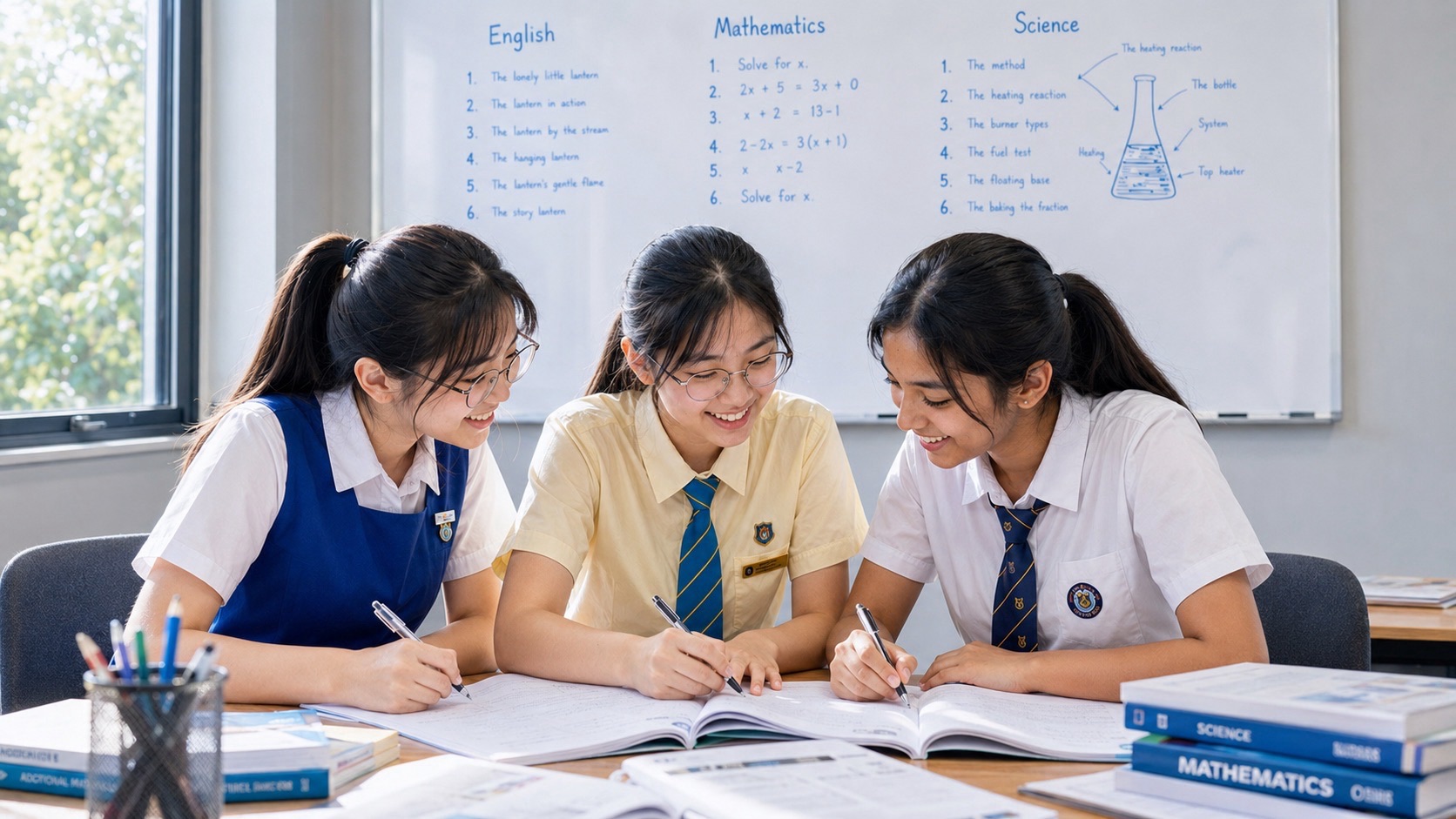
When a child describes a Science experiment, they may write what they think happened rather than what they actually observed. A leaf changing colour, a bubble appearing or a thermometer reading rising can support an explanation, but the explanation is not itself the direct observation. Parents may see the child using scientific words and assume the answer is complete.
A useful approach is to record what was seen or measured first, then explain what that evidence may mean using the taught concept. Ask the child to label the observation, inference and supporting reason separately. This improves precision without demanding advanced scientific vocabulary beyond the school syllabus.
- Record the visible change or measured result precisely.
- Separate observations from explanations about unseen processes.
- Check whether the inference follows from the evidence.
- Consider alternative explanations when appropriate.
- Use the wording required by the actual question.
This parent guide provides an immediate approach, age-appropriate options and a way to check whether the child can apply the skill independently.
1. What counts as an observation?
An observation is information obtained through the relevant senses or measurements, such as a colour change, mass reading or movement. Record the conditions and units when they matter. Avoid adding an explanation to the observation sentence before the evidence is clear.
Try this with schoolwork: Choose one current, relevant example. Let the child explain the first attempt, then ask one question that reveals the reasoning. Provide a small prompt only when necessary and check the same skill later on a different suitable task.
2. What counts as an inference?
An inference is an interpretation supported by observations and existing knowledge. For example, observing droplets on a cold surface differs from inferring that water vapour condensed. The inference must be scientifically justified and may require additional evidence.
Try this with schoolwork: Choose one current, relevant example. Let the child explain the first attempt, then ask one question that reveals the reasoning. Provide a small prompt only when necessary and check the same skill later on a different suitable task.
3. Why the distinction affects answers
Questions may ask ‘What do you observe?’ or ‘Explain the result.’ The first needs the observed result; the second usually requires relevant scientific reasoning. Mixing them can leave the actual demand unanswered.
Try this with schoolwork: Choose one current, relevant example. Let the child explain the first attempt, then ask one question that reveals the reasoning. Provide a small prompt only when necessary and check the same skill later on a different suitable task.
4. Teach a two-column method
Create columns headed ‘What I observed or measured’ and ‘What it may mean’. Ask the child to justify the second column using the lesson concept. A younger child can do this orally before writing.
Try this with schoolwork: Choose one current, relevant example. Let the child explain the first attempt, then ask one question that reveals the reasoning. Provide a small prompt only when necessary and check the same skill later on a different suitable task.
5. Avoid making conclusions stronger than the evidence
One observation does not necessarily establish a unique cause. Where the syllabus calls for fair tests, check what changed and what stayed comparable. Do not invent additional experimental results.
Try this with schoolwork: Choose one current, relevant example. Let the child explain the first attempt, then ask one question that reveals the reasoning. Provide a small prompt only when necessary and check the same skill later on a different suitable task.
6. Practise on a new diagram or result
Present a different, suitable observation and ask for the evidence first, then the inference. Check the distinction against teacher feedback and current school materials.
Try this with schoolwork: Choose one current, relevant example. Let the child explain the first attempt, then ask one question that reveals the reasoning. Provide a small prompt only when necessary and check the same skill later on a different suitable task.
Questions parents commonly ask
Is an inference just a guess?
No. A useful inference is reasoned from evidence and relevant knowledge, although it may still need checking.
Can one observation support more than one explanation?
Yes. Additional evidence may be needed to distinguish plausible explanations.
Should Primary pupils use formal scientific terms?
Use the terminology and level expected by their teacher, while building the underlying distinction.
A four-week parent support plan
Week 1: Observe two or three suitable tasks and identify the specific gap. Week 2: Teach one targeted strategy with manageable guided practice. Week 3: Reduce prompts and test the skill on a fresh example. Week 4: Review what the child can now do independently and ask the teacher for clarification where needed. This is a flexible review sequence, not a guarantee of results within four weeks.
When to seek additional help
If the difficulty continues despite suitable explanation and practice, share specific examples with the teacher. Do not assume a fixed ability or diagnose a learning condition from one behaviour. Follow the current school and MOE/SEAB syllabus requirements.
Prepared for Punggol parents on 22 November 2026.


