
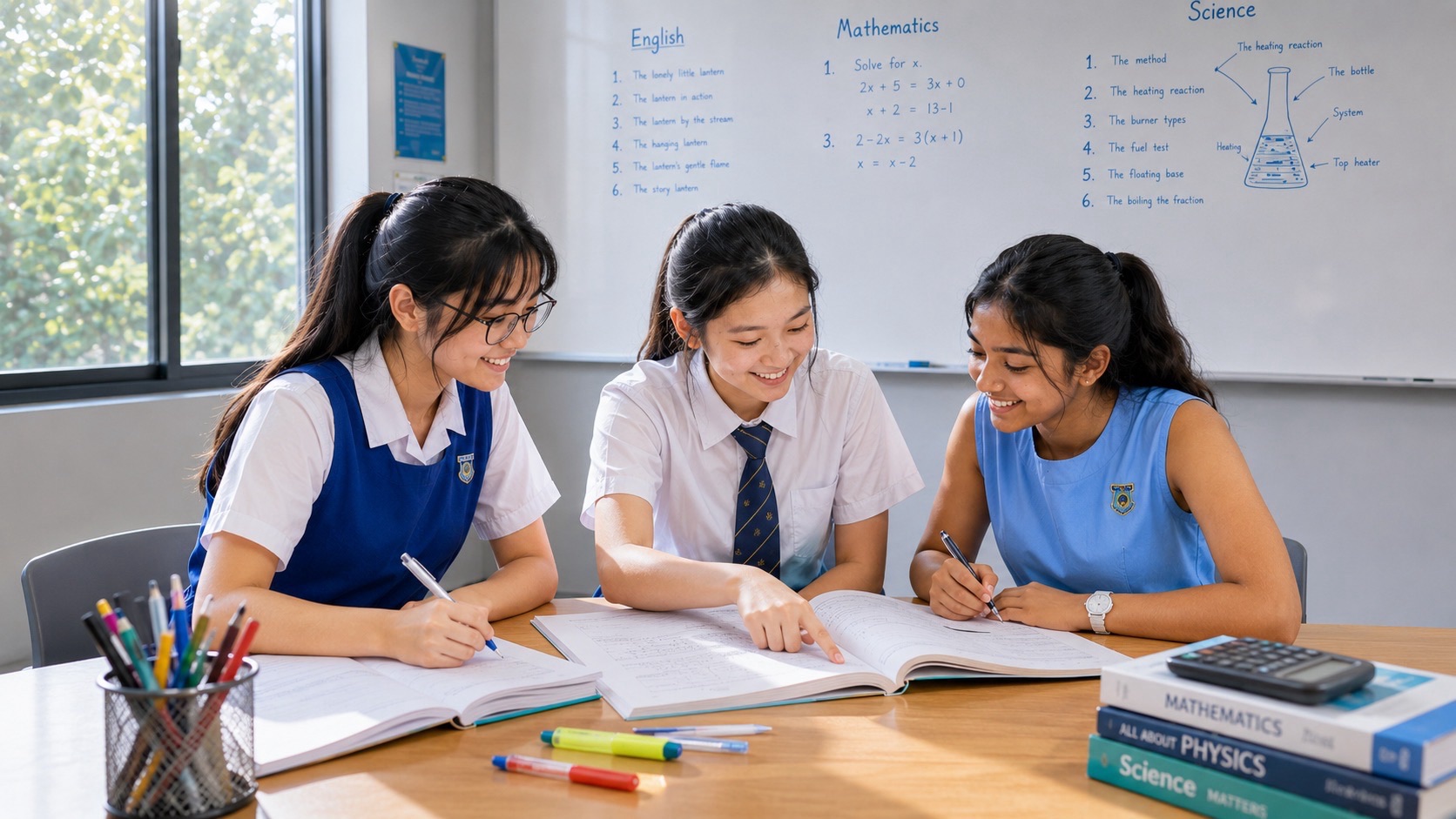
Your child can reproduce a model answer almost word for word, yet the response becomes weak when the question changes slightly. Parents may see accurate memorisation and assume that the topic is secure. But a model answer is an example of how knowledge can be organised for a particular task; it is not a script that automatically fits every question.
Help your child identify what the example is doing: which question it answers, what knowledge it uses, how the evidence supports the point and which parts are specific to that wording. Then practise explaining the same idea in a different way and adapting it to a related question. The goal is not to abandon useful structures, but to understand when and how to use them.
- Compare the exact question with the model answer before learning its wording.
- Identify the knowledge, reasoning and evidence that make the answer relevant.
- Separate reusable structure from details that belong only to that question.
- Practise expressing the same idea in the child’s own accurate words.
- Use a related but changed question to check whether the learning transfers.
1. Why memorising a model answer can appear successful
A model response provides a ready-made sequence. The student can see the vocabulary, structure and level of detail expected. Reproducing it may create a sense of confidence, especially when practice questions closely resemble the example.
The difficulty appears when the student must decide what is relevant without being shown the answer first. A changed command word, a different source or a new context may require the learner to select different evidence or explain a different relationship. Memorisation alone does not make that decision.
2. Read the question before studying the model
Ask the child to state what the original question required. Was it asking for a definition, explanation, comparison, inference, calculation or evaluation? The answer must be judged against that task. A well-written paragraph can still be incorrect if it answers a different question.
Next, ask which parts of the model directly answer the question and which parts provide supporting detail. This helps the student see that an answer is built in response to a task, not selected simply because it looks familiar.
3. Separate knowledge from wording
Model answers often contain subject-specific terms that should be learned accurately. However, students should also understand the meaning behind those terms. Ask the child to explain the idea aloud in simpler language, then help them use the correct terminology in a clear response.
For example, a Science definition may require precise wording, while an explanation may require the student to connect a process with an observation. An English comprehension response may need relevant evidence, not a memorised paragraph from a previous passage. Follow the subject teacher’s requirements about what must be stated precisely.
4. Identify the reusable structure
Some features of an answer can be adapted. A comparison may need two clearly identified items and a stated similarity or difference. An explanation may need a claim followed by a reason. A source-based response may need evidence and an explanation of how that evidence supports a point.
Teach the child to recognise the purpose of the structure rather than repeat its exact sentences. A structure is a tool for organising thinking; it should not force every answer into the same shape.
5. Change one part of the question at a time
After discussing a model, use a related question with one change. The topic might stay the same while the command word changes, or the concept may remain but the example context changes. Ask the child which parts of the earlier answer remain useful and which must be replaced.
Do not begin with a completely unrelated or much more difficult question. The first aim is to make the transfer visible, not to catch the child out.
6. Practise reconstructing, not copying
Close the model answer. Ask the child to state the main idea, list the points needed and produce a fresh response. Then compare it with the model and teacher guidance. The comparison should focus on missing knowledge, reasoning and relevance—not whether the sentences are identical.
If the child’s response is inaccurate, clarify the underlying concept before asking for another independent attempt. Repeatedly rewriting a model without understanding it is unlikely to build flexible application.
7. Apply the approach across subjects
English
For comprehension, the child should locate evidence in the passage being assessed and explain how it answers the question. A memorised answer from another passage cannot replace reading the current text. For composition, model examples can show paragraph development, but the student must adapt the content to the prompt, purpose and audience.
Mathematics
A worked solution can demonstrate a method, but the student must identify when that method applies. Ask what information in the new problem supports the choice and whether another method would be more appropriate.
Science
Definitions and key facts may need accurate recall. Application questions require the child to connect the scientific concept to the specific situation, diagram, data or observation presented. Practise explaining that connection in the child’s own clear words.
8. Watch for answers that sound impressive but miss the point
Long answers are not necessarily good answers. A child may reproduce several memorised sentences without addressing the question directly. Ask them to underline the sentence that answers the task and explain why it is relevant. If no sentence does so, the response needs to be rebuilt.
Teach the student to prioritise accuracy and relevance over length. The expected depth depends on the subject, level and command word.
9. Use feedback to improve the next attempt
After a practice response, identify one feature to retain and one to improve. It might be the use of evidence, the accuracy of terminology, the sequence of reasoning or the link back to the question. Let the child apply that feedback to another task rather than merely copy the corrected answer.
Ask the teacher which answer conventions are expected for the current class and syllabus. A general online template should not override subject-specific instruction.
Parent questions
Is memorisation always a bad way to study?
No. Students need to remember facts, definitions, vocabulary and some procedures. The problem is treating memorised wording as a substitute for understanding and selecting relevant knowledge.
Should my child always answer in their own words?
They should understand what they write and express it accurately. Some technical terms or definitions may require precise wording. Ask the teacher which parts must be stated exactly and which require explanation or application.
How can I tell whether the child has adapted the answer?
Give a related question with a changed requirement and ask the child to explain which knowledge still applies. A successful response should address the new question, not simply repeat the earlier one.
A practical next step for Punggol parents
Take one model answer your child has learned. Cover it, ask your child to explain its main idea and identify why each part was included. Then use a related question with a different wording and ask them to build a new response. For additional guidance on evidence-based answers, see Why Does My Child Know the Answer but Cannot Explain Where It Came From?.
Educational guidance only. Use model responses and answer structures that match the child’s current school subject and assessment expectations.


