
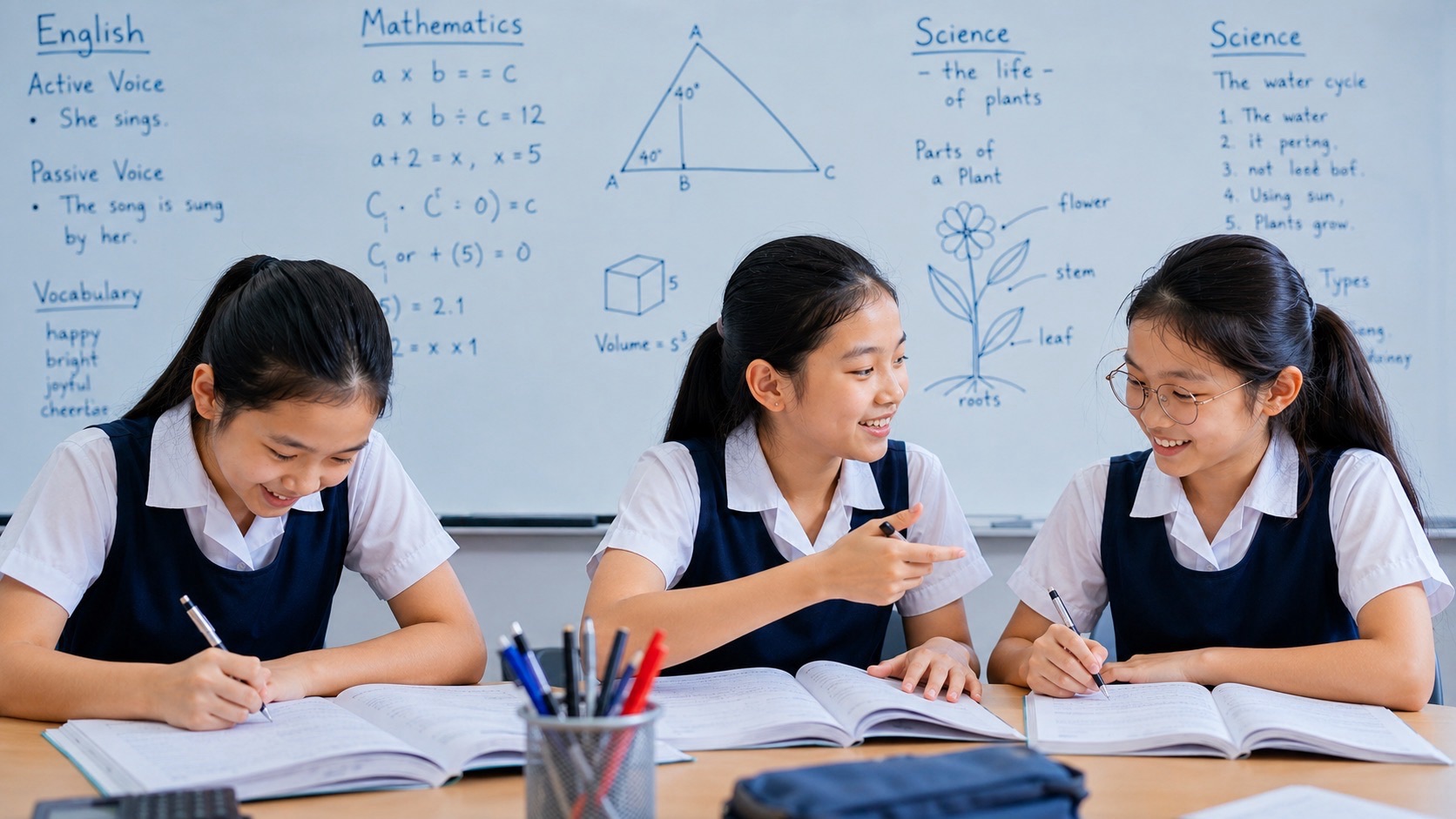
A child who did reasonably well in Primary Science can still feel unsettled when Secondary 1 Science begins. Parents may see new terms, longer explanations, unfamiliar diagrams and more independent work, then worry that the child has lost interest or is no longer capable. The change does not automatically mean that the child has a learning problem. It may mean that the child is adjusting to a different pace, a larger volume of terminology and a new expectation to explain scientific ideas more precisely.
Secondary Science builds on earlier learning but asks pupils to become more deliberate in how they use concepts, evidence, models and practical observations. The precise content and assessment expectations depend on the subject and level taken at the school. For families in Punggol, the first task is to identify which part of the transition is difficult: foundational knowledge, scientific language, independent study, mathematical skills used in Science, practical work or examination responses. This article gives parents a calm way to make that distinction and decide what support is appropriate.
At a glance: what changes when Science moves into secondary school?
- Students meet more specialised scientific vocabulary and are expected to use terms accurately.
- Topics may involve abstract models, symbols, relationships and explanations rather than only familiar everyday examples.
- In some areas, pupils need to use Mathematics, graphs, units or rearranged formulae to interpret scientific situations.
- Practical work requires careful observation, measurement, recording and safe procedures.
- Students usually need to organise their own revision across several subjects and teachers.
- Parents should identify the first weak step before adding tuition or increasing study hours.
Why a strong Primary Science pupil may struggle at first
Primary Science develops concepts through familiar contexts and an integrated view of the subject. Secondary learning can become more specialised and detailed. A child may have understood a primary-level idea in a practical or everyday context but may not yet be comfortable representing it with a diagram, model, symbol, equation or more formal explanation. This is a transition in the way knowledge is organised and communicated, not simply a matter of learning more pages.
The child may also face a different timetable, multiple subject teachers, longer homework instructions and a new system for tracking assignments. A pupil who previously relied on a parent to remind them of every task may need time to build an independent routine. These organisational pressures can make Science appear to be the problem even when the underlying difficulty is time management or adjustment to secondary school.
Problem 1: scientific vocabulary becomes more demanding
In primary school, a child may be able to describe a process in everyday language. At secondary level, the learner may need to distinguish between closely related scientific terms and use them in a precise way. A student who memorises definitions without understanding how the words differ can confuse them in a written answer. Long textbook sentences can also make the concept feel harder than it is.
Parents can help by asking the student to explain each new term in three ways: a simple meaning, an example, and a sentence showing how the term applies to the current topic. Ask the child to compare two similar terms and explain the difference. Avoid requiring the student to copy a full glossary without using the words in context. A small number of well-understood terms is more valuable than a large list that cannot be applied.
Problem 2: the child memorises facts but cannot see the model behind them
Science often uses models to represent things that cannot be observed directly or are too complex to understand at once. Students may need to think about particles, fields, cells, systems or transfers of energy. A model is a way of representing and explaining selected features of a real situation; it is not necessarily a photograph of reality. Children can become confused when they treat the model as a literal picture or memorise its labels without knowing what the parts represent.
When a new model is introduced, ask: What does each part represent? What can this model help us explain? What does it leave out? Can we use it to predict what may happen if one condition changes? These questions encourage the child to understand the purpose and limitations of a model instead of memorising a diagram mechanically.
Problem 3: Mathematics begins to affect Science confidence
Some secondary Science work uses measurement, ratios, graphs, units, rearrangement of simple equations or interpretation of numerical relationships. A student who is uncertain about the mathematical step may conclude that the whole Science topic is impossible. The difficulty might be with unit conversion, substituting values, reading axes, handling negative numbers or choosing the correct operation.
Parents can ask the child to show the exact line where the solution stops making sense. If the student understands the scientific idea but cannot complete the calculation, practise the relevant Mathematics skill separately and then return to the Science context. If the student can calculate but does not understand what the number represents, the gap is conceptual. Keeping these two problems separate prevents wasted revision.
Problem 4: practical work feels stressful or unfamiliar
Practical Science involves more than following instructions. Students need to observe accurately, handle equipment responsibly, record results clearly and understand why a procedure is used. A learner who rushes, worries about making a mistake or focuses only on finishing may miss important observations. Practical confidence grows through careful instruction and safe, supervised practice at school.
Parents should not try to recreate laboratory lessons at home with chemicals, flames, glassware, electrical equipment or other hazards. Instead, ask the student to describe what was investigated, what was changed, what was measured and what the results showed. Use school-provided diagrams, worksheets or recorded demonstrations when the practical activity itself cannot be repeated safely.
Problem 5: the child has not developed an independent Science study routine
Secondary students need to keep track of topic notes, corrections, assignments and upcoming assessments. Some students revise only when a test is announced. Others reread the textbook for long periods without checking whether they can explain the ideas. A pupil may also spend too much time on one difficult question and leave other topics untouched.
Help the child create a simple weekly cycle: review what was taught, identify one unclear point, retrieve key concepts without notes, correct errors and attempt a small number of questions. At the end of the week, check which topics can be explained independently and which still need teacher clarification. The purpose is not to fill every evening with extra work; it is to build a predictable method that can be sustained.
A four-week transition plan for parents and students
Week 1 — Map the difficulty. Gather recent worksheets and class notes. Identify whether errors concern vocabulary, concepts, Mathematics, practical skills or study organisation. Ask the student which part feels most confusing.
Week 2 — Repair one foundation at a time. Select one weak idea. Revisit the explanation, draw a simple model, define essential terms and work through one example with guidance. Do not try to repair the entire term in a few nights.
Week 3 — Practise independence. Use a fresh question. Let the student decide which concept applies, show the working and explain the answer. The parent should observe rather than supply each next step.
Week 4 — Review evidence of progress. Compare the new work with the original errors. Has the student become more accurate, more independent or better at explaining uncertainty? If the same problem persists, bring actual examples to the teacher and ask for a targeted next step.
How parents can distinguish a content gap from an adjustment problem
A content gap usually appears in a particular concept or skill. The child may be able to manage other subjects and daily routines but cannot explain a specific Science topic. An adjustment problem may be broader: the student forgets assignments, does not know how to organise notes, is overwhelmed by several teachers or has difficulty starting homework across subjects. These patterns need different support.
Ask the student to talk through one difficult Science question. If they cannot explain the words in the question, the first task may be reading comprehension or vocabulary. If they understand the question but cannot recall the concept, revisit the content. If they know the concept but cannot complete the numerical step, check the Mathematics foundation. If they can solve it with help but not alone, practise gradual independence.
What support options are reasonable?
- School teacher: ask which concepts or skills need attention and whether the child is meeting the expectations for the subject level.
- Home routine: support organisation, short retrieval practice and regular correction of errors.
- Targeted Science tuition: consider it when the child needs consistent subject-specific explanations, practice and feedback.
- Broader learning support: discuss persistent difficulties across several subjects with the school; consider professional advice when appropriate.
Do not assume that every Secondary 1 pupil who struggles needs a tutor. A few weeks of adjustment, better organisation or a clear explanation from the teacher may be enough. If tuition is considered, ask how the provider will identify gaps and measure independent progress. Avoid promises of guaranteed grades or claims that a child must master all secondary topics before the school has taught them.
Understanding the G1, G2 and G3 context
Under Full Subject-Based Banding, students may take subjects at different levels according to their learning needs and school arrangements. Parents should not treat a subject level as a permanent judgement of a child’s ability. Discuss the student’s demonstrated understanding, pace, confidence and longer-term learning goals with the school. The exact subject offering and examination route should be checked against the current school information and SEAB syllabus for the relevant year.
SEAB states that the Singapore-Cambridge Secondary Education Certificate (SEC) will replace the separate GCE N(T), N(A) and O-Level examinations from 2027. Students will sit subjects at their respective G1, G2 or G3 levels. Families should therefore avoid mixing 2026 examination arrangements with the 2027 SEC framework when planning ahead.
How eduKate Punggol approaches the transition
Our Punggol Science learning material is designed to help parents identify whether the issue is foundational knowledge, application, practical reasoning or answer construction. The Secondary Science curriculum guide can help families understand the later subject structure, while the G2 Science SEC preparation guide is relevant to families checking the next examination stage. These pages are reference material, not a reason to rush a student beyond the work being taught.
Frequently asked questions
Should my child revise all of Primary Science before Secondary 1?
Not necessarily. Identify the specific foundation that the current topic depends on. Review that concept when it is relevant rather than turning the school holiday into a complete re-teaching of every primary chapter.
Is Secondary Science mainly about memorising more terms?
No. Vocabulary matters, but pupils also need to understand concepts, models, evidence, practical methods and relationships. Memorisation without understanding can make unfamiliar questions harder.
When should I speak to the Science teacher?
Speak with the teacher when the same difficulty persists, the child cannot identify what to practise, or recent work shows a repeated misconception. Bring specific examples and ask for one or two priority actions.
Official and further reading
MOE Primary Science Teaching and Learning Syllabus · SEAB: Secondary Education Certificate (SEC) · SEAB: SEC syllabuses for school candidates · Punggol Secondary Science curriculum guide


