
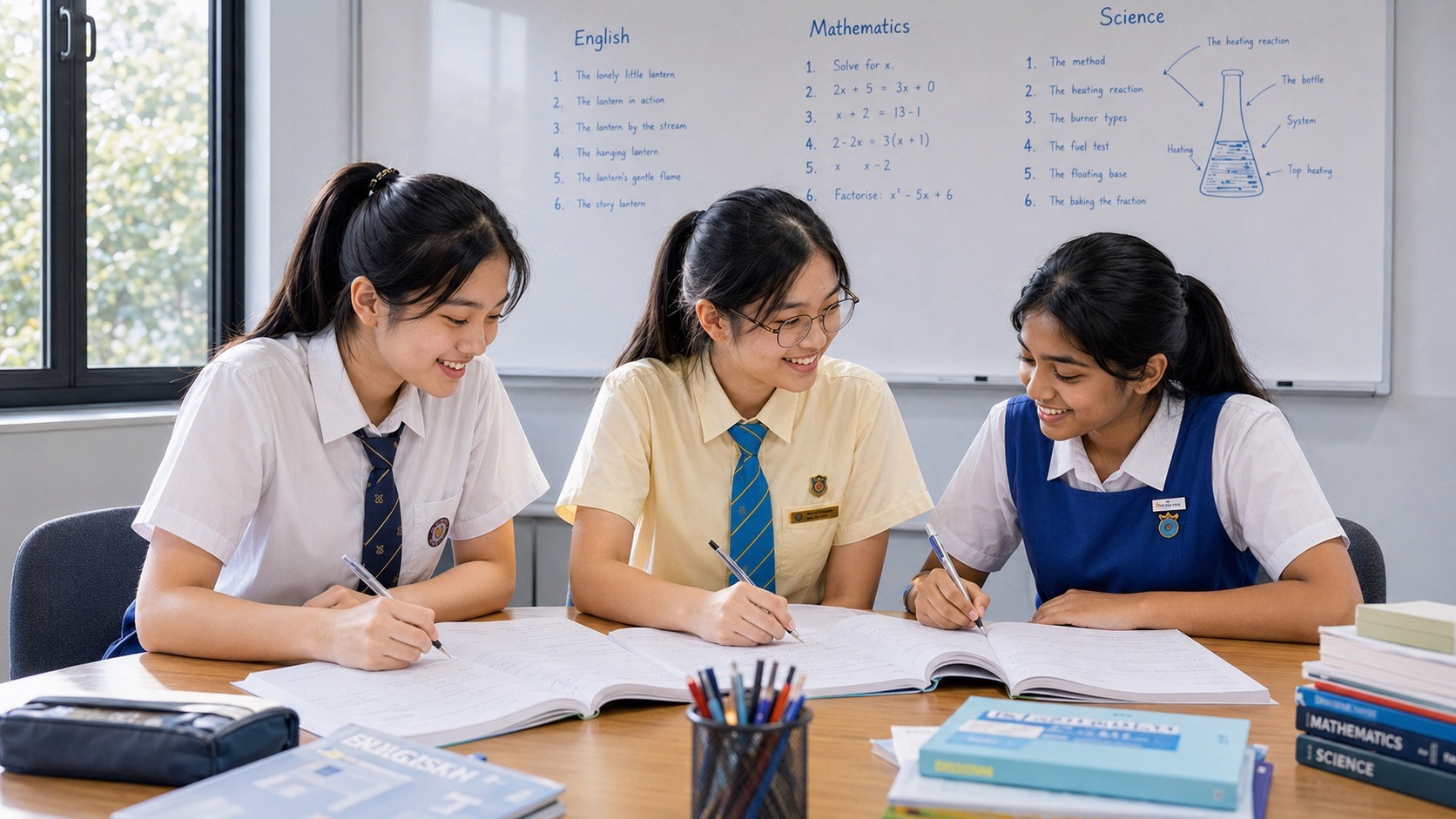
Mathematics examination preparation in Punggol for the 2026 Standard PSLE needs a clear distinction between the two papers. Calculators are not allowed in Paper 1, but they are allowed in Paper 2. This does not mean that Paper 2 is simply a calculator test. Pupils must still interpret the question, select the correct method, organise the steps and decide whether the result makes sense.
Parents may see a child entering calculations quickly yet still losing marks. The calculator may be used correctly for the wrong operation, or the child may enter a number incorrectly, forget brackets or accept an implausible answer without checking. The solution is to teach deliberate calculator habits alongside mathematical reasoning. A device should support calculation, not replace understanding.
- Confirm the calculator rules and permitted device guidance for the examination year.
- Ask the child to estimate the answer before entering a calculation where possible.
- Practise accurate entry, brackets and reading the display.
- Keep the mathematical method clear instead of writing only a calculator result.
- Check that the final result answers the question and uses the correct unit.
- Retain no-calculator practice for Paper 1.
What calculator permission means in the 2026 format
SEAB’s 2026 Standard PSLE Mathematics format specifies that Paper 2 lasts 1 hour 20 minutes, carries 50 marks and allows calculator use. Paper 1 carries the other 50 marks, lasts 1 hour 10 minutes and does not allow calculators. See the SEAB PSLE format page and published syllabus. Parents should use the school’s instructions for the approved calculator and examination arrangements.
Calculator permission does not tell a pupil which operation to perform. If the child multiplies when the question requires division, the calculator will produce a precise answer to the wrong calculation. The student must understand the relationship before pressing keys.
Teach a three-stage calculator habit
Before pressing the buttons: plan
The child should identify what is being found, list the relevant quantities and decide on the mathematical relationship. For a calculation involving several operations, the pupil should know which parts belong together. Ask the child to describe the intended calculation in words before entering it.
During entry: enter carefully
Teach the student to copy numbers slowly and check decimal points, signs and brackets. A calculator display can look convincing even when a digit has been mistyped. For multi-step calculations, use brackets where necessary. Practise the functions that are actually permitted and appropriate for the examination, rather than introducing unnecessary advanced features.
After entry: interpret
The calculator output is not automatically the answer. Ask whether the value is the right size, whether the unit is correct and whether it represents what the question asks. If a question asks for a whole number of objects, the student must consider the context and relevant instructions rather than blindly copying a decimal display.
Common calculator-related errors
| Error pattern | Why it happens | Teaching response |
|---|---|---|
| Wrong digits entered | The child rushes or copies inaccurately | Read each number from the question and check the display. |
| Missing brackets | The grouping is not represented correctly | Say the calculation aloud and identify which terms belong together. |
| Wrong operation | Numbers are entered before the relationship is interpreted | Write the intended operation or equation first. |
| Decimal or negative sign missed | Small display details are overlooked | Compare the entered expression with the written plan. |
| Answer accepted without context check | Calculator output is treated as automatically correct | Estimate the expected size and interpret the result with units. |
Keep written reasoning visible
For structured and long-answer questions, the child should make the mathematical approach understandable. The calculator performs a numerical operation, but it does not show why that operation is appropriate. The written solution should identify the relevant relationship and show the necessary steps clearly according to the question and school guidance.
Do not teach the child to write a long explanation for every calculation. The aim is clear working, not unnecessary words. A diagram, equation, labelled calculation or concise statement may be suitable depending on the question. Parents should use marked schoolwork and teacher feedback to understand what level of working is expected.
A short practice sequence for home
- Give the child a Paper 2-style question that has already been taught.
- Ask the child to identify the unknown and write the calculation or method first.
- Ask for an estimate of the likely answer where meaningful.
- Let the child enter the calculation, checking digits and brackets.
- Ask the child to explain what the display means in the context of the question.
- Check units, reasonableness and any rounding or whole-number instruction.
- Repeat with a different question after a gap.
If the child can complete the calculation but cannot explain why it is needed, return to the mathematical concept. If the method is correct but the display is wrong, practise entry and notation. If the display is correct but the final answer is unsuitable, focus on interpretation and units. Separate these errors instead of treating every calculator mistake alike.
Do not let calculator practice weaken Paper 1
A pupil preparing for both papers needs different routines. Paper 1 practice must be done without a calculator under the applicable examination rules. Paper 2 practice should include appropriate calculator use while preserving estimation, number sense and written reasoning. Some short activities can be done with the calculator put aside, especially when the purpose is to retrieve number facts or judge the size of an answer.
Do not create a false choice between mental arithmetic and calculator use. Both have a role. The important thing is to know which paper is being practised and why the tool is or is not permitted.
What if the calculator itself causes anxiety?
Use the same permitted device for familiar practice where school guidance allows, so that the child can learn the buttons and display. Start with basic operations, then practise the functions needed for the child’s current syllabus. Avoid last-minute device changes or unfamiliar shortcuts. If the child becomes very anxious, ask the teacher to confirm the examination requirements and guide the practice routine.
Parent questions
Can my child use a calculator for every question in Paper 2?
The 2026 Standard Mathematics syllabus permits calculators in Paper 2. However, pupils must still follow the examination instructions and show or provide the required responses. Calculator permission does not remove the need to demonstrate mathematical understanding.
Should my child enter the whole expression in one go?
Only if they understand the expression and can enter it correctly. Some calculations are safer in stages. The child should know what each part represents and use brackets where necessary.
Does a calculator prevent arithmetic mistakes?
It can reduce some manual calculation errors, but it cannot prevent wrong data entry, unsuitable operations, incorrect grouping or poor interpretation. Estimation and checking remain important.
Should Paper 1 and Paper 2 use the same revision method?
No. Both papers assess Mathematics, but the permitted tools and question structures differ. Maintain no-calculator accuracy for Paper 1 and practise deliberate calculator use plus structured reasoning for Paper 2.
Related Punggol parent guides
- 2026 PSLE Mathematics Paper 1 and Paper 2 guide
- How can my child build confidence in Paper 1 without a calculator?
- How can my child make written answers and working clearer?
Prepared for parents in Punggol and Sengkang. The calculator guidance here concerns the 2026 Standard PSLE Mathematics Paper 2 format. Always check the latest SEAB syllabus and the school’s approved-calculator instructions.


