
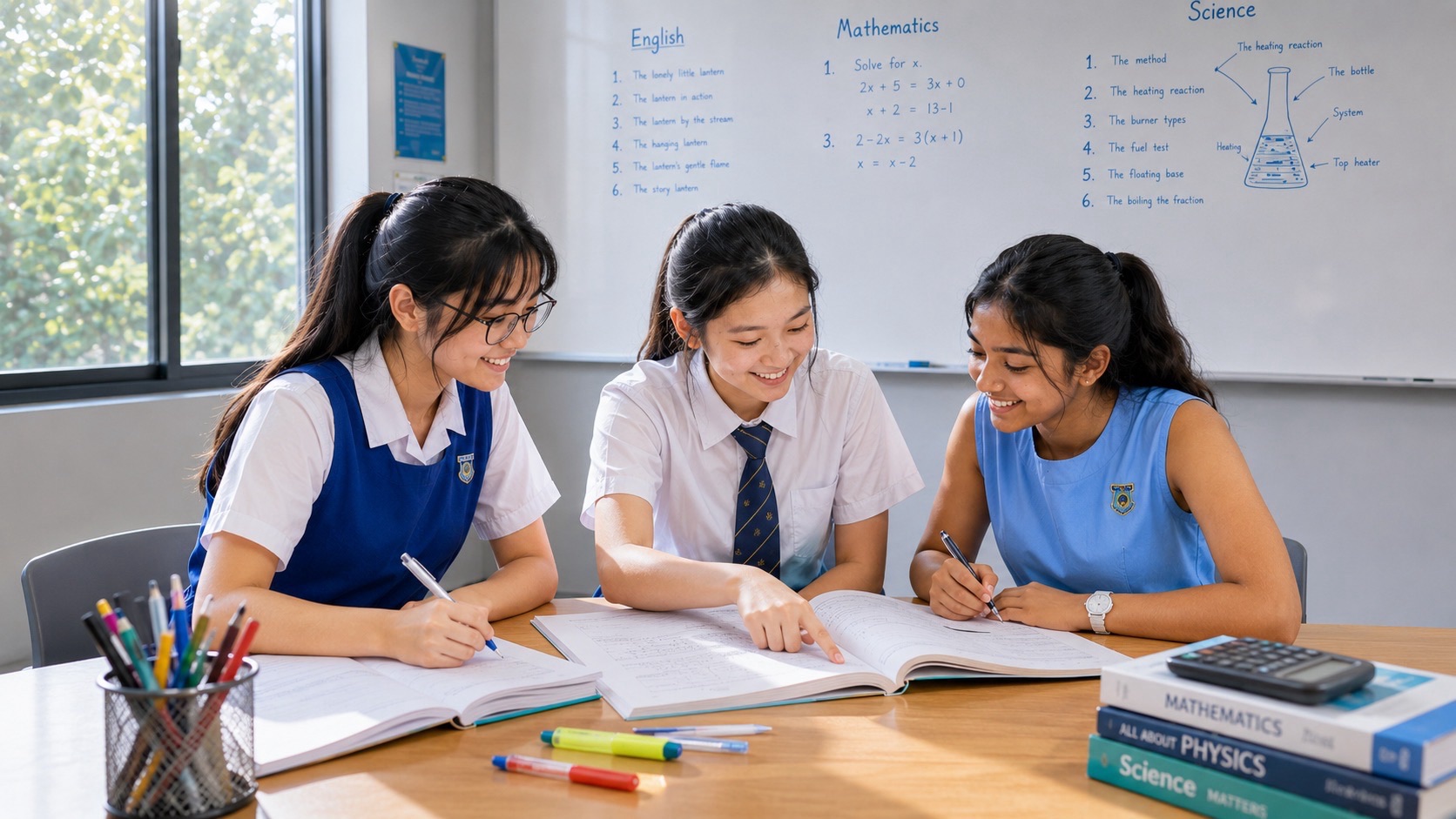
Your child asks an AI tool to summarise a chapter or generate examination notes. The result looks organised and easy to read, so the family may assume it is accurate and complete. But an AI-generated summary can omit an important condition, introduce an error, use an unfamiliar explanation or refer to a syllabus that does not match the child’s subject and year.
AI can be a useful study assistant when students use it to organise ideas, generate practice questions or explain a concept in another way. It should not become the final authority on what the child must learn. Check important information against school notes, textbooks and current official syllabus documents. Then ask the child to explain and apply the learning without relying on the generated material.
- Use AI to support learning, not to replace school notes or teacher explanations.
- Check every important fact, definition, formula and example against trusted materials.
- Confirm that the generated notes match the child’s subject, level and examination year.
- Ask the tool to identify uncertainty and provide questions rather than accepting confident wording blindly.
- Turn the notes into retrieval and application practice, then attempt questions independently.
- Follow school rules on AI use and never assume external tools are permitted during an assessment.
This guide is for parents in Punggol and Sengkang whose children use AI tools as part of examination revision. The tool can help generate a starting point, but the student remains responsible for checking, understanding and applying the material. School instructions and assessment-integrity rules take priority.
1. Treat the AI summary as a draft, not an official source
An AI tool may produce a fluent explanation that sounds convincing even when a detail is wrong or incomplete. It may combine information from different syllabuses, use outdated terminology or simplify a concept until an important qualification disappears.
Ask the child to compare the summary with the current lesson notes and textbook. If a statement cannot be verified, do not memorise it as fact. Record the uncertainty and ask the teacher when the point matters to the syllabus or assessment.
2. Check syllabus, level and examination year
Prompts should identify the child’s subject, level, syllabus code where available and examination year. This reduces the risk that the tool generates material for a different course. It does not guarantee accuracy, so the output still needs to be checked.
For national examinations, use SEAB’s published syllabuses and assessment information as the reference. For school tests, use the teacher’s stated coverage. Do not allow an AI summary to define what is examinable.
3. Ask AI to explain, compare or generate questions—not just shorten notes
Useful study prompts can ask for a simpler explanation of a concept, a comparison between two ideas, a set of practice questions at the correct level or a checklist of points to verify against the textbook. The child should then assess whether the output is relevant and correct.
For example, ask the tool to generate questions from a supplied school note and then check whether each question reflects the actual content. If the tool adds facts that were not in the note, separate them and verify them before using them.
4. Verify important information line by line
Check definitions, formulas, units, dates, processes and worked examples against trusted materials. In Mathematics, work through the generated solution and verify each step. In Science, ensure the concept is scientifically accurate and applied to the right context. In English, check that examples are grammatically sound and the language fits the intended meaning.
Do not accept an answer merely because it agrees with what the child hoped to see. A generated response may confirm a mistaken belief. Verification is part of the revision task.
5. Turn the notes into active learning
Once verified, close the notes and ask the child to explain the main ideas. Use short questions, diagrams or worked examples to check recall. Then attempt a fresh question that requires application. A child who can only recognise the AI summary when reading it has not yet demonstrated independent learning.
Use the generated material as a bridge towards independent performance, not as a permanent prompt that the child needs beside every question.
6. Avoid letting AI do the child’s thinking
If a student asks AI to solve every practice question, they may collect many correct-looking answers without learning how to reach them. A better sequence is to make an attempt first, ask for a hint or explanation when stuck, and then solve a new question without assistance.
Parents should encourage the child to explain which part of the AI response they accepted, rejected or corrected. This makes the verification process visible and builds judgment.
7. Protect privacy and follow school rules
Do not upload personal details, confidential school records or another student’s work into an AI tool without permission and a clear understanding of the tool’s privacy arrangements. Follow age requirements and any family or school rules for use.
During examinations and graded assessments, follow the instructions about permitted resources. An open-book or digital assessment does not automatically permit internet access, AI assistance or collaboration. Never assume a tool is allowed unless the specific assessment rules say so.
8. Know when a teacher’s explanation is still needed
If AI-generated explanations conflict with the school notes, or the child remains confused after several attempts, take the specific question to the teacher. AI can offer another wording, but it cannot replace the teacher’s understanding of the child’s classroom progress, assessment requirements and expected methods.
A safe AI revision check
- Is the prompt tied to the correct subject, level and syllabus?
- Have the facts and worked examples been verified against school materials?
- Are any claims unsupported, uncertain or outside the assessment scope?
- Can the child explain the material without looking at the AI output?
- Can the child answer a fresh question independently?
- Does the planned use comply with school and assessment rules?
Questions parents commonly ask
Can AI make all my child’s revision notes?
It can help create drafts or organise supplied material, but the child and parent should verify the output. AI-generated notes should not replace the current syllabus, school notes or teacher guidance.
Should my child trust AI explanations if they sound detailed?
No. Fluency is not proof of accuracy. Check important explanations, calculations and examples against reliable sources.
Can AI generate mock examination papers?
It can generate practice questions, but their accuracy, difficulty and syllabus alignment must be checked. They are supplementary practice, not official examination papers or predictions.
Can my child use AI during an examination?
Only if the specific assessment instructions explicitly permit it. Most students should assume no external assistance unless the school or examining body clearly states otherwise.
Further guidance
- Choose the Right Revision Books and Materials
- Help My Child Remember What They Study
- SEAB SEC Syllabuses for School Candidates
Prepared for parents in Punggol and Sengkang. Information checked on 22 November 2026. Follow school policies, age requirements, privacy guidance and the current examination rules for AI and external resources.


