
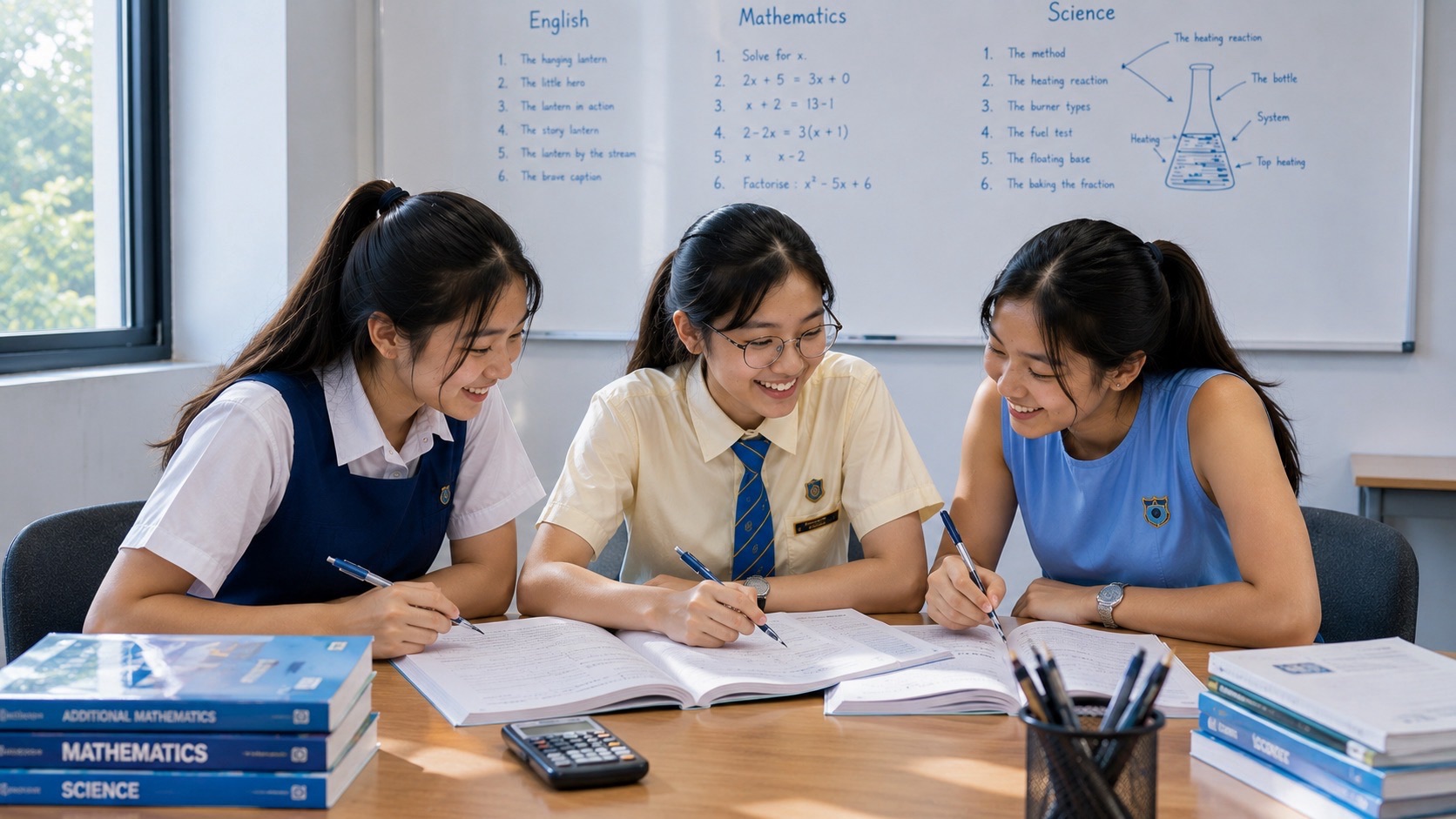
- Actual school and track eligibility.
- Curriculum, individual G-level subject options and support.
- ALP activities for everyone versus selected groups.
- CCA access and training days.
- Full morning and late-CCA route.
- Student preference and family feasibility.
Frequently asked questions
Are Bukit Batok Secondary and Bukit View the same school? No; they have different campuses and distinctive programmes.
Where is Bukit Batok Secondary? 50 Bukit Batok West Avenue 8.
What is Bukit View’s JOULES? A clean-energy and sustainability applied programme.
What does Dunearn offer in applied learning? Industry-related modules including food innovation, coding and design examples.
What are Hillgrove’s upper-secondary applied subjects? The published 2026 list includes Mobile Robotics (G1) and Electronics (G3), subject to future availability.
Where is Swiss Cottage Secondary? 3 Bukit Batok Street 34, near Bukit Gombak.
Is Jurongville near Jurong East MRT? It is on Jurong East Avenue 1 with several bus connections; check the full route.
Did Hong Kah Secondary merge into Jurongville? Yes, in 2019.
Is Commonwealth Secondary beside Commonwealth MRT? No; its actual campus is 698 West Coast Road.
What is Crest Secondary’s educational focus? Practice-oriented applied and ITE Skills Subject learning for eligible pupils.
Can every PG3 pupil choose Crest? No; its specialised eligibility focuses on PG1 and the PG1/PG2 option band.
Should an eligible Crest applicant still submit normal choices? Follow the current MOE and Crest invitation; the SEAB/MOE release advises applicants to retain S1 Option Form choices.
Can a PG2 pupil take some G3 subjects? Where eligibility and school arrangements allow.
Is an ALP equivalent to IP? No, they are different curricula.
Does an old COP guarantee a 2027 place? No, it is a historical reference.
When is the confirmed 2026 school-choice deadline? 4:30 pm on 30 November 2026.
Official sources and local Punggol comparisons
Checked 20 November 2026. This guide uses school-operated programme and contact sources and MOE’s confirmed 2026 PSLE timetable. Reconfirm current subject offerings, fares, admissions routes and opening times before acting.
SEAB/MOE PSLE 2026 release; MOE SchoolFinder; Bukit Batok Secondary STEM; Bukit View JOULES; Dunearn applied modules; Hillgrove subjects; Swiss Cottage programmes; Jurongville electronics; Commonwealth eco stewardship; Crest eligibility.
Nearby existing eduKate guides: Four Punggol schools; Bukit Panjang and Choa Chu Kang; Clementi, Dover and Bukit Timah; immutable teaching reference.
Next action: identify one eligible west-side school with a distinctive programme, check its correct admission route and compare its full school-day journey with a local Punggol option. Do not put a specialised school on a standard six-choice list unless the official rules explicitly permit that choice.
Three fictional family scenarios
Case A: a strong Science pupil. The family considers Bukit View JOULES and Commonwealth Eco Stewardship, alongside Punggol Secondary. They compare the real student experiments, ask how Science and Maths foundations are taught, and test both long journeys. A stronger programme fit may justify travel, but an old cut-off alone does not.
Case B: a pupil who enjoys robotics. The family investigates Jurongville’s electronics, Hillgrove’s applied subjects and a nearer Greendale or Compassvale programme. They check whether the relevant activity is a whole-cohort module or an upper-secondary subject that might not be available until later.
Case C: a PG1-eligible pupil seeking applied learning. Parents explore Crest through its authorised application process, ask about support and vocational subjects, and also prepare an eligible mainstream six-choice list when instructed. They understand Crest is not a generic PG3 or IP choice.
Each case respects the pupil’s actual opportunities and the home’s practical constraints rather than promising admission.
What parents should ask on an open-house visit
Begin with school and programme eligibility. Ask which Posting Groups and particular G-level subjects the school offers, and how subject-level movement is considered after evidence of readiness. For a specialised school, ask about the exact application process and how it interacts with normal posting.
Next ask what ordinary pupils experience under the ALP, which extensions are selected, and how teachers support learners who struggle with a prerequisite concept. If the school offers robotics or electronics, ask whether the child is taught to reason and explain rather than merely assemble something.
Ask about school culture and first-term support. A child should know where to get help, how CCA allocation works and which adult to approach when the new school day feels overwhelming.
Before leaving, confirm the main gate, morning reporting time and typical CCA dismissal. For a family travelling from Punggol, those facts can materially change whether a school belongs in the six choices.
- Actual school and track eligibility.
- Curriculum, individual G-level subject options and support.
- ALP activities for everyone versus selected groups.
- CCA access and training days.
- Full morning and late-CCA route.
- Student preference and family feasibility.
Frequently asked questions
Are Bukit Batok Secondary and Bukit View the same school? No; they have different campuses and distinctive programmes.
Where is Bukit Batok Secondary? 50 Bukit Batok West Avenue 8.
What is Bukit View’s JOULES? A clean-energy and sustainability applied programme.
What does Dunearn offer in applied learning? Industry-related modules including food innovation, coding and design examples.
What are Hillgrove’s upper-secondary applied subjects? The published 2026 list includes Mobile Robotics (G1) and Electronics (G3), subject to future availability.
Where is Swiss Cottage Secondary? 3 Bukit Batok Street 34, near Bukit Gombak.
Is Jurongville near Jurong East MRT? It is on Jurong East Avenue 1 with several bus connections; check the full route.
Did Hong Kah Secondary merge into Jurongville? Yes, in 2019.
Is Commonwealth Secondary beside Commonwealth MRT? No; its actual campus is 698 West Coast Road.
What is Crest Secondary’s educational focus? Practice-oriented applied and ITE Skills Subject learning for eligible pupils.
Can every PG3 pupil choose Crest? No; its specialised eligibility focuses on PG1 and the PG1/PG2 option band.
Should an eligible Crest applicant still submit normal choices? Follow the current MOE and Crest invitation; the SEAB/MOE release advises applicants to retain S1 Option Form choices.
Can a PG2 pupil take some G3 subjects? Where eligibility and school arrangements allow.
Is an ALP equivalent to IP? No, they are different curricula.
Does an old COP guarantee a 2027 place? No, it is a historical reference.
When is the confirmed 2026 school-choice deadline? 4:30 pm on 30 November 2026.
Official sources and local Punggol comparisons
Checked 20 November 2026. This guide uses school-operated programme and contact sources and MOE’s confirmed 2026 PSLE timetable. Reconfirm current subject offerings, fares, admissions routes and opening times before acting.
SEAB/MOE PSLE 2026 release; MOE SchoolFinder; Bukit Batok Secondary STEM; Bukit View JOULES; Dunearn applied modules; Hillgrove subjects; Swiss Cottage programmes; Jurongville electronics; Commonwealth eco stewardship; Crest eligibility.
Nearby existing eduKate guides: Four Punggol schools; Bukit Panjang and Choa Chu Kang; Clementi, Dover and Bukit Timah; immutable teaching reference.
Next action: identify one eligible west-side school with a distinctive programme, check its correct admission route and compare its full school-day journey with a local Punggol option. Do not put a specialised school on a standard six-choice list unless the official rules explicitly permit that choice.
- Home-to-gate time at the actual reporting hour.
- Public transport waiting and transfer burden.
- Safe route after CCA or outdoor activities.
- Monthly fares, materials and applicable assistance.
- Time for study, meals, friendships and sleep.
Three fictional family scenarios
Case A: a strong Science pupil. The family considers Bukit View JOULES and Commonwealth Eco Stewardship, alongside Punggol Secondary. They compare the real student experiments, ask how Science and Maths foundations are taught, and test both long journeys. A stronger programme fit may justify travel, but an old cut-off alone does not.
Case B: a pupil who enjoys robotics. The family investigates Jurongville’s electronics, Hillgrove’s applied subjects and a nearer Greendale or Compassvale programme. They check whether the relevant activity is a whole-cohort module or an upper-secondary subject that might not be available until later.
Case C: a PG1-eligible pupil seeking applied learning. Parents explore Crest through its authorised application process, ask about support and vocational subjects, and also prepare an eligible mainstream six-choice list when instructed. They understand Crest is not a generic PG3 or IP choice.
Each case respects the pupil’s actual opportunities and the home’s practical constraints rather than promising admission.
What parents should ask on an open-house visit
Begin with school and programme eligibility. Ask which Posting Groups and particular G-level subjects the school offers, and how subject-level movement is considered after evidence of readiness. For a specialised school, ask about the exact application process and how it interacts with normal posting.
Next ask what ordinary pupils experience under the ALP, which extensions are selected, and how teachers support learners who struggle with a prerequisite concept. If the school offers robotics or electronics, ask whether the child is taught to reason and explain rather than merely assemble something.
Ask about school culture and first-term support. A child should know where to get help, how CCA allocation works and which adult to approach when the new school day feels overwhelming.
Before leaving, confirm the main gate, morning reporting time and typical CCA dismissal. For a family travelling from Punggol, those facts can materially change whether a school belongs in the six choices.
- Actual school and track eligibility.
- Curriculum, individual G-level subject options and support.
- ALP activities for everyone versus selected groups.
- CCA access and training days.
- Full morning and late-CCA route.
- Student preference and family feasibility.
Frequently asked questions
Are Bukit Batok Secondary and Bukit View the same school? No; they have different campuses and distinctive programmes.
Where is Bukit Batok Secondary? 50 Bukit Batok West Avenue 8.
What is Bukit View’s JOULES? A clean-energy and sustainability applied programme.
What does Dunearn offer in applied learning? Industry-related modules including food innovation, coding and design examples.
What are Hillgrove’s upper-secondary applied subjects? The published 2026 list includes Mobile Robotics (G1) and Electronics (G3), subject to future availability.
Where is Swiss Cottage Secondary? 3 Bukit Batok Street 34, near Bukit Gombak.
Is Jurongville near Jurong East MRT? It is on Jurong East Avenue 1 with several bus connections; check the full route.
Did Hong Kah Secondary merge into Jurongville? Yes, in 2019.
Is Commonwealth Secondary beside Commonwealth MRT? No; its actual campus is 698 West Coast Road.
What is Crest Secondary’s educational focus? Practice-oriented applied and ITE Skills Subject learning for eligible pupils.
Can every PG3 pupil choose Crest? No; its specialised eligibility focuses on PG1 and the PG1/PG2 option band.
Should an eligible Crest applicant still submit normal choices? Follow the current MOE and Crest invitation; the SEAB/MOE release advises applicants to retain S1 Option Form choices.
Can a PG2 pupil take some G3 subjects? Where eligibility and school arrangements allow.
Is an ALP equivalent to IP? No, they are different curricula.
Does an old COP guarantee a 2027 place? No, it is a historical reference.
When is the confirmed 2026 school-choice deadline? 4:30 pm on 30 November 2026.
Official sources and local Punggol comparisons
Checked 20 November 2026. This guide uses school-operated programme and contact sources and MOE’s confirmed 2026 PSLE timetable. Reconfirm current subject offerings, fares, admissions routes and opening times before acting.
SEAB/MOE PSLE 2026 release; MOE SchoolFinder; Bukit Batok Secondary STEM; Bukit View JOULES; Dunearn applied modules; Hillgrove subjects; Swiss Cottage programmes; Jurongville electronics; Commonwealth eco stewardship; Crest eligibility.
Nearby existing eduKate guides: Four Punggol schools; Bukit Panjang and Choa Chu Kang; Clementi, Dover and Bukit Timah; immutable teaching reference.
Next action: identify one eligible west-side school with a distinctive programme, check its correct admission route and compare its full school-day journey with a local Punggol option. Do not put a specialised school on a standard six-choice list unless the official rules explicitly permit that choice.
How to compare an academic programme with hands-on learning
Some Punggol parents want a school where their child can explore environmental experiments, electronics, food innovation or creative making. The Bukit Batok–Jurong East corridor offers several ways to do that, but they are not all equivalent and cannot be arranged on a single ‘STEM ranking’.
JOULES emphasises clean energy and sustainability; Jurongville focuses on electronics and smart technology; Commonwealth uses ecology and community stewardship; Dunearn gives practical exposure to industries; Bukit Batok Secondary uses design thinking and environmental problem-solving. Crest has a distinct practice-oriented curriculum and admission population.
Ask what a normal first-year pupil actually does. Does the work require research, numerical reasoning, explanation, teamwork or building a physical prototype? Which parts are universal and which depend on selection? A detailed answer is more useful than the word ‘innovation’.
Match academic support to the child’s needs. A pupil strong in building but developing reading skills may need a different pace or feedback from one who reads well and wants more advanced Maths. Full SBB’s subject-specific flexibility can be relevant, but must follow the school’s actual criteria.
Finally compare with nearby Punggol programmes. When a nearer school offers suitable learning, an extra cross-island journey needs a genuine benefit the child can explain.
The 2026 PSLE result release and six-school choices
The 2026 PSLE result release is confirmed for Tuesday 24 November at 11:00 am. School candidates obtain their results using the arrangements set by their primary school. The official S1 Portal opens at 11:30 am the same day and closes at 4:30 pm on Monday 30 November 2026.
Families should read all four subject Achievement Levels and the child’s personalised Posting Group eligibility. At specified boundary scores, a choice between two groups may be permitted. Follow the current form instructions rather than invent a school list combining incompatible group data.
MOE advises six genuine preferences and two or three schools with previous cut-offs less stringent than the child’s PSLE Score. A previous intake’s cut-off is evidence of past admission demand, not a minimum set in advance for the next year.
Specialised applications such as Crest can have a separate process and should be handled according to MOE and school instructions while maintaining the normal S1 form as directed. Successful DSA candidates follow their specific allocation and commitment rules.
The 2026 posting outcome is tentatively expected on 18 December, with MOE to confirm any later change. Parents should not call a tentative future date a settled result.
The real Punggol-to-west travel budget
A school near Bukit Gombak may require a different set of rail connections from one near Jurong East, and a West Coast Road campus needs a further last-mile route. The first journey from a Punggol block can vary considerably, particularly for households on the LRT loops.
Record the morning assembly time, first bus or train, transfers, final school gate and total travel. Repeat the process after CCA, when a child may be tired or carrying equipment. For schools with offsite applied modules or additional language lessons, the actual weekly journey may involve more than two destinations.
Calculate student fares and consider whether a monthly concession pass is cheaper than pay-per-ride use. Add school meals, books, uniforms and any specialist CCA equipment; ask about financial assistance through the school’s authorised channel where necessary.
Distance is not a Primary 1-style priority advantage in normal S1 posting. It is a real condition of the pupil’s everyday life and can affect homework, sleep and whether they participate fully in programmes.
An attractive school should remain attractive when the routine is tested on a normal Wednesday, not only during an open house.
- Home-to-gate time at the actual reporting hour.
- Public transport waiting and transfer burden.
- Safe route after CCA or outdoor activities.
- Monthly fares, materials and applicable assistance.
- Time for study, meals, friendships and sleep.
Three fictional family scenarios
Case A: a strong Science pupil. The family considers Bukit View JOULES and Commonwealth Eco Stewardship, alongside Punggol Secondary. They compare the real student experiments, ask how Science and Maths foundations are taught, and test both long journeys. A stronger programme fit may justify travel, but an old cut-off alone does not.
Case B: a pupil who enjoys robotics. The family investigates Jurongville’s electronics, Hillgrove’s applied subjects and a nearer Greendale or Compassvale programme. They check whether the relevant activity is a whole-cohort module or an upper-secondary subject that might not be available until later.
Case C: a PG1-eligible pupil seeking applied learning. Parents explore Crest through its authorised application process, ask about support and vocational subjects, and also prepare an eligible mainstream six-choice list when instructed. They understand Crest is not a generic PG3 or IP choice.
Each case respects the pupil’s actual opportunities and the home’s practical constraints rather than promising admission.
What parents should ask on an open-house visit
Begin with school and programme eligibility. Ask which Posting Groups and particular G-level subjects the school offers, and how subject-level movement is considered after evidence of readiness. For a specialised school, ask about the exact application process and how it interacts with normal posting.
Next ask what ordinary pupils experience under the ALP, which extensions are selected, and how teachers support learners who struggle with a prerequisite concept. If the school offers robotics or electronics, ask whether the child is taught to reason and explain rather than merely assemble something.
Ask about school culture and first-term support. A child should know where to get help, how CCA allocation works and which adult to approach when the new school day feels overwhelming.
Before leaving, confirm the main gate, morning reporting time and typical CCA dismissal. For a family travelling from Punggol, those facts can materially change whether a school belongs in the six choices.
- Actual school and track eligibility.
- Curriculum, individual G-level subject options and support.
- ALP activities for everyone versus selected groups.
- CCA access and training days.
- Full morning and late-CCA route.
- Student preference and family feasibility.
Frequently asked questions
Are Bukit Batok Secondary and Bukit View the same school? No; they have different campuses and distinctive programmes.
Where is Bukit Batok Secondary? 50 Bukit Batok West Avenue 8.
What is Bukit View’s JOULES? A clean-energy and sustainability applied programme.
What does Dunearn offer in applied learning? Industry-related modules including food innovation, coding and design examples.
What are Hillgrove’s upper-secondary applied subjects? The published 2026 list includes Mobile Robotics (G1) and Electronics (G3), subject to future availability.
Where is Swiss Cottage Secondary? 3 Bukit Batok Street 34, near Bukit Gombak.
Is Jurongville near Jurong East MRT? It is on Jurong East Avenue 1 with several bus connections; check the full route.
Did Hong Kah Secondary merge into Jurongville? Yes, in 2019.
Is Commonwealth Secondary beside Commonwealth MRT? No; its actual campus is 698 West Coast Road.
What is Crest Secondary’s educational focus? Practice-oriented applied and ITE Skills Subject learning for eligible pupils.
Can every PG3 pupil choose Crest? No; its specialised eligibility focuses on PG1 and the PG1/PG2 option band.
Should an eligible Crest applicant still submit normal choices? Follow the current MOE and Crest invitation; the SEAB/MOE release advises applicants to retain S1 Option Form choices.
Can a PG2 pupil take some G3 subjects? Where eligibility and school arrangements allow.
Is an ALP equivalent to IP? No, they are different curricula.
Does an old COP guarantee a 2027 place? No, it is a historical reference.
When is the confirmed 2026 school-choice deadline? 4:30 pm on 30 November 2026.
Official sources and local Punggol comparisons
Checked 20 November 2026. This guide uses school-operated programme and contact sources and MOE’s confirmed 2026 PSLE timetable. Reconfirm current subject offerings, fares, admissions routes and opening times before acting.
SEAB/MOE PSLE 2026 release; MOE SchoolFinder; Bukit Batok Secondary STEM; Bukit View JOULES; Dunearn applied modules; Hillgrove subjects; Swiss Cottage programmes; Jurongville electronics; Commonwealth eco stewardship; Crest eligibility.
Nearby existing eduKate guides: Four Punggol schools; Bukit Panjang and Choa Chu Kang; Clementi, Dover and Bukit Timah; immutable teaching reference.
Next action: identify one eligible west-side school with a distinctive programme, check its correct admission route and compare its full school-day journey with a local Punggol option. Do not put a specialised school on a standard six-choice list unless the official rules explicitly permit that choice.
- MOE/SEAB 2026 eligibility and procedures: official PSLE release.
- Crest admissions FAQ: PG1 and application routes.
- Crest campus: 561 Jurong East Street 24.
How to compare an academic programme with hands-on learning
Some Punggol parents want a school where their child can explore environmental experiments, electronics, food innovation or creative making. The Bukit Batok–Jurong East corridor offers several ways to do that, but they are not all equivalent and cannot be arranged on a single ‘STEM ranking’.
JOULES emphasises clean energy and sustainability; Jurongville focuses on electronics and smart technology; Commonwealth uses ecology and community stewardship; Dunearn gives practical exposure to industries; Bukit Batok Secondary uses design thinking and environmental problem-solving. Crest has a distinct practice-oriented curriculum and admission population.
Ask what a normal first-year pupil actually does. Does the work require research, numerical reasoning, explanation, teamwork or building a physical prototype? Which parts are universal and which depend on selection? A detailed answer is more useful than the word ‘innovation’.
Match academic support to the child’s needs. A pupil strong in building but developing reading skills may need a different pace or feedback from one who reads well and wants more advanced Maths. Full SBB’s subject-specific flexibility can be relevant, but must follow the school’s actual criteria.
Finally compare with nearby Punggol programmes. When a nearer school offers suitable learning, an extra cross-island journey needs a genuine benefit the child can explain.
The 2026 PSLE result release and six-school choices
The 2026 PSLE result release is confirmed for Tuesday 24 November at 11:00 am. School candidates obtain their results using the arrangements set by their primary school. The official S1 Portal opens at 11:30 am the same day and closes at 4:30 pm on Monday 30 November 2026.
Families should read all four subject Achievement Levels and the child’s personalised Posting Group eligibility. At specified boundary scores, a choice between two groups may be permitted. Follow the current form instructions rather than invent a school list combining incompatible group data.
MOE advises six genuine preferences and two or three schools with previous cut-offs less stringent than the child’s PSLE Score. A previous intake’s cut-off is evidence of past admission demand, not a minimum set in advance for the next year.
Specialised applications such as Crest can have a separate process and should be handled according to MOE and school instructions while maintaining the normal S1 form as directed. Successful DSA candidates follow their specific allocation and commitment rules.
The 2026 posting outcome is tentatively expected on 18 December, with MOE to confirm any later change. Parents should not call a tentative future date a settled result.
The real Punggol-to-west travel budget
A school near Bukit Gombak may require a different set of rail connections from one near Jurong East, and a West Coast Road campus needs a further last-mile route. The first journey from a Punggol block can vary considerably, particularly for households on the LRT loops.
Record the morning assembly time, first bus or train, transfers, final school gate and total travel. Repeat the process after CCA, when a child may be tired or carrying equipment. For schools with offsite applied modules or additional language lessons, the actual weekly journey may involve more than two destinations.
Calculate student fares and consider whether a monthly concession pass is cheaper than pay-per-ride use. Add school meals, books, uniforms and any specialist CCA equipment; ask about financial assistance through the school’s authorised channel where necessary.
Distance is not a Primary 1-style priority advantage in normal S1 posting. It is a real condition of the pupil’s everyday life and can affect homework, sleep and whether they participate fully in programmes.
An attractive school should remain attractive when the routine is tested on a normal Wednesday, not only during an open house.
- Home-to-gate time at the actual reporting hour.
- Public transport waiting and transfer burden.
- Safe route after CCA or outdoor activities.
- Monthly fares, materials and applicable assistance.
- Time for study, meals, friendships and sleep.
Three fictional family scenarios
Case A: a strong Science pupil. The family considers Bukit View JOULES and Commonwealth Eco Stewardship, alongside Punggol Secondary. They compare the real student experiments, ask how Science and Maths foundations are taught, and test both long journeys. A stronger programme fit may justify travel, but an old cut-off alone does not.
Case B: a pupil who enjoys robotics. The family investigates Jurongville’s electronics, Hillgrove’s applied subjects and a nearer Greendale or Compassvale programme. They check whether the relevant activity is a whole-cohort module or an upper-secondary subject that might not be available until later.
Case C: a PG1-eligible pupil seeking applied learning. Parents explore Crest through its authorised application process, ask about support and vocational subjects, and also prepare an eligible mainstream six-choice list when instructed. They understand Crest is not a generic PG3 or IP choice.
Each case respects the pupil’s actual opportunities and the home’s practical constraints rather than promising admission.
What parents should ask on an open-house visit
Begin with school and programme eligibility. Ask which Posting Groups and particular G-level subjects the school offers, and how subject-level movement is considered after evidence of readiness. For a specialised school, ask about the exact application process and how it interacts with normal posting.
Next ask what ordinary pupils experience under the ALP, which extensions are selected, and how teachers support learners who struggle with a prerequisite concept. If the school offers robotics or electronics, ask whether the child is taught to reason and explain rather than merely assemble something.
Ask about school culture and first-term support. A child should know where to get help, how CCA allocation works and which adult to approach when the new school day feels overwhelming.
Before leaving, confirm the main gate, morning reporting time and typical CCA dismissal. For a family travelling from Punggol, those facts can materially change whether a school belongs in the six choices.
- Actual school and track eligibility.
- Curriculum, individual G-level subject options and support.
- ALP activities for everyone versus selected groups.
- CCA access and training days.
- Full morning and late-CCA route.
- Student preference and family feasibility.
Frequently asked questions
Are Bukit Batok Secondary and Bukit View the same school? No; they have different campuses and distinctive programmes.
Where is Bukit Batok Secondary? 50 Bukit Batok West Avenue 8.
What is Bukit View’s JOULES? A clean-energy and sustainability applied programme.
What does Dunearn offer in applied learning? Industry-related modules including food innovation, coding and design examples.
What are Hillgrove’s upper-secondary applied subjects? The published 2026 list includes Mobile Robotics (G1) and Electronics (G3), subject to future availability.
Where is Swiss Cottage Secondary? 3 Bukit Batok Street 34, near Bukit Gombak.
Is Jurongville near Jurong East MRT? It is on Jurong East Avenue 1 with several bus connections; check the full route.
Did Hong Kah Secondary merge into Jurongville? Yes, in 2019.
Is Commonwealth Secondary beside Commonwealth MRT? No; its actual campus is 698 West Coast Road.
What is Crest Secondary’s educational focus? Practice-oriented applied and ITE Skills Subject learning for eligible pupils.
Can every PG3 pupil choose Crest? No; its specialised eligibility focuses on PG1 and the PG1/PG2 option band.
Should an eligible Crest applicant still submit normal choices? Follow the current MOE and Crest invitation; the SEAB/MOE release advises applicants to retain S1 Option Form choices.
Can a PG2 pupil take some G3 subjects? Where eligibility and school arrangements allow.
Is an ALP equivalent to IP? No, they are different curricula.
Does an old COP guarantee a 2027 place? No, it is a historical reference.
When is the confirmed 2026 school-choice deadline? 4:30 pm on 30 November 2026.
Official sources and local Punggol comparisons
Checked 20 November 2026. This guide uses school-operated programme and contact sources and MOE’s confirmed 2026 PSLE timetable. Reconfirm current subject offerings, fares, admissions routes and opening times before acting.
SEAB/MOE PSLE 2026 release; MOE SchoolFinder; Bukit Batok Secondary STEM; Bukit View JOULES; Dunearn applied modules; Hillgrove subjects; Swiss Cottage programmes; Jurongville electronics; Commonwealth eco stewardship; Crest eligibility.
Nearby existing eduKate guides: Four Punggol schools; Bukit Panjang and Choa Chu Kang; Clementi, Dover and Bukit Timah; immutable teaching reference.
Next action: identify one eligible west-side school with a distinctive programme, check its correct admission route and compare its full school-day journey with a local Punggol option. Do not put a specialised school on a standard six-choice list unless the official rules explicitly permit that choice.
Crest Secondary: an alternative practice-oriented route, not an ordinary PG3 school
Crest Secondary School is at 561 Jurong East Street 24, Singapore 609561. It offers a more practice-oriented curriculum for eligible pupils with a focus on applied skills and progression to appropriate post-secondary learning.
This is where admission advice must be especially precise. MOE and SEAB’s 17 November 2026 notice identifies Crest and Spectra as alternatives for pupils eligible for Posting Group 1 or the PG1/PG2 option band and encourages interested pupils to apply through their authorised procedures. It also states that those who apply directly should continue submitting the normal S1 Option Form in case they are not accepted into the specialised school.
Crest’s own current FAQ says that since 2024 the school has participated in the S1 Posting Exercise and allows eligible pupils to pursue a pre-registration/direct application or an applicable S1 Portal route. The school’s invitation letter and latest instructions govern how a particular eligible child should apply. Do not claim all families must use one channel exclusively, and do not use Crest as a generic PG3 fallback.
The curriculum includes ITE Skills Subjects and hands-on experiences designed to develop practical abilities. The school’s official guidance describes progression toward relevant ITE programmes and further education subject to grades and admission rules. A specialised route should be presented as an educational fit for suitable pupils, not a punishment or a sign the learner’s future is fixed.
Parents need to know the pupil’s actual result and eligibility first. If the child’s strengths suggest that applied and practice-oriented learning would be appropriate, consult the primary school and Crest’s admissions team. Ask about subject options, transport, student support and the actual route to the Jurong East campus.
Above all, keep the ordinary six-school application valid where instructed. A family should not abandon a guaranteed procedural opportunity while waiting for a specialised application outcome.
- MOE/SEAB 2026 eligibility and procedures: official PSLE release.
- Crest admissions FAQ: PG1 and application routes.
- Crest campus: 561 Jurong East Street 24.
How to compare an academic programme with hands-on learning
Some Punggol parents want a school where their child can explore environmental experiments, electronics, food innovation or creative making. The Bukit Batok–Jurong East corridor offers several ways to do that, but they are not all equivalent and cannot be arranged on a single ‘STEM ranking’.
JOULES emphasises clean energy and sustainability; Jurongville focuses on electronics and smart technology; Commonwealth uses ecology and community stewardship; Dunearn gives practical exposure to industries; Bukit Batok Secondary uses design thinking and environmental problem-solving. Crest has a distinct practice-oriented curriculum and admission population.
Ask what a normal first-year pupil actually does. Does the work require research, numerical reasoning, explanation, teamwork or building a physical prototype? Which parts are universal and which depend on selection? A detailed answer is more useful than the word ‘innovation’.
Match academic support to the child’s needs. A pupil strong in building but developing reading skills may need a different pace or feedback from one who reads well and wants more advanced Maths. Full SBB’s subject-specific flexibility can be relevant, but must follow the school’s actual criteria.
Finally compare with nearby Punggol programmes. When a nearer school offers suitable learning, an extra cross-island journey needs a genuine benefit the child can explain.
The 2026 PSLE result release and six-school choices
The 2026 PSLE result release is confirmed for Tuesday 24 November at 11:00 am. School candidates obtain their results using the arrangements set by their primary school. The official S1 Portal opens at 11:30 am the same day and closes at 4:30 pm on Monday 30 November 2026.
Families should read all four subject Achievement Levels and the child’s personalised Posting Group eligibility. At specified boundary scores, a choice between two groups may be permitted. Follow the current form instructions rather than invent a school list combining incompatible group data.
MOE advises six genuine preferences and two or three schools with previous cut-offs less stringent than the child’s PSLE Score. A previous intake’s cut-off is evidence of past admission demand, not a minimum set in advance for the next year.
Specialised applications such as Crest can have a separate process and should be handled according to MOE and school instructions while maintaining the normal S1 form as directed. Successful DSA candidates follow their specific allocation and commitment rules.
The 2026 posting outcome is tentatively expected on 18 December, with MOE to confirm any later change. Parents should not call a tentative future date a settled result.
The real Punggol-to-west travel budget
A school near Bukit Gombak may require a different set of rail connections from one near Jurong East, and a West Coast Road campus needs a further last-mile route. The first journey from a Punggol block can vary considerably, particularly for households on the LRT loops.
Record the morning assembly time, first bus or train, transfers, final school gate and total travel. Repeat the process after CCA, when a child may be tired or carrying equipment. For schools with offsite applied modules or additional language lessons, the actual weekly journey may involve more than two destinations.
Calculate student fares and consider whether a monthly concession pass is cheaper than pay-per-ride use. Add school meals, books, uniforms and any specialist CCA equipment; ask about financial assistance through the school’s authorised channel where necessary.
Distance is not a Primary 1-style priority advantage in normal S1 posting. It is a real condition of the pupil’s everyday life and can affect homework, sleep and whether they participate fully in programmes.
An attractive school should remain attractive when the routine is tested on a normal Wednesday, not only during an open house.
- Home-to-gate time at the actual reporting hour.
- Public transport waiting and transfer burden.
- Safe route after CCA or outdoor activities.
- Monthly fares, materials and applicable assistance.
- Time for study, meals, friendships and sleep.
Three fictional family scenarios
Case A: a strong Science pupil. The family considers Bukit View JOULES and Commonwealth Eco Stewardship, alongside Punggol Secondary. They compare the real student experiments, ask how Science and Maths foundations are taught, and test both long journeys. A stronger programme fit may justify travel, but an old cut-off alone does not.
Case B: a pupil who enjoys robotics. The family investigates Jurongville’s electronics, Hillgrove’s applied subjects and a nearer Greendale or Compassvale programme. They check whether the relevant activity is a whole-cohort module or an upper-secondary subject that might not be available until later.
Case C: a PG1-eligible pupil seeking applied learning. Parents explore Crest through its authorised application process, ask about support and vocational subjects, and also prepare an eligible mainstream six-choice list when instructed. They understand Crest is not a generic PG3 or IP choice.
Each case respects the pupil’s actual opportunities and the home’s practical constraints rather than promising admission.
What parents should ask on an open-house visit
Begin with school and programme eligibility. Ask which Posting Groups and particular G-level subjects the school offers, and how subject-level movement is considered after evidence of readiness. For a specialised school, ask about the exact application process and how it interacts with normal posting.
Next ask what ordinary pupils experience under the ALP, which extensions are selected, and how teachers support learners who struggle with a prerequisite concept. If the school offers robotics or electronics, ask whether the child is taught to reason and explain rather than merely assemble something.
Ask about school culture and first-term support. A child should know where to get help, how CCA allocation works and which adult to approach when the new school day feels overwhelming.
Before leaving, confirm the main gate, morning reporting time and typical CCA dismissal. For a family travelling from Punggol, those facts can materially change whether a school belongs in the six choices.
- Actual school and track eligibility.
- Curriculum, individual G-level subject options and support.
- ALP activities for everyone versus selected groups.
- CCA access and training days.
- Full morning and late-CCA route.
- Student preference and family feasibility.
Frequently asked questions
Are Bukit Batok Secondary and Bukit View the same school? No; they have different campuses and distinctive programmes.
Where is Bukit Batok Secondary? 50 Bukit Batok West Avenue 8.
What is Bukit View’s JOULES? A clean-energy and sustainability applied programme.
What does Dunearn offer in applied learning? Industry-related modules including food innovation, coding and design examples.
What are Hillgrove’s upper-secondary applied subjects? The published 2026 list includes Mobile Robotics (G1) and Electronics (G3), subject to future availability.
Where is Swiss Cottage Secondary? 3 Bukit Batok Street 34, near Bukit Gombak.
Is Jurongville near Jurong East MRT? It is on Jurong East Avenue 1 with several bus connections; check the full route.
Did Hong Kah Secondary merge into Jurongville? Yes, in 2019.
Is Commonwealth Secondary beside Commonwealth MRT? No; its actual campus is 698 West Coast Road.
What is Crest Secondary’s educational focus? Practice-oriented applied and ITE Skills Subject learning for eligible pupils.
Can every PG3 pupil choose Crest? No; its specialised eligibility focuses on PG1 and the PG1/PG2 option band.
Should an eligible Crest applicant still submit normal choices? Follow the current MOE and Crest invitation; the SEAB/MOE release advises applicants to retain S1 Option Form choices.
Can a PG2 pupil take some G3 subjects? Where eligibility and school arrangements allow.
Is an ALP equivalent to IP? No, they are different curricula.
Does an old COP guarantee a 2027 place? No, it is a historical reference.
When is the confirmed 2026 school-choice deadline? 4:30 pm on 30 November 2026.
Official sources and local Punggol comparisons
Checked 20 November 2026. This guide uses school-operated programme and contact sources and MOE’s confirmed 2026 PSLE timetable. Reconfirm current subject offerings, fares, admissions routes and opening times before acting.
SEAB/MOE PSLE 2026 release; MOE SchoolFinder; Bukit Batok Secondary STEM; Bukit View JOULES; Dunearn applied modules; Hillgrove subjects; Swiss Cottage programmes; Jurongville electronics; Commonwealth eco stewardship; Crest eligibility.
Nearby existing eduKate guides: Four Punggol schools; Bukit Panjang and Choa Chu Kang; Clementi, Dover and Bukit Timah; immutable teaching reference.
Next action: identify one eligible west-side school with a distinctive programme, check its correct admission route and compare its full school-day journey with a local Punggol option. Do not put a specialised school on a standard six-choice list unless the official rules explicitly permit that choice.
- Campus and transport: Commonwealth Secondary.
- Eco Stewardship: four-pillar framework.
- Learning activities: eco-habitat fieldwork.
Crest Secondary: an alternative practice-oriented route, not an ordinary PG3 school
Crest Secondary School is at 561 Jurong East Street 24, Singapore 609561. It offers a more practice-oriented curriculum for eligible pupils with a focus on applied skills and progression to appropriate post-secondary learning.
This is where admission advice must be especially precise. MOE and SEAB’s 17 November 2026 notice identifies Crest and Spectra as alternatives for pupils eligible for Posting Group 1 or the PG1/PG2 option band and encourages interested pupils to apply through their authorised procedures. It also states that those who apply directly should continue submitting the normal S1 Option Form in case they are not accepted into the specialised school.
Crest’s own current FAQ says that since 2024 the school has participated in the S1 Posting Exercise and allows eligible pupils to pursue a pre-registration/direct application or an applicable S1 Portal route. The school’s invitation letter and latest instructions govern how a particular eligible child should apply. Do not claim all families must use one channel exclusively, and do not use Crest as a generic PG3 fallback.
The curriculum includes ITE Skills Subjects and hands-on experiences designed to develop practical abilities. The school’s official guidance describes progression toward relevant ITE programmes and further education subject to grades and admission rules. A specialised route should be presented as an educational fit for suitable pupils, not a punishment or a sign the learner’s future is fixed.
Parents need to know the pupil’s actual result and eligibility first. If the child’s strengths suggest that applied and practice-oriented learning would be appropriate, consult the primary school and Crest’s admissions team. Ask about subject options, transport, student support and the actual route to the Jurong East campus.
Above all, keep the ordinary six-school application valid where instructed. A family should not abandon a guaranteed procedural opportunity while waiting for a specialised application outcome.
- MOE/SEAB 2026 eligibility and procedures: official PSLE release.
- Crest admissions FAQ: PG1 and application routes.
- Crest campus: 561 Jurong East Street 24.
How to compare an academic programme with hands-on learning
Some Punggol parents want a school where their child can explore environmental experiments, electronics, food innovation or creative making. The Bukit Batok–Jurong East corridor offers several ways to do that, but they are not all equivalent and cannot be arranged on a single ‘STEM ranking’.
JOULES emphasises clean energy and sustainability; Jurongville focuses on electronics and smart technology; Commonwealth uses ecology and community stewardship; Dunearn gives practical exposure to industries; Bukit Batok Secondary uses design thinking and environmental problem-solving. Crest has a distinct practice-oriented curriculum and admission population.
Ask what a normal first-year pupil actually does. Does the work require research, numerical reasoning, explanation, teamwork or building a physical prototype? Which parts are universal and which depend on selection? A detailed answer is more useful than the word ‘innovation’.
Match academic support to the child’s needs. A pupil strong in building but developing reading skills may need a different pace or feedback from one who reads well and wants more advanced Maths. Full SBB’s subject-specific flexibility can be relevant, but must follow the school’s actual criteria.
Finally compare with nearby Punggol programmes. When a nearer school offers suitable learning, an extra cross-island journey needs a genuine benefit the child can explain.
The 2026 PSLE result release and six-school choices
The 2026 PSLE result release is confirmed for Tuesday 24 November at 11:00 am. School candidates obtain their results using the arrangements set by their primary school. The official S1 Portal opens at 11:30 am the same day and closes at 4:30 pm on Monday 30 November 2026.
Families should read all four subject Achievement Levels and the child’s personalised Posting Group eligibility. At specified boundary scores, a choice between two groups may be permitted. Follow the current form instructions rather than invent a school list combining incompatible group data.
MOE advises six genuine preferences and two or three schools with previous cut-offs less stringent than the child’s PSLE Score. A previous intake’s cut-off is evidence of past admission demand, not a minimum set in advance for the next year.
Specialised applications such as Crest can have a separate process and should be handled according to MOE and school instructions while maintaining the normal S1 form as directed. Successful DSA candidates follow their specific allocation and commitment rules.
The 2026 posting outcome is tentatively expected on 18 December, with MOE to confirm any later change. Parents should not call a tentative future date a settled result.
The real Punggol-to-west travel budget
A school near Bukit Gombak may require a different set of rail connections from one near Jurong East, and a West Coast Road campus needs a further last-mile route. The first journey from a Punggol block can vary considerably, particularly for households on the LRT loops.
Record the morning assembly time, first bus or train, transfers, final school gate and total travel. Repeat the process after CCA, when a child may be tired or carrying equipment. For schools with offsite applied modules or additional language lessons, the actual weekly journey may involve more than two destinations.
Calculate student fares and consider whether a monthly concession pass is cheaper than pay-per-ride use. Add school meals, books, uniforms and any specialist CCA equipment; ask about financial assistance through the school’s authorised channel where necessary.
Distance is not a Primary 1-style priority advantage in normal S1 posting. It is a real condition of the pupil’s everyday life and can affect homework, sleep and whether they participate fully in programmes.
An attractive school should remain attractive when the routine is tested on a normal Wednesday, not only during an open house.
- Home-to-gate time at the actual reporting hour.
- Public transport waiting and transfer burden.
- Safe route after CCA or outdoor activities.
- Monthly fares, materials and applicable assistance.
- Time for study, meals, friendships and sleep.
Three fictional family scenarios
Case A: a strong Science pupil. The family considers Bukit View JOULES and Commonwealth Eco Stewardship, alongside Punggol Secondary. They compare the real student experiments, ask how Science and Maths foundations are taught, and test both long journeys. A stronger programme fit may justify travel, but an old cut-off alone does not.
Case B: a pupil who enjoys robotics. The family investigates Jurongville’s electronics, Hillgrove’s applied subjects and a nearer Greendale or Compassvale programme. They check whether the relevant activity is a whole-cohort module or an upper-secondary subject that might not be available until later.
Case C: a PG1-eligible pupil seeking applied learning. Parents explore Crest through its authorised application process, ask about support and vocational subjects, and also prepare an eligible mainstream six-choice list when instructed. They understand Crest is not a generic PG3 or IP choice.
Each case respects the pupil’s actual opportunities and the home’s practical constraints rather than promising admission.
What parents should ask on an open-house visit
Begin with school and programme eligibility. Ask which Posting Groups and particular G-level subjects the school offers, and how subject-level movement is considered after evidence of readiness. For a specialised school, ask about the exact application process and how it interacts with normal posting.
Next ask what ordinary pupils experience under the ALP, which extensions are selected, and how teachers support learners who struggle with a prerequisite concept. If the school offers robotics or electronics, ask whether the child is taught to reason and explain rather than merely assemble something.
Ask about school culture and first-term support. A child should know where to get help, how CCA allocation works and which adult to approach when the new school day feels overwhelming.
Before leaving, confirm the main gate, morning reporting time and typical CCA dismissal. For a family travelling from Punggol, those facts can materially change whether a school belongs in the six choices.
- Actual school and track eligibility.
- Curriculum, individual G-level subject options and support.
- ALP activities for everyone versus selected groups.
- CCA access and training days.
- Full morning and late-CCA route.
- Student preference and family feasibility.
Frequently asked questions
Are Bukit Batok Secondary and Bukit View the same school? No; they have different campuses and distinctive programmes.
Where is Bukit Batok Secondary? 50 Bukit Batok West Avenue 8.
What is Bukit View’s JOULES? A clean-energy and sustainability applied programme.
What does Dunearn offer in applied learning? Industry-related modules including food innovation, coding and design examples.
What are Hillgrove’s upper-secondary applied subjects? The published 2026 list includes Mobile Robotics (G1) and Electronics (G3), subject to future availability.
Where is Swiss Cottage Secondary? 3 Bukit Batok Street 34, near Bukit Gombak.
Is Jurongville near Jurong East MRT? It is on Jurong East Avenue 1 with several bus connections; check the full route.
Did Hong Kah Secondary merge into Jurongville? Yes, in 2019.
Is Commonwealth Secondary beside Commonwealth MRT? No; its actual campus is 698 West Coast Road.
What is Crest Secondary’s educational focus? Practice-oriented applied and ITE Skills Subject learning for eligible pupils.
Can every PG3 pupil choose Crest? No; its specialised eligibility focuses on PG1 and the PG1/PG2 option band.
Should an eligible Crest applicant still submit normal choices? Follow the current MOE and Crest invitation; the SEAB/MOE release advises applicants to retain S1 Option Form choices.
Can a PG2 pupil take some G3 subjects? Where eligibility and school arrangements allow.
Is an ALP equivalent to IP? No, they are different curricula.
Does an old COP guarantee a 2027 place? No, it is a historical reference.
When is the confirmed 2026 school-choice deadline? 4:30 pm on 30 November 2026.
Official sources and local Punggol comparisons
Checked 20 November 2026. This guide uses school-operated programme and contact sources and MOE’s confirmed 2026 PSLE timetable. Reconfirm current subject offerings, fares, admissions routes and opening times before acting.
SEAB/MOE PSLE 2026 release; MOE SchoolFinder; Bukit Batok Secondary STEM; Bukit View JOULES; Dunearn applied modules; Hillgrove subjects; Swiss Cottage programmes; Jurongville electronics; Commonwealth eco stewardship; Crest eligibility.
Nearby existing eduKate guides: Four Punggol schools; Bukit Panjang and Choa Chu Kang; Clementi, Dover and Bukit Timah; immutable teaching reference.
Next action: identify one eligible west-side school with a distinctive programme, check its correct admission route and compare its full school-day journey with a local Punggol option. Do not put a specialised school on a standard six-choice list unless the official rules explicitly permit that choice.
Commonwealth Secondary: the campus is in Jurong East, not at Commonwealth MRT
Commonwealth Secondary School is at 698 West Coast Road, Singapore 608784, with Jurong East as a nearby MRT reference. The school name is historical; it does not mean the school is beside Commonwealth MRT in Queenstown. Punggol parents should check the actual address before calculating travel.
Commonwealth’s 2026 Eco Stewardship framework spans campus, curriculum, culture and community. The school has green learning spaces used for experiments and fieldwork, including water-quality observations, urban agriculture, biodiversity and other sustainability questions.
Students may investigate the school’s eco-habitats in Geography, explore farm-to-table activities in Science or design environmentally useful systems in Craft and Technology. The strongest learning involves measurable observations and a clear explanation of results, rather than simply calling an activity ‘green’.
Commonwealth also lists DSA talent areas such as environmental science, coding, performing arts, sports and Tamil for the 2026 exercise. That DSA window is closed as of November. A parent who did not apply cannot assume a late DSA audition exists, and ordinary posting is a separate process.
The school’s curriculum and co-curricular experiences may be attractive to a child interested in the environment. Still, a family must compare the journey to West Coast Road with the shorter Punggol route, including CCA schedules and the child’s ability to keep up academically.
Ask what subject levels and combination choices the child can actually offer; a strong environment programme does not automatically provide IP or IB.
- Campus and transport: Commonwealth Secondary.
- Eco Stewardship: four-pillar framework.
- Learning activities: eco-habitat fieldwork.
Crest Secondary: an alternative practice-oriented route, not an ordinary PG3 school
Crest Secondary School is at 561 Jurong East Street 24, Singapore 609561. It offers a more practice-oriented curriculum for eligible pupils with a focus on applied skills and progression to appropriate post-secondary learning.
This is where admission advice must be especially precise. MOE and SEAB’s 17 November 2026 notice identifies Crest and Spectra as alternatives for pupils eligible for Posting Group 1 or the PG1/PG2 option band and encourages interested pupils to apply through their authorised procedures. It also states that those who apply directly should continue submitting the normal S1 Option Form in case they are not accepted into the specialised school.
Crest’s own current FAQ says that since 2024 the school has participated in the S1 Posting Exercise and allows eligible pupils to pursue a pre-registration/direct application or an applicable S1 Portal route. The school’s invitation letter and latest instructions govern how a particular eligible child should apply. Do not claim all families must use one channel exclusively, and do not use Crest as a generic PG3 fallback.
The curriculum includes ITE Skills Subjects and hands-on experiences designed to develop practical abilities. The school’s official guidance describes progression toward relevant ITE programmes and further education subject to grades and admission rules. A specialised route should be presented as an educational fit for suitable pupils, not a punishment or a sign the learner’s future is fixed.
Parents need to know the pupil’s actual result and eligibility first. If the child’s strengths suggest that applied and practice-oriented learning would be appropriate, consult the primary school and Crest’s admissions team. Ask about subject options, transport, student support and the actual route to the Jurong East campus.
Above all, keep the ordinary six-school application valid where instructed. A family should not abandon a guaranteed procedural opportunity while waiting for a specialised application outcome.
- MOE/SEAB 2026 eligibility and procedures: official PSLE release.
- Crest admissions FAQ: PG1 and application routes.
- Crest campus: 561 Jurong East Street 24.
How to compare an academic programme with hands-on learning
Some Punggol parents want a school where their child can explore environmental experiments, electronics, food innovation or creative making. The Bukit Batok–Jurong East corridor offers several ways to do that, but they are not all equivalent and cannot be arranged on a single ‘STEM ranking’.
JOULES emphasises clean energy and sustainability; Jurongville focuses on electronics and smart technology; Commonwealth uses ecology and community stewardship; Dunearn gives practical exposure to industries; Bukit Batok Secondary uses design thinking and environmental problem-solving. Crest has a distinct practice-oriented curriculum and admission population.
Ask what a normal first-year pupil actually does. Does the work require research, numerical reasoning, explanation, teamwork or building a physical prototype? Which parts are universal and which depend on selection? A detailed answer is more useful than the word ‘innovation’.
Match academic support to the child’s needs. A pupil strong in building but developing reading skills may need a different pace or feedback from one who reads well and wants more advanced Maths. Full SBB’s subject-specific flexibility can be relevant, but must follow the school’s actual criteria.
Finally compare with nearby Punggol programmes. When a nearer school offers suitable learning, an extra cross-island journey needs a genuine benefit the child can explain.
The 2026 PSLE result release and six-school choices
The 2026 PSLE result release is confirmed for Tuesday 24 November at 11:00 am. School candidates obtain their results using the arrangements set by their primary school. The official S1 Portal opens at 11:30 am the same day and closes at 4:30 pm on Monday 30 November 2026.
Families should read all four subject Achievement Levels and the child’s personalised Posting Group eligibility. At specified boundary scores, a choice between two groups may be permitted. Follow the current form instructions rather than invent a school list combining incompatible group data.
MOE advises six genuine preferences and two or three schools with previous cut-offs less stringent than the child’s PSLE Score. A previous intake’s cut-off is evidence of past admission demand, not a minimum set in advance for the next year.
Specialised applications such as Crest can have a separate process and should be handled according to MOE and school instructions while maintaining the normal S1 form as directed. Successful DSA candidates follow their specific allocation and commitment rules.
The 2026 posting outcome is tentatively expected on 18 December, with MOE to confirm any later change. Parents should not call a tentative future date a settled result.
The real Punggol-to-west travel budget
A school near Bukit Gombak may require a different set of rail connections from one near Jurong East, and a West Coast Road campus needs a further last-mile route. The first journey from a Punggol block can vary considerably, particularly for households on the LRT loops.
Record the morning assembly time, first bus or train, transfers, final school gate and total travel. Repeat the process after CCA, when a child may be tired or carrying equipment. For schools with offsite applied modules or additional language lessons, the actual weekly journey may involve more than two destinations.
Calculate student fares and consider whether a monthly concession pass is cheaper than pay-per-ride use. Add school meals, books, uniforms and any specialist CCA equipment; ask about financial assistance through the school’s authorised channel where necessary.
Distance is not a Primary 1-style priority advantage in normal S1 posting. It is a real condition of the pupil’s everyday life and can affect homework, sleep and whether they participate fully in programmes.
An attractive school should remain attractive when the routine is tested on a normal Wednesday, not only during an open house.
- Home-to-gate time at the actual reporting hour.
- Public transport waiting and transfer burden.
- Safe route after CCA or outdoor activities.
- Monthly fares, materials and applicable assistance.
- Time for study, meals, friendships and sleep.
Three fictional family scenarios
Case A: a strong Science pupil. The family considers Bukit View JOULES and Commonwealth Eco Stewardship, alongside Punggol Secondary. They compare the real student experiments, ask how Science and Maths foundations are taught, and test both long journeys. A stronger programme fit may justify travel, but an old cut-off alone does not.
Case B: a pupil who enjoys robotics. The family investigates Jurongville’s electronics, Hillgrove’s applied subjects and a nearer Greendale or Compassvale programme. They check whether the relevant activity is a whole-cohort module or an upper-secondary subject that might not be available until later.
Case C: a PG1-eligible pupil seeking applied learning. Parents explore Crest through its authorised application process, ask about support and vocational subjects, and also prepare an eligible mainstream six-choice list when instructed. They understand Crest is not a generic PG3 or IP choice.
Each case respects the pupil’s actual opportunities and the home’s practical constraints rather than promising admission.
What parents should ask on an open-house visit
Begin with school and programme eligibility. Ask which Posting Groups and particular G-level subjects the school offers, and how subject-level movement is considered after evidence of readiness. For a specialised school, ask about the exact application process and how it interacts with normal posting.
Next ask what ordinary pupils experience under the ALP, which extensions are selected, and how teachers support learners who struggle with a prerequisite concept. If the school offers robotics or electronics, ask whether the child is taught to reason and explain rather than merely assemble something.
Ask about school culture and first-term support. A child should know where to get help, how CCA allocation works and which adult to approach when the new school day feels overwhelming.
Before leaving, confirm the main gate, morning reporting time and typical CCA dismissal. For a family travelling from Punggol, those facts can materially change whether a school belongs in the six choices.
- Actual school and track eligibility.
- Curriculum, individual G-level subject options and support.
- ALP activities for everyone versus selected groups.
- CCA access and training days.
- Full morning and late-CCA route.
- Student preference and family feasibility.
Frequently asked questions
Are Bukit Batok Secondary and Bukit View the same school? No; they have different campuses and distinctive programmes.
Where is Bukit Batok Secondary? 50 Bukit Batok West Avenue 8.
What is Bukit View’s JOULES? A clean-energy and sustainability applied programme.
What does Dunearn offer in applied learning? Industry-related modules including food innovation, coding and design examples.
What are Hillgrove’s upper-secondary applied subjects? The published 2026 list includes Mobile Robotics (G1) and Electronics (G3), subject to future availability.
Where is Swiss Cottage Secondary? 3 Bukit Batok Street 34, near Bukit Gombak.
Is Jurongville near Jurong East MRT? It is on Jurong East Avenue 1 with several bus connections; check the full route.
Did Hong Kah Secondary merge into Jurongville? Yes, in 2019.
Is Commonwealth Secondary beside Commonwealth MRT? No; its actual campus is 698 West Coast Road.
What is Crest Secondary’s educational focus? Practice-oriented applied and ITE Skills Subject learning for eligible pupils.
Can every PG3 pupil choose Crest? No; its specialised eligibility focuses on PG1 and the PG1/PG2 option band.
Should an eligible Crest applicant still submit normal choices? Follow the current MOE and Crest invitation; the SEAB/MOE release advises applicants to retain S1 Option Form choices.
Can a PG2 pupil take some G3 subjects? Where eligibility and school arrangements allow.
Is an ALP equivalent to IP? No, they are different curricula.
Does an old COP guarantee a 2027 place? No, it is a historical reference.
When is the confirmed 2026 school-choice deadline? 4:30 pm on 30 November 2026.
Official sources and local Punggol comparisons
Checked 20 November 2026. This guide uses school-operated programme and contact sources and MOE’s confirmed 2026 PSLE timetable. Reconfirm current subject offerings, fares, admissions routes and opening times before acting.
SEAB/MOE PSLE 2026 release; MOE SchoolFinder; Bukit Batok Secondary STEM; Bukit View JOULES; Dunearn applied modules; Hillgrove subjects; Swiss Cottage programmes; Jurongville electronics; Commonwealth eco stewardship; Crest eligibility.
Nearby existing eduKate guides: Four Punggol schools; Bukit Panjang and Choa Chu Kang; Clementi, Dover and Bukit Timah; immutable teaching reference.
Next action: identify one eligible west-side school with a distinctive programme, check its correct admission route and compare its full school-day journey with a local Punggol option. Do not put a specialised school on a standard six-choice list unless the official rules explicitly permit that choice.
- School address and buses: Jurongville Secondary.
- Electronics and coding: STEM ALP.
- 2019 merger: Jurongville history.
Commonwealth Secondary: the campus is in Jurong East, not at Commonwealth MRT
Commonwealth Secondary School is at 698 West Coast Road, Singapore 608784, with Jurong East as a nearby MRT reference. The school name is historical; it does not mean the school is beside Commonwealth MRT in Queenstown. Punggol parents should check the actual address before calculating travel.
Commonwealth’s 2026 Eco Stewardship framework spans campus, curriculum, culture and community. The school has green learning spaces used for experiments and fieldwork, including water-quality observations, urban agriculture, biodiversity and other sustainability questions.
Students may investigate the school’s eco-habitats in Geography, explore farm-to-table activities in Science or design environmentally useful systems in Craft and Technology. The strongest learning involves measurable observations and a clear explanation of results, rather than simply calling an activity ‘green’.
Commonwealth also lists DSA talent areas such as environmental science, coding, performing arts, sports and Tamil for the 2026 exercise. That DSA window is closed as of November. A parent who did not apply cannot assume a late DSA audition exists, and ordinary posting is a separate process.
The school’s curriculum and co-curricular experiences may be attractive to a child interested in the environment. Still, a family must compare the journey to West Coast Road with the shorter Punggol route, including CCA schedules and the child’s ability to keep up academically.
Ask what subject levels and combination choices the child can actually offer; a strong environment programme does not automatically provide IP or IB.
- Campus and transport: Commonwealth Secondary.
- Eco Stewardship: four-pillar framework.
- Learning activities: eco-habitat fieldwork.
Crest Secondary: an alternative practice-oriented route, not an ordinary PG3 school
Crest Secondary School is at 561 Jurong East Street 24, Singapore 609561. It offers a more practice-oriented curriculum for eligible pupils with a focus on applied skills and progression to appropriate post-secondary learning.
This is where admission advice must be especially precise. MOE and SEAB’s 17 November 2026 notice identifies Crest and Spectra as alternatives for pupils eligible for Posting Group 1 or the PG1/PG2 option band and encourages interested pupils to apply through their authorised procedures. It also states that those who apply directly should continue submitting the normal S1 Option Form in case they are not accepted into the specialised school.
Crest’s own current FAQ says that since 2024 the school has participated in the S1 Posting Exercise and allows eligible pupils to pursue a pre-registration/direct application or an applicable S1 Portal route. The school’s invitation letter and latest instructions govern how a particular eligible child should apply. Do not claim all families must use one channel exclusively, and do not use Crest as a generic PG3 fallback.
The curriculum includes ITE Skills Subjects and hands-on experiences designed to develop practical abilities. The school’s official guidance describes progression toward relevant ITE programmes and further education subject to grades and admission rules. A specialised route should be presented as an educational fit for suitable pupils, not a punishment or a sign the learner’s future is fixed.
Parents need to know the pupil’s actual result and eligibility first. If the child’s strengths suggest that applied and practice-oriented learning would be appropriate, consult the primary school and Crest’s admissions team. Ask about subject options, transport, student support and the actual route to the Jurong East campus.
Above all, keep the ordinary six-school application valid where instructed. A family should not abandon a guaranteed procedural opportunity while waiting for a specialised application outcome.
- MOE/SEAB 2026 eligibility and procedures: official PSLE release.
- Crest admissions FAQ: PG1 and application routes.
- Crest campus: 561 Jurong East Street 24.
How to compare an academic programme with hands-on learning
Some Punggol parents want a school where their child can explore environmental experiments, electronics, food innovation or creative making. The Bukit Batok–Jurong East corridor offers several ways to do that, but they are not all equivalent and cannot be arranged on a single ‘STEM ranking’.
JOULES emphasises clean energy and sustainability; Jurongville focuses on electronics and smart technology; Commonwealth uses ecology and community stewardship; Dunearn gives practical exposure to industries; Bukit Batok Secondary uses design thinking and environmental problem-solving. Crest has a distinct practice-oriented curriculum and admission population.
Ask what a normal first-year pupil actually does. Does the work require research, numerical reasoning, explanation, teamwork or building a physical prototype? Which parts are universal and which depend on selection? A detailed answer is more useful than the word ‘innovation’.
Match academic support to the child’s needs. A pupil strong in building but developing reading skills may need a different pace or feedback from one who reads well and wants more advanced Maths. Full SBB’s subject-specific flexibility can be relevant, but must follow the school’s actual criteria.
Finally compare with nearby Punggol programmes. When a nearer school offers suitable learning, an extra cross-island journey needs a genuine benefit the child can explain.
The 2026 PSLE result release and six-school choices
The 2026 PSLE result release is confirmed for Tuesday 24 November at 11:00 am. School candidates obtain their results using the arrangements set by their primary school. The official S1 Portal opens at 11:30 am the same day and closes at 4:30 pm on Monday 30 November 2026.
Families should read all four subject Achievement Levels and the child’s personalised Posting Group eligibility. At specified boundary scores, a choice between two groups may be permitted. Follow the current form instructions rather than invent a school list combining incompatible group data.
MOE advises six genuine preferences and two or three schools with previous cut-offs less stringent than the child’s PSLE Score. A previous intake’s cut-off is evidence of past admission demand, not a minimum set in advance for the next year.
Specialised applications such as Crest can have a separate process and should be handled according to MOE and school instructions while maintaining the normal S1 form as directed. Successful DSA candidates follow their specific allocation and commitment rules.
The 2026 posting outcome is tentatively expected on 18 December, with MOE to confirm any later change. Parents should not call a tentative future date a settled result.
The real Punggol-to-west travel budget
A school near Bukit Gombak may require a different set of rail connections from one near Jurong East, and a West Coast Road campus needs a further last-mile route. The first journey from a Punggol block can vary considerably, particularly for households on the LRT loops.
Record the morning assembly time, first bus or train, transfers, final school gate and total travel. Repeat the process after CCA, when a child may be tired or carrying equipment. For schools with offsite applied modules or additional language lessons, the actual weekly journey may involve more than two destinations.
Calculate student fares and consider whether a monthly concession pass is cheaper than pay-per-ride use. Add school meals, books, uniforms and any specialist CCA equipment; ask about financial assistance through the school’s authorised channel where necessary.
Distance is not a Primary 1-style priority advantage in normal S1 posting. It is a real condition of the pupil’s everyday life and can affect homework, sleep and whether they participate fully in programmes.
An attractive school should remain attractive when the routine is tested on a normal Wednesday, not only during an open house.
- Home-to-gate time at the actual reporting hour.
- Public transport waiting and transfer burden.
- Safe route after CCA or outdoor activities.
- Monthly fares, materials and applicable assistance.
- Time for study, meals, friendships and sleep.
Three fictional family scenarios
Case A: a strong Science pupil. The family considers Bukit View JOULES and Commonwealth Eco Stewardship, alongside Punggol Secondary. They compare the real student experiments, ask how Science and Maths foundations are taught, and test both long journeys. A stronger programme fit may justify travel, but an old cut-off alone does not.
Case B: a pupil who enjoys robotics. The family investigates Jurongville’s electronics, Hillgrove’s applied subjects and a nearer Greendale or Compassvale programme. They check whether the relevant activity is a whole-cohort module or an upper-secondary subject that might not be available until later.
Case C: a PG1-eligible pupil seeking applied learning. Parents explore Crest through its authorised application process, ask about support and vocational subjects, and also prepare an eligible mainstream six-choice list when instructed. They understand Crest is not a generic PG3 or IP choice.
Each case respects the pupil’s actual opportunities and the home’s practical constraints rather than promising admission.
What parents should ask on an open-house visit
Begin with school and programme eligibility. Ask which Posting Groups and particular G-level subjects the school offers, and how subject-level movement is considered after evidence of readiness. For a specialised school, ask about the exact application process and how it interacts with normal posting.
Next ask what ordinary pupils experience under the ALP, which extensions are selected, and how teachers support learners who struggle with a prerequisite concept. If the school offers robotics or electronics, ask whether the child is taught to reason and explain rather than merely assemble something.
Ask about school culture and first-term support. A child should know where to get help, how CCA allocation works and which adult to approach when the new school day feels overwhelming.
Before leaving, confirm the main gate, morning reporting time and typical CCA dismissal. For a family travelling from Punggol, those facts can materially change whether a school belongs in the six choices.
- Actual school and track eligibility.
- Curriculum, individual G-level subject options and support.
- ALP activities for everyone versus selected groups.
- CCA access and training days.
- Full morning and late-CCA route.
- Student preference and family feasibility.
Frequently asked questions
Are Bukit Batok Secondary and Bukit View the same school? No; they have different campuses and distinctive programmes.
Where is Bukit Batok Secondary? 50 Bukit Batok West Avenue 8.
What is Bukit View’s JOULES? A clean-energy and sustainability applied programme.
What does Dunearn offer in applied learning? Industry-related modules including food innovation, coding and design examples.
What are Hillgrove’s upper-secondary applied subjects? The published 2026 list includes Mobile Robotics (G1) and Electronics (G3), subject to future availability.
Where is Swiss Cottage Secondary? 3 Bukit Batok Street 34, near Bukit Gombak.
Is Jurongville near Jurong East MRT? It is on Jurong East Avenue 1 with several bus connections; check the full route.
Did Hong Kah Secondary merge into Jurongville? Yes, in 2019.
Is Commonwealth Secondary beside Commonwealth MRT? No; its actual campus is 698 West Coast Road.
What is Crest Secondary’s educational focus? Practice-oriented applied and ITE Skills Subject learning for eligible pupils.
Can every PG3 pupil choose Crest? No; its specialised eligibility focuses on PG1 and the PG1/PG2 option band.
Should an eligible Crest applicant still submit normal choices? Follow the current MOE and Crest invitation; the SEAB/MOE release advises applicants to retain S1 Option Form choices.
Can a PG2 pupil take some G3 subjects? Where eligibility and school arrangements allow.
Is an ALP equivalent to IP? No, they are different curricula.
Does an old COP guarantee a 2027 place? No, it is a historical reference.
When is the confirmed 2026 school-choice deadline? 4:30 pm on 30 November 2026.
Official sources and local Punggol comparisons
Checked 20 November 2026. This guide uses school-operated programme and contact sources and MOE’s confirmed 2026 PSLE timetable. Reconfirm current subject offerings, fares, admissions routes and opening times before acting.
SEAB/MOE PSLE 2026 release; MOE SchoolFinder; Bukit Batok Secondary STEM; Bukit View JOULES; Dunearn applied modules; Hillgrove subjects; Swiss Cottage programmes; Jurongville electronics; Commonwealth eco stewardship; Crest eligibility.
Nearby existing eduKate guides: Four Punggol schools; Bukit Panjang and Choa Chu Kang; Clementi, Dover and Bukit Timah; immutable teaching reference.
Next action: identify one eligible west-side school with a distinctive programme, check its correct admission route and compare its full school-day journey with a local Punggol option. Do not put a specialised school on a standard six-choice list unless the official rules explicitly permit that choice.
Jurongville Secondary: electronics, drones and a merged school history
Jurongville Secondary School is at 202 Jurong East Avenue 1, Singapore 609790. Its official programme is Real-World Learning through Electronics, with lower-secondary pupils learning the basics of electronics and coding, controlling robots through block programming and exploring practical drone activities.
Jurongville’s school history says it merged with Hong Kah Secondary School in 2019. The historical name should not be counted as a second separate 2027 institution. A family that uses an old directory may mistakenly add a closed school name or the wrong campus.
The school’s 2026 booklist even differentiates G1, G2 and G3 materials and tells parents to follow the school’s actual subject-level recommendations. This is the operational form of Full SBB: pupils may have different subject levels, and families must purchase the right resources rather than assume one whole-child group fixes every textbook.
Ask whether the introductory electronics programme is schoolwide and what additional robotics or competitions require selection. A student who enjoys building devices may find it motivating, but still needs sound Maths and English foundations to explain a circuit or algorithm.
Jurongville’s contact page provides bus connections from Jurong East and Chinese Garden. Its school safety information describes a restricted vehicle-turning period around the morning gate. Those details affect travel planning, particularly if a caregiver sometimes drives the pupil.
A Punggol family should compare Jurongville with closer engineering and coding programmes before deciding whether the extra journey is justified.
- School address and buses: Jurongville Secondary.
- Electronics and coding: STEM ALP.
- 2019 merger: Jurongville history.
Commonwealth Secondary: the campus is in Jurong East, not at Commonwealth MRT
Commonwealth Secondary School is at 698 West Coast Road, Singapore 608784, with Jurong East as a nearby MRT reference. The school name is historical; it does not mean the school is beside Commonwealth MRT in Queenstown. Punggol parents should check the actual address before calculating travel.
Commonwealth’s 2026 Eco Stewardship framework spans campus, curriculum, culture and community. The school has green learning spaces used for experiments and fieldwork, including water-quality observations, urban agriculture, biodiversity and other sustainability questions.
Students may investigate the school’s eco-habitats in Geography, explore farm-to-table activities in Science or design environmentally useful systems in Craft and Technology. The strongest learning involves measurable observations and a clear explanation of results, rather than simply calling an activity ‘green’.
Commonwealth also lists DSA talent areas such as environmental science, coding, performing arts, sports and Tamil for the 2026 exercise. That DSA window is closed as of November. A parent who did not apply cannot assume a late DSA audition exists, and ordinary posting is a separate process.
The school’s curriculum and co-curricular experiences may be attractive to a child interested in the environment. Still, a family must compare the journey to West Coast Road with the shorter Punggol route, including CCA schedules and the child’s ability to keep up academically.
Ask what subject levels and combination choices the child can actually offer; a strong environment programme does not automatically provide IP or IB.
- Campus and transport: Commonwealth Secondary.
- Eco Stewardship: four-pillar framework.
- Learning activities: eco-habitat fieldwork.
Crest Secondary: an alternative practice-oriented route, not an ordinary PG3 school
Crest Secondary School is at 561 Jurong East Street 24, Singapore 609561. It offers a more practice-oriented curriculum for eligible pupils with a focus on applied skills and progression to appropriate post-secondary learning.
This is where admission advice must be especially precise. MOE and SEAB’s 17 November 2026 notice identifies Crest and Spectra as alternatives for pupils eligible for Posting Group 1 or the PG1/PG2 option band and encourages interested pupils to apply through their authorised procedures. It also states that those who apply directly should continue submitting the normal S1 Option Form in case they are not accepted into the specialised school.
Crest’s own current FAQ says that since 2024 the school has participated in the S1 Posting Exercise and allows eligible pupils to pursue a pre-registration/direct application or an applicable S1 Portal route. The school’s invitation letter and latest instructions govern how a particular eligible child should apply. Do not claim all families must use one channel exclusively, and do not use Crest as a generic PG3 fallback.
The curriculum includes ITE Skills Subjects and hands-on experiences designed to develop practical abilities. The school’s official guidance describes progression toward relevant ITE programmes and further education subject to grades and admission rules. A specialised route should be presented as an educational fit for suitable pupils, not a punishment or a sign the learner’s future is fixed.
Parents need to know the pupil’s actual result and eligibility first. If the child’s strengths suggest that applied and practice-oriented learning would be appropriate, consult the primary school and Crest’s admissions team. Ask about subject options, transport, student support and the actual route to the Jurong East campus.
Above all, keep the ordinary six-school application valid where instructed. A family should not abandon a guaranteed procedural opportunity while waiting for a specialised application outcome.
- MOE/SEAB 2026 eligibility and procedures: official PSLE release.
- Crest admissions FAQ: PG1 and application routes.
- Crest campus: 561 Jurong East Street 24.
How to compare an academic programme with hands-on learning
Some Punggol parents want a school where their child can explore environmental experiments, electronics, food innovation or creative making. The Bukit Batok–Jurong East corridor offers several ways to do that, but they are not all equivalent and cannot be arranged on a single ‘STEM ranking’.
JOULES emphasises clean energy and sustainability; Jurongville focuses on electronics and smart technology; Commonwealth uses ecology and community stewardship; Dunearn gives practical exposure to industries; Bukit Batok Secondary uses design thinking and environmental problem-solving. Crest has a distinct practice-oriented curriculum and admission population.
Ask what a normal first-year pupil actually does. Does the work require research, numerical reasoning, explanation, teamwork or building a physical prototype? Which parts are universal and which depend on selection? A detailed answer is more useful than the word ‘innovation’.
Match academic support to the child’s needs. A pupil strong in building but developing reading skills may need a different pace or feedback from one who reads well and wants more advanced Maths. Full SBB’s subject-specific flexibility can be relevant, but must follow the school’s actual criteria.
Finally compare with nearby Punggol programmes. When a nearer school offers suitable learning, an extra cross-island journey needs a genuine benefit the child can explain.
The 2026 PSLE result release and six-school choices
The 2026 PSLE result release is confirmed for Tuesday 24 November at 11:00 am. School candidates obtain their results using the arrangements set by their primary school. The official S1 Portal opens at 11:30 am the same day and closes at 4:30 pm on Monday 30 November 2026.
Families should read all four subject Achievement Levels and the child’s personalised Posting Group eligibility. At specified boundary scores, a choice between two groups may be permitted. Follow the current form instructions rather than invent a school list combining incompatible group data.
MOE advises six genuine preferences and two or three schools with previous cut-offs less stringent than the child’s PSLE Score. A previous intake’s cut-off is evidence of past admission demand, not a minimum set in advance for the next year.
Specialised applications such as Crest can have a separate process and should be handled according to MOE and school instructions while maintaining the normal S1 form as directed. Successful DSA candidates follow their specific allocation and commitment rules.
The 2026 posting outcome is tentatively expected on 18 December, with MOE to confirm any later change. Parents should not call a tentative future date a settled result.
The real Punggol-to-west travel budget
A school near Bukit Gombak may require a different set of rail connections from one near Jurong East, and a West Coast Road campus needs a further last-mile route. The first journey from a Punggol block can vary considerably, particularly for households on the LRT loops.
Record the morning assembly time, first bus or train, transfers, final school gate and total travel. Repeat the process after CCA, when a child may be tired or carrying equipment. For schools with offsite applied modules or additional language lessons, the actual weekly journey may involve more than two destinations.
Calculate student fares and consider whether a monthly concession pass is cheaper than pay-per-ride use. Add school meals, books, uniforms and any specialist CCA equipment; ask about financial assistance through the school’s authorised channel where necessary.
Distance is not a Primary 1-style priority advantage in normal S1 posting. It is a real condition of the pupil’s everyday life and can affect homework, sleep and whether they participate fully in programmes.
An attractive school should remain attractive when the routine is tested on a normal Wednesday, not only during an open house.
- Home-to-gate time at the actual reporting hour.
- Public transport waiting and transfer burden.
- Safe route after CCA or outdoor activities.
- Monthly fares, materials and applicable assistance.
- Time for study, meals, friendships and sleep.
Three fictional family scenarios
Case A: a strong Science pupil. The family considers Bukit View JOULES and Commonwealth Eco Stewardship, alongside Punggol Secondary. They compare the real student experiments, ask how Science and Maths foundations are taught, and test both long journeys. A stronger programme fit may justify travel, but an old cut-off alone does not.
Case B: a pupil who enjoys robotics. The family investigates Jurongville’s electronics, Hillgrove’s applied subjects and a nearer Greendale or Compassvale programme. They check whether the relevant activity is a whole-cohort module or an upper-secondary subject that might not be available until later.
Case C: a PG1-eligible pupil seeking applied learning. Parents explore Crest through its authorised application process, ask about support and vocational subjects, and also prepare an eligible mainstream six-choice list when instructed. They understand Crest is not a generic PG3 or IP choice.
Each case respects the pupil’s actual opportunities and the home’s practical constraints rather than promising admission.
What parents should ask on an open-house visit
Begin with school and programme eligibility. Ask which Posting Groups and particular G-level subjects the school offers, and how subject-level movement is considered after evidence of readiness. For a specialised school, ask about the exact application process and how it interacts with normal posting.
Next ask what ordinary pupils experience under the ALP, which extensions are selected, and how teachers support learners who struggle with a prerequisite concept. If the school offers robotics or electronics, ask whether the child is taught to reason and explain rather than merely assemble something.
Ask about school culture and first-term support. A child should know where to get help, how CCA allocation works and which adult to approach when the new school day feels overwhelming.
Before leaving, confirm the main gate, morning reporting time and typical CCA dismissal. For a family travelling from Punggol, those facts can materially change whether a school belongs in the six choices.
- Actual school and track eligibility.
- Curriculum, individual G-level subject options and support.
- ALP activities for everyone versus selected groups.
- CCA access and training days.
- Full morning and late-CCA route.
- Student preference and family feasibility.
Frequently asked questions
Are Bukit Batok Secondary and Bukit View the same school? No; they have different campuses and distinctive programmes.
Where is Bukit Batok Secondary? 50 Bukit Batok West Avenue 8.
What is Bukit View’s JOULES? A clean-energy and sustainability applied programme.
What does Dunearn offer in applied learning? Industry-related modules including food innovation, coding and design examples.
What are Hillgrove’s upper-secondary applied subjects? The published 2026 list includes Mobile Robotics (G1) and Electronics (G3), subject to future availability.
Where is Swiss Cottage Secondary? 3 Bukit Batok Street 34, near Bukit Gombak.
Is Jurongville near Jurong East MRT? It is on Jurong East Avenue 1 with several bus connections; check the full route.
Did Hong Kah Secondary merge into Jurongville? Yes, in 2019.
Is Commonwealth Secondary beside Commonwealth MRT? No; its actual campus is 698 West Coast Road.
What is Crest Secondary’s educational focus? Practice-oriented applied and ITE Skills Subject learning for eligible pupils.
Can every PG3 pupil choose Crest? No; its specialised eligibility focuses on PG1 and the PG1/PG2 option band.
Should an eligible Crest applicant still submit normal choices? Follow the current MOE and Crest invitation; the SEAB/MOE release advises applicants to retain S1 Option Form choices.
Can a PG2 pupil take some G3 subjects? Where eligibility and school arrangements allow.
Is an ALP equivalent to IP? No, they are different curricula.
Does an old COP guarantee a 2027 place? No, it is a historical reference.
When is the confirmed 2026 school-choice deadline? 4:30 pm on 30 November 2026.
Official sources and local Punggol comparisons
Checked 20 November 2026. This guide uses school-operated programme and contact sources and MOE’s confirmed 2026 PSLE timetable. Reconfirm current subject offerings, fares, admissions routes and opening times before acting.
SEAB/MOE PSLE 2026 release; MOE SchoolFinder; Bukit Batok Secondary STEM; Bukit View JOULES; Dunearn applied modules; Hillgrove subjects; Swiss Cottage programmes; Jurongville electronics; Commonwealth eco stewardship; Crest eligibility.
Nearby existing eduKate guides: Four Punggol schools; Bukit Panjang and Choa Chu Kang; Clementi, Dover and Bukit Timah; immutable teaching reference.
Next action: identify one eligible west-side school with a distinctive programme, check its correct admission route and compare its full school-day journey with a local Punggol option. Do not put a specialised school on a standard six-choice list unless the official rules explicitly permit that choice.
- Official contact: Swiss Cottage.
- Sustainable sciences and leadership: distinctive programmes.
Jurongville Secondary: electronics, drones and a merged school history
Jurongville Secondary School is at 202 Jurong East Avenue 1, Singapore 609790. Its official programme is Real-World Learning through Electronics, with lower-secondary pupils learning the basics of electronics and coding, controlling robots through block programming and exploring practical drone activities.
Jurongville’s school history says it merged with Hong Kah Secondary School in 2019. The historical name should not be counted as a second separate 2027 institution. A family that uses an old directory may mistakenly add a closed school name or the wrong campus.
The school’s 2026 booklist even differentiates G1, G2 and G3 materials and tells parents to follow the school’s actual subject-level recommendations. This is the operational form of Full SBB: pupils may have different subject levels, and families must purchase the right resources rather than assume one whole-child group fixes every textbook.
Ask whether the introductory electronics programme is schoolwide and what additional robotics or competitions require selection. A student who enjoys building devices may find it motivating, but still needs sound Maths and English foundations to explain a circuit or algorithm.
Jurongville’s contact page provides bus connections from Jurong East and Chinese Garden. Its school safety information describes a restricted vehicle-turning period around the morning gate. Those details affect travel planning, particularly if a caregiver sometimes drives the pupil.
A Punggol family should compare Jurongville with closer engineering and coding programmes before deciding whether the extra journey is justified.
- School address and buses: Jurongville Secondary.
- Electronics and coding: STEM ALP.
- 2019 merger: Jurongville history.
Commonwealth Secondary: the campus is in Jurong East, not at Commonwealth MRT
Commonwealth Secondary School is at 698 West Coast Road, Singapore 608784, with Jurong East as a nearby MRT reference. The school name is historical; it does not mean the school is beside Commonwealth MRT in Queenstown. Punggol parents should check the actual address before calculating travel.
Commonwealth’s 2026 Eco Stewardship framework spans campus, curriculum, culture and community. The school has green learning spaces used for experiments and fieldwork, including water-quality observations, urban agriculture, biodiversity and other sustainability questions.
Students may investigate the school’s eco-habitats in Geography, explore farm-to-table activities in Science or design environmentally useful systems in Craft and Technology. The strongest learning involves measurable observations and a clear explanation of results, rather than simply calling an activity ‘green’.
Commonwealth also lists DSA talent areas such as environmental science, coding, performing arts, sports and Tamil for the 2026 exercise. That DSA window is closed as of November. A parent who did not apply cannot assume a late DSA audition exists, and ordinary posting is a separate process.
The school’s curriculum and co-curricular experiences may be attractive to a child interested in the environment. Still, a family must compare the journey to West Coast Road with the shorter Punggol route, including CCA schedules and the child’s ability to keep up academically.
Ask what subject levels and combination choices the child can actually offer; a strong environment programme does not automatically provide IP or IB.
- Campus and transport: Commonwealth Secondary.
- Eco Stewardship: four-pillar framework.
- Learning activities: eco-habitat fieldwork.
Crest Secondary: an alternative practice-oriented route, not an ordinary PG3 school
Crest Secondary School is at 561 Jurong East Street 24, Singapore 609561. It offers a more practice-oriented curriculum for eligible pupils with a focus on applied skills and progression to appropriate post-secondary learning.
This is where admission advice must be especially precise. MOE and SEAB’s 17 November 2026 notice identifies Crest and Spectra as alternatives for pupils eligible for Posting Group 1 or the PG1/PG2 option band and encourages interested pupils to apply through their authorised procedures. It also states that those who apply directly should continue submitting the normal S1 Option Form in case they are not accepted into the specialised school.
Crest’s own current FAQ says that since 2024 the school has participated in the S1 Posting Exercise and allows eligible pupils to pursue a pre-registration/direct application or an applicable S1 Portal route. The school’s invitation letter and latest instructions govern how a particular eligible child should apply. Do not claim all families must use one channel exclusively, and do not use Crest as a generic PG3 fallback.
The curriculum includes ITE Skills Subjects and hands-on experiences designed to develop practical abilities. The school’s official guidance describes progression toward relevant ITE programmes and further education subject to grades and admission rules. A specialised route should be presented as an educational fit for suitable pupils, not a punishment or a sign the learner’s future is fixed.
Parents need to know the pupil’s actual result and eligibility first. If the child’s strengths suggest that applied and practice-oriented learning would be appropriate, consult the primary school and Crest’s admissions team. Ask about subject options, transport, student support and the actual route to the Jurong East campus.
Above all, keep the ordinary six-school application valid where instructed. A family should not abandon a guaranteed procedural opportunity while waiting for a specialised application outcome.
- MOE/SEAB 2026 eligibility and procedures: official PSLE release.
- Crest admissions FAQ: PG1 and application routes.
- Crest campus: 561 Jurong East Street 24.
How to compare an academic programme with hands-on learning
Some Punggol parents want a school where their child can explore environmental experiments, electronics, food innovation or creative making. The Bukit Batok–Jurong East corridor offers several ways to do that, but they are not all equivalent and cannot be arranged on a single ‘STEM ranking’.
JOULES emphasises clean energy and sustainability; Jurongville focuses on electronics and smart technology; Commonwealth uses ecology and community stewardship; Dunearn gives practical exposure to industries; Bukit Batok Secondary uses design thinking and environmental problem-solving. Crest has a distinct practice-oriented curriculum and admission population.
Ask what a normal first-year pupil actually does. Does the work require research, numerical reasoning, explanation, teamwork or building a physical prototype? Which parts are universal and which depend on selection? A detailed answer is more useful than the word ‘innovation’.
Match academic support to the child’s needs. A pupil strong in building but developing reading skills may need a different pace or feedback from one who reads well and wants more advanced Maths. Full SBB’s subject-specific flexibility can be relevant, but must follow the school’s actual criteria.
Finally compare with nearby Punggol programmes. When a nearer school offers suitable learning, an extra cross-island journey needs a genuine benefit the child can explain.
The 2026 PSLE result release and six-school choices
The 2026 PSLE result release is confirmed for Tuesday 24 November at 11:00 am. School candidates obtain their results using the arrangements set by their primary school. The official S1 Portal opens at 11:30 am the same day and closes at 4:30 pm on Monday 30 November 2026.
Families should read all four subject Achievement Levels and the child’s personalised Posting Group eligibility. At specified boundary scores, a choice between two groups may be permitted. Follow the current form instructions rather than invent a school list combining incompatible group data.
MOE advises six genuine preferences and two or three schools with previous cut-offs less stringent than the child’s PSLE Score. A previous intake’s cut-off is evidence of past admission demand, not a minimum set in advance for the next year.
Specialised applications such as Crest can have a separate process and should be handled according to MOE and school instructions while maintaining the normal S1 form as directed. Successful DSA candidates follow their specific allocation and commitment rules.
The 2026 posting outcome is tentatively expected on 18 December, with MOE to confirm any later change. Parents should not call a tentative future date a settled result.
The real Punggol-to-west travel budget
A school near Bukit Gombak may require a different set of rail connections from one near Jurong East, and a West Coast Road campus needs a further last-mile route. The first journey from a Punggol block can vary considerably, particularly for households on the LRT loops.
Record the morning assembly time, first bus or train, transfers, final school gate and total travel. Repeat the process after CCA, when a child may be tired or carrying equipment. For schools with offsite applied modules or additional language lessons, the actual weekly journey may involve more than two destinations.
Calculate student fares and consider whether a monthly concession pass is cheaper than pay-per-ride use. Add school meals, books, uniforms and any specialist CCA equipment; ask about financial assistance through the school’s authorised channel where necessary.
Distance is not a Primary 1-style priority advantage in normal S1 posting. It is a real condition of the pupil’s everyday life and can affect homework, sleep and whether they participate fully in programmes.
An attractive school should remain attractive when the routine is tested on a normal Wednesday, not only during an open house.
- Home-to-gate time at the actual reporting hour.
- Public transport waiting and transfer burden.
- Safe route after CCA or outdoor activities.
- Monthly fares, materials and applicable assistance.
- Time for study, meals, friendships and sleep.
Three fictional family scenarios
Case A: a strong Science pupil. The family considers Bukit View JOULES and Commonwealth Eco Stewardship, alongside Punggol Secondary. They compare the real student experiments, ask how Science and Maths foundations are taught, and test both long journeys. A stronger programme fit may justify travel, but an old cut-off alone does not.
Case B: a pupil who enjoys robotics. The family investigates Jurongville’s electronics, Hillgrove’s applied subjects and a nearer Greendale or Compassvale programme. They check whether the relevant activity is a whole-cohort module or an upper-secondary subject that might not be available until later.
Case C: a PG1-eligible pupil seeking applied learning. Parents explore Crest through its authorised application process, ask about support and vocational subjects, and also prepare an eligible mainstream six-choice list when instructed. They understand Crest is not a generic PG3 or IP choice.
Each case respects the pupil’s actual opportunities and the home’s practical constraints rather than promising admission.
What parents should ask on an open-house visit
Begin with school and programme eligibility. Ask which Posting Groups and particular G-level subjects the school offers, and how subject-level movement is considered after evidence of readiness. For a specialised school, ask about the exact application process and how it interacts with normal posting.
Next ask what ordinary pupils experience under the ALP, which extensions are selected, and how teachers support learners who struggle with a prerequisite concept. If the school offers robotics or electronics, ask whether the child is taught to reason and explain rather than merely assemble something.
Ask about school culture and first-term support. A child should know where to get help, how CCA allocation works and which adult to approach when the new school day feels overwhelming.
Before leaving, confirm the main gate, morning reporting time and typical CCA dismissal. For a family travelling from Punggol, those facts can materially change whether a school belongs in the six choices.
- Actual school and track eligibility.
- Curriculum, individual G-level subject options and support.
- ALP activities for everyone versus selected groups.
- CCA access and training days.
- Full morning and late-CCA route.
- Student preference and family feasibility.
Frequently asked questions
Are Bukit Batok Secondary and Bukit View the same school? No; they have different campuses and distinctive programmes.
Where is Bukit Batok Secondary? 50 Bukit Batok West Avenue 8.
What is Bukit View’s JOULES? A clean-energy and sustainability applied programme.
What does Dunearn offer in applied learning? Industry-related modules including food innovation, coding and design examples.
What are Hillgrove’s upper-secondary applied subjects? The published 2026 list includes Mobile Robotics (G1) and Electronics (G3), subject to future availability.
Where is Swiss Cottage Secondary? 3 Bukit Batok Street 34, near Bukit Gombak.
Is Jurongville near Jurong East MRT? It is on Jurong East Avenue 1 with several bus connections; check the full route.
Did Hong Kah Secondary merge into Jurongville? Yes, in 2019.
Is Commonwealth Secondary beside Commonwealth MRT? No; its actual campus is 698 West Coast Road.
What is Crest Secondary’s educational focus? Practice-oriented applied and ITE Skills Subject learning for eligible pupils.
Can every PG3 pupil choose Crest? No; its specialised eligibility focuses on PG1 and the PG1/PG2 option band.
Should an eligible Crest applicant still submit normal choices? Follow the current MOE and Crest invitation; the SEAB/MOE release advises applicants to retain S1 Option Form choices.
Can a PG2 pupil take some G3 subjects? Where eligibility and school arrangements allow.
Is an ALP equivalent to IP? No, they are different curricula.
Does an old COP guarantee a 2027 place? No, it is a historical reference.
When is the confirmed 2026 school-choice deadline? 4:30 pm on 30 November 2026.
Official sources and local Punggol comparisons
Checked 20 November 2026. This guide uses school-operated programme and contact sources and MOE’s confirmed 2026 PSLE timetable. Reconfirm current subject offerings, fares, admissions routes and opening times before acting.
SEAB/MOE PSLE 2026 release; MOE SchoolFinder; Bukit Batok Secondary STEM; Bukit View JOULES; Dunearn applied modules; Hillgrove subjects; Swiss Cottage programmes; Jurongville electronics; Commonwealth eco stewardship; Crest eligibility.
Nearby existing eduKate guides: Four Punggol schools; Bukit Panjang and Choa Chu Kang; Clementi, Dover and Bukit Timah; immutable teaching reference.
Next action: identify one eligible west-side school with a distinctive programme, check its correct admission route and compare its full school-day journey with a local Punggol option. Do not put a specialised school on a standard six-choice list unless the official rules explicitly permit that choice.
Swiss Cottage Secondary: sustainable Science and thoughtful leadership
Swiss Cottage Secondary School is at 3 Bukit Batok Street 34, Singapore 659322, with Bukit Gombak MRT identified as the nearest rail station. It is distinct from Bukit Batok Secondary and Bukit View Secondary; the similar town name does not mean the same academic experience or entrance.
The school’s Applied Sciences for Sustainable Development programme aims to help pupils link scientific knowledge to sustainable futures. Its second distinctive programme is Thoughtful Leadership, with emphasis on student action, community service and responsible citizenship.
The school describes a framework that moves from awareness to action and advocacy. Parents can ask for concrete examples: what data pupils examine, what local problem they seek to solve, what was tried, what changed after feedback and how students understand the consequences of their decision.
Swiss Cottage’s community youth leadership tradition may interest a pupil who enjoys service, but parents should distinguish schoolwide experiences from selected leadership roles. No ordinary admission automatically secures a leadership title, CCA team or competition opportunity.
Families should also ask how the student’s individual G-level subjects are scheduled, what support exists when Maths or reading becomes difficult and which upper-secondary subjects are actually offered. The destination of a school is not determined solely by its programme name.
The school’s official transport information lists buses and Bukit Gombak MRT, allowing the family to start a proper Punggol door-to-gate route trial.
- Official contact: Swiss Cottage.
- Sustainable sciences and leadership: distinctive programmes.
Jurongville Secondary: electronics, drones and a merged school history
Jurongville Secondary School is at 202 Jurong East Avenue 1, Singapore 609790. Its official programme is Real-World Learning through Electronics, with lower-secondary pupils learning the basics of electronics and coding, controlling robots through block programming and exploring practical drone activities.
Jurongville’s school history says it merged with Hong Kah Secondary School in 2019. The historical name should not be counted as a second separate 2027 institution. A family that uses an old directory may mistakenly add a closed school name or the wrong campus.
The school’s 2026 booklist even differentiates G1, G2 and G3 materials and tells parents to follow the school’s actual subject-level recommendations. This is the operational form of Full SBB: pupils may have different subject levels, and families must purchase the right resources rather than assume one whole-child group fixes every textbook.
Ask whether the introductory electronics programme is schoolwide and what additional robotics or competitions require selection. A student who enjoys building devices may find it motivating, but still needs sound Maths and English foundations to explain a circuit or algorithm.
Jurongville’s contact page provides bus connections from Jurong East and Chinese Garden. Its school safety information describes a restricted vehicle-turning period around the morning gate. Those details affect travel planning, particularly if a caregiver sometimes drives the pupil.
A Punggol family should compare Jurongville with closer engineering and coding programmes before deciding whether the extra journey is justified.
- School address and buses: Jurongville Secondary.
- Electronics and coding: STEM ALP.
- 2019 merger: Jurongville history.
Commonwealth Secondary: the campus is in Jurong East, not at Commonwealth MRT
Commonwealth Secondary School is at 698 West Coast Road, Singapore 608784, with Jurong East as a nearby MRT reference. The school name is historical; it does not mean the school is beside Commonwealth MRT in Queenstown. Punggol parents should check the actual address before calculating travel.
Commonwealth’s 2026 Eco Stewardship framework spans campus, curriculum, culture and community. The school has green learning spaces used for experiments and fieldwork, including water-quality observations, urban agriculture, biodiversity and other sustainability questions.
Students may investigate the school’s eco-habitats in Geography, explore farm-to-table activities in Science or design environmentally useful systems in Craft and Technology. The strongest learning involves measurable observations and a clear explanation of results, rather than simply calling an activity ‘green’.
Commonwealth also lists DSA talent areas such as environmental science, coding, performing arts, sports and Tamil for the 2026 exercise. That DSA window is closed as of November. A parent who did not apply cannot assume a late DSA audition exists, and ordinary posting is a separate process.
The school’s curriculum and co-curricular experiences may be attractive to a child interested in the environment. Still, a family must compare the journey to West Coast Road with the shorter Punggol route, including CCA schedules and the child’s ability to keep up academically.
Ask what subject levels and combination choices the child can actually offer; a strong environment programme does not automatically provide IP or IB.
- Campus and transport: Commonwealth Secondary.
- Eco Stewardship: four-pillar framework.
- Learning activities: eco-habitat fieldwork.
Crest Secondary: an alternative practice-oriented route, not an ordinary PG3 school
Crest Secondary School is at 561 Jurong East Street 24, Singapore 609561. It offers a more practice-oriented curriculum for eligible pupils with a focus on applied skills and progression to appropriate post-secondary learning.
This is where admission advice must be especially precise. MOE and SEAB’s 17 November 2026 notice identifies Crest and Spectra as alternatives for pupils eligible for Posting Group 1 or the PG1/PG2 option band and encourages interested pupils to apply through their authorised procedures. It also states that those who apply directly should continue submitting the normal S1 Option Form in case they are not accepted into the specialised school.
Crest’s own current FAQ says that since 2024 the school has participated in the S1 Posting Exercise and allows eligible pupils to pursue a pre-registration/direct application or an applicable S1 Portal route. The school’s invitation letter and latest instructions govern how a particular eligible child should apply. Do not claim all families must use one channel exclusively, and do not use Crest as a generic PG3 fallback.
The curriculum includes ITE Skills Subjects and hands-on experiences designed to develop practical abilities. The school’s official guidance describes progression toward relevant ITE programmes and further education subject to grades and admission rules. A specialised route should be presented as an educational fit for suitable pupils, not a punishment or a sign the learner’s future is fixed.
Parents need to know the pupil’s actual result and eligibility first. If the child’s strengths suggest that applied and practice-oriented learning would be appropriate, consult the primary school and Crest’s admissions team. Ask about subject options, transport, student support and the actual route to the Jurong East campus.
Above all, keep the ordinary six-school application valid where instructed. A family should not abandon a guaranteed procedural opportunity while waiting for a specialised application outcome.
- MOE/SEAB 2026 eligibility and procedures: official PSLE release.
- Crest admissions FAQ: PG1 and application routes.
- Crest campus: 561 Jurong East Street 24.
How to compare an academic programme with hands-on learning
Some Punggol parents want a school where their child can explore environmental experiments, electronics, food innovation or creative making. The Bukit Batok–Jurong East corridor offers several ways to do that, but they are not all equivalent and cannot be arranged on a single ‘STEM ranking’.
JOULES emphasises clean energy and sustainability; Jurongville focuses on electronics and smart technology; Commonwealth uses ecology and community stewardship; Dunearn gives practical exposure to industries; Bukit Batok Secondary uses design thinking and environmental problem-solving. Crest has a distinct practice-oriented curriculum and admission population.
Ask what a normal first-year pupil actually does. Does the work require research, numerical reasoning, explanation, teamwork or building a physical prototype? Which parts are universal and which depend on selection? A detailed answer is more useful than the word ‘innovation’.
Match academic support to the child’s needs. A pupil strong in building but developing reading skills may need a different pace or feedback from one who reads well and wants more advanced Maths. Full SBB’s subject-specific flexibility can be relevant, but must follow the school’s actual criteria.
Finally compare with nearby Punggol programmes. When a nearer school offers suitable learning, an extra cross-island journey needs a genuine benefit the child can explain.
The 2026 PSLE result release and six-school choices
The 2026 PSLE result release is confirmed for Tuesday 24 November at 11:00 am. School candidates obtain their results using the arrangements set by their primary school. The official S1 Portal opens at 11:30 am the same day and closes at 4:30 pm on Monday 30 November 2026.
Families should read all four subject Achievement Levels and the child’s personalised Posting Group eligibility. At specified boundary scores, a choice between two groups may be permitted. Follow the current form instructions rather than invent a school list combining incompatible group data.
MOE advises six genuine preferences and two or three schools with previous cut-offs less stringent than the child’s PSLE Score. A previous intake’s cut-off is evidence of past admission demand, not a minimum set in advance for the next year.
Specialised applications such as Crest can have a separate process and should be handled according to MOE and school instructions while maintaining the normal S1 form as directed. Successful DSA candidates follow their specific allocation and commitment rules.
The 2026 posting outcome is tentatively expected on 18 December, with MOE to confirm any later change. Parents should not call a tentative future date a settled result.
The real Punggol-to-west travel budget
A school near Bukit Gombak may require a different set of rail connections from one near Jurong East, and a West Coast Road campus needs a further last-mile route. The first journey from a Punggol block can vary considerably, particularly for households on the LRT loops.
Record the morning assembly time, first bus or train, transfers, final school gate and total travel. Repeat the process after CCA, when a child may be tired or carrying equipment. For schools with offsite applied modules or additional language lessons, the actual weekly journey may involve more than two destinations.
Calculate student fares and consider whether a monthly concession pass is cheaper than pay-per-ride use. Add school meals, books, uniforms and any specialist CCA equipment; ask about financial assistance through the school’s authorised channel where necessary.
Distance is not a Primary 1-style priority advantage in normal S1 posting. It is a real condition of the pupil’s everyday life and can affect homework, sleep and whether they participate fully in programmes.
An attractive school should remain attractive when the routine is tested on a normal Wednesday, not only during an open house.
- Home-to-gate time at the actual reporting hour.
- Public transport waiting and transfer burden.
- Safe route after CCA or outdoor activities.
- Monthly fares, materials and applicable assistance.
- Time for study, meals, friendships and sleep.
Three fictional family scenarios
Case A: a strong Science pupil. The family considers Bukit View JOULES and Commonwealth Eco Stewardship, alongside Punggol Secondary. They compare the real student experiments, ask how Science and Maths foundations are taught, and test both long journeys. A stronger programme fit may justify travel, but an old cut-off alone does not.
Case B: a pupil who enjoys robotics. The family investigates Jurongville’s electronics, Hillgrove’s applied subjects and a nearer Greendale or Compassvale programme. They check whether the relevant activity is a whole-cohort module or an upper-secondary subject that might not be available until later.
Case C: a PG1-eligible pupil seeking applied learning. Parents explore Crest through its authorised application process, ask about support and vocational subjects, and also prepare an eligible mainstream six-choice list when instructed. They understand Crest is not a generic PG3 or IP choice.
Each case respects the pupil’s actual opportunities and the home’s practical constraints rather than promising admission.
What parents should ask on an open-house visit
Begin with school and programme eligibility. Ask which Posting Groups and particular G-level subjects the school offers, and how subject-level movement is considered after evidence of readiness. For a specialised school, ask about the exact application process and how it interacts with normal posting.
Next ask what ordinary pupils experience under the ALP, which extensions are selected, and how teachers support learners who struggle with a prerequisite concept. If the school offers robotics or electronics, ask whether the child is taught to reason and explain rather than merely assemble something.
Ask about school culture and first-term support. A child should know where to get help, how CCA allocation works and which adult to approach when the new school day feels overwhelming.
Before leaving, confirm the main gate, morning reporting time and typical CCA dismissal. For a family travelling from Punggol, those facts can materially change whether a school belongs in the six choices.
- Actual school and track eligibility.
- Curriculum, individual G-level subject options and support.
- ALP activities for everyone versus selected groups.
- CCA access and training days.
- Full morning and late-CCA route.
- Student preference and family feasibility.
Frequently asked questions
Are Bukit Batok Secondary and Bukit View the same school? No; they have different campuses and distinctive programmes.
Where is Bukit Batok Secondary? 50 Bukit Batok West Avenue 8.
What is Bukit View’s JOULES? A clean-energy and sustainability applied programme.
What does Dunearn offer in applied learning? Industry-related modules including food innovation, coding and design examples.
What are Hillgrove’s upper-secondary applied subjects? The published 2026 list includes Mobile Robotics (G1) and Electronics (G3), subject to future availability.
Where is Swiss Cottage Secondary? 3 Bukit Batok Street 34, near Bukit Gombak.
Is Jurongville near Jurong East MRT? It is on Jurong East Avenue 1 with several bus connections; check the full route.
Did Hong Kah Secondary merge into Jurongville? Yes, in 2019.
Is Commonwealth Secondary beside Commonwealth MRT? No; its actual campus is 698 West Coast Road.
What is Crest Secondary’s educational focus? Practice-oriented applied and ITE Skills Subject learning for eligible pupils.
Can every PG3 pupil choose Crest? No; its specialised eligibility focuses on PG1 and the PG1/PG2 option band.
Should an eligible Crest applicant still submit normal choices? Follow the current MOE and Crest invitation; the SEAB/MOE release advises applicants to retain S1 Option Form choices.
Can a PG2 pupil take some G3 subjects? Where eligibility and school arrangements allow.
Is an ALP equivalent to IP? No, they are different curricula.
Does an old COP guarantee a 2027 place? No, it is a historical reference.
When is the confirmed 2026 school-choice deadline? 4:30 pm on 30 November 2026.
Official sources and local Punggol comparisons
Checked 20 November 2026. This guide uses school-operated programme and contact sources and MOE’s confirmed 2026 PSLE timetable. Reconfirm current subject offerings, fares, admissions routes and opening times before acting.
SEAB/MOE PSLE 2026 release; MOE SchoolFinder; Bukit Batok Secondary STEM; Bukit View JOULES; Dunearn applied modules; Hillgrove subjects; Swiss Cottage programmes; Jurongville electronics; Commonwealth eco stewardship; Crest eligibility.
Nearby existing eduKate guides: Four Punggol schools; Bukit Panjang and Choa Chu Kang; Clementi, Dover and Bukit Timah; immutable teaching reference.
Next action: identify one eligible west-side school with a distinctive programme, check its correct admission route and compare its full school-day journey with a local Punggol option. Do not put a specialised school on a standard six-choice list unless the official rules explicitly permit that choice.
- Campus: Hillgrove contact.
- Applied subject levels: G1 Mobile Robotics and G3 Electronics.
- Air Scouts: CCA information.
Swiss Cottage Secondary: sustainable Science and thoughtful leadership
Swiss Cottage Secondary School is at 3 Bukit Batok Street 34, Singapore 659322, with Bukit Gombak MRT identified as the nearest rail station. It is distinct from Bukit Batok Secondary and Bukit View Secondary; the similar town name does not mean the same academic experience or entrance.
The school’s Applied Sciences for Sustainable Development programme aims to help pupils link scientific knowledge to sustainable futures. Its second distinctive programme is Thoughtful Leadership, with emphasis on student action, community service and responsible citizenship.
The school describes a framework that moves from awareness to action and advocacy. Parents can ask for concrete examples: what data pupils examine, what local problem they seek to solve, what was tried, what changed after feedback and how students understand the consequences of their decision.
Swiss Cottage’s community youth leadership tradition may interest a pupil who enjoys service, but parents should distinguish schoolwide experiences from selected leadership roles. No ordinary admission automatically secures a leadership title, CCA team or competition opportunity.
Families should also ask how the student’s individual G-level subjects are scheduled, what support exists when Maths or reading becomes difficult and which upper-secondary subjects are actually offered. The destination of a school is not determined solely by its programme name.
The school’s official transport information lists buses and Bukit Gombak MRT, allowing the family to start a proper Punggol door-to-gate route trial.
- Official contact: Swiss Cottage.
- Sustainable sciences and leadership: distinctive programmes.
Jurongville Secondary: electronics, drones and a merged school history
Jurongville Secondary School is at 202 Jurong East Avenue 1, Singapore 609790. Its official programme is Real-World Learning through Electronics, with lower-secondary pupils learning the basics of electronics and coding, controlling robots through block programming and exploring practical drone activities.
Jurongville’s school history says it merged with Hong Kah Secondary School in 2019. The historical name should not be counted as a second separate 2027 institution. A family that uses an old directory may mistakenly add a closed school name or the wrong campus.
The school’s 2026 booklist even differentiates G1, G2 and G3 materials and tells parents to follow the school’s actual subject-level recommendations. This is the operational form of Full SBB: pupils may have different subject levels, and families must purchase the right resources rather than assume one whole-child group fixes every textbook.
Ask whether the introductory electronics programme is schoolwide and what additional robotics or competitions require selection. A student who enjoys building devices may find it motivating, but still needs sound Maths and English foundations to explain a circuit or algorithm.
Jurongville’s contact page provides bus connections from Jurong East and Chinese Garden. Its school safety information describes a restricted vehicle-turning period around the morning gate. Those details affect travel planning, particularly if a caregiver sometimes drives the pupil.
A Punggol family should compare Jurongville with closer engineering and coding programmes before deciding whether the extra journey is justified.
- School address and buses: Jurongville Secondary.
- Electronics and coding: STEM ALP.
- 2019 merger: Jurongville history.
Commonwealth Secondary: the campus is in Jurong East, not at Commonwealth MRT
Commonwealth Secondary School is at 698 West Coast Road, Singapore 608784, with Jurong East as a nearby MRT reference. The school name is historical; it does not mean the school is beside Commonwealth MRT in Queenstown. Punggol parents should check the actual address before calculating travel.
Commonwealth’s 2026 Eco Stewardship framework spans campus, curriculum, culture and community. The school has green learning spaces used for experiments and fieldwork, including water-quality observations, urban agriculture, biodiversity and other sustainability questions.
Students may investigate the school’s eco-habitats in Geography, explore farm-to-table activities in Science or design environmentally useful systems in Craft and Technology. The strongest learning involves measurable observations and a clear explanation of results, rather than simply calling an activity ‘green’.
Commonwealth also lists DSA talent areas such as environmental science, coding, performing arts, sports and Tamil for the 2026 exercise. That DSA window is closed as of November. A parent who did not apply cannot assume a late DSA audition exists, and ordinary posting is a separate process.
The school’s curriculum and co-curricular experiences may be attractive to a child interested in the environment. Still, a family must compare the journey to West Coast Road with the shorter Punggol route, including CCA schedules and the child’s ability to keep up academically.
Ask what subject levels and combination choices the child can actually offer; a strong environment programme does not automatically provide IP or IB.
- Campus and transport: Commonwealth Secondary.
- Eco Stewardship: four-pillar framework.
- Learning activities: eco-habitat fieldwork.
Crest Secondary: an alternative practice-oriented route, not an ordinary PG3 school
Crest Secondary School is at 561 Jurong East Street 24, Singapore 609561. It offers a more practice-oriented curriculum for eligible pupils with a focus on applied skills and progression to appropriate post-secondary learning.
This is where admission advice must be especially precise. MOE and SEAB’s 17 November 2026 notice identifies Crest and Spectra as alternatives for pupils eligible for Posting Group 1 or the PG1/PG2 option band and encourages interested pupils to apply through their authorised procedures. It also states that those who apply directly should continue submitting the normal S1 Option Form in case they are not accepted into the specialised school.
Crest’s own current FAQ says that since 2024 the school has participated in the S1 Posting Exercise and allows eligible pupils to pursue a pre-registration/direct application or an applicable S1 Portal route. The school’s invitation letter and latest instructions govern how a particular eligible child should apply. Do not claim all families must use one channel exclusively, and do not use Crest as a generic PG3 fallback.
The curriculum includes ITE Skills Subjects and hands-on experiences designed to develop practical abilities. The school’s official guidance describes progression toward relevant ITE programmes and further education subject to grades and admission rules. A specialised route should be presented as an educational fit for suitable pupils, not a punishment or a sign the learner’s future is fixed.
Parents need to know the pupil’s actual result and eligibility first. If the child’s strengths suggest that applied and practice-oriented learning would be appropriate, consult the primary school and Crest’s admissions team. Ask about subject options, transport, student support and the actual route to the Jurong East campus.
Above all, keep the ordinary six-school application valid where instructed. A family should not abandon a guaranteed procedural opportunity while waiting for a specialised application outcome.
- MOE/SEAB 2026 eligibility and procedures: official PSLE release.
- Crest admissions FAQ: PG1 and application routes.
- Crest campus: 561 Jurong East Street 24.
How to compare an academic programme with hands-on learning
Some Punggol parents want a school where their child can explore environmental experiments, electronics, food innovation or creative making. The Bukit Batok–Jurong East corridor offers several ways to do that, but they are not all equivalent and cannot be arranged on a single ‘STEM ranking’.
JOULES emphasises clean energy and sustainability; Jurongville focuses on electronics and smart technology; Commonwealth uses ecology and community stewardship; Dunearn gives practical exposure to industries; Bukit Batok Secondary uses design thinking and environmental problem-solving. Crest has a distinct practice-oriented curriculum and admission population.
Ask what a normal first-year pupil actually does. Does the work require research, numerical reasoning, explanation, teamwork or building a physical prototype? Which parts are universal and which depend on selection? A detailed answer is more useful than the word ‘innovation’.
Match academic support to the child’s needs. A pupil strong in building but developing reading skills may need a different pace or feedback from one who reads well and wants more advanced Maths. Full SBB’s subject-specific flexibility can be relevant, but must follow the school’s actual criteria.
Finally compare with nearby Punggol programmes. When a nearer school offers suitable learning, an extra cross-island journey needs a genuine benefit the child can explain.
The 2026 PSLE result release and six-school choices
The 2026 PSLE result release is confirmed for Tuesday 24 November at 11:00 am. School candidates obtain their results using the arrangements set by their primary school. The official S1 Portal opens at 11:30 am the same day and closes at 4:30 pm on Monday 30 November 2026.
Families should read all four subject Achievement Levels and the child’s personalised Posting Group eligibility. At specified boundary scores, a choice between two groups may be permitted. Follow the current form instructions rather than invent a school list combining incompatible group data.
MOE advises six genuine preferences and two or three schools with previous cut-offs less stringent than the child’s PSLE Score. A previous intake’s cut-off is evidence of past admission demand, not a minimum set in advance for the next year.
Specialised applications such as Crest can have a separate process and should be handled according to MOE and school instructions while maintaining the normal S1 form as directed. Successful DSA candidates follow their specific allocation and commitment rules.
The 2026 posting outcome is tentatively expected on 18 December, with MOE to confirm any later change. Parents should not call a tentative future date a settled result.
The real Punggol-to-west travel budget
A school near Bukit Gombak may require a different set of rail connections from one near Jurong East, and a West Coast Road campus needs a further last-mile route. The first journey from a Punggol block can vary considerably, particularly for households on the LRT loops.
Record the morning assembly time, first bus or train, transfers, final school gate and total travel. Repeat the process after CCA, when a child may be tired or carrying equipment. For schools with offsite applied modules or additional language lessons, the actual weekly journey may involve more than two destinations.
Calculate student fares and consider whether a monthly concession pass is cheaper than pay-per-ride use. Add school meals, books, uniforms and any specialist CCA equipment; ask about financial assistance through the school’s authorised channel where necessary.
Distance is not a Primary 1-style priority advantage in normal S1 posting. It is a real condition of the pupil’s everyday life and can affect homework, sleep and whether they participate fully in programmes.
An attractive school should remain attractive when the routine is tested on a normal Wednesday, not only during an open house.
- Home-to-gate time at the actual reporting hour.
- Public transport waiting and transfer burden.
- Safe route after CCA or outdoor activities.
- Monthly fares, materials and applicable assistance.
- Time for study, meals, friendships and sleep.
Three fictional family scenarios
Case A: a strong Science pupil. The family considers Bukit View JOULES and Commonwealth Eco Stewardship, alongside Punggol Secondary. They compare the real student experiments, ask how Science and Maths foundations are taught, and test both long journeys. A stronger programme fit may justify travel, but an old cut-off alone does not.
Case B: a pupil who enjoys robotics. The family investigates Jurongville’s electronics, Hillgrove’s applied subjects and a nearer Greendale or Compassvale programme. They check whether the relevant activity is a whole-cohort module or an upper-secondary subject that might not be available until later.
Case C: a PG1-eligible pupil seeking applied learning. Parents explore Crest through its authorised application process, ask about support and vocational subjects, and also prepare an eligible mainstream six-choice list when instructed. They understand Crest is not a generic PG3 or IP choice.
Each case respects the pupil’s actual opportunities and the home’s practical constraints rather than promising admission.
What parents should ask on an open-house visit
Begin with school and programme eligibility. Ask which Posting Groups and particular G-level subjects the school offers, and how subject-level movement is considered after evidence of readiness. For a specialised school, ask about the exact application process and how it interacts with normal posting.
Next ask what ordinary pupils experience under the ALP, which extensions are selected, and how teachers support learners who struggle with a prerequisite concept. If the school offers robotics or electronics, ask whether the child is taught to reason and explain rather than merely assemble something.
Ask about school culture and first-term support. A child should know where to get help, how CCA allocation works and which adult to approach when the new school day feels overwhelming.
Before leaving, confirm the main gate, morning reporting time and typical CCA dismissal. For a family travelling from Punggol, those facts can materially change whether a school belongs in the six choices.
- Actual school and track eligibility.
- Curriculum, individual G-level subject options and support.
- ALP activities for everyone versus selected groups.
- CCA access and training days.
- Full morning and late-CCA route.
- Student preference and family feasibility.
Frequently asked questions
Are Bukit Batok Secondary and Bukit View the same school? No; they have different campuses and distinctive programmes.
Where is Bukit Batok Secondary? 50 Bukit Batok West Avenue 8.
What is Bukit View’s JOULES? A clean-energy and sustainability applied programme.
What does Dunearn offer in applied learning? Industry-related modules including food innovation, coding and design examples.
What are Hillgrove’s upper-secondary applied subjects? The published 2026 list includes Mobile Robotics (G1) and Electronics (G3), subject to future availability.
Where is Swiss Cottage Secondary? 3 Bukit Batok Street 34, near Bukit Gombak.
Is Jurongville near Jurong East MRT? It is on Jurong East Avenue 1 with several bus connections; check the full route.
Did Hong Kah Secondary merge into Jurongville? Yes, in 2019.
Is Commonwealth Secondary beside Commonwealth MRT? No; its actual campus is 698 West Coast Road.
What is Crest Secondary’s educational focus? Practice-oriented applied and ITE Skills Subject learning for eligible pupils.
Can every PG3 pupil choose Crest? No; its specialised eligibility focuses on PG1 and the PG1/PG2 option band.
Should an eligible Crest applicant still submit normal choices? Follow the current MOE and Crest invitation; the SEAB/MOE release advises applicants to retain S1 Option Form choices.
Can a PG2 pupil take some G3 subjects? Where eligibility and school arrangements allow.
Is an ALP equivalent to IP? No, they are different curricula.
Does an old COP guarantee a 2027 place? No, it is a historical reference.
When is the confirmed 2026 school-choice deadline? 4:30 pm on 30 November 2026.
Official sources and local Punggol comparisons
Checked 20 November 2026. This guide uses school-operated programme and contact sources and MOE’s confirmed 2026 PSLE timetable. Reconfirm current subject offerings, fares, admissions routes and opening times before acting.
SEAB/MOE PSLE 2026 release; MOE SchoolFinder; Bukit Batok Secondary STEM; Bukit View JOULES; Dunearn applied modules; Hillgrove subjects; Swiss Cottage programmes; Jurongville electronics; Commonwealth eco stewardship; Crest eligibility.
Nearby existing eduKate guides: Four Punggol schools; Bukit Panjang and Choa Chu Kang; Clementi, Dover and Bukit Timah; immutable teaching reference.
Next action: identify one eligible west-side school with a distinctive programme, check its correct admission route and compare its full school-day journey with a local Punggol option. Do not put a specialised school on a standard six-choice list unless the official rules explicitly permit that choice.
Hillgrove Secondary: practical subjects and Air Scouts
Hillgrove Secondary is at 10 Bukit Batok Street 52, Singapore 659250. Its school overview describes its identity as a co-educational school in the Bukit Gombak area, with academic and co-curricular experiences that can appeal to pupils who prefer learning by making and investigating.
The school’s current applied-subject information identifies Mobile Robotics at G1 and Electronics at G3 among upper-secondary applied options. This is unusually useful for Full SBB parent planning because it demonstrates that subject offerings have particular G-level structures rather than one generic ‘technology’ syllabus for everyone.
However, a pupil entering in 2027 cannot assume that a specific upper-secondary elective will be available unchanged in 2029. Subject eligibility, prerequisites, timetable and curriculum may develop. Ask the school for the current guide and review options again in Secondary 2 before upper-secondary selection.
Hillgrove’s 2026 cohort learning activities also included maker projects, fieldwork and exposure to scientists. The Air Scouts CCA has experiences in flight and campcraft, with a published Wednesday training time of 3–5 pm for that 2026 schedule. An interested pupil should ask about actual future membership and training, not assume a guaranteed CCA allocation.
For a Punggol child, the possibility of Wednesday afternoon training makes the late homeward journey important. A school that offers a compelling activity may still be difficult to attend if return transport is unreliable or the child loses sleep.
Good fit combines academic foundation, realistic subject options, CCA opportunities and a supported school community.
- Campus: Hillgrove contact.
- Applied subject levels: G1 Mobile Robotics and G3 Electronics.
- Air Scouts: CCA information.
Swiss Cottage Secondary: sustainable Science and thoughtful leadership
Swiss Cottage Secondary School is at 3 Bukit Batok Street 34, Singapore 659322, with Bukit Gombak MRT identified as the nearest rail station. It is distinct from Bukit Batok Secondary and Bukit View Secondary; the similar town name does not mean the same academic experience or entrance.
The school’s Applied Sciences for Sustainable Development programme aims to help pupils link scientific knowledge to sustainable futures. Its second distinctive programme is Thoughtful Leadership, with emphasis on student action, community service and responsible citizenship.
The school describes a framework that moves from awareness to action and advocacy. Parents can ask for concrete examples: what data pupils examine, what local problem they seek to solve, what was tried, what changed after feedback and how students understand the consequences of their decision.
Swiss Cottage’s community youth leadership tradition may interest a pupil who enjoys service, but parents should distinguish schoolwide experiences from selected leadership roles. No ordinary admission automatically secures a leadership title, CCA team or competition opportunity.
Families should also ask how the student’s individual G-level subjects are scheduled, what support exists when Maths or reading becomes difficult and which upper-secondary subjects are actually offered. The destination of a school is not determined solely by its programme name.
The school’s official transport information lists buses and Bukit Gombak MRT, allowing the family to start a proper Punggol door-to-gate route trial.
- Official contact: Swiss Cottage.
- Sustainable sciences and leadership: distinctive programmes.
Jurongville Secondary: electronics, drones and a merged school history
Jurongville Secondary School is at 202 Jurong East Avenue 1, Singapore 609790. Its official programme is Real-World Learning through Electronics, with lower-secondary pupils learning the basics of electronics and coding, controlling robots through block programming and exploring practical drone activities.
Jurongville’s school history says it merged with Hong Kah Secondary School in 2019. The historical name should not be counted as a second separate 2027 institution. A family that uses an old directory may mistakenly add a closed school name or the wrong campus.
The school’s 2026 booklist even differentiates G1, G2 and G3 materials and tells parents to follow the school’s actual subject-level recommendations. This is the operational form of Full SBB: pupils may have different subject levels, and families must purchase the right resources rather than assume one whole-child group fixes every textbook.
Ask whether the introductory electronics programme is schoolwide and what additional robotics or competitions require selection. A student who enjoys building devices may find it motivating, but still needs sound Maths and English foundations to explain a circuit or algorithm.
Jurongville’s contact page provides bus connections from Jurong East and Chinese Garden. Its school safety information describes a restricted vehicle-turning period around the morning gate. Those details affect travel planning, particularly if a caregiver sometimes drives the pupil.
A Punggol family should compare Jurongville with closer engineering and coding programmes before deciding whether the extra journey is justified.
- School address and buses: Jurongville Secondary.
- Electronics and coding: STEM ALP.
- 2019 merger: Jurongville history.
Commonwealth Secondary: the campus is in Jurong East, not at Commonwealth MRT
Commonwealth Secondary School is at 698 West Coast Road, Singapore 608784, with Jurong East as a nearby MRT reference. The school name is historical; it does not mean the school is beside Commonwealth MRT in Queenstown. Punggol parents should check the actual address before calculating travel.
Commonwealth’s 2026 Eco Stewardship framework spans campus, curriculum, culture and community. The school has green learning spaces used for experiments and fieldwork, including water-quality observations, urban agriculture, biodiversity and other sustainability questions.
Students may investigate the school’s eco-habitats in Geography, explore farm-to-table activities in Science or design environmentally useful systems in Craft and Technology. The strongest learning involves measurable observations and a clear explanation of results, rather than simply calling an activity ‘green’.
Commonwealth also lists DSA talent areas such as environmental science, coding, performing arts, sports and Tamil for the 2026 exercise. That DSA window is closed as of November. A parent who did not apply cannot assume a late DSA audition exists, and ordinary posting is a separate process.
The school’s curriculum and co-curricular experiences may be attractive to a child interested in the environment. Still, a family must compare the journey to West Coast Road with the shorter Punggol route, including CCA schedules and the child’s ability to keep up academically.
Ask what subject levels and combination choices the child can actually offer; a strong environment programme does not automatically provide IP or IB.
- Campus and transport: Commonwealth Secondary.
- Eco Stewardship: four-pillar framework.
- Learning activities: eco-habitat fieldwork.
Crest Secondary: an alternative practice-oriented route, not an ordinary PG3 school
Crest Secondary School is at 561 Jurong East Street 24, Singapore 609561. It offers a more practice-oriented curriculum for eligible pupils with a focus on applied skills and progression to appropriate post-secondary learning.
This is where admission advice must be especially precise. MOE and SEAB’s 17 November 2026 notice identifies Crest and Spectra as alternatives for pupils eligible for Posting Group 1 or the PG1/PG2 option band and encourages interested pupils to apply through their authorised procedures. It also states that those who apply directly should continue submitting the normal S1 Option Form in case they are not accepted into the specialised school.
Crest’s own current FAQ says that since 2024 the school has participated in the S1 Posting Exercise and allows eligible pupils to pursue a pre-registration/direct application or an applicable S1 Portal route. The school’s invitation letter and latest instructions govern how a particular eligible child should apply. Do not claim all families must use one channel exclusively, and do not use Crest as a generic PG3 fallback.
The curriculum includes ITE Skills Subjects and hands-on experiences designed to develop practical abilities. The school’s official guidance describes progression toward relevant ITE programmes and further education subject to grades and admission rules. A specialised route should be presented as an educational fit for suitable pupils, not a punishment or a sign the learner’s future is fixed.
Parents need to know the pupil’s actual result and eligibility first. If the child’s strengths suggest that applied and practice-oriented learning would be appropriate, consult the primary school and Crest’s admissions team. Ask about subject options, transport, student support and the actual route to the Jurong East campus.
Above all, keep the ordinary six-school application valid where instructed. A family should not abandon a guaranteed procedural opportunity while waiting for a specialised application outcome.
- MOE/SEAB 2026 eligibility and procedures: official PSLE release.
- Crest admissions FAQ: PG1 and application routes.
- Crest campus: 561 Jurong East Street 24.
How to compare an academic programme with hands-on learning
Some Punggol parents want a school where their child can explore environmental experiments, electronics, food innovation or creative making. The Bukit Batok–Jurong East corridor offers several ways to do that, but they are not all equivalent and cannot be arranged on a single ‘STEM ranking’.
JOULES emphasises clean energy and sustainability; Jurongville focuses on electronics and smart technology; Commonwealth uses ecology and community stewardship; Dunearn gives practical exposure to industries; Bukit Batok Secondary uses design thinking and environmental problem-solving. Crest has a distinct practice-oriented curriculum and admission population.
Ask what a normal first-year pupil actually does. Does the work require research, numerical reasoning, explanation, teamwork or building a physical prototype? Which parts are universal and which depend on selection? A detailed answer is more useful than the word ‘innovation’.
Match academic support to the child’s needs. A pupil strong in building but developing reading skills may need a different pace or feedback from one who reads well and wants more advanced Maths. Full SBB’s subject-specific flexibility can be relevant, but must follow the school’s actual criteria.
Finally compare with nearby Punggol programmes. When a nearer school offers suitable learning, an extra cross-island journey needs a genuine benefit the child can explain.
The 2026 PSLE result release and six-school choices
The 2026 PSLE result release is confirmed for Tuesday 24 November at 11:00 am. School candidates obtain their results using the arrangements set by their primary school. The official S1 Portal opens at 11:30 am the same day and closes at 4:30 pm on Monday 30 November 2026.
Families should read all four subject Achievement Levels and the child’s personalised Posting Group eligibility. At specified boundary scores, a choice between two groups may be permitted. Follow the current form instructions rather than invent a school list combining incompatible group data.
MOE advises six genuine preferences and two or three schools with previous cut-offs less stringent than the child’s PSLE Score. A previous intake’s cut-off is evidence of past admission demand, not a minimum set in advance for the next year.
Specialised applications such as Crest can have a separate process and should be handled according to MOE and school instructions while maintaining the normal S1 form as directed. Successful DSA candidates follow their specific allocation and commitment rules.
The 2026 posting outcome is tentatively expected on 18 December, with MOE to confirm any later change. Parents should not call a tentative future date a settled result.
The real Punggol-to-west travel budget
A school near Bukit Gombak may require a different set of rail connections from one near Jurong East, and a West Coast Road campus needs a further last-mile route. The first journey from a Punggol block can vary considerably, particularly for households on the LRT loops.
Record the morning assembly time, first bus or train, transfers, final school gate and total travel. Repeat the process after CCA, when a child may be tired or carrying equipment. For schools with offsite applied modules or additional language lessons, the actual weekly journey may involve more than two destinations.
Calculate student fares and consider whether a monthly concession pass is cheaper than pay-per-ride use. Add school meals, books, uniforms and any specialist CCA equipment; ask about financial assistance through the school’s authorised channel where necessary.
Distance is not a Primary 1-style priority advantage in normal S1 posting. It is a real condition of the pupil’s everyday life and can affect homework, sleep and whether they participate fully in programmes.
An attractive school should remain attractive when the routine is tested on a normal Wednesday, not only during an open house.
- Home-to-gate time at the actual reporting hour.
- Public transport waiting and transfer burden.
- Safe route after CCA or outdoor activities.
- Monthly fares, materials and applicable assistance.
- Time for study, meals, friendships and sleep.
Three fictional family scenarios
Case A: a strong Science pupil. The family considers Bukit View JOULES and Commonwealth Eco Stewardship, alongside Punggol Secondary. They compare the real student experiments, ask how Science and Maths foundations are taught, and test both long journeys. A stronger programme fit may justify travel, but an old cut-off alone does not.
Case B: a pupil who enjoys robotics. The family investigates Jurongville’s electronics, Hillgrove’s applied subjects and a nearer Greendale or Compassvale programme. They check whether the relevant activity is a whole-cohort module or an upper-secondary subject that might not be available until later.
Case C: a PG1-eligible pupil seeking applied learning. Parents explore Crest through its authorised application process, ask about support and vocational subjects, and also prepare an eligible mainstream six-choice list when instructed. They understand Crest is not a generic PG3 or IP choice.
Each case respects the pupil’s actual opportunities and the home’s practical constraints rather than promising admission.
What parents should ask on an open-house visit
Begin with school and programme eligibility. Ask which Posting Groups and particular G-level subjects the school offers, and how subject-level movement is considered after evidence of readiness. For a specialised school, ask about the exact application process and how it interacts with normal posting.
Next ask what ordinary pupils experience under the ALP, which extensions are selected, and how teachers support learners who struggle with a prerequisite concept. If the school offers robotics or electronics, ask whether the child is taught to reason and explain rather than merely assemble something.
Ask about school culture and first-term support. A child should know where to get help, how CCA allocation works and which adult to approach when the new school day feels overwhelming.
Before leaving, confirm the main gate, morning reporting time and typical CCA dismissal. For a family travelling from Punggol, those facts can materially change whether a school belongs in the six choices.
- Actual school and track eligibility.
- Curriculum, individual G-level subject options and support.
- ALP activities for everyone versus selected groups.
- CCA access and training days.
- Full morning and late-CCA route.
- Student preference and family feasibility.
Frequently asked questions
Are Bukit Batok Secondary and Bukit View the same school? No; they have different campuses and distinctive programmes.
Where is Bukit Batok Secondary? 50 Bukit Batok West Avenue 8.
What is Bukit View’s JOULES? A clean-energy and sustainability applied programme.
What does Dunearn offer in applied learning? Industry-related modules including food innovation, coding and design examples.
What are Hillgrove’s upper-secondary applied subjects? The published 2026 list includes Mobile Robotics (G1) and Electronics (G3), subject to future availability.
Where is Swiss Cottage Secondary? 3 Bukit Batok Street 34, near Bukit Gombak.
Is Jurongville near Jurong East MRT? It is on Jurong East Avenue 1 with several bus connections; check the full route.
Did Hong Kah Secondary merge into Jurongville? Yes, in 2019.
Is Commonwealth Secondary beside Commonwealth MRT? No; its actual campus is 698 West Coast Road.
What is Crest Secondary’s educational focus? Practice-oriented applied and ITE Skills Subject learning for eligible pupils.
Can every PG3 pupil choose Crest? No; its specialised eligibility focuses on PG1 and the PG1/PG2 option band.
Should an eligible Crest applicant still submit normal choices? Follow the current MOE and Crest invitation; the SEAB/MOE release advises applicants to retain S1 Option Form choices.
Can a PG2 pupil take some G3 subjects? Where eligibility and school arrangements allow.
Is an ALP equivalent to IP? No, they are different curricula.
Does an old COP guarantee a 2027 place? No, it is a historical reference.
When is the confirmed 2026 school-choice deadline? 4:30 pm on 30 November 2026.
Official sources and local Punggol comparisons
Checked 20 November 2026. This guide uses school-operated programme and contact sources and MOE’s confirmed 2026 PSLE timetable. Reconfirm current subject offerings, fares, admissions routes and opening times before acting.
SEAB/MOE PSLE 2026 release; MOE SchoolFinder; Bukit Batok Secondary STEM; Bukit View JOULES; Dunearn applied modules; Hillgrove subjects; Swiss Cottage programmes; Jurongville electronics; Commonwealth eco stewardship; Crest eligibility.
Nearby existing eduKate guides: Four Punggol schools; Bukit Panjang and Choa Chu Kang; Clementi, Dover and Bukit Timah; immutable teaching reference.
Next action: identify one eligible west-side school with a distinctive programme, check its correct admission route and compare its full school-day journey with a local Punggol option. Do not put a specialised school on a standard six-choice list unless the official rules explicitly permit that choice.
- Actual campus and transport: Dunearn Secondary.
- Current applied modules: industry exploration.
Hillgrove Secondary: practical subjects and Air Scouts
Hillgrove Secondary is at 10 Bukit Batok Street 52, Singapore 659250. Its school overview describes its identity as a co-educational school in the Bukit Gombak area, with academic and co-curricular experiences that can appeal to pupils who prefer learning by making and investigating.
The school’s current applied-subject information identifies Mobile Robotics at G1 and Electronics at G3 among upper-secondary applied options. This is unusually useful for Full SBB parent planning because it demonstrates that subject offerings have particular G-level structures rather than one generic ‘technology’ syllabus for everyone.
However, a pupil entering in 2027 cannot assume that a specific upper-secondary elective will be available unchanged in 2029. Subject eligibility, prerequisites, timetable and curriculum may develop. Ask the school for the current guide and review options again in Secondary 2 before upper-secondary selection.
Hillgrove’s 2026 cohort learning activities also included maker projects, fieldwork and exposure to scientists. The Air Scouts CCA has experiences in flight and campcraft, with a published Wednesday training time of 3–5 pm for that 2026 schedule. An interested pupil should ask about actual future membership and training, not assume a guaranteed CCA allocation.
For a Punggol child, the possibility of Wednesday afternoon training makes the late homeward journey important. A school that offers a compelling activity may still be difficult to attend if return transport is unreliable or the child loses sleep.
Good fit combines academic foundation, realistic subject options, CCA opportunities and a supported school community.
- Campus: Hillgrove contact.
- Applied subject levels: G1 Mobile Robotics and G3 Electronics.
- Air Scouts: CCA information.
Swiss Cottage Secondary: sustainable Science and thoughtful leadership
Swiss Cottage Secondary School is at 3 Bukit Batok Street 34, Singapore 659322, with Bukit Gombak MRT identified as the nearest rail station. It is distinct from Bukit Batok Secondary and Bukit View Secondary; the similar town name does not mean the same academic experience or entrance.
The school’s Applied Sciences for Sustainable Development programme aims to help pupils link scientific knowledge to sustainable futures. Its second distinctive programme is Thoughtful Leadership, with emphasis on student action, community service and responsible citizenship.
The school describes a framework that moves from awareness to action and advocacy. Parents can ask for concrete examples: what data pupils examine, what local problem they seek to solve, what was tried, what changed after feedback and how students understand the consequences of their decision.
Swiss Cottage’s community youth leadership tradition may interest a pupil who enjoys service, but parents should distinguish schoolwide experiences from selected leadership roles. No ordinary admission automatically secures a leadership title, CCA team or competition opportunity.
Families should also ask how the student’s individual G-level subjects are scheduled, what support exists when Maths or reading becomes difficult and which upper-secondary subjects are actually offered. The destination of a school is not determined solely by its programme name.
The school’s official transport information lists buses and Bukit Gombak MRT, allowing the family to start a proper Punggol door-to-gate route trial.
- Official contact: Swiss Cottage.
- Sustainable sciences and leadership: distinctive programmes.
Jurongville Secondary: electronics, drones and a merged school history
Jurongville Secondary School is at 202 Jurong East Avenue 1, Singapore 609790. Its official programme is Real-World Learning through Electronics, with lower-secondary pupils learning the basics of electronics and coding, controlling robots through block programming and exploring practical drone activities.
Jurongville’s school history says it merged with Hong Kah Secondary School in 2019. The historical name should not be counted as a second separate 2027 institution. A family that uses an old directory may mistakenly add a closed school name or the wrong campus.
The school’s 2026 booklist even differentiates G1, G2 and G3 materials and tells parents to follow the school’s actual subject-level recommendations. This is the operational form of Full SBB: pupils may have different subject levels, and families must purchase the right resources rather than assume one whole-child group fixes every textbook.
Ask whether the introductory electronics programme is schoolwide and what additional robotics or competitions require selection. A student who enjoys building devices may find it motivating, but still needs sound Maths and English foundations to explain a circuit or algorithm.
Jurongville’s contact page provides bus connections from Jurong East and Chinese Garden. Its school safety information describes a restricted vehicle-turning period around the morning gate. Those details affect travel planning, particularly if a caregiver sometimes drives the pupil.
A Punggol family should compare Jurongville with closer engineering and coding programmes before deciding whether the extra journey is justified.
- School address and buses: Jurongville Secondary.
- Electronics and coding: STEM ALP.
- 2019 merger: Jurongville history.
Commonwealth Secondary: the campus is in Jurong East, not at Commonwealth MRT
Commonwealth Secondary School is at 698 West Coast Road, Singapore 608784, with Jurong East as a nearby MRT reference. The school name is historical; it does not mean the school is beside Commonwealth MRT in Queenstown. Punggol parents should check the actual address before calculating travel.
Commonwealth’s 2026 Eco Stewardship framework spans campus, curriculum, culture and community. The school has green learning spaces used for experiments and fieldwork, including water-quality observations, urban agriculture, biodiversity and other sustainability questions.
Students may investigate the school’s eco-habitats in Geography, explore farm-to-table activities in Science or design environmentally useful systems in Craft and Technology. The strongest learning involves measurable observations and a clear explanation of results, rather than simply calling an activity ‘green’.
Commonwealth also lists DSA talent areas such as environmental science, coding, performing arts, sports and Tamil for the 2026 exercise. That DSA window is closed as of November. A parent who did not apply cannot assume a late DSA audition exists, and ordinary posting is a separate process.
The school’s curriculum and co-curricular experiences may be attractive to a child interested in the environment. Still, a family must compare the journey to West Coast Road with the shorter Punggol route, including CCA schedules and the child’s ability to keep up academically.
Ask what subject levels and combination choices the child can actually offer; a strong environment programme does not automatically provide IP or IB.
- Campus and transport: Commonwealth Secondary.
- Eco Stewardship: four-pillar framework.
- Learning activities: eco-habitat fieldwork.
Crest Secondary: an alternative practice-oriented route, not an ordinary PG3 school
Crest Secondary School is at 561 Jurong East Street 24, Singapore 609561. It offers a more practice-oriented curriculum for eligible pupils with a focus on applied skills and progression to appropriate post-secondary learning.
This is where admission advice must be especially precise. MOE and SEAB’s 17 November 2026 notice identifies Crest and Spectra as alternatives for pupils eligible for Posting Group 1 or the PG1/PG2 option band and encourages interested pupils to apply through their authorised procedures. It also states that those who apply directly should continue submitting the normal S1 Option Form in case they are not accepted into the specialised school.
Crest’s own current FAQ says that since 2024 the school has participated in the S1 Posting Exercise and allows eligible pupils to pursue a pre-registration/direct application or an applicable S1 Portal route. The school’s invitation letter and latest instructions govern how a particular eligible child should apply. Do not claim all families must use one channel exclusively, and do not use Crest as a generic PG3 fallback.
The curriculum includes ITE Skills Subjects and hands-on experiences designed to develop practical abilities. The school’s official guidance describes progression toward relevant ITE programmes and further education subject to grades and admission rules. A specialised route should be presented as an educational fit for suitable pupils, not a punishment or a sign the learner’s future is fixed.
Parents need to know the pupil’s actual result and eligibility first. If the child’s strengths suggest that applied and practice-oriented learning would be appropriate, consult the primary school and Crest’s admissions team. Ask about subject options, transport, student support and the actual route to the Jurong East campus.
Above all, keep the ordinary six-school application valid where instructed. A family should not abandon a guaranteed procedural opportunity while waiting for a specialised application outcome.
- MOE/SEAB 2026 eligibility and procedures: official PSLE release.
- Crest admissions FAQ: PG1 and application routes.
- Crest campus: 561 Jurong East Street 24.
How to compare an academic programme with hands-on learning
Some Punggol parents want a school where their child can explore environmental experiments, electronics, food innovation or creative making. The Bukit Batok–Jurong East corridor offers several ways to do that, but they are not all equivalent and cannot be arranged on a single ‘STEM ranking’.
JOULES emphasises clean energy and sustainability; Jurongville focuses on electronics and smart technology; Commonwealth uses ecology and community stewardship; Dunearn gives practical exposure to industries; Bukit Batok Secondary uses design thinking and environmental problem-solving. Crest has a distinct practice-oriented curriculum and admission population.
Ask what a normal first-year pupil actually does. Does the work require research, numerical reasoning, explanation, teamwork or building a physical prototype? Which parts are universal and which depend on selection? A detailed answer is more useful than the word ‘innovation’.
Match academic support to the child’s needs. A pupil strong in building but developing reading skills may need a different pace or feedback from one who reads well and wants more advanced Maths. Full SBB’s subject-specific flexibility can be relevant, but must follow the school’s actual criteria.
Finally compare with nearby Punggol programmes. When a nearer school offers suitable learning, an extra cross-island journey needs a genuine benefit the child can explain.
The 2026 PSLE result release and six-school choices
The 2026 PSLE result release is confirmed for Tuesday 24 November at 11:00 am. School candidates obtain their results using the arrangements set by their primary school. The official S1 Portal opens at 11:30 am the same day and closes at 4:30 pm on Monday 30 November 2026.
Families should read all four subject Achievement Levels and the child’s personalised Posting Group eligibility. At specified boundary scores, a choice between two groups may be permitted. Follow the current form instructions rather than invent a school list combining incompatible group data.
MOE advises six genuine preferences and two or three schools with previous cut-offs less stringent than the child’s PSLE Score. A previous intake’s cut-off is evidence of past admission demand, not a minimum set in advance for the next year.
Specialised applications such as Crest can have a separate process and should be handled according to MOE and school instructions while maintaining the normal S1 form as directed. Successful DSA candidates follow their specific allocation and commitment rules.
The 2026 posting outcome is tentatively expected on 18 December, with MOE to confirm any later change. Parents should not call a tentative future date a settled result.
The real Punggol-to-west travel budget
A school near Bukit Gombak may require a different set of rail connections from one near Jurong East, and a West Coast Road campus needs a further last-mile route. The first journey from a Punggol block can vary considerably, particularly for households on the LRT loops.
Record the morning assembly time, first bus or train, transfers, final school gate and total travel. Repeat the process after CCA, when a child may be tired or carrying equipment. For schools with offsite applied modules or additional language lessons, the actual weekly journey may involve more than two destinations.
Calculate student fares and consider whether a monthly concession pass is cheaper than pay-per-ride use. Add school meals, books, uniforms and any specialist CCA equipment; ask about financial assistance through the school’s authorised channel where necessary.
Distance is not a Primary 1-style priority advantage in normal S1 posting. It is a real condition of the pupil’s everyday life and can affect homework, sleep and whether they participate fully in programmes.
An attractive school should remain attractive when the routine is tested on a normal Wednesday, not only during an open house.
- Home-to-gate time at the actual reporting hour.
- Public transport waiting and transfer burden.
- Safe route after CCA or outdoor activities.
- Monthly fares, materials and applicable assistance.
- Time for study, meals, friendships and sleep.
Three fictional family scenarios
Case A: a strong Science pupil. The family considers Bukit View JOULES and Commonwealth Eco Stewardship, alongside Punggol Secondary. They compare the real student experiments, ask how Science and Maths foundations are taught, and test both long journeys. A stronger programme fit may justify travel, but an old cut-off alone does not.
Case B: a pupil who enjoys robotics. The family investigates Jurongville’s electronics, Hillgrove’s applied subjects and a nearer Greendale or Compassvale programme. They check whether the relevant activity is a whole-cohort module or an upper-secondary subject that might not be available until later.
Case C: a PG1-eligible pupil seeking applied learning. Parents explore Crest through its authorised application process, ask about support and vocational subjects, and also prepare an eligible mainstream six-choice list when instructed. They understand Crest is not a generic PG3 or IP choice.
Each case respects the pupil’s actual opportunities and the home’s practical constraints rather than promising admission.
What parents should ask on an open-house visit
Begin with school and programme eligibility. Ask which Posting Groups and particular G-level subjects the school offers, and how subject-level movement is considered after evidence of readiness. For a specialised school, ask about the exact application process and how it interacts with normal posting.
Next ask what ordinary pupils experience under the ALP, which extensions are selected, and how teachers support learners who struggle with a prerequisite concept. If the school offers robotics or electronics, ask whether the child is taught to reason and explain rather than merely assemble something.
Ask about school culture and first-term support. A child should know where to get help, how CCA allocation works and which adult to approach when the new school day feels overwhelming.
Before leaving, confirm the main gate, morning reporting time and typical CCA dismissal. For a family travelling from Punggol, those facts can materially change whether a school belongs in the six choices.
- Actual school and track eligibility.
- Curriculum, individual G-level subject options and support.
- ALP activities for everyone versus selected groups.
- CCA access and training days.
- Full morning and late-CCA route.
- Student preference and family feasibility.
Frequently asked questions
Are Bukit Batok Secondary and Bukit View the same school? No; they have different campuses and distinctive programmes.
Where is Bukit Batok Secondary? 50 Bukit Batok West Avenue 8.
What is Bukit View’s JOULES? A clean-energy and sustainability applied programme.
What does Dunearn offer in applied learning? Industry-related modules including food innovation, coding and design examples.
What are Hillgrove’s upper-secondary applied subjects? The published 2026 list includes Mobile Robotics (G1) and Electronics (G3), subject to future availability.
Where is Swiss Cottage Secondary? 3 Bukit Batok Street 34, near Bukit Gombak.
Is Jurongville near Jurong East MRT? It is on Jurong East Avenue 1 with several bus connections; check the full route.
Did Hong Kah Secondary merge into Jurongville? Yes, in 2019.
Is Commonwealth Secondary beside Commonwealth MRT? No; its actual campus is 698 West Coast Road.
What is Crest Secondary’s educational focus? Practice-oriented applied and ITE Skills Subject learning for eligible pupils.
Can every PG3 pupil choose Crest? No; its specialised eligibility focuses on PG1 and the PG1/PG2 option band.
Should an eligible Crest applicant still submit normal choices? Follow the current MOE and Crest invitation; the SEAB/MOE release advises applicants to retain S1 Option Form choices.
Can a PG2 pupil take some G3 subjects? Where eligibility and school arrangements allow.
Is an ALP equivalent to IP? No, they are different curricula.
Does an old COP guarantee a 2027 place? No, it is a historical reference.
When is the confirmed 2026 school-choice deadline? 4:30 pm on 30 November 2026.
Official sources and local Punggol comparisons
Checked 20 November 2026. This guide uses school-operated programme and contact sources and MOE’s confirmed 2026 PSLE timetable. Reconfirm current subject offerings, fares, admissions routes and opening times before acting.
SEAB/MOE PSLE 2026 release; MOE SchoolFinder; Bukit Batok Secondary STEM; Bukit View JOULES; Dunearn applied modules; Hillgrove subjects; Swiss Cottage programmes; Jurongville electronics; Commonwealth eco stewardship; Crest eligibility.
Nearby existing eduKate guides: Four Punggol schools; Bukit Panjang and Choa Chu Kang; Clementi, Dover and Bukit Timah; immutable teaching reference.
Next action: identify one eligible west-side school with a distinctive programme, check its correct admission route and compare its full school-day journey with a local Punggol option. Do not put a specialised school on a standard six-choice list unless the official rules explicitly permit that choice.
Dunearn Secondary: food science, applied modules and learning about work
Dunearn Secondary School is at 21 Bukit Batok West Avenue 2, Singapore 659204. Its historical programme information describes food science and technology, while its current applied learning modules page gives more detailed examples of how older students explore practical industries.
Recent applied modules have included food innovation, coding for AI, game-character design, hospitality-related tasks and other activities in collaboration with polytechnics or ITE. Pupils can experience the methods of a discipline before deciding whether they want to pursue further education in it. These experiences are valuable but do not constitute automatic admission to a later diploma.
Parents should ask which modules are available in the actual current school year and which require selection or are delivered to a particular Secondary 3 group. A 2025 project on designing a food product is evidence that the programme existed then, not a promise that every 2027 Secondary 1 pupil will receive identical work.
Food Science draws on chemistry, accurate measurement, hygiene, nutrition and communication. A pupil who enjoys cooking or sensory analysis may become motivated to understand why ingredients behave differently, while another who enjoys digital art may be drawn to character design. The school can explain how these experiences build transferable skills.
Dunearn’s location near Bukit Batok West Avenue 2 is served by buses with Bukit Gombak and Bukit Batok station approaches. The family needs to compare the route with nearer Punggol or Sengkang schools offering similarly practical programmes.
Ask about classroom learning support at different G-levels, co-curricular life, school culture and the child’s ability to manage a long commute.
- Actual campus and transport: Dunearn Secondary.
- Current applied modules: industry exploration.
Hillgrove Secondary: practical subjects and Air Scouts
Hillgrove Secondary is at 10 Bukit Batok Street 52, Singapore 659250. Its school overview describes its identity as a co-educational school in the Bukit Gombak area, with academic and co-curricular experiences that can appeal to pupils who prefer learning by making and investigating.
The school’s current applied-subject information identifies Mobile Robotics at G1 and Electronics at G3 among upper-secondary applied options. This is unusually useful for Full SBB parent planning because it demonstrates that subject offerings have particular G-level structures rather than one generic ‘technology’ syllabus for everyone.
However, a pupil entering in 2027 cannot assume that a specific upper-secondary elective will be available unchanged in 2029. Subject eligibility, prerequisites, timetable and curriculum may develop. Ask the school for the current guide and review options again in Secondary 2 before upper-secondary selection.
Hillgrove’s 2026 cohort learning activities also included maker projects, fieldwork and exposure to scientists. The Air Scouts CCA has experiences in flight and campcraft, with a published Wednesday training time of 3–5 pm for that 2026 schedule. An interested pupil should ask about actual future membership and training, not assume a guaranteed CCA allocation.
For a Punggol child, the possibility of Wednesday afternoon training makes the late homeward journey important. A school that offers a compelling activity may still be difficult to attend if return transport is unreliable or the child loses sleep.
Good fit combines academic foundation, realistic subject options, CCA opportunities and a supported school community.
- Campus: Hillgrove contact.
- Applied subject levels: G1 Mobile Robotics and G3 Electronics.
- Air Scouts: CCA information.
Swiss Cottage Secondary: sustainable Science and thoughtful leadership
Swiss Cottage Secondary School is at 3 Bukit Batok Street 34, Singapore 659322, with Bukit Gombak MRT identified as the nearest rail station. It is distinct from Bukit Batok Secondary and Bukit View Secondary; the similar town name does not mean the same academic experience or entrance.
The school’s Applied Sciences for Sustainable Development programme aims to help pupils link scientific knowledge to sustainable futures. Its second distinctive programme is Thoughtful Leadership, with emphasis on student action, community service and responsible citizenship.
The school describes a framework that moves from awareness to action and advocacy. Parents can ask for concrete examples: what data pupils examine, what local problem they seek to solve, what was tried, what changed after feedback and how students understand the consequences of their decision.
Swiss Cottage’s community youth leadership tradition may interest a pupil who enjoys service, but parents should distinguish schoolwide experiences from selected leadership roles. No ordinary admission automatically secures a leadership title, CCA team or competition opportunity.
Families should also ask how the student’s individual G-level subjects are scheduled, what support exists when Maths or reading becomes difficult and which upper-secondary subjects are actually offered. The destination of a school is not determined solely by its programme name.
The school’s official transport information lists buses and Bukit Gombak MRT, allowing the family to start a proper Punggol door-to-gate route trial.
- Official contact: Swiss Cottage.
- Sustainable sciences and leadership: distinctive programmes.
Jurongville Secondary: electronics, drones and a merged school history
Jurongville Secondary School is at 202 Jurong East Avenue 1, Singapore 609790. Its official programme is Real-World Learning through Electronics, with lower-secondary pupils learning the basics of electronics and coding, controlling robots through block programming and exploring practical drone activities.
Jurongville’s school history says it merged with Hong Kah Secondary School in 2019. The historical name should not be counted as a second separate 2027 institution. A family that uses an old directory may mistakenly add a closed school name or the wrong campus.
The school’s 2026 booklist even differentiates G1, G2 and G3 materials and tells parents to follow the school’s actual subject-level recommendations. This is the operational form of Full SBB: pupils may have different subject levels, and families must purchase the right resources rather than assume one whole-child group fixes every textbook.
Ask whether the introductory electronics programme is schoolwide and what additional robotics or competitions require selection. A student who enjoys building devices may find it motivating, but still needs sound Maths and English foundations to explain a circuit or algorithm.
Jurongville’s contact page provides bus connections from Jurong East and Chinese Garden. Its school safety information describes a restricted vehicle-turning period around the morning gate. Those details affect travel planning, particularly if a caregiver sometimes drives the pupil.
A Punggol family should compare Jurongville with closer engineering and coding programmes before deciding whether the extra journey is justified.
- School address and buses: Jurongville Secondary.
- Electronics and coding: STEM ALP.
- 2019 merger: Jurongville history.
Commonwealth Secondary: the campus is in Jurong East, not at Commonwealth MRT
Commonwealth Secondary School is at 698 West Coast Road, Singapore 608784, with Jurong East as a nearby MRT reference. The school name is historical; it does not mean the school is beside Commonwealth MRT in Queenstown. Punggol parents should check the actual address before calculating travel.
Commonwealth’s 2026 Eco Stewardship framework spans campus, curriculum, culture and community. The school has green learning spaces used for experiments and fieldwork, including water-quality observations, urban agriculture, biodiversity and other sustainability questions.
Students may investigate the school’s eco-habitats in Geography, explore farm-to-table activities in Science or design environmentally useful systems in Craft and Technology. The strongest learning involves measurable observations and a clear explanation of results, rather than simply calling an activity ‘green’.
Commonwealth also lists DSA talent areas such as environmental science, coding, performing arts, sports and Tamil for the 2026 exercise. That DSA window is closed as of November. A parent who did not apply cannot assume a late DSA audition exists, and ordinary posting is a separate process.
The school’s curriculum and co-curricular experiences may be attractive to a child interested in the environment. Still, a family must compare the journey to West Coast Road with the shorter Punggol route, including CCA schedules and the child’s ability to keep up academically.
Ask what subject levels and combination choices the child can actually offer; a strong environment programme does not automatically provide IP or IB.
- Campus and transport: Commonwealth Secondary.
- Eco Stewardship: four-pillar framework.
- Learning activities: eco-habitat fieldwork.
Crest Secondary: an alternative practice-oriented route, not an ordinary PG3 school
Crest Secondary School is at 561 Jurong East Street 24, Singapore 609561. It offers a more practice-oriented curriculum for eligible pupils with a focus on applied skills and progression to appropriate post-secondary learning.
This is where admission advice must be especially precise. MOE and SEAB’s 17 November 2026 notice identifies Crest and Spectra as alternatives for pupils eligible for Posting Group 1 or the PG1/PG2 option band and encourages interested pupils to apply through their authorised procedures. It also states that those who apply directly should continue submitting the normal S1 Option Form in case they are not accepted into the specialised school.
Crest’s own current FAQ says that since 2024 the school has participated in the S1 Posting Exercise and allows eligible pupils to pursue a pre-registration/direct application or an applicable S1 Portal route. The school’s invitation letter and latest instructions govern how a particular eligible child should apply. Do not claim all families must use one channel exclusively, and do not use Crest as a generic PG3 fallback.
The curriculum includes ITE Skills Subjects and hands-on experiences designed to develop practical abilities. The school’s official guidance describes progression toward relevant ITE programmes and further education subject to grades and admission rules. A specialised route should be presented as an educational fit for suitable pupils, not a punishment or a sign the learner’s future is fixed.
Parents need to know the pupil’s actual result and eligibility first. If the child’s strengths suggest that applied and practice-oriented learning would be appropriate, consult the primary school and Crest’s admissions team. Ask about subject options, transport, student support and the actual route to the Jurong East campus.
Above all, keep the ordinary six-school application valid where instructed. A family should not abandon a guaranteed procedural opportunity while waiting for a specialised application outcome.
- MOE/SEAB 2026 eligibility and procedures: official PSLE release.
- Crest admissions FAQ: PG1 and application routes.
- Crest campus: 561 Jurong East Street 24.
How to compare an academic programme with hands-on learning
Some Punggol parents want a school where their child can explore environmental experiments, electronics, food innovation or creative making. The Bukit Batok–Jurong East corridor offers several ways to do that, but they are not all equivalent and cannot be arranged on a single ‘STEM ranking’.
JOULES emphasises clean energy and sustainability; Jurongville focuses on electronics and smart technology; Commonwealth uses ecology and community stewardship; Dunearn gives practical exposure to industries; Bukit Batok Secondary uses design thinking and environmental problem-solving. Crest has a distinct practice-oriented curriculum and admission population.
Ask what a normal first-year pupil actually does. Does the work require research, numerical reasoning, explanation, teamwork or building a physical prototype? Which parts are universal and which depend on selection? A detailed answer is more useful than the word ‘innovation’.
Match academic support to the child’s needs. A pupil strong in building but developing reading skills may need a different pace or feedback from one who reads well and wants more advanced Maths. Full SBB’s subject-specific flexibility can be relevant, but must follow the school’s actual criteria.
Finally compare with nearby Punggol programmes. When a nearer school offers suitable learning, an extra cross-island journey needs a genuine benefit the child can explain.
The 2026 PSLE result release and six-school choices
The 2026 PSLE result release is confirmed for Tuesday 24 November at 11:00 am. School candidates obtain their results using the arrangements set by their primary school. The official S1 Portal opens at 11:30 am the same day and closes at 4:30 pm on Monday 30 November 2026.
Families should read all four subject Achievement Levels and the child’s personalised Posting Group eligibility. At specified boundary scores, a choice between two groups may be permitted. Follow the current form instructions rather than invent a school list combining incompatible group data.
MOE advises six genuine preferences and two or three schools with previous cut-offs less stringent than the child’s PSLE Score. A previous intake’s cut-off is evidence of past admission demand, not a minimum set in advance for the next year.
Specialised applications such as Crest can have a separate process and should be handled according to MOE and school instructions while maintaining the normal S1 form as directed. Successful DSA candidates follow their specific allocation and commitment rules.
The 2026 posting outcome is tentatively expected on 18 December, with MOE to confirm any later change. Parents should not call a tentative future date a settled result.
The real Punggol-to-west travel budget
A school near Bukit Gombak may require a different set of rail connections from one near Jurong East, and a West Coast Road campus needs a further last-mile route. The first journey from a Punggol block can vary considerably, particularly for households on the LRT loops.
Record the morning assembly time, first bus or train, transfers, final school gate and total travel. Repeat the process after CCA, when a child may be tired or carrying equipment. For schools with offsite applied modules or additional language lessons, the actual weekly journey may involve more than two destinations.
Calculate student fares and consider whether a monthly concession pass is cheaper than pay-per-ride use. Add school meals, books, uniforms and any specialist CCA equipment; ask about financial assistance through the school’s authorised channel where necessary.
Distance is not a Primary 1-style priority advantage in normal S1 posting. It is a real condition of the pupil’s everyday life and can affect homework, sleep and whether they participate fully in programmes.
An attractive school should remain attractive when the routine is tested on a normal Wednesday, not only during an open house.
- Home-to-gate time at the actual reporting hour.
- Public transport waiting and transfer burden.
- Safe route after CCA or outdoor activities.
- Monthly fares, materials and applicable assistance.
- Time for study, meals, friendships and sleep.
Three fictional family scenarios
Case A: a strong Science pupil. The family considers Bukit View JOULES and Commonwealth Eco Stewardship, alongside Punggol Secondary. They compare the real student experiments, ask how Science and Maths foundations are taught, and test both long journeys. A stronger programme fit may justify travel, but an old cut-off alone does not.
Case B: a pupil who enjoys robotics. The family investigates Jurongville’s electronics, Hillgrove’s applied subjects and a nearer Greendale or Compassvale programme. They check whether the relevant activity is a whole-cohort module or an upper-secondary subject that might not be available until later.
Case C: a PG1-eligible pupil seeking applied learning. Parents explore Crest through its authorised application process, ask about support and vocational subjects, and also prepare an eligible mainstream six-choice list when instructed. They understand Crest is not a generic PG3 or IP choice.
Each case respects the pupil’s actual opportunities and the home’s practical constraints rather than promising admission.
What parents should ask on an open-house visit
Begin with school and programme eligibility. Ask which Posting Groups and particular G-level subjects the school offers, and how subject-level movement is considered after evidence of readiness. For a specialised school, ask about the exact application process and how it interacts with normal posting.
Next ask what ordinary pupils experience under the ALP, which extensions are selected, and how teachers support learners who struggle with a prerequisite concept. If the school offers robotics or electronics, ask whether the child is taught to reason and explain rather than merely assemble something.
Ask about school culture and first-term support. A child should know where to get help, how CCA allocation works and which adult to approach when the new school day feels overwhelming.
Before leaving, confirm the main gate, morning reporting time and typical CCA dismissal. For a family travelling from Punggol, those facts can materially change whether a school belongs in the six choices.
- Actual school and track eligibility.
- Curriculum, individual G-level subject options and support.
- ALP activities for everyone versus selected groups.
- CCA access and training days.
- Full morning and late-CCA route.
- Student preference and family feasibility.
Frequently asked questions
Are Bukit Batok Secondary and Bukit View the same school? No; they have different campuses and distinctive programmes.
Where is Bukit Batok Secondary? 50 Bukit Batok West Avenue 8.
What is Bukit View’s JOULES? A clean-energy and sustainability applied programme.
What does Dunearn offer in applied learning? Industry-related modules including food innovation, coding and design examples.
What are Hillgrove’s upper-secondary applied subjects? The published 2026 list includes Mobile Robotics (G1) and Electronics (G3), subject to future availability.
Where is Swiss Cottage Secondary? 3 Bukit Batok Street 34, near Bukit Gombak.
Is Jurongville near Jurong East MRT? It is on Jurong East Avenue 1 with several bus connections; check the full route.
Did Hong Kah Secondary merge into Jurongville? Yes, in 2019.
Is Commonwealth Secondary beside Commonwealth MRT? No; its actual campus is 698 West Coast Road.
What is Crest Secondary’s educational focus? Practice-oriented applied and ITE Skills Subject learning for eligible pupils.
Can every PG3 pupil choose Crest? No; its specialised eligibility focuses on PG1 and the PG1/PG2 option band.
Should an eligible Crest applicant still submit normal choices? Follow the current MOE and Crest invitation; the SEAB/MOE release advises applicants to retain S1 Option Form choices.
Can a PG2 pupil take some G3 subjects? Where eligibility and school arrangements allow.
Is an ALP equivalent to IP? No, they are different curricula.
Does an old COP guarantee a 2027 place? No, it is a historical reference.
When is the confirmed 2026 school-choice deadline? 4:30 pm on 30 November 2026.
Official sources and local Punggol comparisons
Checked 20 November 2026. This guide uses school-operated programme and contact sources and MOE’s confirmed 2026 PSLE timetable. Reconfirm current subject offerings, fares, admissions routes and opening times before acting.
SEAB/MOE PSLE 2026 release; MOE SchoolFinder; Bukit Batok Secondary STEM; Bukit View JOULES; Dunearn applied modules; Hillgrove subjects; Swiss Cottage programmes; Jurongville electronics; Commonwealth eco stewardship; Crest eligibility.
Nearby existing eduKate guides: Four Punggol schools; Bukit Panjang and Choa Chu Kang; Clementi, Dover and Bukit Timah; immutable teaching reference.
Next action: identify one eligible west-side school with a distinctive programme, check its correct admission route and compare its full school-day journey with a local Punggol option. Do not put a specialised school on a standard six-choice list unless the official rules explicitly permit that choice.
- Official address: Bukit View.
- JOULES programme: clean energy and sustainability.
- Science projects: solar car and water testing.
Dunearn Secondary: food science, applied modules and learning about work
Dunearn Secondary School is at 21 Bukit Batok West Avenue 2, Singapore 659204. Its historical programme information describes food science and technology, while its current applied learning modules page gives more detailed examples of how older students explore practical industries.
Recent applied modules have included food innovation, coding for AI, game-character design, hospitality-related tasks and other activities in collaboration with polytechnics or ITE. Pupils can experience the methods of a discipline before deciding whether they want to pursue further education in it. These experiences are valuable but do not constitute automatic admission to a later diploma.
Parents should ask which modules are available in the actual current school year and which require selection or are delivered to a particular Secondary 3 group. A 2025 project on designing a food product is evidence that the programme existed then, not a promise that every 2027 Secondary 1 pupil will receive identical work.
Food Science draws on chemistry, accurate measurement, hygiene, nutrition and communication. A pupil who enjoys cooking or sensory analysis may become motivated to understand why ingredients behave differently, while another who enjoys digital art may be drawn to character design. The school can explain how these experiences build transferable skills.
Dunearn’s location near Bukit Batok West Avenue 2 is served by buses with Bukit Gombak and Bukit Batok station approaches. The family needs to compare the route with nearer Punggol or Sengkang schools offering similarly practical programmes.
Ask about classroom learning support at different G-levels, co-curricular life, school culture and the child’s ability to manage a long commute.
- Actual campus and transport: Dunearn Secondary.
- Current applied modules: industry exploration.
Hillgrove Secondary: practical subjects and Air Scouts
Hillgrove Secondary is at 10 Bukit Batok Street 52, Singapore 659250. Its school overview describes its identity as a co-educational school in the Bukit Gombak area, with academic and co-curricular experiences that can appeal to pupils who prefer learning by making and investigating.
The school’s current applied-subject information identifies Mobile Robotics at G1 and Electronics at G3 among upper-secondary applied options. This is unusually useful for Full SBB parent planning because it demonstrates that subject offerings have particular G-level structures rather than one generic ‘technology’ syllabus for everyone.
However, a pupil entering in 2027 cannot assume that a specific upper-secondary elective will be available unchanged in 2029. Subject eligibility, prerequisites, timetable and curriculum may develop. Ask the school for the current guide and review options again in Secondary 2 before upper-secondary selection.
Hillgrove’s 2026 cohort learning activities also included maker projects, fieldwork and exposure to scientists. The Air Scouts CCA has experiences in flight and campcraft, with a published Wednesday training time of 3–5 pm for that 2026 schedule. An interested pupil should ask about actual future membership and training, not assume a guaranteed CCA allocation.
For a Punggol child, the possibility of Wednesday afternoon training makes the late homeward journey important. A school that offers a compelling activity may still be difficult to attend if return transport is unreliable or the child loses sleep.
Good fit combines academic foundation, realistic subject options, CCA opportunities and a supported school community.
- Campus: Hillgrove contact.
- Applied subject levels: G1 Mobile Robotics and G3 Electronics.
- Air Scouts: CCA information.
Swiss Cottage Secondary: sustainable Science and thoughtful leadership
Swiss Cottage Secondary School is at 3 Bukit Batok Street 34, Singapore 659322, with Bukit Gombak MRT identified as the nearest rail station. It is distinct from Bukit Batok Secondary and Bukit View Secondary; the similar town name does not mean the same academic experience or entrance.
The school’s Applied Sciences for Sustainable Development programme aims to help pupils link scientific knowledge to sustainable futures. Its second distinctive programme is Thoughtful Leadership, with emphasis on student action, community service and responsible citizenship.
The school describes a framework that moves from awareness to action and advocacy. Parents can ask for concrete examples: what data pupils examine, what local problem they seek to solve, what was tried, what changed after feedback and how students understand the consequences of their decision.
Swiss Cottage’s community youth leadership tradition may interest a pupil who enjoys service, but parents should distinguish schoolwide experiences from selected leadership roles. No ordinary admission automatically secures a leadership title, CCA team or competition opportunity.
Families should also ask how the student’s individual G-level subjects are scheduled, what support exists when Maths or reading becomes difficult and which upper-secondary subjects are actually offered. The destination of a school is not determined solely by its programme name.
The school’s official transport information lists buses and Bukit Gombak MRT, allowing the family to start a proper Punggol door-to-gate route trial.
- Official contact: Swiss Cottage.
- Sustainable sciences and leadership: distinctive programmes.
Jurongville Secondary: electronics, drones and a merged school history
Jurongville Secondary School is at 202 Jurong East Avenue 1, Singapore 609790. Its official programme is Real-World Learning through Electronics, with lower-secondary pupils learning the basics of electronics and coding, controlling robots through block programming and exploring practical drone activities.
Jurongville’s school history says it merged with Hong Kah Secondary School in 2019. The historical name should not be counted as a second separate 2027 institution. A family that uses an old directory may mistakenly add a closed school name or the wrong campus.
The school’s 2026 booklist even differentiates G1, G2 and G3 materials and tells parents to follow the school’s actual subject-level recommendations. This is the operational form of Full SBB: pupils may have different subject levels, and families must purchase the right resources rather than assume one whole-child group fixes every textbook.
Ask whether the introductory electronics programme is schoolwide and what additional robotics or competitions require selection. A student who enjoys building devices may find it motivating, but still needs sound Maths and English foundations to explain a circuit or algorithm.
Jurongville’s contact page provides bus connections from Jurong East and Chinese Garden. Its school safety information describes a restricted vehicle-turning period around the morning gate. Those details affect travel planning, particularly if a caregiver sometimes drives the pupil.
A Punggol family should compare Jurongville with closer engineering and coding programmes before deciding whether the extra journey is justified.
- School address and buses: Jurongville Secondary.
- Electronics and coding: STEM ALP.
- 2019 merger: Jurongville history.
Commonwealth Secondary: the campus is in Jurong East, not at Commonwealth MRT
Commonwealth Secondary School is at 698 West Coast Road, Singapore 608784, with Jurong East as a nearby MRT reference. The school name is historical; it does not mean the school is beside Commonwealth MRT in Queenstown. Punggol parents should check the actual address before calculating travel.
Commonwealth’s 2026 Eco Stewardship framework spans campus, curriculum, culture and community. The school has green learning spaces used for experiments and fieldwork, including water-quality observations, urban agriculture, biodiversity and other sustainability questions.
Students may investigate the school’s eco-habitats in Geography, explore farm-to-table activities in Science or design environmentally useful systems in Craft and Technology. The strongest learning involves measurable observations and a clear explanation of results, rather than simply calling an activity ‘green’.
Commonwealth also lists DSA talent areas such as environmental science, coding, performing arts, sports and Tamil for the 2026 exercise. That DSA window is closed as of November. A parent who did not apply cannot assume a late DSA audition exists, and ordinary posting is a separate process.
The school’s curriculum and co-curricular experiences may be attractive to a child interested in the environment. Still, a family must compare the journey to West Coast Road with the shorter Punggol route, including CCA schedules and the child’s ability to keep up academically.
Ask what subject levels and combination choices the child can actually offer; a strong environment programme does not automatically provide IP or IB.
- Campus and transport: Commonwealth Secondary.
- Eco Stewardship: four-pillar framework.
- Learning activities: eco-habitat fieldwork.
Crest Secondary: an alternative practice-oriented route, not an ordinary PG3 school
Crest Secondary School is at 561 Jurong East Street 24, Singapore 609561. It offers a more practice-oriented curriculum for eligible pupils with a focus on applied skills and progression to appropriate post-secondary learning.
This is where admission advice must be especially precise. MOE and SEAB’s 17 November 2026 notice identifies Crest and Spectra as alternatives for pupils eligible for Posting Group 1 or the PG1/PG2 option band and encourages interested pupils to apply through their authorised procedures. It also states that those who apply directly should continue submitting the normal S1 Option Form in case they are not accepted into the specialised school.
Crest’s own current FAQ says that since 2024 the school has participated in the S1 Posting Exercise and allows eligible pupils to pursue a pre-registration/direct application or an applicable S1 Portal route. The school’s invitation letter and latest instructions govern how a particular eligible child should apply. Do not claim all families must use one channel exclusively, and do not use Crest as a generic PG3 fallback.
The curriculum includes ITE Skills Subjects and hands-on experiences designed to develop practical abilities. The school’s official guidance describes progression toward relevant ITE programmes and further education subject to grades and admission rules. A specialised route should be presented as an educational fit for suitable pupils, not a punishment or a sign the learner’s future is fixed.
Parents need to know the pupil’s actual result and eligibility first. If the child’s strengths suggest that applied and practice-oriented learning would be appropriate, consult the primary school and Crest’s admissions team. Ask about subject options, transport, student support and the actual route to the Jurong East campus.
Above all, keep the ordinary six-school application valid where instructed. A family should not abandon a guaranteed procedural opportunity while waiting for a specialised application outcome.
- MOE/SEAB 2026 eligibility and procedures: official PSLE release.
- Crest admissions FAQ: PG1 and application routes.
- Crest campus: 561 Jurong East Street 24.
How to compare an academic programme with hands-on learning
Some Punggol parents want a school where their child can explore environmental experiments, electronics, food innovation or creative making. The Bukit Batok–Jurong East corridor offers several ways to do that, but they are not all equivalent and cannot be arranged on a single ‘STEM ranking’.
JOULES emphasises clean energy and sustainability; Jurongville focuses on electronics and smart technology; Commonwealth uses ecology and community stewardship; Dunearn gives practical exposure to industries; Bukit Batok Secondary uses design thinking and environmental problem-solving. Crest has a distinct practice-oriented curriculum and admission population.
Ask what a normal first-year pupil actually does. Does the work require research, numerical reasoning, explanation, teamwork or building a physical prototype? Which parts are universal and which depend on selection? A detailed answer is more useful than the word ‘innovation’.
Match academic support to the child’s needs. A pupil strong in building but developing reading skills may need a different pace or feedback from one who reads well and wants more advanced Maths. Full SBB’s subject-specific flexibility can be relevant, but must follow the school’s actual criteria.
Finally compare with nearby Punggol programmes. When a nearer school offers suitable learning, an extra cross-island journey needs a genuine benefit the child can explain.
The 2026 PSLE result release and six-school choices
The 2026 PSLE result release is confirmed for Tuesday 24 November at 11:00 am. School candidates obtain their results using the arrangements set by their primary school. The official S1 Portal opens at 11:30 am the same day and closes at 4:30 pm on Monday 30 November 2026.
Families should read all four subject Achievement Levels and the child’s personalised Posting Group eligibility. At specified boundary scores, a choice between two groups may be permitted. Follow the current form instructions rather than invent a school list combining incompatible group data.
MOE advises six genuine preferences and two or three schools with previous cut-offs less stringent than the child’s PSLE Score. A previous intake’s cut-off is evidence of past admission demand, not a minimum set in advance for the next year.
Specialised applications such as Crest can have a separate process and should be handled according to MOE and school instructions while maintaining the normal S1 form as directed. Successful DSA candidates follow their specific allocation and commitment rules.
The 2026 posting outcome is tentatively expected on 18 December, with MOE to confirm any later change. Parents should not call a tentative future date a settled result.
The real Punggol-to-west travel budget
A school near Bukit Gombak may require a different set of rail connections from one near Jurong East, and a West Coast Road campus needs a further last-mile route. The first journey from a Punggol block can vary considerably, particularly for households on the LRT loops.
Record the morning assembly time, first bus or train, transfers, final school gate and total travel. Repeat the process after CCA, when a child may be tired or carrying equipment. For schools with offsite applied modules or additional language lessons, the actual weekly journey may involve more than two destinations.
Calculate student fares and consider whether a monthly concession pass is cheaper than pay-per-ride use. Add school meals, books, uniforms and any specialist CCA equipment; ask about financial assistance through the school’s authorised channel where necessary.
Distance is not a Primary 1-style priority advantage in normal S1 posting. It is a real condition of the pupil’s everyday life and can affect homework, sleep and whether they participate fully in programmes.
An attractive school should remain attractive when the routine is tested on a normal Wednesday, not only during an open house.
- Home-to-gate time at the actual reporting hour.
- Public transport waiting and transfer burden.
- Safe route after CCA or outdoor activities.
- Monthly fares, materials and applicable assistance.
- Time for study, meals, friendships and sleep.
Three fictional family scenarios
Case A: a strong Science pupil. The family considers Bukit View JOULES and Commonwealth Eco Stewardship, alongside Punggol Secondary. They compare the real student experiments, ask how Science and Maths foundations are taught, and test both long journeys. A stronger programme fit may justify travel, but an old cut-off alone does not.
Case B: a pupil who enjoys robotics. The family investigates Jurongville’s electronics, Hillgrove’s applied subjects and a nearer Greendale or Compassvale programme. They check whether the relevant activity is a whole-cohort module or an upper-secondary subject that might not be available until later.
Case C: a PG1-eligible pupil seeking applied learning. Parents explore Crest through its authorised application process, ask about support and vocational subjects, and also prepare an eligible mainstream six-choice list when instructed. They understand Crest is not a generic PG3 or IP choice.
Each case respects the pupil’s actual opportunities and the home’s practical constraints rather than promising admission.
What parents should ask on an open-house visit
Begin with school and programme eligibility. Ask which Posting Groups and particular G-level subjects the school offers, and how subject-level movement is considered after evidence of readiness. For a specialised school, ask about the exact application process and how it interacts with normal posting.
Next ask what ordinary pupils experience under the ALP, which extensions are selected, and how teachers support learners who struggle with a prerequisite concept. If the school offers robotics or electronics, ask whether the child is taught to reason and explain rather than merely assemble something.
Ask about school culture and first-term support. A child should know where to get help, how CCA allocation works and which adult to approach when the new school day feels overwhelming.
Before leaving, confirm the main gate, morning reporting time and typical CCA dismissal. For a family travelling from Punggol, those facts can materially change whether a school belongs in the six choices.
- Actual school and track eligibility.
- Curriculum, individual G-level subject options and support.
- ALP activities for everyone versus selected groups.
- CCA access and training days.
- Full morning and late-CCA route.
- Student preference and family feasibility.
Frequently asked questions
Are Bukit Batok Secondary and Bukit View the same school? No; they have different campuses and distinctive programmes.
Where is Bukit Batok Secondary? 50 Bukit Batok West Avenue 8.
What is Bukit View’s JOULES? A clean-energy and sustainability applied programme.
What does Dunearn offer in applied learning? Industry-related modules including food innovation, coding and design examples.
What are Hillgrove’s upper-secondary applied subjects? The published 2026 list includes Mobile Robotics (G1) and Electronics (G3), subject to future availability.
Where is Swiss Cottage Secondary? 3 Bukit Batok Street 34, near Bukit Gombak.
Is Jurongville near Jurong East MRT? It is on Jurong East Avenue 1 with several bus connections; check the full route.
Did Hong Kah Secondary merge into Jurongville? Yes, in 2019.
Is Commonwealth Secondary beside Commonwealth MRT? No; its actual campus is 698 West Coast Road.
What is Crest Secondary’s educational focus? Practice-oriented applied and ITE Skills Subject learning for eligible pupils.
Can every PG3 pupil choose Crest? No; its specialised eligibility focuses on PG1 and the PG1/PG2 option band.
Should an eligible Crest applicant still submit normal choices? Follow the current MOE and Crest invitation; the SEAB/MOE release advises applicants to retain S1 Option Form choices.
Can a PG2 pupil take some G3 subjects? Where eligibility and school arrangements allow.
Is an ALP equivalent to IP? No, they are different curricula.
Does an old COP guarantee a 2027 place? No, it is a historical reference.
When is the confirmed 2026 school-choice deadline? 4:30 pm on 30 November 2026.
Official sources and local Punggol comparisons
Checked 20 November 2026. This guide uses school-operated programme and contact sources and MOE’s confirmed 2026 PSLE timetable. Reconfirm current subject offerings, fares, admissions routes and opening times before acting.
SEAB/MOE PSLE 2026 release; MOE SchoolFinder; Bukit Batok Secondary STEM; Bukit View JOULES; Dunearn applied modules; Hillgrove subjects; Swiss Cottage programmes; Jurongville electronics; Commonwealth eco stewardship; Crest eligibility.
Nearby existing eduKate guides: Four Punggol schools; Bukit Panjang and Choa Chu Kang; Clementi, Dover and Bukit Timah; immutable teaching reference.
Next action: identify one eligible west-side school with a distinctive programme, check its correct admission route and compare its full school-day journey with a local Punggol option. Do not put a specialised school on a standard six-choice list unless the official rules explicitly permit that choice.
Bukit View: JOULES and clean energy
Bukit View Secondary is at 16 Bukit Batok Street 21, Singapore 659633. Its JOULES Applied Learning Programme stands for Junior Outstanding Leaders in Energy for Sustainability, combining environmental Science, clean energy, programming and leadership.
The school’s current Science description includes Secondary 1 learning about clean energy and the design of a solar car. Secondary 2 extends into Smart Cities, water testing and robotic applications. These are distinct from simply saying the school is good at Science: they give a parent concrete tasks to ask about.
An interested pupil should be able to explain why a solar vehicle works differently after a design change and how a robot gathers evidence. Ask whether teachers emphasise the variables, measurement and revision of ideas rather than only the final product. A child new to engineering should have opportunities for appropriately guided introduction.
Bukit View also describes environmental student leadership. Parents should separate schoolwide introductory activities from selected leadership or competition positions. An ordinary admission cannot guarantee a student a particular award or scholarship.
The official contact page names Bukit Batok MRT and several connecting bus services. This can help with route planning but is not the same as a full Punggol commute. Compare the child’s energy after a CCA day, not only the optimistic time shown at midday.
Where the pupil’s Maths foundation is weak, ask what support is available before expecting success in a more demanding technical module. The best applied learning reinforces accurate reasoning.
- Official address: Bukit View.
- JOULES programme: clean energy and sustainability.
- Science projects: solar car and water testing.
Dunearn Secondary: food science, applied modules and learning about work
Dunearn Secondary School is at 21 Bukit Batok West Avenue 2, Singapore 659204. Its historical programme information describes food science and technology, while its current applied learning modules page gives more detailed examples of how older students explore practical industries.
Recent applied modules have included food innovation, coding for AI, game-character design, hospitality-related tasks and other activities in collaboration with polytechnics or ITE. Pupils can experience the methods of a discipline before deciding whether they want to pursue further education in it. These experiences are valuable but do not constitute automatic admission to a later diploma.
Parents should ask which modules are available in the actual current school year and which require selection or are delivered to a particular Secondary 3 group. A 2025 project on designing a food product is evidence that the programme existed then, not a promise that every 2027 Secondary 1 pupil will receive identical work.
Food Science draws on chemistry, accurate measurement, hygiene, nutrition and communication. A pupil who enjoys cooking or sensory analysis may become motivated to understand why ingredients behave differently, while another who enjoys digital art may be drawn to character design. The school can explain how these experiences build transferable skills.
Dunearn’s location near Bukit Batok West Avenue 2 is served by buses with Bukit Gombak and Bukit Batok station approaches. The family needs to compare the route with nearer Punggol or Sengkang schools offering similarly practical programmes.
Ask about classroom learning support at different G-levels, co-curricular life, school culture and the child’s ability to manage a long commute.
- Actual campus and transport: Dunearn Secondary.
- Current applied modules: industry exploration.
Hillgrove Secondary: practical subjects and Air Scouts
Hillgrove Secondary is at 10 Bukit Batok Street 52, Singapore 659250. Its school overview describes its identity as a co-educational school in the Bukit Gombak area, with academic and co-curricular experiences that can appeal to pupils who prefer learning by making and investigating.
The school’s current applied-subject information identifies Mobile Robotics at G1 and Electronics at G3 among upper-secondary applied options. This is unusually useful for Full SBB parent planning because it demonstrates that subject offerings have particular G-level structures rather than one generic ‘technology’ syllabus for everyone.
However, a pupil entering in 2027 cannot assume that a specific upper-secondary elective will be available unchanged in 2029. Subject eligibility, prerequisites, timetable and curriculum may develop. Ask the school for the current guide and review options again in Secondary 2 before upper-secondary selection.
Hillgrove’s 2026 cohort learning activities also included maker projects, fieldwork and exposure to scientists. The Air Scouts CCA has experiences in flight and campcraft, with a published Wednesday training time of 3–5 pm for that 2026 schedule. An interested pupil should ask about actual future membership and training, not assume a guaranteed CCA allocation.
For a Punggol child, the possibility of Wednesday afternoon training makes the late homeward journey important. A school that offers a compelling activity may still be difficult to attend if return transport is unreliable or the child loses sleep.
Good fit combines academic foundation, realistic subject options, CCA opportunities and a supported school community.
- Campus: Hillgrove contact.
- Applied subject levels: G1 Mobile Robotics and G3 Electronics.
- Air Scouts: CCA information.
Swiss Cottage Secondary: sustainable Science and thoughtful leadership
Swiss Cottage Secondary School is at 3 Bukit Batok Street 34, Singapore 659322, with Bukit Gombak MRT identified as the nearest rail station. It is distinct from Bukit Batok Secondary and Bukit View Secondary; the similar town name does not mean the same academic experience or entrance.
The school’s Applied Sciences for Sustainable Development programme aims to help pupils link scientific knowledge to sustainable futures. Its second distinctive programme is Thoughtful Leadership, with emphasis on student action, community service and responsible citizenship.
The school describes a framework that moves from awareness to action and advocacy. Parents can ask for concrete examples: what data pupils examine, what local problem they seek to solve, what was tried, what changed after feedback and how students understand the consequences of their decision.
Swiss Cottage’s community youth leadership tradition may interest a pupil who enjoys service, but parents should distinguish schoolwide experiences from selected leadership roles. No ordinary admission automatically secures a leadership title, CCA team or competition opportunity.
Families should also ask how the student’s individual G-level subjects are scheduled, what support exists when Maths or reading becomes difficult and which upper-secondary subjects are actually offered. The destination of a school is not determined solely by its programme name.
The school’s official transport information lists buses and Bukit Gombak MRT, allowing the family to start a proper Punggol door-to-gate route trial.
- Official contact: Swiss Cottage.
- Sustainable sciences and leadership: distinctive programmes.
Jurongville Secondary: electronics, drones and a merged school history
Jurongville Secondary School is at 202 Jurong East Avenue 1, Singapore 609790. Its official programme is Real-World Learning through Electronics, with lower-secondary pupils learning the basics of electronics and coding, controlling robots through block programming and exploring practical drone activities.
Jurongville’s school history says it merged with Hong Kah Secondary School in 2019. The historical name should not be counted as a second separate 2027 institution. A family that uses an old directory may mistakenly add a closed school name or the wrong campus.
The school’s 2026 booklist even differentiates G1, G2 and G3 materials and tells parents to follow the school’s actual subject-level recommendations. This is the operational form of Full SBB: pupils may have different subject levels, and families must purchase the right resources rather than assume one whole-child group fixes every textbook.
Ask whether the introductory electronics programme is schoolwide and what additional robotics or competitions require selection. A student who enjoys building devices may find it motivating, but still needs sound Maths and English foundations to explain a circuit or algorithm.
Jurongville’s contact page provides bus connections from Jurong East and Chinese Garden. Its school safety information describes a restricted vehicle-turning period around the morning gate. Those details affect travel planning, particularly if a caregiver sometimes drives the pupil.
A Punggol family should compare Jurongville with closer engineering and coding programmes before deciding whether the extra journey is justified.
- School address and buses: Jurongville Secondary.
- Electronics and coding: STEM ALP.
- 2019 merger: Jurongville history.
Commonwealth Secondary: the campus is in Jurong East, not at Commonwealth MRT
Commonwealth Secondary School is at 698 West Coast Road, Singapore 608784, with Jurong East as a nearby MRT reference. The school name is historical; it does not mean the school is beside Commonwealth MRT in Queenstown. Punggol parents should check the actual address before calculating travel.
Commonwealth’s 2026 Eco Stewardship framework spans campus, curriculum, culture and community. The school has green learning spaces used for experiments and fieldwork, including water-quality observations, urban agriculture, biodiversity and other sustainability questions.
Students may investigate the school’s eco-habitats in Geography, explore farm-to-table activities in Science or design environmentally useful systems in Craft and Technology. The strongest learning involves measurable observations and a clear explanation of results, rather than simply calling an activity ‘green’.
Commonwealth also lists DSA talent areas such as environmental science, coding, performing arts, sports and Tamil for the 2026 exercise. That DSA window is closed as of November. A parent who did not apply cannot assume a late DSA audition exists, and ordinary posting is a separate process.
The school’s curriculum and co-curricular experiences may be attractive to a child interested in the environment. Still, a family must compare the journey to West Coast Road with the shorter Punggol route, including CCA schedules and the child’s ability to keep up academically.
Ask what subject levels and combination choices the child can actually offer; a strong environment programme does not automatically provide IP or IB.
- Campus and transport: Commonwealth Secondary.
- Eco Stewardship: four-pillar framework.
- Learning activities: eco-habitat fieldwork.
Crest Secondary: an alternative practice-oriented route, not an ordinary PG3 school
Crest Secondary School is at 561 Jurong East Street 24, Singapore 609561. It offers a more practice-oriented curriculum for eligible pupils with a focus on applied skills and progression to appropriate post-secondary learning.
This is where admission advice must be especially precise. MOE and SEAB’s 17 November 2026 notice identifies Crest and Spectra as alternatives for pupils eligible for Posting Group 1 or the PG1/PG2 option band and encourages interested pupils to apply through their authorised procedures. It also states that those who apply directly should continue submitting the normal S1 Option Form in case they are not accepted into the specialised school.
Crest’s own current FAQ says that since 2024 the school has participated in the S1 Posting Exercise and allows eligible pupils to pursue a pre-registration/direct application or an applicable S1 Portal route. The school’s invitation letter and latest instructions govern how a particular eligible child should apply. Do not claim all families must use one channel exclusively, and do not use Crest as a generic PG3 fallback.
The curriculum includes ITE Skills Subjects and hands-on experiences designed to develop practical abilities. The school’s official guidance describes progression toward relevant ITE programmes and further education subject to grades and admission rules. A specialised route should be presented as an educational fit for suitable pupils, not a punishment or a sign the learner’s future is fixed.
Parents need to know the pupil’s actual result and eligibility first. If the child’s strengths suggest that applied and practice-oriented learning would be appropriate, consult the primary school and Crest’s admissions team. Ask about subject options, transport, student support and the actual route to the Jurong East campus.
Above all, keep the ordinary six-school application valid where instructed. A family should not abandon a guaranteed procedural opportunity while waiting for a specialised application outcome.
- MOE/SEAB 2026 eligibility and procedures: official PSLE release.
- Crest admissions FAQ: PG1 and application routes.
- Crest campus: 561 Jurong East Street 24.
How to compare an academic programme with hands-on learning
Some Punggol parents want a school where their child can explore environmental experiments, electronics, food innovation or creative making. The Bukit Batok–Jurong East corridor offers several ways to do that, but they are not all equivalent and cannot be arranged on a single ‘STEM ranking’.
JOULES emphasises clean energy and sustainability; Jurongville focuses on electronics and smart technology; Commonwealth uses ecology and community stewardship; Dunearn gives practical exposure to industries; Bukit Batok Secondary uses design thinking and environmental problem-solving. Crest has a distinct practice-oriented curriculum and admission population.
Ask what a normal first-year pupil actually does. Does the work require research, numerical reasoning, explanation, teamwork or building a physical prototype? Which parts are universal and which depend on selection? A detailed answer is more useful than the word ‘innovation’.
Match academic support to the child’s needs. A pupil strong in building but developing reading skills may need a different pace or feedback from one who reads well and wants more advanced Maths. Full SBB’s subject-specific flexibility can be relevant, but must follow the school’s actual criteria.
Finally compare with nearby Punggol programmes. When a nearer school offers suitable learning, an extra cross-island journey needs a genuine benefit the child can explain.
The 2026 PSLE result release and six-school choices
The 2026 PSLE result release is confirmed for Tuesday 24 November at 11:00 am. School candidates obtain their results using the arrangements set by their primary school. The official S1 Portal opens at 11:30 am the same day and closes at 4:30 pm on Monday 30 November 2026.
Families should read all four subject Achievement Levels and the child’s personalised Posting Group eligibility. At specified boundary scores, a choice between two groups may be permitted. Follow the current form instructions rather than invent a school list combining incompatible group data.
MOE advises six genuine preferences and two or three schools with previous cut-offs less stringent than the child’s PSLE Score. A previous intake’s cut-off is evidence of past admission demand, not a minimum set in advance for the next year.
Specialised applications such as Crest can have a separate process and should be handled according to MOE and school instructions while maintaining the normal S1 form as directed. Successful DSA candidates follow their specific allocation and commitment rules.
The 2026 posting outcome is tentatively expected on 18 December, with MOE to confirm any later change. Parents should not call a tentative future date a settled result.
The real Punggol-to-west travel budget
A school near Bukit Gombak may require a different set of rail connections from one near Jurong East, and a West Coast Road campus needs a further last-mile route. The first journey from a Punggol block can vary considerably, particularly for households on the LRT loops.
Record the morning assembly time, first bus or train, transfers, final school gate and total travel. Repeat the process after CCA, when a child may be tired or carrying equipment. For schools with offsite applied modules or additional language lessons, the actual weekly journey may involve more than two destinations.
Calculate student fares and consider whether a monthly concession pass is cheaper than pay-per-ride use. Add school meals, books, uniforms and any specialist CCA equipment; ask about financial assistance through the school’s authorised channel where necessary.
Distance is not a Primary 1-style priority advantage in normal S1 posting. It is a real condition of the pupil’s everyday life and can affect homework, sleep and whether they participate fully in programmes.
An attractive school should remain attractive when the routine is tested on a normal Wednesday, not only during an open house.
- Home-to-gate time at the actual reporting hour.
- Public transport waiting and transfer burden.
- Safe route after CCA or outdoor activities.
- Monthly fares, materials and applicable assistance.
- Time for study, meals, friendships and sleep.
Three fictional family scenarios
Case A: a strong Science pupil. The family considers Bukit View JOULES and Commonwealth Eco Stewardship, alongside Punggol Secondary. They compare the real student experiments, ask how Science and Maths foundations are taught, and test both long journeys. A stronger programme fit may justify travel, but an old cut-off alone does not.
Case B: a pupil who enjoys robotics. The family investigates Jurongville’s electronics, Hillgrove’s applied subjects and a nearer Greendale or Compassvale programme. They check whether the relevant activity is a whole-cohort module or an upper-secondary subject that might not be available until later.
Case C: a PG1-eligible pupil seeking applied learning. Parents explore Crest through its authorised application process, ask about support and vocational subjects, and also prepare an eligible mainstream six-choice list when instructed. They understand Crest is not a generic PG3 or IP choice.
Each case respects the pupil’s actual opportunities and the home’s practical constraints rather than promising admission.
What parents should ask on an open-house visit
Begin with school and programme eligibility. Ask which Posting Groups and particular G-level subjects the school offers, and how subject-level movement is considered after evidence of readiness. For a specialised school, ask about the exact application process and how it interacts with normal posting.
Next ask what ordinary pupils experience under the ALP, which extensions are selected, and how teachers support learners who struggle with a prerequisite concept. If the school offers robotics or electronics, ask whether the child is taught to reason and explain rather than merely assemble something.
Ask about school culture and first-term support. A child should know where to get help, how CCA allocation works and which adult to approach when the new school day feels overwhelming.
Before leaving, confirm the main gate, morning reporting time and typical CCA dismissal. For a family travelling from Punggol, those facts can materially change whether a school belongs in the six choices.
- Actual school and track eligibility.
- Curriculum, individual G-level subject options and support.
- ALP activities for everyone versus selected groups.
- CCA access and training days.
- Full morning and late-CCA route.
- Student preference and family feasibility.
Frequently asked questions
Are Bukit Batok Secondary and Bukit View the same school? No; they have different campuses and distinctive programmes.
Where is Bukit Batok Secondary? 50 Bukit Batok West Avenue 8.
What is Bukit View’s JOULES? A clean-energy and sustainability applied programme.
What does Dunearn offer in applied learning? Industry-related modules including food innovation, coding and design examples.
What are Hillgrove’s upper-secondary applied subjects? The published 2026 list includes Mobile Robotics (G1) and Electronics (G3), subject to future availability.
Where is Swiss Cottage Secondary? 3 Bukit Batok Street 34, near Bukit Gombak.
Is Jurongville near Jurong East MRT? It is on Jurong East Avenue 1 with several bus connections; check the full route.
Did Hong Kah Secondary merge into Jurongville? Yes, in 2019.
Is Commonwealth Secondary beside Commonwealth MRT? No; its actual campus is 698 West Coast Road.
What is Crest Secondary’s educational focus? Practice-oriented applied and ITE Skills Subject learning for eligible pupils.
Can every PG3 pupil choose Crest? No; its specialised eligibility focuses on PG1 and the PG1/PG2 option band.
Should an eligible Crest applicant still submit normal choices? Follow the current MOE and Crest invitation; the SEAB/MOE release advises applicants to retain S1 Option Form choices.
Can a PG2 pupil take some G3 subjects? Where eligibility and school arrangements allow.
Is an ALP equivalent to IP? No, they are different curricula.
Does an old COP guarantee a 2027 place? No, it is a historical reference.
When is the confirmed 2026 school-choice deadline? 4:30 pm on 30 November 2026.
Official sources and local Punggol comparisons
Checked 20 November 2026. This guide uses school-operated programme and contact sources and MOE’s confirmed 2026 PSLE timetable. Reconfirm current subject offerings, fares, admissions routes and opening times before acting.
SEAB/MOE PSLE 2026 release; MOE SchoolFinder; Bukit Batok Secondary STEM; Bukit View JOULES; Dunearn applied modules; Hillgrove subjects; Swiss Cottage programmes; Jurongville electronics; Commonwealth eco stewardship; Crest eligibility.
Nearby existing eduKate guides: Four Punggol schools; Bukit Panjang and Choa Chu Kang; Clementi, Dover and Bukit Timah; immutable teaching reference.
Next action: identify one eligible west-side school with a distinctive programme, check its correct admission route and compare its full school-day journey with a local Punggol option. Do not put a specialised school on a standard six-choice list unless the official rules explicitly permit that choice.
- School contact and buses: Bukit Batok Secondary.
- ALP: STEM Environmental Education.
Bukit View: JOULES and clean energy
Bukit View Secondary is at 16 Bukit Batok Street 21, Singapore 659633. Its JOULES Applied Learning Programme stands for Junior Outstanding Leaders in Energy for Sustainability, combining environmental Science, clean energy, programming and leadership.
The school’s current Science description includes Secondary 1 learning about clean energy and the design of a solar car. Secondary 2 extends into Smart Cities, water testing and robotic applications. These are distinct from simply saying the school is good at Science: they give a parent concrete tasks to ask about.
An interested pupil should be able to explain why a solar vehicle works differently after a design change and how a robot gathers evidence. Ask whether teachers emphasise the variables, measurement and revision of ideas rather than only the final product. A child new to engineering should have opportunities for appropriately guided introduction.
Bukit View also describes environmental student leadership. Parents should separate schoolwide introductory activities from selected leadership or competition positions. An ordinary admission cannot guarantee a student a particular award or scholarship.
The official contact page names Bukit Batok MRT and several connecting bus services. This can help with route planning but is not the same as a full Punggol commute. Compare the child’s energy after a CCA day, not only the optimistic time shown at midday.
Where the pupil’s Maths foundation is weak, ask what support is available before expecting success in a more demanding technical module. The best applied learning reinforces accurate reasoning.
- Official address: Bukit View.
- JOULES programme: clean energy and sustainability.
- Science projects: solar car and water testing.
Dunearn Secondary: food science, applied modules and learning about work
Dunearn Secondary School is at 21 Bukit Batok West Avenue 2, Singapore 659204. Its historical programme information describes food science and technology, while its current applied learning modules page gives more detailed examples of how older students explore practical industries.
Recent applied modules have included food innovation, coding for AI, game-character design, hospitality-related tasks and other activities in collaboration with polytechnics or ITE. Pupils can experience the methods of a discipline before deciding whether they want to pursue further education in it. These experiences are valuable but do not constitute automatic admission to a later diploma.
Parents should ask which modules are available in the actual current school year and which require selection or are delivered to a particular Secondary 3 group. A 2025 project on designing a food product is evidence that the programme existed then, not a promise that every 2027 Secondary 1 pupil will receive identical work.
Food Science draws on chemistry, accurate measurement, hygiene, nutrition and communication. A pupil who enjoys cooking or sensory analysis may become motivated to understand why ingredients behave differently, while another who enjoys digital art may be drawn to character design. The school can explain how these experiences build transferable skills.
Dunearn’s location near Bukit Batok West Avenue 2 is served by buses with Bukit Gombak and Bukit Batok station approaches. The family needs to compare the route with nearer Punggol or Sengkang schools offering similarly practical programmes.
Ask about classroom learning support at different G-levels, co-curricular life, school culture and the child’s ability to manage a long commute.
- Actual campus and transport: Dunearn Secondary.
- Current applied modules: industry exploration.
Hillgrove Secondary: practical subjects and Air Scouts
Hillgrove Secondary is at 10 Bukit Batok Street 52, Singapore 659250. Its school overview describes its identity as a co-educational school in the Bukit Gombak area, with academic and co-curricular experiences that can appeal to pupils who prefer learning by making and investigating.
The school’s current applied-subject information identifies Mobile Robotics at G1 and Electronics at G3 among upper-secondary applied options. This is unusually useful for Full SBB parent planning because it demonstrates that subject offerings have particular G-level structures rather than one generic ‘technology’ syllabus for everyone.
However, a pupil entering in 2027 cannot assume that a specific upper-secondary elective will be available unchanged in 2029. Subject eligibility, prerequisites, timetable and curriculum may develop. Ask the school for the current guide and review options again in Secondary 2 before upper-secondary selection.
Hillgrove’s 2026 cohort learning activities also included maker projects, fieldwork and exposure to scientists. The Air Scouts CCA has experiences in flight and campcraft, with a published Wednesday training time of 3–5 pm for that 2026 schedule. An interested pupil should ask about actual future membership and training, not assume a guaranteed CCA allocation.
For a Punggol child, the possibility of Wednesday afternoon training makes the late homeward journey important. A school that offers a compelling activity may still be difficult to attend if return transport is unreliable or the child loses sleep.
Good fit combines academic foundation, realistic subject options, CCA opportunities and a supported school community.
- Campus: Hillgrove contact.
- Applied subject levels: G1 Mobile Robotics and G3 Electronics.
- Air Scouts: CCA information.
Swiss Cottage Secondary: sustainable Science and thoughtful leadership
Swiss Cottage Secondary School is at 3 Bukit Batok Street 34, Singapore 659322, with Bukit Gombak MRT identified as the nearest rail station. It is distinct from Bukit Batok Secondary and Bukit View Secondary; the similar town name does not mean the same academic experience or entrance.
The school’s Applied Sciences for Sustainable Development programme aims to help pupils link scientific knowledge to sustainable futures. Its second distinctive programme is Thoughtful Leadership, with emphasis on student action, community service and responsible citizenship.
The school describes a framework that moves from awareness to action and advocacy. Parents can ask for concrete examples: what data pupils examine, what local problem they seek to solve, what was tried, what changed after feedback and how students understand the consequences of their decision.
Swiss Cottage’s community youth leadership tradition may interest a pupil who enjoys service, but parents should distinguish schoolwide experiences from selected leadership roles. No ordinary admission automatically secures a leadership title, CCA team or competition opportunity.
Families should also ask how the student’s individual G-level subjects are scheduled, what support exists when Maths or reading becomes difficult and which upper-secondary subjects are actually offered. The destination of a school is not determined solely by its programme name.
The school’s official transport information lists buses and Bukit Gombak MRT, allowing the family to start a proper Punggol door-to-gate route trial.
- Official contact: Swiss Cottage.
- Sustainable sciences and leadership: distinctive programmes.
Jurongville Secondary: electronics, drones and a merged school history
Jurongville Secondary School is at 202 Jurong East Avenue 1, Singapore 609790. Its official programme is Real-World Learning through Electronics, with lower-secondary pupils learning the basics of electronics and coding, controlling robots through block programming and exploring practical drone activities.
Jurongville’s school history says it merged with Hong Kah Secondary School in 2019. The historical name should not be counted as a second separate 2027 institution. A family that uses an old directory may mistakenly add a closed school name or the wrong campus.
The school’s 2026 booklist even differentiates G1, G2 and G3 materials and tells parents to follow the school’s actual subject-level recommendations. This is the operational form of Full SBB: pupils may have different subject levels, and families must purchase the right resources rather than assume one whole-child group fixes every textbook.
Ask whether the introductory electronics programme is schoolwide and what additional robotics or competitions require selection. A student who enjoys building devices may find it motivating, but still needs sound Maths and English foundations to explain a circuit or algorithm.
Jurongville’s contact page provides bus connections from Jurong East and Chinese Garden. Its school safety information describes a restricted vehicle-turning period around the morning gate. Those details affect travel planning, particularly if a caregiver sometimes drives the pupil.
A Punggol family should compare Jurongville with closer engineering and coding programmes before deciding whether the extra journey is justified.
- School address and buses: Jurongville Secondary.
- Electronics and coding: STEM ALP.
- 2019 merger: Jurongville history.
Commonwealth Secondary: the campus is in Jurong East, not at Commonwealth MRT
Commonwealth Secondary School is at 698 West Coast Road, Singapore 608784, with Jurong East as a nearby MRT reference. The school name is historical; it does not mean the school is beside Commonwealth MRT in Queenstown. Punggol parents should check the actual address before calculating travel.
Commonwealth’s 2026 Eco Stewardship framework spans campus, curriculum, culture and community. The school has green learning spaces used for experiments and fieldwork, including water-quality observations, urban agriculture, biodiversity and other sustainability questions.
Students may investigate the school’s eco-habitats in Geography, explore farm-to-table activities in Science or design environmentally useful systems in Craft and Technology. The strongest learning involves measurable observations and a clear explanation of results, rather than simply calling an activity ‘green’.
Commonwealth also lists DSA talent areas such as environmental science, coding, performing arts, sports and Tamil for the 2026 exercise. That DSA window is closed as of November. A parent who did not apply cannot assume a late DSA audition exists, and ordinary posting is a separate process.
The school’s curriculum and co-curricular experiences may be attractive to a child interested in the environment. Still, a family must compare the journey to West Coast Road with the shorter Punggol route, including CCA schedules and the child’s ability to keep up academically.
Ask what subject levels and combination choices the child can actually offer; a strong environment programme does not automatically provide IP or IB.
- Campus and transport: Commonwealth Secondary.
- Eco Stewardship: four-pillar framework.
- Learning activities: eco-habitat fieldwork.
Crest Secondary: an alternative practice-oriented route, not an ordinary PG3 school
Crest Secondary School is at 561 Jurong East Street 24, Singapore 609561. It offers a more practice-oriented curriculum for eligible pupils with a focus on applied skills and progression to appropriate post-secondary learning.
This is where admission advice must be especially precise. MOE and SEAB’s 17 November 2026 notice identifies Crest and Spectra as alternatives for pupils eligible for Posting Group 1 or the PG1/PG2 option band and encourages interested pupils to apply through their authorised procedures. It also states that those who apply directly should continue submitting the normal S1 Option Form in case they are not accepted into the specialised school.
Crest’s own current FAQ says that since 2024 the school has participated in the S1 Posting Exercise and allows eligible pupils to pursue a pre-registration/direct application or an applicable S1 Portal route. The school’s invitation letter and latest instructions govern how a particular eligible child should apply. Do not claim all families must use one channel exclusively, and do not use Crest as a generic PG3 fallback.
The curriculum includes ITE Skills Subjects and hands-on experiences designed to develop practical abilities. The school’s official guidance describes progression toward relevant ITE programmes and further education subject to grades and admission rules. A specialised route should be presented as an educational fit for suitable pupils, not a punishment or a sign the learner’s future is fixed.
Parents need to know the pupil’s actual result and eligibility first. If the child’s strengths suggest that applied and practice-oriented learning would be appropriate, consult the primary school and Crest’s admissions team. Ask about subject options, transport, student support and the actual route to the Jurong East campus.
Above all, keep the ordinary six-school application valid where instructed. A family should not abandon a guaranteed procedural opportunity while waiting for a specialised application outcome.
- MOE/SEAB 2026 eligibility and procedures: official PSLE release.
- Crest admissions FAQ: PG1 and application routes.
- Crest campus: 561 Jurong East Street 24.
How to compare an academic programme with hands-on learning
Some Punggol parents want a school where their child can explore environmental experiments, electronics, food innovation or creative making. The Bukit Batok–Jurong East corridor offers several ways to do that, but they are not all equivalent and cannot be arranged on a single ‘STEM ranking’.
JOULES emphasises clean energy and sustainability; Jurongville focuses on electronics and smart technology; Commonwealth uses ecology and community stewardship; Dunearn gives practical exposure to industries; Bukit Batok Secondary uses design thinking and environmental problem-solving. Crest has a distinct practice-oriented curriculum and admission population.
Ask what a normal first-year pupil actually does. Does the work require research, numerical reasoning, explanation, teamwork or building a physical prototype? Which parts are universal and which depend on selection? A detailed answer is more useful than the word ‘innovation’.
Match academic support to the child’s needs. A pupil strong in building but developing reading skills may need a different pace or feedback from one who reads well and wants more advanced Maths. Full SBB’s subject-specific flexibility can be relevant, but must follow the school’s actual criteria.
Finally compare with nearby Punggol programmes. When a nearer school offers suitable learning, an extra cross-island journey needs a genuine benefit the child can explain.
The 2026 PSLE result release and six-school choices
The 2026 PSLE result release is confirmed for Tuesday 24 November at 11:00 am. School candidates obtain their results using the arrangements set by their primary school. The official S1 Portal opens at 11:30 am the same day and closes at 4:30 pm on Monday 30 November 2026.
Families should read all four subject Achievement Levels and the child’s personalised Posting Group eligibility. At specified boundary scores, a choice between two groups may be permitted. Follow the current form instructions rather than invent a school list combining incompatible group data.
MOE advises six genuine preferences and two or three schools with previous cut-offs less stringent than the child’s PSLE Score. A previous intake’s cut-off is evidence of past admission demand, not a minimum set in advance for the next year.
Specialised applications such as Crest can have a separate process and should be handled according to MOE and school instructions while maintaining the normal S1 form as directed. Successful DSA candidates follow their specific allocation and commitment rules.
The 2026 posting outcome is tentatively expected on 18 December, with MOE to confirm any later change. Parents should not call a tentative future date a settled result.
The real Punggol-to-west travel budget
A school near Bukit Gombak may require a different set of rail connections from one near Jurong East, and a West Coast Road campus needs a further last-mile route. The first journey from a Punggol block can vary considerably, particularly for households on the LRT loops.
Record the morning assembly time, first bus or train, transfers, final school gate and total travel. Repeat the process after CCA, when a child may be tired or carrying equipment. For schools with offsite applied modules or additional language lessons, the actual weekly journey may involve more than two destinations.
Calculate student fares and consider whether a monthly concession pass is cheaper than pay-per-ride use. Add school meals, books, uniforms and any specialist CCA equipment; ask about financial assistance through the school’s authorised channel where necessary.
Distance is not a Primary 1-style priority advantage in normal S1 posting. It is a real condition of the pupil’s everyday life and can affect homework, sleep and whether they participate fully in programmes.
An attractive school should remain attractive when the routine is tested on a normal Wednesday, not only during an open house.
- Home-to-gate time at the actual reporting hour.
- Public transport waiting and transfer burden.
- Safe route after CCA or outdoor activities.
- Monthly fares, materials and applicable assistance.
- Time for study, meals, friendships and sleep.
Three fictional family scenarios
Case A: a strong Science pupil. The family considers Bukit View JOULES and Commonwealth Eco Stewardship, alongside Punggol Secondary. They compare the real student experiments, ask how Science and Maths foundations are taught, and test both long journeys. A stronger programme fit may justify travel, but an old cut-off alone does not.
Case B: a pupil who enjoys robotics. The family investigates Jurongville’s electronics, Hillgrove’s applied subjects and a nearer Greendale or Compassvale programme. They check whether the relevant activity is a whole-cohort module or an upper-secondary subject that might not be available until later.
Case C: a PG1-eligible pupil seeking applied learning. Parents explore Crest through its authorised application process, ask about support and vocational subjects, and also prepare an eligible mainstream six-choice list when instructed. They understand Crest is not a generic PG3 or IP choice.
Each case respects the pupil’s actual opportunities and the home’s practical constraints rather than promising admission.
What parents should ask on an open-house visit
Begin with school and programme eligibility. Ask which Posting Groups and particular G-level subjects the school offers, and how subject-level movement is considered after evidence of readiness. For a specialised school, ask about the exact application process and how it interacts with normal posting.
Next ask what ordinary pupils experience under the ALP, which extensions are selected, and how teachers support learners who struggle with a prerequisite concept. If the school offers robotics or electronics, ask whether the child is taught to reason and explain rather than merely assemble something.
Ask about school culture and first-term support. A child should know where to get help, how CCA allocation works and which adult to approach when the new school day feels overwhelming.
Before leaving, confirm the main gate, morning reporting time and typical CCA dismissal. For a family travelling from Punggol, those facts can materially change whether a school belongs in the six choices.
- Actual school and track eligibility.
- Curriculum, individual G-level subject options and support.
- ALP activities for everyone versus selected groups.
- CCA access and training days.
- Full morning and late-CCA route.
- Student preference and family feasibility.
Frequently asked questions
Are Bukit Batok Secondary and Bukit View the same school? No; they have different campuses and distinctive programmes.
Where is Bukit Batok Secondary? 50 Bukit Batok West Avenue 8.
What is Bukit View’s JOULES? A clean-energy and sustainability applied programme.
What does Dunearn offer in applied learning? Industry-related modules including food innovation, coding and design examples.
What are Hillgrove’s upper-secondary applied subjects? The published 2026 list includes Mobile Robotics (G1) and Electronics (G3), subject to future availability.
Where is Swiss Cottage Secondary? 3 Bukit Batok Street 34, near Bukit Gombak.
Is Jurongville near Jurong East MRT? It is on Jurong East Avenue 1 with several bus connections; check the full route.
Did Hong Kah Secondary merge into Jurongville? Yes, in 2019.
Is Commonwealth Secondary beside Commonwealth MRT? No; its actual campus is 698 West Coast Road.
What is Crest Secondary’s educational focus? Practice-oriented applied and ITE Skills Subject learning for eligible pupils.
Can every PG3 pupil choose Crest? No; its specialised eligibility focuses on PG1 and the PG1/PG2 option band.
Should an eligible Crest applicant still submit normal choices? Follow the current MOE and Crest invitation; the SEAB/MOE release advises applicants to retain S1 Option Form choices.
Can a PG2 pupil take some G3 subjects? Where eligibility and school arrangements allow.
Is an ALP equivalent to IP? No, they are different curricula.
Does an old COP guarantee a 2027 place? No, it is a historical reference.
When is the confirmed 2026 school-choice deadline? 4:30 pm on 30 November 2026.
Official sources and local Punggol comparisons
Checked 20 November 2026. This guide uses school-operated programme and contact sources and MOE’s confirmed 2026 PSLE timetable. Reconfirm current subject offerings, fares, admissions routes and opening times before acting.
SEAB/MOE PSLE 2026 release; MOE SchoolFinder; Bukit Batok Secondary STEM; Bukit View JOULES; Dunearn applied modules; Hillgrove subjects; Swiss Cottage programmes; Jurongville electronics; Commonwealth eco stewardship; Crest eligibility.
Nearby existing eduKate guides: Four Punggol schools; Bukit Panjang and Choa Chu Kang; Clementi, Dover and Bukit Timah; immutable teaching reference.
Next action: identify one eligible west-side school with a distinctive programme, check its correct admission route and compare its full school-day journey with a local Punggol option. Do not put a specialised school on a standard six-choice list unless the official rules explicitly permit that choice.
Do not confuse three western school clusters
Bukit Batok is a town around the North-South Line, Bukit Gombak is a neighbouring station area, and Jurong East is an interchange and separate planning area. A school at Bukit Batok West Avenue 8, another at Bukit Batok Street 34 and a third at West Coast Road are not interchangeable transport destinations.
From Punggol, the family may use several rail connections or buses depending on the exact home block and school. A child starting near Punggol MRT has a different first leg from one in Sumang, Northshore or Punggol Field. The journey planner may give plausible options but should be checked for the school’s required morning reporting time.
Include the correct gate. Jurongville’s school safety page, for example, describes a no-right-turn period for vehicles leaving its campus and publishes gate guidance. That matters for caregivers, buses and independent pupils. Parents should not infer the correct entrance from the postal code alone.
The longer the journey, the more substantial the academic or personal benefit should be. A strong school culture, useful subject support, a specific programme or CCA interest may be good reasons. A historical admission number on a ranking website is not a reason in itself.
Start with the four local Punggol schools, then compare eligible western institutions that offer something the child genuinely wants and can access repeatedly.
Bukit Batok Secondary: empathetic problem-solving in STEM
Bukit Batok Secondary is at 50 Bukit Batok West Avenue 8, Singapore 658962. Its 2026 ALP in STEM–Environmental Education aims to develop empathetic problem solvers who use design thinking and scientific knowledge to address sustainability challenges.
At Secondary 1, pupils explore Code for Fun and AI applications. At Secondary 2, they can work on a school legacy-trail redesign, learning how technology and design connect with people and community identity. Older pupils may undertake more advanced work with partners such as polytechnics or industry organisations.
The school’s ALP explicitly distinguishes a broad Tier 1 for all, selected Tier 2 interest groups and a further talent stretch tier. Parents should ask which activities their incoming child would actually undertake, and which advanced opportunities require selection. The distinction matters to a pupil who expects to build complex AI projects from the first week.
A student interested in environmental science might enjoy applying programming to a real challenge. However, the ability to work with code does not remove the need for accurate algebra, reading comprehension or scientific explanations. Ask how core lessons are sequenced at the child’s intended G-level.
The school also publishes a Community and Youth Leadership pathway and guidance on learning habits. A parent might value these routines when helping a child gain independence. But the actual school culture should be explored through visits and conversations, not inferred from programme titles alone.
To reach Bukit Batok West Avenue 8, the school lists Bukit Batok MRT and feeder buses. Add the transfer, waiting and final walk when calculating the journey from Punggol.
- School contact and buses: Bukit Batok Secondary.
- ALP: STEM Environmental Education.
Bukit View: JOULES and clean energy
Bukit View Secondary is at 16 Bukit Batok Street 21, Singapore 659633. Its JOULES Applied Learning Programme stands for Junior Outstanding Leaders in Energy for Sustainability, combining environmental Science, clean energy, programming and leadership.
The school’s current Science description includes Secondary 1 learning about clean energy and the design of a solar car. Secondary 2 extends into Smart Cities, water testing and robotic applications. These are distinct from simply saying the school is good at Science: they give a parent concrete tasks to ask about.
An interested pupil should be able to explain why a solar vehicle works differently after a design change and how a robot gathers evidence. Ask whether teachers emphasise the variables, measurement and revision of ideas rather than only the final product. A child new to engineering should have opportunities for appropriately guided introduction.
Bukit View also describes environmental student leadership. Parents should separate schoolwide introductory activities from selected leadership or competition positions. An ordinary admission cannot guarantee a student a particular award or scholarship.
The official contact page names Bukit Batok MRT and several connecting bus services. This can help with route planning but is not the same as a full Punggol commute. Compare the child’s energy after a CCA day, not only the optimistic time shown at midday.
Where the pupil’s Maths foundation is weak, ask what support is available before expecting success in a more demanding technical module. The best applied learning reinforces accurate reasoning.
- Official address: Bukit View.
- JOULES programme: clean energy and sustainability.
- Science projects: solar car and water testing.
Dunearn Secondary: food science, applied modules and learning about work
Dunearn Secondary School is at 21 Bukit Batok West Avenue 2, Singapore 659204. Its historical programme information describes food science and technology, while its current applied learning modules page gives more detailed examples of how older students explore practical industries.
Recent applied modules have included food innovation, coding for AI, game-character design, hospitality-related tasks and other activities in collaboration with polytechnics or ITE. Pupils can experience the methods of a discipline before deciding whether they want to pursue further education in it. These experiences are valuable but do not constitute automatic admission to a later diploma.
Parents should ask which modules are available in the actual current school year and which require selection or are delivered to a particular Secondary 3 group. A 2025 project on designing a food product is evidence that the programme existed then, not a promise that every 2027 Secondary 1 pupil will receive identical work.
Food Science draws on chemistry, accurate measurement, hygiene, nutrition and communication. A pupil who enjoys cooking or sensory analysis may become motivated to understand why ingredients behave differently, while another who enjoys digital art may be drawn to character design. The school can explain how these experiences build transferable skills.
Dunearn’s location near Bukit Batok West Avenue 2 is served by buses with Bukit Gombak and Bukit Batok station approaches. The family needs to compare the route with nearer Punggol or Sengkang schools offering similarly practical programmes.
Ask about classroom learning support at different G-levels, co-curricular life, school culture and the child’s ability to manage a long commute.
- Actual campus and transport: Dunearn Secondary.
- Current applied modules: industry exploration.
Hillgrove Secondary: practical subjects and Air Scouts
Hillgrove Secondary is at 10 Bukit Batok Street 52, Singapore 659250. Its school overview describes its identity as a co-educational school in the Bukit Gombak area, with academic and co-curricular experiences that can appeal to pupils who prefer learning by making and investigating.
The school’s current applied-subject information identifies Mobile Robotics at G1 and Electronics at G3 among upper-secondary applied options. This is unusually useful for Full SBB parent planning because it demonstrates that subject offerings have particular G-level structures rather than one generic ‘technology’ syllabus for everyone.
However, a pupil entering in 2027 cannot assume that a specific upper-secondary elective will be available unchanged in 2029. Subject eligibility, prerequisites, timetable and curriculum may develop. Ask the school for the current guide and review options again in Secondary 2 before upper-secondary selection.
Hillgrove’s 2026 cohort learning activities also included maker projects, fieldwork and exposure to scientists. The Air Scouts CCA has experiences in flight and campcraft, with a published Wednesday training time of 3–5 pm for that 2026 schedule. An interested pupil should ask about actual future membership and training, not assume a guaranteed CCA allocation.
For a Punggol child, the possibility of Wednesday afternoon training makes the late homeward journey important. A school that offers a compelling activity may still be difficult to attend if return transport is unreliable or the child loses sleep.
Good fit combines academic foundation, realistic subject options, CCA opportunities and a supported school community.
- Campus: Hillgrove contact.
- Applied subject levels: G1 Mobile Robotics and G3 Electronics.
- Air Scouts: CCA information.
Swiss Cottage Secondary: sustainable Science and thoughtful leadership
Swiss Cottage Secondary School is at 3 Bukit Batok Street 34, Singapore 659322, with Bukit Gombak MRT identified as the nearest rail station. It is distinct from Bukit Batok Secondary and Bukit View Secondary; the similar town name does not mean the same academic experience or entrance.
The school’s Applied Sciences for Sustainable Development programme aims to help pupils link scientific knowledge to sustainable futures. Its second distinctive programme is Thoughtful Leadership, with emphasis on student action, community service and responsible citizenship.
The school describes a framework that moves from awareness to action and advocacy. Parents can ask for concrete examples: what data pupils examine, what local problem they seek to solve, what was tried, what changed after feedback and how students understand the consequences of their decision.
Swiss Cottage’s community youth leadership tradition may interest a pupil who enjoys service, but parents should distinguish schoolwide experiences from selected leadership roles. No ordinary admission automatically secures a leadership title, CCA team or competition opportunity.
Families should also ask how the student’s individual G-level subjects are scheduled, what support exists when Maths or reading becomes difficult and which upper-secondary subjects are actually offered. The destination of a school is not determined solely by its programme name.
The school’s official transport information lists buses and Bukit Gombak MRT, allowing the family to start a proper Punggol door-to-gate route trial.
- Official contact: Swiss Cottage.
- Sustainable sciences and leadership: distinctive programmes.
Jurongville Secondary: electronics, drones and a merged school history
Jurongville Secondary School is at 202 Jurong East Avenue 1, Singapore 609790. Its official programme is Real-World Learning through Electronics, with lower-secondary pupils learning the basics of electronics and coding, controlling robots through block programming and exploring practical drone activities.
Jurongville’s school history says it merged with Hong Kah Secondary School in 2019. The historical name should not be counted as a second separate 2027 institution. A family that uses an old directory may mistakenly add a closed school name or the wrong campus.
The school’s 2026 booklist even differentiates G1, G2 and G3 materials and tells parents to follow the school’s actual subject-level recommendations. This is the operational form of Full SBB: pupils may have different subject levels, and families must purchase the right resources rather than assume one whole-child group fixes every textbook.
Ask whether the introductory electronics programme is schoolwide and what additional robotics or competitions require selection. A student who enjoys building devices may find it motivating, but still needs sound Maths and English foundations to explain a circuit or algorithm.
Jurongville’s contact page provides bus connections from Jurong East and Chinese Garden. Its school safety information describes a restricted vehicle-turning period around the morning gate. Those details affect travel planning, particularly if a caregiver sometimes drives the pupil.
A Punggol family should compare Jurongville with closer engineering and coding programmes before deciding whether the extra journey is justified.
- School address and buses: Jurongville Secondary.
- Electronics and coding: STEM ALP.
- 2019 merger: Jurongville history.
Commonwealth Secondary: the campus is in Jurong East, not at Commonwealth MRT
Commonwealth Secondary School is at 698 West Coast Road, Singapore 608784, with Jurong East as a nearby MRT reference. The school name is historical; it does not mean the school is beside Commonwealth MRT in Queenstown. Punggol parents should check the actual address before calculating travel.
Commonwealth’s 2026 Eco Stewardship framework spans campus, curriculum, culture and community. The school has green learning spaces used for experiments and fieldwork, including water-quality observations, urban agriculture, biodiversity and other sustainability questions.
Students may investigate the school’s eco-habitats in Geography, explore farm-to-table activities in Science or design environmentally useful systems in Craft and Technology. The strongest learning involves measurable observations and a clear explanation of results, rather than simply calling an activity ‘green’.
Commonwealth also lists DSA talent areas such as environmental science, coding, performing arts, sports and Tamil for the 2026 exercise. That DSA window is closed as of November. A parent who did not apply cannot assume a late DSA audition exists, and ordinary posting is a separate process.
The school’s curriculum and co-curricular experiences may be attractive to a child interested in the environment. Still, a family must compare the journey to West Coast Road with the shorter Punggol route, including CCA schedules and the child’s ability to keep up academically.
Ask what subject levels and combination choices the child can actually offer; a strong environment programme does not automatically provide IP or IB.
- Campus and transport: Commonwealth Secondary.
- Eco Stewardship: four-pillar framework.
- Learning activities: eco-habitat fieldwork.
Crest Secondary: an alternative practice-oriented route, not an ordinary PG3 school
Crest Secondary School is at 561 Jurong East Street 24, Singapore 609561. It offers a more practice-oriented curriculum for eligible pupils with a focus on applied skills and progression to appropriate post-secondary learning.
This is where admission advice must be especially precise. MOE and SEAB’s 17 November 2026 notice identifies Crest and Spectra as alternatives for pupils eligible for Posting Group 1 or the PG1/PG2 option band and encourages interested pupils to apply through their authorised procedures. It also states that those who apply directly should continue submitting the normal S1 Option Form in case they are not accepted into the specialised school.
Crest’s own current FAQ says that since 2024 the school has participated in the S1 Posting Exercise and allows eligible pupils to pursue a pre-registration/direct application or an applicable S1 Portal route. The school’s invitation letter and latest instructions govern how a particular eligible child should apply. Do not claim all families must use one channel exclusively, and do not use Crest as a generic PG3 fallback.
The curriculum includes ITE Skills Subjects and hands-on experiences designed to develop practical abilities. The school’s official guidance describes progression toward relevant ITE programmes and further education subject to grades and admission rules. A specialised route should be presented as an educational fit for suitable pupils, not a punishment or a sign the learner’s future is fixed.
Parents need to know the pupil’s actual result and eligibility first. If the child’s strengths suggest that applied and practice-oriented learning would be appropriate, consult the primary school and Crest’s admissions team. Ask about subject options, transport, student support and the actual route to the Jurong East campus.
Above all, keep the ordinary six-school application valid where instructed. A family should not abandon a guaranteed procedural opportunity while waiting for a specialised application outcome.
- MOE/SEAB 2026 eligibility and procedures: official PSLE release.
- Crest admissions FAQ: PG1 and application routes.
- Crest campus: 561 Jurong East Street 24.
How to compare an academic programme with hands-on learning
Some Punggol parents want a school where their child can explore environmental experiments, electronics, food innovation or creative making. The Bukit Batok–Jurong East corridor offers several ways to do that, but they are not all equivalent and cannot be arranged on a single ‘STEM ranking’.
JOULES emphasises clean energy and sustainability; Jurongville focuses on electronics and smart technology; Commonwealth uses ecology and community stewardship; Dunearn gives practical exposure to industries; Bukit Batok Secondary uses design thinking and environmental problem-solving. Crest has a distinct practice-oriented curriculum and admission population.
Ask what a normal first-year pupil actually does. Does the work require research, numerical reasoning, explanation, teamwork or building a physical prototype? Which parts are universal and which depend on selection? A detailed answer is more useful than the word ‘innovation’.
Match academic support to the child’s needs. A pupil strong in building but developing reading skills may need a different pace or feedback from one who reads well and wants more advanced Maths. Full SBB’s subject-specific flexibility can be relevant, but must follow the school’s actual criteria.
Finally compare with nearby Punggol programmes. When a nearer school offers suitable learning, an extra cross-island journey needs a genuine benefit the child can explain.
The 2026 PSLE result release and six-school choices
The 2026 PSLE result release is confirmed for Tuesday 24 November at 11:00 am. School candidates obtain their results using the arrangements set by their primary school. The official S1 Portal opens at 11:30 am the same day and closes at 4:30 pm on Monday 30 November 2026.
Families should read all four subject Achievement Levels and the child’s personalised Posting Group eligibility. At specified boundary scores, a choice between two groups may be permitted. Follow the current form instructions rather than invent a school list combining incompatible group data.
MOE advises six genuine preferences and two or three schools with previous cut-offs less stringent than the child’s PSLE Score. A previous intake’s cut-off is evidence of past admission demand, not a minimum set in advance for the next year.
Specialised applications such as Crest can have a separate process and should be handled according to MOE and school instructions while maintaining the normal S1 form as directed. Successful DSA candidates follow their specific allocation and commitment rules.
The 2026 posting outcome is tentatively expected on 18 December, with MOE to confirm any later change. Parents should not call a tentative future date a settled result.
The real Punggol-to-west travel budget
A school near Bukit Gombak may require a different set of rail connections from one near Jurong East, and a West Coast Road campus needs a further last-mile route. The first journey from a Punggol block can vary considerably, particularly for households on the LRT loops.
Record the morning assembly time, first bus or train, transfers, final school gate and total travel. Repeat the process after CCA, when a child may be tired or carrying equipment. For schools with offsite applied modules or additional language lessons, the actual weekly journey may involve more than two destinations.
Calculate student fares and consider whether a monthly concession pass is cheaper than pay-per-ride use. Add school meals, books, uniforms and any specialist CCA equipment; ask about financial assistance through the school’s authorised channel where necessary.
Distance is not a Primary 1-style priority advantage in normal S1 posting. It is a real condition of the pupil’s everyday life and can affect homework, sleep and whether they participate fully in programmes.
An attractive school should remain attractive when the routine is tested on a normal Wednesday, not only during an open house.
- Home-to-gate time at the actual reporting hour.
- Public transport waiting and transfer burden.
- Safe route after CCA or outdoor activities.
- Monthly fares, materials and applicable assistance.
- Time for study, meals, friendships and sleep.
Three fictional family scenarios
Case A: a strong Science pupil. The family considers Bukit View JOULES and Commonwealth Eco Stewardship, alongside Punggol Secondary. They compare the real student experiments, ask how Science and Maths foundations are taught, and test both long journeys. A stronger programme fit may justify travel, but an old cut-off alone does not.
Case B: a pupil who enjoys robotics. The family investigates Jurongville’s electronics, Hillgrove’s applied subjects and a nearer Greendale or Compassvale programme. They check whether the relevant activity is a whole-cohort module or an upper-secondary subject that might not be available until later.
Case C: a PG1-eligible pupil seeking applied learning. Parents explore Crest through its authorised application process, ask about support and vocational subjects, and also prepare an eligible mainstream six-choice list when instructed. They understand Crest is not a generic PG3 or IP choice.
Each case respects the pupil’s actual opportunities and the home’s practical constraints rather than promising admission.
What parents should ask on an open-house visit
Begin with school and programme eligibility. Ask which Posting Groups and particular G-level subjects the school offers, and how subject-level movement is considered after evidence of readiness. For a specialised school, ask about the exact application process and how it interacts with normal posting.
Next ask what ordinary pupils experience under the ALP, which extensions are selected, and how teachers support learners who struggle with a prerequisite concept. If the school offers robotics or electronics, ask whether the child is taught to reason and explain rather than merely assemble something.
Ask about school culture and first-term support. A child should know where to get help, how CCA allocation works and which adult to approach when the new school day feels overwhelming.
Before leaving, confirm the main gate, morning reporting time and typical CCA dismissal. For a family travelling from Punggol, those facts can materially change whether a school belongs in the six choices.
- Actual school and track eligibility.
- Curriculum, individual G-level subject options and support.
- ALP activities for everyone versus selected groups.
- CCA access and training days.
- Full morning and late-CCA route.
- Student preference and family feasibility.
Frequently asked questions
Are Bukit Batok Secondary and Bukit View the same school? No; they have different campuses and distinctive programmes.
Where is Bukit Batok Secondary? 50 Bukit Batok West Avenue 8.
What is Bukit View’s JOULES? A clean-energy and sustainability applied programme.
What does Dunearn offer in applied learning? Industry-related modules including food innovation, coding and design examples.
What are Hillgrove’s upper-secondary applied subjects? The published 2026 list includes Mobile Robotics (G1) and Electronics (G3), subject to future availability.
Where is Swiss Cottage Secondary? 3 Bukit Batok Street 34, near Bukit Gombak.
Is Jurongville near Jurong East MRT? It is on Jurong East Avenue 1 with several bus connections; check the full route.
Did Hong Kah Secondary merge into Jurongville? Yes, in 2019.
Is Commonwealth Secondary beside Commonwealth MRT? No; its actual campus is 698 West Coast Road.
What is Crest Secondary’s educational focus? Practice-oriented applied and ITE Skills Subject learning for eligible pupils.
Can every PG3 pupil choose Crest? No; its specialised eligibility focuses on PG1 and the PG1/PG2 option band.
Should an eligible Crest applicant still submit normal choices? Follow the current MOE and Crest invitation; the SEAB/MOE release advises applicants to retain S1 Option Form choices.
Can a PG2 pupil take some G3 subjects? Where eligibility and school arrangements allow.
Is an ALP equivalent to IP? No, they are different curricula.
Does an old COP guarantee a 2027 place? No, it is a historical reference.
When is the confirmed 2026 school-choice deadline? 4:30 pm on 30 November 2026.
Official sources and local Punggol comparisons
Checked 20 November 2026. This guide uses school-operated programme and contact sources and MOE’s confirmed 2026 PSLE timetable. Reconfirm current subject offerings, fares, admissions routes and opening times before acting.
SEAB/MOE PSLE 2026 release; MOE SchoolFinder; Bukit Batok Secondary STEM; Bukit View JOULES; Dunearn applied modules; Hillgrove subjects; Swiss Cottage programmes; Jurongville electronics; Commonwealth eco stewardship; Crest eligibility.
Nearby existing eduKate guides: Four Punggol schools; Bukit Panjang and Choa Chu Kang; Clementi, Dover and Bukit Timah; immutable teaching reference.
Next action: identify one eligible west-side school with a distinctive programme, check its correct admission route and compare its full school-day journey with a local Punggol option. Do not put a specialised school on a standard six-choice list unless the official rules explicitly permit that choice.
- Bukit Batok Secondary: STEM–Environmental Education with Code for Fun, AI and real-world design projects.
- Bukit View: JOULES, clean energy and environmental technologies, including solar cars.
- Dunearn: food science and applied modules exposing pupils to real industries such as food innovation, AI coding and game design.
- Hillgrove: hands-on STEAM with upper-secondary applied subjects and Air Scouts CCA, subject to selection and timetable.
- Swiss Cottage: Applied Sciences for Sustainable Development and Thoughtful Leadership, with a distinct Bukit Gombak campus.
- Jurongville: real-world learning through electronics, drones and block programming; it merged with Hong Kah Secondary in 2019.
- Commonwealth Secondary: Eco Stewardship across campus, curriculum, culture and community at West Coast Road.
- Crest Secondary: specialised practice-oriented route for eligible PG1 or PG1/PG2-option pupils; consult MOE and Crest for its actual application instructions.
- Compare the full Punggol-to-campus journey, including a late CCA return, before ranking an available school.
Do not confuse three western school clusters
Bukit Batok is a town around the North-South Line, Bukit Gombak is a neighbouring station area, and Jurong East is an interchange and separate planning area. A school at Bukit Batok West Avenue 8, another at Bukit Batok Street 34 and a third at West Coast Road are not interchangeable transport destinations.
From Punggol, the family may use several rail connections or buses depending on the exact home block and school. A child starting near Punggol MRT has a different first leg from one in Sumang, Northshore or Punggol Field. The journey planner may give plausible options but should be checked for the school’s required morning reporting time.
Include the correct gate. Jurongville’s school safety page, for example, describes a no-right-turn period for vehicles leaving its campus and publishes gate guidance. That matters for caregivers, buses and independent pupils. Parents should not infer the correct entrance from the postal code alone.
The longer the journey, the more substantial the academic or personal benefit should be. A strong school culture, useful subject support, a specific programme or CCA interest may be good reasons. A historical admission number on a ranking website is not a reason in itself.
Start with the four local Punggol schools, then compare eligible western institutions that offer something the child genuinely wants and can access repeatedly.
Bukit Batok Secondary: empathetic problem-solving in STEM
Bukit Batok Secondary is at 50 Bukit Batok West Avenue 8, Singapore 658962. Its 2026 ALP in STEM–Environmental Education aims to develop empathetic problem solvers who use design thinking and scientific knowledge to address sustainability challenges.
At Secondary 1, pupils explore Code for Fun and AI applications. At Secondary 2, they can work on a school legacy-trail redesign, learning how technology and design connect with people and community identity. Older pupils may undertake more advanced work with partners such as polytechnics or industry organisations.
The school’s ALP explicitly distinguishes a broad Tier 1 for all, selected Tier 2 interest groups and a further talent stretch tier. Parents should ask which activities their incoming child would actually undertake, and which advanced opportunities require selection. The distinction matters to a pupil who expects to build complex AI projects from the first week.
A student interested in environmental science might enjoy applying programming to a real challenge. However, the ability to work with code does not remove the need for accurate algebra, reading comprehension or scientific explanations. Ask how core lessons are sequenced at the child’s intended G-level.
The school also publishes a Community and Youth Leadership pathway and guidance on learning habits. A parent might value these routines when helping a child gain independence. But the actual school culture should be explored through visits and conversations, not inferred from programme titles alone.
To reach Bukit Batok West Avenue 8, the school lists Bukit Batok MRT and feeder buses. Add the transfer, waiting and final walk when calculating the journey from Punggol.
- School contact and buses: Bukit Batok Secondary.
- ALP: STEM Environmental Education.
Bukit View: JOULES and clean energy
Bukit View Secondary is at 16 Bukit Batok Street 21, Singapore 659633. Its JOULES Applied Learning Programme stands for Junior Outstanding Leaders in Energy for Sustainability, combining environmental Science, clean energy, programming and leadership.
The school’s current Science description includes Secondary 1 learning about clean energy and the design of a solar car. Secondary 2 extends into Smart Cities, water testing and robotic applications. These are distinct from simply saying the school is good at Science: they give a parent concrete tasks to ask about.
An interested pupil should be able to explain why a solar vehicle works differently after a design change and how a robot gathers evidence. Ask whether teachers emphasise the variables, measurement and revision of ideas rather than only the final product. A child new to engineering should have opportunities for appropriately guided introduction.
Bukit View also describes environmental student leadership. Parents should separate schoolwide introductory activities from selected leadership or competition positions. An ordinary admission cannot guarantee a student a particular award or scholarship.
The official contact page names Bukit Batok MRT and several connecting bus services. This can help with route planning but is not the same as a full Punggol commute. Compare the child’s energy after a CCA day, not only the optimistic time shown at midday.
Where the pupil’s Maths foundation is weak, ask what support is available before expecting success in a more demanding technical module. The best applied learning reinforces accurate reasoning.
- Official address: Bukit View.
- JOULES programme: clean energy and sustainability.
- Science projects: solar car and water testing.
Dunearn Secondary: food science, applied modules and learning about work
Dunearn Secondary School is at 21 Bukit Batok West Avenue 2, Singapore 659204. Its historical programme information describes food science and technology, while its current applied learning modules page gives more detailed examples of how older students explore practical industries.
Recent applied modules have included food innovation, coding for AI, game-character design, hospitality-related tasks and other activities in collaboration with polytechnics or ITE. Pupils can experience the methods of a discipline before deciding whether they want to pursue further education in it. These experiences are valuable but do not constitute automatic admission to a later diploma.
Parents should ask which modules are available in the actual current school year and which require selection or are delivered to a particular Secondary 3 group. A 2025 project on designing a food product is evidence that the programme existed then, not a promise that every 2027 Secondary 1 pupil will receive identical work.
Food Science draws on chemistry, accurate measurement, hygiene, nutrition and communication. A pupil who enjoys cooking or sensory analysis may become motivated to understand why ingredients behave differently, while another who enjoys digital art may be drawn to character design. The school can explain how these experiences build transferable skills.
Dunearn’s location near Bukit Batok West Avenue 2 is served by buses with Bukit Gombak and Bukit Batok station approaches. The family needs to compare the route with nearer Punggol or Sengkang schools offering similarly practical programmes.
Ask about classroom learning support at different G-levels, co-curricular life, school culture and the child’s ability to manage a long commute.
- Actual campus and transport: Dunearn Secondary.
- Current applied modules: industry exploration.
Hillgrove Secondary: practical subjects and Air Scouts
Hillgrove Secondary is at 10 Bukit Batok Street 52, Singapore 659250. Its school overview describes its identity as a co-educational school in the Bukit Gombak area, with academic and co-curricular experiences that can appeal to pupils who prefer learning by making and investigating.
The school’s current applied-subject information identifies Mobile Robotics at G1 and Electronics at G3 among upper-secondary applied options. This is unusually useful for Full SBB parent planning because it demonstrates that subject offerings have particular G-level structures rather than one generic ‘technology’ syllabus for everyone.
However, a pupil entering in 2027 cannot assume that a specific upper-secondary elective will be available unchanged in 2029. Subject eligibility, prerequisites, timetable and curriculum may develop. Ask the school for the current guide and review options again in Secondary 2 before upper-secondary selection.
Hillgrove’s 2026 cohort learning activities also included maker projects, fieldwork and exposure to scientists. The Air Scouts CCA has experiences in flight and campcraft, with a published Wednesday training time of 3–5 pm for that 2026 schedule. An interested pupil should ask about actual future membership and training, not assume a guaranteed CCA allocation.
For a Punggol child, the possibility of Wednesday afternoon training makes the late homeward journey important. A school that offers a compelling activity may still be difficult to attend if return transport is unreliable or the child loses sleep.
Good fit combines academic foundation, realistic subject options, CCA opportunities and a supported school community.
- Campus: Hillgrove contact.
- Applied subject levels: G1 Mobile Robotics and G3 Electronics.
- Air Scouts: CCA information.
Swiss Cottage Secondary: sustainable Science and thoughtful leadership
Swiss Cottage Secondary School is at 3 Bukit Batok Street 34, Singapore 659322, with Bukit Gombak MRT identified as the nearest rail station. It is distinct from Bukit Batok Secondary and Bukit View Secondary; the similar town name does not mean the same academic experience or entrance.
The school’s Applied Sciences for Sustainable Development programme aims to help pupils link scientific knowledge to sustainable futures. Its second distinctive programme is Thoughtful Leadership, with emphasis on student action, community service and responsible citizenship.
The school describes a framework that moves from awareness to action and advocacy. Parents can ask for concrete examples: what data pupils examine, what local problem they seek to solve, what was tried, what changed after feedback and how students understand the consequences of their decision.
Swiss Cottage’s community youth leadership tradition may interest a pupil who enjoys service, but parents should distinguish schoolwide experiences from selected leadership roles. No ordinary admission automatically secures a leadership title, CCA team or competition opportunity.
Families should also ask how the student’s individual G-level subjects are scheduled, what support exists when Maths or reading becomes difficult and which upper-secondary subjects are actually offered. The destination of a school is not determined solely by its programme name.
The school’s official transport information lists buses and Bukit Gombak MRT, allowing the family to start a proper Punggol door-to-gate route trial.
- Official contact: Swiss Cottage.
- Sustainable sciences and leadership: distinctive programmes.
Jurongville Secondary: electronics, drones and a merged school history
Jurongville Secondary School is at 202 Jurong East Avenue 1, Singapore 609790. Its official programme is Real-World Learning through Electronics, with lower-secondary pupils learning the basics of electronics and coding, controlling robots through block programming and exploring practical drone activities.
Jurongville’s school history says it merged with Hong Kah Secondary School in 2019. The historical name should not be counted as a second separate 2027 institution. A family that uses an old directory may mistakenly add a closed school name or the wrong campus.
The school’s 2026 booklist even differentiates G1, G2 and G3 materials and tells parents to follow the school’s actual subject-level recommendations. This is the operational form of Full SBB: pupils may have different subject levels, and families must purchase the right resources rather than assume one whole-child group fixes every textbook.
Ask whether the introductory electronics programme is schoolwide and what additional robotics or competitions require selection. A student who enjoys building devices may find it motivating, but still needs sound Maths and English foundations to explain a circuit or algorithm.
Jurongville’s contact page provides bus connections from Jurong East and Chinese Garden. Its school safety information describes a restricted vehicle-turning period around the morning gate. Those details affect travel planning, particularly if a caregiver sometimes drives the pupil.
A Punggol family should compare Jurongville with closer engineering and coding programmes before deciding whether the extra journey is justified.
- School address and buses: Jurongville Secondary.
- Electronics and coding: STEM ALP.
- 2019 merger: Jurongville history.
Commonwealth Secondary: the campus is in Jurong East, not at Commonwealth MRT
Commonwealth Secondary School is at 698 West Coast Road, Singapore 608784, with Jurong East as a nearby MRT reference. The school name is historical; it does not mean the school is beside Commonwealth MRT in Queenstown. Punggol parents should check the actual address before calculating travel.
Commonwealth’s 2026 Eco Stewardship framework spans campus, curriculum, culture and community. The school has green learning spaces used for experiments and fieldwork, including water-quality observations, urban agriculture, biodiversity and other sustainability questions.
Students may investigate the school’s eco-habitats in Geography, explore farm-to-table activities in Science or design environmentally useful systems in Craft and Technology. The strongest learning involves measurable observations and a clear explanation of results, rather than simply calling an activity ‘green’.
Commonwealth also lists DSA talent areas such as environmental science, coding, performing arts, sports and Tamil for the 2026 exercise. That DSA window is closed as of November. A parent who did not apply cannot assume a late DSA audition exists, and ordinary posting is a separate process.
The school’s curriculum and co-curricular experiences may be attractive to a child interested in the environment. Still, a family must compare the journey to West Coast Road with the shorter Punggol route, including CCA schedules and the child’s ability to keep up academically.
Ask what subject levels and combination choices the child can actually offer; a strong environment programme does not automatically provide IP or IB.
- Campus and transport: Commonwealth Secondary.
- Eco Stewardship: four-pillar framework.
- Learning activities: eco-habitat fieldwork.
Crest Secondary: an alternative practice-oriented route, not an ordinary PG3 school
Crest Secondary School is at 561 Jurong East Street 24, Singapore 609561. It offers a more practice-oriented curriculum for eligible pupils with a focus on applied skills and progression to appropriate post-secondary learning.
This is where admission advice must be especially precise. MOE and SEAB’s 17 November 2026 notice identifies Crest and Spectra as alternatives for pupils eligible for Posting Group 1 or the PG1/PG2 option band and encourages interested pupils to apply through their authorised procedures. It also states that those who apply directly should continue submitting the normal S1 Option Form in case they are not accepted into the specialised school.
Crest’s own current FAQ says that since 2024 the school has participated in the S1 Posting Exercise and allows eligible pupils to pursue a pre-registration/direct application or an applicable S1 Portal route. The school’s invitation letter and latest instructions govern how a particular eligible child should apply. Do not claim all families must use one channel exclusively, and do not use Crest as a generic PG3 fallback.
The curriculum includes ITE Skills Subjects and hands-on experiences designed to develop practical abilities. The school’s official guidance describes progression toward relevant ITE programmes and further education subject to grades and admission rules. A specialised route should be presented as an educational fit for suitable pupils, not a punishment or a sign the learner’s future is fixed.
Parents need to know the pupil’s actual result and eligibility first. If the child’s strengths suggest that applied and practice-oriented learning would be appropriate, consult the primary school and Crest’s admissions team. Ask about subject options, transport, student support and the actual route to the Jurong East campus.
Above all, keep the ordinary six-school application valid where instructed. A family should not abandon a guaranteed procedural opportunity while waiting for a specialised application outcome.
- MOE/SEAB 2026 eligibility and procedures: official PSLE release.
- Crest admissions FAQ: PG1 and application routes.
- Crest campus: 561 Jurong East Street 24.
How to compare an academic programme with hands-on learning
Some Punggol parents want a school where their child can explore environmental experiments, electronics, food innovation or creative making. The Bukit Batok–Jurong East corridor offers several ways to do that, but they are not all equivalent and cannot be arranged on a single ‘STEM ranking’.
JOULES emphasises clean energy and sustainability; Jurongville focuses on electronics and smart technology; Commonwealth uses ecology and community stewardship; Dunearn gives practical exposure to industries; Bukit Batok Secondary uses design thinking and environmental problem-solving. Crest has a distinct practice-oriented curriculum and admission population.
Ask what a normal first-year pupil actually does. Does the work require research, numerical reasoning, explanation, teamwork or building a physical prototype? Which parts are universal and which depend on selection? A detailed answer is more useful than the word ‘innovation’.
Match academic support to the child’s needs. A pupil strong in building but developing reading skills may need a different pace or feedback from one who reads well and wants more advanced Maths. Full SBB’s subject-specific flexibility can be relevant, but must follow the school’s actual criteria.
Finally compare with nearby Punggol programmes. When a nearer school offers suitable learning, an extra cross-island journey needs a genuine benefit the child can explain.
The 2026 PSLE result release and six-school choices
The 2026 PSLE result release is confirmed for Tuesday 24 November at 11:00 am. School candidates obtain their results using the arrangements set by their primary school. The official S1 Portal opens at 11:30 am the same day and closes at 4:30 pm on Monday 30 November 2026.
Families should read all four subject Achievement Levels and the child’s personalised Posting Group eligibility. At specified boundary scores, a choice between two groups may be permitted. Follow the current form instructions rather than invent a school list combining incompatible group data.
MOE advises six genuine preferences and two or three schools with previous cut-offs less stringent than the child’s PSLE Score. A previous intake’s cut-off is evidence of past admission demand, not a minimum set in advance for the next year.
Specialised applications such as Crest can have a separate process and should be handled according to MOE and school instructions while maintaining the normal S1 form as directed. Successful DSA candidates follow their specific allocation and commitment rules.
The 2026 posting outcome is tentatively expected on 18 December, with MOE to confirm any later change. Parents should not call a tentative future date a settled result.
The real Punggol-to-west travel budget
A school near Bukit Gombak may require a different set of rail connections from one near Jurong East, and a West Coast Road campus needs a further last-mile route. The first journey from a Punggol block can vary considerably, particularly for households on the LRT loops.
Record the morning assembly time, first bus or train, transfers, final school gate and total travel. Repeat the process after CCA, when a child may be tired or carrying equipment. For schools with offsite applied modules or additional language lessons, the actual weekly journey may involve more than two destinations.
Calculate student fares and consider whether a monthly concession pass is cheaper than pay-per-ride use. Add school meals, books, uniforms and any specialist CCA equipment; ask about financial assistance through the school’s authorised channel where necessary.
Distance is not a Primary 1-style priority advantage in normal S1 posting. It is a real condition of the pupil’s everyday life and can affect homework, sleep and whether they participate fully in programmes.
An attractive school should remain attractive when the routine is tested on a normal Wednesday, not only during an open house.
- Home-to-gate time at the actual reporting hour.
- Public transport waiting and transfer burden.
- Safe route after CCA or outdoor activities.
- Monthly fares, materials and applicable assistance.
- Time for study, meals, friendships and sleep.
Three fictional family scenarios
Case A: a strong Science pupil. The family considers Bukit View JOULES and Commonwealth Eco Stewardship, alongside Punggol Secondary. They compare the real student experiments, ask how Science and Maths foundations are taught, and test both long journeys. A stronger programme fit may justify travel, but an old cut-off alone does not.
Case B: a pupil who enjoys robotics. The family investigates Jurongville’s electronics, Hillgrove’s applied subjects and a nearer Greendale or Compassvale programme. They check whether the relevant activity is a whole-cohort module or an upper-secondary subject that might not be available until later.
Case C: a PG1-eligible pupil seeking applied learning. Parents explore Crest through its authorised application process, ask about support and vocational subjects, and also prepare an eligible mainstream six-choice list when instructed. They understand Crest is not a generic PG3 or IP choice.
Each case respects the pupil’s actual opportunities and the home’s practical constraints rather than promising admission.
What parents should ask on an open-house visit
Begin with school and programme eligibility. Ask which Posting Groups and particular G-level subjects the school offers, and how subject-level movement is considered after evidence of readiness. For a specialised school, ask about the exact application process and how it interacts with normal posting.
Next ask what ordinary pupils experience under the ALP, which extensions are selected, and how teachers support learners who struggle with a prerequisite concept. If the school offers robotics or electronics, ask whether the child is taught to reason and explain rather than merely assemble something.
Ask about school culture and first-term support. A child should know where to get help, how CCA allocation works and which adult to approach when the new school day feels overwhelming.
Before leaving, confirm the main gate, morning reporting time and typical CCA dismissal. For a family travelling from Punggol, those facts can materially change whether a school belongs in the six choices.
- Actual school and track eligibility.
- Curriculum, individual G-level subject options and support.
- ALP activities for everyone versus selected groups.
- CCA access and training days.
- Full morning and late-CCA route.
- Student preference and family feasibility.
Frequently asked questions
Are Bukit Batok Secondary and Bukit View the same school? No; they have different campuses and distinctive programmes.
Where is Bukit Batok Secondary? 50 Bukit Batok West Avenue 8.
What is Bukit View’s JOULES? A clean-energy and sustainability applied programme.
What does Dunearn offer in applied learning? Industry-related modules including food innovation, coding and design examples.
What are Hillgrove’s upper-secondary applied subjects? The published 2026 list includes Mobile Robotics (G1) and Electronics (G3), subject to future availability.
Where is Swiss Cottage Secondary? 3 Bukit Batok Street 34, near Bukit Gombak.
Is Jurongville near Jurong East MRT? It is on Jurong East Avenue 1 with several bus connections; check the full route.
Did Hong Kah Secondary merge into Jurongville? Yes, in 2019.
Is Commonwealth Secondary beside Commonwealth MRT? No; its actual campus is 698 West Coast Road.
What is Crest Secondary’s educational focus? Practice-oriented applied and ITE Skills Subject learning for eligible pupils.
Can every PG3 pupil choose Crest? No; its specialised eligibility focuses on PG1 and the PG1/PG2 option band.
Should an eligible Crest applicant still submit normal choices? Follow the current MOE and Crest invitation; the SEAB/MOE release advises applicants to retain S1 Option Form choices.
Can a PG2 pupil take some G3 subjects? Where eligibility and school arrangements allow.
Is an ALP equivalent to IP? No, they are different curricula.
Does an old COP guarantee a 2027 place? No, it is a historical reference.
When is the confirmed 2026 school-choice deadline? 4:30 pm on 30 November 2026.
Official sources and local Punggol comparisons
Checked 20 November 2026. This guide uses school-operated programme and contact sources and MOE’s confirmed 2026 PSLE timetable. Reconfirm current subject offerings, fares, admissions routes and opening times before acting.
SEAB/MOE PSLE 2026 release; MOE SchoolFinder; Bukit Batok Secondary STEM; Bukit View JOULES; Dunearn applied modules; Hillgrove subjects; Swiss Cottage programmes; Jurongville electronics; Commonwealth eco stewardship; Crest eligibility.
Nearby existing eduKate guides: Four Punggol schools; Bukit Panjang and Choa Chu Kang; Clementi, Dover and Bukit Timah; immutable teaching reference.
Next action: identify one eligible west-side school with a distinctive programme, check its correct admission route and compare its full school-day journey with a local Punggol option. Do not put a specialised school on a standard six-choice list unless the official rules explicitly permit that choice.
For Punggol parents comparing secondary schools in Bukit Batok, Bukit Gombak and Jurong East, begin with eight distinct institutions: Bukit Batok Secondary at 50 Bukit Batok West Avenue 8, Bukit View Secondary at 16 Bukit Batok Street 21, Dunearn Secondary at 21 Bukit Batok West Avenue 2, Hillgrove Secondary at 10 Bukit Batok Street 52, Swiss Cottage Secondary at 3 Bukit Batok Street 34, Jurongville Secondary at 202 Jurong East Avenue 1, Commonwealth Secondary at 698 West Coast Road and Crest Secondary at 561 Jurong East Street 24. These schools have different learning emphases: environmental design, clean energy, food innovation, maker education, electronics and sustainability. Crest is a specialised practice-oriented school whose admissions require particular attention; it should not be confused with an ordinary G3 or IP school.
For Secondary 1 admission in 2027, the child’s valid PSLE Posting Group and the correct school’s entry route come first. PG1/PG2/PG3 identify mainstream admission categories, while G1/G2/G3 are individual subject levels under Full Subject-Based Banding. IP and IB are different curricula or final qualifications. The 2026 PSLE results arrive Tuesday 24 November at 11:00 am, and MOE’s S1 Portal opens at 11:30 am, with the six-school preference deadline at 4:30 pm on Monday 30 November. Punggol families should weigh current SchoolFinder eligibility against actual academic support, programmes, CCAs and the full journey across Singapore. A previous cut-off is a planning reference, not a guarantee.
- Bukit Batok Secondary: STEM–Environmental Education with Code for Fun, AI and real-world design projects.
- Bukit View: JOULES, clean energy and environmental technologies, including solar cars.
- Dunearn: food science and applied modules exposing pupils to real industries such as food innovation, AI coding and game design.
- Hillgrove: hands-on STEAM with upper-secondary applied subjects and Air Scouts CCA, subject to selection and timetable.
- Swiss Cottage: Applied Sciences for Sustainable Development and Thoughtful Leadership, with a distinct Bukit Gombak campus.
- Jurongville: real-world learning through electronics, drones and block programming; it merged with Hong Kah Secondary in 2019.
- Commonwealth Secondary: Eco Stewardship across campus, curriculum, culture and community at West Coast Road.
- Crest Secondary: specialised practice-oriented route for eligible PG1 or PG1/PG2-option pupils; consult MOE and Crest for its actual application instructions.
- Compare the full Punggol-to-campus journey, including a late CCA return, before ranking an available school.
Do not confuse three western school clusters
Bukit Batok is a town around the North-South Line, Bukit Gombak is a neighbouring station area, and Jurong East is an interchange and separate planning area. A school at Bukit Batok West Avenue 8, another at Bukit Batok Street 34 and a third at West Coast Road are not interchangeable transport destinations.
From Punggol, the family may use several rail connections or buses depending on the exact home block and school. A child starting near Punggol MRT has a different first leg from one in Sumang, Northshore or Punggol Field. The journey planner may give plausible options but should be checked for the school’s required morning reporting time.
Include the correct gate. Jurongville’s school safety page, for example, describes a no-right-turn period for vehicles leaving its campus and publishes gate guidance. That matters for caregivers, buses and independent pupils. Parents should not infer the correct entrance from the postal code alone.
The longer the journey, the more substantial the academic or personal benefit should be. A strong school culture, useful subject support, a specific programme or CCA interest may be good reasons. A historical admission number on a ranking website is not a reason in itself.
Start with the four local Punggol schools, then compare eligible western institutions that offer something the child genuinely wants and can access repeatedly.
Bukit Batok Secondary: empathetic problem-solving in STEM
Bukit Batok Secondary is at 50 Bukit Batok West Avenue 8, Singapore 658962. Its 2026 ALP in STEM–Environmental Education aims to develop empathetic problem solvers who use design thinking and scientific knowledge to address sustainability challenges.
At Secondary 1, pupils explore Code for Fun and AI applications. At Secondary 2, they can work on a school legacy-trail redesign, learning how technology and design connect with people and community identity. Older pupils may undertake more advanced work with partners such as polytechnics or industry organisations.
The school’s ALP explicitly distinguishes a broad Tier 1 for all, selected Tier 2 interest groups and a further talent stretch tier. Parents should ask which activities their incoming child would actually undertake, and which advanced opportunities require selection. The distinction matters to a pupil who expects to build complex AI projects from the first week.
A student interested in environmental science might enjoy applying programming to a real challenge. However, the ability to work with code does not remove the need for accurate algebra, reading comprehension or scientific explanations. Ask how core lessons are sequenced at the child’s intended G-level.
The school also publishes a Community and Youth Leadership pathway and guidance on learning habits. A parent might value these routines when helping a child gain independence. But the actual school culture should be explored through visits and conversations, not inferred from programme titles alone.
To reach Bukit Batok West Avenue 8, the school lists Bukit Batok MRT and feeder buses. Add the transfer, waiting and final walk when calculating the journey from Punggol.
- School contact and buses: Bukit Batok Secondary.
- ALP: STEM Environmental Education.
Bukit View: JOULES and clean energy
Bukit View Secondary is at 16 Bukit Batok Street 21, Singapore 659633. Its JOULES Applied Learning Programme stands for Junior Outstanding Leaders in Energy for Sustainability, combining environmental Science, clean energy, programming and leadership.
The school’s current Science description includes Secondary 1 learning about clean energy and the design of a solar car. Secondary 2 extends into Smart Cities, water testing and robotic applications. These are distinct from simply saying the school is good at Science: they give a parent concrete tasks to ask about.
An interested pupil should be able to explain why a solar vehicle works differently after a design change and how a robot gathers evidence. Ask whether teachers emphasise the variables, measurement and revision of ideas rather than only the final product. A child new to engineering should have opportunities for appropriately guided introduction.
Bukit View also describes environmental student leadership. Parents should separate schoolwide introductory activities from selected leadership or competition positions. An ordinary admission cannot guarantee a student a particular award or scholarship.
The official contact page names Bukit Batok MRT and several connecting bus services. This can help with route planning but is not the same as a full Punggol commute. Compare the child’s energy after a CCA day, not only the optimistic time shown at midday.
Where the pupil’s Maths foundation is weak, ask what support is available before expecting success in a more demanding technical module. The best applied learning reinforces accurate reasoning.
- Official address: Bukit View.
- JOULES programme: clean energy and sustainability.
- Science projects: solar car and water testing.
Dunearn Secondary: food science, applied modules and learning about work
Dunearn Secondary School is at 21 Bukit Batok West Avenue 2, Singapore 659204. Its historical programme information describes food science and technology, while its current applied learning modules page gives more detailed examples of how older students explore practical industries.
Recent applied modules have included food innovation, coding for AI, game-character design, hospitality-related tasks and other activities in collaboration with polytechnics or ITE. Pupils can experience the methods of a discipline before deciding whether they want to pursue further education in it. These experiences are valuable but do not constitute automatic admission to a later diploma.
Parents should ask which modules are available in the actual current school year and which require selection or are delivered to a particular Secondary 3 group. A 2025 project on designing a food product is evidence that the programme existed then, not a promise that every 2027 Secondary 1 pupil will receive identical work.
Food Science draws on chemistry, accurate measurement, hygiene, nutrition and communication. A pupil who enjoys cooking or sensory analysis may become motivated to understand why ingredients behave differently, while another who enjoys digital art may be drawn to character design. The school can explain how these experiences build transferable skills.
Dunearn’s location near Bukit Batok West Avenue 2 is served by buses with Bukit Gombak and Bukit Batok station approaches. The family needs to compare the route with nearer Punggol or Sengkang schools offering similarly practical programmes.
Ask about classroom learning support at different G-levels, co-curricular life, school culture and the child’s ability to manage a long commute.
- Actual campus and transport: Dunearn Secondary.
- Current applied modules: industry exploration.
Hillgrove Secondary: practical subjects and Air Scouts
Hillgrove Secondary is at 10 Bukit Batok Street 52, Singapore 659250. Its school overview describes its identity as a co-educational school in the Bukit Gombak area, with academic and co-curricular experiences that can appeal to pupils who prefer learning by making and investigating.
The school’s current applied-subject information identifies Mobile Robotics at G1 and Electronics at G3 among upper-secondary applied options. This is unusually useful for Full SBB parent planning because it demonstrates that subject offerings have particular G-level structures rather than one generic ‘technology’ syllabus for everyone.
However, a pupil entering in 2027 cannot assume that a specific upper-secondary elective will be available unchanged in 2029. Subject eligibility, prerequisites, timetable and curriculum may develop. Ask the school for the current guide and review options again in Secondary 2 before upper-secondary selection.
Hillgrove’s 2026 cohort learning activities also included maker projects, fieldwork and exposure to scientists. The Air Scouts CCA has experiences in flight and campcraft, with a published Wednesday training time of 3–5 pm for that 2026 schedule. An interested pupil should ask about actual future membership and training, not assume a guaranteed CCA allocation.
For a Punggol child, the possibility of Wednesday afternoon training makes the late homeward journey important. A school that offers a compelling activity may still be difficult to attend if return transport is unreliable or the child loses sleep.
Good fit combines academic foundation, realistic subject options, CCA opportunities and a supported school community.
- Campus: Hillgrove contact.
- Applied subject levels: G1 Mobile Robotics and G3 Electronics.
- Air Scouts: CCA information.
Swiss Cottage Secondary: sustainable Science and thoughtful leadership
Swiss Cottage Secondary School is at 3 Bukit Batok Street 34, Singapore 659322, with Bukit Gombak MRT identified as the nearest rail station. It is distinct from Bukit Batok Secondary and Bukit View Secondary; the similar town name does not mean the same academic experience or entrance.
The school’s Applied Sciences for Sustainable Development programme aims to help pupils link scientific knowledge to sustainable futures. Its second distinctive programme is Thoughtful Leadership, with emphasis on student action, community service and responsible citizenship.
The school describes a framework that moves from awareness to action and advocacy. Parents can ask for concrete examples: what data pupils examine, what local problem they seek to solve, what was tried, what changed after feedback and how students understand the consequences of their decision.
Swiss Cottage’s community youth leadership tradition may interest a pupil who enjoys service, but parents should distinguish schoolwide experiences from selected leadership roles. No ordinary admission automatically secures a leadership title, CCA team or competition opportunity.
Families should also ask how the student’s individual G-level subjects are scheduled, what support exists when Maths or reading becomes difficult and which upper-secondary subjects are actually offered. The destination of a school is not determined solely by its programme name.
The school’s official transport information lists buses and Bukit Gombak MRT, allowing the family to start a proper Punggol door-to-gate route trial.
- Official contact: Swiss Cottage.
- Sustainable sciences and leadership: distinctive programmes.
Jurongville Secondary: electronics, drones and a merged school history
Jurongville Secondary School is at 202 Jurong East Avenue 1, Singapore 609790. Its official programme is Real-World Learning through Electronics, with lower-secondary pupils learning the basics of electronics and coding, controlling robots through block programming and exploring practical drone activities.
Jurongville’s school history says it merged with Hong Kah Secondary School in 2019. The historical name should not be counted as a second separate 2027 institution. A family that uses an old directory may mistakenly add a closed school name or the wrong campus.
The school’s 2026 booklist even differentiates G1, G2 and G3 materials and tells parents to follow the school’s actual subject-level recommendations. This is the operational form of Full SBB: pupils may have different subject levels, and families must purchase the right resources rather than assume one whole-child group fixes every textbook.
Ask whether the introductory electronics programme is schoolwide and what additional robotics or competitions require selection. A student who enjoys building devices may find it motivating, but still needs sound Maths and English foundations to explain a circuit or algorithm.
Jurongville’s contact page provides bus connections from Jurong East and Chinese Garden. Its school safety information describes a restricted vehicle-turning period around the morning gate. Those details affect travel planning, particularly if a caregiver sometimes drives the pupil.
A Punggol family should compare Jurongville with closer engineering and coding programmes before deciding whether the extra journey is justified.
- School address and buses: Jurongville Secondary.
- Electronics and coding: STEM ALP.
- 2019 merger: Jurongville history.
Commonwealth Secondary: the campus is in Jurong East, not at Commonwealth MRT
Commonwealth Secondary School is at 698 West Coast Road, Singapore 608784, with Jurong East as a nearby MRT reference. The school name is historical; it does not mean the school is beside Commonwealth MRT in Queenstown. Punggol parents should check the actual address before calculating travel.
Commonwealth’s 2026 Eco Stewardship framework spans campus, curriculum, culture and community. The school has green learning spaces used for experiments and fieldwork, including water-quality observations, urban agriculture, biodiversity and other sustainability questions.
Students may investigate the school’s eco-habitats in Geography, explore farm-to-table activities in Science or design environmentally useful systems in Craft and Technology. The strongest learning involves measurable observations and a clear explanation of results, rather than simply calling an activity ‘green’.
Commonwealth also lists DSA talent areas such as environmental science, coding, performing arts, sports and Tamil for the 2026 exercise. That DSA window is closed as of November. A parent who did not apply cannot assume a late DSA audition exists, and ordinary posting is a separate process.
The school’s curriculum and co-curricular experiences may be attractive to a child interested in the environment. Still, a family must compare the journey to West Coast Road with the shorter Punggol route, including CCA schedules and the child’s ability to keep up academically.
Ask what subject levels and combination choices the child can actually offer; a strong environment programme does not automatically provide IP or IB.
- Campus and transport: Commonwealth Secondary.
- Eco Stewardship: four-pillar framework.
- Learning activities: eco-habitat fieldwork.
Crest Secondary: an alternative practice-oriented route, not an ordinary PG3 school
Crest Secondary School is at 561 Jurong East Street 24, Singapore 609561. It offers a more practice-oriented curriculum for eligible pupils with a focus on applied skills and progression to appropriate post-secondary learning.
This is where admission advice must be especially precise. MOE and SEAB’s 17 November 2026 notice identifies Crest and Spectra as alternatives for pupils eligible for Posting Group 1 or the PG1/PG2 option band and encourages interested pupils to apply through their authorised procedures. It also states that those who apply directly should continue submitting the normal S1 Option Form in case they are not accepted into the specialised school.
Crest’s own current FAQ says that since 2024 the school has participated in the S1 Posting Exercise and allows eligible pupils to pursue a pre-registration/direct application or an applicable S1 Portal route. The school’s invitation letter and latest instructions govern how a particular eligible child should apply. Do not claim all families must use one channel exclusively, and do not use Crest as a generic PG3 fallback.
The curriculum includes ITE Skills Subjects and hands-on experiences designed to develop practical abilities. The school’s official guidance describes progression toward relevant ITE programmes and further education subject to grades and admission rules. A specialised route should be presented as an educational fit for suitable pupils, not a punishment or a sign the learner’s future is fixed.
Parents need to know the pupil’s actual result and eligibility first. If the child’s strengths suggest that applied and practice-oriented learning would be appropriate, consult the primary school and Crest’s admissions team. Ask about subject options, transport, student support and the actual route to the Jurong East campus.
Above all, keep the ordinary six-school application valid where instructed. A family should not abandon a guaranteed procedural opportunity while waiting for a specialised application outcome.
- MOE/SEAB 2026 eligibility and procedures: official PSLE release.
- Crest admissions FAQ: PG1 and application routes.
- Crest campus: 561 Jurong East Street 24.
How to compare an academic programme with hands-on learning
Some Punggol parents want a school where their child can explore environmental experiments, electronics, food innovation or creative making. The Bukit Batok–Jurong East corridor offers several ways to do that, but they are not all equivalent and cannot be arranged on a single ‘STEM ranking’.
JOULES emphasises clean energy and sustainability; Jurongville focuses on electronics and smart technology; Commonwealth uses ecology and community stewardship; Dunearn gives practical exposure to industries; Bukit Batok Secondary uses design thinking and environmental problem-solving. Crest has a distinct practice-oriented curriculum and admission population.
Ask what a normal first-year pupil actually does. Does the work require research, numerical reasoning, explanation, teamwork or building a physical prototype? Which parts are universal and which depend on selection? A detailed answer is more useful than the word ‘innovation’.
Match academic support to the child’s needs. A pupil strong in building but developing reading skills may need a different pace or feedback from one who reads well and wants more advanced Maths. Full SBB’s subject-specific flexibility can be relevant, but must follow the school’s actual criteria.
Finally compare with nearby Punggol programmes. When a nearer school offers suitable learning, an extra cross-island journey needs a genuine benefit the child can explain.
The 2026 PSLE result release and six-school choices
The 2026 PSLE result release is confirmed for Tuesday 24 November at 11:00 am. School candidates obtain their results using the arrangements set by their primary school. The official S1 Portal opens at 11:30 am the same day and closes at 4:30 pm on Monday 30 November 2026.
Families should read all four subject Achievement Levels and the child’s personalised Posting Group eligibility. At specified boundary scores, a choice between two groups may be permitted. Follow the current form instructions rather than invent a school list combining incompatible group data.
MOE advises six genuine preferences and two or three schools with previous cut-offs less stringent than the child’s PSLE Score. A previous intake’s cut-off is evidence of past admission demand, not a minimum set in advance for the next year.
Specialised applications such as Crest can have a separate process and should be handled according to MOE and school instructions while maintaining the normal S1 form as directed. Successful DSA candidates follow their specific allocation and commitment rules.
The 2026 posting outcome is tentatively expected on 18 December, with MOE to confirm any later change. Parents should not call a tentative future date a settled result.
The real Punggol-to-west travel budget
A school near Bukit Gombak may require a different set of rail connections from one near Jurong East, and a West Coast Road campus needs a further last-mile route. The first journey from a Punggol block can vary considerably, particularly for households on the LRT loops.
Record the morning assembly time, first bus or train, transfers, final school gate and total travel. Repeat the process after CCA, when a child may be tired or carrying equipment. For schools with offsite applied modules or additional language lessons, the actual weekly journey may involve more than two destinations.
Calculate student fares and consider whether a monthly concession pass is cheaper than pay-per-ride use. Add school meals, books, uniforms and any specialist CCA equipment; ask about financial assistance through the school’s authorised channel where necessary.
Distance is not a Primary 1-style priority advantage in normal S1 posting. It is a real condition of the pupil’s everyday life and can affect homework, sleep and whether they participate fully in programmes.
An attractive school should remain attractive when the routine is tested on a normal Wednesday, not only during an open house.
- Home-to-gate time at the actual reporting hour.
- Public transport waiting and transfer burden.
- Safe route after CCA or outdoor activities.
- Monthly fares, materials and applicable assistance.
- Time for study, meals, friendships and sleep.
Three fictional family scenarios
Case A: a strong Science pupil. The family considers Bukit View JOULES and Commonwealth Eco Stewardship, alongside Punggol Secondary. They compare the real student experiments, ask how Science and Maths foundations are taught, and test both long journeys. A stronger programme fit may justify travel, but an old cut-off alone does not.
Case B: a pupil who enjoys robotics. The family investigates Jurongville’s electronics, Hillgrove’s applied subjects and a nearer Greendale or Compassvale programme. They check whether the relevant activity is a whole-cohort module or an upper-secondary subject that might not be available until later.
Case C: a PG1-eligible pupil seeking applied learning. Parents explore Crest through its authorised application process, ask about support and vocational subjects, and also prepare an eligible mainstream six-choice list when instructed. They understand Crest is not a generic PG3 or IP choice.
Each case respects the pupil’s actual opportunities and the home’s practical constraints rather than promising admission.
What parents should ask on an open-house visit
Begin with school and programme eligibility. Ask which Posting Groups and particular G-level subjects the school offers, and how subject-level movement is considered after evidence of readiness. For a specialised school, ask about the exact application process and how it interacts with normal posting.
Next ask what ordinary pupils experience under the ALP, which extensions are selected, and how teachers support learners who struggle with a prerequisite concept. If the school offers robotics or electronics, ask whether the child is taught to reason and explain rather than merely assemble something.
Ask about school culture and first-term support. A child should know where to get help, how CCA allocation works and which adult to approach when the new school day feels overwhelming.
Before leaving, confirm the main gate, morning reporting time and typical CCA dismissal. For a family travelling from Punggol, those facts can materially change whether a school belongs in the six choices.
- Actual school and track eligibility.
- Curriculum, individual G-level subject options and support.
- ALP activities for everyone versus selected groups.
- CCA access and training days.
- Full morning and late-CCA route.
- Student preference and family feasibility.
Frequently asked questions
Are Bukit Batok Secondary and Bukit View the same school? No; they have different campuses and distinctive programmes.
Where is Bukit Batok Secondary? 50 Bukit Batok West Avenue 8.
What is Bukit View’s JOULES? A clean-energy and sustainability applied programme.
What does Dunearn offer in applied learning? Industry-related modules including food innovation, coding and design examples.
What are Hillgrove’s upper-secondary applied subjects? The published 2026 list includes Mobile Robotics (G1) and Electronics (G3), subject to future availability.
Where is Swiss Cottage Secondary? 3 Bukit Batok Street 34, near Bukit Gombak.
Is Jurongville near Jurong East MRT? It is on Jurong East Avenue 1 with several bus connections; check the full route.
Did Hong Kah Secondary merge into Jurongville? Yes, in 2019.
Is Commonwealth Secondary beside Commonwealth MRT? No; its actual campus is 698 West Coast Road.
What is Crest Secondary’s educational focus? Practice-oriented applied and ITE Skills Subject learning for eligible pupils.
Can every PG3 pupil choose Crest? No; its specialised eligibility focuses on PG1 and the PG1/PG2 option band.
Should an eligible Crest applicant still submit normal choices? Follow the current MOE and Crest invitation; the SEAB/MOE release advises applicants to retain S1 Option Form choices.
Can a PG2 pupil take some G3 subjects? Where eligibility and school arrangements allow.
Is an ALP equivalent to IP? No, they are different curricula.
Does an old COP guarantee a 2027 place? No, it is a historical reference.
When is the confirmed 2026 school-choice deadline? 4:30 pm on 30 November 2026.
Official sources and local Punggol comparisons
Checked 20 November 2026. This guide uses school-operated programme and contact sources and MOE’s confirmed 2026 PSLE timetable. Reconfirm current subject offerings, fares, admissions routes and opening times before acting.
SEAB/MOE PSLE 2026 release; MOE SchoolFinder; Bukit Batok Secondary STEM; Bukit View JOULES; Dunearn applied modules; Hillgrove subjects; Swiss Cottage programmes; Jurongville electronics; Commonwealth eco stewardship; Crest eligibility.
Nearby existing eduKate guides: Four Punggol schools; Bukit Panjang and Choa Chu Kang; Clementi, Dover and Bukit Timah; immutable teaching reference.
Next action: identify one eligible west-side school with a distinctive programme, check its correct admission route and compare its full school-day journey with a local Punggol option. Do not put a specialised school on a standard six-choice list unless the official rules explicitly permit that choice.


