
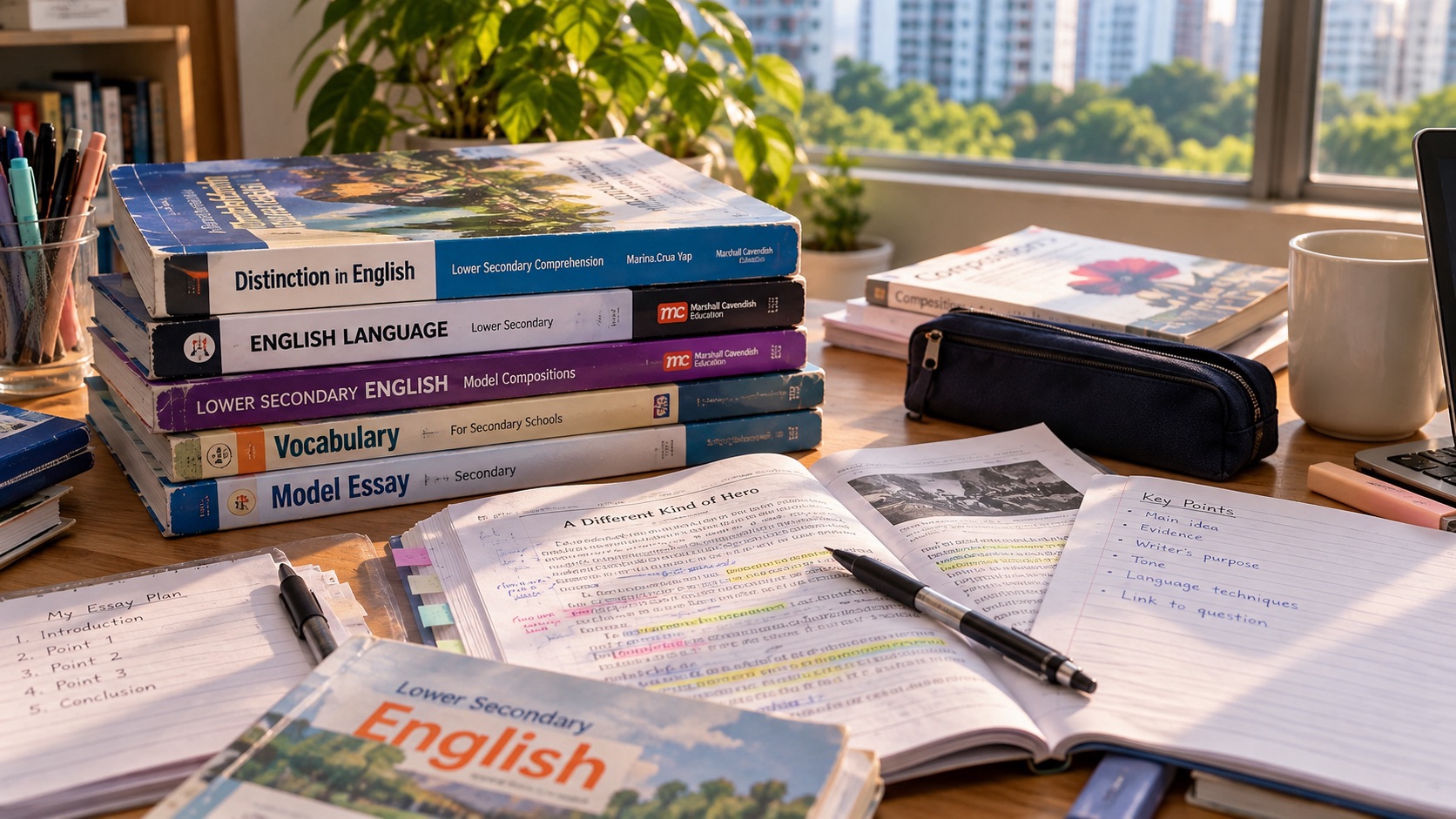
A Primary 1 English Sentence Writing tutor in Punggol should help a child turn a genuine spoken idea into a clear written sentence, then slowly connect related sentences into simple meaningful stories. The useful question is not whether a seven-year-old can memorise a PSLE composition introduction; it is whether the child can say what they mean, choose words, write with readable spacing and review one error independently. eduKatePunggol’s published small-group approach describes up to three pupils, normally 1.5 hours per lesson, with actual group availability, location and suitability to be confirmed. A competent tutor uses the small class to hear each child’s original ideas rather than dictate one polished paragraph to all three.
MOE’s English Language Syllabus 2020 for Primary includes Writing and Representing, supported by listening, speaking, reading, grammar and vocabulary. In early primary, learners develop writing readiness and handwriting, learn age-appropriate spelling, generate and select ideas, and begin organising meaningful messages for real purposes. STELLAR’s Modified Language Experience Approach can bridge shared experiences, class discussion and independent writing. Primary 1 has no weighted examinations, and there is no SEAB national P1 composition or English writing paper. The twenty original prompts below are school-style writing activities, not official examination questions or predictions of future PSLE achievement levels.
- Correct reference: MOE English Language Syllabus 2020 (Primary) and the current school’s STELLAR and writing progression.
- Start with an idea: ask the child to say one real sentence before expecting a neat written answer.
- Foundational skills: handwriting readiness, spacing, familiar spelling patterns, capitals, sentence meaning, basic grammar and punctuation.
- Developmental sequence: spoken idea → supported sentence → independently written sentence → two related sentences → a short simple recount when ready.
- Assessment honesty: no weighted P1 school exam or official SEAB composition; classroom feedback is still valuable.
- Small-group test: each of three learners should produce original writing and receive specific individual feedback, not copy a single tutor’s model.
- Parent’s first move: save one unassisted sentence, one teacher comment and a fresh topic to use after teaching.
- Healthy outcome: clearer written expression with fewer prompts, better confidence and no premature examination pressure.
A very common problem is hidden by beautiful copying. A child writes ‘The children are playing happily in the garden’ perfectly after the tutor supplies every word. When asked to write a sentence about a different playground scene, they produce ‘boy happy’. The real missing link is not the ability to copy; it is converting thought into a sentence without adult wording. That is where an individualised lesson should begin.
A useful small-group sequence is listen to the child’s spoken thought → select one clear idea → model a relevant sentence feature → let the child compose a new sentence → check whether the message makes sense. The tutor should not correct fifteen unrelated details at once. Choose the earliest obstacle: idea selection, spoken sentence structure, spelling of a taught word, capitals, spacing or punctuation. Then give a fresh prompt that shows whether the child learned it.
What the 2020 MOE Writing and Representing syllabus actually means
The national syllabus describes two broad focus areas: mechanics of writing and representing, and writing and representing creatively and critically for different purposes, audiences and contexts. Lower-primary learners are developing handwriting, spelling and the ability to generate, select, organise, express and revise ideas. Those are connected goals. Neat handwriting without an original message is incomplete writing, while a good spoken idea needs suitable support to become readable print.
Do not confuse the curriculum’s long-term goals with a Primary 1 requirement to produce upper-primary examination essays. A new pupil may begin by writing labels, a clear sentence, a short invitation or a few connected sentences about an experience. The teacher’s current scheme of work defines what is expected this term. A parent or tutor should support genuine language use rather than impose an advanced composition template because it is advertised as ‘latest PSLE style’.
At Punggol Cove Primary School, the 2026 STELLAR programme describes the Modified Language Experience Approach: pupils participate in an experience linked to a shared book, talk about it, contribute to class writing, work in groups, then move to individual writing. The school’s example includes P1 lantern-making connected to a story unit. This demonstrates the bridge from shared meaning to written text. It does not mean every school has the identical craft or term arrangement.
Five different gaps that can produce the same weak sentence
A good oral idea that cannot yet be written
A child may tell an engaging story about recess but write only ‘park ball’. The priority is turning one spoken clause into a written message. Let the pupil choose the idea, repeat it aloud, count the words if helpful, then attempt it with appropriately taught words. Copying a tutor’s sophisticated sentence might mask the bridge that needs teaching.
An incomplete spoken sentence
The child says ‘He running’. Before demanding writing, model the missing relationship in speech: ‘He is running.’ Practise with a different picture and invite the child to say the new sentence independently. Spoken grammar and written grammar can reinforce each other. Avoid giving adult-level terminology before the learner can hear and use the difference.
Handwriting or spacing difficulty
The child knows what to say but has trouble forming letters or leaving gaps between words. Provide a manageable writing surface, suitable grip and brief targeted practice. Check whether the child can express meaning orally; an uneven letter is not automatically evidence of weak ideas. Ask the school about appropriate handwriting support if difficulty persists.
A spelling pattern not yet secure
A child may write a plausible phonetic attempt that differs from standard spelling. Identify whether the target word has actually been taught. Teach one useful sound–letter pattern or common word in a meaningful sentence, then change the topic. Do not treat a new unfamiliar word as a major character flaw or cancel every imaginative idea to fix spelling.
The child writes words but cannot revise meaning
An answer may contain a sentence but not communicate the intended thought. Read it back together and ask whether an unfamiliar reader would understand who did what. Encourage one purposeful revision. At P1, revising can be as small as adding a missing person, choosing a more accurate verb or ending a question with a question mark.
Twenty original Primary 1 sentence-writing exercises, with guided revision
1. A first complete sentence
Original writing prompt: Picture: a child holds a kite.
One possible child-friendly model: ‘The child holds a kite.’
What this teaches: If the pupil writes ‘child kite’, show that a reader needs to know what the child does.
Changed independent practice: Change to a child holding a book; ask for a new sentence without dictation.
2. Turn a spoken thought into writing
Original writing prompt: The pupil says they drank water after PE.
One possible child-friendly model: ‘I drank water after PE.’
What this teaches: Record the child’s own idea before modelling word order or handwriting.
Changed independent practice: Ask for a new sentence about a different event after school.
3. Add the missing verb
Original writing prompt: Draft: ‘The girl happy.’
One possible child-friendly model: ‘The girl is happy.’
What this teaches: Ask what connects the person to the feeling; say it before writing.
Changed independent practice: Use an unrelated picture and ask for an accurate sentence about another feeling.
4. Choose a meaningful action
Original writing prompt: Picture: a cat sleeping on a sofa.
One possible child-friendly model: ‘The cat is sleeping on the sofa.’
What this teaches: The child may name objects but leave out what happens. Ask ‘What is the cat doing?’
Changed independent practice: Try a fresh scene of a dog running across a garden.
5. Use an accurate place word
Original writing prompt: Picture: a ball under the chair.
One possible child-friendly model: ‘The ball is under the chair.’
What this teaches: A written answer saying ‘on’ changes the scene. Demonstrate positions with a toy.
Changed independent practice: Show the ball behind a box and ask for new wording.
6. Start with a capital letter
Original writing prompt: Draft: ‘my sister has a bike.’
One possible child-friendly model: ‘My sister has a bike.’
What this teaches: Explain how a sentence begins in standard writing; do not demand rewriting an entire page.
Changed independent practice: Ask the child to create another original sentence with the first word capitalised.
7. End a statement
Original writing prompt: Draft: ‘We play at recess’
One possible child-friendly model: ‘We play at recess.’
What this teaches: Help the pupil hear when the message is complete and mark the sentence boundary.
Changed independent practice: Use a different personal statement and check punctuation independently.
8. Write a question
Original writing prompt: Prompt: ask a friend where a book is.
One possible child-friendly model: ‘Where is my book?’
What this teaches: Explain how a question differs from a statement and needs appropriate punctuation.
Changed independent practice: Invite a new question about a missing water bottle.
9. Keep words apart
Original writing prompt: Draft is written as ‘Ilikemybook’.
One possible child-friendly model: ‘I like my book.’
What this teaches: Ask the learner to say the words, count them and leave visible spaces.
Changed independent practice: Use a new short sentence to test whether spacing is remembered.
10. Use a suitable pronoun
Original writing prompt: Picture: one boy playing football.
One possible child-friendly model: ‘He is playing football.’
What this teaches: Distinguish one person from a group rather than selecting a pronoun by chance.
Changed independent practice: Show two friends playing and ask for a sentence with ‘They’.
11. Match is and are
Original writing prompt: Pictures: one bird and two birds.
One possible child-friendly model: ‘The bird is singing.’ and ‘The birds are singing.’
What this teaches: Model how language changes when there is one versus more than one.
Changed independent practice: Use a new pair of pictures with cats or children.
12. Connect two genuine details
Original writing prompt: Prompt: you visited a park and saw a slide.
One possible child-friendly model: ‘I went to the park. I saw a slide.’
What this teaches: Some children produce unrelated sentences. Ask what happened and what was noticed.
Changed independent practice: Change to a library visit and ask for two connected sentences.
13. Put events in order
Original writing prompt: Pictures: a child opens a lunchbox, eats, then closes it.
One possible child-friendly model: ‘First, I opened my lunchbox. Then I ate my food.’
What this teaches: A child may list objects instead of showing an action sequence. Model one time connector.
Changed independent practice: Use a new sequence involving packing a school bag.
14. Add a relevant adjective
Original writing prompt: Draft: ‘I saw a dog.’ Picture: the dog is brown.
One possible child-friendly model: ‘I saw a brown dog.’
What this teaches: Teach that a description should make the reader’s picture more accurate, not longer for its own sake.
Changed independent practice: Ask for another precise description in an unrelated scene.
15. Replace a vague word
Original writing prompt: Draft: ‘The boy did a thing with the ball.’
One possible child-friendly model: ‘The boy kicked the ball.’
What this teaches: Ask which action is visible rather than accepting vague fillers.
Changed independent practice: Change the scene to a girl throwing a ball and choose a new verb.
16. Write a polite message
Original writing prompt: Prompt: ask a classmate to share a ruler.
One possible child-friendly model: ‘May I borrow your ruler, please?’
What this teaches: Purpose and audience matter. Help the child use a respectful request, not just a noun list.
Changed independent practice: Ask for a different request to a teacher, using suitable language.
17. Write an honest feeling and reason
Original writing prompt: Prompt: you are glad because your friend helped you.
One possible child-friendly model: ‘I felt happy because my friend helped me.’
What this teaches: A child may write ‘happy happy’ without stating what happened. Provide the reason structure only when ready.
Changed independent practice: Ask for an original feeling and reason after a different event.
18. Describe a picture without inventing facts
Original writing prompt: Picture: a child walking in rain; no thunder shown.
One possible child-friendly model: ‘The child is walking in the rain.’
What this teaches: Do not insist that thunder or fear must appear simply because a model composition mentions them.
Changed independent practice: Use another picture and distinguish what is visible from imagined details.
19. Review a sentence for meaning
Original writing prompt: Draft: ‘Ben gave Mei a pencil.’ Intended story: Mei gave Ben the pencil.
One possible child-friendly model: ‘Mei gave Ben a pencil.’
What this teaches: The grammar is fine but the meaning is reversed. Teach the writer to read back and check who did what.
Changed independent practice: Provide a new giver–receiver scenario and ask for accurate wording.
20. Write a small independent recount
Original writing prompt: Prompt: tell about a game you played yesterday.
One possible child-friendly model: ‘Yesterday, I played catch with my cousin. We laughed when the ball rolled away.’
What this teaches: The sample shows two connected ideas; do not demand identical sentences or assume everyone has a cousin.
Changed independent practice: Invite a different real experience; allow the child to choose and write their own age-appropriate details.
Three routes to better P1 writing, not one forced composition format
Route A — the beginning writer who still needs oral support
Let the child tell a short genuine story before writing. Choose one sentence and help them hear the words in order. Use familiar vocabulary, print awareness and targeted letter formation. A successful independent sentence after a model is a meaningful milestone. Do not push an exhausted beginner to write a six-paragraph composition when sentence construction is still unstable.
Route B — the confident speaker who writes fragments
This learner may tell a well-organised story yet write bare nouns or omit key verbs. Practise person–action–place relationships using familiar scenes, then write a short sentence. After the tutor teaches one structure, provide a changed picture and let the child select words independently. The writing should preserve the pupil’s own idea rather than become an adult’s wording.
Route C — the fluent P1 writer ready for extension
Offer a second connected sentence, a more precise action word, a simple recount or a meaningful message to someone. Teach the pupil to check whether a reader will understand. The challenge is clarity, specificity and genuine expression, not premature PSLE story templates or the number of difficult adjectives crammed into one line.
How the Modified Language Experience Approach supports writing
An experience gives the child something real to describe. A safe school craft, story enactment, picture discussion or everyday family activity can generate oral language. The tutor can help pupils compare possible ideas and choose one, without deciding the entire content for them. Class or small-group writing may model a structure; independent writing then checks the bridge between understanding and expression.
The transition from collective text to individual sentence matters. A student who copies the shared class sentence has participated in one stage, but the teacher still needs to ask what they can create without the model. A good small-group tutorial might use the same shared experience but encourage three different authentic sentences: one about a material, another about an action, and another about a feeling or outcome.
Parents can practise this approach at home after a simple real event, such as preparing a snack or visiting the library. Invite a quick oral retelling, select one idea and allow a short written response. Read it back and praise what the child successfully communicated. The goal is to make writing feel like a natural extension of talking, not a punishment that follows every outing.
A teacher-friendly correction order
- Meaning first: can a new reader understand who did what?
- Completeness second: is the sentence missing a necessary word or relationship?
- Age-appropriate grammar: does the structure support the intended message?
- Spelling: distinguish a taught pattern that needs retrieval from an unfamiliar word the child has not learned.
- Mechanics: check sentence capitals, spacing, punctuation and appropriate handwriting, selecting one or two priorities.
- Independence: after modelling, check a fresh task so the child is not merely copying.
Correction should not erase the child’s voice. If the pupil writes ‘My funny dog ran to the door’ and the sentence is clear, a tutor need not replace it with ‘My energetic canine sprinted energetically toward the entrance’ in the name of higher standards. At P1, clear accurate words are more valuable than ornamental vocabulary a child cannot explain. Ask whether each edit makes the meaning better.
An illustrative three-pupil 90-minute writing tutorial
- 0–10 minutes: oral conversation and one earlier sentence retrieval.
- 10–25 minutes: shared picture or short story; every pupil says a genuine idea.
- 25–40 minutes: demonstrate one writing target such as a complete action sentence.
- 40–50 minutes: movement, story game or attention reset appropriate for P1.
- 50–65 minutes: each pupil independently writes a sentence about a changed topic.
- 65–80 minutes: connect two sentences or revise one meaning error with specific feedback.
- 80–90 minutes: new short check, confidence reflection and one manageable home activity.
This is a teaching illustration, not a guaranteed class timetable. A P1 pupil may find a long session tiring; the group should adapt with appropriate variety and breaks. The point of a small group is close observation, not making the youngest pupils sit still through an older child’s lesson format.
Eight weeks to build independent writing without exam pressure
- Week 1: save an original unassisted sentence and the school’s actual writing expectations.
- Week 2: identify whether the main gap is idea, spoken structure, handwriting, spelling or punctuation.
- Week 3: model one target and invite a new sentence on a familiar topic.
- Week 4: compare a changed-topic independent sentence against the baseline.
- Week 5: add one meaningful detail or second sentence when the child is ready.
- Week 6: revisit an earlier taught feature after a break to check lasting learning.
- Week 7: write a small message for a real purpose rather than only a worksheet blank.
- Week 8: review the child’s independence, confidence, school feedback and extra-class workload.
What parents can do without buying a P1 composition workbook
Keep a small notebook for one-sentence entries. The child might write ‘I saw a butterfly at the park’ after a supervised outing, or ‘I helped Dad put the books away’ after a family routine. Let the child decide which event mattered. A short authentic message is valuable because it has a purpose. Provide a model only as needed, then leave room for an unaided attempt.
Read stories together and draw attention to one useful sentence, rather than demanding that the child copy whole pages. Ask how the author shows an action or place. Then invite a different sentence using the same simple language relationship. Texts from the Punggol Regional Library or current school reader can support this without constant purchases.
Parents should consider whether writing resistance comes from fatigue, fear of correction, motor strain or not knowing what to say. Talk with the school teacher if the difficulty persists. A pupil who writes confidently in class may need no private tuition. A child with a significant specific difficulty might benefit from school-based literacy support or an appropriately individualised intervention rather than a three-pupil writing class.
Frequently asked questions about P1 sentence writing
Does Singapore have a national P1 composition paper?
No. SEAB does not conduct a national Primary 1 English examination, and schools have no weighted P1/P2 examinations under MOE policy. Early writing is assessed through age-appropriate classroom work and feedback.
Which syllabus governs P1 writing in 2027?
The relevant national reference is MOE’s English Language Syllabus 2020 for Primary, including Writing and Representing, grammar, vocabulary and related language learning. The school’s specific current tasks and sequence determine what your child should do this term.
Should children copy model compositions?
Short models can demonstrate language, but copying is not the same as independent composition. Encourage a genuine oral idea, then a new sentence using age-appropriate words. Copying many polished paragraphs can hide a basic sentence-writing gap.
How long should a P1 written answer be?
It depends on the task and child’s current readiness. A clear independent sentence may be appropriate; sometimes two related sentences or a short recount are possible. Follow the school scope rather than setting a universal paragraph length.
Is spelling more important than content?
Both matter, but they should be taught proportionately. A child expressing a real idea with emerging spelling needs targeted correction rather than wholesale rewriting. Distinguish spelling of taught words from unfamiliar words and preserve motivation to write.
What if my child writes fragments?
Ask for the complete spoken thought first. Teach one missing element such as a verb or a connecting word, model it once and check a fresh sentence. The goal is a message another reader can understand.
Does P1 need advanced vocabulary?
No arbitrary collection of difficult words guarantees good writing. Accurate, meaningful vocabulary and clear sentences come first. Let richer words enter through enjoyable reading and repeated use in suitable contexts.
How do we teach punctuation?
Begin with meaningful sentence boundaries: capitals at the start and appropriate ending marks. Read a statement and a question aloud, discuss their different purposes and let the child write one of each independently.
Can writing practice begin with drawings?
Yes. A picture or experience can help a young learner generate and order ideas. The next move is to say what the picture means, choose a sentence and write it. Drawing supports writing; it need not be the final assessment.
Is handwriting neatness a reliable measure of writing ability?
No. A child may have fine ideas but developing letter formation, or copy neatly without expressing an independent thought. Observe meaning and mechanics separately, and seek school advice about persistent motor concerns.
Can the child write in English while using another home language?
Yes. Meaningful family conversation in another language can coexist with genuine English reading, speaking and writing opportunities. A tutor should check the child’s actual language skill rather than assuming home language determines intelligence or future achievement.
How should a three-pupil class differ from a large class?
Every pupil should get their own oral planning turn, independent writing attempt and a specific correction. A group limit is useful only when the tutor differentiates and tracks real progress. A common copied worksheet is not individualised instruction.
How can parents measure success after a month?
Compare new original sentences with the starting sample. Look for clearer meaning, fewer adult prompts, more reliable taught spelling and a willingness to revise one small issue. School confidence and manageable homework matter too.
When should I seek school literacy support?
Ask the teacher if the child persistently struggles with foundational reading or writing despite appropriate instruction. MOE school-based support, including LSP where relevant, may be available. Do not assume every writing error is a learning disorder.
Related eduKatePunggol writing and reading guides
- P1 reading comprehension: 20 original passages and questions
- P1 STELLAR: Shared Book and Modified Language Experience approaches
- Full P1 English syllabus parent guide
- P1 creative writing enrichment and simple story writing
- English literacy support, STELLAR and school options
Official curriculum and school examples
- MOE English Language Syllabus 2020 (Primary): Writing and Representing
- Punggol Cove Primary School English programme and MLEA, updated 2026
- MOE removal of weighted P1/P2 assessments and examinations
- eduKate Clementi small-group first-principles reference
Updated November 2026. All writing prompts and model sentences on this page are original, developmental examples rather than official SEAB items. The child’s current school feedback and syllabus coverage should determine the next step. A tutor should never promise a future PSLE grade or a specific class opening without confirmation.


