
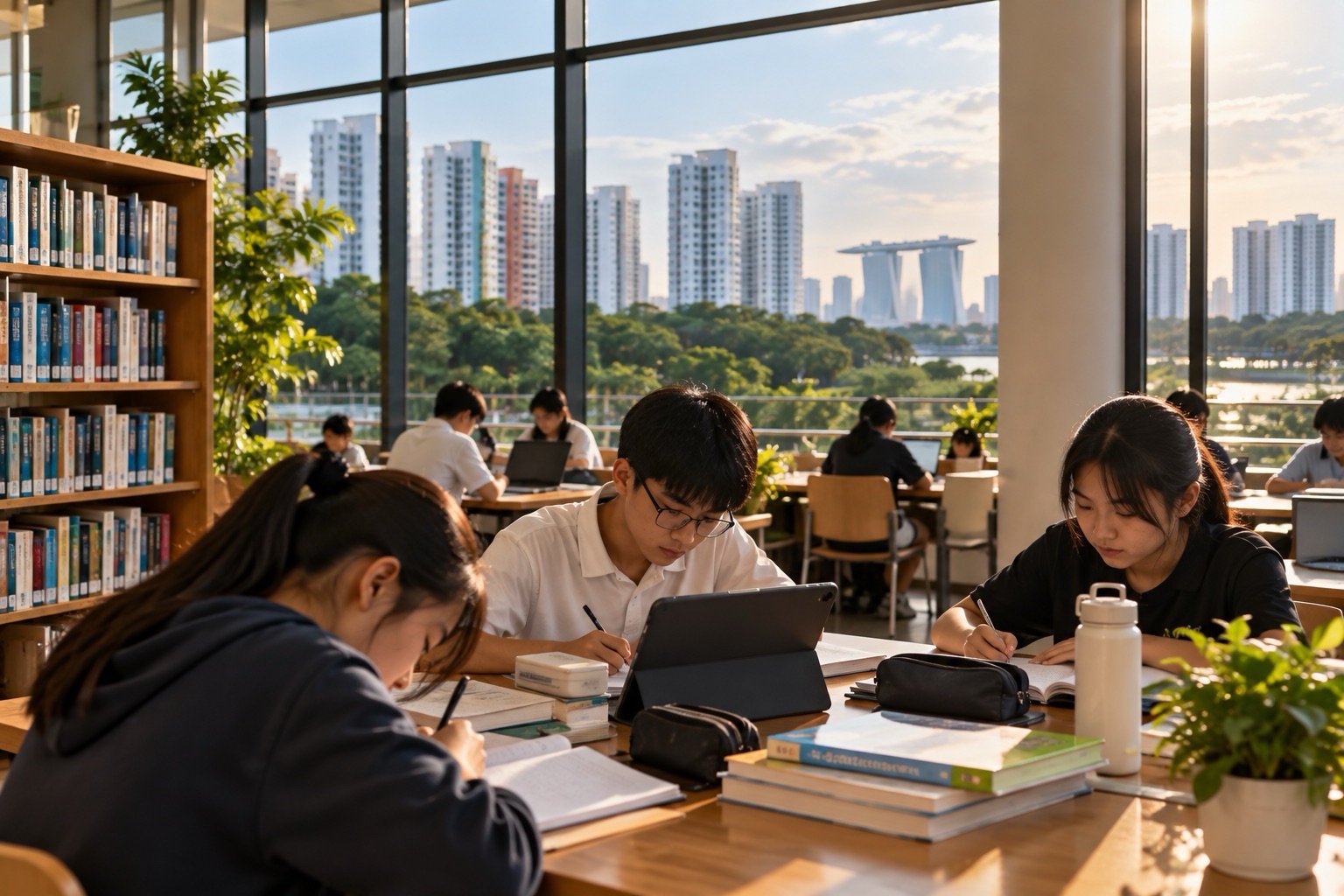
For Punggol parents whose child is enrolled in G3 Higher Tamil Language, the official 2027 Singapore-Cambridge Secondary Education Certificate (SEC) syllabus is K357, not ordinary Tamil K322 or Literature in Tamil K334. The scheme has three national papers: Writing, 2 hours, 80 marks (40%); Language Use and Reading Comprehension, 1 hour 45 minutes, 80 marks (40%); and Oral, approximately 10–15 minutes, 40 marks (20%). The writing tasks require at least 130 Tamil words for the functional response and 300 Tamil words for composition. Parents should start by confirming the child’s actual school entry and reading one marked piece of written and oral feedback before deciding on tuition.
This independent eduKate Punggol guide explains the 2027/2028 Full Subject-Based Banding changes and how a family can support Higher Tamil honestly. Posting Group 3 (PG3) describes initial secondary admission; G3 describes an individual subject level. The first SEC cohort graduates in 2027, whereas children entering Secondary 1 in 2027 would normally reach the examination years later. Use the candidate-year K357 syllabus when published for that later cohort. High-fidelity language learning means reading for evidence, writing appropriately for an audience, correcting real grammar problems and discussing a video flexibly. It does not mean memorising one perfect essay, controlling the national paper or guaranteeing admission results.
- Exact qualification: SEC 2027 Higher Tamil K357, former reference 1147; separate from standard G3 Tamil K322.
- Paper 1 Writing: 2 hours, 80 marks/40%; functional task at least 130 Tamil words (20 marks), composition at least 300 words (60 marks).
- Paper 2: Language Use and Reading Comprehension, 1h45, 80 marks/40%; sentence completion, correction, word combinations and reading.
- Paper 3: Oral, approximately 10–15 minutes, 40 marks/20%; a video prompt, a presentation of up to two minutes and examiner discussion.
- Video preparation: 10 minutes; prepare relevant points, not a memorised generic speech.
- Important distinction: K357 has no separately weighted listening-comprehension paper in the published 2027 scheme.
- Parent method: diagnose the largest recurring issue and retest with an unfamiliar task one week later.
- 2028: check the later examination-year document, school placement, deadlines and course prerequisites.
1. Higher Tamil is not standard Tamil with extra homework
SEAB lists K357 as a separate G3 Higher Tamil qualification. It has different paper structures, minimum writing lengths and oral requirements from standard Tamil K322. Students taking standard Tamil should not be prepared using the complete K357 examination schedule, nor should Higher Tamil students assume a standard reading-aloud-and-listening programme covers their national assessment.
The older reference for Higher Tamil was 1147. Families may still encounter this code in older teaching materials. The 2027 SEC code is K357, and the applicable official syllabus is the authority for the national examination. School candidates are entered through their schools; parents should contact teachers early if a subject-confirmation record appears incorrect.
2. PG3 and G3: what parents should understand
Full Subject-Based Banding enables pupils to pursue different individual subjects at suitable levels under MOE and school arrangements. The child’s admission Posting Group does not tell parents whether the school has actually placed them in Higher Tamil. A strong interest in languages can support readiness, but availability, eligibility and school processes matter.
Ask the Mother Tongue teacher which subject is offered, why Higher Tamil is appropriate, how it fits with other G3 subjects and whether a level review is possible. The aim is a sustainable educational route rather than maximum difficulty for its own sake. A child who speaks Tamil comfortably at home may still need significant formal reading and writing practice.
3. What begins with the SEC in 2027
The SEC replaces the relevant earlier separate national secondary examinations from 2027 and records subjects at their actual levels. Schools manage examination registration for their school candidates. For a 2027 graduating child, confirm K357 and the school’s written/oral arrangements; for a child who begins Secondary 1 in 2027, focus on current lower-secondary literacy rather than final-paper drilling.
For future cohorts, do not assume every 2027 requirement is fixed. Use SEAB’s directory and the school’s official current-year timetable when the child’s examination approaches. Examination planning should be precise about dates, paper types, available materials and any approved support arrangements.
4. Paper 1: writing has two purposes
The two-hour Writing paper is worth 80 marks, contributing 40% of the result. It consists of a shorter functional task and a more developed composition. The 2027 scheme permits an approved dictionary subject to examination rules. Before planning a study schedule, explain to the child that the two tasks call for different styles and decisions, even though both are written in Tamil.
Functional writing is worth 20 marks and requires at least 130 Tamil words. Students choose one of two prompts, such as an email or letter-style communication based on a specified context. The longer composition is worth 60 marks and requires at least 300 words on one of three topics. The quality of expression and response relevance matter more than filling space with repetitions.
5. Functional writing: the reader determines the language
A successful functional response answers the question a real recipient would need answered. The candidate should identify who is receiving the message, the relationship between writer and recipient, the exact information that needs to be communicated and the expected response or action. Formal and informal situations require appropriate word choices and tone.
An invented example might ask a student to write to an organiser about changing the time of a school event. A clear response includes the event, the relevant reason, the new time and the action requested. A long introduction about the general importance of school activities might be irrelevant. Parents can ask ‘Could the recipient act on this?’ before discussing stylistic polish.
6. Composition: sustaining a connected argument or narrative
At least 300 Tamil words are required for the 2027 composition. A longer task needs a plan and logical development. A narrative should establish a situation, develop events and show how a decision leads to consequences. An argumentative or explanatory response needs a clear position and connected reasons, not a sequence of unrelated moral statements.
One useful correction exercise is to select a paragraph whose meaning is vague. Ask the child what they are trying to communicate, then add one specific observation or example and revise one grammatical structure. The child should explain why the new paragraph is clearer. Rewriting every line for the student may make the script look better without improving independent performance.
7. Paper 2: grammar is part of communicating meaning
The language-use and reading paper lasts 1 hour 45 minutes, contributes 40% and totals 80 marks. It includes contextual sentence completion, error correction, word combinations or separation, and comprehension questions. Students should understand the forms being assessed, including how an expression functions in context. Simply memorising an English equivalent for every Tamil word does not necessarily produce accurate formal sentences.
A child who cannot explain why a sentence is incorrect may need explicit instruction on grammar or word construction. Ask them to identify what changed and why, then use the corrected form in a different sentence. An error journal can record one pattern per entry; it should not become a humiliating collection of everything the child has ever done wrong.
8. Sentence completion: read more than the blank
To complete a passage meaningfully, the student must consider its subject, the relationship between sentences, grammatical agreement and context. A proposed word can seem plausible in isolation and fail in the paragraph. Encourage the child to read the sentence before and after the blank, then check the coherence of the whole passage after selecting an answer.
A parent can practise with a short teacher-approved passage. Ask the student to explain their choice in ordinary language, even if they initially use English to clarify meaning. Then return to a correct Tamil example. Learning should end with appropriate use in Tamil, not only a translation exercise.
9. Error correction: the original mistake matters
The 2027 syllabus includes identifying and correcting particular errors in supplied text. These may involve inappropriate forms or choices in context. A student who copies a corrected passage from an answer key may appear successful but fail on a new question because the underlying rule is still unclear.
Make a three-column practice record: incorrect expression, corrected expression and reason. Add a fourth column with a new sentence created by the student. After several days, give unfamiliar material using the same rule. Where the child remains uncertain, ask the Tamil teacher rather than guessing a formal grammatical rule.
10. Word combinations and separation
Paper 2 includes tasks involving the combination or separation of Tamil words, which rely on appropriate linguistic structure and meaning. Students may recognise the individual elements but fail to construct or split them correctly within the conventions being tested. Teach the underlying relationship between component words rather than mechanically joining adjacent expressions.
Use the school’s current examples first, then introduce a new example for independent practice. A child who can explain why two elements belong together is developing a flexible skill. Memorising twenty completed items without understanding the rule is less dependable.
11. Reading comprehension: answer from the source
Higher Tamil reading includes understanding longer passages, retrieving information, interpreting intended meaning and responding to contextual vocabulary. A pupil may know the topic well but answer from personal assumptions instead of what the passage supports. Teach the distinction between a direct statement and a reasonable inference.
For one question, ask the child to locate the source phrase, then explain the link between that detail and the proposed answer. An unsupported claim about a character’s feelings or writer’s intention is not strengthened by making it longer. Where the question asks for a comparison, the learner must make the actual relationship explicit rather than describe two ideas independently.
12. Building reading stamina without discouragement
Some students can understand short Tamil passages but find longer ones exhausting. The solution is not always to assign a full comprehension paper daily. Begin with a manageable authentic text from school or an age-appropriate source, check the central idea and discuss two relevant details. Gradually extend length and range.
Use varied genres including stories, news, explanations, interviews or cultural material as appropriate to the class. Reading can be enjoyable and intellectually demanding at the same time. Parents should not shame a teenager because their household uses more than one language or because formal Tamil reading takes effort.
13. Oral: the 2027 video-based format
The 2027 Higher Tamil oral is worth 40 marks, or 20%, and lasts approximately 10–15 minutes. Candidates receive ten minutes of video preparation, then deliver a presentation based on the prompt of no more than two minutes. The presentation and the examiner discussion each carry 20 marks. The child must understand what the visual stimulus shows and respond to the topic, not merely recite a polished generic speech.
During preparation, encourage a short plan: observation, position, one or two reasons, relevant example and a possible alternative viewpoint. The answer should remain connected to the actual stimulus. Repeatedly rehearsing the same paragraph for every video is a weak substitute for interpretation.
14. Examiner discussion: flexible thinking rather than perfect recitation
The discussion can require a student to clarify, expand or defend a point. A strong participant listens to the question and answers it without drifting into a prepared essay. A relevant example may help; a long irrelevant story may conceal uncertainty. Oral skill includes conversation, not only presentation.
A parent can ask one natural follow-up after a short spoken response: ‘Why does that matter?’, ‘Who else might see it differently?’, or ‘How would you improve this?’ These can be adapted into Tamil by a competent teacher or family member. Respect a reluctant child’s comfort and avoid making every family conversation an oral examination.
15. The essential difference from K322 standard Tamil
Standard Tamil K322 includes separate assessment of oral reading and listening, with different paper weights and shorter writing requirements. Higher Tamil K357 instead focuses on Writing 40%, Language Use and Reading 40%, and video-based Oral 20%. It has no separately weighted listening-comprehension paper in the 2027 scheme.
Do not use standard Tamil’s exam format as the complete revision guide simply because a workbook is labelled ‘G3 Tamil’. Compare code, year, paper duration and task type before selecting resources. Some reading and vocabulary materials can support both levels, but the final assessment skills need specific preparation.
16. A practical diagnosis parents can do with schoolwork
Collect one marked functional response, one composition, a grammar or reading exercise and some oral feedback. Ask the child to describe what each task requires and which step was difficult. Possible causes include limited vocabulary, inappropriate register, grammatical form, weak inference, lack of paragraph structure or anxiety in spoken interaction. These need distinct responses.
Choose one or two of the most repeated problems. Write a short improvement goal and a retest date. A learner who understands the correction only when the teacher points to it is not yet independent. After a week, offer a different prompt and check whether the principle transfers.
17. A parent checklist for useful progress
- Confirm the actual G3 Higher Tamil K357 subject and the examination year.
- Check the two Writing tasks separately for relevance, structure and language accuracy.
- Use a small contextual vocabulary and grammar notebook instead of a huge copied list.
- Require textual evidence before unsupported comprehension inferences.
- Practise word combinations and corrections using teacher-approved examples.
- For video oral, focus on the given situation, a reasoned presentation and genuine discussion.
- Keep authentic work from before and after correction to observe real progress.
- Protect reading enjoyment, school commitments, CCA, adequate rest and wellbeing.
18. A twelve-week home-learning sequence
Weeks 1–3: diagnose the largest two issues in schoolwork. Repair one grammar form and one comprehension or writing problem. Use short original sentences and teacher feedback rather than lengthy memorised passages.
Weeks 4–6: practise the repaired skills with new genres and writing contexts. If the goal is audience, give a different recipient and purpose. If the goal is inference, use an unfamiliar short text and ask for source evidence.
Weeks 7–9: increase independence. Let the child plan a composition paragraph and a short video response without adult wording. Add gentle timing after the student understands the content. Keep feedback specific rather than criticising overall language ability.
Weeks 10–12: retest the two skills on new work. Look for improved relevance, fewer repeated grammar errors, more accurate evidence and better response to oral follow-up. Discuss the next needs with the school teacher instead of automatically increasing workload.
19. Secondary 1 to Secondary 4: an honest timeline
Secondary 1: build lower-secondary literacy, reading habits and confidence in discussion. A newly posted child should not begin with every current SEC Higher Tamil paper.
Secondary 2: expand reading range and formal written expression. Ask teachers how Higher Tamil level placement and continuation are determined and what workload to expect.
Secondary 3: when the subject is confirmed, map the candidate’s current syllabus to writing, grammar, reading and video oral. Maintain a small error log and revise using school topics.
Secondary 4: follow the actual examination-year K357 PDF and school timetable. For 2027 the scheme described here applies; for 2028 and later confirm the new year’s published instructions before national revision.
20. Punggol family constraints are part of a useful plan
Students in Punggol may travel across Singapore to school, return late from CCA or live in homes where several languages are used. A flexible plan might include three short reading or vocabulary sessions, one focused writing task and one informal oral discussion each week. This is a suggested family routine rather than an MOE mandate.
Parents do not need to be expert Tamil language teachers to support organisation, good resources and contact with the school. If the parent cannot correct a specialised grammar form, refer to a teacher or trusted reference rather than guessing. Maintaining a respectful environment helps a student persist with demanding work.
21. Extra tuition and realistic promises
A capable tutor should explain the exact K357 structure, inspect a real error, teach the underlying principle and verify improvement on unfamiliar work. Ask how they support longer Tamil writing, contextual grammar and video-based interaction. Avoid promises of a distinction, leaked unseen videos or memorised model essays that cannot adapt to the task.
The immutable Clementi Mathematics article describes a specific three-person tutorial and close feedback system. It is an editorial and pedagogical reference, not evidence that identical Higher Tamil tuition class size, fees or schedules exist in Punggol. Extra lessons are worthwhile only when they meet a genuine need the child cannot address sufficiently through school and manageable home practice.
22. Future pathways and the value of language
Higher Tamil can deepen literacy, cultural understanding and communication, all useful beyond the examination. Admission rules may treat Mother Tongue and Higher Mother Tongue results differently in particular pathways, but the exact rules depend on the institution and application year. SEC-linked post-secondary admissions changes begin in 2028.
Parents should check current MOE, JC, MI, polytechnic, PFP or ITE requirements at the right time and should not promise a particular course place from one Higher Tamil grade. For younger students, preserve broad learning skills and a healthy relationship with language.
23. Frequently asked questions
What is the correct 2027 SEC Higher Tamil code?
K357, formerly reference 1147. It differs from regular Tamil Language K322 and Literature in Tamil K334.
How long are the two writing tasks?
At least 130 Tamil words for functional writing and 300 Tamil words for composition under the official 2027 K357 scheme.
Does Higher Tamil have a separate listening-comprehension mark?
No. The three 2027 papers are Writing 40%, Language Use and Reading 40%, and video-based Oral 20%.
What happens at the oral examination?
Ten minutes of video preparation, an oral presentation of up to two minutes, and a follow-up discussion with the examiner.
Must every PG3 student take Higher Tamil?
No. Ask the child’s school about actual subject level, placement and eligibility.
Can a teenager improve without expensive materials?
Yes. Targeted reading, corrective feedback, new-example retesting and suitable school resources can build skills. Additional tuition is not automatically required.
Official references and useful Punggol reading
This independent parent guide is not issued or endorsed by MOE or SEAB. The examination-year official syllabus and school instructions govern the actual assessment.
- SEAB: 2027 G3 school-candidate subject directory
- Official 2027 Higher Tamil K357 syllabus PDF
- SEAB SEC assessment and school-candidate information
- Punggol G3 Higher Tamil writing, language correction and video oral
- Punggol PG3 standard Tamil K322 comparison
- Punggol G3 language and subject pathways
- Primary 6 Tamil language transition
- Checking the child’s official subject level and exam code
- Immutable Clementi small-group teaching reference


