
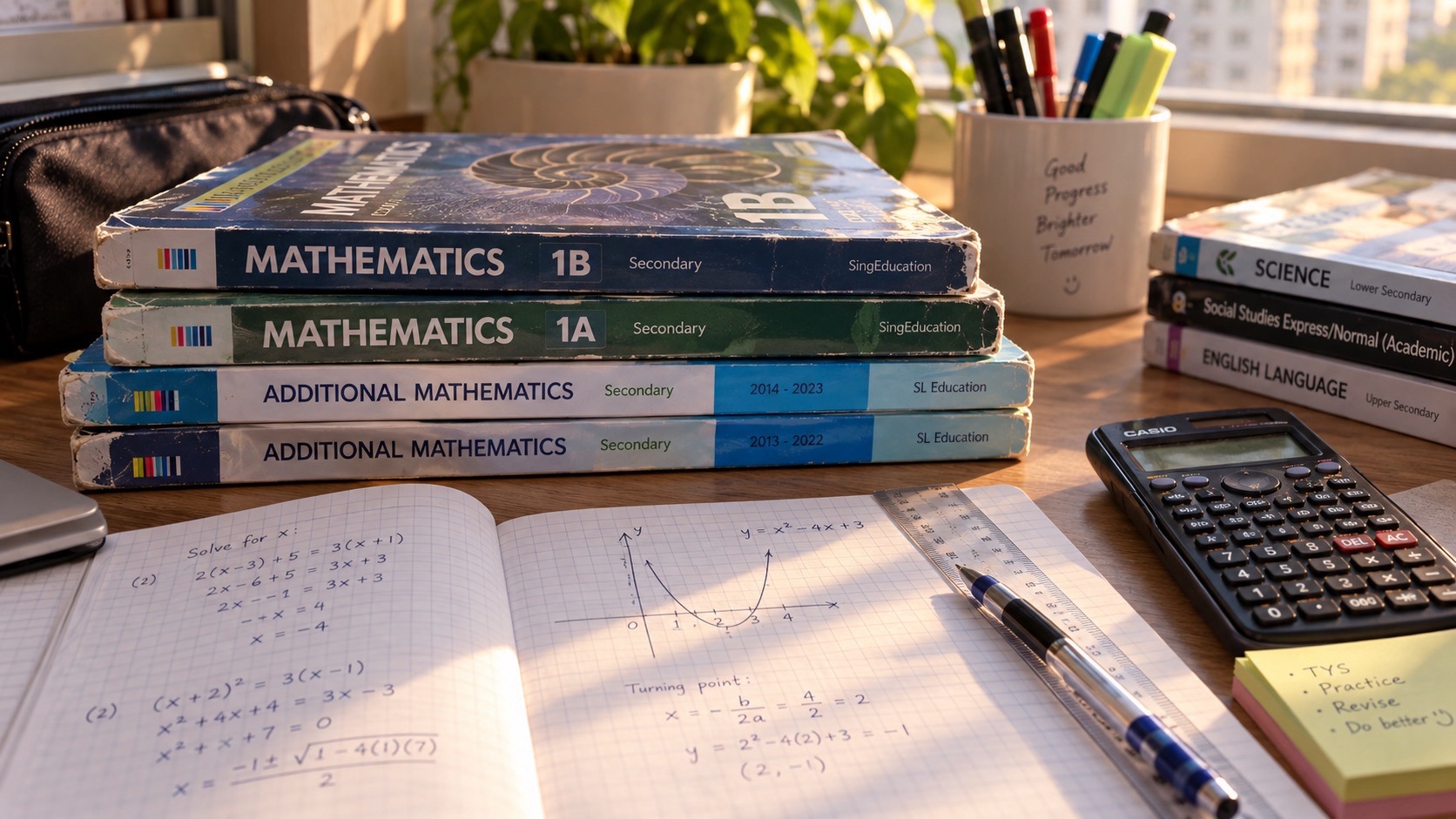
For a Punggol parent planning G3 Mathematics under Full Subject-Based Banding, begin with the correct subject: SEC 2027 G3 Mathematics K310, not Additional Mathematics K341. K310 covers Number and Algebra, Geometry and Measurement, and Statistics and Probability. Its examination has two papers, each 2 hours 15 minutes and worth 50%. The immediate step is to check your child’s actual subject level, examine one recent mathematics script and identify the single recurring reasoning error that costs the most marks.
This independent eduKate Punggol guide is written for PG3 families planning 2027/2028 learning and SEC preparation. PG3 is the Secondary 1 posting group; G3 is an individual subject level. The first SEC examinations take place in 2027, but a child entering Secondary 1 in 2027 would ordinarily reach Secondary 4 years later. Use the official syllabus published for that child’s actual examination year. High-fidelity practice here means practice matched to genuine skills; engineered control means a sensible study and feedback system, never a promise to control results or a student’s future.
- Official reference: SEAB G3 Mathematics K310 for the 2027 SEC examination.
- Examination: Paper 1 and Paper 2, 2 hours 15 minutes each, 90 marks each and 50% weighting each.
- Subject strands: Number and Algebra; Geometry and Measurement; Statistics and Probability.
- Core skills: algebra, fractions, ratio, equations, graphs, geometry, data, probability and reasoning.
- Do first: diagnose errors using schoolwork rather than buying a pile of assessment books.
- For Punggol: fit study around the real school timetable, travel, CCA and sleep.
- A Mathematics distinction: K310 and Additional Mathematics K341 are separate SEC subjects.
- Planning caution: check SEAB’s examination-year syllabus and the school’s current subject-level offer.
1. The verified facts behind SEC G3 Mathematics in 2027
The Singapore-Cambridge Secondary Education Certificate (SEC) replaces the previous separate N(T), N(A) and O-Level examinations from 2027 under Full SBB. SEAB lists G3 Mathematics K310 for 2027 school candidates; the 2026-and-earlier reference code was 4052. The new code helps families find the correct syllabus and school entry. SEAB states that the overall examination standards remain aligned with the corresponding former examination levels. The name change is not proof that the maths has become easier or harder.
The current K310 syllabus states that Paper 1 has approximately 26 short-answer questions and Paper 2 has nine to ten questions of varying length; the final Paper 2 question focuses on a real-world context. All questions are compulsory. Both papers last 2 hours 15 minutes and each carries 90 marks, 50% of the subject result. Essential working must be shown where needed; omitting it can lose marks even when a final answer is right.
Approved calculators may be used in both papers, and relevant mathematical formulae will be supplied. That does not remove the need to know which method applies. The syllabus requires a sensible degree of accuracy, with answers generally to three significant figures or one decimal place for angles unless otherwise specified. Students should have geometrical instruments and follow the exact published examination instructions. Calculator use is a checking tool, not an alternative to understanding.
2. PG3 does not mean one mathematics route for every student
A Punggol student admitted through PG3 will generally begin core academic subjects at the corresponding level, but the actual school subject record—not the admission label—is what determines the current syllabus. Under Full SBB, schools can consider subject-level changes at appropriate points according to the child’s performance, interests, readiness and overall workload. Do not tell a child that the PG3 label fixes their entire secondary career or guarantees a place in Additional Mathematics.
For students already in Secondary 3 or 4, ask for the registered upper-secondary subject combinations and syllabus codes. Some pupils take K310 without K341; others take both. Some may take different G-levels in different subjects. Subject offering varies by school and is not automatically decided by a tuition centre. For a child starting Secondary 1 in 2027, focus on current school work and build the prerequisites before using upper-secondary SEC papers as the primary learning material.
3. What ‘precision education’ means in Mathematics
In this guide, precision education means first locating the wrong mental step. A student may lose a mark because a negative sign was overlooked, because a fraction was simplified illegally, because an equation was not kept balanced, because a diagram was read incorrectly or because the answer lacks units. These are different problems. They need different explanations. Giving the learner twenty more questions without understanding the cause can train the mistake to become faster.
An effective correction has four stages: identify the exact line where reasoning failed; explain the underlying mathematical rule; redo the question independently; then test a slightly different question a week later. The final transfer test is important. A child who copies a corrected solution on the same evening has not necessarily mastered the principle.
High-fidelity learning means a task tests the skill we intend to teach. A fractions worksheet measures fraction operations; a word problem checks whether the student can identify quantities and relationships; a timed paper checks fluency and planning. Each is useful in the right context, but they cannot substitute for one another. ‘Engineered control’ describes the parent’s ability to keep a log and schedule checkpoints, not any ability to force a grade.
4. A 30-minute baseline parents can conduct at home
Take one actual school assessment or homework sample. Select six mistakes across different topic types. Do not simply ask the child to recalculate them; ask the child to explain what each question was asking and why the selected operation made sense. Note where they hesitate. Then offer one straightforward example to isolate the rule. Most parents will find that the errors cluster into two or three categories rather than being random.
- Concept error: the student does not understand why an operation or property is valid.
- Translation error: the student understands the arithmetic but cannot turn words into an equation or diagram.
- Procedure error: the correct method is chosen but executed incorrectly.
- Representation error: a graph, table, geometric figure or unit is misread.
- Accuracy error: sign, arithmetic, substitution, significant figures or rounding is wrong.
- Communication error: essential steps, reasons, labels or units are absent.
- Pacing error: the child knows the content but cannot manage an unfamiliar multi-part task efficiently.
Label only the most important category for the first four weeks. Keep the original question, the wrong working, the corrected working and one short explanation of what changed. That is a useful learning record. A large spreadsheet with dozens of metrics is unnecessary for most students; a notebook or a few pages in a folder work just as well.
5. The Primary 6 to Secondary 1 mathematical transition
At Primary 6, pupils may rely on bar models, arithmetic strategies or known patterns. In Secondary 1, they must become comfortable with variables, directed numbers, expressions and equations. For example, solving 3 × 7 = 21 is calculating; solving 3x = 21 is reasoning about an unknown value within an equation. The student has to understand that multiplying and dividing both sides is an operation on a balanced relationship, rather than memorising the misleading phrase ‘move the three across’.
Begin with fractions, percentages, negative numbers, order of operations, multiples, algebraic notation and substitution. When a child is uncertain, return to number-line diagrams or simple numerical cases. Require the learner to say why a rule works before asking for speed. This is the teaching logic behind the immutable Clementi Mathematics reference: establish clarity, correct the precise mistaken step, then build fluency through guided independent practice.
- Check operations with positive and negative numbers without relying on guesses about signs.
- Explain a fraction as a number, a ratio and a part of a whole in different contexts.
- Translate a sentence such as ‘three more than twice x’ into 2x + 3 and explain why.
- Show how the distributive law works for 3(a + b), including a negative value.
- Solve one-step and two-step linear equations while preserving equality.
- Read coordinates, scales and labels before interpreting a graph.
- Estimate whether an answer is plausible, especially when units or percentages are involved.
6. Number and Algebra: the foundation of most later difficulties
The official syllabus includes numbers and operations, ratio and proportion, percentages, rate and speed, algebraic expressions and formulae, equations, graphs and other progressively demanding algebra. The parent need not decide the sequence; the school will teach topics in its curriculum order. But the family can look for connections. Ratio errors often lead to percentage errors; fraction weakness makes algebraic fractions harder; unreliable operations with negatives affect equations, inequalities and graphs.
One useful habit is to check every algebraic manipulation with a small valid numerical example. If the student claims that 3(x + 2) equals 3x + 2, substitute x = 1: the two expressions give different results, revealing the mistake. Then draw a rectangular or grouped model to show why multiplication distributes over both terms. Return to the algebra only after the student understands what went wrong.
For word problems, students should identify what the variable represents and include units in the setup. ‘Let x be the cost of a concession ticket in dollars’ is better than a floating x with no meaning. After solving, substitute the answer into the original condition and assess whether it makes sense. This protects against obtaining a mathematically neat value that answers a different question.
7. Geometry and Measurement: diagrams are data, not decoration
Geometry work requires students to identify relationships, apply properties accurately and communicate reasoning. A diagram can be drawn out of scale. Students should not infer two lines are parallel merely because they look parallel, and a measured angle cannot replace the reasoning expected by a question unless measurement is authorised. Teach students to mark given facts differently from inferred facts and to cite the relevant property for each step.
In measurement, attach units early and check dimensions. Area is measured in square units, volume in cubic units and speed in distance per time. Students often lose confidence not because a theorem is complicated but because they cannot keep track of what a quantity represents. A final answer in square centimetres when the question asks for a length should trigger a check, even if the number looks plausible.
Punggol provides everyday examples without requiring extra tuition equipment: estimate a walking distance, compare two journeys with different average speeds, calculate a rectangular floor area or reason about the slope of a ramp. Keep the exercise age-appropriate and based on the child’s own measured data. These are applications, not claims that a particular local landmark appears in the SEC paper.
8. Statistics and Probability: interpret before computing
Under the third syllabus strand, students learn to work with data and probability. The useful habit is to read the variable, unit, scale and sampling context before calculating. A graph with a truncated vertical axis can look dramatic; an average can conceal variation; a probability value can be numerically correct but applied to the wrong event. Ask students to state in words what the figure represents.
Try a family data task: record the times needed for five comparable homework sessions, calculate and discuss the average, and ask whether the data are reliable. That conversation can raise questions about sample size, unusually difficult tasks and the difference between a trend and a guarantee. Avoid using such numbers to shame a slow learner. The purpose is to practise interpreting evidence, not to turn childhood into a performance dashboard.
9. Real-world problem solving and the final Paper 2 question
SEAB says K310 may integrate ideas across strands and includes an extended problem in a real-world context at the end of Paper 2. Examples in the syllabus range from travel plans and sports to household finance, data tables and graphs. It is unwise to predict that a particular Punggol scenario will appear. Instead, train general problem-solving: read, select information, represent relationships, calculate, interpret and communicate.
A useful procedure is ‘understand, model, solve, check’. Understand: underline the quantity sought and note constraints. Model: create a table, diagram or equation. Solve: show the method clearly. Check: put the answer back into the context, including its unit and reasonable size. The child should know how to explain why their chosen representation helps.
Consider an invented Punggol commute example: a student estimates a trip using two segments of differing durations and distances. Instead of giving them the formula first, ask how they would organise the data and distinguish average speed for each segment from average speed for the entire trip. This is a teaching scenario, not a verified transport time or a suggested real-world route.
10. Error control: the seven-day retest
After any major mistake, write a one-line diagnosis, followed by a corrected example. On the next day, attempt another problem with the same principle but different numbers. About a week later, attempt a mixed problem without a hint. If the student succeeds independently, record the skill as stable. If not, return to a visual explanation or a simpler prerequisite. Repetition without explanation is not the same as reliable improvement.
Do not keep a permanent list of the child’s failures in a way that embarrasses them. An error log is a private learning tool and should also record progress, such as ‘can now check an equation by substitution’. A parent can ask, ‘Which kind of problem feels less confusing than it did last month?’ That question supports useful self-monitoring.
11. Calculator use, mathematical working and exam technique
K310 allows an approved calculator for both papers. The syllabus nevertheless assesses method and reasoning. Train the student to estimate first, compute second and check third. For example, if a percentage reduction gives a value larger than the original quantity, a quick estimation check should reveal the contradiction. The calculator can evaluate an expression correctly while the entered expression itself is wrong.
Children need to learn the distinction between exact and rounded answers. Keep an exact form through intermediate working when possible, then round at the appropriate final step according to the question. Read requirements for significant figures and angle accuracy rather than applying one rounding rule indiscriminately. Label diagrams and coordinates, show substitutions, and record supporting steps where the question expects an explanation.
12. A practical 12-week Mathematics improvement plan
Weeks 1–3: identify the real bottleneck
Select two school chapters and six representative errors. Repair the earliest prerequisite: number sense, fractions, negative values or algebraic representation. Keep sessions short and deliberate. During a ten-minute correction, ask the child to verbalise one step, complete two similar problems and then write the general rule in their own words.
Weeks 4–6: vary the surface, preserve the principle
Use the same concept in different forms: a symbolic equation, a worded situation, a table and a graph. When the child becomes confident with one form, change the representation. This prevents false mastery created by repeating an identical worksheet pattern. If a new form causes confusion, return to the connection between the forms rather than launching into a longer drill.
Weeks 7–9: integrate topics and build accuracy
Offer mixed questions involving at least two ideas, such as ratio and percentage or geometry and algebra. Add an estimation step and a final answer check. Occasionally use a modest time limit when the content is familiar, but do not mistake slow careful reasoning for lack of ability. Accuracy and explanation normally deserve attention before raw speed.
Weeks 10–12: test independent transfer
Choose unfamiliar tasks without tutor hints, compare them with the original baseline and ask which errors still recur. Where progress stalls, inspect whether the teaching strategy fits. A child who still cannot interpret a word problem may need literacy and modelling support rather than tougher computation questions. Keep a written decision about the next month’s learning target.
13. A Secondary 1–4 roadmap that respects changing syllabuses
Secondary 1: establish the language of algebra
Use the school’s current G3 content sequence, not full K310 exam drills, to build confidence with symbolic reasoning and consistent working. Balance homework with adjustment to new routines. Support fractions and negatives quietly when they interfere with school algebra.
Secondary 2: connect methods and build independence
Strengthen equations, graphs, geometry reasoning, proportions and data interpretation as those are taught. Review what happens when two topics combine. Ask the school what subject-level reviews, upper-secondary combinations or bridging expectations may apply. Encourage the student to manage a revision folder without parental micromanagement.
Secondary 3: understand the actual subject combination
If the student takes K310 and Additional Mathematics K341, keep two separate syllabus maps. Additional Mathematics presupposes parts of Mathematics and introduces its own demanding topics; taking both is a curriculum decision, not the definition of being PG3. Ask whether the child can sustain the combined workload alongside Science, Humanities, languages and CCA.
Secondary 4: complete content and practise SEC conditions
Graduating students should confirm the correct examination-year paper code, permitted calculator, any updated formula sheet and the official timetable. Use focused topic practice to close gaps, then undertake mixed and timed work with analysis after each paper. For a 2027 candidate, the written Mathematics papers fall under SEAB’s October–November SEC window. Later cohorts must check their own published schedules.
14. Punggol study design: consistency within a real week
Students in the Punggol area may have long CCA days, changing school-dismissal times and commutes beyond the estate. A plan that ignores these factors becomes another source of failure. Draw a simple weekly schedule and place sleep, meals, school homework and CCA first. Reserve one or two shorter practice blocks and a correction review instead of adding an unstructured evening of repeated papers.
A workable non-exam week might include three 20-minute concept sessions, one 30-minute mixed set and one ten-minute error-log review. This is a suggested family routine, not a ministry rule. Adapt it to school assessments and the child’s capacity. Some weeks require rest or a pause; the test of the plan is whether the student can sustain it while remaining curious and healthy.
15. How to choose tutoring without believing a guarantee
Some families benefit from small-group or individual support when the learner needs frequent checking of their reasoning. A good teacher asks to see the student’s own working and can explain why an incorrect manipulation is invalid. Ask for a diagnostic first lesson, transparent workload, an approach to homework corrections and evidence that the child can solve unfamiliar problems independently. A polished worksheet is not the same thing as precise teaching.
The immutable eduKateSG Clementi reference describes three-student Secondary 1 Mathematics tutorials and a lesson approach centred on algebra transition, careful explanation and close feedback. Treat it as a pedagogical model, not a claim that identical class size, location, schedule or fees apply in Punggol. If the school already provides effective support and the child is improving, extra paid tuition may not be necessary.
16. Questions Punggol parents should ask teachers
- Which mathematics G-level is my child actually studying, and when will any review take place?
- Which two topics are the biggest obstacles right now, based on schoolwork?
- Is the student misunderstanding concepts, misreading questions or making execution errors?
- What methods and notation does the school expect students to show?
- Would the child benefit from short prerequisite work, an extension task or learning support?
- If choosing Additional Mathematics, what readiness evidence and subject-combination rules apply?
- Are there any approved calculator or assessment requirements specific to the present school cohort?
- How can we reduce overload while maintaining confidence and regular practice?
17. K310 is not K341: the Additional Mathematics decision
Families sometimes describe both subjects as ‘SEC G3 Math’. That shorthand can cause confusion. SEAB lists Mathematics K310 and Additional Mathematics K341 separately. K341 includes advanced algebra and other concepts which require a stable foundation. A student may find Mathematics accessible but struggle when introduced too early to a heavier Additional Mathematics load. Discuss school prerequisites and likely pathways before enrolling the child in two different tutorial programmes.
A parent considering A Mathematics should ask about the child’s actual ability to manipulate algebra, interpret graphs and persist through unfamiliar multi-step problems. Interest matters too. For a Secondary 1 child, spending months on strong core algebra may be more valuable than rushing to upper-secondary topics to impress others.
18. SEC grades and post-secondary options without false certainty
From 2028 a new Post-Secondary Admissions Exercise is planned following the first SEC results, with revised pathway arrangements and aggregate rules. A combination of subjects and grades matters for JC, MI, Polytechnic and ITE eligibility, not a tutor’s assertion that one mathematics grade guarantees a course. Some courses also have specific Mathematics or Science prerequisites. Check the official criteria for the application year and the precise G-levels counted.
For a child entering Secondary 1 in 2027, the family’s main obligation is not to forecast the rules years in advance. It is to build thinking, communication and number sense so the learner can keep options open. When upper-secondary subject choices arrive, revisit course prerequisites with the school. If the student’s strengths shift, a healthy plan should respond to evidence rather than defend a decision made at age twelve.
19. Frequent errors in parental planning
- Do not buy every ‘K310’ revision title without checking the school chapter order; instead choose resources that fit the next instructional need.
- Do not praise only speed; instead recognise the correct model and clear reasoning.
- Do not assume the calculator supplies a method; instead make estimation and interpretation routine.
- Do not equate PG3 with mandatory A Mathematics; instead check the child’s actual combination.
- Do not imitate an outdated O-Level subject code on an SEC registration; instead verify K310 or the official examination-year code.
- Do not ignore travel and CCA; instead create a sustainable weekly schedule.
- Do not compare siblings using a single examination score; instead look at each child’s concrete progress.
20. Frequently asked questions
Are Paper 1 and Paper 2 both non-calculator papers?
No. The published 2027 K310 syllabus permits approved calculators in both papers. Students must still show essential reasoning and follow the current instructions.
Is Additional Mathematics automatically included in K310?
No. The separate 2027 subject is K341. Ask the school whether it is offered to the learner and which prerequisites apply.
Should a Secondary 1 PG3 child start past SEC Mathematics papers now?
Not as the main resource. Build the school’s current foundations in number, algebra and mathematical communication first. Use age-appropriate unfamiliar problems to develop flexibility.
How quickly can we tell whether tutoring is helping?
Use work samples taken several weeks apart and look for corrected reasoning that survives a new question. A good tutor should be able to explain the diagnosis and change the method when progress is not transferring.
Does the official 2027 K310 PDF confirm the 2028 syllabus?
It confirms 2027, not all subsequent years. Check the 2028 SEAB directory when released and follow any school notices for that cohort.
Official evidence and related eduKate Punggol guides
This independent parent guide is not an official MOE, SEAB or school document. Official syllabuses, subject offers and the actual examination-year timetable always prevail.
- 2027 SEAB G3 syllabus directory
- Official 2027 G3 Mathematics K310 syllabus and assessment
- SEAB SEC rules, timetable and grades
- MOE 2028 post-secondary pathways information
- Punggol G3 Mathematics K310 and advanced problem solving
- Secondary 1 PG3 English and Mathematics readiness
- How Mathematics subject levels can change
- Choosing Additional Mathematics in Secondary 3
- How to read a G3 SEC syllabus PDF
- G3 subjects and future admission prerequisites
- Punggol parent school-selection workbook
- Immutable Clementi small-group tutorial reference


