
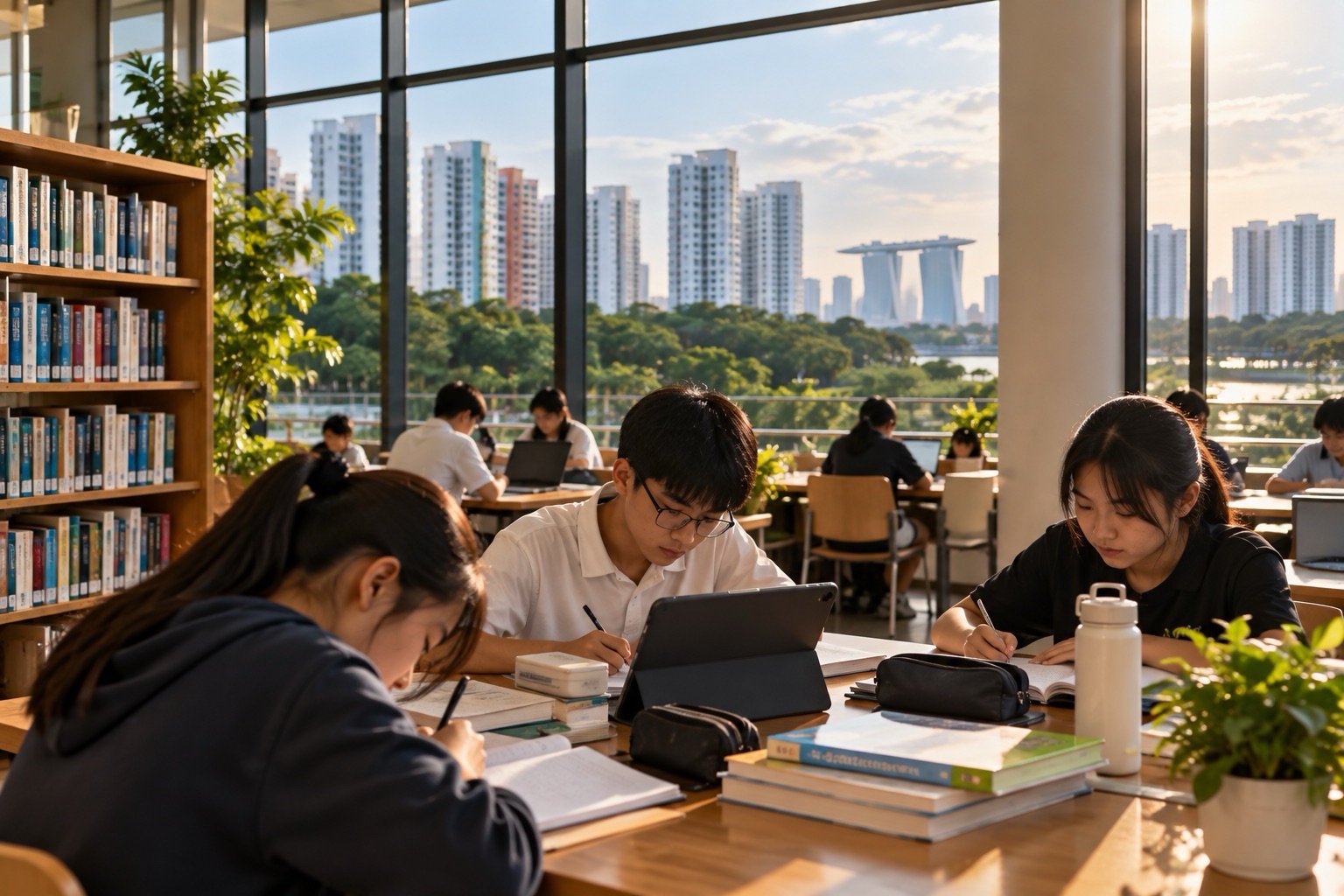
For Punggol parents researching G2 History, the official 2027 SEC standalone syllabus is K227. It has two compulsory written papers of 1 hour 50 minutes each, 50 marks and 50% each. Paper 1 covers European control in Southeast Asia and challenges to dominance from the 1870s to 1942; Paper 2 covers the post-Second World War world, the Cold War and decolonisation through 1991. Each paper combines a source-based case study and essays, and candidates type answers in a digital booklet. Strong preparation means historical evidence and explanation, not just a memorised chronology.
Posting Group 2 (PG2) is a school-admission arrangement, whereas G2 is the level of an individual subject. Standalone History K227 is not combined Humanities Social Studies/History K230: the paper structure and scope differ. The inaugural SEC is for the graduating 2027 cohort; a pupil starting Secondary 1 in 2027 would ordinarily reach Secondary 4 in 2030. This guide uses the verified 2027 K227 document to support honest planning in 2027/2028 without claiming that future syllabuses or any Punggol school combination are guaranteed.
- Correct code: SEC 2027 G2 History K227, not combined Humanities K230.
- Paper 1: 1 hour 50 minutes, 50 marks, 50%; European expansion in Southeast Asia and challenges to European dominance, 1870s–1942.
- Paper 2: 1 hour 50 minutes, 50 marks, 50%; Cold War and Southeast Asian decolonisation, 1940s–1991.
- Each paper: one 30-mark source-based case study and two 10-mark essays chosen from three questions.
- Response format: hard-copy question paper and typed digital answer booklet.
- History skills: causation, change and continuity, significance, sourcing and comparison.
- Family move: analyse a first incorrect inference before drilling extra essays.
1. What parents should decide first: PG2 or the G2 subject?
A Posting Group is used to facilitate Secondary 1 school admission. The G-level specifies the standard at which an individual subject is offered. A child admitted through PG2 does not necessarily take every subject at G2 and may study some subjects at a different level where eligibility and school arrangements permit. The distinction is explained in MOE’s Full SBB guidance. Parents should use the result slip and the school’s current subject records, not their memories of old streaming labels.
For the PSLE 2026 cohort, a score of 21–22 can allow PG2 or PG3, scores 23–24 ordinarily fall under PG2, and score 25 may permit PG1 or PG2. These are general descriptions rather than a guarantee for any individual; follow the result slip and official eligibility rules. In particular, choosing PG2 should be a considered school and learning decision. A child’s wellbeing, interests, teacher feedback and realistic school options matter more than an adult’s sense that one group name sounds superior.
The 17 November 2026 SEAB–MOE release announced PSLE results on 24 November 2026 at 11.00am, with the S1 portal available from 11.30am and submission closing 30 November at 4.30pm. The later posting-result day was tentatively 18 December. Families should check the final notice, make six genuine school choices in preference order, and use SchoolFinder. Last year’s score ranges do not guarantee a place this year.
2. SEC 2027 and the separate meaning of 2028
The Singapore–Cambridge Secondary Education Certificate is introduced for graduating students in 2027, replacing the previous separate N(T), N(A) and O-Level certificate names. SEC records subjects at the individual G1, G2 or G3 level sat. The official 2027 G2 school-candidate syllabus list identifies History as K227. Its paper scheme is for the national upper-secondary examination, not a schoolwide Secondary 1 test.
The 2027/2028 subtitle is a family planning horizon. A child who begins Secondary 1 in 2027 would ordinarily sit the Secondary 4 SEC in 2030. It would be misleading to promise that every question type, prescribed work or examination arrangement in 2027 must be identical in 2030. Follow the receiving school’s present lower-secondary curriculum for younger learners, and SEAB’s exact syllabus for the real examination year for older students.
3. High fidelity and precision should produce clearer teaching, not pressure
“High fidelity” means using practice that actually corresponds to the skills and assessment objectives of History. “Precision education” means identifying a particular missing step, such as remembering names and dates but failing to explain historical causes or evaluate conflicting sources, and addressing that step. “Engineered control” means parents controlling useful conditions: correct sources, a regular place to study, reasonable practice time, enough sleep, timely feedback and an honest discussion with the child. These expressions are an editorial framework, not terms conferring an MOE endorsement or guaranteeing results.
A reliable cycle starts with an independent task. Ask the pupil to describe where confusion began and why. Select one difficulty, explain it using a small example, then ask for an unfamiliar but related response. Revisit several days later without hints. The learner’s ability to explain and adapt the principle is better evidence of mastery than completing many questions immediately after seeing a model.
This also means allowing a child to have an interpretation or opinion that differs from the parent’s, as long as it is respectful and supported. History and Literature are not strengthened by forcing the student to memorise an adult’s viewpoint. When a learner becomes anxious or avoids reading because every sentence is corrected, lighten the practice and seek guidance. A confident independent thinker is a better outcome than a compliant collector of answer templates.
4. The verified 2027 national K227 examination
The primary source is SEAB’s 2027 SEC G2 History syllabus (K227). Before using any textbook, past-paper compilation or online worksheet, verify the syllabus code and the school’s subject combination. A similar subject name may have a different assessment scheme. The 2027 national papers are described below, not as compulsory homework lengths for Secondary 1.
| 2027 G2 History K227 | Official structure | Weight |
|---|---|---|
| Paper 1, 1 hour 50 minutes | 1870s–1942. Source-based case study 30 marks; answer two of three essay questions, 10 marks each. | 50% |
| Paper 2, 1 hour 50 minutes | 1940s–1991. Source-based case study 30 marks; answer two of three essay questions, 10 marks each. | 50% |
| Both papers | Maximum five sources in each case study. Questions printed on paper; candidates type into digital answer booklets. | 100% together |
SEAB marks source-based content using AO1 knowledge plus AO3 interpretation/evaluation and essays using AO1 knowledge plus AO2 explanation. Within each 50-mark paper, source questions account for 30 marks and essays 20 marks. The syllabus identifies certain topics with an asterisk as permissible source-based case studies; not every background overview is externally examined. Follow the actual syllabus table when distinguishing examinable and non-examinable overview content.
5. One school-level decision can affect the subject choices available later
The four mainstream Punggol secondary schools — Edgefield Secondary, Greendale Secondary, Punggol Secondary and Yusof Ishak Secondary — are geographical starting points for families. This is not a ranking or confirmation that all four offer History at the desired G-level or combination. Ask for current school documentation and use eduKate’s four-school comparison as a starting framework. If the shortlist is too narrow, investigate reachable Sengkang or Hougang schools and confirm their present options independently.
- Check the exact Posting Group eligibility and six-school submission process on the child’s results slip.
- Ask whether the school offers K227 or the relevant current-year version of History, and what the entry criteria are.
- Do not assume that publication of a national SEAB syllabus means every school has teaching and timetabling for it.
- Review teacher feedback on the child’s comprehension, reasoning, workload and interest before selecting an upper-secondary option.
- Travel the likely morning route and the return route after CCA. Account for transfers, rain, crowded services and fatigue.
- Compare guidance and support for students, school culture, activities and the child’s willingness to attend.
- Only then consider whether extra tuition adds something the school and a modest home routine cannot already provide.
See eduKate’s Punggol Secondary 1 2027 guide for orientation and its Secondary 3 subject-combination guide for later decisions. The subject choices available in a national examination catalogue, the choices a school offers, and the options for which a pupil is eligible are three distinct things.
6. History is a disciplined way to explain change, not a date collection
A timeline can establish what happened before something else. It cannot, by itself, explain why one event produced another or why an individual acted. The K227 syllabus examines cause and consequence, change and continuity, significance and the evaluation of multiple sources. Parents should ask the child to move from a statement of sequence to an explanatory link: what conditions made an event possible, what triggered the change, and what evidence supports that explanation.
For example, an essay about a historical policy cannot merely repeat the policy name, key personalities and date. It should explain the pressures behind the policy, how it worked in context, and at least one consequence relevant to the question. Different groups may have experienced the same development differently. Encouraging that distinction makes history more accurate and less likely to become a simplified story with a single hero or villain.
7. Paper 1: Southeast Asian colonial control and its consequences
The first paper opens with European control in Southeast Asia, including the specific study of British Malaya from the 1870s to the 1920s. Learners examine the shift in British policy and influence, including developments in Perak, the operation of colonial administration and economic or social changes. The topic involves interpreting motivations, institutional change and local responses; it is not simply an invitation to memorise names of colonial officers.
A good learning activity draws a two-column table: one column states an action by a governing power; another describes an affected group and an evidenced consequence. Ask the learner whether an economic change benefited everyone equally. The answer may differ across groups and time periods. A strong response should demonstrate a relationship, not suggest that one event automatically explains every outcome.
K227 also includes the impact of the First World War peace settlement in Europe and attempts at collective security in the 1920s. These provide context for political instability and later conflict. Students should know the difference between the aims of the peace settlements, their terms and the consequences observed in the immediate period. A pupil who knows the phrase ‘Treaty of Versailles’ but cannot explain why a term mattered has not yet mastered the concept.
8. Paper 1: authoritarian rule, Nazi Germany and Militarist Japan
The syllabus includes the rise of authoritarian regimes, with Nazi Germany a specified source-based case-study topic and Militarist Japan in the broader content. The educational task is to understand conditions, propaganda, institutions, coercion and political choices in historical context. This is not a venue for endorsing extremist ideas, trivialising persecution or treating violence as entertainment. Use age-appropriate school materials and teach pupils to distinguish analysis of propaganda from approval of it.
A common error is to reduce a complex political development to one individual’s personality. Ask students to examine economic pressures, political structures, the role of organisations and the interaction between leaders and institutions. These factors are not interchangeable; an essay should choose what matters for the specific question and explain mechanisms. Students should also consider the effects on different groups, using historical evidence rather than stereotypes.
The syllabus then examines developments leading to the Second World War in Europe and the Asia-Pacific. A strong response recognises decisions, sequences and consequences without pretending all countries had the same motivations. A small cause-and-effect map can help: long-term conditions, immediate developments, actions and outcomes. Encourage students to cite appropriate school sources and be precise about geography and dates.
9. Paper 2: the Cold War and decolonisation, 1940s–1991
The second paper covers the post-war world, including the origins and development of the Cold War in Europe. It also examines conflict outside Europe, including the Korean War and Vietnam War case studies. To explain these developments, a learner needs to understand shifting alliances, competing priorities, actions and responses. Simple statements that two countries ‘disliked each other’ are inadequate historical explanation.
For Cold War questions, ask the student to state whose policy they are discussing, what that actor hoped to achieve, and how another actor interpreted or responded to it. A source may emphasise security while another emphasises influence. Distinguish the source’s perspective from the historian’s wider assessment. Historical reasoning accepts that political actors can interpret the same event differently, while still evaluating which claims are supported.
The K227 syllabus also includes decolonisation in Southeast Asia with British Malaya from 1945 to 1957 as a specified source-based topic. Students should understand processes by which colonial rule changed, the role of different actors, and the conditions under which new political arrangements emerged. Decolonisation is not an instant one-date event. Asking ‘who negotiated, who resisted, and what changed in practice?’ encourages deeper understanding.
The end of the Cold War is part of the wider narrative. Students should distinguish an overview that serves context from content explicitly prescribed for source-based assessment, using the syllabus’s asterisk markers. Never tell students that a useful overview can be ignored entirely just because its topic is not independently examinable: background knowledge can help explain an examinable historical development.
10. The source-based case study: inference needs corroboration
Each K227 paper includes a 30-mark source-based case study of up to five sources. A source may be a speech, cartoon, photograph, newspaper account or later interpretation. The first task is identifying its explicit content. Next ask what it implies, whose perspective is represented and how its origin, audience and purpose affect its usefulness for the precise question. A statement can be useful evidence for what a political actor wished to claim without proving every part of that claim was true.
Compare two sources point by point. If a government statement portrays a decision as necessary while a contemporary critic describes it as harmful, explain exactly which aspect differs. Do not stop at ‘one source agrees, the other disagrees’. The pupil should refer to relevant details, assess how the perspectives relate to context, and note which claims can be corroborated with independent information. Two sources may describe different aspects of an event without being directly contradictory.
A source-based answer can go wrong when the student quotes a long passage without explanation. A short, relevant phrase tied to a clear inference is usually more useful than copying several lines. Train a sequence: read the question command; select the meaningful evidence; articulate the inference; then evaluate or compare if requested. This disciplined sequence works across unfamiliar sources without requiring a memorised answer for every topic.
11. Essays: answer two out of three questions on each paper
Both K227 papers contain three essay questions from which the candidate chooses two. Each essay is worth 10 marks. That is not permission to prepare only two favourite essays from the entire syllabus. Questions can be set on the specified syllabus issues and may require different kinds of explanation. Teach the student to read all choices carefully, identify the exact demand and choose questions where they can support a clear argument with accurate knowledge.
A workable paragraph has a direct claim, a relevant historical fact, explanation linking it to the claim and a return to the question. If asked about relative importance, the conclusion should weigh factors rather than merely repeat them. If asked about consequences, the answer must identify what changed, for whom and when. Rote dates have value only when placed in a causal or chronological explanation.
Do not equate a longer response with a stronger one. A rambling account of everything the student remembers may show content but fail the task. Ask a young learner to say their thesis aloud in one sentence. If they cannot do so, their written answer probably needs planning. They can then list two or three relevant supporting facts and decide which are essential.
12. Typed History answers: thinking survives the keyboard
For 2027 K227, candidates receive printed question papers and use a digital answer booklet. This makes the ability to type coherent responses relevant, but it does not turn History into a typing-speed contest. The pupil still has to interpret sources, select evidence and explain historical causation. In school, follow the teacher’s actual e-Examination training and any arrangements for students with access needs.
A useful practice method is to plan a response on paper in three lines, then type the paragraph without looking up a model answer. Afterwards, check whether every sentence has a purpose and whether the source is cited appropriately in the response. The goal is to remove technical friction while preserving historical argument. Never advise a family to buy software or hardware simply because a blog imagines that the national exam requires it.
13. Worked example A: a school-level causal explanation
Consider an invented historical practice prompt: a local authority changes a rule after trade conditions deteriorate. A weak answer says ‘because trade was bad’. A stronger answer identifies what economic pressure was present, why that might affect decision-makers and what new rule was intended to change. Then ask whether other political or social factors could also matter. The example is a reasoning demonstration, not an allegation about a real historical government.
A good explanation stays close to the documented evidence. If the only source available is a public announcement, it may reveal the authority’s stated reason but not prove that this was the only motivation. The learner should know the difference between summarising a source’s claim and establishing an evidence-supported historical explanation.
14. Worked example B: two sources, one event
Imagine two fictional newspaper reports about the same protest. One foregrounds the disruption to transport; the other foregrounds the participants’ stated concerns. Do the accounts necessarily contradict? They may emphasise different experiences of the same event. Ask the student what each source is useful for, who produced it, which facts can be checked and what further evidence would support a broader conclusion. This is a safe generic exercise, not a quotation from any national History paper.
Now change one source: suppose its author was not present and relied on a second-hand account. Does that make the source automatically worthless? No; its usefulness depends on the claim. It may still reflect how information circulated, but it may be weaker for establishing exact eyewitness details. Teaching this nuance is more productive than memorising ‘primary reliable, secondary unreliable’ as a universal rule.
15. An eight-week lower-secondary History bridge
| Weeks | Skill focus | Independent evidence |
|---|---|---|
| 1–2 | Put events in context with chronology and a simple map. | Correctly distinguishes earlier conditions from later consequences. |
| 3–4 | Explain cause, consequence and change. | Uses facts to show how or why something happened. |
| 5–6 | Infer and compare perspectives from short sources. | Cites evidence and recognises a source’s limits. |
| 7–8 | Plan and write short historical explanations. | Answers the actual question without listing every memorised fact. |
This is an optional bridge for home discussion, not an official Secondary 1 syllabus timetable. The receiving school may start with different historical themes. A pupil with strong factual recall but weak source comparison needs precise source-work practice; a pupil with fluent explanations but poor chronology needs a clearer timeline. The right fix should follow real work rather than a generic package.
15A. Common mistakes to correct early
- Treating a date as an explanation of a cause.
- Confusing the view expressed in a source with an independently verified fact.
- Using the word ‘biased’ without showing which claim is affected.
- Writing both essay answers on a single narrow preferred topic.
- Ignoring Southeast Asian history while focusing only on European leaders.
- Memorising whole paragraph models that do not fit a changed question.
- Confusing standalone K227 History with the Social Studies/History K230 combination.
Parents can make a one-page error log with the task, mistaken assumption, correct reasoning and delayed re-test. Celebrate a learner who changes a judgement after seeing better evidence. That is historical literacy, not indecision.
16. Three support pathways without false promises
Repair the missing prerequisite
If the child cannot start an answer, diagnose the earliest unreliable foundation. For History this might be remembering names and dates but failing to explain historical causes or evaluate conflicting sources. Explain one idea with a short, appropriate example and ask for an independent changed task. Avoid throwing full national practice papers at a new Secondary 1 student who needs help understanding a sentence, timeline, question command or paragraph structure.
Stabilise when the student is inconsistent
If homework looks good but assessments vary, compare a few marked scripts. The issue may be remembering evidence, selecting what the question asks for, managing time, or writing a coherent explanation. Use brief spaced practice and return to older material after several days. Track whether the student can apply a method without the tutor naming the technique first.
Extend when understanding is already strong
Secure learners can analyse an unfamiliar source, compare alternative interpretations or evaluate a more complex argument. Depth matters more than racing ahead. If considering another subject level, ask the school about sustained readiness, eligibility, timetable and the likely effect on all subjects. Neither staying at G2 nor moving to G3 should be treated as a moral verdict on the student.
17. A practical 2026–2028 family calendar
| When | Parent action | Avoid this assumption |
|---|---|---|
| 24–30 November 2026 | Read the official PSLE result slip and submit six suitable school choices. | The previous year’s last-posted score guarantees admission. |
| December 2026 | Follow final S1 posting details and prepare books, uniform, orientation and transport. | A previously tentative posting date cannot change. |
| January–March 2027 | Focus on new school routines, reading and current classroom tasks. | A Secondary 1 entrant sits SEC in 2027. |
| Mid–late 2027 | Review teacher guidance, learning evidence and workload. | One high score automatically grants entry to another G-level. |
| 2028 onward | Check the actual examination-year syllabus and school subject combinations. | All 2027 paper details will remain permanently identical. |
Under the SEC, pupils receive a certificate reflecting the subjects and levels they actually sit. Admission after secondary school may involve JC/MI, polytechnics, PFP where applicable and ITE, under different subject and grade requirements. Families must check current official admissions information for the relevant year; a PG2 admission route in Secondary 1 does not guarantee a future diploma or JC offer. Keep options open through sustained learning, guidance and realistic expectations.
18. What a useful conversation with the school sounds like
Bring two genuine pieces of History schoolwork and ask three questions: What does my child already do accurately without help? At what exact step does performance become unreliable? What kind of fresh task would demonstrate that the gap has closed? This makes the discussion specific. A teacher can also explain the current class syllabus, examination requirements, and whether the child’s level or subject combination suits the available timetable.
If a small teacher-led intervention works and the child remains engaged, no external tuition may be needed. If the same misconception persists after feedback, if independent work is impossible or if workload is creating serious distress, ask for school learning and wellbeing support and consider appropriate outside help. A tutor should describe a diagnostic process, not promise a particular grade or G3 promotion. Cost, travel, class size and quality of explanation are material concerns.
The immutable Clementi Secondary 1 Mathematics tutorial reference provides a model of precise diagnosis, manageable teaching, retrieval and independent checking. Those principles can be adapted to History; the Clementi Mathematics premises and particular lesson arrangements are not claims about a Punggol History or Literature tuition branch.
19. Parent FAQs
What is the difference between PG2 and G2?
PG2 facilitates school admission; G2 names a subject level. The school and MOE requirements determine the actual subject levels for a child.
Does every Punggol school offer this SEC subject?
No such assumption is justified. Ask each school for its current upper-secondary combination booklet and eligibility rules.
Will my new Secondary 1 child sit these 2027 national papers?
No. A child entering Secondary 1 in 2027 would ordinarily complete Secondary 4 in 2030. The national 2027 document is useful as a verified reference, not a current term timetable.
Is an examination paper from a previous cohort sufficient for future candidates?
It can be used to practise transferable skills, but the actual code, content, set texts and paper instructions must be checked against the examination-year SEAB syllabus.
Should parents insist on model-answer memorisation?
Models can demonstrate structure but cannot guarantee relevance to a changed question. Teach why an answer works and ask the child to explain an unfamiliar task independently.
Is K227 the same examination as K230 combined Humanities?
No. K227 is standalone History with two History papers. K230 combines Social Studies and History with another assessment structure.
Are K227 answers typed in the 2027 SEC?
Yes. The official syllabus specifies paper question booklets and digital answer booklets for both History papers.
How many essays are compulsory?
Each of the two papers sets three essay questions and requires candidates to answer two, with 10 marks per answer.
Does the source-based question cover every topic?
The K227 syllabus identifies particular source-based case-study topics with an asterisk. Other content can be examinable in essays or provide necessary context, so parents should read the official syllabus carefully.
Should historical conflict be taught using graphic videos?
No. Use age-appropriate reputable historical materials. Explain causes, decisions and human consequences without sensationalism or endorsing harmful ideologies.
20. Seven days of purposeful practice — without a tuition timetable takeover
| Day | What parents can support | Independent outcome |
|---|---|---|
| 1 | Read a real school assessment and ask what felt hardest. | One specific bottleneck is named. |
| 2 | Model a small relevant example. | Child explains what makes it correct. |
| 3 | Give a changed question or passage. | Child makes a fresh attempt without copying. |
| 4 | Leave space for CCA, family time and rest. | Child maintains a healthy schedule. |
| 5 | Revisit the original skill with no hints. | Shows retention rather than immediate repetition. |
| 6 | Discuss a related authentic book, event or source. | Child makes a thoughtful connection. |
| 7 | Review feedback, praise genuine progress and set one next step. | Improvement is visible and manageable. |
This is an optional framework. The suitable amount of extra practice depends on age, wellbeing, other subjects and the child’s current needs. A learner who already reads confidently and works independently need not complete all seven activities. Parents should avoid treating a timetable as successful merely because it is full. Ask whether understanding has improved and whether the pupil still enjoys learning.
21. Verified reading and parent checklist
- Open the official K227 syllabus PDF and note the correct examination year.
- Confirm the code in SEAB’s G2 syllabus directory.
- Separate the Posting Group from the subject level in the family’s education plan.
- Ask the school what it offers and how the child’s readiness is evaluated.
- Inspect two pieces of independent work and diagnose one meaningful obstacle.
- Follow teacher guidance; do not buy unrelated higher-level examination papers.
- Protect sleep, friendships, meals, school activities and a realistic Punggol commute.
- Use MOE SchoolFinder and the 2026 PSLE posting announcement for decisions that require current official evidence.
Explore these relevant eduKate ecosystem resources: G2 K227 History paper overview; G2 History Paper 1 British Malaya and authoritarian regimes; G2 History Paper 2 Cold War and decolonisation; K230 Social Studies and History combined comparison. Treat all secondary-school comparisons as supporting material and check the relevant MOE and SEAB publication before acting on examination-year details.
Historical understanding is the ability to distinguish a claim from evidence, to explain why events unfolded and to recognise how decisions affected different people. A Punggol learner who develops those habits is being prepared for more than an examination: they are learning to read the world with care.
Editorial verification: 19 November 2026. Independent eduKate Punggol parent guide, not an official MOE or SEAB publication. The K227 details refer to the verified 2027 SEC G2 syllabus. Later-year regulations, school subject offerings and post-secondary admission policies must be reconfirmed.


