
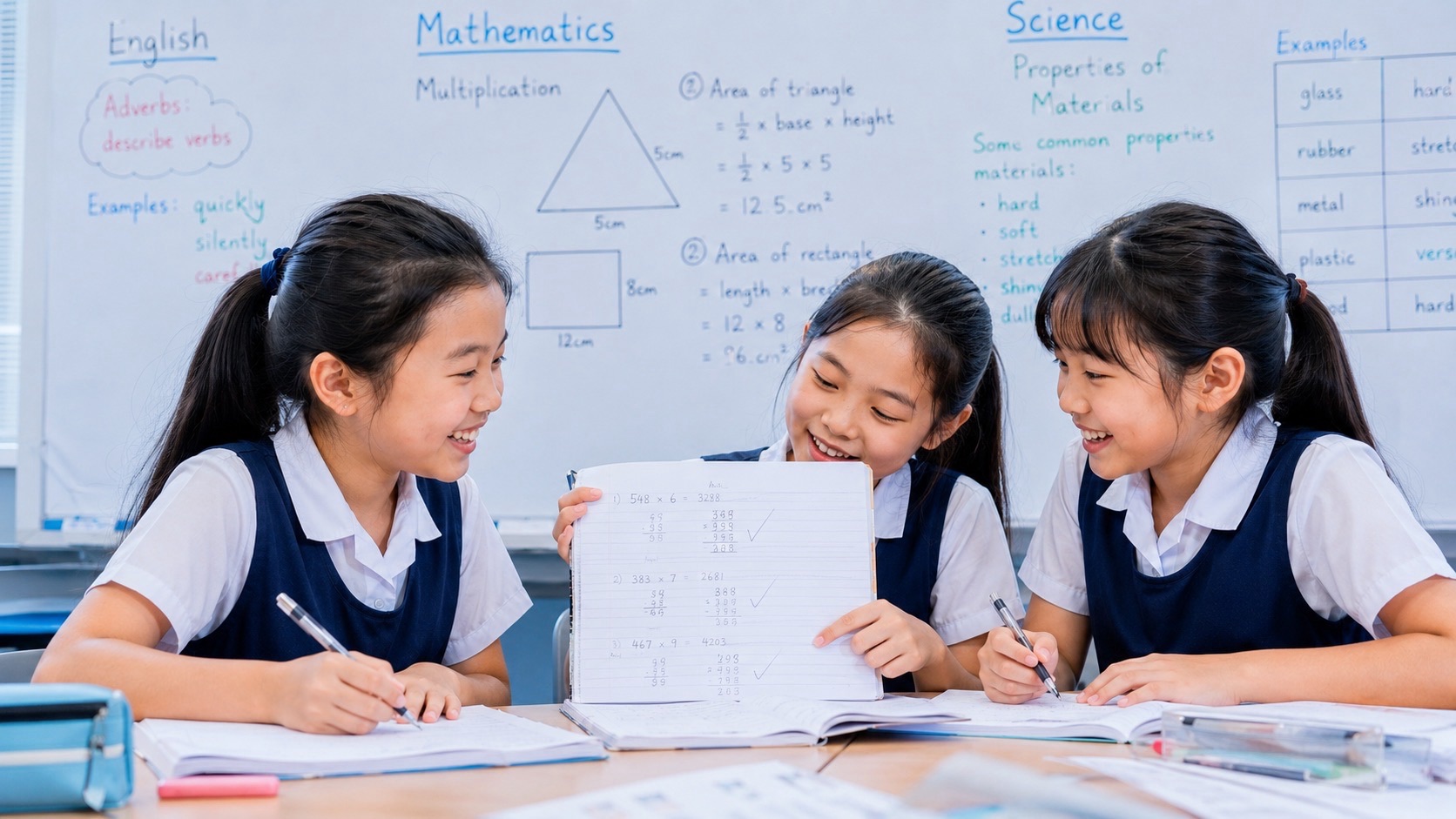
An effective Primary 3 Science tutor for Punggol families should turn children’s curiosity into clear observation, classification, evidence and explanation. eduKatePunggol’s published small-group model uses up to three learners in 1.5-hour tutorials. The educational goal is not to memorise a book of model answers: it is to help each child identify living things, compare material properties, understand life cycles and explain magnets, then answer a fresh question independently.
The official 2023 MOE Primary Science Syllabus, updated May 2024 identifies the actual Primary 3 topics. There is no standalone national SEAB Primary 3 Science examination; school-style exercises should follow the child’s school’s current work and assessments. Parents can first check whether the child understands Science concepts in class, because tuition is optional and does not guarantee any specific grade.
- P3 core: living and non-living things; materials and properties; plant and animal life cycles; magnets.
- Teaching priority: observation → classification and evidence → explanation → independent application.
- Correct exam context: current school-set P3 assessments, not a national SEAB paper.
- Published group model: maximum three learners, 1.5-hour tuition; confirm location, availability and fees.
- First diagnostic: one classification task, one materials question, one life-cycle sequence and one magnet explanation.
- Useful progress: a new correct explanation without tutor hints.
- Parent principle: support curiosity, protect safety and do not push older-syllabus content prematurely.
A child might know that a butterfly begins as an egg yet fail to explain why the drawing is called a cycle. Another might say a metal spoon is magnetic because it is shiny, when the actual property has not been tested. These mistakes are not solved by demanding longer answers. The tutor should ask what evidence the child used and repair the underlying concept before asking for a new conclusion.
Punggol offers everyday opportunities to think scientifically, from the materials used in waterway shelters to the life cycles of plants seen on safe neighbourhood walks. The family need not perform elaborate experiments. Short observations, careful questions and changed examples often show more real understanding than a thick stack of corrected worksheets.
The complete Primary 3 Science syllabus and learning pathway
1. What Primary 3 Science actually teaches
Primary 3 is the first formal Science year in Singapore mainstream primary schools. The MOE 2023 Primary Science syllabus, updated May 2024 assigns four main P3 areas: diversity of living and non-living things, diversity of materials, life cycles of plants and animals, and magnetism. The subject also teaches ways of observing, classifying, comparing and explaining.
This scope is smaller than the entire P3–P6 Science syllabus. Plant systems, the human digestive system, light and heat appear in Primary 4 in the syllabus table. Reproduction in detail, electricity and other later content belong to higher primary levels. A tutor should not disguise an upper-primary question as an urgent P3 must-know just because it looks impressive.
Parent action: check the school’s present units. Use the official P3 content list rather than a commercial book’s most advanced chapters.
2. The first scientific skill is careful observation
Observation is a report of what can be seen, heard, measured or otherwise detected appropriately. Inference is an explanation drawn from observations. Children may mix them: ‘the leaf has brown edges’ is an observation; ‘the plant did not get enough water’ may be a possible inference but cannot be established from that single detail alone.
Use a familiar plant on a balcony or a school garden photograph. Ask the learner to say three observations without explaining them, then propose possible reasons for one feature. A cautious pupil may offer more than one possible explanation and describe what additional evidence would help. That is closer to scientific thinking than selecting a confident answer unsupported by the facts.
Parent action: separate ‘I noticed’ from ‘I think this might mean’. This habit improves both school answers and everyday reasoning.
3. Living and non-living things: do not use movement alone
P3 Science describes broad characteristics of living things: they need water, food and air to survive, grow, respond and reproduce. One isolated characteristic does not settle the classification. A toy car can move, but it does not grow, reproduce or carry out the life processes of living things. A seed may appear still, but it is part of a living plant’s life cycle.
Ask: why is a wind-up toy non-living while a plant is living? The child should mention life characteristics, not simply ‘the toy is made of plastic’. A mushroom is a living thing but not a plant; fungi are recognised as their own broad group. Avoid insisting that every living thing must walk, have eyes or make noise.
Parent action: teach evidence-based classification and ask for a counterexample whenever the child offers a one-word rule.
4. The broad groups of living things
The syllabus introduces plants, animals, fungi and bacteria as broad groups, and broad animal groups such as amphibians, birds, fish, insects, mammals and reptiles. A beginner should notice shared and different observable characteristics. These groups give the child a useful organisation of diversity without requiring memorisation of obscure species trivia.
For example, birds have feathers and fish have different observable features suited to their environments. A pupil might mistakenly classify a bat as a bird because it flies; ask which features of mammals matter instead. Use a drawing or photograph with two or three observable clues and explain why one clue alone can be misleading.
Parent action: choose ordinary examples and encourage your child to explain the feature used, not merely remember the correct category.
5. Classification means stating a rule
When asked to sort objects, children sometimes form a group they can see but cannot explain the rule. A scientifically useful classification depends on a consistent property: things made of metal, materials that allow water through, or living things with a certain broad observable feature. The choice of rule must match the evidence.
Give three objects: a clear plastic bottle, a cloth bag and a ceramic cup. You might classify them by whether they are flexible, whether most light passes through or whether they absorb water. The groups will change when the rule changes; this is expected. The child should label the chosen property instead of assuming every object belongs permanently to only one collection.
Parent action: ask ‘What property did you use?’ and ‘Would the grouping change if we used a different property?’
6. Materials: learn properties before remembering uses
The MOE P3 topic includes familiar materials such as wood, metal, ceramic, rubber, glass, plastic and fabric. The important properties include strength, flexibility, ability to float or sink, waterproofness and how much light can pass through. A material is useful for a job because relevant properties suit the design. The child should connect those properties to everyday objects.
A raincoat must limit the passage of water; a window usually needs to allow light through; a storage container may need to be strong enough to carry its contents. ‘Plastic is always best’ is not an explanation. Different plastics, shapes and uses create different choices, and a responsible question specifies the desired function.
Parent action: ask the child to suggest two materials for an object and compare their relevant properties rather than recite a favourite.
7. Strength and flexibility are not the same
Strength is the ability to bear a load without breaking; flexibility is the ability to bend without breaking. A pupil may call a material strong simply because it feels hard, or flexible simply because it is thin. Those are not reliable definitions. Use simple safe demonstrations to make the properties distinct.
For example, a thin paper strip bends easily but may tear under a modest load. A sturdy wooden ruler may support a small load while bending much less. The exact outcome depends on the object and how the test is conducted. Do not claim that every piece of a named material has identical behaviour regardless of thickness or shape.
Parent action: have your child use the words ‘bend’ and ‘break’ precisely in a short explanation.
8. Waterproofness is about absorption
In the syllabus notes, waterproof materials are described as materials that do not absorb water. Pupils can confuse waterproofness with floating or with a surface looking smooth. A material may float and still absorb water, while a waterproof object may sink because floating depends on the overall object and situation.
Compare a piece of cloth with a suitable plastic sheet using a small amount of water under adult supervision. Observe whether water is absorbed. The conclusion should describe what was tested, not assert that all cloths are identical. A child who says ‘the material is waterproof because no water soaked in during this test’ is giving evidence relevant to the property.
Parent action: ask which observation supports the answer and whether the test was fair enough to compare the samples.
9. Floating and sinking without premature density formulae
The P3 syllabus asks pupils to compare the ability of objects to float or sink; formal density calculations are not required here. A large object can float while a small one sinks. Size alone does not decide the outcome. Shape, material and conditions matter, so broad statements such as ‘heavy things always sink’ should be challenged with ordinary examples.
At home, use safe small objects in a bowl of water with supervision. Record whether each object remains on or near the surface or moves to the bottom. Do not allow the child to infer waterproofness from floating alone; these are separate characteristics. The goal is a careful, age-appropriate comparison, not a claim to have proved a universal law.
Parent action: draw a two-column observation table and ask the child to describe the evidence before making an explanation.
10. Light passing through materials
The Science syllabus examines whether most, some or no light passes through a material. At this stage the key is observable comparison rather than requiring advanced terminology. A clear glass panel may let much light through, a thin curtain some light, and a wooden board little or no light.
Ask the child to compare a transparent-looking folder, a piece of tracing paper and cardboard under suitable lighting. Describe the observation first; do not confuse the colour of a material with the amount of light passing through. The same kind of simple observation can help a child explain why certain materials are chosen for windows, screens or shade.
Parent action: ask which feature matters for the particular object rather than expecting every clear material to have every desirable property.
11. Life cycles of plants: stages, not memorised diagrams
P3 focuses on stages such as seed, young plant and adult plant for flowering plants grown from seeds. Children should understand that living things change through recognisable stages and that life cycles can repeat. Detailed mechanisms of pollination and fertilisation are introduced later in the syllabus, not as routine P3 core content.
A class might observe beans growing over time and record dated drawings. One seed germinates sooner than another, but a picture taken on one day does not describe the whole cycle. Invite pupils to order stage pictures, describe observable changes and explain that the adult plant can produce seeds that begin a new cycle.
Parent action: take a weekly plant photograph and ask the child to distinguish a genuine change from an assumption about what will happen next.
12. Animal life cycles can differ substantially
The syllabus names everyday examples including chicken, cockroach, frog, grasshopper, beetle, butterfly and mosquito. It is more useful to compare stages and patterns than to memorise every possible animal’s life cycle. A chicken’s young resembles an adult in broad form, while a butterfly undergoes a conspicuous change from larva to adult.
A child may put all egg-laying animals in one life-cycle diagram, incorrectly assuming that every young animal resembles its adult or goes through the same stages. Ask what stages are shown and which differences are visible. A good explanation describes the specific cycle rather than generalising beyond the given organism.
Parent action: practise comparing two cycles aloud: what is shared, what is different and which evidence shows that?
13. Sequencing, repetition and what a cycle means
Some children describe a life cycle as a straight line with an ending. Help them see why it is drawn as a repeating sequence: adults produce the next generation, allowing the pattern to continue. This does not mean an individual butterfly or plant starts its own childhood again. The repeated sequence occurs across generations.
Use a simple seed → young plant → adult flowering plant → seeds diagram, then ask which stage begins the next generation. Invite the pupil to explain a second cycle without looking at the first. This checks the concept of a cycle rather than the ability to copy arrow placement from a worksheet.
Parent action: ask ‘Whose life begins when the cycle repeats?’ to detect whether the child is confusing the individual with the generations.
14. Magnets: attraction and repulsion
P3 pupils meet magnets as objects that can exert pushes or pulls. Unlike magnetic poles attract and like poles repel. A child may remember ‘magnets attract’ and therefore be surprised when two magnets push away from each other. The relationship between poles matters, not simply the fact that an object is magnetic.
Use two labelled magnets safely and let the child predict what will happen when north faces south, north faces north and south faces south. Rotate one magnet and repeat. The tutor should ask for an explanation using the pole arrangement rather than accept ‘because magnets are strong’. Avoid placing magnets near devices that could be damaged.
Parent action: ask pupils to predict before observing and to say exactly what changed between the trials.
15. Magnetic material is not the same as any metal
A common misconception is that every shiny or metallic-looking object will be attracted by a magnet. The syllabus says magnets attract magnetic materials and may be made from iron or steel; not every material labelled metal behaves in the same way. A household test can be useful, but a coating, alloy or object construction may complicate interpretation.
Collect a few safe objects such as a steel paper clip, an aluminium item and a plastic object. Observe carefully which is attracted by the magnet. Ask the child to describe the result for these exact specimens rather than claim that every item from the same broad category behaves identically.
Parent action: use ‘this sample was attracted’ as the observation before attempting a broader conclusion.
16. What a fair comparison looks like at P3
Children do not need upper-secondary laboratory vocabulary to learn why a comparison should be fair. If two materials are tested for strength but have very different thicknesses and shapes, a result may not show what the child thinks it shows. Ask which condition changed and what stayed similar.
An age-appropriate task might compare how water passes through equal-sized samples of two materials using the same amount of water and similar waiting time. Where a result is unclear, describe the limitation honestly. The scientific habit is to avoid claiming more certainty than an observation supports.
Parent action: let your child propose one way to make the comparison more reliable.
17. Scientific answers should contain evidence
Pupils sometimes give the right word with no explanation: ‘This is waterproof’ or ‘This is a living thing.’ Many school-style questions require the reason. Build a simple answer structure: observation or provided fact, relevant scientific concept, conclusion. The exact number of sentences depends on the question and the school’s expected response.
Example: ‘Why is the plastic sheet suitable for a rain cover?’ A supported answer is: ‘The sheet did not absorb the water during the demonstration, so it helps keep the object underneath dry.’ A vague reply such as ‘because plastic is good’ lacks the property and explanation. A changed question about a window may require transparency instead.
Parent action: ask ‘Which fact from the question matters?’ before expecting a longer answer.
18. Graphs, tables and labels in Science practice
Even in the first formal Science year, a child should learn to extract information from a simple table or observation record. The hardest step is often identifying what is actually compared. A table of three materials and three properties does not justify answering a question about an untested property.
Suppose an observation table says Material A bends easily, Material B does not, and Material C bends slightly. To answer which is most flexible in that test, Material A is supported. It does not follow that Material A is automatically the strongest or most waterproof; those outcomes have not been given.
Parent action: circle the tested property and refuse to infer a second, unmeasured property from the same table.
19. A Punggol waterway walk can become inquiry
Punggol’s park and waterway environment can give families opportunities to notice plants, animals, structures and materials in daily life. The educational value is in careful observation, respectful questions and safe conduct. Children should not touch wildlife, uproot plants, take water samples or conduct unsupervised experiments merely to make a worksheet more ‘hands on’.
Invite the child to classify two visible plants by observable features, notice why a railing must be strong, or discuss whether a sheltered sign must resist rain. Photograph only appropriate objects, avoid collecting living things and stay on designated paths. Everyday observation can deepen meaning without claiming that the park is a formal MOE outdoor assessment site.
Parent action: keep a short observation diary with ‘What I saw’, ‘What I think’ and ‘What I still need to know’.
20. What a three-pupil Science tutorial should do
The educational value of a small group is that each student can make a prediction, provide an explanation, receive feedback and try a fresh example. One child may confuse movement with life, another may think every metal is magnetic and a third may struggle with life-cycle ordering. A skilled tutor will not treat the three different misconceptions as a single weakness called ‘Science’.
eduKatePunggol’s published tutorial model uses groups of up to three and 1.5-hour sessions. That gives the possibility of close observation but does not guarantee learning by itself. The tutor should listen to each child, check their individual reasoning and preserve opportunities for disagreement supported by evidence. The goal is independent explanation rather than imitation of the loudest student.
Parent action: ask for a sample of how the tutor corrects three different answers while keeping all pupils engaged.
21. A possible 90-minute Science tutorial
A balanced session might use ten minutes for recalling earlier concepts, fifteen to examine an observation, twenty for explicit teaching, twenty for guided investigations or diagrams, fifteen for independent questions and ten for explaining and correcting errors. Real class pacing should depend on what the pupils need; this is an illustration rather than a published timetable guarantee.
For magnets, children could predict pole interactions, compare what happens and answer a new question. For materials, they might identify the most relevant property for an object. For life cycles, they could order unfamiliar diagrams and explain the repeating pattern. Every activity should connect evidence to a concept, not merely keep children occupied.
Parent action: ask what fresh question the child answered without assistance before leaving the lesson.
22. Four-week recovery and revision plan
Week 1: use a few current school questions to locate the first misunderstanding, then teach one core idea with examples. Week 2: practise observation and explanation using new familiar objects. Week 3: mix two P3 topics and require the child to explain why a chosen idea applies. Week 4: check a fresh task, revisit the initial error and compare the support needed.
This cycle is more defensible than claiming that four weeks will produce an A. A pupil who has only just begun Science may need more time to connect vocabulary, evidence and written expression. Home practice can be short: a few minutes of observation, conversation and a small set of carefully selected questions, leaving time for rest and other interests.
Parent action: value independent explanation, not an adult-assisted perfect score.
23. School assessment and the limits of ‘latest’ papers
There is no national SEAB Primary 3 Science paper. In 2026 and 2027, P3 schools use their own assessment approaches within the MOE curriculum, and MOE has removed mid-year examinations. The phrase ‘latest style’ should therefore describe current syllabus-aligned school-style reasoning tasks, not privileged access to an unseen official paper.
Different schools may assess observation, explanation and taught concepts in different proportions. Ask for this term’s school scope, review the teacher’s examples and prepare for the actual tasks. A pupil should still be able to reason when a diagram, familiar animal or material is changed; otherwise preparation may be too closely tied to one workbook.
Parent action: prefer new application questions over repeated memorisation of exact model answers.
24. When additional Science tuition is and is not worthwhile
If the pupil is curious, following classwork, completing suitable work independently and asking good questions, additional tuition may be unnecessary. A parent can support Science by observing ordinary phenomena and encouraging careful explanations. A child should not be pushed into advanced topics solely because peers are attending classes.
Support may be useful when a repeated misconception persists after teacher feedback, the pupil cannot connect evidence with a conclusion, or there is a genuine need for appropriately paced extension. Before enrolling, clarify class fit, exact venue, timetable, fees, travel, lesson content and a review method. A Punggol-facing title does not confirm a particular station-side classroom or an available seat.
Parent action: request an explanation of the precise learning need and how the tutor will know that it has improved.
25. Keep the route towards P4 and PSLE sensible
Primary 4 adds new scientific topics, so secure P3 concepts give students a useful base for later learning. Children who can observe carefully, read a diagram, compare properties and write a supported explanation are building general inquiry skills. Jumping to P6 light, electricity or energy questions before the P3 topics are understood can produce vocabulary memorisation without comprehension.
For a child in P3 in 2027, the expected PSLE year under normal progression is 2030. Parents should check the official exam documents when that year approaches rather than assume the present SEAB PSLE format will stay unchanged. At P3, the priority is to follow the school and MOE syllabus with curiosity and accuracy.
Parent action: track mastery of present concepts first. Let stronger reasoning make later topics easier rather than treating every P3 lesson as a mock PSLE.
26. Fourteen original school-style P3 Science questions
Practice 1: A toy car moves across the floor. Does movement prove it is alive?
Model reasoning: No. Movement alone is not sufficient; living things show a set of life characteristics. A wind-up toy is non-living. Give a changed example so the pupil must use the idea again, without copying the same sentence. These are original curriculum-aligned examples, not past SEAB P3 examination questions.
Practice 2: A seed looks still. Must it be non-living?
Model reasoning: No. A viable seed is part of a living plant’s life cycle and can grow into a young plant under suitable conditions. Give a changed example so the pupil must use the idea again, without copying the same sentence. These are original curriculum-aligned examples, not past SEAB P3 examination questions.
Practice 3: A bat flies. Does that automatically make it a bird?
Model reasoning: No. Flight alone is not the classification rule; bats are mammals. Give a changed example so the pupil must use the idea again, without copying the same sentence. These are original curriculum-aligned examples, not past SEAB P3 examination questions.
Practice 4: Is a mushroom a plant?
Model reasoning: No. It is a fungus, a recognised group of living things. Give a changed example so the pupil must use the idea again, without copying the same sentence. These are original curriculum-aligned examples, not past SEAB P3 examination questions.
Practice 5: Which property matters most for a rain cover?
Model reasoning: Waterproofness—whether the material avoids absorbing water in the relevant situation. Give a changed example so the pupil must use the idea again, without copying the same sentence. These are original curriculum-aligned examples, not past SEAB P3 examination questions.
Practice 6: A ruler bends without breaking. Which property has been observed?
Model reasoning: Flexibility, not automatically strength. Give a changed example so the pupil must use the idea again, without copying the same sentence. These are original curriculum-aligned examples, not past SEAB P3 examination questions.
Practice 7: A clear window allows light through. Which property is relevant?
Model reasoning: The ability of a material to allow much light to pass through. Give a changed example so the pupil must use the idea again, without copying the same sentence. These are original curriculum-aligned examples, not past SEAB P3 examination questions.
Practice 8: Does every heavy object sink?
Model reasoning: No. The result must be observed for the actual object; mass alone is not sufficient to determine floating. Give a changed example so the pupil must use the idea again, without copying the same sentence. These are original curriculum-aligned examples, not past SEAB P3 examination questions.
Practice 9: Place the plant stages in order: adult plant, seed, young plant.
Model reasoning: Seed → young plant → adult plant; the next generation may begin with seeds from the adult. Give a changed example so the pupil must use the idea again, without copying the same sentence. These are original curriculum-aligned examples, not past SEAB P3 examination questions.
Practice 10: Does an individual adult butterfly turn into an egg again?
Model reasoning: No. The adult’s offspring begin the next generation; the individual does not return to its own earlier stage. Give a changed example so the pupil must use the idea again, without copying the same sentence. These are original curriculum-aligned examples, not past SEAB P3 examination questions.
Practice 11: What happens when the north pole of a magnet faces the south pole of another?
Model reasoning: Unlike poles attract. Give a changed example so the pupil must use the idea again, without copying the same sentence. These are original curriculum-aligned examples, not past SEAB P3 examination questions.
Practice 12: What happens when north faces north?
Model reasoning: Like poles repel. Give a changed example so the pupil must use the idea again, without copying the same sentence. These are original curriculum-aligned examples, not past SEAB P3 examination questions.
Practice 13: Is a plastic ruler ordinarily attracted by a magnet?
Model reasoning: Ordinary plastic is not a magnetic material; test the specific object where relevant. Give a changed example so the pupil must use the idea again, without copying the same sentence. These are original curriculum-aligned examples, not past SEAB P3 examination questions.
Practice 14: A table records a material’s flexibility only. Can you infer it is waterproof?
Model reasoning: No. Waterproofness is a different property that was not tested. Give a changed example so the pupil must use the idea again, without copying the same sentence. These are original curriculum-aligned examples, not past SEAB P3 examination questions.
Frequently asked questions for parents
Is there a national SEAB Primary 3 Science paper?
No. MOE sets the curriculum, while schools assess pupils through their own arrangements. Use your child’s current school scope.
What is the first P3 Science chapter?
Schools can sequence lessons differently. The official P3 syllabus includes diversity of living things and materials, life cycles and magnets. Ask the child’s teacher for the current sequence.
Will tuition teach P4 light or electricity immediately?
That should not be assumed. P4 includes light, while electricity appears later in the primary syllabus. Teaching ahead is sensible only when foundations and the child’s needs support it.
Should my child memorise long model answers?
Precise terms are useful, but memorised explanations can fail when the evidence changes. Teach the relationship between the observation and conclusion.
Why are small groups useful in Science?
They permit each child to make predictions and receive individual reasoning feedback while discussing alternative interpretations. Quality still depends on the tutor.
Are home experiments essential?
No. Ordinary safe observations and brief reasoning tasks can be valuable. Use adult supervision and avoid unsafe magnets, electricity, chemicals or wildlife handling.
How quickly should Science marks improve?
There is no honest fixed timetable. Better explanations and independent problem solving may be visible before school scores shift.
What should we bring to a consultation?
School topic list, marked work, notes on the child’s misconceptions and a few questions the learner cannot explain independently.
Official sources and connected eduKate guides
- MOE 2023 Primary Science Syllabus, updated May 2024
- MOE: weighted assessments and mid-year examination changes
- P3 Science for Punggol: curiosity to evidence
- Punggol Science education: diversity, life cycles and magnets
- Primary 3 Science small-group tutor and class size
- P3 to P4 learning transition
- eduKate small-group tutorial model: Clementi reference
The correct next move for a Punggol parent
Start with the child, not a promise of top grades. Choose one current school task, listen to the explanation and identify whether observation, classification, knowledge or evidence is missing. A suitable small-group tutor should teach that specific gap, then check a fresh response and show the parent what changed. Confirm the actual tutor, class location, fee, timetable and seat before enrolling. If school teaching and safe home inquiry are working, continue them without unnecessary extra lessons. Properly taught kids shine a bright light into the future.


