
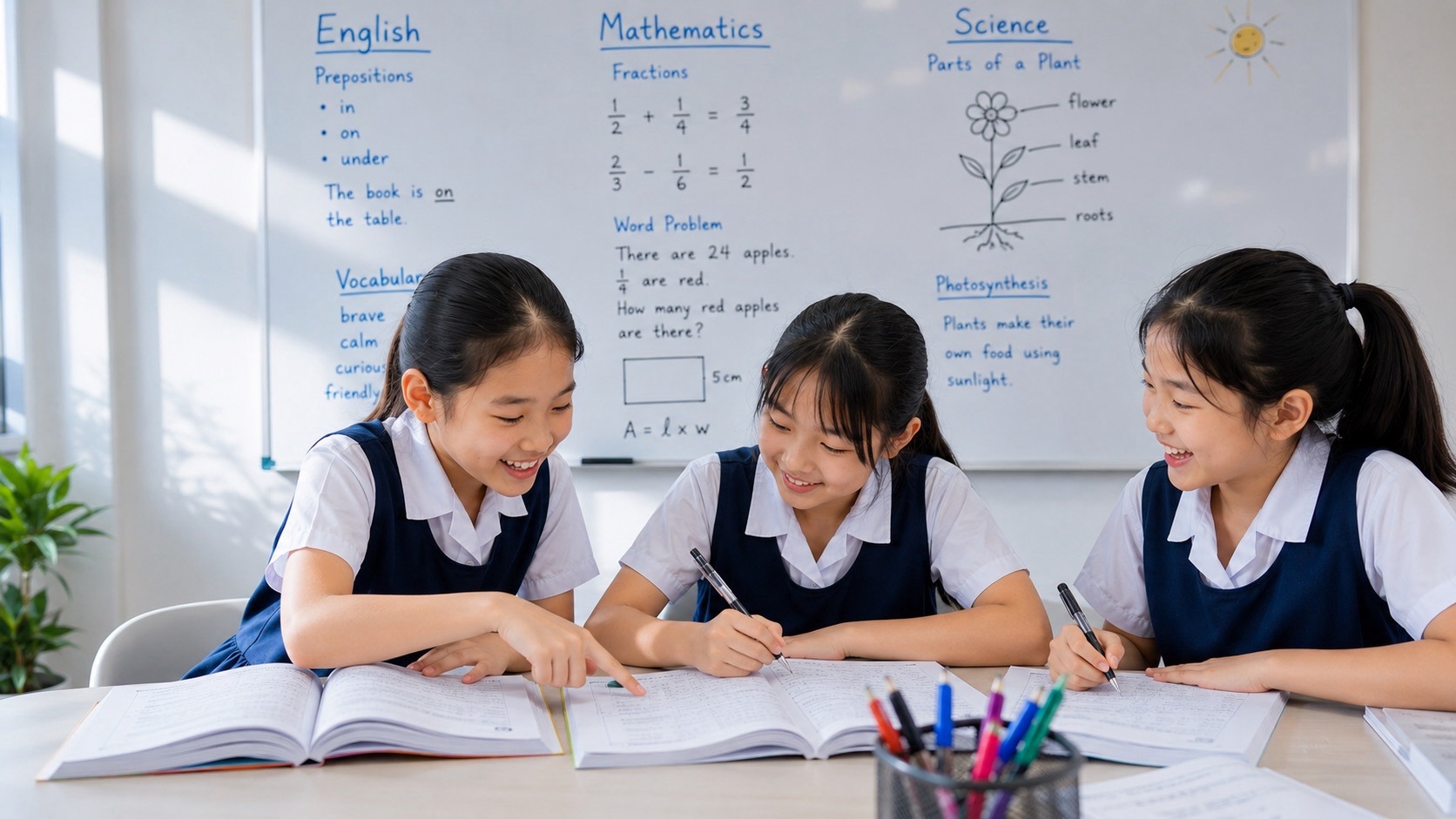
A Primary 2 Mathematics tutor in Punggol should help children understand what numbers mean before asking them to complete harder worksheets. eduKatePunggol publishes a small-group approach of up to three students, generally in 1.5-hour tutorials near Punggol MRT. The first useful parent move is to check place value, three-digit addition and subtraction, equal groups, early fractions and the child’s ability to explain a word problem. A low-confidence child needs a different lesson from one who understands the concept but makes repeated calculation errors.
The relevant curriculum is the MOE Primary Mathematics Syllabus, updated October 2025. Singapore does not have weighted assessments or examinations in Primary 1 or 2, nor a national SEAB Primary 2 Mathematics examination. ‘P2 examination-style’ in this guide means short, age-appropriate school learning checks and original practice questions, not a current national examination format. Parents should use their child’s school topic order and feedback rather than rush into PSLE drilling.
- Level: Primary 2 Mathematics for Punggol families; prepare steadily for the P3 transition.
- MOE content: Whole numbers up to 1,000; three-digit addition/subtraction; tables of 2, 3, 4, 5 and 10; corresponding division; fractions; money; measurement; time; shapes and picture graphs with scales.
- Assessment reality: No national P2 SEAB paper or weighted P1/P2 school examinations; use non-weighted evidence of understanding.
- Class model: Up to three students, usually a 90-minute tutorial; suitability, availability and current terms must be confirmed.
- First action: Let the child solve one new problem, explain each choice and check whether the answer is sensible.
- Goal: Reliable number sense, transferable strategies and a child who can solve unfamiliar lower-primary problems with fewer prompts.
Why Primary 2 Mathematics changes the child’s thinking
Primary 1 often introduces counting, addition, subtraction and simple quantities. In Primary 2, the learner now works with hundreds, relationships among multiplication and division, fraction parts and scaled representations. A child can no longer assume that every picture stands for exactly one item or that a familiar column procedure explains the quantities involved.
A good tutor must see the thinking behind a wrong answer. Consider 406. One child reads it as forty-six because the zero seems invisible. Another reads it correctly but represents it as four hundreds and six tens. The written numeral looks the same on the worksheet; the teaching repair is different. P2 Mathematics becomes much easier when the tutor can diagnose that difference before moving on.
Parents should treat school feedback and independent attempts as evidence. Speed alone is unreliable. A child who races through twenty familiar sums but cannot explain a new word problem may have learned a routine without understanding when it is appropriate.
Exactly which topics does the updated MOE syllabus cover?
The October 2025 updated MOE Mathematics syllabus assigns whole numbers up to 1,000, including place value, comparing, ordering, patterns and odd/even numbers. Addition and subtraction include algorithms up to three digits and suitable mental calculation. Multiplication and division use the tables of 2, 3, 4, 5 and 10, with attention to the inverse relationship between the operations.
P2 fractions include understanding parts of one whole, unit and like fractions, comparisons with denominators not exceeding 12, and addition or subtraction of like fractions within one whole. Money includes dollars and cents written in decimal notation. Measurement includes length, mass, liquid volume and time. Geometry includes appropriate two-dimensional shape work and recognition of three-dimensional objects. Data work includes picture graphs with scales.
The school may teach these concepts in a different sequence or emphasise different applications in a particular term. Do not present a model method from Primary 5 as the required answer to a P2 task when concrete or pictorial reasoning would be more suitable. National syllabuses guide progression; they are not a promise that every child must complete every hard variation by a specific week.
First principle: number symbols stand for quantities
Ask a child to build 582 using place-value cards or base-ten blocks. Five hundreds, eight tens and two ones give the number its structure. Now compare 582 with 528. Both contain the same three digits, but different placement changes their values. The hundreds are equal; the tens decide which is greater.
Another useful probe is 603. If the child says it has six hundreds and three tens, the tutor should make the zero-ten position visible. A zero is not an empty detail; it tells us that the tens place contains no tens. This matters later when children regroup in column subtraction, read money notation and organise larger numbers.
Place-value teaching should alternate concrete, drawn and symbolic forms. The pupil first builds the quantity, then draws a simplified representation, then writes and explains the numeral. Remove the materials gradually. The learning is secure when the child can make sense of a new number without the adult placing every block.
Addition and subtraction: regrouping must make sense
A learner who can compute 238 + 141 but fails 278 + 146 may be uncertain when ten ones must become one ten. Before enforcing an algorithm, show 8 + 6 as fourteen ones: exchange ten for one ten, leaving four ones. Carrying is a shorthand for a valid quantity exchange, not a magical digit written above a column.
Subtraction requires the inverse exchange. In 402 – 175, regrouping across a zero is not merely a tricky trick. The child must understand that one hundred can be exchanged for ten tens, and one of those tens can be exchanged for ten ones. Diagrams and place-value materials can support this before a symbolic method is used independently.
Check the answer using estimation or the inverse operation. If 278 + 146 is written as 314, notice that two numbers near 300 and 150 should total more than 400. This habit makes the child an active reasoner rather than someone waiting for the tutor’s answer sheet.
Multiplication and division: the group must be visible
The P2 syllabus explicitly includes the 2, 3, 4, 5 and 10 multiplication tables. Children should learn quick recall, but they also need to understand equal groups. A question such as ‘four trays contain five cups each’ can be pictured as four equal groups of five, giving twenty cups. A drawing or array helps the learner understand what is being counted.
Division should be connected to the same facts. Twenty cups shared among four trays means five per tray; this reverses the relationship. Ask how 4 × 5 = 20, 5 × 4 = 20, 20 ÷ 4 = 5 and 20 ÷ 5 = 4 are related. Understanding these connections makes later applications more flexible than rote recitation alone.
Do not push all upper-primary operations simply because a child knows the early tables. The tables of 6, 7, 8 and 9 are a later core development. An eager child may explore more, but a struggling pupil needs mastery of P2 expectations before extension becomes useful.
Fractions: the whole and the pieces must agree
A fraction describes a relationship to a whole. In two identical paper strips, one split into thirds and one into sixths, a third is larger than a sixth. Children sometimes assume that six must be bigger than three because six is a larger whole number. Folding paper or drawing equal-sized strips exposes why that reasoning fails for fraction pieces.
For like fractions, keep the piece size fixed. Two eighths plus three eighths make five eighths, not five sixteenths. The denominator names the type of part; the numerator counts how many of those parts are involved. This is a more durable explanation than telling the pupil to ‘leave the bottom number alone’.
Ensure that compared fractions use the same whole. Half of a small cake need not be more food than a third of a much larger cake. A tutor should not ask the child to memorise fraction ordering without controlling the underlying assumptions.
Money: make notation meaningful
$3.25 means three dollars and twenty-five cents. The decimal point is not a separator inserted randomly into a string of digits. Use real or model coins and convert $3.25 to 325 cents. Compare $3.05 and $3.50, explaining that five cents and fifty cents differ.
A useful Punggol-life story is a child purchasing two low-cost stationery items at a shop. The teaching task is to combine prices correctly, check whether the amount fits the money provided, and explain the change. Prices are illustrative and should not be presented as current shop prices or tuition fees.
When a pupil writes that $2.80 is less than $2.8, the tutor can show that they represent the same amount. That is an early chance to connect notation with quantity, while staying within the child’s current understanding.
Measurement, time, geometry and data
Measurement questions should begin with sensible units. A book is measured in centimetres or metres depending on the context, not kilograms. A water bottle has capacity; a schoolbag has mass. The tutor checks whether the child chose the correct physical quantity before looking at arithmetic.
Reading the time to the minute requires more than naming an hour hand. Use actual or drawn clocks, connect minutes to an hour and describe the elapsed time using manageable examples. If a task begins at 3:10 and lasts twenty minutes, count forward to 3:30. When the idea is secure, introduce different intervals and contexts.
Shape work distinguishes flat shapes from three-dimensional objects: a circle is not a sphere, and a rectangle is not a cuboid. Picture graphs may use one symbol to stand for more than one object. If each symbol means two books, four symbols mean eight books. The child must read the key before counting pictures.
Ten original P2-style learning checks with worked explanations
1. Understand zero in 507
Question: In 507, how many hundreds, tens and ones are there? Correct reasoning: five hundreds, zero tens and seven ones. An error such as fifty-seven suggests the tens placeholder was ignored. Ask the learner to build 507 and then 570, compare the values and explain the different positions. Independent check: represent 609 without help.
2. Compare 709 and 790
Question: Which number is greater, and why? Both numbers have seven hundreds. Compare tens next: nine tens exceed zero tens, so 790 is greater. A pupil who compares only the last digit may choose 709. Use place-value cards to show why the highest differing place determines the order. Independent check: order 407, 470 and 704.
3. Add with a regrouping step
Question: 267 + 158. First add the ones: seven plus eight make fifteen, so exchange ten ones for one ten. Add the tens including the new ten, then hundreds, obtaining 425. Check: 267 + 150 is 417, then another eight gives 425. A student should demonstrate why the carried digit stands for a ten. New check: 286 + 137.
4. Subtract using place value
Question: 503 – 174. Exchange one hundred into ten tens, then one ten into ten ones, and subtract carefully to obtain 329. The tutor should not merely chant ‘borrow from next door’. Ask the child to account for the exchanges and then check 329 + 174 = 503. New check: 602 – 285 with appropriate support.
5. Turn an equal-group story into multiplication
Question: There are four tables with three chairs at each. How many chairs? Four groups of three make twelve: 4 × 3 = 12. If the child writes 4 + 3 = 7, draw four clearly separate groups and count. Then change the story to three tables with four chairs each and discuss why the total is also twelve.
6. Link multiplication and division
Question: Fifteen beads are arranged in three equal groups. How many beads are in each group? Use 3 × 5 = 15 to find 15 ÷ 3 = 5. If the pupil says twelve because they subtract three once, teach the distinction between a single subtraction and equal sharing. New check: twenty beads arranged into five equal groups.
7. Compare unit fractions fairly
Question: Which is larger, 1/4 or 1/8 of the same-sized strip? A fourth is larger because the whole is split into fewer equal pieces. Draw two same-sized bars and shade one part in each. New check: compare 1/3 and 1/6, naming the assumption that the wholes are equal.
8. Add like fractions
Question: 2/9 + 4/9. The pieces are ninths; two plus four ninths make 6/9. The denominator remains nine because the unit has not changed. If the child obtains 6/18, use a nine-part strip and physically count six shaded parts. New check: 7/10 – 3/10 using a matching diagram.
9. Convert money and find change
Question: Mei has $5.00 and buys an item for $2.35. What remains? Convert if helpful to 500 – 235 = 265 cents, which is $2.65. Alternatively regroup the dollars and cents carefully. Check that $2.35 + $2.65 = $5.00. The central skill is keeping units consistent and writing the amount correctly.
10. Read the picture-graph key
Question: Each picture of a star represents four books. One category has three stars. How many books? Three groups of four give twelve, not three. A pupil who counts only symbols has ignored the scale. Ask where the legend or key appears and how to explain its role. Independent check: a new graph where one symbol represents five items.
These are original teaching examples, not leaked or official school papers. The tutor should choose tasks according to the child’s current school topics and readiness. The most informative evidence is what the child does on a different problem after the worked example has been removed.
What a good three-pupil Mathematics tutorial looks like
A small group can help because the tutor hears three different ways of thinking. One child may be strong in number facts but weak in reading word problems. Another may build excellent models yet make arithmetic slips. A third may be fast but unwilling to check units. If the tutor gives all three an identical correction, the small size has not been used well.
An effective cycle begins with independent work. The tutor inspects the first wrong step, asks the pupil to explain the choice and teaches the missing relationship. The child tries a guided variation and then a fresh problem without the tutor completing it. Another pupil can explain a different method, but every student should eventually demonstrate an individual answer.
At eduKatePunggol, the published model is up to three pupils for usually 90 minutes. For a young learner, the actual lesson should include varied activities and suitable pauses. Parents should ask about group compatibility, school topic alignment, progress feedback and whether a child needing intensive individual support should use another arrangement first.
An illustrative 1.5-hour lesson structure
- First 10 minutes: Retrieve earlier skills with short number facts and a simple explanation.
- Next 15 minutes: Explore a new concept using objects, pictures or familiar situations.
- Next 20 minutes: Guided questions that expose different misconceptions.
- Next 15 minutes: Independent tasks using the same principle in a changed form.
- Next 15 minutes: Mixed word problems or retrieval from previous weeks.
- Final 15 minutes: Correction, checking habit and manageable practice to take home.
The example should be adapted to the children’s attention and fatigue; it is not an instruction to keep a P2 child writing without rest for ninety minutes. The tutor should preserve enough time for a pupil to struggle productively, try independently and explain what changed.
Repair, stabilisation and extension need different plans
A repair student may still count all objects one by one or misunderstand three-digit values. The correct sequence is to locate the first unstable concept, demonstrate it concretely, practise accurately, then return to the class topic. Giving harder word problems without that repair may deepen avoidance.
A stabilisation student understands place value and fractions in class but forgets a week later or selects the wrong operation in unfamiliar questions. The plan should include retrieval after a delay, a mixture of representations and a self-check routine. Correctly repeating the immediately demonstrated example is not sufficient evidence.
An extension student already handles P2 content independently. Deepen explanation: find two methods, check a surprising answer, make a story for an equation or explain why a tempting wrong method fails. Moving the child to Primary 5 paper formats is not necessary to offer worthwhile challenge.
Six-week plan for a Punggol family
Week 1: establish a truthful baseline
Collect schoolwork, teacher comments and a short independent set covering current topics. Record the point where each error starts: reading, representation, concept, calculation or checking. Ask the child how they decided what to do. A vague label such as ‘bad at Maths’ does not provide a teaching plan.
Week 2: repair the first weak link
Choose no more than two priority relationships. A learner who confuses 306 and 360 may need place-value models before three-digit regrouping. A child who treats division as one subtraction needs equal groups. Use concrete and drawn forms, then check a symbolic form alone.
Week 3: practise without the original context
Change the surface story. Replace toy blocks with library books or bus passengers, while keeping the numerical relationship at the same level. The tutor should see whether the child recognises that the method still applies. A new context is a stronger check than copying a neat model answer.
Week 4: revisit earlier knowledge
Mix one older task with current work. Ask pupils to explain why a multiplication question is not an addition-of-two-numbers question. Let errors reveal what has been forgotten. Short deliberate retrieval beats a very long session of identical tasks.
Week 5: build checking habits
Teach estimate, inverse-check and units. The child should ask whether an answer is plausible before showing it to the adult. For a money problem, write the dollar sign correctly; for measurement, state the unit; for graphs, inspect the key. These are mathematical thinking habits, not cosmetic presentation rules.
Week 6: independent recheck and next decision
Re-test with new questions at a similar demand level. Compare the original error pattern, explanations and number of adult prompts. Share actual evidence with parents; do not promise a grade increase when P2 has no weighted examinations. Continue, change focus or reduce tuition based on what the child demonstrably needs.
The parent home routine: ten useful minutes instead of another pile of worksheets
Five minutes of number talk can be enough to expose an idea: ‘Which is nearer to 500, 492 or 538?’ Ask for the reason. Follow with a few minutes of counting money, using a clock or comparing measured quantities during ordinary family activities. The child should feel that Mathematics explains the world, not only paper questions.
When homework becomes difficult, resist telling the first step immediately. Ask, ‘What is the question asking?’, ‘What do you know?’, and ‘Can you show it with a drawing?’ If the child still cannot begin, reduce the complexity and model one small relationship. Endless guessing under pressure is not productive perseverance.
A child who repeatedly dreads arithmetic may need a less demanding routine or discussion with the teacher. Learning should include sleep, physical play and time away from academic demands. More hours are not automatically more learning.
Practical examples from a Punggol family day
At a shop near Waterway Point, a parent can ask what change is due from an imaginary purchase. On a walk, the family might estimate how long a journey will take, then compare it with a clock. A grocery list can provide equal-group examples; a shared snack can illustrate halves, quarters and equal pieces.
These should remain age-appropriate, safe conversations, not formal tests conducted in public. The point is to help the child recognise that quantities, time, money, shapes and grouping have everyday meanings. When a learner connects classroom symbols with an understandable experience, word problems become easier to interpret.
If the child has already mastered a context, vary the underlying question: ‘What if each group contains one more item?’, or ‘How do you know the answer is too large?’ That creates curiosity and strengthens explanation without pretending the child is sitting a high-stakes exam.
Choosing between school teaching, a home routine and tuition
If the teacher sees steady progress and the child solves current-level problems independently, more tuition may be unnecessary. Parents can continue practice through ordinary activities and occasional short reviews. Do not purchase tuition simply because another family has done so.
If the same misconception recurs in several contexts, talk with the teacher and inspect what is already being tried. A P2 Mathematics tutor can be valuable when the gap needs systematic diagnosis and correction. Ask for examples of the child’s own independent work after several lesson cycles rather than vague promises of ‘AL1’ in the future.
For intensive learning needs, a different format or additional school-based support may be more appropriate than a three-pupil class. The right decision comes from the student’s needs, the teaching match and evidence of progress. Parents should confirm actual class availability and fee, not assume that an article guarantees a place.
Preparation for Primary 3 and the longer PSLE journey
Primary 3 adds more advanced number facts, topics and expectations. The best preparation is a stable P2 foundation. A pupil who understands equal groups, fractions as equal parts, place value, units and checking can build later concepts more confidently. A child who only memorised steps may be vulnerable when questions change.
Parents can read the existing Primary 2 Mathematics small-group guide and the fractions and early problem-solving companion. The eduKatePunggol learning routes directory helps parents locate the next stage without turning this year into a PSLE countdown.
The PSLE is an important examination much later in the primary-school journey. It is not a reason to substitute P6 questions for P2 learning. A strong foundation protects future options better than premature pressure.
Frequently asked questions
Does Primary 2 have Mathematics examinations?
No. MOE removed weighted assessments and examinations in P1 and P2. Schools can still observe, assign tasks and give feedback. There is no national SEAB P2 Mathematics paper.
What numbers does P2 Mathematics reach?
The current MOE syllabus covers whole numbers up to 1,000 and three-digit addition and subtraction. The teaching emphasis includes place value, representations, reasoning and accuracy.
Which multiplication tables are expected?
The P2 syllabus includes the tables of 2, 3, 4, 5 and 10 and related division. Pupils should develop both understanding of equal groups and increasingly reliable recall.
Does P2 include fractions?
Yes. Unit and like fractions, simple comparisons and addition or subtraction of like fractions within a whole are included, with the stated denominator scope. Use equal-sized wholes when explaining fractions.
What if my child can get the answer but cannot explain it?
Invite an explanation with a drawing or physical model. Check a second question with changed numbers. Correct performance can come from a memorised pattern; flexible explanation is a better sign that understanding is secure.
Should a P2 child practise timed PSLE papers?
Not as the default. Start with current-level questions and independent reasoning. Time pressure is useful only where developmentally appropriate, after understanding and accuracy are reasonably stable.
What if the child hates word problems?
Check whether the obstacle is mathematical or linguistic. Ask the child to retell the situation, identify quantities and draw a simple representation. Teaching more calculations may not help a pupil who misunderstands the story.
Does three-pupil tuition guarantee progress?
No. It creates an opportunity for close observation and feedback, but outcomes depend on tutor practice, class fit, the child’s readiness and consistency of learning. Evaluate changes over several lessons.
Where can Punggol parents ask about a suitable class?
eduKatePunggol publishes 83 Punggol Central, Singapore 828761, near Punggol MRT and Waterway Point. Classes and consultations are by appointment; confirm current times, fees and available places.
Official syllabus, companion articles and parent contact
- MOE Primary Mathematics Syllabus P1–P6, updated October 2025 — the authoritative current-content reference.
- MOE assessment policy for P1 and P2 — no weighted P1/P2 assessments or exams.
- Primary 2 Mathematics small-group tutor guide in Punggol — topic-by-topic examples.
- Primary 2 fractions and early problem solving in Punggol — deeper supporting instruction.
- eduKatePunggol home, contact and tuition details — confirm availability and subject match.
A good Primary 2 Mathematics plan does not begin with a promise about a distant PSLE score. It begins with the exact number relationship the child does not yet understand, teaches it plainly and checks that the child can use it alone. That is the practical meaning of a good small-group tutorial.


