
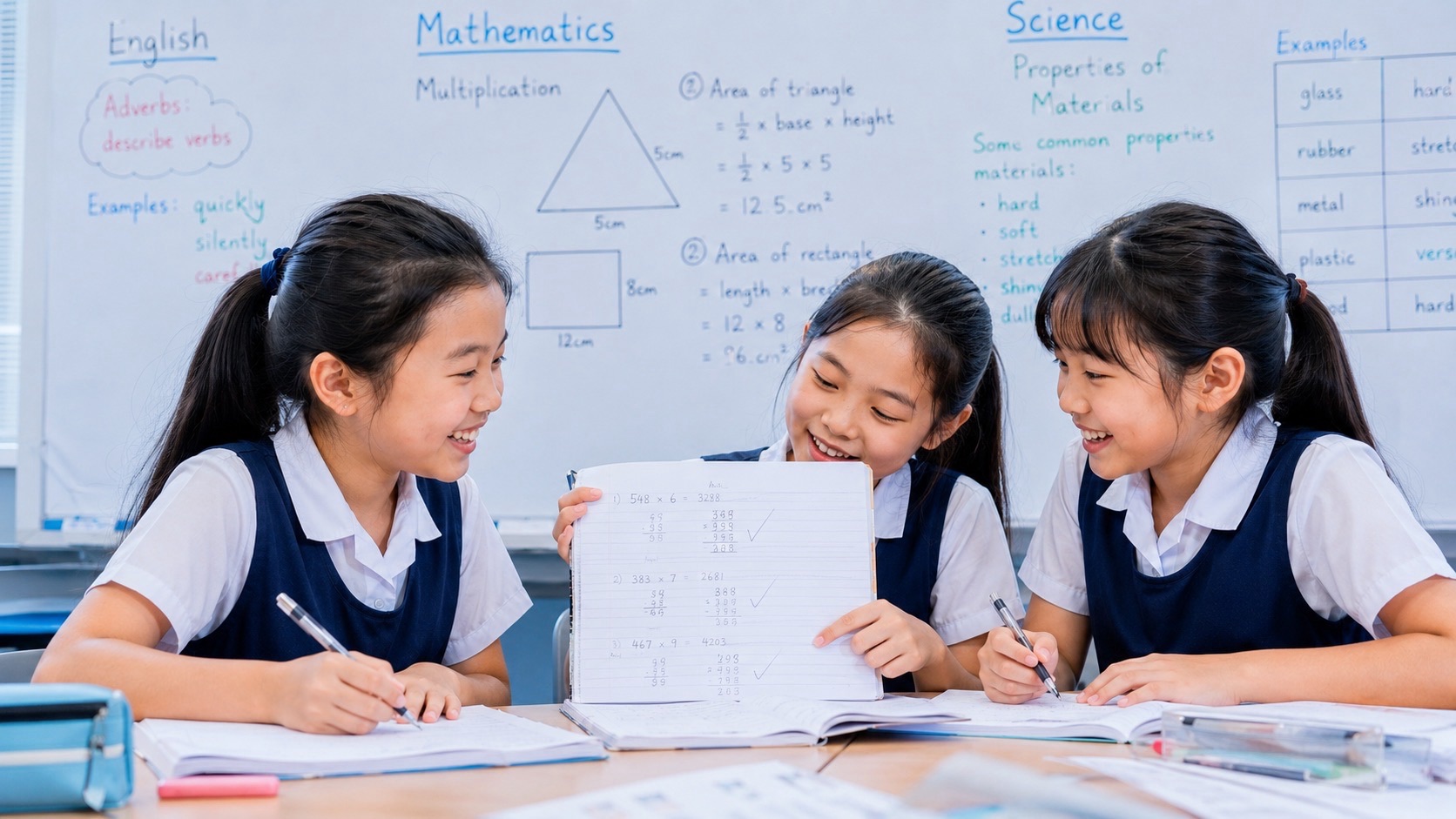
A Primary 1 Social Studies syllabus guide for Punggol parents should help a young child understand their identity, their different group roles and the places around them. It is not a course in memorising examination answers. eduKatePunggol’s wider small-group model describes tutorials with up to three children, typically 1.5 hours, but this is not confirmation that a specialist P1 Social Studies tuition class is operating. Most families should begin with school activities, age-appropriate stories and ordinary supervised neighbourhood experiences before considering paid enrichment.
The applicable national framework is MOE’s 2020 Social Studies (Primary) Teaching and Learning Syllabus, updated July 2024. The P1 theme is Knowing Myself, Others and My Surroundings, asking how a child relates to people and places. Singapore has no weighted P1 or P2 school examinations, and SEAB does not conduct a national P1 Social Studies examination. The P1 questions below are original inquiry-style learning checks, not past or predicted examination items. Teachers report P1/P2 Social Studies learning through the Holistic Development Profile.
- Correct P1 topic: Knowing Myself, Others and My Surroundings; identity, group membership, responsibility and meaningful nearby places.
- Official source: MOE Social Studies Primary syllabus 2020, updated July 2024.
- Assessment truth: no weighted P1 tests or national SEAB P1 Social Studies paper; observe and discuss learning instead.
- Learning process: notice carefully, ask questions, explain a reason, respect differences, consider consequences and care for places.
- Local context: Punggol school spaces, familiar public places and supervised neighbourhood walks can support inquiry.
- Small-group value: each child can observe, speak and listen, but no paid tuition is automatically necessary.
- First parent action: ask one genuine question about self, one about a group role and one about a place.
- Healthy outcome: a curious, thoughtful child who can relate actions to people and places with growing independence.
This article follows the direct information-first structure of eduKate’s immutable Clementi small-group tutorial reference. The principle is not to teach a page for the sake of finishing it. Instead, give a child a real task, notice precisely what they understand, explain the missing relationship and test it in a fresh situation. A P1 pupil who can repeat “be responsible” but does not know why leaving shared pencils on the floor is harmful needs an example of cause and consequence, not a longer word list.
An easy home diagnostic lasts five minutes. Ask “What makes you different from another person in a good way?”, “Which groups are you part of and how can you help?” and “Where do you feel connected around Punggol, and why?” Let the child answer with spoken words or a sketch. The aim is not to reveal private family details or compete with classmates; it is to notice whether they can offer an authentic idea and one understandable reason.
What P1 Social Studies covers under the MOE syllabus
MOE gives the Primary One inquiry focus as “Who am I in relation to the people and places around me?” The three key understandings are that my identity makes me unique, groups I belong to can shape my identity and I can relate to places around me. These ideas are studied through close experience with family, class, friends, school and neighbourhood. This is a foundational humanities experience rather than an early History or Geography examination.
In the identity theme, children recognise that people have names, interests, talents, experiences and personal characteristics. They also learn to notice similarities and differences respectfully. Adults should not demand that a child disclose sensitive family information, make claims about what an ethnicity implies or publicly compare appearances. A simple inquiry question can be answered with a safe preference, strength or interest; respect matters more than a rehearsed identity label.
In the group theme, children explore the roles they play at home, in class, with friends and in other communities. Roles can change. A learner may be a sibling, a classroom helper, a teammate and a library visitor. They should also recognise that decisions affect others. A child who takes every marker before others can join in has made a choice with consequences for their group.
In the place theme, pupils learn to recognise important places, find their way around familiar school or neighbourhood spaces with appropriate supervision and explain why places matter. Their relationship to a place may come from people they meet, activities they enjoy or experiences they remember. Caring for a clean classroom or shared park is a concrete form of appreciation. The learning is not a demand for independent Punggol navigation by a seven-year-old.
Knowledge, skills and values: what teachers can actually notice
- Knowledge: recognition of personal uniqueness, different roles, shared attributes and places nearby.
- Observation: describing what is visible before jumping to an explanation.
- Questioning: asking relevant who, what, where or why questions to collect information with guidance.
- Discussion: offering a view, listening to another pupil and changing a first idea when evidence improves.
- Reflection: considering consequences and proposing a reasonable action.
- Participation: working in groups with age-appropriate teacher guidance.
- Care and belonging: showing respect for classmates and considering shared places and resources.
For P1/P2 Social Studies, the official syllabus identifies reporting through a Holistic Development Profile. It identifies compulsory annual performance tasks for P3–P6, not for P1. Younger pupils can still show learning by drawing, talking, observing, presenting or making a simple shared product. Do not confuse such formative work with an unannounced national written paper. Ask your child’s own school how its P1 Social Studies outcomes appear in reports.
Eighteen original Primary 1 inquiry-style practice questions
1. We have similarities and differences
Original inquiry task: Two fictional children both like drawing; one also likes football. Are they exactly the same person?
Reasonable answer: No. A shared interest does not remove other differences.
Teach the thinking: Use two paper circles with overlapping interests. Discuss why different interests deserve equal respect.
New example: Compare a new pair of invented characters and identify a shared strength plus a distinct preference.
2. My name is part of my identity
Original inquiry task: A new classmate’s name is difficult to pronounce. What is a respectful first response?
Reasonable answer: Listen and ask politely how to say it correctly.
Teach the thinking: A person’s name deserves care. Do not guess a story about their background or make fun of unfamiliar sounds.
New example: Practise introducing another fictional pupil thoughtfully, without assumptions.
3. Different talents can help a team
Original inquiry task: One pupil can draw clearly; another is good at explaining. Which is more important for a group poster?
Reasonable answer: Both can contribute in different ways.
Teach the thinking: Give meaningful roles and show that contribution does not have to look identical.
New example: Change the project to planning a class game and ask each pupil’s useful role.
4. I belong to more than one group
Original inquiry task: A child attends school, plays in a sports team and lives with family. Name groups in the child’s life.
Reasonable answer: The school or class, team and family are examples.
Teach the thinking: Show how one person can occupy overlapping groups with different responsibilities.
New example: Ask for two non-private groups that matter to the learner and explain why.
5. My role changes depending on the group
Original inquiry task: A child helps tidy at home and leads a game at school. Do the roles need to be identical?
Reasonable answer: No. A person takes different roles in different groups.
Teach the thinking: Use role cards and ask how the same child contributes appropriately in each situation.
New example: Add a new role such as library visitor or teammate and choose a sensible action.
6. Decisions affect classmates
Original inquiry task: Someone leaves craft scissors on the floor. What might happen and what should be done?
Reasonable answer: Someone could get hurt; tell a responsible adult and store the equipment safely.
Teach the thinking: Connect choice to likely consequence and a simple safe action; avoid shaming a real pupil.
New example: Change to a spilled drink and ask for an appropriate response.
7. Taking turns with shared items
Original inquiry task: Three pupils want one class marker at the same time. What can they do?
Reasonable answer: Make a fair turn-taking arrangement or choose a way to share work.
Teach the thinking: Invite each child’s suggestion and practise agreeing on a workable order.
New example: Offer a new shared object and ask the group to choose a different fair arrangement.
8. Including someone who is new
Original inquiry task: A new classmate looks uncertain about the playground rules. What could you do?
Reasonable answer: Offer a welcome, explain the game and ask whether they want to join.
Teach the thinking: Teach a kind invitation while respecting the other child’s right to decline.
New example: Role-play including a new participant in a different activity.
9. Respecting different family routines
Original inquiry task: Two pupils have different foods or traditions at home. Must one copy the other?
Reasonable answer: No. They can be friends and respect differences.
Teach the thinking: Use neutral examples. Do not presume a child’s faith, ethnicity or home arrangements from appearance or name.
New example: Ask how to include two imaginary classmates with different preferences.
10. Finding help at school
Original inquiry task: A new pupil cannot locate the classroom after an organised activity. What is a safe next step?
Reasonable answer: Follow school instructions and ask a designated teacher or school staff member for help.
Teach the thinking: Teach familiar approved school locations and who can help. Do not suggest unsupervised wandering.
New example: Use the child’s real school map with a trusted adult to plan a supervised familiar route.
11. A meaningful public place
Original inquiry task: A child says the neighbourhood library is special. What reason could explain that?
Reasonable answer: They enjoy books, learn there or spend time with someone important.
Teach the thinking: A place is meaningful because of experience and use, not merely a name in a list.
New example: Ask about a different suitable place and one real memory connected to it.
12. Caring for a Punggol park
Original inquiry task: The group finishes a snack on a supervised park visit. What should happen to the wrapper?
Reasonable answer: Dispose of it properly, following the place’s rules and adult guidance.
Teach the thinking: Discuss public cleanliness and consideration for other visitors, while respecting hygiene and safety.
New example: Apply the same idea to waste in a classroom or school canteen.
13. Observations versus guesses
Original inquiry task: A child notices wet pavement. Does this prove that it rained?
Reasonable answer: No. Rain is possible, but the water could have another source.
Teach the thinking: Separate observation (‘pavement is wet’) from inference (‘maybe it rained’).
New example: Show a new picture and ask for one certain observation and one possible explanation.
14. Asking a question to learn
Original inquiry task: You see an unfamiliar school mural. What question could help you understand it?
Reasonable answer: Who made it, what does it show or why was it created?
Teach the thinking: Help the child ask questions based on the object, not only repeat a teacher’s model.
New example: Choose a different feature and invite a fresh question.
15. Relevant information
Original inquiry task: The class wants to find out why children enjoy the reading corner. Is asking favourite books more relevant than shoe sizes?
Reasonable answer: Yes. Reading preferences relate to the inquiry question.
Teach the thinking: Distinguish useful evidence from irrelevant or unnecessary personal data.
New example: Change the goal to planning a playground activity and choose helpful questions.
16. Making a careful comparison
Original inquiry task: One picture of a garden seems to have more flowers than another. How might you check?
Reasonable answer: Look closely and compare or count visible flowers.
Teach the thinking: Practice a supported claim rather than copying the loudest child’s guess.
New example: Present new images and invite a comparison supported by a visible detail.
17. A group action has a consequence
Original inquiry task: A team agrees to tidy shared materials but one member leaves early. What could happen?
Reasonable answer: Others might have extra work; the group could arrange responsibilities fairly.
Teach the thinking: Invite respectful discussion of shared responsibility rather than blaming or moralising.
New example: Give a new group project and ask what would make the responsibilities fair.
18. A different view can still make sense
Original inquiry task: Two pupils choose different favourite community spaces and explain why. Must one answer be wrong?
Reasonable answer: No. Different personal experiences can lead to different reasonable choices.
Teach the thinking: Separate factual inaccuracies from preferences and evidence-based reasons. Teach listening before disagreement.
New example: Ask the child to explain a second sensible viewpoint without surrendering their own.
A supervised Punggol neighbourhood inquiry
Punggol provides familiar settings for learning about place and community. A short, safe family outing to a local playground, the library, a community facility or a suitable part of Punggol Waterway Park can introduce observation, shared responsibility and belonging. These are suggestions rather than a required MOE field trip. Parent supervision, weather, mobility and access needs come before completing any activity.
Choose one small spot and let the child observe. Ask: ‘Who might use this place?’, ‘What can we see?’ and ‘How should we treat it?’ Encourage a sketch, a few spoken sentences or a photograph of a public feature. Do not photograph other children without appropriate consent, publish the family’s home address or make an independent seven-year-old travel to collect information. Social understanding includes protecting other people.
A useful follow-up is a picture journal with three boxes labelled ‘I noticed’, ‘I wonder’ and ‘I can care for’. One learner might draw the benches, another a tree and another a reading shelf. The response is only valuable if it comes from a real observation or an honest question; the adult should not write a polished speech and ask the child to copy it.
Next week choose a different familiar place. The child may now ask a more specific question or notice that two places serve different people. That is authentic progress in inquiry. It cannot be expressed fairly as a predicted P1 Social Studies examination mark.
When small-group enrichment helps and when no tuition is the right answer
Most young children can learn P1 Social Studies concepts through school lessons, friendships, family talk and everyday surroundings. A paid subject-specific examination course is usually unnecessary. Some families may choose a small discussion or enrichment group for a child who benefits from supported turn-taking, speaking, observational drawing or structured exploration. The goal should remain authentic participation, not filling extra answer sheets.
A three-child group can be useful if each member gets to speak and if the adult differentiates for the child who answers with a drawing, the child who speaks freely and the child who needs extra time. Ask how they decide whether a child has understood a concept. An instructor who only checks a worksheet answer may miss the reasoning. Likewise, a class dominated by one confident speaker may not be suitable for a quieter pupil.
The public descriptions of eduKatePunggol’s small-group tutorials should not be read as a guarantee that this unusual P1 subject has an operating class. Ask about the actual tutor’s subject knowledge, programme, venue, fees, class size, safety, lesson duration and suitability. If school progress is healthy, a calm free family discussion is often the more efficient choice.
An optional 90-minute inquiry session — illustrative only
- 0–10 min: welcome, safe personal-interest question and explanation of the day’s inquiry.
- 10–25 min: observe a familiar image of a group or place; every child shares one detail.
- 25–40 min: discuss who belongs to the group and what roles people play.
- 40–55 min: draw a useful place or role and explain one decision.
- 55–65 min: movement or rest; no continuous copying or timed test.
- 65–80 min: collaborate on one fair-use or caring-for-places scenario.
- 80–90 min: individual reflection, a new scenario and a modest home observation.
This plan is not a confirmed service timetable. Many pupils would be better served by a few minutes of carefully supported inquiry during a normal outing. A long extra class after school may reduce the child’s energy for exactly the social experiences the syllabus wants them to notice.
Eight weeks of simple, free family learning
- Week 1: three baseline questions about self, group and place; record the child’s own words.
- Week 2: discuss how two fictional children share some interests but have others that differ.
- Week 3: observe a helpful role at home or in school and its consequence.
- Week 4: identify a meaningful familiar place and one reason it matters.
- Week 5: practise asking a relevant new question about a place or group.
- Week 6: discuss a fair turn-taking scenario with more than one plausible solution.
- Week 7: draw or talk about ways to care for a shared area without risky behaviour.
- Week 8: revisit the starting themes with unfamiliar examples; compare reasons and independence.
Three learner pathways: adapt without labels
A thoughtful child who is shy speaking publicly
Understanding may be strong even when a child is quiet. Give time to think, allow pointing and drawing, then invite a short sentence. Use predictable turns and do not demand personal disclosures. The teacher may be able to support participation better than an extra class. Progress could be one relevant volunteered observation rather than a long public presentation.
A child who repeats ‘be responsible’ but cannot apply it
Teach one concrete cause-and-effect relationship. If a pupil says everyone should care for shared places, ask what a person should do when materials block a path. Help connect an action with its effect on other users. A new scenario later shows whether the idea transferred. Avoid treating slogans as equivalent to knowledge, or one error as a character flaw.
A child who finds long written answers difficult
P1 Social Studies is not an upper-primary essay examination. Show understanding through an oral explanation, drawing, sequencing pictures or answering one targeted question as the school permits. If literacy difficulties appear across subjects, coordinate with the classroom teacher and relevant support, not a heavier Social Studies workbook.
Frequently asked questions from Punggol parents
Is Social Studies a Primary 1 subject?
Yes. It is part of Singapore’s primary curriculum. The P1 theme is ‘Knowing Myself, Others and My Surroundings’. The learning uses inquiry into people and places, not national examinations or memorising detailed secondary-school humanities facts.
What official syllabus applies in 2027?
The official reference for this guide is MOE’s 2020 Social Studies (Primary) syllabus, updated July 2024. Its P1 section names the three core understandings and inquiry focus. Ask the school which experiences and tasks it uses this term rather than looking for a fictional 2027 SEAB P1 paper.
Do P1 children sit Social Studies examinations?
No. P1 and P2 have no weighted school assessments or examinations under MOE policy, and there is no national P1 Social Studies paper. Schools can still assess learning formatively and report through the Holistic Development Profile.
Are performance tasks compulsory in P1?
The syllabus requires at least one annual performance task for P3–P6, while P1/P2 have their own developmental reporting approach. Drawing, talk or a class project may help a P1 pupil show learning but should not be presented as a national examination.
Does a child need to memorise history?
Not as the main P1 Social Studies priority. The immediate topics are personal identity, relationships, roles and surroundings. History and wider national development appear more directly at later primary stages.
Which Punggol public spaces work as learning examples?
The child’s own school environment, a familiar library, a supervised community space or an accessible part of Punggol Waterway Park can inspire useful observations. Pick a safe destination the family already knows and follow its rules. No location is a compulsory P1 exam requirement.
What if a child and parent give different answers?
For a question about personal preference or meaningful places, more than one response can be reasonable. Ask for a truthful reason and observable detail. Correct unsafe or factually incorrect claims, but avoid forcing the child to prefer the same place as the adult.
Can a shy child benefit from group activities?
Yes, when the adult welcomes different response formats, protects turns and keeps discussion emotionally safe. But a child who struggles with group settings may need classroom support or a gentler format first. The existence of three seats does not guarantee a good group match.
What is a sign that learning is improving?
A more specific observation, an independently asked question, a reason for a group rule, or an explanation of how an action affects other people is useful evidence. Compare fresh tasks and the teacher’s qualitative feedback rather than estimating a national examination grade.
Is a private P1 Social Studies tutor necessary?
Usually not. School programmes and everyday experiences can teach much of the P1 content well. Consider enrichment if there is a real participation or inquiry need and the child can benefit without undue workload. Confirm any advertised programme directly rather than assuming it exists.
How should we help children with different learning needs?
Offer access through images, simple spoken questions, shorter writing tasks and inclusive participation as appropriate. Work with the school on any identified needs. One child’s quietness or spelling difficulty does not establish a lack of understanding or personal character.
Why should a parent care about this subject?
Children develop habits of observation, respectful dialogue, awareness of others and responsible decisions. These skills matter throughout life, but they cannot be reduced to a predicted PSLE score. The immediate goal is to help a seven-year-old make thoughtful connections in familiar settings.
Related eduKate Punggol reading
- Primary 2 Social Studies inquiry guide
- Singapore P1–P6 curriculum parent roadmap
- Primary school programmes, arts, sports, PAL and CCAs
- Starting P1 in Punggol: orientation and the first 30 school days
- Primary learning needs and support options
Official sources and verification
- MOE Social Studies Primary 2020 syllabus, updated July 2024
- MOE P1 and P2 assessment and examination changes
- Waterway Primary P1/P2 learning outcomes and assessment
- eduKate Clementi reference for small-group teaching structure
November 2026 editorial note: These learning checks are original and non-weighted. They are not official SEAB or school questions, and no P1 Social Studies private class availability, price or venue has been asserted. The child’s actual school communications and the MOE syllabus remain the primary sources.


