
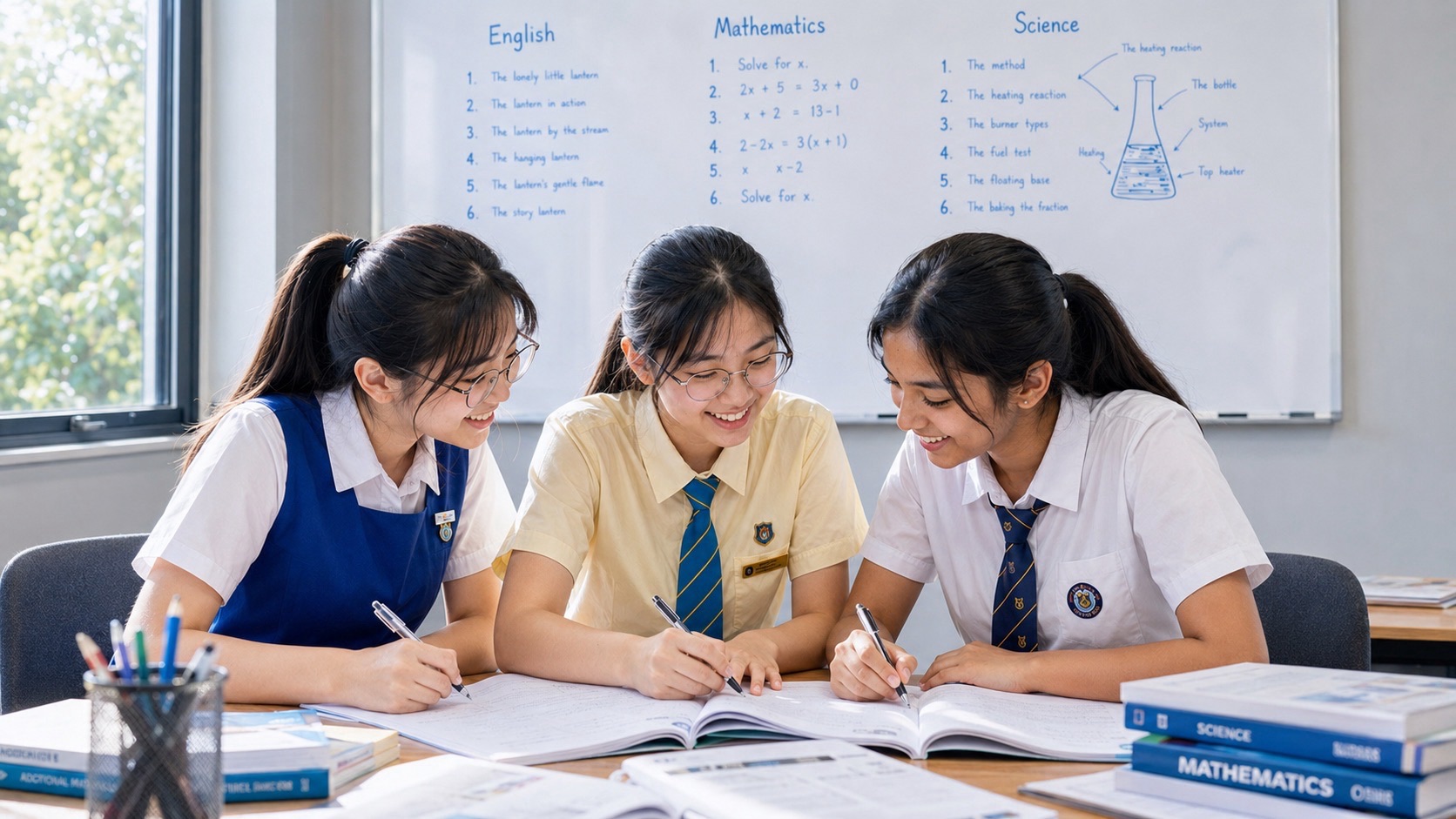
For students in Punggol taking G2 Science in the 2027 Singapore-Cambridge Secondary Education Certificate (SEC), SEAB lists three combinations: K223 Physics and Chemistry, K224 Physics and Biology, and K225 Chemistry and Biology. The exact code matters because it tells the family which two scientific disciplines and examination papers apply. These are different combinations at the same G2 subject level, not three grades of Science.
This guide explains the choice between the three combinations, the assessment structure, scientific knowledge, problem solving and practical skills. It also helps Punggol parents support a child who finds concepts, data handling or structured questions difficult. Science is more than memorising facts: students must understand ideas, interpret evidence, solve problems and evaluate investigations.
- 2027 G2 Science codes: K223 (Physics, Chemistry), K224 (Physics, Biology), K225 (Chemistry, Biology).
- Students take four papers from the six-paper framework, according to their chosen two-discipline combination.
- Each selected discipline has a 20-mark Multiple Choice paper worth 20% and a 30-mark Structured paper worth 30%.
- Theory assessment objectives are approximately 45% knowledge with understanding, 45% handling information and solving problems, and 10% experimental skills and investigations.
- Practical experiences remain important: students need to understand apparatus, measurements, tables, graphs, errors, safety and method evaluation.
- Parents should match the subject combination to interests, readiness, school availability and longer-term plans, not merely to what friends choose.
- P
A Punggol family plan for choosing and learning G2 Science
For Punggol parents, the first decision is to confirm the exact Science combination offered by the student’s school and recorded in the subject plan. A learner may take Physics with Chemistry (K223), Physics with Biology (K224), or Chemistry with Biology (K225). The combination should be chosen through the school’s available options and a discussion of the student’s interests, learning strengths and future possibilities. It should not be selected simply because friends are taking it or because one pairing sounds more prestigious.
Parents can help a child understand the differences by discussing the kinds of questions each discipline asks. Physics examines physical relationships and how systems behave. Chemistry considers substances, particles, reactions and patterns of change. Biology explores living systems and how their structures and processes relate. These are broad descriptions rather than substitutes for the detailed syllabus. The official code and syllabus determine which content is assessed.
Science is also practical. Students need to know why a method is fair, how measurements are recorded, why a graph is suitable, what a result can and cannot establish, and how safety affects an investigation. If a student can memorise a definition but cannot explain a table or identify a variable, revision should include data and experimental reasoning rather than another round of fact copying.
Three practical starting points
- Falling behind: separate vocabulary, concept understanding, calculation and data interpretation. Rebuild one weak area with diagrams, examples and a short independent check.
- Maintaining: connect each topic to a labelled diagram, a short explanation and a question that requires interpretation of information.
- Progressing: practise unfamiliar experimental situations, compare possible explanations and evaluate whether the evidence supports a conclusion.
Punggol families should ask the Science teacher which practical experiences the school has completed and what students are expected to remember about the methods. Never try to reproduce a laboratory procedure at home if it involves chemicals, heat, electricity, glassware or other hazards. Home learning can use safe observations, simulations, reading and discussion; school practical work must follow teacher supervision and laboratory safety rules.
Connect Science to the child’s questions about the world
A student may become more interested in Science when a concept helps explain something seen in daily life: why a shadow changes, how food is preserved, how a bicycle slows down, why materials behave differently or how living things respond to their environment. These examples can make a topic easier to remember, but parents should distinguish a familiar example from the precise scientific explanation required by the syllabus.
When reviewing a school test, classify each lost mark. Was the student missing a fact, misunderstanding a scientific relationship, choosing the wrong unit, misreading a graph, failing to describe an observation or making an unsupported conclusion? That diagnosis turns a disappointing result into a plan. It also prevents parents from assuming that every Science difficulty is caused by insufficient memorisation.
unggol family focus: confirm the subject code, school sequence and support arrangements before choosing materials or making a subject-level decision.
1. Why the exact G2 Science code matters
SEAB’s 2027 G2 school-candidate directory lists three G2 Science combinations. K223 is Science (Physics, Chemistry). K224 is Science (Physics, Biology). K225 is Science (Chemistry, Biology). These are not three different grades of Science; they are three combinations of two scientific disciplines at the G2 subject level.
The older reference codes shown by SEAB are 5105 for K223, 5106 for K224 and 5107 for K225. These references can help parents compare earlier school records. For examination preparation, use the 2027 code and the actual 2027 syllabus PDF. A worksheet or past paper for a different combination may not cover the student’s full syllabus.
Ask the school to confirm the student’s precise combination. Do not assume that all G2 Science students study Physics, Chemistry and Biology together. Each candidate’s paper selection depends on the two disciplines specified by the code.
2. The purpose of G2 Science learning
The syllabus aims to provide students with a worthwhile science education whether or not they continue studying science beyond this level. It develops understanding and skills connected to scientific practices, real-world applications, future learning and work, and the ability to analyse and solve problems in biological, chemical and physical systems.
Science also includes values and habits of mind. Curiosity encourages students to ask questions. Integrity matters when recording and communicating data. Objectivity requires evidence rather than personal preference. Open-mindedness allows a student to revise an explanation when new evidence appears. Resilience is needed when an investigation does not produce the expected result.
This means a science lesson should not be reduced to copying definitions. Students need to understand what a concept explains, how evidence supports it, how to use it in a new situation and what limitations apply to the explanation. Memorisation has a role, but it is not the whole subject.
3. The six-paper structure: why candidates take four
The G2 Science syllabus contains six papers in total, but each student takes four according to the two-discipline combination. K223 candidates take Papers 1, 2, 3 and 4: Physics multiple choice and structured papers, plus Chemistry multiple choice and structured papers. K224 candidates take Papers 1, 2, 5 and 6: Physics and Biology. K225 candidates take Papers 3, 4, 5 and 6: Chemistry and Biology.
The papers are paired in one session lasting 1 hour 15 minutes. Candidates are advised not to spend more than 30 minutes on each selected multiple-choice paper. The multiple-choice paper for each discipline has 20 marks and is worth 20%. The structured paper has 30 marks and is worth 30%. In total, each of the two disciplines contributes 50% of the overall G2 Science assessment.
The structured paper has compulsory questions in Section A and two structured questions in Section B, of which candidates answer one. Parents should confirm that practice materials follow the correct selected disciplines and the latest assessment structure. A paper from the wrong combination may give a misleading picture of readiness.
4. The three assessment objectives
Theory papers assess three broad areas. Knowledge with Understanding accounts for approximately 45% of theory-paper marks, with approximately 20% allocated to recall. Handling Information and Solving Problems accounts for approximately 45%. Experimental Skills and Investigations accounts for approximately 10%. These weightings explain why a student cannot depend only on memorising definitions.
Knowledge with understanding includes scientific phenomena, facts, laws, definitions, concepts, theories, scientific vocabulary, instruments, apparatus, quantities, units and relevant applications. Questions may ask students to define, state, name, describe, explain or outline.
Handling information and solving problems includes selecting, organising and presenting information, translating information between words, diagrams, tables, graphs and numbers, identifying patterns, explaining relationships, making predictions and solving problems. Questions may ask students to predict, deduce, suggest, calculate or determine.
Experimental skills and investigations include selecting and using techniques and apparatus, taking readings, recording observations, interpreting data, evaluating methods and suggesting improvements. Students should understand how evidence is produced, not only remember the conclusion from a textbook.
5. Physics: connect models to the physical world
For students taking Physics, the syllabus develops a coherent understanding of energy, matter and their interrelationships. It uses observations and models to explain physical behaviour. Students need to understand quantities, units, relationships, diagrams, graphs and mathematical representations where relevant.
Physics can become difficult when students memorise a formula but cannot identify the quantities in a question. A strong approach is to describe the situation, identify known and unknown quantities, select a relationship, substitute values with units and check whether the answer is sensible. A diagram or graph may reveal information that is not obvious from the text alone.
Parents can help by asking the student to explain a physical idea using a familiar example. Why does a change in speed matter? What does a gradient represent in a graph? Which measurement would support a claim? The child should be able to connect the explanation to the principle rather than repeat a sentence without understanding.
6. Chemistry: explain substances, changes and evidence
For students taking Chemistry, the syllabus requires understanding of substances, their properties, changes and the models used to explain them. Scientific vocabulary and chemical symbols are important because a small change in a formula or notation can represent a different substance or relationship.
Students should distinguish observation from explanation. A colour change, gas produced or temperature change may be an observation. The explanation must connect that evidence to the relevant chemical idea. A student who memorises what a reaction looks like may struggle when the same principle appears with unfamiliar substances or data.
The periodic table is provided as part of the relevant structured Chemistry paper for K223 and K225. Students should still know how to find and interpret information in it, rather than assume that having a reference table means no preparation is needed.
7. Biology: explain living systems with precise language
For students taking Biology, the challenge often involves learning scientific terms and understanding how parts of a living system relate to one another. Students need to connect structures to functions, describe processes in the correct sequence and use evidence when interpreting a biological situation.
Biology answers should be specific. A student may know the general idea but lose clarity by using vague words such as ‘thing’, ‘stuff’ or ‘it’ when a particular structure or process is required. Build vocabulary by linking each term to a diagram, an explanation and an example.
Diagrams are helpful when they show relationships, but labels should be accurate and explanations should answer the question. Students should practise describing a process without relying solely on a picture, then use the diagram to check that the explanation is complete.
8. Practical work is important even when the examination is written
The 2027 G2 Science assessment framework lists six theory papers. Experimental skills and investigations are assessed within the theory framework; the syllabus emphasises that appropriate practical work is important for learning and for meeting the experimental objectives. Parents should not interpret the absence of a separate practical paper in this listed scheme as a reason to ignore experiments.
Students may be asked to select an appropriate technique, choose apparatus, draw or label an apparatus diagram, read a scale, record measurements, complete a table, plot a graph, determine a gradient or intersection, interpret observations, suggest a modification, identify possible errors or comment on safety.
These skills are learned more effectively through real or well-designed practical experiences. A student who has actually used a measuring cylinder, balance, thermometer or other apparatus is better placed to understand the limitations of a reading than one who has only memorised a diagram. Schools provide the practical programme; home revision can reinforce the reasoning behind it.
9. Tables, graphs and experimental data
Data handling is a central part of science. Students should know how to read headings, units, scales, decimal places and significant features in a table. They need to recognise trends, anomalies and relationships, and distinguish a pattern from a conclusion that the data does not support.
Graph skills include plotting points accurately, choosing appropriate scales, drawing a suitable line or curve, reading values and interpreting gradients or intersections when required. Students should not draw a smooth curve simply because it looks neat if the data and task do not justify it.
When a question asks for a conclusion, the student should use the actual evidence. A statement such as ‘the experiment proves the theory’ is often too strong. Better scientific reasoning identifies the trend, supports it with data and recognises any limits or possible sources of error.
10. Handling unfamiliar questions
The syllabus explains that problem-solving questions may use information unfamiliar to the candidate. Students are expected to apply principles and concepts within the syllabus to the new situation. They are not being tested on memorising every possible context.
A useful response routine is to identify what the question gives, state the relevant principle, connect the principle to the new information, show the reasoning and provide a conclusion. For a prediction, explain which relationship supports it. For a suggestion, connect the response to a scientific reason rather than invent an unsupported action.
Students who panic when they see unfamiliar names, contexts or diagrams may need guided exposure to new situations. Change one feature at a time: use a new diagram, a new data set or a new everyday context while keeping the underlying concept familiar. This builds transfer without overwhelming the learner.
11. Choosing between K223, K224 and K225
The three combinations share the same broad G2 Science assessment framework, but their subject content differs. A student who is curious about physical systems and chemical change may prefer K223. A student interested in physical systems and living systems may prefer K224. A student who prefers chemical and biological systems may consider K225. These examples are starting points for discussion, not substitutes for school advice.
Parents should ask what combinations the school offers, whether the student has the prerequisites and interest for each, how the combination fits with other subjects and CCA, and whether any future course has specific science requirements. The child should understand what each discipline involves before making a choice.
Do not select a combination only because a friend chooses it or because one option sounds more prestigious. A student who is interested in Biology may be unhappy with a Physics-Chemistry combination. Likewise, a child who enjoys explaining physical phenomena may prefer a combination that includes Physics. Actual interest and readiness matter.
12. G2 Science and the Full SBB system
Full SBB provides subject-level flexibility. Students may offer different subjects at G1, G2 or G3 according to their strengths, learning needs and school arrangements. A student’s subject level in Science should therefore be considered separately from English, Mathematics and Humanities.
A parent considering whether the child should continue at G2 or be considered for a different level should ask the school to explain the learning evidence. Does the student understand the core concepts? Can the student interpret data independently? Are practical skills developing? Does the workload remain manageable? What would a more demanding level require in terms of pace, depth and independent study?
A higher subject level is not a prize for a child, and remaining at G2 is not a failure. The decision should support sustained learning and future options. A move should only be considered where the student is ready and the school’s process allows it.
13. Common G2 Science difficulties
- Memorising definitions without understanding the scientific idea.
- Confusing an observation with an explanation.
- Using everyday language where a precise scientific term is required.
- Failing to read units, scales or table headings carefully.
- Describing a trend without using evidence from the data.
- Choosing an apparatus without considering what must be measured.
- Writing a conclusion that goes beyond the evidence.
- Not recognising the relationship between a graph and the scientific concept.
- Learning each topic separately but struggling to apply it to a new context.
- Revising only the discipline that feels easiest and neglecting the other selected discipline.
14. A useful weekly study routine
Start with the school topic being taught. The student should read the relevant notes, create a short explanation in their own words and answer a small number of questions without looking at the worked example. The aim is to check whether the concept is understood, not just whether the notes have been highlighted.
Next, practise data and application skills. Use a table, graph, experimental description or unfamiliar context. Ask the student to identify the evidence and explain the conclusion. These skills need regular attention because they cannot be built through definition memorisation alone.
Finally, retrieve an older concept. Ask the child to explain it without notes or connect it to the current topic. Keep the routine short enough to be sustained alongside homework, CCA and rest. A student who is tired and disengaged will not benefit from an excessive revision timetable.
15. How to teach science vocabulary
Scientific vocabulary should be taught as a network of precise meanings. A term may have a familiar everyday meaning and a more exact scientific meaning. Students need to know which meaning is required in a particular question and how the term relates to other concepts.
The eduKate VocabularyOS method can help by linking a term to a definition, diagram, contrast, real-world example and retrieval question. The student should be able to use the term to explain a process, not simply recognise it when reading. Ask for a sentence that connects the term to a cause, effect or observation.
Vocabulary lists are useful when they are reviewed and used. A long list copied once into a notebook is not a learning system. Short sets of words, revisited after a delay and applied in explanations, provide more useful evidence of mastery.
16. Repair, stabilise and extend
The repair pathway is for a student whose understanding has gaps. Identify whether the difficulty comes from scientific vocabulary, prior knowledge, interpreting diagrams, reading data or understanding cause and effect. Rebuild the prerequisite and then reconnect it to the current school topic.
The stabilisation pathway suits a student who understands lessons but is inconsistent in structured answers or data questions. Use retrieval, mixed practice, answer planning and correction routines. The student should explain why a particular piece of evidence supports the conclusion.
The extension pathway is for students who are secure and curious. They may explore more demanding applications, evaluate methods, compare explanations and investigate how scientific knowledge connects to technology, health, environment and society. Extension should deepen understanding rather than accelerate through content without secure foundations.
17. How parents should read a Science result
A single grade does not show which discipline or skill needs attention. Review performance in each subject area and question type. Does the student know the content but struggle with multiple-choice precision? Can the student explain ideas but fail to interpret graphs? Does the student write incomplete structured answers? Is the gap concentrated in one discipline?
Ask the teacher for examples of the student’s work and the most important next step. Look for whether the same issue appears across several topics. A poor result after one difficult paper may not represent the student’s overall ability. A repeated pattern across topic tests, data questions and structured responses is more informative.
Agree on one or two measurable goals. For example, the student may learn to explain a data trend using two figures, label a diagram correctly or organise a structured answer around the command word. These goals can be reviewed after several weeks.
18. What additional support should actually do
Additional tuition or academic support may be useful when a student repeatedly cannot explain basic concepts, struggles to transfer knowledge to application questions, misreads data, or has persistent gaps in one of the two selected disciplines. It should begin with diagnosis rather than a generic promise to cover the entire syllabus.
A good support programme should use the correct 2027 code, teach scientific ideas through explanations and models, include data and experimental reasoning, review misconceptions and ask the student to answer independently. Parents should be able to see what was taught, what remains uncertain and what the next lesson will address.
Support is not necessary for every child. If the student is progressing well, can complete school work and has appropriate access to practical learning, school teaching and a modest home routine may be enough. Choose additional help because it solves a specific problem, not because the examination is approaching.
19. Eight-week preparation plan
In weeks one and two, identify the subject combination and review one topic from each selected discipline. Check content knowledge, vocabulary, application and data interpretation. Record recurring errors and ask the student to explain a concept aloud.
In weeks three and four, repair the two most important gaps. Use diagrams, simple models, worked explanations and short practice. Include experimental thinking: what is measured, what is changed, what is kept constant and what evidence would support a conclusion.
In weeks five and six, mix questions from both disciplines and include unfamiliar contexts. Practise the multiple-choice and structured response formats. In weeks seven and eight, complete a timed set, review the errors and make a realistic final revision plan. Adjust the timetable around the school calendar and the student’s wellbeing.
20. Questions parents can ask the Science teacher
- Which of K223, K224 or K225 is the student’s registered school-candidate subject?
- Which discipline currently needs the most support?
- Is the difficulty mainly content knowledge, vocabulary, data handling or application?
- How is the student performing in practical work and experimental reasoning?
- Can the student explain conclusions using evidence rather than unsupported statements?
- What does the school recommend for a student considering a different subject level?
- Which 2027 syllabus PDF and specimen or school resources should be used?
21. Avoid the common mistake of revising only facts
Facts matter, but science questions often require a student to do something with the facts. They may need to interpret a graph, explain a pattern, suggest a change to an experimental procedure or evaluate a conclusion. Parents should ask the child not only ‘What is the definition?’ but also ‘How would you recognise this in a new situation?’
Use short explanation prompts. Ask what would happen if one condition changed, which measurement would be useful, why a particular result is unusual or what evidence would weaken an explanation. The student should support the response with a principle or data point.
This kind of practice is especially useful for students who perform well when the question closely resembles class notes but struggle when the wording changes. It teaches them to look for the underlying idea instead of searching for a memorised sentence.
22. Science connects to real decisions and civilisation
Science helps students understand physical systems, living organisms, materials, energy, environment and technology. It also raises questions about evidence, risk, ethics, health and the way decisions affect people and the natural world. This wider context can make scientific learning meaningful without changing the official examination requirements.
The CivilisationOS approach treats scientific knowledge as a way of understanding the world and making better decisions. A student can learn to distinguish a claim from evidence, recognise uncertainty and explain why a practical investigation matters. These habits support learning beyond the SEC.
Keep the exam syllabus as the boundary for formal preparation. Use wider examples to deepen curiosity, not to distract the child with facts that are outside the assessment scope.
23. Final guidance for parents
Begin by checking the exact G2 Science code and the official 2027 syllabus. Understand which two disciplines the child is taking, what papers are required and how the assessment objectives are weighted. Then look at the student’s current understanding, practical learning and ability to apply knowledge to new information.
Ask the school about subject combination choices and any future pathway requirements that matter to your family. Do not assume every student should take the same pair, and do not equate the G2 label with a fixed view of the child’s potential. The best choice is the combination that fits interest, readiness, school availability and future plans.
Good science education helps a child become curious, careful with evidence and confident in explaining how the world works. Examination preparation should support these qualities rather than replace them.
The official SEAB syllabus is the authority for examination scope and assessment. The school remains the best source for the student’s current subject offer, teaching sequence, internal assessment dates and support arrangements. For a Punggol family, the sensible decision is the one that matches the learner’s demonstrated readiness and keeps study sustainable over the full secondary-school journey.
Punggol parents’ questions about G2 Science
Is K223 more difficult than K224 or K225?
The codes identify different two-discipline combinations, not a simple ranking of difficulty. Suitability depends on the student’s interests, strengths, school options and ability to manage the content.
Can practical skills be ignored when revising theory?
No. Experimental design, measurements, tables, graphs and evaluation are part of scientific learning. Follow the exact current syllabus and school guidance.
Should we do experiments at home?
Only safe, age-appropriate observations or approved activities. Do not recreate laboratory experiments involving hazardous materials, heat, electricity or specialist apparatus.
- SEAB 2027 G2 school-candidate syllabus directory: official G2 syllabus list.
- SEAB Secondary Education Certificate information: examination, grading and certification details.
- MOE Full Subject-Based Banding: official Full SBB information.
- MOE Committee of Supply 2026: current post-secondary admissions and education updates.
Official syllabus and parent reference links
- 2027 SEAB G2 school-candidate syllabus directory — https://www.seab.gov.sg/secondary-education-certificate-sec/g2-syllabuses-for-school-candidates-2027/
- 2027 official K223/K224/K225 G2 Science syllabus PDF — https://isomer-user-content.by.gov.sg/334/43cba396-cd09-4d86-9e64-0e4ec0c327ff/K223_y27_sy.pdf
- SEAB SEC examination and grading information — https://www.seab.gov.sg/secondary-education-certificate-sec/
- eduKate 2027 SEC all-subject syllabus directory — https://edukatesg.com/portfolio/which-seab-syllabus-should-my-child-use-sec-all-subject-directory/
- Immutable eduKate Clementi small-group teaching reference — https://edukatesg.com/portfolio/secondary-1-mathematics-tutor-clementi-small-groups-tutorials/
The official SEAB syllabus is the controlling document for examination scope and assessment. School instructions remain important for classroom pacing, internal assessment and candidate arrangements. Parents should confirm any matter that affects their child directly with the school or SEAB rather than relying on an older PDF or a general online summary.
The aim is not to make a child study constantly. It is to make each study session purposeful, understandable and connected to the next step. Properly taught kids shine a bright light into the future.
24. A closer look at the command words in Science
Students should learn to recognise what a science question is asking them to do. “State” usually calls for a concise fact or term. “Describe” asks for the relevant features or sequence. “Explain” requires a scientific reason that connects cause and effect. “Suggest” invites an appropriate idea that is consistent with the information and scientific principles. “Determine” may require a value or conclusion to be worked out from the evidence. The exact meaning depends on the context, so students should read the complete instruction and not respond from a memorised template.
For calculation questions, students should identify the quantities and units before substituting values. For data questions, they should state a trend and support it with a comparison or reading. For experimental questions, they should understand the purpose of the method and how the variables relate to the result. These are learnable habits. They become more reliable when students practise them across both selected disciplines rather than only in the topic that feels easiest.
25. How to make corrections useful after a test
After a school test, ask the student to sort each lost mark into a reason: knowledge not remembered, concept not understood, question misread, evidence overlooked, calculation inaccurate, scientific term imprecise or response incomplete. This prevents the common reaction of simply redoing every question. A correction should include the correct idea, the reason the original answer failed and a new question that checks whether the student can now apply the idea independently.
Parents should also distinguish a content gap from a skill gap. If a student cannot recall a concept, revisit the learning and retrieval. If the student knows the concept but cannot apply it to a graph or unfamiliar situation, practise interpretation and transfer. The distinction helps the next lesson become more efficient and reduces the feeling that the entire subject must be relearned.
26. Keep practical science connected to safety and careful observation
Scientific investigations also teach students to work carefully and responsibly. Apparatus should be selected for the measurement required, readings should be recorded honestly, and unexpected results should not be altered to match a textbook expectation. Students need to understand that safety procedures protect people and preserve the quality of evidence. Parents should leave laboratory procedures to supervised school settings and encourage the child to discuss the purpose of the method, the risks identified by the teacher and the limits of the data.


