
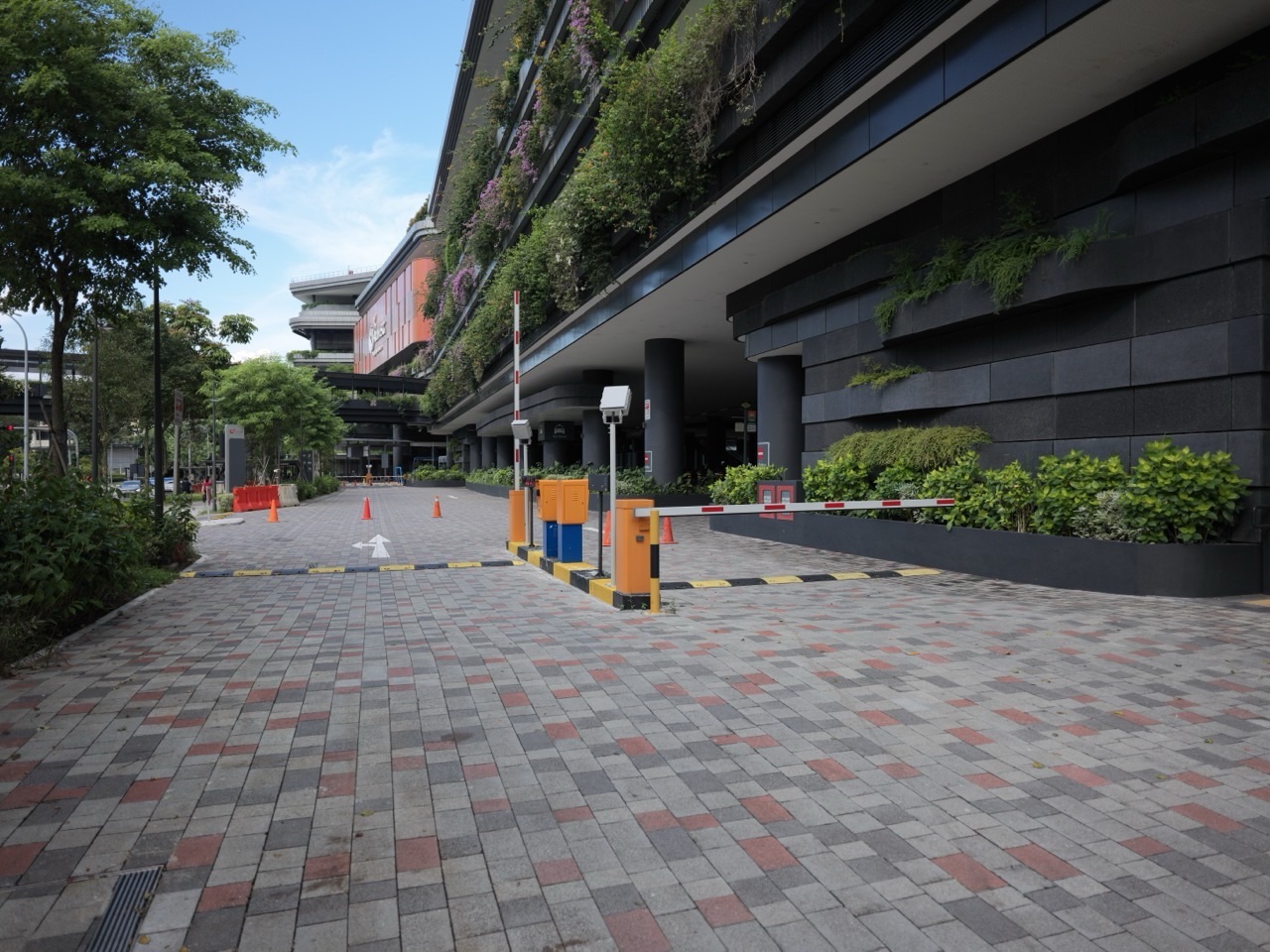
A driver approaching a Punggol multi-storey car park may see a height-limit sign, a clearance bar or a warning frame at the entrance. These features are important because a van, roof box, bicycle rack, delivery vehicle or tall commercial vehicle may not fit beneath the structure. If the sign is unreadable, the warning bar is hanging loose or the clearance marker appears to have been struck, do not guess whether your vehicle can enter. Stop at a safe place before the entrance, check the actual posted limit and contact the car park operator if the information or structure is damaged.
HDB’s season-parking terms expressly require motorists to ensure that their vehicles meet the height and weight limits shown on the signboard at the entrance to a sheltered car park. Singapore’s Parking Places (Provision of Parking Places and Parking Lots) Rules also contain headroom provisions for specified parking structures, including a general minimum clear height and conditions for permitted projections. These legal provisions do not mean that every car park has one identical entrance limit or clearance bar. Drivers must obey the actual site sign, while owners and operators must maintain clear, reliable information and safe infrastructure.
- Do not drive beneath a damaged or unreadable clearance bar just because another vehicle has passed.
- Check the sign’s actual height limit and your vehicle’s total loaded height, including roof racks, cargo and accessories.
- Do not stop in a live entry lane, reverse blindly or leave a vehicle blocking traffic while checking the sign.
- Report the car park name, block, entrance, direction of travel, displayed limit and visible damage.
- Distinguish a warning sign, hanging clearance bar, height detector, overhead beam and car park gantry.
- Contact HDB or the relevant Town Council for the actual HDB car park; use the private car park operator for malls and condominiums.
- Do not touch, lift, tie back or reposition a damaged bar or sign.
- If an overhead component is hanging or may fall, keep clear and notify the operator urgently.
1. Why height-clearance information matters
Multi-storey car parks have physical limits. A vehicle that is taller than the available entrance or internal clearance can hit a beam, pipe, sign, sprinkler installation or other overhead feature. The consequences may include vehicle damage, damage to the building or equipment, falling material and obstruction of the entrance.
A driver should check total vehicle height, not just the original factory specification. Roof boxes, bicycles, work equipment, cargo and modifications can change the height of the loaded vehicle. A sign at the entrance is a practical warning, not a decoration that can be ignored because a car looks small.
2. The sign and the warning bar are not always the same thing
A clearance sign states the maximum permitted height. A suspended bar or frame may provide a physical warning before a vehicle reaches a lower overhead structure. Some sites use sensors, flashing indicators or other controls, while others rely on signage alone.
Do not assume a bar is an official measuring device or that it will stop a vehicle. It may be a warning feature, and it can itself be misaligned or damaged. Read the posted limit and follow all instructions. If the sign and physical bar seem inconsistent, stop before entering and ask the operator.
3. Vehicle height is measured in the real configuration
The relevant height is the vehicle as it is being driven, not merely the height quoted in a brochure for a standard model. Roof racks, cargo pods, bicycle carriers, roof-mounted air-conditioning units, ladders and loaded items can increase the overall height.
A driver should know the actual loaded height before approaching a low-clearance facility. If it is uncertain, do not estimate from the driver’s seat or assume an empty rack makes no difference. Use a safer alternative parking location if the height cannot be verified.
4. HDB’s season-parking terms put responsibility on motorists
HDB’s season-parking terms say motorists must ensure that vehicles meet the height and weight limits shown on the signboard at the entrance of a sheltered car park. The terms also refer to commercial vehicles fitting within the parking lot without causing obstruction or danger.
This means a valid season-parking permit is not permission for a vehicle of any height to enter any sheltered car park. The driver must observe the specific site limit. If the entrance sign has been damaged or is unreadable, seek clarification before proceeding rather than assuming the permit overrides the restriction.
5. The legal headroom rule is not a universal entrance sign
The Parking Places (Provision of Parking Places and Parking Lots) Rules 2018 provide minimum dimensions for parking structures, including headroom in specified parts of a building. They refer to a general clear height of at least 2.4 metres and allow certain building items to project below that height only subject to a lower limit of at least 2.2 metres.
This is a legal design provision for the parking places covered by the rules. It should not be mistaken for the actual entrance height of every HDB, mall or private car park. Existing structures, ramps and individual site arrangements still require the relevant sign and operator’s directions. The driver should not calculate a site-specific clearance from the regulation alone.
6. Why a clearance bar can be damaged
A warning bar may be struck by a vehicle, delivery equipment or another object. It can bend, detach from one support, hang at an angle or lose a reflective strip. A bar that appears displaced may no longer provide the expected early warning and could become a falling-object hazard.
Do not push it back into alignment, tie it to a pole or stand beneath it for a close photograph. The operator must assess the mounting, support and intended position. A report should explain where it hangs and whether it moves or obstructs the entrance.
7. A sign that has faded or lost its numbers
A sign may become difficult to read because of sunlight, dirt, water damage, peeling material or impact. If the number is partly missing, a driver cannot safely assume the remaining digit or infer the original limit from another nearby car park.
Describe which part is unreadable and whether any second sign provides the same information. If there is no reliable alternative, do not enter a low-clearance structure until the operator confirms the limit. A faded sign is a safety communication issue, not just a cosmetic complaint.
8. A missing height sign
An empty sign frame or missing height plate may mean that maintenance or replacement is underway, but it may also leave drivers without essential information. A driver unfamiliar with the facility should not rely on memory or a photograph of an old notice.
Report the exact entrance and approach direction. Ask the operator to confirm the actual vehicle limit before entry. A sign that is missing at one entrance may not have the same information as a different entrance, particularly where the car park has separate ramps or vehicle routes.
9. A warning bar that hangs too low
A clearance bar that has shifted down may give a false warning or itself obstruct a vehicle that would otherwise fit. If it appears loose or lower than the sign indicates, stop before reaching it. Do not drive slowly underneath simply to test whether the vehicle clears.
A properly maintained operator can check both the bar’s setting and the actual overhead clearance. A motorist should not decide which measurement is correct by comparing the bar to a car roof. Any suspected discrepancy should be referred to the site manager.
10. What if the bar swings freely?
Some lightweight warning bars may be designed to move or give an audible warning when contacted. That does not mean the driver should deliberately hit it. A bar that swings unexpectedly, has detached parts or continues moving after light wind may have a damaged mounting.
Do not test the bar using a vehicle. Report the visible movement and keep people away if parts may fall. The operator can determine whether the installation is a normal flexible warning feature or a damaged one.
11. A height sensor or warning light
Some facilities use sensors or illuminated indicators to warn drivers of excessive vehicle height. A flashing light, blank display or apparently inaccurate warning may involve the sensor, power supply, calibration or other equipment. A driver cannot diagnose the system from one pass.
If the system warns that the vehicle is too tall, obey it and do not enter. If it remains blank or appears inconsistent with the sign, stop and ask staff. Never bypass a barrier or drive around a detector to gain access.
12. Do not confuse the clearance warning with an exit gantry
A parking entrance or exit gantry controls vehicle access and may use an electronic parking system. A height-clearance bar warns about overhead space. They may be close together, but their functions and maintenance needs are distinct.
Our Punggol car park exit gantry guide covers a barrier that will not open and electronic parking issues. This article focuses on vehicle height and overhead clearance. If both a gantry and clearance warning are damaged, report each component separately.
13. A van with a roof rack
A van’s factory height may not include a roof rack, ladder, work platform or equipment stored on top. A business driver approaching a sheltered HDB car park should check the loaded configuration against the posted limit before entering.
If the height is unknown, do not rely on a colleague’s estimate or an old job sheet. Use an appropriate outdoor parking option or contact the operator. A commercial vehicle that obstructs or damages an entrance can create problems for other drivers as well as its owner.
14. A family car with bicycles on the roof
Families may transport bicycles on roof-mounted racks for weekend trips. The combined height can be significantly different from the normal car height. A vehicle that fits into an ordinary car park may still exceed a sheltered entrance limit with bicycles attached.
Check the combined height before departure and identify a suitable parking alternative. Do not assume that a vehicle will clear because a similar model entered previously without a bicycle rack. The accessories are part of the actual vehicle configuration for clearance purposes.
15. A roof box or cargo pod
A roof box may add substantial height, and its contents may alter the vehicle’s position or loading. The box must also be fitted according to the manufacturer’s instructions. A damaged clamp or loose box is an additional hazard even if the car meets the car park’s height limit.
Do not remove a roof box in a live entrance lane or place luggage on the roadway while other vehicles approach. Find a safe place and plan the correct parking option. If the sign is unreadable, get the operator’s information before trying to enter.
16. Delivery and service vehicles
Delivery vans, service trucks and vehicles carrying ladders may have different roof profiles from private passenger cars. Some may exceed a sheltered car park’s height or weight restriction even when the vehicle itself is not especially long.
Drivers should check the site-specific restriction and use authorised loading bays or external parking if needed. Do not unload tools or remove a roof fixture in a public lane to force compliance. The vehicle operator has to plan a lawful and safe delivery route.
17. Why weight limits may appear with height limits
A sign may state both height and weight restrictions. Vehicle mass can affect ramps, decks and structural design as well as the vehicle’s ability to manoeuvre. A vehicle that satisfies the height limit may still exceed a stated weight limit.
Read all the restrictions. Do not treat a clearance bar as the only test of eligibility. HDB’s season-parking terms specifically mention height and weight limits for sheltered car parks. If a vehicle’s loaded weight is uncertain, seek operator guidance rather than relying on an assumption.
18. What happens if a vehicle strikes a clearance bar
A vehicle may hit a warning bar and stop, or it may continue and strike an overhead structure. The driver should stop safely, avoid reversing into other traffic and contact the operator or security for instructions. Check for visible damage from a safe position without touching the bar.
If the vehicle has already struck a beam, sprinkler, sign or other building component, do not simply drive away because the car appears undamaged. Report the incident and follow the operator’s instructions. A damaged ceiling component may create a risk for people and vehicles using the car park.
19. What if the vehicle is stuck under a beam?
A vehicle that has become trapped beneath an overhead obstruction should not be forced forward or reversed rapidly. Tyre movement may worsen damage or bring down attached equipment. Keep people away from the affected area and call onsite management or emergency assistance if there is immediate danger.
The driver should follow the operator’s instructions and avoid attempting to deflate tyres, remove vehicle parts or lift the structure without qualified help. The property owner may need to isolate the lane and arrange technical assessment before moving the vehicle.
20. A broken bar can be more dangerous than no bar
A missing warning bar may remove an early visual cue, but a loose bar can itself strike or fall onto a vehicle. A bar that is hanging in the travel path can create a collision risk even for vehicles that comply with the posted height.
The operator should assess whether the entrance can remain open safely and whether temporary warning measures or closure are required. Drivers should not move a barrier or decide that the structure is sufficiently secure because it still hangs from one side.
21. Why the sign must be visible before the decision point
A driver needs to know the height restriction before committing to a narrow or sloping entrance. A sign placed too late may leave no safe place to turn around. A missing advance notice can be as important as a damaged sign at the entrance itself.
Report the approach direction and the distance between the sign and the point where a vehicle can safely divert. This helps the operator understand whether the information is visible early enough. Do not stop abruptly in a traffic lane to read a sign that should have been placed earlier.
22. A low vehicle does not automatically fit everywhere
A vehicle may have a low roof yet still carry cargo, equipment or an attachment higher than the body. Also, an internal ramp or beam may have a lower local projection than the overall garage structure. A driver should observe all signs and any clearance restrictions inside the facility.
Do not assume the entrance sign is the only constraint. Continue to watch for internal signs, direction arrows, hanging services and operator instructions. If a vehicle is close to the limit, ask before entering rather than relying on a narrow estimated margin.
23. Height signs at private malls and condominiums
A mall or condominium may set and display its own height limit based on its structure, internal route and maintenance arrangements. It may have more than one entrance with different limits. A sign at an HDB car park nearby is not a substitute for the private site’s own information.
Contact the private parking operator, security desk or managing agent. Do not direct the complaint to HDB simply because the mall is in a Punggol neighbourhood. The actual owner and operator determine who can repair the bar or replace the sign.
24. HDB and Town Council responsibility
The OneService Work HDB Car Park Maintenance guide identifies signage and other car park infrastructure as assets that HDB or Town Councils maintain depending on location. The responsible party may inspect, arrange technical assessment and schedule repair.
A height-clearance sign or warning bar within an HDB car park should be reported with the block, car park and entrance. The receiving body can confirm the asset owner and whether another contractor or agency must respond. A resident does not need to decide the contractual division before making a clear report.
25. Use OneService for suitable HDB infrastructure faults
The OneService App and chatbot route eligible municipal feedback to the relevant agency or Town Council. The report should identify the entrance, direction, damaged sign or warning bar, and why it affects vehicle access or safety.
Do not use OneService as a substitute for urgent onsite notification if a heavy bar is hanging over traffic. Contact the property operator directly as well. The app’s case reference can be useful for subsequent updates, but there is no universal promise that every repair will be completed within a fixed number of days.
26. What a useful photograph should show
A safe photograph may show the entrance sign, warning bar and surrounding car park name or block. It should be taken from a safe position outside the moving vehicle path. If the component is unstable, do not approach it merely to obtain a close-up image.
Avoid photographing other drivers or registration plates unless the actual incident process requires it. The issue is the car park infrastructure and clearance information. A clear overview plus exact written details is usually more useful than a close image with no location context.
27. What if the sign is obscured by a tree or banner?
A sign may be intact but hidden by foliage, a temporary banner or construction material. A driver can miss the limit even though the information exists. The problem is visibility rather than missing lettering.
Report what obscures the sign and the direction from which drivers approach. Do not cut branches, remove banners or climb a pole. The property manager can coordinate the appropriate maintenance or relocation work.
28. What if two signs show different heights?
Different entrances or internal areas may have different restrictions, but signs at the same approach that conflict can confuse drivers. Do not choose the larger limit simply because it is more convenient. Stop before entering and ask the operator to clarify which restriction applies.
A report should identify both signs and where each is positioned. The operator can determine whether one sign is outdated or refers to a different route. Never drive a tall vehicle beneath the lower sign in order to test which figure is correct.
29. Why a clearance measurement should not be improvised
A driver might measure the bar using a tape held at an angle or estimate its height from the vehicle roof. Such a measurement may be inaccurate because the ground slopes, the bar moves or the vehicle has an uneven roof profile.
The operator should provide the official clearance and arrange any technical remeasurement. A public complaint can state that the displayed limit is unreadable or that a bar has shifted. It should not publish a guessed measurement as an official site limit.
30. What about vehicles with roof-mounted air-conditioning?
Some commercial and specialised vehicles have roof-mounted equipment that is not included in the common passenger-car height estimate. The unit may be fixed and not removable for an ordinary trip. Drivers must know the full height and select a route that can accommodate it.
Do not rely on a car park entrance that appears wide enough. Height restrictions concern the vertical clearance, not just the visible opening width. Ask the operator about approved alternatives if the vehicle exceeds the site limit.
31. An example at an HDB sheltered car park
A resident approaches an HDB sheltered car park with a roof box and finds that the height sign has lost one digit. The driver stops before the entry, finds a safe alternative and reports the unreadable sign with the block and entrance location. The resident does not attempt to drive beneath the warning bar to see whether it clears.
This is a hypothetical example, not a report of a damaged Punggol car park entrance. It demonstrates that a driver should not sacrifice safety to save a short diversion. A valid season-parking permit does not override height and weight restrictions.
32. A delivery van at a condominium
A delivery driver arrives at a condominium with equipment on the roof and sees a clearance bar hanging at an angle. The driver contacts security from a safe stopping point and asks for the approved loading route. The driver does not lift the bar or reverse into the public road without checking that it is safe.
The management office can identify whether the entrance is closed, whether another route is approved and whether a contractor should inspect the bar. This is a private-premises example, not an assertion that HDB controls the facility.
33. A vehicle has already touched the bar
A motorist hears a scrape and notices that the warning frame moved after the roof rack passed beneath it. The driver stops in a safe place and informs the car park manager. The manager can inspect the bar and any overhead structure before deciding whether the lane remains usable.
Do not assume no damage occurred simply because the vehicle has no visible scratch. A loosened support or displaced sensor may affect the next driver. The report should be prompt, factual and include the time and approach.
34. When an entrance should be closed
A facility manager may decide to close or redirect traffic where a clearance bar is unstable, a sign is missing or overhead damage creates uncertainty. The closure and alternative route should be communicated through authorised signs or staff instructions.
Drivers should obey a barrier and not drive around it. A parked car or urgent delivery does not authorise entry through a restricted lane. The operator determines when inspection and repair allow reopening.
35. Why emergency vehicles need separate consideration
Emergency, service and maintenance vehicles can have different dimensions and operational needs. However, the driver still needs to follow the site’s access rules and should not assume an emergency or service label removes a physical height limit.
The property owner can provide the appropriate access arrangement where required. Do not advise drivers to ignore a clearance bar because they are performing a delivery, moving a resident or transporting equipment. Safety depends on the actual vehicle and structure.
36. A sign that shows the wrong unit
Some signs may display height in metres, while other information may be shown in another unit. If a sign is damaged or its unit is unclear, a driver may misread the limit. An ambiguous or incorrectly printed value should be checked by the operator.
Do not convert a guessed figure and treat it as confirmed. Report the exact text visible and request clarification. The operator must ensure the correct units, legibility and placement for drivers approaching the car park.
37. Repeated strikes and maintenance history
If warning bars are repeatedly struck at the same entrance, there may be a problem with visibility, placement, approach geometry or driver compliance. The repeated events may justify a broader review rather than replacing the same bar without investigating the cause.
A resident can report observed dates and prior case numbers. Do not identify or accuse a particular vehicle unless there is reliable evidence and a proper incident process. The operator can review maintenance records and determine whether the site needs a different warning arrangement.
38. A good report template
A concise report might read: ‘At [Punggol car park/block], the vehicle entrance from [road or approach] has a damaged/unreadable height sign and the warning bar is [actual condition]. I noticed it at [date/time]. Please confirm the safe clearance and inspect the sign/bar before further vehicles are directed beneath it.’
This wording describes observations without inventing an exact limit or blaming a driver. If the bar may fall, state that separately and contact onsite staff urgently. A photo should be taken only from a safe, stationary position.
39. What to do while the sign is being repaired
If the operator confirms a temporary route or alternative parking arrangement, follow that instruction. Do not rely on an old photograph, a neighbour’s memory or a third-party parking map where current site signage is missing. A replacement sign should be verified through the official operator.
If a vehicle does not meet the confirmed height, use another suitable parking location. The driver’s convenience does not justify a collision risk. Keep any temporary permit or redirection instruction if the arrangement affects a booking or delivery.
40. The practical takeaway
Height-clearance signs and warning bars help drivers decide whether a vehicle can safely enter a sheltered car park. A damaged warning system creates uncertainty for the next driver as well as a possible physical hazard. The correct response is to stop before the decision point, use the actual site restrictions and report the defect to the right operator.
HDB’s own season-parking terms require motorists to observe the site’s height and weight limits. The legal headroom rules describe parking-space design, not a universal permission to enter every garage. Precise reporting and careful driving protect vehicles, buildings and other car park users.
Car park height-clearance reporting checklist
- Check the actual height and weight restriction before entering.
- Measure the vehicle in its fully loaded configuration, including roof accessories.
- Stop in a safe area before a damaged or unreadable sign or bar.
- Do not test clearance by driving beneath an uncertain warning frame.
- Identify the car park, block, entrance, level and approach direction.
- Describe whether the sign is missing, faded, obscured or contradictory.
- Describe any loose, bent or hanging warning bar or sensor.
- Contact HDB/Town Council for the actual HDB asset or the private operator for private parking.
- Notify staff urgently if a component may fall or the entrance is unsafe.
- Keep any case reference and follow official diversion or closure instructions.
Frequently asked questions
Does a valid HDB season-parking permit let any vehicle enter?
No. HDB’s terms require a vehicle to meet the height and weight limits displayed at a sheltered car park.
Is every HDB sheltered car park’s height limit the same?
Do not assume so. Check the actual entrance sign for the specific car park.
What is the legal minimum headroom in a car park?
The Parking Places Rules include a general 2.4 m clear-height provision for specified parking structures, with certain items permitted to project to not less than 2.2 m. This is not the same as every site’s vehicle entrance limit.
Does a warning bar measure vehicle height?
It may be a warning feature rather than a certified measurement device. Follow the posted sign and operator instructions.
Can I lift a damaged warning bar?
No. It may have a damaged support or be unsafe to handle. Report it to the operator.
What if the sign is unreadable?
Do not guess. Stop before entering and ask the car park manager to confirm the correct limit.
What if I have a roof box or bicycle rack?
Include it in your actual loaded vehicle height and check the sign before entering.
What if my van carries ladders?
Treat all roof-mounted cargo and equipment as part of the vehicle height. Use an alternative route if it exceeds the limit.
What if the bar is hanging loose?
Keep clear and notify onsite staff urgently. It may present a falling-object risk.
Can I drive under a bar that another car has just passed?
Not safely on that basis alone. The other vehicle may have a different height, or the site may have a specific issue.
Who repairs an HDB car park clearance sign?
HDB or the relevant Town Council depending on the asset and location. OneService can route suitable maintenance reports.
Who repairs a condominium height bar?
The MCST, managing agent or appointed private parking operator.
Is a height bar the same as an EPS gantry?
No. A gantry controls vehicle access or payment; a clearance bar warns about overhead height.
What if two signs show different limits?
Stop before entry and ask the operator which restriction applies. Report both signs and their positions.
Should I reverse out of the entrance if uncertain?
Only if it can be done safely and legally. Avoid reversing blindly or blocking traffic; seek staff assistance.
What if a vehicle has already hit the bar?
Stop safely, notify the operator and follow instructions. Do not assume there was no damage just because the car looks fine.
Can a driver measure the bar using a phone app?
Do not treat an informal measurement as the official site clearance. The operator must confirm the actual limit.
Does a broken sign mean the car park must close?
The operator must assess the risk and decide whether to close, redirect or install temporary warnings.
Can I use OneService?
Yes for suitable HDB or municipal infrastructure reports; use the private operator for private car parks.
What is the shortest useful report?
‘At [car park entrance], the height sign/bar is [actual damage] on [date/time]; please confirm the safe clearance and inspect before vehicles enter.’
Official sources and related Punggol reading
- HDB — Season Parking Terms: Height and Weight Limits at Sheltered Car Parks
- Singapore Statutes Online — Parking Places (Provision of Parking Places and Parking Lots) Rules
- OneService — HDB Car Park Infrastructure Maintenance
- OneService — Report HDB Car Park Defects
- HDB — Parking Services and Car Park Information
- eduKate Punggol — Car Park Exit Gantry Problems
- eduKate Punggol — Convex Safety Mirror Faults at Car Parks
Updated 15 November 2026. This guide does not state or verify the height limit of any named Punggol car park. The statutory headroom provisions and HDB permit terms have distinct scopes; drivers must follow the actual sign and the operator’s instructions. Do not test or alter a damaged warning bar.


