
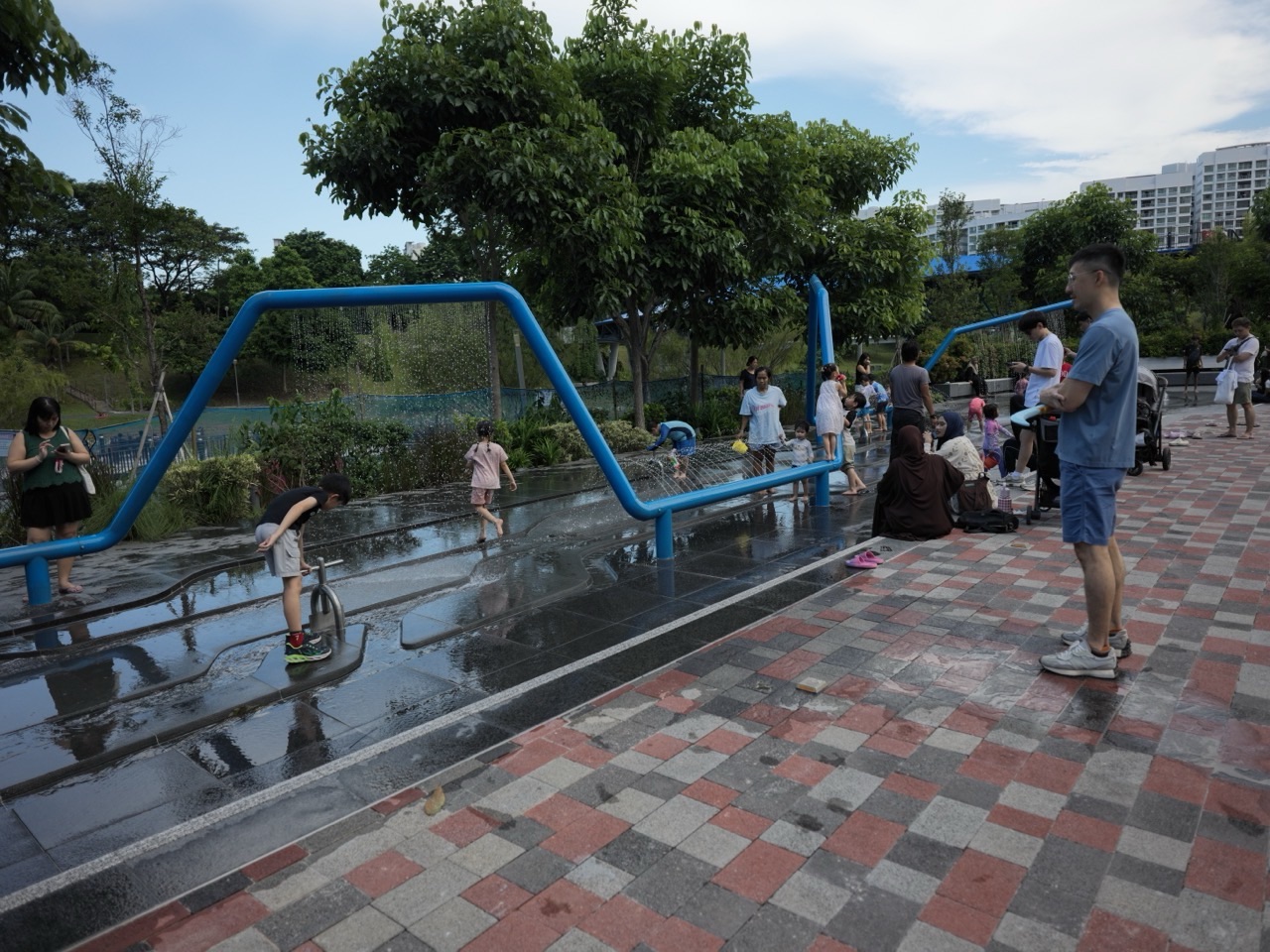
The right ActiveSG Punggol activity changes with age. A toddler can enjoy suitable supervised play features at the free public Play Street, but cannot use the indoor gym. Children younger than twelve are excluded from all ActiveSG public gyms under SportSG rules. Those aged twelve to fourteen may be eligible for gym use with a parent-linked MyActiveSG+ account and a purchased pass, while older eligible users follow their own account and admission conditions. SportSG provides concession pricing for seniors aged 55 and above and free entry to its public gyms and pools for Singapore citizens aged 65 and above. These are separate eligibility rules, not a single all-ages family ticket.
Punggol Sport Centre is at 11 Sentul Crescent, Singapore 828656, near Sam Kee LRT. Its free 24-hour Play Street includes slides, toddler play areas and movement stations. The swimming complex has five different pools, including a 0.3-metre-deep kids’ pool, but pool admission, public opening and adult supervision must be checked independently. As of 14 November 2026, the centre is approaching its formal 22 November opening, when SportSG advertises a date-specific free gym and pool offer. That event does not waive gym age restrictions, swimming rules or the need to use the correct facility.
- Toddlers and preschoolers: choose suitable Play Street features with direct caregiver supervision; check current safety signs.
- Ages 0–11: no entry to ActiveSG public gyms, including accompanying an adult.
- Under 12 at the pool: SportSG says children under 12 may enter only with a parent or caregiver; suitable water area and supervision matter.
- Ages 12–14: may be eligible for gym use, but a parent must link the child’s MyActiveSG+ account and buy an appropriate pass.
- Age 15 and above: follow the relevant personal account, Singpass eligibility and facility rules; a birthday does not guarantee every concession.
- Ages 55+: SportSG lists senior concession pricing for eligible passes, depending on the member profile and product.
- Singapore citizens 65+: free ActiveSG public gym and pool admission with the relevant ID verification; not automatically available to non-citizens.
- Tourists without Singpass: may purchase single-entry gym or pool passes at the facility, but cannot ordinarily book courts or programmes on MyActiveSG+.
- Ages of children joining sports programmes: read the named programme’s own eligibility rather than generalising from gym rules.
- Courts: a badminton or pickleball booking has a particular reservation and player arrangement; age alone does not create availability.
- Official answers: SportSG ActiveSG FAQ and MyActiveSG+. Checked 14 November 2026.
The first distinction: play areas, gyms, pools and courts
Not everything at Punggol Sport Centre uses the same age and access rules. The Play Street is a free public thoroughfare with suitable play and movement features. The indoor gym is an admission-based exercise facility with a strict minimum age. The five-pool swimming complex uses admission and water-safety conditions. Booked badminton, tennis and pickleball courts have their own appropriate player and facility requirements. An organised class can also specify its own participant ages.
A parent should therefore avoid asking only, “Is my child old enough for ActiveSG?” The more useful question is, “Which specific Punggol activity are we planning, and what does its operator require?” That question prevents young children from being taken into restricted areas or older adults being promised a concession for the wrong product.
Toddlers: a short supervised Play Street visit
SportSG confirms that Punggol’s public Play Street has toddler play areas, slides, play tubes and movement features. That can provide a suitable short family outing without the need to rent a sports court, subject to the actual equipment instructions. Toddlers differ in size, coordination and confidence, so a caregiver should not assume every slide is suitable merely because the development includes a toddler area.
A young child may enjoy watching the LRT, looking at the building and spending a few minutes on appropriate equipment. The outing should remain flexible, with normal care items and an easy way home. The Play Street is not a nursery or supervised childcare venue. The adult remains responsible for the child throughout the visit.
Preschoolers: the playground is not the gym
Some preschoolers love climbing and sliding, while others prefer observing first. A parent can choose suitable public Play Street features and support the child’s comfort. That does not mean the family can enter the indoor gym to explore weight machines. ActiveSG public gym regulations exclude all children under twelve, including preschoolers who are merely accompanying a parent.
The rule is about safety and facility use, not whether the child is energetic or advanced in movement. A short public walk or age-appropriate play can be a better introduction to the centre. If a formal preschool sport class is desired, confirm an actual listed programme, permitted age, provider and session at the specific venue rather than assuming one exists.
Ages six and seven: the beginner activity question
Children in early primary school may enjoy familiar movement games and gentle supervised racket activities in an appropriately booked and permitted venue. They may also enjoy the public Play Street, which does not require a badminton reservation. However, age six or seven does not grant independent access to public gyms or specialist areas such as the rooftop archery range. These facilities have separate purposes and conditions.
A parent should choose a realistic activity based on the child’s readiness and interest. A child who does not yet control a shuttlecock may prefer simple cooperative play or a shorter outing rather than a formal match. The goal is making sport enjoyable without turning the new centre into another performance assessment.
Ages eight to eleven: what is actually allowed?
A primary-school pupil aged eight, nine, ten or eleven remains below the minimum age for ActiveSG public gyms. The parent should not attempt to bypass that restriction by buying an adult pass or by asking the child to sit inside. Other activities, such as suitable booked racket sports, may be options depending on the venue’s actual participant rules, safety requirements and supervision arrangements.
Parents can also plan a short free Play Street visit or an age-appropriate swimming activity when the specific pool is publicly operating. The presence of a 0.3-metre kids’ pool does not remove adult supervision duties. A family needs to check admission, appropriate water depth and care arrangements instead of treating “public pool” as a universal permission.
Aged eleven and nearly twelve: the birthday does not count early
A child who will turn twelve next month is still under twelve today. ActiveSG’s gym minimum applies to actual age, not school year, height or a parent’s estimate of maturity. A Primary 6 pupil may be old enough for gym entry later in the year but ineligible earlier. A student card or parent account does not override the age requirement.
If a child is interested in gym training, parents can use the waiting period to discuss safe exercise and explore legitimate age-appropriate activities. The new sport centre offers public walking and booked sports options, while formal youth programmes must be checked for eligibility. There is no need to force early entry into an adult exercise room to build enthusiasm for activity.
Age twelve: when gym eligibility begins
SportSG’s official FAQ says children must be at least twelve to use ActiveSG public gyms. That is the starting eligibility threshold, not a guarantee of entry. A twelve-year-old also needs the correct pass or applicable admission and must follow the operator’s under-fifteen linked-account requirements. Buying a family member’s pass is not enough.
A first eligible visit should focus on orientation and understanding safe equipment use. A twelve-year-old may benefit from appropriate adult help and staff guidance, and should not imitate a demanding online workout. The gym’s size and inclusive equipment provide potential options but do not replace correct technique, readiness or supervision expectations where relevant.
Ages twelve to fourteen: linked child accounts
Children below fifteen cannot have their own Singpass account under the relevant MyActiveSG+ arrangements. SportSG therefore instructs a parent to link the child’s profile to the adult’s MyActiveSG+ account and purchase an appropriate pass for eligible gym use. The child’s account and pass must be associated with the right participant. An older sibling’s login or a borrowed admission code is not an acceptable substitute.
This linked-account workflow is useful for other eligible programmes and swimming passes too. But it does not create automatic permission for every facility or class. The actual activity’s age and booking requirements remain decisive. Parents should complete administration before travelling to avoid a problem at the gym entrance.
Why a parent-linked account is not a family pass
Linking a child means that the parent can manage certain passes, bookings and programme registrations on their behalf. It does not turn the adult’s gym or swimming pass into unrestricted admission for all household members. Each person must meet the product’s eligibility and admission conditions, and a popular court can still be fully booked. This distinction is important when families with children of different ages travel together.
A parent should verify exactly who the pass is for, which date it covers and whether the child is eligible. If the family wants badminton, book the appropriate court instead of relying on the gym pass. A sensible arrangement assigns each person a clear activity and supervision plan.
How a child without a smartphone can enter a pool
SportSG’s child entry FAQ says a linked child with a purchased pool pass can use a student pass or seek manual staff verification. In some situations, a caregiver may use the appropriate QR code method. The process depends on the pool’s actual entry system and the member’s pass, so it should be checked before visiting Punggol.
The important safety distinction is that being able to pass through the gantry does not mean the child may swim independently. SportSG says children younger than twelve may enter the pool only with a parent or caregiver. Correct digital verification and active human supervision are separate obligations.
Swimming children under twelve: the caregiver requirement
SportSG’s published pool entry FAQ specifically says children under twelve can enter the pool only with a parent or caregiver. That is broader than assuming a confident nine-year-old can enter alone because they swim well at school. Families should check both the entry rule and the specific swimming complex’s current supervision standards, including any stricter requirements for very young children.
A parent should choose the right area for the child’s ability and follow lifeguard instructions. The Punggol competition pool is two metres deep, while the training pool is 1.2 metres and the kids’ pool is 0.3 metres. None of these numbers proves a child can be left unattended. Suitable supervision remains essential regardless of depth.
Why the 0.3-metre kids’ pool still needs adult attention
Thirty centimetres sounds shallow to an adult, but young children can still be at risk in water. The kids’ pool is designed for younger users, yet it is not an unsupervised toddler playground. Active supervision and the actual facility rules matter more than a reassuring label. Parents should ensure that a child can enter the area appropriately and remain under their responsibility.
Do not assume the new pool is publicly operating on the intended date without checking. Punggol’s formal opening is on 22 November 2026, with a one-day promotional entry announcement. Even if pool admission is free at an event, age, ability and safety restrictions remain. A free ticket does not change the nature of water.
Twelve-year-old swimmer versus twelve-year-old gym user
At age twelve, the child may become eligible for gym use under the appropriate account and pass rules, but swimming still involves its own supervision and safety considerations. The two products are separate. A gym entry rule is not a general statement about swimming ability, and a child’s prior SwimSafer participation does not automatically qualify them for every exercise machine.
Parents should select the specific experience the student wants. A child may enjoy swimming but dislike the gym, or prefer a casual badminton game with a friend. The best option is not necessarily the activity whose age threshold has just been reached. Comfort, actual facility availability and proper care arrangements matter.
Age fifteen: a change in account administration
At fifteen, a young person may become eligible for their own Singpass account under Singapore’s system, and MyActiveSG+ registration can then follow the applicable individual process. That can change who manages certain passes and bookings. However, turning fifteen does not make all events free or remove ordinary booking, payment, safety and facility conditions. Account administration and sporting suitability are different matters.
A teenager who begins organising their own badminton sessions should still follow the correct booking workflow, check player numbers and prepare equipment. Parents may remain involved in travel or spending decisions according to the family’s circumstances. The system encourages legitimate personal accounts rather than sharing passwords within a group of friends.
Ages fifteen to seventeen: independent sport with sensible boundaries
Older teenagers may want to meet classmates for racket sports or use the gym. They should still observe court reservations, gym rules, suitable training technique and the centre’s opening hours. A student who is eligible for the gym does not gain entry to restricted archery areas or a competition pitch. Specialised activities require their own approved programme or event arrangements.
The practical plan includes the sport, participant count, equipment, budget, safe route and return time. A casual outing can be enjoyable without making it a school competition. If a teenager is new to a particular machine or activity, asking authorised staff for guidance is more sensible than copying risky demonstrations from social media.
Ages eighteen to fifty-four: adult passes and ordinary rules
Most adults in this range will follow the operator’s standard membership and admission arrangements, subject to citizenship, residency, pass type and any relevant concession. A person with a valid gym pass can visit the correct operating facility; a badminton court requires a separate reservation. There is no single Punggol ticket that automatically covers every sport in the development.
For a first visit, confirm the actual activity and route, then keep the session realistic. An adult may enjoy the 1,500-square-metre gym, a properly booked court, the free Play Street or a public waterway walk. The right choice depends on preferences and practical conditions, not simply age.
What about an adult beginner who dislikes gyms?
An adult may be eligible for admission but still dislike weight machines, busy equipment rooms or structured workouts. That is a matter of preference, not a problem that must be corrected. Punggol has public walking and play features that may be more comfortable, as well as booked badminton or table tennis for people who prefer a social game. The gym is only one part of the development.
A person who wants to try the gym can begin with a simple appropriate orientation and modest familiar activity. If they do not enjoy it, a legitimate alternative may serve them better. The purpose of public sport is participation and wellbeing rather than forcing every user into the same routine.
Why the age fifty-five concession is important
SportSG’s updated FAQ states that seniors aged fifty-five and above may qualify for concession pricing on single- and multi-entry passes. The exact option is based on the member profile and product, so a visitor should check what MyActiveSG+ actually displays rather than assume one fixed discount rate. A resident with a birthday that changes their eligibility may want to review current options before buying a pass.
This concession is distinct from the free-entry policy for Singapore citizens aged sixty-five and above. A sixty-year-old should not infer that all gyms and pools become free automatically simply because they are in a senior concession category. Clear thresholds help families budget accurately.
Ages fifty-five to sixty-four: what to expect
For this group, a qualifying senior concession may reduce certain admission costs, subject to actual membership and operator rules. The person still needs a valid pass or other approved admission, and a court booking remains a separate product. An ActiveSG credit balance can also have eligibility and usage limits. A public guide should not substitute a universal quoted price for the real transaction displayed in the system.
Activity choice remains individual. Some people enjoy vigorous sport, while others prefer walking, gentle swimming or suitable resistance work. Age alone does not dictate intensity or medical suitability. The new centre’s inclusive equipment offers options, but users should choose what matches their readiness and professional advice when needed.
Singapore citizens aged sixty-five and over: free gym and pool entry
SportSG’s official FAQ confirms free entry to its public gyms and swimming pools for Singapore citizens aged sixty-five and above. This is a standing eligibility policy, not merely the special promotional event on 22 November. The user must still verify identity through the approved process, and the named Punggol facility must be operating for the intended activity. Free admission also does not necessarily cover every programme, specialised service or court reservation.
A senior can bring suitable ID and ask staff for assistance with the current entry method where necessary. The FAQ says no ordinary pass purchase is needed for qualifying public gym and pool entry. Nonetheless, verify the actual venue’s operational status and any specific programme conditions before travelling.
Why citizenship matters to the 65+ rule
It would be misleading to say that everyone aged sixty-five and over receives free ActiveSG gym and swimming admission. SportSG specifically limits the published free-entry concession to Singapore citizens. Permanent residents, foreign residents and visitors may have different eligibility or pay standard or concession rates according to the current product. Age and citizenship must be considered together.
A family helping an older visitor should check the correct participant profile and legitimate ID verification. Do not assume that a foreign relative visiting Singapore for the holidays has the same free-entry entitlement as a Singapore citizen senior. Accurate information prevents unpleasant surprises at the pool entrance.
What if a senior does not have a smartphone?
SportSG provides physical-identity verification options for eligible members, including qualifying seniors. The FAQ explains that a Singapore citizen aged sixty-five and above can use an NRIC or approved physical ID to enter public gyms and pools for free. Some updated pool gantry arrangements may involve additional account activation or scanning steps depending on the installation, so check the current procedure for the specific venue.
A relative can help the senior understand the rules but should not hand over passwords or use someone else’s profile. If the scanner does not work, seek assistance from authorised staff rather than entering through a gate behind another user. A simple, legitimate process is more reliable than an informal shortcut.
Teenager and grandparent visiting together
A teenager and a grandparent may want a shared outing but have very different activity preferences. One may enjoy a booked table-tennis game, while the other prefers the free Play Street or a gentle waterway visit. If both want to enter the gym, check each person’s eligibility and actual admission separately. The older person’s free concession does not create an additional free pass for a teenager.
The family should also plan transport, rest opportunities and any accessibility needs. A multigenerational visit can be enjoyable without requiring everyone to use the same machine or pool. The best programme is one that accommodates real preferences rather than a simplified age stereotype.
Parents who want to exercise while children play
A parent might plan to use the gym while a child explores Play Street. But the free public route is not a childcare service, and the child may require continuous adult supervision. A parent should not simply leave an under-twelve near the slide and spend an hour in the gym. If different adults are available, arrange who cares for the child and where the group will reunite.
A booked court also has its own safe participant and spectator conditions. Non-playing siblings cannot be left unattended in corridors or equipment areas. Family sport succeeds when adult responsibilities are explicit and every child is appropriately supervised.
Age-appropriate badminton and table tennis
Racket sports can appeal to different ages, but a venue’s booking rule and an actual player’s readiness are separate from gym minimum ages. Two suitable people can play singles, while four can organise doubles when permitted by the court reservation. A child may benefit from gentle cooperative rallies rather than a full adult competitive match.
Do not assume a three-year-old can safely join a high-speed tennis game because the court is available. A parent can explore a genuine age-appropriate programme or choose a different public activity. The number of courts in Punggol does not remove the need to consider ability, equipment and supervision.
Swimming lessons versus normal pool admission
A public pool pass generally covers the type of entry described by the operator, not a formal swimming lesson. SwimSafer and other programmes have their own provider, registration, age and skill expectations. A child may be eligible for ordinary supervised recreation without being enrolled in a class. Conversely, a learner who needs coaching should look for a genuine suitable programme rather than assume a lifeguard provides instruction.
The new Punggol complex has separate competition, training, lagoon, wellness and kids’ pools. The intended water area should match the activity and participant. A different depth or programme setting can materially affect suitability. Always verify current public operations and actual facility rules.
What a visitor without Singpass can do
SportSG’s updated FAQ distinguishes foreigners residing in Singapore with Singpass from tourists and visitors who do not have it. Foreign residents with an eligible Singpass account can register for MyActiveSG+ and access the products available to their profile. Tourists without Singpass cannot ordinarily book sports facilities or register for programmes through that system, but can purchase single-entry passes for ActiveSG gyms and swimming pools at the facility.
This means a tourist should not assume they can rent a badminton court using a friend’s credentials. However, a legitimate public Play Street visit or qualifying gym or pool admission may be possible, subject to venue operations and current rules. Nationality, account status and activity type all matter.
Permanent residents and concession categories
Singapore Permanent Residents may be eligible for certain ActiveSG member products and credits, but they should not assume the same free 65+ admission reserved for Singapore citizens. Some multi-entry passes are limited to particular membership categories, and a product that does not appear in the user’s account may not be available to that profile. The correct information comes from MyActiveSG+ and SportSG’s latest FAQ.
Do not mix up price concessions with unrestricted entry. A valid pass still does not authorise use of a reserved court, private lesson or restricted training range. A specific family outing should be based on the actual product and participant rather than a general statement that someone is a resident.
Why under-fifteen account management matters for siblings
A parent with two children under fifteen can link eligible child profiles for specific passes and programme registration, but each child’s eligibility and credits remain individual. A booking for one child is not automatically a pass for a sibling. When calculating costs, check the actual participants and activity categories. The account helps administer family sport without replacing personal admission rules.
This becomes important if one child is eleven and the other thirteen. The younger child cannot enter the gym; the older may be eligible with the correct linked account and pass. A family that understands both thresholds can choose a shared alternative instead of discovering the conflict at reception.
The 22 November opening promotion is a separate category
The formal opening of Punggol Sport Centre on Sunday 22 November 2026 includes advertised all-day free gym and swimming-pool entry. That is a date-specific event offer, while senior concessions and normal pass rules exist separately. A parent should not describe the opening promotion as the ordinary daily rate or assume it covers badminton, tennis, private coaching or food.
Even a free-entry day does not waive the under-twelve gym restriction or pool supervision rules. Visitors should follow the operator’s actual event instructions and understand any capacity conditions. If the family prefers a quieter outing, the public Play Street offers a different free experience at other times.
The age question for Active Health Lab appointments
The Punggol Active Health Lab at #B1-01 offers programmes under a pre-booked arrangement, with a published timetable and no walk-ins. Age eligibility can differ according to the named programme. An adult or senior should not assume every assessment is appropriate for them, and a secondary student should not infer that a parent-linked account grants access to an adult service.
Check the actual Active Health programme, participant conditions, venue and available session before planning travel. Its registration is separate from an ordinary gym pass. If a specific programme is not listed for the intended age, ask the lab or choose another legitimate activity.
The age question for organised sports classes
Punggol may host different activities and SportSG offers national programmes, but a nationwide advertisement does not prove a particular class operates at the new sport centre on the date a family wants. Age bands, coach arrangements and the actual location can differ. A child’s age alone is not enough to confirm a place.
Before paying, verify the programme’s provider, age, ability level, dates, venue and supervision conditions. If the family is uncertain, choose one manageable ordinary court game or suitable public activity first. A slow introduction can help people discover interests without buying an unsuitable multi-week programme.
Equipment and attire also depend on the age and activity
A primary-school child playing badminton needs appropriate court footwear and a manageable racket, while an adult visiting the gym needs proper sports clothing and a personal towel under the regulations. A swimming family needs suitable swimwear and any personal-care items required. A toddler using Play Street may simply need ordinary practical clothing and close adult supervision. One generic sports bag is not necessarily appropriate for all these activities.
Do not assume rental equipment or changing facilities are available for every visitor. Pack for the confirmed activity, and keep personal belongings clear of corridors and emergency routes. A simpler outing is often more comfortable for a household with several generations.
How to plan a five-person multigenerational outing
Imagine two adults, a preschooler, a thirteen-year-old and a Singapore citizen grandparent aged sixty-six. They cannot simply purchase one gym pass for the group. The preschooler is under the gym minimum, the thirteen-year-old may need a linked account and eligible pass, the adults follow ordinary admission and the qualifying grandparent has a separate free gym/pool concession.
A suitable shared public Play Street visit may therefore be easier than trying to admit everyone to the gym. If separate activities are chosen, adults must organise childcare, accessible routes and a clear meeting point. The aim is not to maximise the number of paid products but to create a manageable visit that respects everyone’s needs.
A simple four-week family activity plan
Week one: identify each participant’s actual age, interests and supervision needs. Choose an activity everyone can legitimately enjoy, perhaps a short suitable public Play Street visit. Check weather and the route.
Week two: if a child or adult wants a specific sport, verify actual booking and admission. Complete any necessary linked accounts in advance. Do not enter a gym with a child who is too young.
Week three: explore an appropriate pool or racket activity only when it is genuinely available, with the right equipment and supervision. Review the total cost and family comfort.
Week four: keep the version the household enjoyed. A monthly public outing, occasional booked badminton game or eligible senior gym session may be more useful than a crowded schedule. Respect individual preferences and change the plan as family circumstances evolve.
Frequently asked questions about age at ActiveSG Punggol
Can a five-year-old use Punggol’s gym? No. ActiveSG public gyms exclude children under twelve.
Can an eleven-year-old use gym equipment if supervised? No. The published under-twelve restriction still applies.
Can a twelve-year-old use the gym? Potentially, with the correct parent-linked account, admission and venue rules.
What about ages twelve to fourteen? The parent manages the relevant linked MyActiveSG+ profile and pass.
Can a fourteen-year-old swim alone? Check the specific pool’s safety and admission requirements; age alone does not establish swimming competence.
Can under-twelves enter the swimming pool alone? SportSG says children under twelve require a parent or caregiver.
What changes at fifteen? The individual may be able to manage their own eligible Singpass and MyActiveSG+ account.
Do 55-year-olds receive senior concessions? SportSG lists concession pricing from age fifty-five for eligible passes.
Is gym entry free for everyone aged sixty-five? No. The published free public gym and swimming entry applies to Singapore citizens aged sixty-five and above.
Do older Singapore citizens need to buy a normal pass? Not for qualifying free gym and pool entry; proper ID and venue operation still matter.
Can tourists use ActiveSG gyms? SportSG says tourists without Singpass can buy single-entry pool or gym passes at the facility.
Do tourists without Singpass book badminton courts? The current FAQ says they cannot ordinarily book facilities or programmes through MyActiveSG+.
Is Play Street free for all ages? SportSG describes the public route as free; each play feature still requires appropriate safe use and supervision.
Official age and account references
The age rules are supported by SportSG’s gym entry FAQ, child pool entry guidance, senior concessions and free entry, and foreign visitor and tourist eligibility. Use MyActiveSG+ for genuine bookings and eligible passes, and SportSG’s Punggol centre guide for Play Street and facility details.
Related local reading: toddlers and preschoolers, entering without a phone, and which Punggol pool suits whom. Verified 14 November 2026. This independent guide does not confirm live facility availability, replace water safety instructions or promise a particular concession to an ineligible visitor.
Continue with the connected guide: ActiveSG Punggol 2027/2028 | Opening Status, Facilities and Visitor Guide. Use its linked index to compare the related questions and choose your next reading.


