
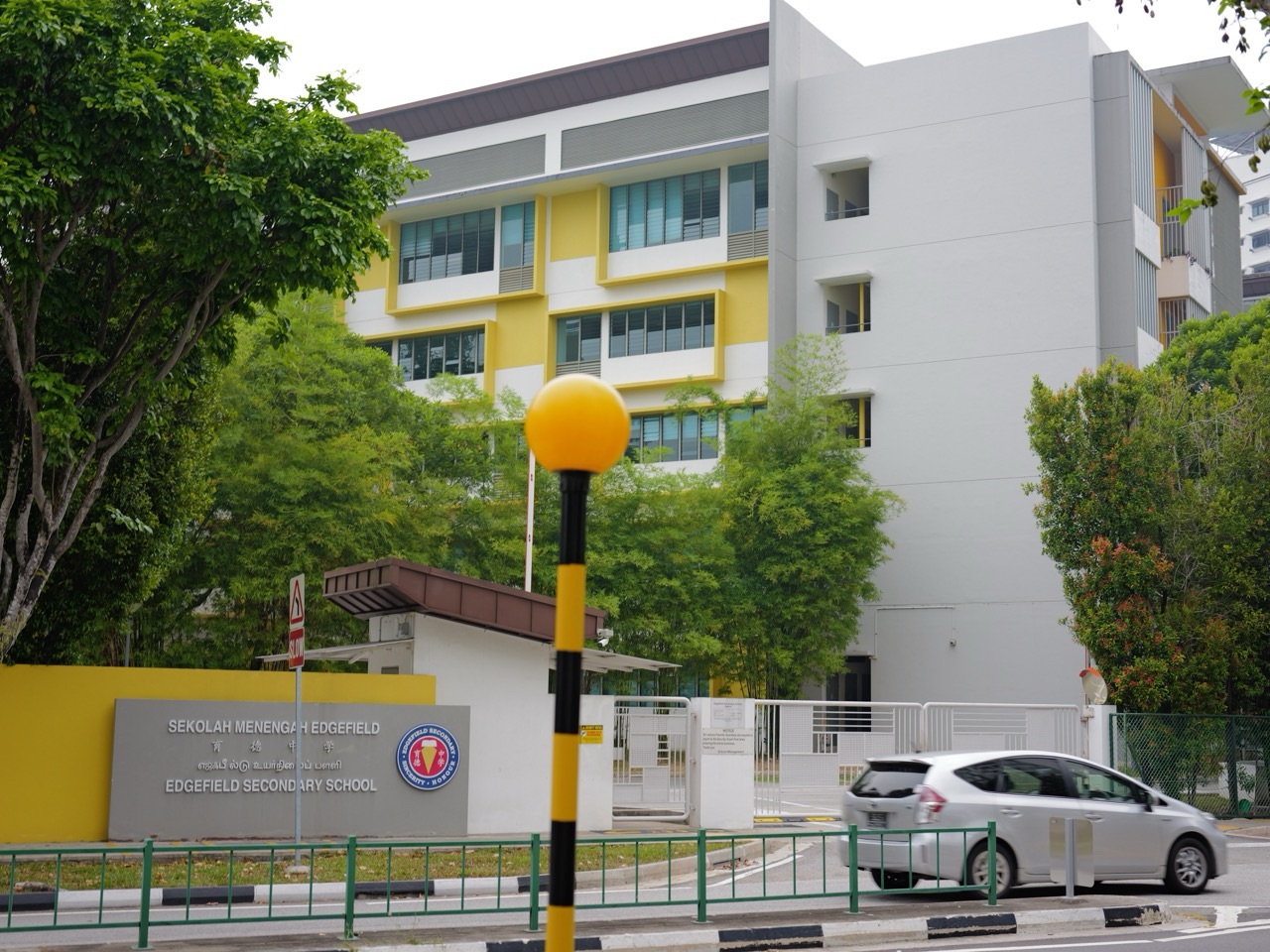
Choosing a G3 or G2 secondary school for a child living in Punggol is a two-part decision: first establish the correct PSLE Posting Group, then compare schools the family can actually reach and the child can actually attend successfully. Punggol’s four mainstream secondary schools are Edgefield at 36 Punggol Field, Greendale at 51 Edgedale Plains, Punggol Secondary at 51 Edgefield Plains, and Yusof Ishak at 8 Sumang Walk. They are in the same town but do not involve the same morning route from every Punggol neighbourhood.
Using the completed 2026 Secondary 1 intake as a historical reference, their PG3 last-posted scores were respectively 14, 16, 19 and 15, while the PG2 figures were 23, 23, 24 and 22. A PSLE Score 17 family, for example, should inspect the PG3 column rather than compare itself against PG2 cut-offs; a Score 23 family should inspect the PG2 column. For Scores 21–22, eligible parents may choose PG2 or PG3, but the selected group is used across the six-choice list. Check the latest official numbers in MOE SchoolFinder before submission. Historical figures are neither offers nor forecasts.
- Four in Punggol: Edgefield, Greendale, Punggol Secondary and Yusof Ishak Secondary.
- 2026 completed-intake PG3 cut-offs: 14, 16, 19 and 15 respectively.
- 2026 completed-intake PG2 cut-offs: 23, 23, 24 and 22 respectively.
- Score 4–20: usually PG3; 21–22: PG2 or PG3 choice; 23–24: PG2.
- No automatic neighbourhood entitlement: living near a secondary school does not grant the Primary 1-style distance priority.
- Consider Sengkang as well: shortlist by valid admission group, programme, CCA and a route the child can sustain.
- Use six ranked options: include varied past cut-offs and genuine preferences; no school’s previous score guarantees entry.
- Future options: later SEC subject levels and grades matter for JC, polytechnic, PFP, ITE and university, not the school’s postcode.

Four school addresses, four different daily journeys
| School | Actual campus address | Useful starting location clue |
|---|---|---|
| Edgefield Secondary | 36 Punggol Field, Singapore 828814 | Punggol Field side; compare the family’s actual path to the school gate. |
| Greendale Secondary | 51 Edgedale Plains, Singapore 828866 | Edgedale/Edgedale Plains side; consider pedestrian crossings and feeder routes. |
| Punggol Secondary | 51 Edgefield Plains, Singapore 828870 | Edgefield Plains side; compare the route with Greendale rather than assuming similar street names mean the same campus. |
| Yusof Ishak Secondary | 8 Sumang Walk, Singapore 828676 | Sumang/western Punggol side; consider the western LRT loop and walking segments. |
These locations are useful because Punggol itself is a large planning area. A family near Punggol Central has a different route from a household near Matilda, Sumang, Northshore, Oasis or the Punggol East side. A child who can walk to one campus may need an LRT journey and a final walk to another. Do not make a town-wide recommendation without asking where the child will actually start each day.
There is also a misleading visual shortcut: a school that looks close on a map can be separated from the home by major roads, awkward pedestrian crossings, a waterway or a transport transfer. A ‘straight line’ estimate is not a school commute. Conversely, a campus beyond the town border may be convenient if it sits on a direct train or bus route. Test the complete route from the actual HDB block or residence at a realistic reporting-time hour.
The first reading mistake: using the wrong cut-off column
| Punggol school | 2026 PG3 COP | 2026 PG2 COP | 2026 PG1 COP |
|---|---|---|---|
| Edgefield Secondary | 14 | 23 | 27 |
| Greendale Secondary | 16 | 23 | 27 |
| Punggol Secondary | 19 | 24 | 27 |
| Yusof Ishak Secondary | 15 | 22 | 27 |
A cut-off point, or COP, is the score of the last student admitted to the school in that posting group for that completed exercise. These figures are for the 2026 admission year, based on PSLE 2025. They must not be described as ‘2027 cut-offs’, because the 2027 admission exercise has not yet produced its final outcomes. The current MOE SchoolFinder profile is the authoritative place to recheck any school’s historical range and programme information.
The numbers must be interpreted in the right direction: lower PSLE totals indicate stronger examination performance. A PSLE Score 14 is numerically stronger than a historical COP of 16; a Score 18 is numerically weaker. Being numerically stronger increases a plausible option but does not create an entitlement. Citizenship, school choice order where applicable, availability and ballot ties may still affect actual posting. A parent should also avoid treating a one-point difference in cut-off as a school-quality score.
Worked case A: a Punggol child with PSLE Score 14
A Score 14 pupil ordinarily belongs to Posting Group 3. In the completed 2026 local table, that result is equal to Edgefield’s historical PG3 COP, numerically stronger than the other three schools’ historical PG3 COPs, and therefore has several plausible local options on past data. It would be incorrect to say, ‘Score 14 guarantees Edgefield.’ The candidate is exactly at an old boundary, and future demand can change. If the family finds another school more suitable for its subjects, learning environment or travel, its first choice should reflect that real preference.
This pupil may already have a firm academic profile but could still require support in a particular subject. Parents should ask about the availability of desired languages, humanities, applied-learning opportunities and the CCA the child would actually join. If the child is anxious about a competitive environment, school climate and teachers’ support mechanisms matter. A score can help identify eligible school ranges; it does not reveal classroom culture.
Worked case B: Score 17, close to several Punggol PG3 boundaries
A child with Score 17 is in PG3 nationally. In this historical table, Punggol Secondary’s PG3 COP of 19 was numerically less demanding, while Edgefield 14, Yusof Ishak 15 and Greendale 16 were tighter than the child’s result. That makes Punggol Secondary a useful local school to examine, not a guaranteed school. A six-choice list should not depend on four Punggol names alone if only one meets the historical score comparison.
This is where the Sengkang corridor becomes a sensible search area. Check the actual PG3 ranges of Compassvale Secondary, Sengkang Secondary, North Vista Secondary, CHIJ St. Joseph’s Convent where relevant, and others that fit the child’s route and school preferences. Do not assume that a school in Sengkang will necessarily have an easier or harder cut-off; the only responsible comparison uses the correct school’s own completed posting-group range.
Worked case C: Scores 19 and 20, when the town may not offer enough historical PG3 matches
Score 19 equals Punggol Secondary’s completed 2026 PG3 COP but is numerically weaker than the other three Punggol PG3 cut-offs. The family should consider options outside the four local campuses and include realistic historical ranges. At Score 20, all four Punggol PG3 COPs from that completed intake were numerically stronger than the child’s result. That is an uncomfortable fact, but hiding it does not help parents. It does not mean Score 20 has no secondary-school options. It means the family needs to search the wider set of eligible PG3 schools, perhaps with a more deliberate commute plan.
Parents sometimes equate ‘nearest’ with ‘available.’ Secondary 1 merit posting does not work like P1 residential distance registration. Your nearest campus can be an unrealistic school choice under the relevant historical group’s cut-off; another school farther away may be a better match. Understand the actual rules before committing a child emotionally to one campus.
Worked case D: Score 21 or 22, the PG2-versus-PG3 boundary
Here the school-choice question becomes more consequential. National rules allow an eligible pupil with Score 21 or 22 to choose between PG2 and PG3 for Secondary 1 posting. In the completed 2026 Punggol table, Score 21 or 22 was numerically weaker than every local PG3 cut-off but fits the numerical reference range for local PG2 school choices. Choosing PG3 may therefore require considering schools farther afield that admitted that score under PG3 in a past cohort, and accepting the different usual starting subject demand.
This is not a recommendation to select PG2 automatically. A pupil may be academically ready for more G3 work, and a family may find a real PG3 school with a practical route and suitable programmes. But the family should have that school’s actual score-range evidence and an honest transport plan before choosing. Write two separate draft lists, one under each group, and compare them rather than imagining the same four local schools will remain equally plausible in both.
For example, at Score 22 the completed 2026 local PG2 COP was exactly 22 for Yusof Ishak, 23 for Edgefield and Greendale, and 24 for Punggol Secondary. This provides a range of historical options, but the next cohort’s cut-offs may shift. Parents must still use six ranked preferences and review schools beyond Punggol to create a balanced list.
Worked case E: Scores 23 and 24, where the correct comparison is PG2
A Score 23 child normally enters through PG2, not PG3. The 2026 local PG2 table shows Score 23 equal to Edgefield and Greendale’s old boundary, numerically stronger than Punggol Secondary’s 24, and numerically weaker than Yusof Ishak’s 22. A Score 24 pupil was at Punggol Secondary’s completed PG2 cut-off and numerically weaker than the others. These are references for cautious shortlisting, not admission predictions.
A PG2 posting does not force a child to remain at G2 for every subject for the entire secondary-school journey. Under Full SBB, some pupils may offer eligible core subjects at G3 from Secondary 1, depending on individual PSLE subject achievements and the school’s subject offer. Others develop subject strengths later and may be considered for a change of level at appropriate junctures. That flexibility is one reason to assess real teaching, support and subject options rather than only the entry label.
What each Punggol school deserves to be asked
Edgefield Secondary: Punggol Field
Families should inspect the school’s current lower-secondary experience, CCAs, support for pupils taking mixed G2/G3 subjects, and how the campus relates to their Punggol Field or other home location. Ask whether a named enrichment or CCA is available to every pupil or only to selected participants. For a child with strong technical interests, ask which activities provide hands-on experience and whether admission or selection is needed. SchoolFinder and the school’s own current prospectus take precedence over older third-party programme descriptions.
With a completed 2026 PG3 COP of 14 and PG2 COP of 23, the two groups present substantially different admissions histories. A parent should not interpret the numerically more selective PG3 group as a measurement of the character or potential of pupils entering through PG2.
Greendale Secondary: Edgedale Plains
Greendale’s completed 2026 PG3 and PG2 cut-offs were 16 and 23. For pupils curious about science, design or practical problem solving, check the school’s current Applied Learning Programme and the real participation route for the incoming cohort. Ask which projects are part of all-student learning and which require a formal selection. The everyday commute along Edgedale Plains should be checked at the beginning and after the CCA day, not inferred from the name ‘Punggol’.
Families should also enquire about subject choices as pupils approach Secondary 3. The future ability to offer Mathematics, Sciences, Humanities and other subjects at the appropriate level matters more to a JC or polytechnic plan than a programme slogan on an old open-house poster.
Punggol Secondary: Edgefield Plains
Punggol Secondary had a completed 2026 PG3 COP of 19 and PG2 COP of 24, giving it a particularly relevant historical role for many Punggol families with these ranges. That does not mean the school is the fallback or that its teaching is necessarily easier. Parents should visit or ask for reliable first-hand information about school culture, support, subject combinations, the CCA timetable and how the student settles into secondary responsibilities.
The location at 51 Edgefield Plains can appear close to other local school addresses without producing the same walking route. Verify the specific gate, crossings and morning arrival point. A family that must arrange school drop-offs for two children should assess both schedules realistically.
Yusof Ishak Secondary: Sumang Walk
Yusof Ishak Secondary’s completed 2026 PG3 COP was 15 and PG2 COP was 22. Its Sumang Walk campus is especially worth inspecting for west-Punggol households, but ‘west Punggol’ is not an admission preference and does not mean that all nearby pupils qualify. Check its current programmes and CCAs, the actual intended pupil group’s access, and the last section of the journey from Sumang-area stops.
At Score 22, its old PG2 COP matched the student’s number. That is a fragile place to mistake a historical observation for a guarantee. Parents should preserve a meaningful six-school plan, not devote all their attention to one exact old cut-off.
Neighbouring Sengkang: expand the set without inventing acceptance
| Nearby school to investigate | Location | What to verify |
|---|---|---|
| Compassvale Secondary | 51 Compassvale Crescent, Singapore 545083 | Actual PG2/PG3 historic range; route via relevant MRT/LRT/buses; languages and subjects. |
| Sengkang Secondary | 10 Compassvale Lane, Singapore 545090 | Actual correct-group range; commute; school culture; CCAs and support. |
| North Vista Secondary | 11 Rivervale Link, Singapore 545081 | PG2/PG3 eligibility and range, Rivervale-side journey, programmes and term timetable. |
| CHIJ St. Joseph’s Convent | 62 Sengkang East Way, Singapore 548595 | Girls’ school suitability, eligibility/affiliation where applicable, school culture and route. |
| Nan Chiau High School | 20 Anchorvale Link, Singapore 545079 | Actual qualifying posting groups, SAP/language requirements where relevant, historic ranges and commute. |
This is an investigation list, not a claim that every named school offers both PG2 and PG3 or that any is reachable at the child’s score. Eligibility, school type, sex, language and programme conditions can rule out a particular name. A parent should check each MOE profile before including it. Hougang and Pasir Ris can also become viable corridors for some families, depending on transport and the child’s eligible group.
Another subtle error is assuming ‘outside Punggol’ always means a longer journey. A direct public transport route to a school in Sengkang may be less tiring than multiple transfers inside Punggol. Conversely, a route that seems manageable on a Sunday afternoon can be congested in the school peak. A single test journey can overturn assumptions built from maps.
Build a home-to-gate commute audit, not a guessed minutes chart
- Record the specific starting HDB block, condominium or pickup point — not simply ‘Punggol MRT’.
- Note the real school reporting time and your intended leave-home time.
- Trace the home walk, transport boarding, transfer, final walk and gate location.
- Try the route on a school-day morning where possible; also check rainy-day alternatives.
- Repeat from school to home after a late CCA or remedial session.
- Check whether the pupil needs adult accompaniment, particular accessibility facilities or a safer crossing.
- Budget time for meals, a shower, homework, revision and sleep — not only the minutes on public transport.
- Do not publish a precision travel estimate without the exact origin, destination and departure conditions.
Transport is not a cosmetic factor. A secondary pupil may have heavier homework, unfamiliar subjects and several CCAs over the week. Adding a tiring journey can increase missed practice and reduce sleep. But families should not automatically choose the absolute nearest school either; a good subject combination, supportive teacher culture and appropriate activities can justify a longer but manageable commute.
The school comparison is bigger than ALP and CCA labels
Schools use terms such as Applied Learning Programme (ALP), Learning for Life Programme (LLP), special projects, enrichment, leadership and school-based talent development. They are not identical. Some are built into the experience of all students. Some require teachers’ nominations or auditions. Some are CCAs, which have particular commitments. Others are subject electives taken only in upper secondary. Parents should identify the exact category and level of access for their child.
Ask specifically about English Language, Mathematics and Science foundation work. Can a pupil who enters in PG2 and is strong in one core subject take that subject at G3 if eligible? What support exists when the more demanding level becomes difficult? What does the school do with a pupil who starts in PG3 but is falling behind in one subject? Academic progress requires intelligent responses to real evidence rather than an unchanging label.
Before ranking, ask how the school communicates assessment and subject level reviews to parents, how it handles bullying and social adjustment, and where pupils receive counselling or Education and Career Guidance. A school with an impressive set of activities but poor fit for a child’s needs may not be the appropriate choice.
The six-choice form: make preference and probability coexist
MOE recommends using all six choices, considering a spread of previous-year cut-offs and including at least two to three schools whose last posted score was numerically weaker than the pupil’s own, where possible. The final selection should also respect the child’s true priorities. A list of six identical high-risk choices does not become safe merely because six names have been filled in. But a list ranked solely by perceived probability can discard a genuinely preferred school before the child has had a chance.
Tie-breakers are not optional fine print. At the same PSLE score, citizenship and school choice order can affect posting, followed by balloting where applicable. Read the current official sequence. A well-ordered list does not guarantee admission, but carelessly ordering the list can create regret. Do not rely on third-party calculators that claim certainty based on old cut-offs.
What to do when your child’s preferred school is a historical stretch
Keep the school in view if it is an allowed, genuinely preferred option, but explain the uncertainty in age-appropriate terms. The child can be told that cut-offs reflect a previous cohort and that an actual posting depends on more than hope. Balance the list with realistic alternatives the child would be willing to attend. An appeal is not a substitute for a properly built first application and may depend on vacancies and other rules.
Avoid turning a result into a family hierarchy. A pupil who enters a less selective school may still flourish academically, lead a CCA, discover design or technical talents, and progress to further education. The important question is what opportunities the child can use, how they are supported, and how they respond to those opportunities.
How the local G3/G2 choice connects to JC, polytechnic, ITE and university
Families should plan for later admissions without confusing the timeline. The SEC begins for the graduating cohort in 2027 and the new post-secondary exercise starts in 2028. A child beginning Secondary 1 in 2027 would usually sit their own national school-leaving examinations several years after that. Later rules should always be rechecked. The school choice is an early platform for building suitable subject results, not an advance reservation for a JC or university.
For the published 2028 framework, JC requires the relevant G3 subject combination with L1R4 gross eligibility of 16 or better; MI uses an L1R4 threshold of 20. The direct polytechnic route uses prescribed G3/G2 ELR2B2 requirements, including four G3 subjects and a permitted G2 subject in one ‘Best’ position from 2028. PFP recognises qualifying combinations with the appropriate G2-scale ELMAB3 calculation. ITE Higher Nitec remains a meaningful skills-based route with possible diploma progression. None of these outcomes follows automatically from the PSLE choice.
A parent worksheet: compare fit, not school fame
| Question | Evidence parents should collect | Avoid |
|---|---|---|
| Is the school realistic for our score? | Current SchoolFinder history for the correct posting group | Mixing PG3 and PG2 cut-offs |
| Will my child cope? | Core ALs, study habits, actual subject levels and school support | Assuming a single PSLE total measures all readiness |
| Can we sustain the journey? | Home-to-gate route at reporting time plus CCA return | Quoted transport minutes from an unknown starting point |
| Does the school offer relevant experiences? | Verified subjects, programmes, selection rules and CCAs | Assuming every advertised activity is open to all |
| What changes later? | Subject-level reviews and SEC pathway prerequisites | Assuming PG2 or PG3 permanently determines university |
Frequently asked questions from Punggol parents
Does living nearer to Edgefield or Greendale give my child priority?
Not in the manner of Primary 1 distance-priority phases. Secondary 1 school posting uses the applicable official merit and posting rules. Distance is a family-fit consideration, not an automatic local admission entitlement.
Can a PG2 pupil attend a school with a low PG3 cut-off?
Potentially, if the school accepts PG2 and the child’s official PG2 eligibility and score satisfy the actual posting conditions. The PG3 number cannot be used as the PG2 number. Verify the correct group and current history.
Should we pick a school with a better past cut-off even if it is further away?
Not automatically. A lower past cut-off indicates the last posted result in one cohort and group, not proof that the school is a better fit for every child. Compare actual programmes, transport, support, child preferences and realistic school options.
Are four Punggol schools enough for the six-choice list?
No. The official process ordinarily uses six ranked school choices. The list can include appropriate schools in Sengkang and other areas after verifying actual admission eligibility and practical transport.
Verified reference points and further reading
- MOE SchoolFinder: school profiles, PSLE ranges and programmes
- MOE PSLE and Full Subject-Based Banding
- MOE 2026: the new post-secondary admissions exercise
- ITE secondary school leavers and current pathways
- eduKate Punggol: score-by-score school-choice hub
- Related guide: which Punggol secondary school can my child enter?
Checked 14 November 2026. Score tables describe the completed 2026 Secondary 1 intake only. This independent guide makes no claim about the unknown final cut-offs of the next exercise, a pupil’s admission, or current vacancies. Verify addresses, programmes, posting groups and instructions with MOE and the individual schools.


