
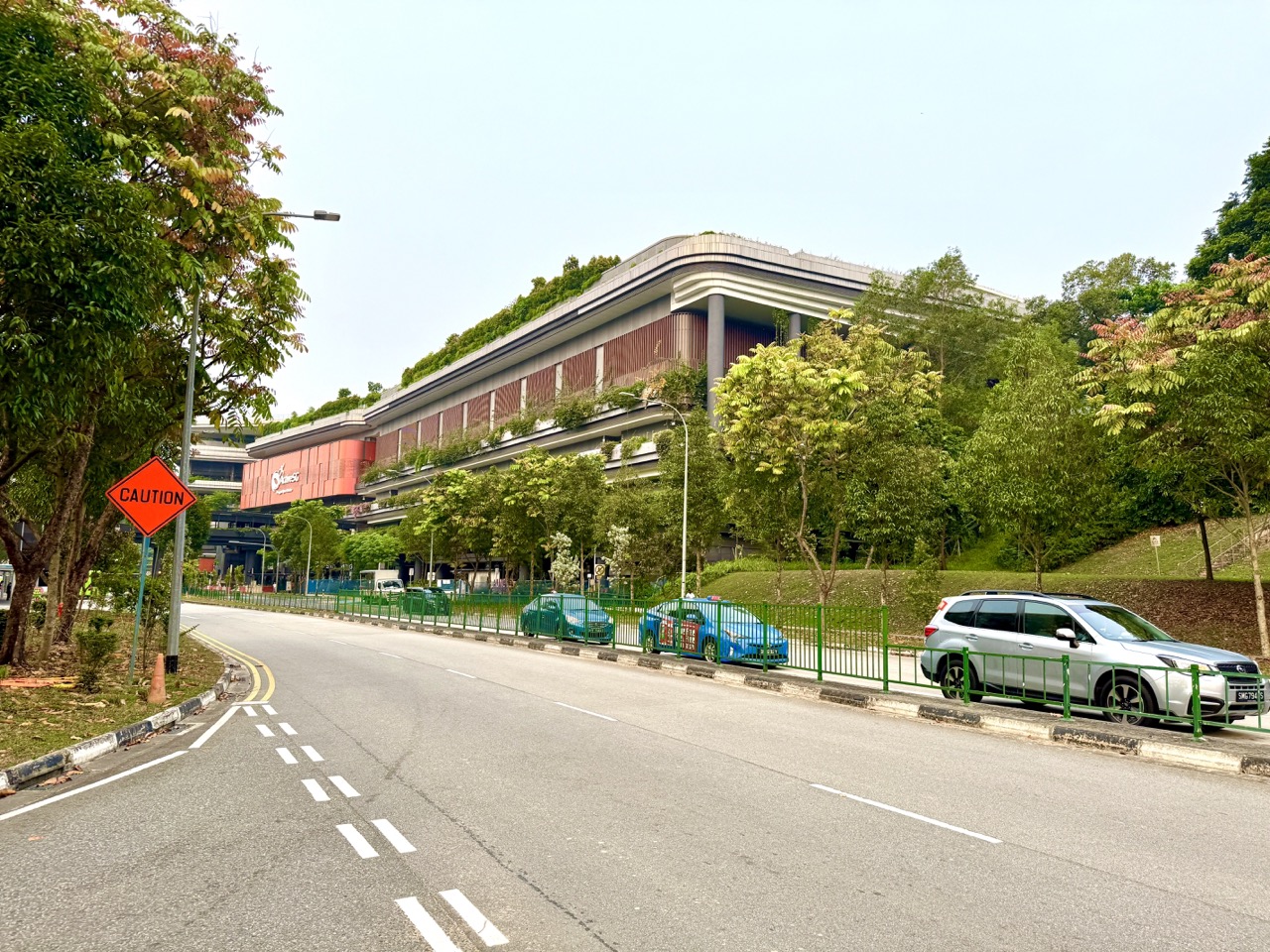
ActiveSG Punggol Sport Centre at 11 Sentul Crescent is a useful starting point for learning Graph Theory, the mathematics of connections. A student can draw a completely fictional network of a home, an LRT station, the sports centre and a community meeting point, then ask which places are connected, whether every place can be reached and which path uses the fewest edges. Alternatively, a class can use an invented doubles-partner network to count relationships without collecting real children’s personal information. The centre began selected public operations on 27 October 2026, with its formal opening scheduled for 22 November 2026. These are paper learning models, not verified pedestrian directions or live court allocations. For actual access use MyActiveSG+.
The basic objects are vertices, representing entities, and edges, representing defined connections. MIT OpenCourseWare’s Mathematics for Computer Science teaches simple graphs, degree, connectivity, trees, bipartite matchings and colouring, while Wolfram MathWorld explains why the sum of degrees in an undirected graph equals twice the number of edges. Graph Theory is distinct from computing an actual travel route or running a booking optimisation: first define what an edge means, whether it has a direction or weight, and which graph property answers the question. This original guide moves from simple drawings to proofs, shortest-path calculations, safe examples and a four-week learning programme. No real residents are tracked or surveyed.
- Location: ActiveSG Punggol Sport Centre, 11 Sentul Crescent; actual venue access and routes must be checked separately.
- Vertices: objects, fictional people or places represented by dots.
- Edges: defined connections, which may be directed or undirected.
- Degree: number of incident edges in a simple undirected graph.
- Handshaking lemma: sum of vertex degrees = twice the edge count.
- Paths and cycles: sequences of adjoining vertices or edges, under precise definitions.
- Connectivity: whether vertices can reach one another through paths.
- Trees: connected graphs with no cycles; a tree with n vertices has n−1 edges.
- Weights: distances, time or other quantities attached to edges, but only when grounded or clearly fictional.
- Bipartite graphs: two distinct sets joined by eligible connections, useful for toy assignment questions.
- Limitations: no unverified walking times, player relationships, private account data or operator network claims.
- Learning route: original worked graphs, proof ideas, safe exercises, FAQs and official references.
Definition lock: Graph Theory is about relationships
A graph consists of vertices and edges in a defined mathematical structure. The vertices could mean places, people or tasks, but that meaning comes from the modeller. An edge might represent a permitted walkway, an imaginary friendship or a scheduled dependency. The diagram is not automatically a geographical map. Moving a vertex’s position on paper usually does not change the graph’s connectivity, provided the edges remain the same. The purpose is understanding which relationships exist and what can be inferred from them. A useful first exercise is to identify the edge definition clearly enough that another student can reproduce the same fictional graph.
A graph is not the same as a statistical graph
In everyday schoolwork, a graph may mean a bar chart or line graph showing data. Graph Theory uses the word for a network of nodes and connections. A line chart of court attendance is not automatically a graph-theoretic network, even though both involve drawn lines. Students should identify which interpretation the question requires. A bar chart can compare counts, while a graph-theory diagram might show which imaginary venues connect by allowed routes. Both can support good reasoning, but their mathematical objects and operations are distinct. This article focuses on network structures rather than statistical visualisation.
Why this differs from Operations Research
An Operations Research model might choose the lowest-cost route or schedule after the feasible network has been defined. Graph Theory first studies the network’s structure: what counts as adjacency, whether a path exists, how degrees behave and what makes a tree. Algorithms for paths are applications, but not every graph question optimises something. A graph can be disconnected even before any costs are assigned, and a matching problem may have structural limits. Learning these principles builds the mathematical foundation for later optimisation. The sport-inspired examples remain hypothetical; no actual Punggol booking is being calculated.

Why this differs from Game Theory
Game Theory examines strategic choices among decision-makers with preferences and payoffs. Graph Theory can represent connections among those players but need not model their decisions. If four fictional people form a partner network, an edge might simply mean two people have already been paired in a classroom exercise. It says nothing about what they prefer or why they chose it. Students should not infer motives from the network alone. The names sound similar, but the subjects answer different questions. Graph Theory describes relationships; Game Theory studies strategic incentives under defined assumptions.
Draw four vertices before adding edges
Write fictional vertices H, S, P and C for home, station, Punggol Sport Centre and community hub. Place the letters at four different points on paper. At this stage there are four vertices and no edges, so every vertex is isolated. Then add lines only for connections explicitly allowed by the toy problem. The diagram’s layout is illustrative, not a real map. The learner should see that naming a place does not guarantee a direct connection to another location. A real route requires verified walkway and transport information, including access restrictions that an invented diagram may omit.
Undirected and directed edges have different meanings
An undirected edge A–B can represent a relationship usable both ways under the chosen model. A directed edge A→B represents a connection from A to B without automatically establishing a return edge. One-way roads or sequential decisions can motivate directed graphs, but do not claim a particular Punggol route is one-way without evidence. Students can compare a double-ended simple line with a single arrow. Their reachability conclusions may differ. A connection’s meaning should be stated in ordinary language before a model assigns direction; otherwise a misleading arrow may be mistaken for an actual transport instruction.
A simple graph has particular restrictions
A simple undirected graph has no loops from a vertex to itself and no multiple edges between the same pair of vertices, under the standard definition. More general graphs may allow these features. A student should not draw three parallel lines between A and B and call the result a simple graph without reconsidering the model. In real transport systems, several routes between the same places may exist, so a multigraph could sometimes be more appropriate. The first lesson should use a simple graph because its definitions and counting are easier. Later refinements depend on the actual modelling goal.
Edges must have a precise definition
A line between two fictional people could mean “these two have played together at least once,” “these two want to play together” or “these two have an authorised simultaneous assignment.” Those are distinct relationships and can produce different graphs. A student’s attractive network is unreliable if the edge definition changes halfway through. Choose one meaning and state it. For privacy, use anonymous invented labels rather than real children’s names or schedules. Graph Theory helps study relationship patterns without needing to publish personal information. Clear modelling boundaries matter more than filling a page with connections.
Degree counts connections at a vertex
In a simple undirected graph, the degree of vertex v is the number of edges incident to it. If A is connected to B, C and D, then deg(A)=3. A student should count the edges, not the nearby drawn letters that lack connections. A vertex may have degree zero and be isolated. A higher degree is not automatically a measure of human popularity or importance; the interpretation depends on the edge definition and data quality. In a toy sports network, degree can describe how many distinct invented partners are connected to one person, but it cannot evaluate social worth.
The handshaking lemma counts every edge twice
For a finite undirected graph, the sum of all vertex degrees equals twice its number of edges. Each edge touches two endpoints and contributes one to each degree count. If a toy graph has four edges, its degree sum is eight. Students can verify this by marking the ends of every line. This is a general identity, not merely a pattern observed in one diagram. The result holds under the usual graph conventions, including appropriate counting of loops in broader undirected graphs. A learner should know which graph definition the exercise uses before applying it.
Worked degree example
Let a fictional network have vertices A,B,C,D and edges AB, AC, BC and CD. The degrees are deg(A)=2, deg(B)=2, deg(C)=3 and deg(D)=1. Their sum is 8, equal to 2×4 edges. Draw the four lines and check each connection manually. This graph is connected and contains a triangle A–B–C–A. The edge CD attaches D to that triangle. Students can use the same example for degree, cycles and bridges. The letters are invented, not an actual network of Punggol children or an operator system diagram.
There must be an even number of odd-degree vertices
The handshaking lemma implies that the number of odd-degree vertices in a finite undirected graph is even. Since the total degree sum is even, odd contributions must occur in an even count. In the toy network, C has degree three and D has degree one, producing two odd-degree vertices. A proposed graph with exactly three odd-degree vertices cannot exist under the standard undirected definition. Students can turn this into a proof challenge: explain why adding even-degree vertices cannot change the parity of the degree sum. This is a structural theorem, not a social statement.
A walk allows repeated vertices
A walk is a sequence of vertices connected by edges, and it may repeat vertices or edges under the usual definition. Starting at A, a walk might go A–B–C–A–C in the toy network if every step follows an edge. A student should distinguish the walk from its drawn route on paper; the same edge can be traversed more than once. Some textbooks distinguish trail and path using different terminology, so follow the chosen source’s definitions. The conceptual lesson is that connected steps need not form a simple nonrepeating route. This matters for later Eulerian questions.
A trail does not repeat edges
A trail is a walk that does not repeat an edge, although it may revisit a vertex. This definition makes sense for a fictional task of tracing lines once without lifting a pencil. A student may return to the starting vertex while still using each edge at most once. The condition concerns edges rather than all positions. It is useful to compare an imagined sports-station network with a trail that covers particular connections. No physical journey is required. A paper graph provides all the information needed for a trail problem and avoids inaccurate real transport claims.
A path avoids repeated vertices
Under a common definition, a simple path does not repeat vertices, apart from related closed-path terminology handled separately. For example A–C–D is a path in the four-vertex toy graph. A–B–C–A is not a simple path because A appears again. Students should state whether their source uses the term path differently and be consistent. A shortest path with nonnegative edge weights can often be taken simple because unnecessary cycles do not help reduce cost. But the result depends on edge definitions and weights. A path in a mathematical network is not a verified accessible walking path.
A cycle returns to the start
A cycle is a closed sequence of edges meeting defined non-repetition conditions. In the toy network A–B–C–A is a three-edge cycle. The connection C–D does not form a cycle by itself. Students can trace a cycle and see that removing one of its edges may still leave its vertices connected through the remaining cycle edges. This observation leads toward bridges and trees. The geometry of the diagram can be bent or stretched without changing which vertex sequence forms the cycle. The defining property is the edge structure, not the shape of the drawing.
Connectivity means there is a path
An undirected graph is connected when a path exists between every pair of vertices. Our A,B,C,D example is connected because D attaches through C and the triangle connects A,B,C. A graph with an isolated E would be disconnected. A child can test connectivity by choosing each starting vertex and seeing whether the other vertices are reachable. The property is structural rather than visual distance. Two dots drawn very close together are not connected unless an edge exists. This helps distinguish real information about a network from the appearance of a map.
Connected components partition a graph
A connected component is a maximal connected part of a graph. If a fictional network has triangle A,B,C and a separate edge D–E, then it has two connected components. A student should not label the triangle alone as the only component just because it contains more edges. Both groups are internally connected, but no path links one group to the other. This concept can represent separate clusters of abstract tasks or places. It should not be used to infer actual neighbourhood isolation or friendship groups without appropriate evidence and an accurate edge definition.
A bridge is an edge whose removal disconnects
In an undirected graph, a bridge is an edge whose removal increases the number of connected components. In our toy example, C–D is a bridge because removing it isolates D. The edges around triangle A–B–C are not bridges because the remaining sides offer an alternate path. A student can identify bridges by deleting one paper line at a time. The theorem illustrates how network structure creates single points of connectivity. In a real transport context, a physical bridge is not necessarily a graph-theory bridge, and this paper example does not identify vulnerable Punggol infrastructure.
Trees are connected and have no cycles
A tree is an undirected connected graph without cycles under the standard definition. If it contains n vertices, it has n−1 edges. A four-vertex tree therefore has three edges. One can start with a simple chain A–B–C–D and see that all four points are connected without a cycle. Adding a new edge between A and D creates a cycle, so the graph is no longer a tree. Removing an edge from the original chain disconnects it. These useful properties explain why trees appear in hierarchical information and some network designs.
A tree has one simple path between any pair
In a tree, there is exactly one simple path between two distinct vertices. If there were two different simple paths, their combined edges would form a cycle, contradicting the tree condition. Students can test the idea using a six-vertex paper tree and then add one extra edge. The extra edge creates an alternative path for some vertex pair and forms a cycle. This is an intuitive proof with a general consequence. It does not mean every practical route network should be designed as a tree; alternate routes can be valuable for resilience.
A spanning tree connects every vertex without cycles
For a connected undirected graph, a spanning tree includes every vertex and chooses enough existing edges to make a connected acyclic subgraph. It contains n−1 edges. Our four-vertex triangle-with-tail graph has several possible spanning trees: remove one edge from the triangle while preserving C–D. The result connects all four vertices with three edges. A student can draw each possibility and compare them. A spanning tree does not automatically choose the cheapest edges unless weights and an optimisation criterion are specified. The basic structural idea comes before the minimum spanning tree problem.
Weighted edges introduce a new question
A weighted graph assigns a value such as imaginary distance, time or cost to each edge. A path’s total weight can then be calculated by summing edge weights under a simple additive model. The values must have compatible units and credible meaning. In a fictional sports-route map, edge AB might have weight two units and AC four units. This is not a measured walking time from Sam Kee or a real accessibility route. A vertex diagram becomes a decision model only after its weights and permissions are defined. Do not invent live transport metrics for the sake of a tidy example.
Worked shortest-path toy network
Imagine fictional nodes H, S, P and C. Assign undirected edge weights H–S=2, S–P=3, H–C=4 and C–P=2 in invented distance units. The route H–S–P totals 5, while H–C–P totals 6. Under this toy graph, H–S–P is shorter. This does not tell a family which real path reaches Punggol Sport Centre fastest, because the edges and numbers are made up. Actual routes need current grounded map data and access conditions. The exercise teaches how path weights are accumulated and compared under a specified network.
Shortest path is not always fewest edges
A graph may contain one expensive direct edge and several cheap intermediate edges. If A–C has weight ten but A–B and B–C each have weight two, the two-edge route totals four and is cheaper than the one-edge route. A student should distinguish unweighted shortest path, often measured by number of edges, from a weighted shortest path measured by a specified cost. The correct objective depends on the question. Time, distance and accessibility constraints are not interchangeable. Do not assume a route with fewer stops is always faster in actual Singapore transport.

Breadth-first search explores layers
Breadth-first search, or BFS, explores vertices in increasing numbers of edges from a starting vertex in an unweighted graph. It can identify a shortest path by edge count under the appropriate assumptions. A student can simulate the process with coloured paper, marking the start, its neighbours and then the next layer. Keep a visited list so cycles do not cause endless repetition. BFS does not automatically find the fastest route when edge weights vary. The learner should identify the graph model and objective before choosing an algorithm, rather than apply one famous technique to every network question.
Dijkstra’s algorithm needs nonnegative weights
Dijkstra’s algorithm finds shortest paths from a source in a graph with nonnegative edge weights, under the standard formulation. It repeatedly selects the unsettled vertex with smallest tentative distance and relaxes its outgoing edges. A student can trace a small synthetic example manually. Negative-weight edges change the problem and may invalidate the simple method’s guarantees. A physical travel-time weight normally should not be negative, but other abstract network problems can contain negative values. This is why algorithm conditions matter. No live Punggol transport or booking data are scraped to teach the procedure.
Euler trails use every edge exactly once
An Euler trail traverses each edge of a graph exactly once. It may revisit vertices, so it is different from a simple path. An Euler circuit is an Euler trail that returns to its starting vertex. For a connected undirected graph with all non-isolated vertices included, an Euler circuit exists if every vertex has even degree. An Euler trail that begins and ends at different vertices exists when exactly two vertices have odd degree. Students should check the graph’s connectivity and degree conditions rather than simply guess by tracing lines randomly. A paper network suffices; public paths do not need to be tested.
Original Euler trail exercise
Use the fictional graph with edges AB, AC, BC and CD. Degrees of C and D are odd, while A and B are even. Therefore an Euler trail is possible from one odd-degree vertex to the other. For example D–C–A–B–C traverses CD, CA, AB and BC once each. A circuit returning to the starting point is not possible with the same edges. Students can draw the graph and verify every edge was used exactly once. This is a mathematical pencil exercise, not a proposed event or maintenance route at a public sport centre.
Hamiltonian paths concern vertices instead
A Hamiltonian path visits every vertex exactly once, while a Hamiltonian cycle returns to its start after visiting every vertex once. These are different from Euler questions, which focus on using edges. Students often confuse the two because both may be drawn as a line through a graph. In our four-vertex example, D–C–A–B is a Hamiltonian path because it visits every vertex once. An Euler trail may revisit C while using all edges. The definitions show why a graph may satisfy one property without satisfying the other. A route problem must identify whether the goal is covering places or connections.
Graph colouring represents conflicts
A vertex colouring assigns colours to vertices so adjacent vertices receive different colours under the standard proper-colouring rule. The colours can represent abstract categories or time slots. For example, a triangle requires three different colours because every pair of its vertices is adjacent. A simple chain can use two alternating colours. Students should not confuse graph colouring with making a visually attractive map. The colour restriction encodes a conflict rule. A real activity timetable would need an accurate graph of incompatible tasks, and a mathematical colouring does not by itself create venue permission or participants’ agreement.
A scheduling conflict graph
Imagine three fictional school activities A, B and C. A shares a required volunteer with B, and B shares one with C, but A and C can happen together. Draw edges AB and BC, with no edge AC. Two colours or time categories are enough: assign A and C the first time and B the second. This simple graph-colouring model illustrates how resource clashes can become edges. It does not establish a real person’s availability or a SportSG allocation. Students should check that every edge connects different colours and explain why unconnected activities may share a slot under the invented assumptions.
Bipartite graphs have two separate sides
A bipartite graph divides its vertices into two sets such that every edge joins a vertex in one set to one in the other. One set might represent three fictional pupils and the other three invented volunteer tasks. An edge means the pupil is eligible and willing to perform the task, under the classroom model. There are no edges within either set. Students can draw two columns and connect selected pairs. Bipartite graphs support matching questions and many other applications. No real children’s abilities, medical circumstances or private schedules need to be collected to learn the concept safely.
Matching pairs vertices without clashes
A matching is a set of graph edges that do not share endpoints. In a fictional bipartite model, pairing each volunteer with a distinct task gives a matching. If Pupil A can do tasks X and Y, B only X, and C only Z, a full matching can use A–Y, B–X and C–Z. Choosing A–X first would block B unless the assignment were revised. Students should see why a greedy first choice can create unnecessary difficulty. The model requires each edge to represent a genuine eligible option. In real life, consent and suitability are not interchangeable with an algorithm’s numerical preference.
Hall’s theorem adds a structural condition
Hall’s marriage theorem gives a necessary and sufficient condition for a matching covering every vertex of one side of a finite bipartite graph. Every subset of those vertices must collectively have at least as many neighbours as the subset contains. Students can understand the intuition before studying the proof. If three fictional volunteers can only take two distinct tasks among them, no matching can assign all three different tasks. The problem is a shortage of available neighbours, not a failure to try hard enough. This is a mathematical feasibility statement; actual people can change preferences or tasks under legitimate arrangements.
Adjacency lists store connections compactly
A graph can be represented by listing each vertex’s neighbours. In the toy network with edges AB, AC, BC, CD, the adjacency list is A: B,C; B: A,C; C: A,B,D; D: C. An undirected edge appears in both endpoints’ lists. Students can check this representation against the original drawing and degree counts. A list may be easier to read than a dense matrix for a sparse graph. It remains a definition of connections, not evidence that any real route or relationship exists. The data source and edge meaning are essential.
Adjacency matrices encode the same graph
For the same graph with vertex order A,B,C,D, the simple undirected adjacency matrix has rows [0,1,1,0], [1,0,1,0], [1,1,0,1] and [0,0,1,0]. Ones mean defined edges and zeros mean no edge under the model. The matrix is symmetric because connections are undirected. Row sums give vertex degrees when the graph has no self-loops. Students can verify that the sum of all matrix entries is eight, twice the four edges. This connects Graph Theory with Linear Algebra without collecting a single real player record.
Matrix powers count walks under a model
For a graph’s adjacency matrix A, the entry in A² at row i and column j counts length-two walks from i to j under the usual unweighted graph interpretation. More generally, powers count walks of a specified length. The student can check the diagonal entry corresponding to vertex C by counting the two-step walks C–A–C, C–B–C and C–D–C. There are three, matching C’s degree in this undirected simple graph. The mathematical result is precise within the fictional network. It is not a measurement of travel trips made by residents or a statement about website traffic.
A graph’s drawing can change without changing its structure
Two drawings may represent the same abstract graph even when vertices are placed differently on paper. Graph isomorphism formalises when a one-to-one relabelling preserves adjacency. A student can take a triangle with a tail and draw it rotated, stretched or with different letter names, then explain why the connections remain equivalent. This is not the same as two geographic maps showing identical physical route lengths. Graph Theory can ignore spatial appearance when the question concerns structure. The advantage is that a mathematical theorem can apply to many differently drawn representations.
Planarity is about crossing-free drawings
A graph is planar if it can be drawn in the plane with edges meeting only at shared endpoints, even if an initial sketch happens to show crossings. Students should not conclude a graph is nonplanar simply because their first drawing is messy. The familiar complete graph on five vertices and complete bipartite graph K3,3 provide important nonplanar examples. Planarity is a structural question, distinct from whether actual bridges cross at different physical heights. A paper exercise can introduce the concept without making any claims about real construction or local road layouts.
Euler’s formula for connected planar graphs
For a connected planar graph drawn without crossings and with appropriate face counting, V−E+F=2, where F includes the unbounded outside face. A triangle has V=3, E=3 and F=2: one inside face and the outside region, so 3−3+2=2. Students often forget to count the outside face. The formula concerns planar graph embeddings, not every three-dimensional building or sports venue. A student can add one diagonal to a suitable planar quadrilateral and verify how edges and faces change together while the equality remains valid.
Networks can fail when one connection is removed
A bridge edge creates a structural vulnerability because its removal disconnects some vertices. The C–D edge in our toy graph is a simple example. A network with alternate paths may remain connected after one edge fails. This gives a connection to reliability engineering, but the graph alone does not establish the probability of failure or how quickly a real service can recover. An actual route’s accessibility may also depend on rules and conditions beyond topological connection. The learner should identify what the edges mean before turning a structural observation into a practical risk claim.
Minimum spanning trees need weights
A minimum spanning tree of a connected weighted undirected graph includes every vertex without cycles and minimises the total selected edge weight. It is not necessarily the shortest route between one particular pair of places. This distinction matters because a student might confuse constructing a low-cost network with choosing one person’s fastest trip. Algorithms such as Kruskal’s and Prim’s can find minimum spanning trees under suitable conditions. They do not construct actual public paths or authorise facility changes. A fictional small network can be solved by enumerating spanning trees and comparing edge totals.
A safe miniature minimum-spanning-tree problem
Draw three fictional vertices A, B and C with edges AB weight two, BC weight three and AC weight six. A spanning tree uses two edges. Selecting AB and BC gives total weight five, lower than the alternatives of eight or nine. The result connects all three vertices and has no cycle. Students should explain why choosing all three edges is not a tree and why the cheapest pair works here. The values are invented tokens, not actual walking minutes or construction costs. The exercise illustrates network design logic rather than a route recommendation for Punggol.
Network structure is not enough for real wayfinding
A family travelling to Punggol Sport Centre needs accurate station, path, entrance, accessibility and opening information. A graph with edge H–P merely says a connection exists under its invented rule; it cannot establish whether there is a real direct pedestrian route, how long it takes or whether it is suitable for a particular person. For real directions, consult current trustworthy mapping and transport sources. Graph Theory should help students understand the underlying mathematical representation, not persuade readers that a paper shortest path is a confirmed local route. The distinction keeps a useful learning exercise from becoming misinformation.
A fictional visitor-network case
A student creates an imaginary network where Home connects to Station, Station to Sport Centre, and Sport Centre to Community Hub. The graph is a chain with four vertices and three edges, so it is a tree. Removing Station–Sport Centre disconnects the imagined network. The learner adds an alternate Station–Community Hub edge and checks how connectivity changes. They can discuss the mathematical resilience of alternate connections without alleging any real pedestrian bridge is blocked or unsafe. The case demonstrates the value of modelling one change at a time and explicitly defining which edges are allowed.
A fictional doubles-partnership case
Five fictional players form a partner network in which edges mean “paired at least once in our imaginary rounds.” A student counts degrees and asks whether every player appears in at least one edge. They can apply the handshaking lemma and identify connected components. The example should never be used to rank actual classmates by popularity or infer private friendships. If the purpose becomes choosing assignments, a separate feasibility model and legitimate preferences would be needed. The graph describes the selected relation, not a person’s worth or sporting talent.
Four-week Graph Theory learning plan
Week one: vertices, edges, degree and handshaking lemma, using a four-point fictional graph. Week two: walks, paths, cycles, connected components, bridges and trees. Week three: weighted paths, BFS, simple shortest-path reasoning and a minimum spanning tree example. Week four: graph colouring, bipartite matching, adjacency matrices and one proof or counterexample. The entire plan can be completed using paper, coloured pencils and invented data. No actual booking, public filming or resident interview is needed. The intended outcome is accurate structural reasoning, not a claim of expertise in every network algorithm after one month.
Common Graph Theory misconceptions

A graph-theoretic network is not the same as a bar chart. A line drawn near a vertex does not create adjacency unless defined as an edge. An Euler trail uses each edge, while a Hamiltonian path visits vertices. A tree is connected and acyclic, but an arbitrary connected graph can contain cycles. A graph drawn with crossings may still be planar. A shortest path by edge count need not be shortest by travel time. And a fictional model does not establish a live walkway or court booking. Clear definitions and source boundaries are the heart of dependable graph reasoning.
Frequently asked questions
What is Graph Theory? The study of vertices and edges and the structures created by their connections.
What does a vertex represent? Any entity defined by the model, such as a fictional place, person or task.
What is the handshaking lemma? The sum of vertex degrees equals twice the number of edges in a finite undirected graph.
How is a path different from a trail? Under common definitions, a trail avoids repeated edges, while a simple path avoids repeated vertices.
What is a tree? A connected graph with no cycles.
Does a tree with n vertices always have n−1 edges? Yes, for an ordinary finite tree.
What is the difference between Euler and Hamiltonian questions? Euler focuses on covering edges, while Hamiltonian focuses on visiting vertices.
What does a bipartite matching do? It selects eligible connections without sharing endpoints.
Can this calculate the actual fastest route to ActiveSG Punggol? Not without real current map, permitted path and travel information.
Is Graph Theory a separate school examination requirement? This is enrichment; learners should consult their actual syllabus and appropriate readiness.
Official sources and next step
Use MIT OpenCourseWare’s Mathematics for Computer Science, Wolfram MathWorld’s handshaking lemma and the course’s graph-theory sections for paths, trees, bipartite matching and networks. SportSG’s official opening notice gives real Punggol venue context; actual sport access is at MyActiveSG+. Separate eduKate Punggol guides cover Operations Research, Linear Algebra and Game Theory.
Your next step: draw four fictional vertices with edges AB, AC, BC and CD, calculate every degree, prove the handshaking identity and find an Euler trail. Then explain why the graph is not a verified walking map.
Editorial note: Independent Graph Theory learning guide prepared 14 November 2026. All routes, edge weights, partners and schedules are fictional; no private SportSG system or person was investigated.
Continue with the connected guide: ActiveSG Punggol 2027/2028 | Opening Status, Facilities and Visitor Guide. Use its linked index to compare the related questions and choose your next reading.


