
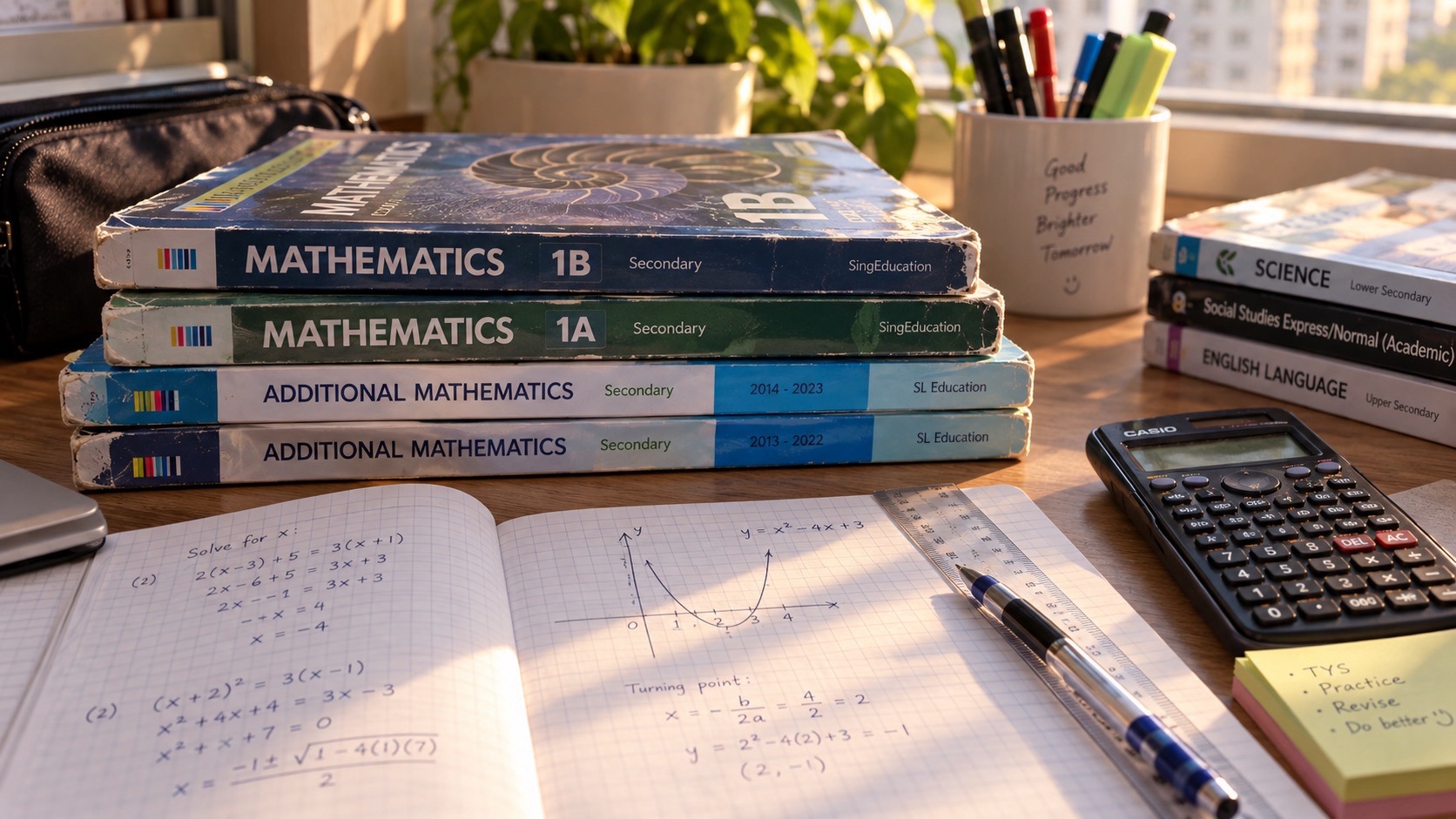
SEC G3 Mathematics vocabulary is the bridge between reading a problem and choosing the correct method. A student who can calculate accurately may still lose marks if they confuse mean with median, area with perimeter, or direct proportion with inverse proportion. Here are 200 useful Mathematics terms with concise meanings, grouped by the key learning strands and common exam-question types.
In Singapore’s 2027 Secondary Education Certificate, G3 Mathematics is SEAB syllabus K310 (the earlier reference code is 4052), not G3 Additional Mathematics K341. The official K310 syllabus comprises Number and Algebra, Geometry and Measurement, and Statistics and Probability. It also emphasises reasoning, communication and real-world problems. This eduKate glossary is an independent teaching resource, not an official 200-word list.
Quick answers for parents and students:
- Look for the first misunderstood word in a marked problem sum; that may explain the wrong operation.
- Draw a bar, triangle, graph, table or Venn diagram to show what a term means.
- Check whether two similar words describe different quantities or relationships.
- Show essential reasoning and keep units compatible even when using a calculator.
- Use this list alongside the school’s topic sequence; never replace solving problems with copying definitions.
1–10: Number types and properties
- integer — A whole number that may be negative, zero or positive.
- rational number — A number expressible as a ratio of integers.
- irrational number — A real number that cannot be written as an integer fraction.
- real number — A number represented on the number line.
- prime number — An integer greater than one with exactly two positive factors.
- composite number — An integer greater than one with more than two factors.
- prime factorisation — Writing a number as a product of primes.
- highest common factor — Greatest positive integer dividing each given integer.
- lowest common multiple — Smallest positive integer that is a multiple of each given integer.
- cube root — A number that gives a stated result when cubed.
Use it: Write a small example with numbers, then check that the term fits.
11–20: Standard form and accuracy
- index — Power written as a superscript.
- base — Number or expression raised to a power.
- laws of indices — Rules for combining powers.
- standard form — Scientific notation A × 10ⁿ with 1 ≤ A < 10.
- estimate — Find an approximate value.
- rounding — Replace a number with a nearby value at chosen precision.
- significant figures — Digits that show the precision of a numerical value.
- decimal place — Position after the decimal point.
- exact value — A quantity not rounded or approximated.
- approximation — An estimated quantity close to the actual value.
Use it: Draw the corresponding graph, diagram or model before calculating.
21–30: Ratio and proportional thinking
- ratio — Comparison of quantities measured in compatible units.
- proportion — Relationship between quantities that scale consistently.
- direct proportion — Relationship in which one quantity changes by the same factor as another.
- inverse proportion — Relationship in which one quantity grows when the other decreases reciprocally.
- scale factor — Multiplier comparing corresponding lengths.
- map scale — Relationship between distance on a map and on the ground.
- unit rate — Rate measured for one unit of another quantity.
- constant of proportionality — Fixed multiplier connecting proportional quantities.
- equivalent ratio — Ratio showing the same comparison after scaling.
- part-to-whole comparison — A comparison of one share with the total.
Use it: Describe a similar-sounding term and why it would be wrong here.
31–40: Percentages and finance
- percent — Meaning out of a hundred.
- percentage change — Change expressed relative to the original value.
- reverse percentage — Finding a starting amount from a changed percentage.
- discount — Reduction from a listed price.
- markup — Increase added to an original price or cost.
- profit — Revenue minus cost when positive.
- loss — When costs exceed revenue.
- simple interest — Interest calculated on the original principal.
- compound interest — Interest calculated on principal plus accumulated interest.
- instalment — A scheduled partial payment.
Use it: Explain the concept to someone who has not learned this topic yet.
41–50: Rates and motion
- rate — A comparison of different types of quantities.
- speed — Distance travelled per unit time.
- average speed — Total distance divided by total time.
- duration — Length of an interval of time.
- distance-time graph — Graph showing how distance changes over time.
- speed-time graph — Graph showing how speed changes over time.
- gradient — Change vertically per horizontal unit.
- conversion factor — Multiplier changing one unit to another equivalent unit.
- uniform speed — Motion at an unchanging speed.
- compound unit — Unit such as km/h or g/cm³ combining measures.
Use it: Write a small example with numbers, then check that the term fits.
51–60: Algebra language
- variable — Symbol representing a quantity that can change.
- coefficient — Number multiplying a variable or term.
- constant — A fixed quantity in an expression.
- term — One part of an expression separated by addition or subtraction.
- expression — Mathematical phrase without an equality sign.
- equation — Statement that two expressions are equal.
- identity — An equality true for all permitted values.
- factor — Expression multiplied by another to make a product.
- expansion — Removing brackets by multiplication.
- factorisation — Rewriting an expression as a product.
Use it: Draw the corresponding graph, diagram or model before calculating.
61–70: Algebraic techniques
- simplification — Rewriting without changing mathematical value.
- substitution — Replacing a variable with a given value or expression.
- subject of a formula — Variable isolated on one side of an equation.
- algebraic fraction — Fraction containing algebraic expressions.
- common denominator — Shared denominator used to combine fractions.
- quadratic expression — Expression whose highest power is two.
- difference of squares — Pattern a² − b² that factors into (a − b)(a + b).
- bracket — Grouping symbol that controls the order of operations.
- linear expression — Expression with variables only to the first power.
- cancellation — Removing a common nonzero factor from numerator and denominator.
Use it: Describe a similar-sounding term and why it would be wrong here.
71–80: Equations and inequalities
- linear equation — Equation of first degree in its variable.
- quadratic equation — Equation of degree two.
- simultaneous equations — Two or more equations solved for shared values.
- elimination method — Solving by removing a variable from equations.
- substitution method — Solving by expressing one variable using another.
- inequality — Comparison using <, >, ≤ or ≥.
- solution set — All values that satisfy given conditions.
- root — Value of a variable satisfying an equation.
- boundary value — Endpoint of an allowed interval.
- verify — Substitute back to check an answer satisfies the original.
Use it: Explain the concept to someone who has not learned this topic yet.
81–90: Functions and graphs
- function — A rule giving one output for each permitted input.
- input — Value supplied to a function.
- output — Value produced by a function.
- Cartesian coordinates — Numbers specifying position relative to two axes.
- ordered pair — Two values written in an agreed sequence.
- x-intercept — Point where a graph meets the horizontal axis.
- y-intercept — Point where a graph meets the vertical axis.
- straight-line graph — Graph of a linear relationship.
- quadratic graph — Graph of a quadratic function.
- parabola — The curved graph of a quadratic function.
Use it: Write a small example with numbers, then check that the term fits.
91–100: Graphs and interpretation
- turning point — Location where a curve changes direction.
- maximum point — Point giving the greatest output over the stated range.
- minimum point — Point giving the smallest output over the stated range.
- axis of symmetry — Line splitting a figure into mirror halves.
- tangent — Line that matches a curve’s gradient at a contact point.
- increasing function — A function whose output rises as input rises.
- decreasing function — A function whose output falls as input rises.
- exponential graph — A graph in which the variable occurs as an exponent.
- interpolation — Estimating between known values.
- extrapolation — Estimating beyond the range of known values.
Use it: Draw the corresponding graph, diagram or model before calculating.
101–110: Sets and diagrams
- set — A defined collection of distinct objects.
- element — An individual member of a set.
- subset — A set with every element contained in another set.
- universal set — All items being considered in a problem.
- complement — Elements in the universal set not in the named set.
- union — Elements belonging to either or both sets.
- intersection — Elements common to two sets.
- empty set — A set containing no elements.
- Venn diagram — Diagram showing overlaps between sets.
- cardinality — Number of elements in a finite set.
Use it: Describe a similar-sounding term and why it would be wrong here.
111–120: Matrices and interpretation
- matrix — Rectangular arrangement of values in rows and columns.
- row — A horizontal line of matrix entries.
- column — A vertical line of matrix entries.
- entry — A single value in a matrix.
- order of matrix — Its numbers of rows and columns.
- scalar — A single number used to multiply a matrix.
- matrix addition — Combining corresponding entries of equally shaped matrices.
- matrix product — Result of multiplying compatible matrices using rows and columns.
- dimension — A size count such as rows, columns or length.
- compatibility — Having dimensions that allow a requested matrix operation.
Use it: Explain the concept to someone who has not learned this topic yet.
121–130: Lines, angles and polygons
- acute angle — An angle smaller than ninety degrees.
- obtuse angle — An angle between ninety and 180 degrees.
- reflex angle — An angle larger than 180 and smaller than 360 degrees.
- vertically opposite angles — Equal angles across intersecting lines.
- transversal — A line crossing two other lines.
- corresponding angles — Angles in matching positions at intersections.
- alternate angles — Angles in alternate positions at parallel lines.
- interior angle — An angle inside a polygon.
- exterior angle — Angle formed outside a polygon by a side extension.
- regular polygon — A polygon whose sides and interior angles are equal.
Use it: Write a small example with numbers, then check that the term fits.
131–140: Congruence and similarity
- congruent — Exactly equal in shape and size.
- similar — Same shape with corresponding sides in proportion.
- corresponding sides — Sides matching between related shapes.
- enlargement — Transformation that scales a shape up.
- reduction — Transformation that scales a shape down.
- perpendicular bisector — A line crossing a segment at its midpoint at 90 degrees.
- angle bisector — Line dividing an angle into two equal angles.
- length ratio — Comparison between corresponding lengths.
- area ratio — Comparison between areas of related figures.
- volume ratio — Comparison between volumes of related solids.
Use it: Draw the corresponding graph, diagram or model before calculating.
141–150: Circles and geometric properties
- radius — Distance from circle centre to circumference.
- diameter — Line joining boundary points through the centre.
- circumference — Distance around a circle.
- chord — Straight segment joining two points on a circle.
- arc — Part of a circle’s circumference.
- sector — Region bounded by two radii and an arc.
- segment — Region between a chord and its corresponding arc.
- cyclic quadrilateral — Quadrilateral with all vertices on one circle.
- angle at centre — Angle formed at a circle’s centre.
- angle at circumference — Angle formed by two chords meeting on a circle.
Use it: Describe a similar-sounding term and why it would be wrong here.
151–160: Trigonometry and bearings
- Pythagoras’ theorem — Right-triangle rule relating the squares of its sides.
- hypotenuse — Longest side opposite the right angle.
- sine — Ratio opposite over hypotenuse in a right triangle.
- cosine — Ratio adjacent over hypotenuse in a right triangle.
- tangent ratio — Ratio opposite over adjacent in a right triangle.
- sine rule — Relationship between sides and sines of opposite angles.
- cosine rule — Formula linking side lengths and the cosine of an angle.
- bearing — Direction measured clockwise from north.
- angle of elevation — Angle of sight upwards from the horizontal.
- angle of depression — Angle of sight downwards from the horizontal.
Use it: Explain the concept to someone who has not learned this topic yet.
161–170: Mensuration and solids
- perimeter — Total distance around a two-dimensional shape.
- area — Space enclosed by a two-dimensional region.
- surface area — Sum of all outside areas of a solid.
- volume — Amount of three-dimensional space occupied.
- prism — Solid with matching parallel polygonal ends.
- cylinder — Solid with two parallel circular faces.
- cone — Solid tapering from a circular base to an apex.
- sphere — Solid whose surface is equally distant from a centre.
- pyramid — Solid whose triangular faces meet at a vertex.
- slant height — Length measured along a cone or pyramid’s side.
Use it: Write a small example with numbers, then check that the term fits.
171–180: Data displays and averages
- data — Recorded observations or values.
- frequency — How many times a value or class occurs.
- class interval — Range grouping numerical observations.
- histogram — Graph with bars representing frequency per class width.
- cumulative frequency — Running total of frequencies up to a value.
- mean — Sum of observations divided by their number.
- median — Middle value of ordered observations.
- mode — Most frequently occurring value.
- range — Largest value minus smallest value.
- interquartile range — Upper quartile minus lower quartile.
Use it: Draw the corresponding graph, diagram or model before calculating.
181–190: Probability and chance
- probability — A measure of how likely an event is.
- experiment — A repeatable process with uncertain results.
- sample space — Set of all possible outcomes.
- event — Collection of outcomes being considered.
- favourable outcome — Outcome that satisfies the requested event.
- mutually exclusive — Events that cannot happen together.
- independent events — Events where one occurrence does not change the other’s probability.
- tree diagram — Branching diagram showing sequential outcomes.
- relative frequency — Observed event frequency divided by number of trials.
- complementary event — The event consisting of outcomes not in another event.
Use it: Describe a similar-sounding term and why it would be wrong here.
191–200: Problem-solving and communication
- model — A simplified mathematical representation of a situation.
- assumption — A condition taken as true for solving.
- constraint — A limit on permitted answers.
- estimate of reasonableness — A judgement about whether a numerical result makes sense.
- justify — Give a logically sound reason.
- interpret — Explain what a mathematical result means in context.
- conclusion — Final outcome supported by reasoning.
- working — Steps showing how an answer was obtained.
- unit consistency — Correct use of compatible measurement units.
- real-world scenario — A practical setting requiring mathematical decisions.
Use it: Explain the concept to someone who has not learned this topic yet.
Maths vocabulary that changes the answer: worked examples
1. Ratio and part-to-whole fraction are not identical
Suppose a class has 12 girls and 18 boys. The ratio girls:boys is 12:18 or 2:3. But girls as a fraction of the class is 12/(12 + 18) = 2/5. A child who divides 2 by 3 when asked for girls as a share of all pupils has misunderstood which quantity the denominator represents. Before calculating, label the comparison and the whole. The same principle applies to recipes, ticket allocations and household finance.
2. Direct proportion differs from inverse proportion
If five notebooks cost $15 at a constant price, ten notebooks cost $30: quantity and cost are in direct proportion. If six workers complete a fixed task in eight days under an idealised equal-productivity assumption, twelve workers might complete it in four days: workers and duration are in inverse proportion. The real workplace may not follow that simple assumption. Good Mathematics makes a model’s conditions explicit.
3. Reverse percentages: what was the original price?
A bag is sold for $72 after a 20% discount. The sale price is 80% of the original. Therefore original price = $72 ÷ 0.80 = $90. Dividing by 0.20 would give an incorrect answer because 20% represents the reduction, not the discounted price. Ask “20% of what?” and “80% of what?” before choosing the operation.
4. An expression is not an equation
Simplify 2(3x − 5) + 4x: the answer is 10x − 10. Solve 2(3x − 5) + 4x = 40: the answer is x = 5. In the first instruction no x-value is requested. The mathematical process begins with recognising the task, not manipulating symbols immediately.
5. Interpreting a quadratic graph
For y = x² − 4x + 3, the x-intercepts are 1 and 3 because these are the roots of (x − 1)(x − 3) = 0. The turning point is (2, −1), obtained by completing the square: y = (x − 2)² − 1. The roots, minimum point and axis of symmetry describe different features. Sketching the parabola helps check whether numerical values are sensible.
6. Sets: union and intersection answer different questions
In a survey, 18 students join a sports club, 14 join a music club and 5 join both. The intersection contains 5. The union contains 18 + 14 − 5 = 27. Adding 18 and 14 without subtracting the overlap double-counts the same students. A Venn diagram makes the overlap visible. A similar error often occurs when a question uses “either”, “both” and “neither”.
7. Similar solids: lengths, areas and volumes scale differently
If two similar cubes have side lengths in the ratio 2:3, their areas are in the ratio 4:9, but their volumes are in the ratio 8:27. The length scale factor is squared for area and cubed for volume. A student who multiplies a volume by 3/2 rather than (3/2)³ has confused the dimensional quantity. State which size is changing before applying a formula.
8. Probability: mutually exclusive and independent are different
On a single fair die roll, “even” and “odd” are mutually exclusive; they cannot happen together. On two separate independent rolls, getting an even number on the first roll does not change the probability of an even number on the second. Independence concerns whether one event affects another’s likelihood, not whether both can occur at once.
9. Mean, median and mode can tell different stories
For the values 2, 3, 3, 4, 18, the mean is 6, the median is 3 and the mode is 3. The unusually high value 18 pulls up the mean. A real-world statement such as “The typical daily time is six minutes” may mislead if the distribution is strongly skewed. The most useful measure depends on the context and what is being asked.
10. Real-world questions are decisions, not just arithmetic
The K310 Paper 2 includes an extended real-world problem. Suppose two travel options have different fares, walking times and arrival constraints. A correct solution requires identifying which costs apply, interpreting a timetable accurately and stating which choice meets the given conditions. Mathematical assumptions such as travel time staying constant should be explicit when they affect the decision. A correct isolated total is not a complete recommendation if it ignores the actual question.
What SEC 2027 K310 requires
The official 2027 G3 Mathematics K310 syllabus specifies Paper 1 and Paper 2, each 2 hours 15 minutes, 90 marks, 50%. Paper 1 contains about 26 short-answer questions. Paper 2 contains 9–10 questions and its last question focuses on applying Mathematics in a real-world situation. An approved calculator may be used in both papers. Relevant formulae are provided. Essential working must be shown; unless otherwise specified, non-exact numerical answers are generally given to three significant figures, or angles in degrees to one decimal place. Candidates should bring suitable geometrical instruments.
Four-week programme: learn concepts with the vocabulary
- Week 1 — Numbers, ratios and finance. Select difficult words from numbers, indices, rates, proportions, percentages and interest. Write short worked examples, explain units, and verify the answer using a rough estimate.
- Week 2 — Algebra and graphs. Compare expansion with factorisation, equation with expression, and root with turning point. Sketch graphs and use substitution to check results.
- Week 3 — Geometry and data. Work with angle properties, congruence, similarity, circle geometry, trigonometry and statistics. Use pictures and measurements rather than rote definitions.
- Week 4 — Mixed real-world tasks. Solve questions involving more than one topic: money plus percentages, travel plus graphs, probability plus sets. Record the first mistaken interpretation and retest it in another context.
Each session may cover five to ten weak terms, not necessarily ten new words. Revisit the same meaning after a few days in an unfamiliar question. A student who already knows a term should not be made to copy it for the sake of completing the list.
What a parent can check in a marked answer
Separate errors into reading (misunderstood a condition), representation (diagram or equation does not model the task), method (wrong formula or operation), execution (arithmetic or algebra mistake), and interpretation (wrong units, range or conclusion). The first error in that chain is usually the place to begin repair. This approach avoids giving another 30 questions to a child whose actual problem is one misunderstood phrase.
Common errors and quick repairs
- “More than” may indicate a difference or comparison; read what the quantities represent before subtracting.
- Percentage increase and decrease use the appropriate original base, not necessarily the latest number mentioned.
- Cancel only common nonzero factors, not unrelated terms in algebraic fractions.
- Do not treat an x-intercept as a turning point unless the graph genuinely has both at the same location.
- Check whether a statement is about length, area or volume before using a scale factor.
- Distinguish independent events from mutually exclusive events.
- Keep units consistent and avoid rounding working too early.
- Make the final sentence answer the real-world decision, not merely repeat a number.
Frequently asked questions
Are these 200 terms on an official SEAB list?
No. They are an independent learning glossary chosen to help students read and solve K310 Mathematics questions. The official syllabus defines what is assessed.
Can a calculator be used for Paper 1 in 2027?
Yes. The official K310 syllabus permits an approved calculator in both papers; it does not eliminate the need to show working.
Is G3 Mathematics the same as Additional Mathematics?
No. G3 Mathematics uses K310; G3 Additional Mathematics uses K341. Always choose assessment materials using the student’s actual subject code.
How do I know whether vocabulary is the problem?
Ask the student to explain the conditions and requested quantity before calculating. If they cannot translate those into a diagram or equation, address reading and representation first.
Is the most difficult term always the highest priority?
No. Prioritise words repeatedly appearing in the student’s mistakes. A misunderstanding of “of the total” may matter more than an unfamiliar advanced label.
Can home activities support secondary Mathematics?
Yes: budgeting, measuring, reading timetables and examining graphs provide concrete situations. Use them as examples rather than treating every daily task as an exam.
Official and next reading
Consult SEAB’s 2027 G3 syllabus index and K310 official syllabus. Compare the K341 Additional Mathematics vocabulary guide to see the different learning demands. For earlier maths foundations, see the PSLE Mathematics 200-word glossary. A student who understands the words in a problem is better equipped to choose, explain and verify the mathematics behind it.
eduKate Punggol independent educational glossary, November 2026. This guide is not an official SEAB prescribed list or an examination promise.


