
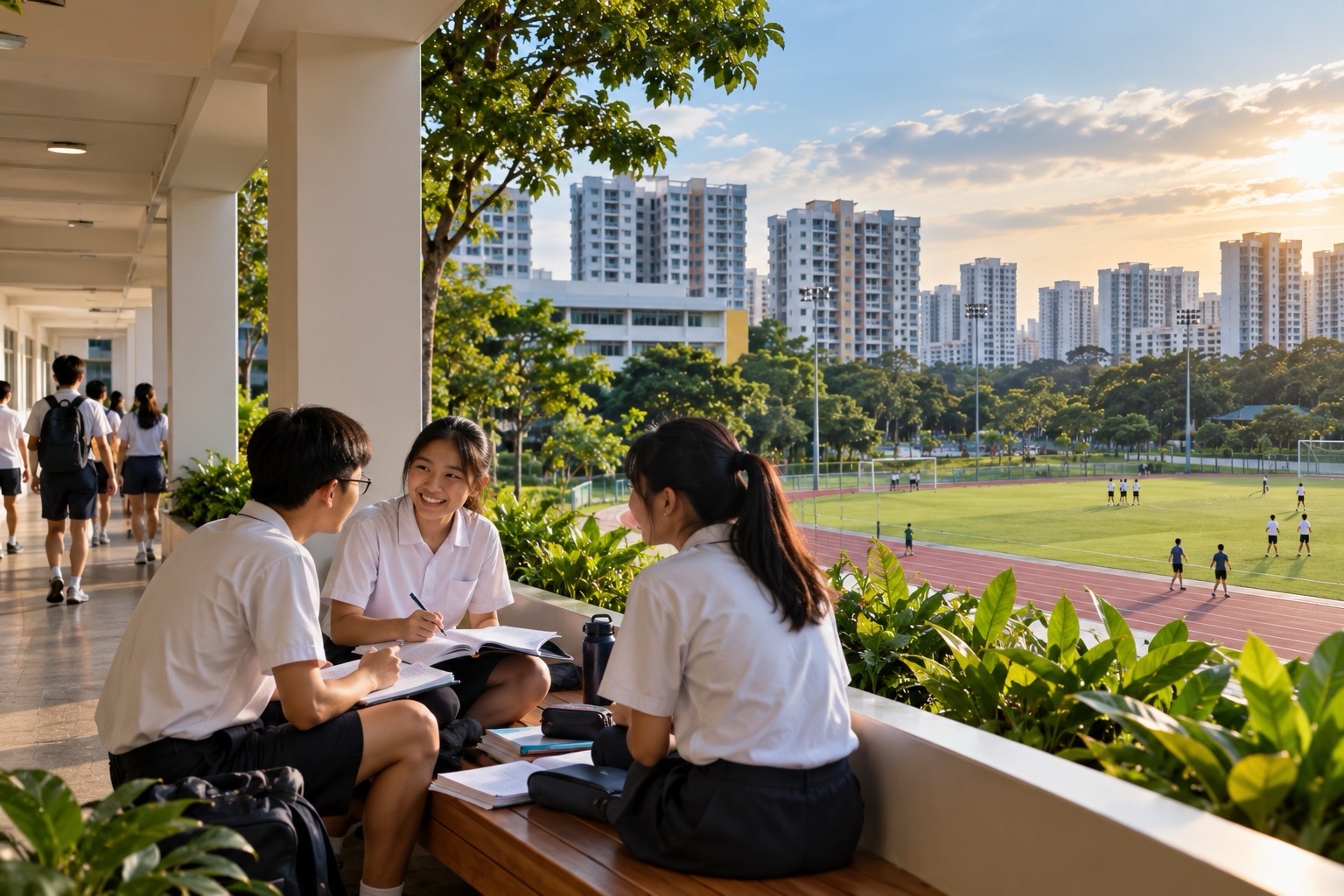
Temasek Secondary School is an autonomous, co-educational government secondary school at 600 Upper East Coast Road, Singapore 465561. Eligible Punggol families can consider it through Posting Group 2 (PG2). For the completed 2026 Secondary 1 intake, its published historical PG2 range was PSLE Score 21–22, and the school’s official 2026 appeal notice confirms 22 as the last admitted score. This is evidence about the previous cohort, not a guaranteed 2027 cut-off. Parents should check the child’s permitted Posting Group and current MOE SchoolFinder record, and test the everyday journey to Upper East Coast Road before ranking it.
Temasek’s distinctive learning goes beyond a single technical ALP label. The Temasek Experience includes a cross-cultural awareness curriculum, C2A, beginning with Project Culture in Secondary 1 and Camp Culture in Secondary 2. Its LEAD@TMS framework offers different student leadership roles, while the Temasek Ignis Programme (TIP) extends selected students in academic inquiry, enrichment and leadership. Outdoor camp, CCA, the Temasek Charity Challenge and broader cultural encounters are additional parts of school life. These opportunities may develop a PG2 student’s strengths, but they do not automatically promise an Ignis place, a G3 subject or a future examination result.
- School: Temasek Secondary School, 600 Upper East Coast Road, Singapore 465561.
- 2026 historical PG2: PSLE 21–22; official school 2026 appeal page confirms last admitted 22.
- 2027 cut-off unknown until the next actual posting exercise; no guaranteed offer.
- Full SBB: PG2 is a school admission group; G2/G3 describe individual academic subject levels.
- Temasek Experience: learning, leadership, cultural awareness, CCAs, camp and service.
- C2A: Cross-Cultural Awareness, exploring culture, identity, history and heritage.
- Secondary 1 Project Culture: teamwork, learning about cultures within Singapore, group oral presentations.
- Secondary 2 Camp Culture: non-residential cultural learning, interfaith understanding and reflection.
- Cross-cultural extensions: selected school exchanges and overseas experiences; not automatic.
- LEAD@TMS: student councillors, peer support leaders, sports captains, class managers and young ambassadors.
- Other selected roles: Student Representative Committee and house captains.
- Temasek Ignis Programme: selected extension in academic depth, authentic interdisciplinary projects and leadership.
- TIP skills: scientific inquiry, Mathematics problem-solving and English purpose, audience, context and culture.
- CCA variety: band, choir, pop a cappella, dance, drama, robotics, environmental science, sports and uniformed groups.
- 2026 open-house programme describes science demonstrations, musical showcases and principal’s talks; verify date and details.
- Daily transport: buses including 10, 13, 14, 25, 43, 46, 55, 137 and 229, with rail connections varying by home.
- Parent next step: check actual academic offer, availability of selected programmes, travel, school culture and wellbeing.
PG2 is not G2, and neither is an entire student
Posting Group 2 is part of the Secondary 1 allocation process under Singapore’s Full Subject-Based Banding. G2 is the academic level of an individual subject. A child who enters Temasek through PG2 may have eligible subjects at other levels under formal school and MOE rules. Neither term says whether the teenager likes a science investigation, speaks confidently about a cultural topic or is a supportive teammate. A school with a rich cross-cultural and leadership curriculum offers chances to recognise these different strengths. Parents should read the official subject-level timetable before buying textbooks, and should avoid treating a PSLE aggregate as a permanent verdict on the pupil’s interests or identity.
Reading the completed 2026 PG2 range
The school’s official 2026 Secondary 1 appeal page confirms that the last pupil admitted through PG2 had a PSLE Score of 22. The completed intake range was 21–22. These figures come from the preceding PSLE cohort and cannot be used as a guaranteed cut-off for 2027. Demand and available places may change, while MOE’s allocation and tie-breaking procedures remain relevant. An applicant scoring 22 should not presume a seat is reserved. The family should record the year and group alongside the number and include realistic alternatives in the six-school choice list. A historical score is valuable for comparison when interpreted accurately, but misleading when presented as a fixed future entry requirement.
Why official appeal information is not an admissions forecast
The 2026 appeal page was written after the previous posting exercise had already concluded. It described how a family could request a transfer subject to vacancies and the school’s criteria. It did not promise that the same admissions numbers or December deadlines would apply to the next cohort. Parents sometimes read an old appeal page and mistake it for a new application window. This can cause missed deadlines or unrealistic expectations. For the coming intake, use current MOE communications and the school’s actual new registration instructions. An earlier document can explain how the school administered one completed process; it cannot override a later official announcement or create an automatic transfer right.
Where Temasek Secondary is located
The official school contact page gives the address as 600 Upper East Coast Road. The school lists Bedok Interchange bus 229, Bedok MRT connections by bus 137 or 25, and a Tanah Merah MRT connection by bus 14, among several routes. These details help Punggol families identify possible access points, but the best journey depends on the particular home and travel time. An address alone does not reveal the walking distance to the stop, likely waiting or the experience after a late CCA. Parents should test the commute on a weekday and practise the correct school entrance and safe crossings with a new Secondary 1 pupil. Independence grows when the child understands both the usual route and a reasonable backup.
School fit is measured on an ordinary Tuesday
An appealing open house can show a vibrant environment, but a teenager will experience ordinary school days far more often. The student must travel, attend several subject lessons, maintain assignments and have sufficient energy for CCA and relationships. A family may reasonably prefer a school with cross-cultural work and student leadership, yet the journey from Punggol could be demanding. Discuss the trade-off honestly. How much sleep can the child get? Will late dismissal create a difficult evening? Does the student want the programme enough to sustain the routine? There is no universal correct answer for all households. The family should choose based on the child’s real needs rather than an impressive historical performance or perceived prestige.
The Temasek Experience as a whole-school journey
The official Temasek Experience page describes a school in which boys and girls become young adults through varied opportunities inside and outside classrooms. It names orientation, outdoor camp, house games, celebrations, literary activities, service and student leadership among examples. This broad approach is useful because adolescents do not all discover their interests at the same time. One pupil might become engaged through culture and history, another through sport, and another through music or robotics. The school should provide ordinary opportunities for exploration while making selected advanced roles clear. Parents can ask which experiences belong to every Secondary 1 class and which require nomination, application or specific talent. The distinction protects families from assuming every publicity highlight is universally available.
Secondary 1 orientation and finding a place in school
Temasek describes Secondary 1 Orientation as a defining early experience for its students. New pupils can learn school routines, form-class relationships, the meaning of school values and where to seek assistance. A child entering through PG2 may share common activities with classmates who have other subject-level profiles. The pupil should learn not to judge friendship or worth by those levels. A quiet student may need time to contribute to a new group, while an outgoing child may need practice listening. Parents can ask after orientation which teacher or peer the teenager feels comfortable approaching. A successful adjustment is gradual; a first week of nervousness does not prove the school was a poor choice, but persistent exclusion deserves appropriate attention.
The outdoor adventure camp and teamwork
The school’s Temasek Experience includes a Secondary 1 Outdoor Adventure Camp. Such an activity can help pupils practise cooperation, communication, planning and safe decision-making in a setting different from the classroom. The precise venue and activities depend on current arrangements, so older photographs should not be treated as a guaranteed itinerary. Pupils must follow instructor instructions and communicate genuine safety or wellbeing concerns. Resilience is not a demand to ignore an injury or continue beyond suitable limits. A teenager who helps a teammate, checks a route or asks a relevant question may be demonstrating leadership. Parents can ask what changed after the group faced an unexpected difficulty rather than focus only on whether the most demanding obstacle was completed.
Cross-Cultural Awareness: the purpose of C2A
C2A stands for Cross-Cultural Awareness. Temasek’s official description recognises that people increasingly interact across different cultural backgrounds, beliefs and histories. Its curriculum asks pupils to construct, share and apply knowledge while learning to collaborate and communicate. The goal is not to memorise stereotypes about nationalities. Students should recognise the differences between universal human behaviour, cultural practices and personal choices. One classmate is not the spokesperson for an entire community. A pupil can learn to ask respectfully, check sources and explain a perspective without claiming it applies to everyone. Such habits are relevant to friendships, Humanities, language learning and future work, regardless of the child’s original Posting Group.
C2A as knowledge construction
The programme uses a staged approach in which pupils acquire information, share ideas and apply understanding in group settings. This makes collaboration more than simply dividing a worksheet into parts. The team needs to examine whether its sources are reliable, discuss disagreements and decide what can reasonably be concluded. If a claim about a community is based on one person’s experience, the group should acknowledge its limited scope. Parents can ask the teenager which assumption was changed after research and how the group handled a different viewpoint. A pupil who revises a conclusion after better evidence demonstrates maturity. The goal is a more careful understanding of other people, not a colourful project that repeats unsupported generalisations.
Secondary 1 Project Culture
Project Culture is a customised Secondary 1 curriculum that introduces cultural systems, values and related communication and information skills. Students work in groups to understand a nationality represented in Singapore and compare certain aspects with familiar local practices. The project culminates in oral communication. A good comparison describes the relevant context and avoids treating cultures as rigid categories in which every person behaves identically. Pupils can learn that a practice may have a history or purpose, while individuals still make different choices. Parents can ask what the student actually researched and whether more than one credible source was used. The educational value is thoughtful inquiry and respectful explanation, not an entertaining collection of costumes and stereotypes.
A group presentation must be both fair and accurate
An oral presentation can teach a child to select information for a particular audience. The group should first agree on the question, identify useful sources and decide which claims require explanation. Every member ought to understand the material they present. A polished slide with unsupported facts should not be considered strong work simply because the speaking is fluent. Parents can ask the teenager to explain one claim without reading the slide and to describe a source that supports it. If the pupil does not know, the next step is more research rather than an improvised answer. This habit helps formal English communication and Humanities reasoning while encouraging integrity in a real collaborative task.
Cultural comparison without stereotypes
A student may be tempted to say that everyone from one country eats the same food, celebrates in the same way or shares one belief. Such statements are rarely suitable without careful qualification. A more responsible approach is to identify a documented practice, describe where it occurs and acknowledge variation among families and communities. Pupils can also consider the difference between nationality, ethnicity, religion and individual identity; they are not interchangeable labels. Teachers can guide respectful questions and help students avoid making a classmate feel responsible for defending an entire culture. Parents should model the same care at home, treating cultural information as a reason for curiosity rather than a fixed prediction about another person.
Secondary 2 Camp Culture
Temasek’s C2A page describes Camp Culture as a non-residential Secondary 2 experience. It includes exposure to different religious and cultural systems in Singapore, discussion and reflection. The page also notes that the programme evolved to emphasise the Singapore Story, multiculturalism and heritage. A future cohort’s visits or specific timetable may differ, so parents should use current school consent and activity information. The educational aim is deeper understanding through appropriate first-hand experience and reflection. A student should learn to ask respectful questions, interpret the significance of a place and distinguish direct observation from later assumptions. Participation should be informed by the school’s safety and inclusivity arrangements rather than copied from an older event itinerary.
Understanding religions with respect
Learning about religious traditions requires sensitivity because beliefs are personally significant to many people. A school visit or classroom discussion should not turn worship or culture into a spectacle. Students can ask how a place is used, what its history is and which rules visitors should observe. They should avoid assuming a believer shares every practice associated with a tradition. Teachers determine the programme’s appropriate boundaries and expectations. Parents who have a particular concern can ask the school directly rather than rely on rumours. A thoughtful pupil emerges with better capacity to communicate across differences, not the idea that a single visit makes them an authority on another person’s faith.
The Singapore Story and heritage sites
C2A connects cross-cultural learning with the history of Singapore. Heritage experiences can help pupils recognise how migration, institutions and community changes shape the country. A photograph or historic object can reveal something real, yet rarely tells a complete story without context. Students should ask who produced the source, when and why. Oral accounts can be valuable but may reflect one person’s perspective. Comparing multiple sources helps avoid simplistic generalisations. Parents can ask the teenager which historical detail changed their view and what additional source might be useful. This method strengthens Humanities and English comprehension while cultivating a more nuanced appreciation of local communities.
Overseas cultural exchange: examples are selective
The school’s current C2A page describes the reintroduction of overseas trips after 2023, including exchanges in Thailand, Malaysia and other ASEAN countries. Such experiences can give selected pupils a chance to interact with peers abroad and compare school life. However, an earlier trip is not a guaranteed 2027 destination or universal entitlement. Participation may depend on age, selection, cost, consent and partner availability. A meaningful exchange involves preparation and reflection rather than simply collecting photographs. Pupils should recognise that one host school cannot represent every child in a country. Parents can encourage respectful listening and curiosity even if their teenager does not participate in a particular trip.
Global awareness without international travel
A pupil can develop valuable cross-cultural skills through local conversations, reading, school projects and analysis of reliable sources. Overseas learning is one useful form of exposure but not the only one. A teenager who represents another culture accurately and listens carefully may show stronger understanding than someone who travelled briefly but never questioned assumptions. The parent can ask what the student learned about the limits of their own perspective. Such reflection supports future collaboration in Singapore’s diverse society. It also avoids making families feel that an expensive trip is necessary for a meaningful education. The actual quality of the learning process matters more than the distance travelled.
LEAD@TMS: leadership as service
LEAD@TMS is Temasek’s student leadership structure. Its official page lists roles including student councillors, peer support leaders, sports captains, class managers and young ambassadors, with additional positions such as Student Representative Committee members and house captains. These are formal responsibilities, not titles automatically assigned to every PG2 entrant. A pupil may practise leadership through everyday class tasks before seeking a selected role. The school values communication, organisation and serving others. Parents can ask what an individual role actually requires and how a pupil demonstrates reliability. A title is less meaningful than being able to help teammates, treat others respectfully and accept accountability when a plan fails.
Student councillors and representing others
A student councillor may be responsible for representing school concerns and assisting school-wide programmes. The role calls for listening, clear communication and respecting school procedures, not merely speaking confidently at assembly. A teenager should distinguish personal preference from the needs of classmates. The pupil may learn to seek feedback and describe a proposed change accurately rather than promise something the school has not approved. Selection and training are governed by the school. Parents should avoid pushing a child into a council position solely for a future portfolio. The stronger motivation is a genuine interest in contributing and a willingness to fulfil obligations even when the work is routine or behind the scenes.
Peer support leaders and appropriate limits
Peer support leaders can help classmates feel included, recognise when someone may need assistance and encourage appropriate help-seeking. However, they are not clinical counsellors and should not be expected to manage serious safety concerns privately. Students should understand when a trusted teacher or trained adult must be involved. Confidentiality and respect matter, especially when a friend shares personal difficulties. A school may provide training for suitable pupils, but selection remains distinct from ordinary friendship. Parents can ask whether their own child knows how to seek help and how the school addresses persistent exclusion or bullying. A strong peer-support culture is visible in daily conduct, not just badges and an investiture ceremony.
Sports captains and house captains
Sports and house leadership can teach teenagers to organise teams, support less experienced participants and respond to disappointing outcomes. A captain who performs well personally may still need to learn how to communicate and allocate opportunities fairly. An unfamiliar sport can reveal different strengths: one pupil may be fast, another may be good at planning or encouraging others. The school determines formal appointments and competition participation. Parents should ask what the child learned about teamwork rather than equate success with winning every match. A PG2 pupil can contribute to the group regardless of the level at which Mathematics is studied. Leadership, physical skill and academic demand are related experiences but not interchangeable assessments.
Class managers and everyday responsibility
Temasek’s class manager role highlights how leadership can begin with ordinary school routines. A reliable class manager may help organise materials, communicate classroom procedures or support a teacher-approved task. This work can be less visible than a public speech, yet it develops follow-through and judgement. A new Secondary 1 pupil might first learn to prepare their own materials and maintain an assignment record before taking on extra responsibility. Parents should not treat a child’s difficulty with organisation as a moral failure; sometimes the instructions or system need to be clarified. Practical self-management grows through a manageable routine, feedback and repeated independent practice. Small reliable actions form the foundation for later leadership.
Young ambassadors and cultural understanding
A Young Ambassador role can connect naturally with the school’s cross-cultural awareness curriculum. A pupil representing a group or welcoming visitors needs to speak accurately, listen respectfully and avoid making grand claims about what every student experiences. An ambassador should know when to refer a question to school staff rather than invent an answer. Such roles may be selected and trained; ordinary C2A participation does not guarantee the appointment. Parents can ask whether the child enjoys learning about others and communicating fairly. The best ambassador is not necessarily the loudest teenager but one who can understand the audience, explain the relevant facts and act respectfully when something unexpected happens.
The Temasek Charity Challenge
LEAD@TMS lists the Temasek Charity Challenge among its leadership experiences. A school charity event can involve planning, teamwork, communication and reflection on the needs of beneficiaries. Its educational value is strongest when students understand the cause, follow partner guidance and accurately describe the contribution. A high fundraising total is not proof that a project solved every underlying issue. Nor should pupils disclose beneficiaries’ private circumstances to make a campaign persuasive. Parents can ask what the group learned from stakeholders and whether the project changed after feedback. Service should develop responsibility, not become a contest to display the most impressive number on social media.
The Temasek Ignis Programme: selected enrichment
The Temasek Ignis Programme, or TIP, is described as a signature extension for pupils with particular talents in intellect and character. Its name comes from Latin for burning flame. It aims to extend academic skills, enriched content and leadership-related capabilities through authentic work. This is a selected programme, not the default curriculum of every PG2 student. A family should ask about current entry criteria, readiness and workload before assuming an applicant is guaranteed a place. A pupil who does not join Ignis can still learn successfully through ordinary subjects, C2A, CCA and leadership opportunities. The child’s worth should not be measured by membership in one particular enrichment track.
Ignis: intellectual depth rather than simply harder worksheets
The TIP description emphasises depth and rigour, authentic materials and inductive reasoning in which students participate actively. Deep learning means understanding a concept well enough to explain why it works and apply it in a new situation. It is different from receiving more pages of exercises without diagnosing misconceptions. In Mathematics, a learner may need to connect symbolic expressions with quantities. In Science, the pupil should understand what a controlled observation supports. In English, purpose and audience affect word choice and organisation. Parents can ask whether the child enjoys these kinds of questions and can sustain the extra work. More demanding enrichment is useful when it builds genuine competence and curiosity.
Ignis Science: inquiry and ethics
The school’s TIP page names scientific inquiry and ethical issues in Science among the intended outcomes. A pupil investigating a question should identify what was measured, which conditions were controlled and what remains uncertain. If several variables changed, a confident causal conclusion may be unjustified. Ethical judgement also matters when a task involves living things, personal information or technology that could affect others. Students should follow school-approved safety and privacy requirements. A polished poster without reliable evidence is not a strong inquiry result. Parents can ask what the learner would test next and which claim needs qualification. The ability to report a limitation honestly is a sign of intellectual maturity, not an embarrassment.
Ignis Mathematics: the metacognitive habit
TIP aims to develop cognitive and metacognitive approaches to Mathematics problem-solving. Metacognition involves monitoring how one reasons: what is the problem asking, which strategy applies and how can the answer be checked? A pupil who reaches an incorrect result can locate the first invalid step rather than start the same process again mechanically. This skill matters across G levels. A learner studying G2 should be appropriately challenged while mastering the actual syllabus; a selected enrichment programme cannot replace formal subject eligibility. Parents can ask the student to explain why a method was chosen and whether another approach could work. A correct answer without understanding is less durable than a defensible method that transfers.
Ignis English: Purpose, Audience, Context and Culture
The TIP page explicitly names Purpose, Audience, Context and Culture, or PACC, in English communication. A news report, formal request, cultural presentation and reflective essay require different information and tone. The pupil should decide what the reader needs before constructing polished sentences. The word choice should also respect cultural context rather than reduce people to stereotypes. A student may speak confidently but still need practice reading a passage accurately or supporting an inference. Selected English enrichment creates opportunities for deeper work, but formal G2 assessment remains syllabus-specific. Parents can ask the teenager to explain one writing choice and show the evidence behind a claim rather than copy an impressive model paragraph.
Ignis leadership: extending responsibility
TIP’s leadership domain includes communication, strategic organisation and opportunities to serve. It refers to John C. Maxwell’s Five Levels of Leadership within the school programme. Students should learn that influence grows from reliability and trust, not simply from acquiring a position. A teenager who plans a class activity must understand the task, assign work fairly and respond when circumstances change. The programme can help selected pupils undertake more complex challenges, but it does not guarantee election to Student Council or a national award. Parents can evaluate whether a leadership opportunity fits the child’s readiness and interests, while recognising that valuable leadership habits also develop in ordinary school life.
LEAD@Thailand and other programme examples
The Temasek Experience lists LEAD@Thailand among its past school activities. Such an example can illustrate opportunities for selected pupils to lead and learn internationally, but the name on a website is not a guaranteed destination or itinerary for the next cohort. International activities require consent, current partner arrangements and appropriate selection or funding. A child should approach another culture with questions rather than assumptions. The educational outcome is what the pupil learned about people, planning and responsibility, not simply where the photograph was taken. Families can encourage these habits through the school’s C2A curriculum even if overseas participation does not arise for their child.
CCAs: a wider school identity than one course label
Temasek lists a broad selection of CCAs, including Band, Choir, Pop Acappella, Dance, Drama, Robotics, Environmental Science, Infocomm & Media, sports and uniformed groups. A teenager may find belonging through an activity unrelated to their academic subject levels. The school controls actual CCA allocation, trials and training schedules. A student who enjoys a performance during open house is not guaranteed a place in that team. Parents should ask what the child genuinely wants to practise and whether the weekly commitment is manageable alongside travel from Punggol. Formal LEAPS 2.0 attainment follows separate criteria; simply joining a group does not automatically secure a particular bonus or post-secondary place.
Robotics and Environmental Science as CCA interests
A technical CCA can allow students to pursue sustained interests beyond an ordinary classroom lesson. Robotics may involve coding, construction, testing and failure analysis. Environmental Science may require careful observation, data and realistic understanding of ecosystems. Neither should be reduced to competition photographs. A pupil can make substantial progress by explaining a small mechanism or evaluating one claim accurately. Parents can ask about beginner training, safety, workload and what project documentation students create. A selected competition is an opportunity, not an entitlement. Most importantly, the teenager should be able to discuss the work personally rather than depend on a prewritten portfolio that someone else prepared.
Performing arts develop a different set of strengths
A pupil interested in Choir, Band, Drama or Pop Acappella may discover that performance involves listening, rehearsing and adapting to others. These skills can support confidence and friendships, but a show is not equivalent to formal English or Music subject qualifications. A child who has never performed may need suitable gradual participation, while an experienced performer may need to learn teamwork and disciplined practice. Parents should respect the teenager’s own interests rather than choose a CCA merely because a previous team won an award. The school’s open-house showcase represents selected moments; ordinary training and relationships reveal whether the child would enjoy the commitment over several years.
What the 2026 Open House can tell a family
The school’s 2026 Open House programme shows scientific demonstrations, principal talks and performances from Band, Drama, Choir, Dance, Wushu and Pop Acappella. These are useful ways to see the school community, but a schedule from a specific event is not a promise that the same demonstrations or timings will recur in 2027. When attending, ask what broad C2A learning looks like, what TIP selection requires and how PG2 pupils receive appropriate subject challenge. Let the child choose one question about an activity. An open house can improve understanding but cannot reserve a place or determine the next PSLE cut-off. The daily commute should be tested separately.
Full SBB and buying the correct books
After posting, the family should rely on Temasek’s current subject-level offer, timetable and booklist. A PG2 pupil may qualify for a more demanding level in a particular subject, and buying every resource at G2 without checking may result in incorrect materials. Ask the school how subject-level adjustments are assessed and how parents can clarify mixed timetables. A strong performance in a cultural project or CCA does not automatically produce a G3 academic offer. Decisions require current rules and evidence of readiness. The objective is suitable learning demand, stable study habits and the ability to solve unfamiliar work independently, not collecting higher labels for status.
G2 English: inference needs evidence
C2A presentations and TIP English enrichment make communication important, but formal comprehension still demands close reading. A pupil may give a plausible inference about a character without selecting the supporting words. Help the student distinguish what the passage directly states, what it implies and why the chosen detail supports that interpretation. Another child may find the right sentence but struggle to organise an explanation. Those are different gaps and require different feedback. A fluent AI-generated paragraph is not strong evidence of independent learning if the teenager cannot explain it. Parents can encourage reading, accurate vocabulary and changed practice questions instead of merely asking for longer or more elaborate answers.
G2 Mathematics: repair the first incorrect step
Consider a child who expands 3(x + 2) as 3x + 2. The multiplier must apply to both terms; the correct result is 3x + 6. A teacher can show three identical groups of x + 2, explain why there are three copies of each term and then test a different expression without hints. A pupil who understands this principle but misreads a graph needs help with interpretation rather than repeating the same algebra lesson. Temasek’s emphasis on problem solving can support this diagnostic approach, but the formal G2 syllabus still needs deliberate teaching and independent practice. The objective is transferable mathematical understanding, not an impressive number of worksheets completed.
G2 Science and the logic of a fair test
An environmental or laboratory investigation may produce a striking result, but a student should distinguish observation from a causal explanation. If several variables change together, the result may not identify which one made the difference. The pupil should ask what was measured, how conditions were controlled and whether another test would strengthen the conclusion. This is also important when reading a claim generated by an AI tool or social media post. Formal Science requires accurate concepts, not only a colourful project description. Parents can ask the teenager to explain one mechanism in plain language and name a limitation. Scientific honesty is an essential skill whatever the student’s initial posting group.
Learning to use technology responsibly
The school’s curriculum and CCAs offer different opportunities to use digital tools. A device can help research, communicate and design, but students should check sources and understand where privacy or copyright applies. A cultural project may involve another person’s story or image, and consent matters before sharing it publicly. A chatbot can produce a plausible but incorrect statement about history, science or school rules. The student should verify important claims with appropriate primary sources. Parents can reinforce good digital habits without turning technology into either a magic solution or a universal threat. The goal is purposeful and ethical independent use, alongside the ability to learn without constant reliance on a screen.
An ordinary week needs space for wellbeing
A child at Temasek may have academic lessons, CCA, C2A, house events and possibly selected Ignis or leadership work. Those activities do not all occur every week for every pupil. Begin with the actual timetable and commute, then allow time for meals, homework, relationships and adequate sleep. A teenager exhausted after a late CCA may benefit more from focused revision and rest than from another long evening of unstructured worksheets. If a persistent academic gap exists, identify the exact misconception and seek appropriate support. More scheduled hours are not automatically better learning. A sustainable routine allows the pupil to take part in the school’s opportunities with energy and genuine interest.
Three fictional PG2 family situations
The score-22 family. A child receives PG2 eligibility and sees that Temasek’s completed 2026 last admitted result was 22. The parents treat it as historical reference and include realistic alternatives, not a guaranteed offer. The cultural researcher. Another pupil enjoys Project Culture but is hesitant speaking. The family supports gradual communication practice without assuming the child must join a selected Young Ambassador role. The curious mathematician. A third teenager is interested in Ignis but needs help with one algebra concept. The family checks actual selection while repairing the misconception rather than promising a place. These hypothetical cases illustrate how admission, learning and interests must be considered separately.
Frequently asked questions about Temasek PG2
Does Temasek Secondary admit PG2 pupils? Its completed 2026 intake had a PG2 range of 21–22. Was 22 guaranteed for future applicants? No. Is Temasek in Punggol? No, it is at 600 Upper East Coast Road. What is Project Culture? A Secondary 1 cross-cultural learning programme with group research and oral communication. What is Camp Culture? A Secondary 2 non-residential cultural and heritage experience. Does every student join Ignis? No, it is selected enrichment. What is LEAD@TMS? The school’s student leadership framework. Can an eligible PG2 pupil study a subject at G3? Potentially under formal rules. Does a selected overseas trip happen for everyone? No. Does a school programme guarantee a future diploma? No.
Your Next Step and official sources
Read Temasek’s official 2026 PG2 cut-off, Contact and Transport, Temasek Experience, C2A and Project/Camp Culture, Temasek Ignis, LEAD@TMS, Official Open House Programme and MOE SchoolFinder. Discuss which programmes the child would genuinely enjoy, test the actual Punggol commute and check the formal subject-level offer after posting. For the six-school process, use the PG2 Punggol choice guide.


