
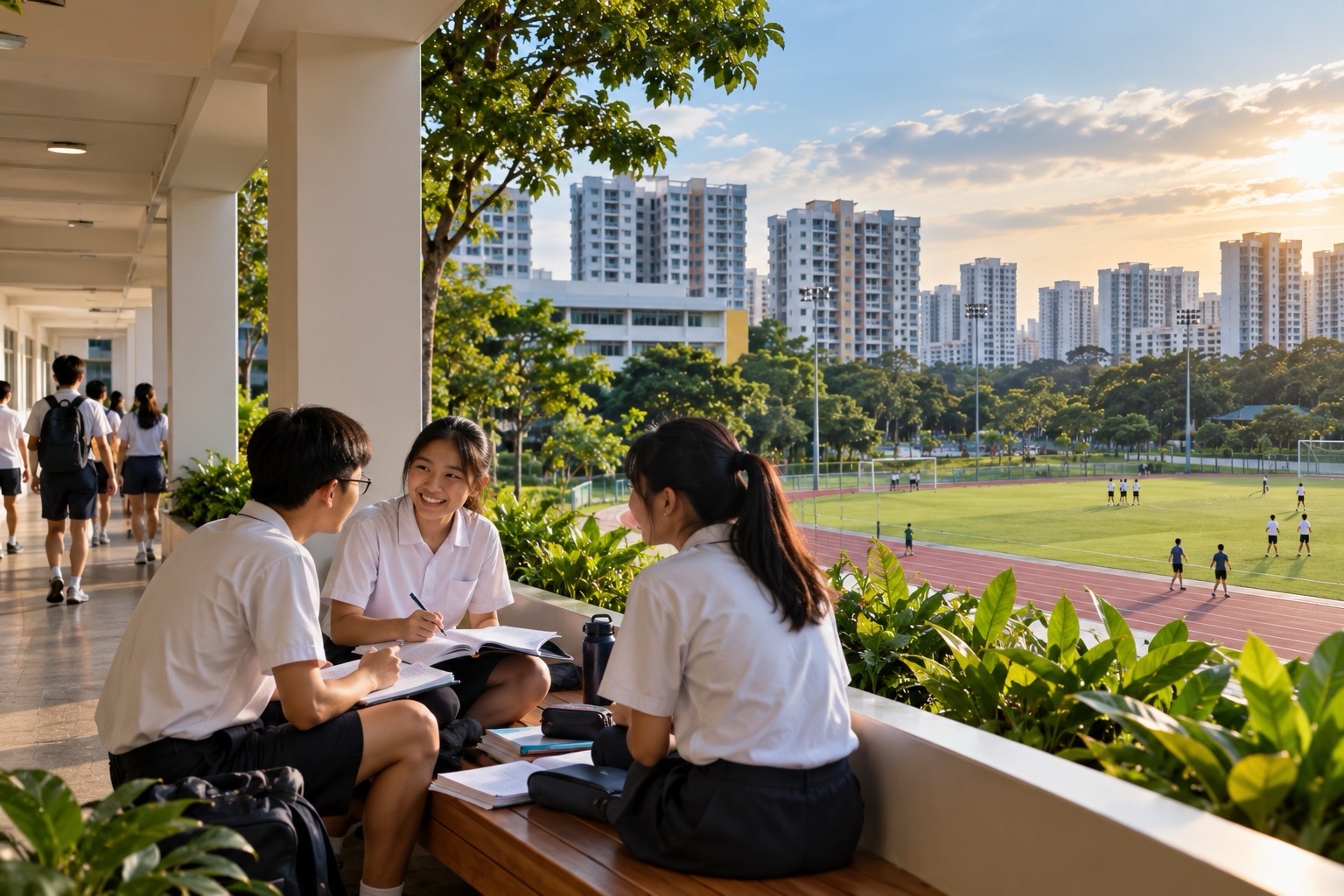
Serangoon Secondary School at 11 Upper Serangoon View, Singapore 534237, is a government co-educational secondary school that eligible families in Punggol can consider through Posting Group 2 (PG2). Its completed 2026 Secondary 1 intake recorded a historical PG2 PSLE Score range of 21–25, with 25 the last admitted score. That result belongs to the pupils posted after the 2025 PSLE, not to a guaranteed 2027 admission cut-off. Parents must confirm the child’s actual permitted Posting Group, check the latest MOE SchoolFinder information and compare the journey from Punggol with other genuine school preferences.
The school has two distinctive programmes. Its Future of Transportation STEM Applied Learning Programme provides 3D modelling and printing in Secondary 1, drone programming in Secondary 2 and selected deeper exploration through the Infocomm Club. Its Project Ablaze Learning for Life Programme develops Community Youth Leadership through the progression Caring for our Peers and School, Serving our Community, Building our Community and Shaping our Society. The school’s SHINE values and motto, For the Growth of Self and the Good of Others, connect technical curiosity with responsible contribution. These are worthwhile experiences, but a PG2 pupil is not automatically admitted to every competition, leadership role or eligible G3 academic subject.
- School and location: Serangoon Secondary School, 11 Upper Serangoon View, Singapore 534237, in Hougang.
- Completed 2026 PG2 historical range: PSLE Score 21–25, last admitted 25; not a guaranteed 2027 cut-off.
- Full SBB: Posting Group 2 is an admissions grouping, while G2 is an individual subject level.
- Nearest transport references: Hougang MRT and Kangkar LRT; buses 62, 74, 102, 113, 119, 136, 147 and 324.
- School motto: For the Growth of Self and the Good of Others.
- SHINE: Self-Directedness, Harmony, Integrity, ResilieNce and Excellence.
- ALP: STEM Future of Transportation, linking Science, Mathematics, Technology and Engineering.
- Secondary 1 ALP: broad-based 3D modelling and printing, designing a functional prototype.
- Secondary 2 ALP: broad-based drone programming, aerodynamics and algorithms.
- Tier 2: selected Secondary 2–3 Infocomm Club technology and deeper STEM opportunities.
- LLP: Project Ablaze—Community Youth Leadership and Values in Action.
- Sec 1 LLP: Caring for our peers and school.
- Sec 2 LLP: Serving our community.
- Sec 3 LLP: Building our community, including historical service with older residents and local partners.
- Sec 4–5 LLP: Shaping our society.
- 2026 DSA: Community Youth Leadership or Programming and 3D Modelling; confirm current criteria.
- Student leadership: Prefects, class and CCA leaders, peer supporters under school selection.
- Next action: check score category, commute, Full SBB subjects, programme access and the child’s actual interests.
Definition lock: PG2 and G2 answer different questions
Posting Group 2 describes the route by which a pupil may be admitted after PSLE under Full Subject-Based Banding. G2 is the curriculum level of one academic subject. A child can join Serangoon Secondary through PG2 and have another eligible subject at a different level according to official school and MOE criteria. A pupil’s ability to code, work with classmates or investigate a community need should not be inferred from the original aggregate. Parents must read the school’s formal subject offer after posting, rather than purchase every textbook from one generic list. The goal is to identify actual strengths and gaps in English, Mathematics, Science and other subjects, then provide suitable learning challenges and support.
The completed 2026 historical score range
Serangoon Secondary’s 2026 PG2 range was 21–25. That means the last admitted pupil for this posting group had a PSLE Score of 25 in the completed exercise. It does not mean the school has promised to accept every PG2 applicant with the same score for 2027. The next cohort’s application pattern, number of seats and MOE tie-breaking rules determine the eventual result. A family should record the historical intake year beside the range and use it to judge realistic options without treating admission as certain. Comparing PG2 with another school’s PG3 figure as though both refer to the same route is misleading. Genuine school preference and academic readiness matter alongside the historical data.
Why a previous cut-off is not a reservation
A cut-off is produced after pupils rank schools and the allocation runs. When several applicants share a score at a boundary, official priority rules may affect the outcome. No private tutor, online guide or school tour can reserve an ordinary Secondary 1 place by referring to an old number. The family should understand the formal choice process and prepare six schools the child could genuinely attend, rather than creating a list based only on apparent score safety. If a pupil has an official choice between Posting Groups, that decision should also consider the individual subject demands. A good shortlist labels every datum by school, year and group, and clearly marks future cut-offs as unknown.
11 Upper Serangoon View is close to Punggol but not in it
The official address is 11 Upper Serangoon View, Singapore 534237, in the Hougang area. The school’s contact page lists Hougang MRT, Kangkar LRT and several bus services as transport references. A family in one part of Punggol may have a suitable connection while another needs a longer bus or rail journey. Test the complete weekday morning route, including waiting, the final walk and safe crossing, rather than rely on a weekend map estimate. Check the return after CCA and any selected activity. A teenager should learn a safe backup when a service is delayed. School suitability includes whether the student can maintain homework, meals, sleep and ordinary family life without chronic travel fatigue.
The motto: growth of self and good of others
Serangoon Secondary’s motto links individual development with community responsibility. A school should help a pupil build understanding, character and independent habits, then consider how those capabilities affect other people. In the ALP, a technical model should be judged on both function and user needs. In Project Ablaze, an activity should respond to a genuine community requirement rather than simply generate publicity. Parents can ask for examples of this balance in normal lessons. A child who learns to correct a mathematical misconception is growing personally; one who helps a teammate understand a task is contributing to others. A motto becomes meaningful through such daily decisions, not merely when a pupil memorises it.
The five SHINE values
The school names its values as Self-Directedness, Harmony, Integrity, ResilieNce and Excellence. Self-direction involves asking questions, organising tasks and learning without complete adult dependence. Harmony means respecting classmates, including those with different subject-level profiles. Integrity is reporting actual results rather than inventing a successful experiment. Resilience means using appropriate feedback and support when a plan fails; it is not a command to ignore illness or serious distress. Excellence should involve meaningful improvement and accurate work, not simply public awards. Parents can ask which value guided one real decision in a group project. The answer can reveal growing judgment more clearly than a generic claim that the teenager is a confident leader.
Future of Transportation: why STEM belongs to real life
The school’s September 2026 ALP description calls its theme the Future of Transportation. Students explore the connection between Science, Mathematics, Technology and Engineering through design and coding. This creates a setting where abstract concepts such as variables, measurements, forces and constraints can acquire practical meaning. But an attractive device is not automatically a good solution. The pupil should identify who would use it, what it is supposed to accomplish and how the result could be tested. A classroom prototype can illustrate a limited principle without proving that it is ready for use on a real road or in professional aviation. The value is understanding and careful reasoning, not a promise of an engineering career.
The two-year Tier 1 STEM progression
The official ALP table lists Secondary 1 3D Modelling and Printing and Secondary 2 Drones Programming as Tier 1 experiences. These are designed as accessible foundations for the cohort, with skills becoming more complex over time. A Secondary 1 pupil may learn to plan an object and understand digital modelling; Secondary 2 builds on logic, mechanics and algorithmic problem-solving. Parents should not assume every student uses every specialist tool or joins the same competition. Teaching and safety arrangements remain the school’s responsibility. A useful parent question is what a typical child can explain independently after each stage. Clear transfer to another problem is more informative than one polished final product.
Secondary 1: basic digital 3D modelling
A digital model lets a student represent an intended object and examine its shape before manufacture. The pupil may need to work with basic functions, dimensions, orientation and constraints. A project should start with a question: what does the object need to do? A beautifully decorated model can still be useless if it does not fit its intended space or cannot be handled safely. The school’s ALP aims to help students use such tools for real-world thinking, not simply to collect images of impressive-looking objects. Parents can ask which measurement mattered and why. If the object needed revision, the child should explain what evidence showed the original design was unsuitable.
From a digital file to a printed prototype
3D printing can reveal the differences between a model on screen and an object in physical space. A joint may be too tight, a surface too fragile or a part difficult to assemble. Such problems can become useful teaching moments when students inspect the first version and make one informed change. The school’s equipment should be used only under its supervised procedures; a general article is not a manufacturing safety manual. A printed object does not automatically prove durability, accessibility or suitability for its intended user. Pupils should learn what the model actually tested and what remains unknown. The educational achievement is thoughtful iteration, not the novelty of a printer operating.
3D modelling as a geometry lesson
Design work can make length, width, angles, scale and proportion more relevant. If a student models two pieces meant to fit together, the numerical relationship matters in a tangible way. But the project should not be assumed to repair every weakness in G2 Mathematics automatically. Teachers still need to explain the formal concepts and check whether the pupil can apply them on paper. A student who is confident rotating a digital object may struggle with symbolic algebra, while another who understands algebra might misread a dimension in the software. Good support diagnoses the specific problem. Parents can ask the child to describe the numerical choice without the software displaying an answer.
Design for people rather than gadgets
A transportation-related prototype may be judged by whether its user can operate it, not simply whether it looks innovative. Students should identify the imagined or real user and understand the conditions of use. A handle that seems convenient to a teenager may be difficult for someone with limited grip. A sign intended to improve navigation may confuse an unfamiliar visitor. Teacher-guided feedback can reveal these problems. The pupil should be willing to revise rather than defend the first idea because it was personally exciting. This connects the STEM ALP with the school motto: individual technical learning is valuable when it can improve life for others responsibly.
Secondary 2: drone programming
The official Tier 1 Secondary 2 programme involves Drones Programming. The school describes learning about aerodynamics, interaction of forces, simulated flight and algorithms that achieve specific objectives. A student should learn to break a complex task into smaller problems and predict how instructions affect the system. If the simulated drone does not complete the route, the child should inspect the logic instead of changing every parameter randomly. Actual drone use requires school supervision and relevant aviation-safety rules. A successful coding task is not a pilot qualification or permission to operate unapproved drones in public spaces. Parents can ask the child to explain one instruction and how it was tested.
Aerodynamics: a careful explanation matters
Flight can demonstrate that different forces act on a moving object. A pupil might use words such as lift, weight, thrust and drag, but merely naming forces is not the same as explaining their relationship to the observation. If a model behaves differently after several conditions change, the student should be cautious about claiming that one design feature caused the result. The school can guide fair comparisons using a simulation or supervised activity. A learner who recognises uncertainty is developing scientific maturity rather than showing weakness. Parents can ask what was measured and what further test would support the claim. This careful reasoning transfers to formal Science and later technical study.
Algorithms: breaking a route into smaller steps
An algorithm gives a structured sequence for completing a task. In a flight simulation, the child may need to plan take-off, turning and moving towards an objective. The student should understand why the steps are ordered as they are and how conditions determine the next action. A small error in sequence can prevent a successful result, which makes debugging meaningful. Parents can ask the teenager to predict the effect of changing one instruction before testing it. If the learner cannot explain the result, the next lesson should focus on reasoning rather than simply copying a new working script. This supports computational thinking without assuming that a short ALP automatically qualifies a child for a formal Computing examination subject.
Debugging builds transferable resilience
A programme may fail the first time because an instruction is incorrect, a condition is misunderstood or the expected result was unrealistic. A thoughtful pupil records what should happen, what actually happened and one plausible reason. Testing that explanation is more productive than making many random edits. The habit is useful in Mathematics when the first incorrect algebra step must be found, and in English when an inference is unsupported by the text. Parents can ask what changed between the first and second attempt and whether the student can explain the correction independently. A failure that produces clear understanding can be more educationally valuable than immediate success without comprehension.
What Tier 2 Infocomm Club really means
The official ALP table describes Tier 2 opportunities for selected Secondary 2 and 3 pupils through the Infocomm Club. These allow deeper exploration of emerging technologies, programming and creative technical work. This is distinct from the broad 3D modelling and drone experiences offered in Tier 1. A PG2 pupil may later show aptitude and interest, but membership and competition opportunities are controlled by the school’s current allocation and selection rules. Parents should ask about training, projects and workload before promising the child a particular advanced platform. A student not selected for the club can still learn sound STEM principles through ordinary classes and other appropriate activities.
Direct School Admission in STEM
Serangoon Secondary’s 2026 DSA materials describe an ALP talent domain in Programming and 3D Modelling, called Real-World Explorations in ICT. Selection considers STEM curiosity, relevant Mathematics and Science capability, conduct and evidence of interest. A DSA application should show genuine projects and the pupil’s ability to explain them. A professionally edited video completed by an adult does not establish independent aptitude. Most importantly, a Confirmed Offer remains conditional on the child’s PSLE result qualifying for a Posting Group offered by the school. The dates and criteria for a future exercise must be checked anew. DSA should suit a real, sustained interest rather than be treated as a temporary shortcut to a preferred school.
Project Ablaze: leadership through meaningful service
Serangoon Secondary’s LLP is called Project Ablaze, focused on Community Youth Leadership. Its aim is to help every student develop responsibility while offering increasingly authentic opportunities for contribution. This broad developmental purpose does not mean every pupil becomes a prefect or senior council officer. Leadership can begin with managing homework, cooperating during class and listening carefully to another person’s needs. An older student may be ready to plan a community initiative with appropriate school support. Parents should ask which experiences the ordinary cohort receives and which formal roles require appointment. A useful project is measured by genuine service and learning, not merely the size of its public audience.
The four stages of Project Ablaze
The school’s DSA and LLP information sets out a clear sequence: Secondary 1 Caring for our Peers and School; Secondary 2 Serving our Community; Secondary 3 Building our Community; and Secondary 4 or 5 Shaping our Society. The progression increases responsibility as the teenager develops. A younger child first learns to recognise needs in the immediate environment. An older pupil can undertake more complex planning and collaboration. These are educational themes, not a guarantee that every named historical service partner or project will recur in 2027. Parents can ask what the particular cohort does in each stage and how reflection is used. Progress should be visible in responsibility and empathy, not merely completion of a checklist.
Secondary 1: caring for peers and the school
A new pupil needs to learn classroom routines, support classmates and understand how school relationships work. The first Project Ablaze stage is suitable for developing empathy close to home. A teenager may notice that a new classmate is uncertain about a schedule or that a shared area needs care. Useful action should follow school guidance and respect personal boundaries. A pupil should not disclose another student’s private difficulty to demonstrate kindness. Parents can ask what practical problem the child noticed and what respectful action was taken. The lesson is that serving others begins with ordinary reliable behaviour rather than waiting for a large charity event.
Secondary 2: serving the wider community
The second stage extends the pupil’s attention beyond immediate classmates. Students may learn to identify local needs, work with suitable partners and communicate fairly with people of different ages or backgrounds. A good service project begins with listening. A team might propose an elaborate performance while the intended participants prefer a conversation or simpler activity. Adjusting the plan after feedback is a sign of good judgement. The school controls actual partners, timing and safeguarding, so historical examples should not be promised to the new cohort. Parents can ask what the teenager learned from people in the community, not only what was delivered. Genuine service develops understanding in both directions.
Secondary 3: building the community
The school’s official Project Ablaze story describes a historical Secondary 3 experience with Jia Ying Senior Activity Centre and HDB, in which students cleaned homes of older residents in one-room rental flats and then spent time talking with them. This is a documented example of the level’s community-building focus, not a guarantee that every future cohort will enter the same flats or work with the same partner. Such activity involves privacy, dignity and appropriate safety procedures. Students should respect residents and avoid treating their homes as material for publicity. A thoughtful reflection asks what the residents actually needed and what the child learned from the interaction. Service must be measured by responsible conduct, not sensational storytelling.
The ethics of home-based community service
Entering a person’s home requires appropriate authorisation, supervision and respect for private life. A school volunteer should not photograph personal belongings, documents or living conditions without approval. An older resident may want companionship rather than a proposed cleaning task, or may have preferences the pupil did not anticipate. The teenager should follow partner and teacher instructions, listen and avoid making assumptions about poverty or age. A parent can encourage the child to describe a lesson learned without revealing identifying personal details. Compassion is strongest when it protects dignity. A short afternoon of service can be meaningful, but should not be exaggerated into a claim that long-standing social problems have been solved.
Secondary 4 and 5: shaping society
The final Project Ablaze stage encourages older students to understand how personal action can affect society. A graduating pupil might need to consider civic issues, communication and more responsible leadership rather than focus only on one local activity. Any actual project depends on school arrangements, partners and student readiness. A mature learner should be able to define an appropriate goal, explain the evidence behind it and evaluate whether the action had the intended benefit. Parents can ask how the child would improve a project after critical feedback. This progression prepares teenagers to participate thoughtfully beyond school, without promising a national leadership award or a particular post-secondary result.
Student leadership structures and selection
The school’s leadership page describes Prefects, CCA Leaders, Class Committee members and Peer Support Leaders. These formal roles can give selected pupils opportunities to organise activities, represent peers and develop responsibility. However, the value of a school-wide LLP is broader than those appointments. A child can learn to plan and serve in ordinary group tasks, whether or not elected to a senior post. Parents should distinguish participation from official leadership recognition, which has its own selection and LEAPS 2.0 rules. A teenager who is reliable and respectful can develop leadership capability without an impressive title. The best conversations examine what the pupil did and who benefited.
Peer support with safe boundaries
Peer supporters may help classmates feel welcome or encourage them to approach appropriate adults when something is wrong. They are not a substitute for trained counsellors, teachers or safeguarding processes. A pupil who learns about a serious safety or wellbeing concern should understand how to report it appropriately rather than promise secrecy beyond safe limits. Students should not use another person’s distress as material for a leadership portfolio. Parents can ask whom the teenager would contact if a classmate needed more help than a friend could provide. Effective peer support combines kindness, confidentiality and recognising one’s limits. Such judgement can be developed across academic levels, not only among pupils with formal badges.
School history and an enduring identity
Serangoon Secondary’s history traces its establishment to 1928. Its current mission and motto link learning with service, reflecting a long institutional focus on character and community. Historical achievements and a familiar name can be points of interest, but they do not determine today’s individual fit. Parents should examine the school as it operates in 2026 and prepares for 2027: which ALP activities are core, how teachers give feedback and what support is available when a student struggles. The practical learning environment matters more than the age of a school. A child can respect tradition while developing new skills in 3D modelling, coding and digital citizenship.
CCAs, friendship and a balanced identity
Serangoon Secondary offers activities through sports, performing arts, uniformed groups and clubs. A pupil interested in drones may choose the Infocomm Club, but another may prefer sport or music and still participate in the school-wide STEM ALP. The school determines CCA allocation and current training schedules, so participation in a selected event is not a universal guarantee. CCA can help teenagers build friendships across academic subject levels and develop a sense of contribution. LEAPS 2.0 recognition follows formal criteria for participation, achievement, leadership and service. Parents should focus on genuine interest and sustainable attendance rather than promise a particular bonus score from joining one club.
Full SBB: the actual timetable determines the books
Under Full Subject-Based Banding, students may share form classes and common curriculum activities while attending appropriate G-level lessons for core academic subjects. The formal subject offer controls each pupil’s English, Mathematics, Science and other timetables, not the general PG2 label alone. Parents should wait for the correct 2027 registration and booklist before purchasing resources. A child who demonstrates aptitude in 3D design does not automatically receive a G3 Maths offer. School and MOE criteria govern later subject-level adjustments, including sustained readiness. The teenager should learn to check instructions from different teachers and maintain a reliable assignment record. These habits can reduce unnecessary stress during the first term.
G2 Mathematics: locate the first invalid step
The Future of Transportation ALP gives contexts for geometry, ratios, angles, coordinates and graphs. Formal G2 Mathematics still requires secure algebraic reasoning. Suppose the pupil expands 3(x + 4) as 3x + 4. This is incorrect because multiplication must apply to both terms, giving 3x + 12. A teacher can represent three groups of x + 4, then test a new expression without hints. Another child may understand the rule but misread a graph’s scale or copy a negative sign. Those are different weaknesses and need different teaching. The educational objective is independent control of the concept, not merely producing a correct answer when a drone simulation supplies the numbers.
G2 Science: observation, force and explanation
A simulated drone or model aircraft may move differently after a change, but a pupil should avoid attributing the difference to one feature when several conditions changed. Science requires understanding the relevant mechanism, variables and evidence. A student should be able to explain what was observed, what might have caused it and what further experiment could clarify the result. A successful model flight is not proof that the principle has been mastered for every unfamiliar assessment question. The ALP provides motivation when teachers connect the practical work to formal Science concepts. Parents can ask the child to explain one result without technical jargon or a video demonstration. Honest acknowledgment of a limitation is part of good scientific reasoning.
G2 English: Project Ablaze requires precise communication
Community service involves people and their experiences, so students need to write and speak accurately. A report about a VIA activity should state what was done, who was involved in general terms and what the students learned, without disclosing private information. Formal G2 English comprehension also requires claim, evidence and explanation. A plausible inference without supporting words from the passage may not meet the question. Another learner may select the correct quotation yet struggle to organise the answer. Teaching should target the specific difficulty, then test the child on a changed passage. A polished AI-generated paragraph cannot replace independent reading and reasoning. Accuracy and empathy should develop together.
Digital citizenship alongside emerging technologies
Coding and 3D design can be exciting, but the school experience also needs responsible digital habits. Students should protect account credentials, respect classmates’ privacy and verify information before using it in a project. AI tools can suggest plausible code or design ideas that fail when tested; the pupil must understand the output rather than rely on fluency. A student making a photo or video for a service project should follow the school’s consent and copyright rules. Parents can discuss what information a tool really needs and why uploading another person’s data may be inappropriate. Future readiness means becoming a discerning user who can identify risks and explain decisions, not simply spending more time online.
Planning a realistic first-term routine
If the child is posted to Serangoon Secondary, use the current 2027 registration instructions rather than copy the dates from a 2024 handbook or old PDF. Confirm the actual subject levels, uniform, books, device and reporting time. Practise the journey from Punggol before school begins. During the first week, focus on timetables and making friends. In the second, establish one assignment record. In the third, discuss a 3D modelling or class service experience. In the fourth, review a recurring academic or wellbeing challenge and use appropriate school support. This is an illustrative family plan, not a school-issued schedule. Increasing independence and knowing when to seek help are more important than immediate competition selection.
Three fictional PG2 families
The score-25 applicant. A child sees Serangoon Secondary’s completed 2026 PG2 last admitted score of 25 and considers the school, but the family knows 2027 may differ and ranks realistic alternatives. The future maker. Another pupil enjoys 3D modelling yet struggles with written Science explanations. Parents support technical curiosity while targeting the exact academic gap. The community-minded learner. A third teenager wants to help others but is not appointed a prefect. The family recognises that ordinary Project Ablaze activities can still develop leadership. These situations are fictional, not actual school places, guarantees or individual programme outcomes.
Frequently asked questions about Serangoon Secondary PG2
Does Serangoon Secondary admit PG2 pupils? Its completed 2026 intake had a range of 21–25. Is score 25 guaranteed for 2027? No. Where is the school? 11 Upper Serangoon View, near Hougang. What is the main ALP? Future of Transportation STEM. What does Secondary 1 study? 3D modelling and printing. What does Secondary 2 study? Drone programming and flight simulations. Does every student join Infocomm Club? No; Tier 2 is selected. What is Project Ablaze? Community Youth Leadership through VIA across year levels. Can eligible PG2 pupils study individual G3 subjects? Potentially under formal rules. Is DSA an unconditional waiver? No. Does a project guarantee a polytechnic place? No.
Your Next Step and authoritative links
Check the official Serangoon Secondary Contact page, Future of Transportation STEM ALP, Project Ablaze and DSA, Project Ablaze historical service story, Student Leadership, MOE SchoolFinder and historical 2026 PG2 ranges. Compare the child’s actual entry route, test the commute and ask which experiences are broad versus selected. For the general six-school decision, use the Punggol PG2 choice guide.


