
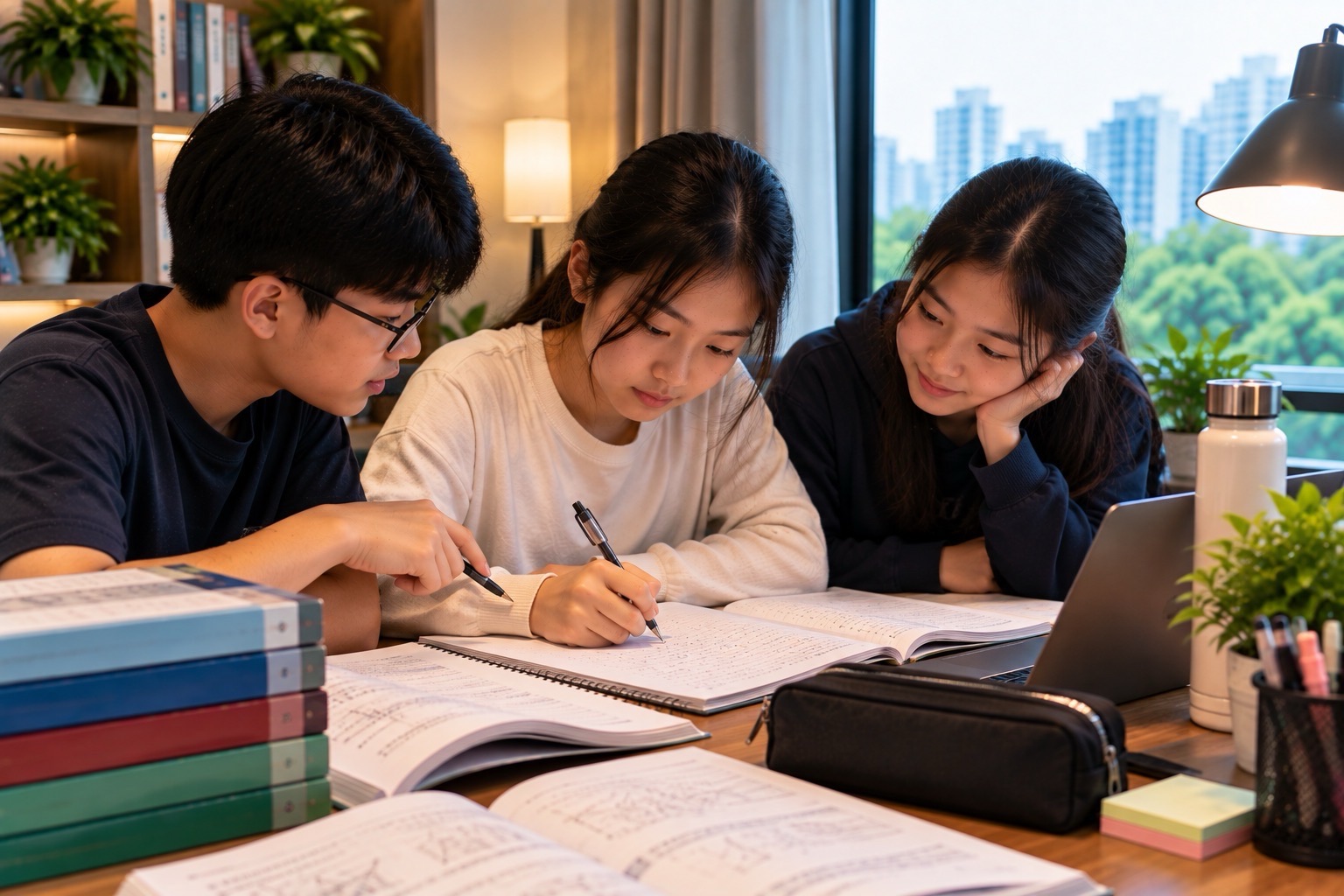
G3 Chemistry K324 and G3 Nutrition and Food Science K346 both explain how materials and food-related processes behave, but they are different Singapore-Cambridge Secondary Education Certificate (SEC) subjects. Chemistry examines particles, bonding, reactions, chemical quantities, acids, salts, electrochemistry and other chemical systems. The verified 2027 Chemistry syllabus requires three papers: a one-hour MCQ paper worth 30%, a 1-hour-45-minute structured/free-response paper worth 50%, and a 1-hour-50-minute supervised practical worth 20%. Nutrition and Food Science examines nutrition and health, food literacy and culinary science. Its 2027 assessment has a two-hour written Paper 1 worth 40% and a 28-hour supervised coursework Paper 2 worth 60%, including investigation, planning, practical food preparation, sensory evaluation and an electronic 20–25-page report. These assessments are not interchangeable and neither should be reduced to recipe memorisation.
For Punggol families choosing Secondary 3 in 2027, the normal final SEC year is **2028**, so the 2028 syllabuses and school coursework instructions become authoritative once published. The immediate action is to check whether the actual school offers Pure Chemistry K324, Nutrition and Food Science K346 or both in the allowed Year 3 combinations. A cooking CCA does not guarantee K346 registration, and a student’s interest in health does not automatically mean the subject satisfies future biomedical or dietetics prerequisites. Compare the teenager’s ability to explain an unfamiliar reaction, interpret scientific data, design a meaningful food investigation and sustain written or supervised work. The right option is a genuine offered course that fits the pupil’s interests, prerequisites, total timetable and realistic post-secondary plans.
- Verified 2027 SEC codes: G3 Chemistry K324 (former 6092) and G3 Nutrition and Food Science K346 (former 6097).
- Chemistry Paper 1: 1 hour, 40 compulsory MCQs, 30%.
- Chemistry Paper 2: 1h45, structured/free-response questions, 80 marks, 50%.
- Chemistry Paper 3: 1h50 formal practical, 40 marks, 20%; safe school laboratory work and evaluation.
- Nutrition and Food Science Paper 1: two-hour written paper, 100 marks, 40%, with MCQ, structured/data and open responses.
- Nutrition and Food Science Paper 2: 28 hours of supervised curriculum coursework, 80 marks, 60%.
- The 2027 food investigation involves research, testing, practical meal/dish preparation, evaluation and a 20–25-page electronic report.
- Chemistry focuses on molecular-level explanation and chemical systems; Food Science applies relevant chemistry, nutrition, preparation and consumer context.
- Neither route automatically guarantees healthcare, dietetics, culinary, science or engineering admission. Check actual course prerequisites.
- Subject options, laboratory and kitchen facilities and timetable blocks depend on the actual school.
- A Secondary 3 entrant in 2027 normally uses the final 2028 SEC syllabus when issued.
Chemistry vs Food Science | What exactly is being investigated?
Definition lock | Chemistry investigates matter; Food Science studies food as an applied system
Chemistry asks how substances are structured, how they react and why their properties emerge from atomic and molecular interactions. Nutrition and Food Science asks how people make informed food choices and how ingredients, preparation processes and practical constraints affect food products. The subjects overlap when a food process involves chemical change, but the examination objectives are different. A pupil who enjoys understanding why one reaction occurs may be attracted to Chemistry’s broad disciplinary scope. Another who likes combining nutrition knowledge with food-product investigation may value K346. Neither choice should be treated as the easy or prestigious route automatically. The task is to match the learner with the actual school’s offered curriculum and the kind of scientific reasoning they are ready to practise.
Exact subject codes matter more than a generic Science label
K324 is the G3 Chemistry code and K346 is Nutrition and Food Science in SEAB’s 2027 school-candidate directory. Older O-Level workbooks may show former reference codes, but their paper structures or practical tasks may not match the pupil’s final examination-year instructions. Some schools use broad timetable labels such as Science or Food Studies, which can conceal the exact formal entry. Before paying for resources or tuition, ask for the full subject name, code, G-level and expected SEC year. A child entering Secondary 3 in 2027 normally sits the final SEC in 2028, so the 2028 syllabus will govern. The teacher should check if an old question remains appropriate. Accuracy here prevents a student from doing irrelevant work while believing they have revised diligently.
School availability must be confirmed before an elective comparison becomes real
The national directory establishes which subjects can be examined, but Punggol-area secondary schools have different Year 3 combinations, staff and facilities. A Science laboratory may support Chemistry, yet it does not prove that every school offers K346 food coursework. A school’s kitchen or food-enrichment activity similarly does not establish formal Nutrition and Food Science candidature. Schools may set subject-selection criteria and schedule combinations in blocks that cannot all be taken together. Families should obtain the actual Year 3 options form and discuss performance with teachers before assuming a choice exists. A private provider cannot independently enter a mainstream school candidate for an unavailable elective. The first practical fact is the actual offer, not the popularity of the subject title.
Pure Chemistry requires models that connect particles to observations
A chemical change may be visible through colour, temperature or gas formation, but describing the observation does not explain it. Chemistry asks students to use relevant ideas about particles, bonding, rearrangement and energy to account for processes. A pupil might memorise that a metal reacts with acid yet struggle to express a balanced equation or explain what products could form under a particular condition. The better method is to identify the substances, the relevant mechanism and the evidence before predicting the result. Teachers can use appropriate diagrams and safe school demonstrations. Home learning should not attempt hazardous chemical reactions because an online revision article mentions them. A short precise explanation supported by an appropriate model develops more useful understanding than a large list of unrelated reaction facts.
Nutrition and Food Science examines context as well as ingredient chemistry
Food Science can involve physical and chemical changes during preparation, but the course also addresses nutrition, food literacy, sustainability and practical choices for people. A student who enjoys cooking may still need to justify why a particular ingredient, technique or meal is suitable for the task. The correct decision depends on the given target group, intended outcome and constraints. An attractive finished dish alone does not establish scientific understanding. Students should be able to describe what was changed, what was observed and why a chosen process affects texture, appearance or other qualities. The coursework requires reflective analysis, not simply a collection of favourite recipes. The subject is a secondary academic course, not professional dietetic advice for unknown individuals.
Atomic structure and bonding provide Chemistry’s causal foundation
Atoms, ions and molecules form different substances with properties related to their arrangement and interactions. A pupil may know the names ionic and covalent but fail to explain why a material conducts in one state and not another. A teacher should begin with the relevant particle model and what the question actually asks. Does the problem concern charges that are free to move, the strength of attractions or a change of state? Then make the explanation traceable from structure to observable property. Memorising one sentence such as ‘ionic bonds are strong’ cannot address every new material. A fresh unfamiliar example reveals whether the child understands the governing principle. These foundations help when later K324 topics require predicting reactions or explaining practical results.
Chemical equations should preserve matter and meaning
Writing a balanced equation is more than adjusting numbers until both sides look symmetrical. It represents a chemical process under specified conditions and reflects conservation of atoms. A candidate may balance an equation mechanically but name the wrong reactant, or calculate a mole quantity without checking which substance the value represents. A good response begins by identifying the process and relevant formulae, then balances and verifies them. If numerical calculations follow, units and mole ratios must be handled consistently. The technique matters throughout K324 and is distinct from the food investigation’s sensory reporting, although both require precision. The pupil should explain what the mathematical symbols mean rather than reproduce a sequence of memorised operations with no connection to the chemistry.
Acids, bases and salts connect practical observations to particle ideas
A student may learn common indicators and pH colours while struggling to explain reactions involving acids or bases. The course expects appropriate understanding of properties, processes and chemical changes, not simply recall of a colour chart. A safe school demonstration can show an observation; the learner then needs to explain why it follows from the relevant chemical concepts. Household substances should not be mixed for unsupervised practice, even when they are familiar products. At home, families can discuss teacher-provided data and balanced equations instead. A specific error such as misinterpreting pH requires targeted explanation, while an equation-balancing error requires a different intervention. This approach keeps laboratory safety and academic effectiveness together.
Electrochemistry tests electron movement and causal explanation
Electrochemistry can feel abstract because electrical effects and chemical changes occur together. A pupil may know the words oxidation and reduction but confuse which particle is transferred or what a diagram’s arrows represent. Good teaching starts with the nature of the substances, ions and electrons, then explains how the process creates the observed outcome. Students should distinguish an electrical current measurement from a reaction equation and use the relevant model consistently. Controlled school laboratory work may reinforce these ideas, but should not be copied through unsafe home setups. Unfamiliar examination questions often test transfer: can a student apply principles to a new electrolyte or arrangement? Knowing definitions is useful, yet demonstrating a causal sequence makes the knowledge reliable.
Food chemistry should explain why a preparation method changes a dish
Cooking processes can affect structure, texture, colour, moisture and other qualities. A pupil may observe that a result is firmer or softer but not understand the specific property or process responsible. A science-based answer identifies what was done, what changed and which relevant ingredient or heat-related mechanism is involved. Not all foods respond in the same way to a technique, so a memorised rule may mislead when ingredients or preparation conditions differ. A responsible practical investigation needs appropriate food handling, supervision and truthful records. Students can practise interpreting supplied observations to explain the process without inventing laboratory results. An authentic understanding of culinary science is more useful than a beautifully decorated dish whose preparation decisions remain unexplained.
Nutrition knowledge should not become prescriptive personal health advice
K346 includes nutrition and health, but a public examination guide must not give a teenager a personal calorie target or encourage restrictive eating from a hypothetical school task. The academic question is what the scenario states about the target group and how food choices might relate to its needs. People differ in activity, health status, culture, resources and preference. A reasonable examination response explains general nutrition principles while respecting those differences. For real medical conditions, qualified healthcare advice and school procedures are appropriate. A pupil should distinguish evidence-based food literacy from internet claims that one ingredient is universally harmful or miraculous. This critical habit is important in interpreting food labels and making thoughtful practical decisions.
Food literacy includes labels, sustainability and evidence
The subject asks students to consider food choices in the context of real information, including product characteristics and wider consequences. A learner who sees a claim such as environmentally friendly should ask what evidence would support it. A food product may have different impacts depending on sourcing, packaging, preparation, transport and waste. Without data, declaring one option universally sustainable is overconfident. A good response identifies what can be concluded from the supplied material and what remains uncertain. This is similar to scientific evaluation in Chemistry, though its context is different. Teachers can use safe fictional food-product comparisons to develop reasoning without inventing data for actual Singapore companies. The focus is thoughtful decision-making rather than a slogan about shopping.
Chemistry’s three-paper structure sets a specific revision balance
In the verified 2027 K324 scheme, Paper 1 is a one-hour forty-question MCQ worth thirty per cent. Paper 2 lasts one hour forty-five minutes, contains eighty marks and contributes fifty per cent. Paper 3 is a one-hour-fifty-minute practical worth twenty per cent. Students need both quick and extended scientific reasoning, as well as accurate laboratory skills. A learner who only does MCQs may neglect the ability to plan, measure or explain unfamiliar data. Another who completes elaborate explanations may waste time if basic chemical facts remain insecure. Use actual marked work to decide which component needs support. The official scheme sets the balance; a general Science tutorial should not replace it with arbitrary percentages or unsafe practical activity.
Chemistry Paper 2 is not simply a long recall test
The structured/free-response paper can combine short explanatory items, data-based questions and a choice among extended-response tasks according to the syllabus. A child might know the definition of an electrolyte but be unable to interpret a graph of a changing quantity or evaluate a chemical procedure. The most useful teaching move is to identify the question’s demand: is it asking for a description, a mechanism, a calculation or a judgement? Then select only relevant principles and write the reasoning in an organised sequence. A copied textbook paragraph may be correct generally but still fail to answer the specific task. Good revision therefore uses unfamiliar questions, short precise feedback and an independent retry with different surface details.
The Chemistry practical tests scientific integrity as well as technique
K324 practical assessment involves planning, manipulation and measurement, presenting observations and data, and drawing appropriate conclusions with evaluation. Candidates work under authorised school laboratory conditions and exam instructions. A polished graph with adjusted data is not evidence of good experimentation if it misrepresents what was measured. Students should record observations accurately, label quantities and units and identify a relevant limitation. When a result differs from expectation, they should investigate rather than fabricate a better one. An evaluation can suggest a specific improvement while acknowledging constraints of the actual experiment. This form of scientific reasoning can be practised safely using teacher-supplied datasets at home. It is not permission to mix chemicals in a kitchen for exam preparation.
Food Science Paper 1 includes data and extended explanation
The K346 written examination lasts two hours, carries one hundred raw marks and is worth forty per cent. The verified 2027 structure includes fifteen marks of multiple-choice items, fifty-five marks of shorter or data-response questions and thirty marks of open-ended work. A student who enjoys making meals should still be comfortable reading tables, applying nutrition principles, selecting relevant ingredients and explaining food science mechanisms. Answers should be specific to the scenario, not generic claims that every balanced meal requires identical foods. A strong pupil explains cause and effect and recognises limits of the provided information. Short written tasks can reveal whether a misconception lies in scientific vocabulary, task comprehension or data interpretation. More recipes alone will not repair those issues.
Food Science Paper 2 is extended supervised investigation
The coursework contributes sixty per cent and is organised around twenty-eight supervised curriculum hours in the 2027 scheme. It involves researching a food task, investigating relevant factors, selecting and preparing appropriate dishes, recording findings and evaluating outcomes. The finished food is part of the work but not the entire assessment. A pupil’s reasoning about choices and observed results should be visible. The teacher and school control practical facilities, safety, authentic assessment and submission requirements. Parents can support organisation but should not cook the assessed dishes or write the report for the student. A familiar home recipe can inspire a question without becoming a substitute for a formal investigation. The assessed learning is the candidate’s own application of food and nutrition science.
The 20–25-page food report needs evidence rather than padding
The K346 coursework report is word-processed, electronically submitted and approximately twenty to twenty-five pages under the 2027 rules. Those pages should communicate research, decisions, testing, outcomes and evaluation coherently. A photograph of a dish does not independently establish why an ingredient was selected, how a condition was changed or whether the result matched the aim. Tables and sensory observations need interpretation. Students should distinguish factual observation from their explanation and justify improvements. A report filled with generic praise or repeated screenshots wastes its limited space. Authenticity is essential: adult-written analysis or invented results undermine the pupil’s own learning and the examination. The best supporting habit is to record meaningful evidence during authorised work rather than reconstruct events from memory after it ends.
Sensory evaluation is more precise than simply saying food tastes good
In food investigation, sensory qualities can include appearance, texture, aroma and other contextually relevant characteristics. A candidate should identify which quality is being evaluated and compare the outcome with the intended result or criteria. A vague note that the dish was delicious communicates enjoyment but little analytical learning. The student should explain what was observed and what it may imply, recognising that preferences differ and one sensory report does not establish a universal conclusion. Teacher guidance matters for hygienic and safe assessment practice. Families can discuss how to make evaluations more specific using non-assessed examples without controlling the candidate’s coursework. This is a genuine scientific habit: a claim becomes stronger when its observation and limitation are explicit.
The two subjects differ in what counts as a practical test
Chemistry’s Paper 3 is a timed examination in laboratory skills, while Food Science’s Paper 2 is an extended coursework investigation with practical preparation and a formal report. Those are different commitments. A Chemistry student needs to interpret equipment and experimental data accurately under timed conditions. A Food Science student needs to develop and document decisions across a series of supervised tasks. A pupil may enjoy one format but not the other. The school must explain the actual safety arrangements, project calendar and permitted help. An outside tutor should not substitute for practical assessment or complete the student’s report. The right subject choice considers whether the teenager is prepared to learn through the particular evidence and process that the exam assesses.
Mathematics and English support both but do not replace subject insight
Chemistry uses quantities, ratios, units and symbols. Food Science also requires measurements, data comparison and clear written evaluation. A pupil strong in arithmetic may still confuse chemical stoichiometry, while a child who writes fluently may fail to explain why ingredients behave a certain way. A teacher should diagnose the first unsupported decision. In a Chemistry calculation, what does the mole ratio express? In a food investigation, what variable was changed and what was actually measured? When the explanation is correct, practise on a new task without the model. This approach builds transferable evidence-based thinking while respecting that each discipline has its own knowledge requirements. Generic English or Maths tuition cannot automatically substitute for subject-specific teaching.
The total school programme is part of a sensible choice
Upper-secondary pupils may have English, Mother Tongue, Mathematics, Humanities, Science, CCA and other electives in addition to K324 or K346. Food coursework can create concentrated preparation and report deadlines, while Chemistry laboratory and written assessments require sustained revision. A family should look at the school’s actual timetable and the child’s other commitments. Choosing a subject because a friend enjoys it may be less helpful than understanding what the learner must do each week. A manageable schedule provides time for conceptual revision, supervision, independent practice and appropriate rest. Ambition is worthwhile when the pupil can engage with the work meaningfully. Excessive added lessons that repeat the same errors can diminish learning rather than strengthen it.
Post-secondary routes depend on current entry criteria
Chemistry may be relevant to some science, technology, engineering or health-related later courses, while Nutrition and Food Science may develop interest in food technology, consumer science or nutrition-related study. Neither is a professional qualification, and no single SEC elective guarantees an academic or career pathway. Actual JC, polytechnic, ITE and future tertiary programmes have their own subject prerequisites and minimum grades, which can change. A pupil taking SEC in 2028 should check the relevant subsequent admissions exercise and the specific courses of interest. Parents can compare several possible routes and discuss them with the school’s education and career counsellor. The right explanation distinguishes learning value from formal eligibility.
A useful parent meeting ends with one precise educational next step
Bring the school options form and one independent Science script. Ask the Chemistry teacher what the child understands about particles, reaction explanations, calculations and practical data. Ask the Food Science teacher whether K346 is available and what research and coursework readiness look like. A teenager may love cooking but need more confidence in written science; another may prefer abstract molecular models and find report-writing less engaging. Both preferences are legitimate. The meeting should produce a confirmed subject option, teacher-supported understanding of the workload and one specific foundation skill to practise. A small group can help with feedback when relevant, but it cannot guarantee exam entry or grades.
Official SEAB 2027 sources and the final 2028 cohort
SEAB’s official G3 Chemistry K324 2027 syllabus defines the three-paper structure and scientific practical skills. The 2027 G3 Nutrition and Food Science K346 specification sets out the 40/60 written and coursework scheme, including the supervised investigation and report. Both appear in the SEAB school-candidate subject directory. These national codes do not guarantee a subject class at every secondary school; the actual Punggol-area school must confirm its offering and any selection requirements.
For a pupil beginning Secondary 3 in 2027, 2028 is normally the final SEC year. Use the 2028 subject-specific documents when published and check the school’s exact practical and coursework conditions. A general comparison helps a family frame good questions but should never substitute for the teacher’s current instructions or the child’s authentic assessed work.

Twelve common Chemistry and Food Science errors with targeted repairs
A pupil may have an academic misconception about reactions or a practical misunderstanding about coursework. Both require diagnosis, but not the same lesson. The examples below identify a specific first unsuitable step and one independent check so that feedback can be more useful than a generic extra worksheet.
1. Chemistry and Food Science are treated as one course
A learner practises molecular Chemistry papers for K346 but ignores food coursework. Related chemical ideas do not make two courses identical, and the formal paper map must come first.
Check K324 or K346 code and the actual assessment structure. The course map is accurate. Try a fresh teacher-provided question, dataset or school document after the explanation to demonstrate independent transfer.
2. A food CCA is mistaken for formal K346 entry
A parent assumes cooking activities prove the school has an examinable subject. A club or enrichment event is not equivalent to school-candidate registration under a national syllabus.
Verify the actual Year 3 subject option and school timetable. Availability is confirmed. Try a fresh teacher-provided question, dataset or school document after the explanation to demonstrate independent transfer.
3. A reaction observation replaces explanation
The pupil says the solution changed colour but does not connect it to a chemical process. Observation is evidence, while a mechanism explains why it occurs. Both are needed where the task asks for cause.
Identify the relevant particles or mechanism and evidence. The scientific claim is causal. Try a fresh teacher-provided question, dataset or school document after the explanation to demonstrate independent transfer.
4. A chemical equation is balanced without correct substances
Numbers match but the equation models the wrong reaction. A symbol equation must represent the actual chemical process before arithmetic balancing can be valid.
Identify reactants and products before applying conservation. The symbolic account is valid. Try a fresh teacher-provided question, dataset or school document after the explanation to demonstrate independent transfer.
5. A mole calculation loses the units
The pupil produces a number but confuses mass with amount of substance. Numbers need physical and chemical meaning. Incorrect units can expose a conceptual mistake.
State quantities, units and correct relationships before calculating. The result is interpretable. Try a fresh teacher-provided question, dataset or school document after the explanation to demonstrate independent transfer.
6. A food investigation has no testable question
A student follows a recipe without describing what changed or why. An investigation needs a defined question and observations, not merely the completion of instructions.
Define the intended quality, relevant factor and observation. The investigation is meaningful. Try a fresh teacher-provided question, dataset or school document after the explanation to demonstrate independent transfer.
7. Food is labelled universally good or bad
A fictional meal plan becomes restrictive advice for every person. Food knowledge should reflect real context and avoid applying one restrictive rule to every person.
Use the task’s actual group and evidence with appropriate limitations. The explanation is responsible. Try a fresh teacher-provided question, dataset or school document after the explanation to demonstrate independent transfer.
8. A sensory evaluation only says tasty
The report lacks a stated criterion or comparable observation. Evaluation needs specific criteria; vague praise cannot justify a scientific conclusion.
Describe appearance, texture or another relevant outcome precisely. The evaluation has evidence. Try a fresh teacher-provided question, dataset or school document after the explanation to demonstrate independent transfer.
9. A coursework report becomes a photo album
The submitted pages show dishes but not reasons, findings or improvements. Authentic coursework includes the pupil’s own decisions and analysis rather than only attractive outcomes.
Document genuine decisions, results and limitations under school supervision. The report reflects learning. Try a fresh teacher-provided question, dataset or school document after the explanation to demonstrate independent transfer.
10. Unsafe home experiments are encouraged as revision
A family tries chemical mixing or hazardous food procedures without proper supervision. School laboratory and kitchen work can involve hazards. Responsible revision does not require unsafe imitation.
Use authorised school practicals and provided data for home analysis. Preparation is safe. Try a fresh teacher-provided question, dataset or school document after the explanation to demonstrate independent transfer.
11. One practical format is mistaken for the other
A pupil expects Food Science’s extended investigation to be a short Chemistry-style lab test. The same word practical can describe different assessment formats. Their time and authenticity conditions matter.
Compare 1h50 Chemistry practical with the 28-hour food coursework. The workload is understood. Try a fresh teacher-provided question, dataset or school document after the explanation to demonstrate independent transfer.
12. 2027 papers are used without 2028 verification
A Secondary 3 entrant in 2027 assumes all paper details remain fixed for SEC 2028. Final examination-year documents are authoritative for their own cohort, not permanently interchangeable.
Check the final 2028 examination syllabus and school guidance. The cohort is aligned. Try a fresh teacher-provided question, dataset or school document after the explanation to demonstrate independent transfer.
Eight-week Chemistry or Food Science foundation plan
This illustrative home-learning schedule uses conceptual questions and safe provided information. It does not authorise chemicals, controlled cooking work or the production of formal coursework outside the supervising school. The student’s actual teacher and 2028 examination rules govern practical arrangements.
Week 1: Confirm subject access
Read school combinations and the K324/K346 paper specifications. Only the actual school can confirm which elective and Science subjects fit its timetable and entry rules.
Independent progress check: The option is available. Keep the original answer, a precise correction and a later unfamiliar task showing whether the method works.
Week 2: Study particle reasoning
Explain a fresh chemical property or reaction using a relevant model. Microscopic explanations should follow the evidence and specific conditions.
Independent progress check: The explanation goes beyond observation. Keep the original answer, a precise correction and a later unfamiliar task showing whether the method works.
Week 3: Check chemical quantity skills
Attempt an unfamiliar equation or quantity task with correct units. A correct numerical answer includes a model of the actual quantities and relationships.
Independent progress check: The calculation is justified. Keep the original answer, a precise correction and a later unfamiliar task showing whether the method works.
Week 4: Examine food processes
Interpret safe teacher-provided evidence about a preparation change. Provided food datasets enable safe explanation of cooking processes without undertaking assessed work at home.
Independent progress check: The hypothesis and observation relate. Keep the original answer, a precise correction and a later unfamiliar task showing whether the method works.
Week 5: Practise food and nutrition literacy
Discuss a fictional meal or label using evidence without making personal diet prescriptions. Scenario-based nutrition questions are educational reasoning rather than individual health advice.
Independent progress check: The argument is contextual. Keep the original answer, a precise correction and a later unfamiliar task showing whether the method works.
Week 6: Compare practical formats
Interpret a timed chemistry practical scenario and an extended food investigation report. Comparing formats helps families understand where supervised learning time and report-writing occur.
Independent progress check: The methods are distinguished. Keep the original answer, a precise correction and a later unfamiliar task showing whether the method works.
Week 7: Develop data explanation
Read a new table and describe what it shows, its limitations and possible next questions. Unfamiliar data distinguish understanding from memorised wording.
Independent progress check: Conclusions remain proportional. Keep the original answer, a precise correction and a later unfamiliar task showing whether the method works.
Week 8: Review the whole school timetable
Discuss current course options, Science readiness and later prerequisites with teachers. The subject decision should reflect genuine interests, current performance and the full school workload.
Independent progress check: The decision is realistic. Keep the original answer, a precise correction and a later unfamiliar task showing whether the method works.
Frequently asked questions for Punggol parents
What is the difference between K324 and K346?
Chemistry studies chemical substances and processes broadly; Nutrition and Food Science applies food, nutrition and investigation. Confirm formal subject availability, school safety rules and any relevant future course prerequisites before making an individual decision.
How is Chemistry examined?
The 2027 scheme is MCQ 30%, structured/free-response 50%, practical 20%. Confirm formal subject availability, school safety rules and any relevant future course prerequisites before making an individual decision.
How is Nutrition and Food Science assessed?
The 2027 scheme is written 40% and supervised coursework 60%. Confirm formal subject availability, school safety rules and any relevant future course prerequisites before making an individual decision.
What does food coursework involve?
An investigation across 28 supervised hours, with practical preparation, evaluation and a report. Confirm formal subject availability, school safety rules and any relevant future course prerequisites before making an individual decision.
Does Chemistry have a timed practical examination?
Yes. The verified 2027 Chemistry K324 Paper 3 lasts one hour fifty minutes. Confirm formal subject availability, school safety rules and any relevant future course prerequisites before making an individual decision.
Can K346 be taken at every Punggol school?
No national listing confirms that. Check the actual school’s Year 3 offerings. Confirm formal subject availability, school safety rules and any relevant future course prerequisites before making an individual decision.
Does K346 qualify a pupil as a dietitian?
No. It is a secondary academic subject and later professional routes have separate requirements. Confirm formal subject availability, school safety rules and any relevant future course prerequisites before making an individual decision.
What syllabus governs Secondary 3 in 2027?
Normally the final 2028 SEC syllabus, once published. Confirm formal subject availability, school safety rules and any relevant future course prerequisites before making an individual decision.
Punggol science guides and useful teaching support
G3 Chemistry K324 guide · G3 Nutrition and Food Science K346 guide · Food Science vs Sports Science guide · G3 Punggol subject-choice hub. The immutable eduKateSG Clementi tutorial reference illustrates direct answers, first-principles diagnosis and independent retry, without implying a guaranteed K324 or K346 class place.
Final parent decision checklist
- Confirm K324 or K346 availability and the child’s actual G3 subject allocation.
- Compare reaction explanations, chemical calculations and a safe food-investigation reasoning task.
- Understand timed Chemistry practical versus 28-hour Food Science supervised coursework.
- Preserve laboratory safety, food hygiene and authentic student report writing.
- Check the final 2028 syllabus and relevant post-secondary course requirements for the actual cohort.


