
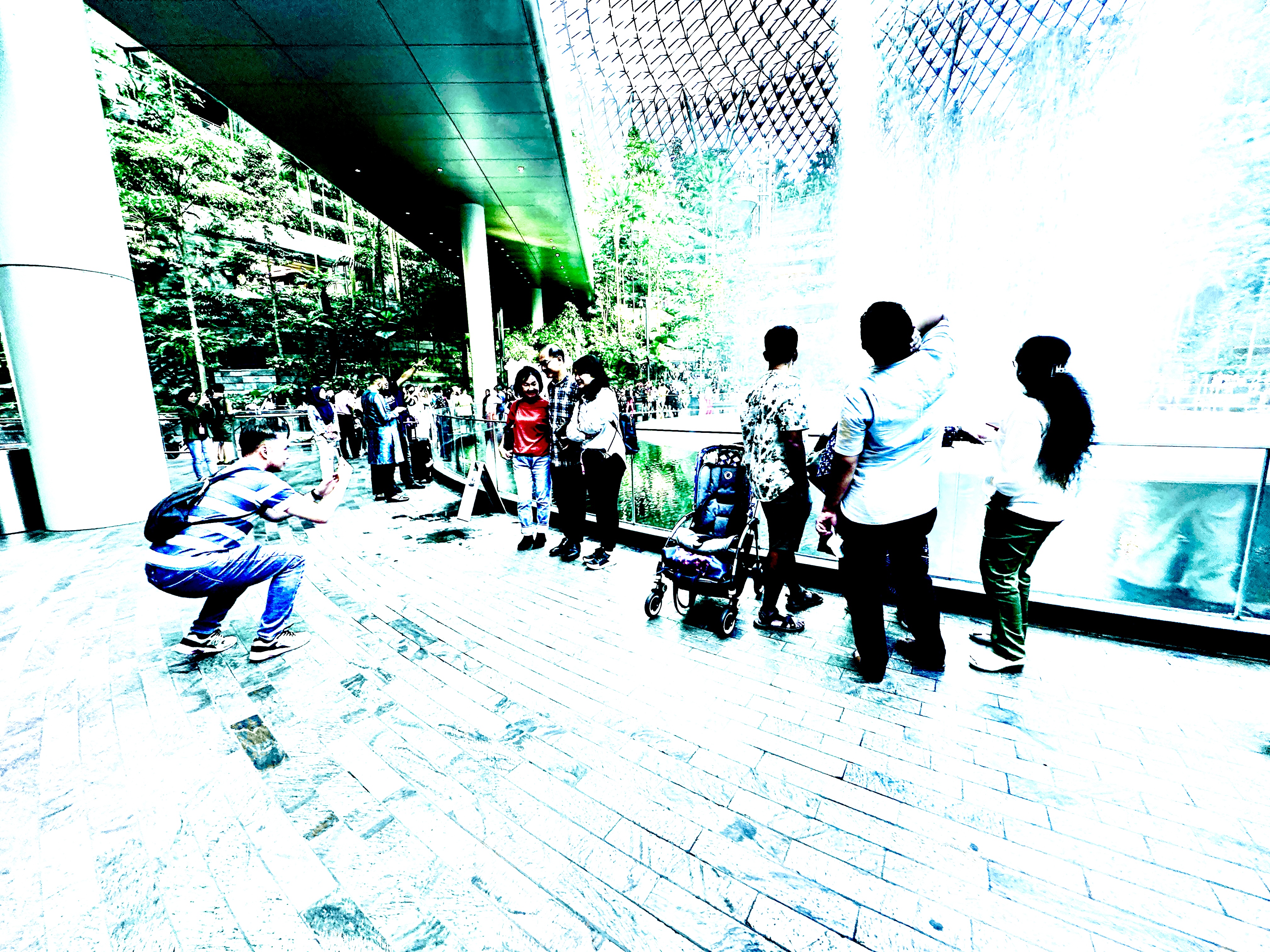
Changi Experience Studio is a ticketed indoor attraction on Level 4 of Jewel Changi Airport. It uses interactive games, projections and exhibits to show how the airport works. At the time of checking, Jewel listed standard tickets at S$25 for adults and S$17 for children aged 5 to 12 and seniors, with separate rates for eligible Singapore residents. Children under 5 enter free under the current studio terms, and child ticket holders need a paying adult with them.
Start with the studio if your group wants the airport games and exhibits. If you only want to see the Rain Vortex, use the separate public area. Canopy Park is another paid attraction on Level 5. For a first visit, allow about an hour to 90 minutes inside the studio as a planning estimate, with extra time for getting there, queues and any other Jewel stop. Check the current rates, hours and private-event notices for your 2027 date.
- Go to Jewel Level 4 and follow the Changi Experience Studio signs.
- Standard rates when checked: S$25 adult and S$17 child or senior. Verify live prices and eligibility.
- Studio child category: 5 to 12. Children under 5 currently enter free. Check accompaniment and activity guidance.
- Current regular hours: weekdays from 11 am, weekends and public holidays from 10 am. Last admission normally 7 pm.
- Choose the studio for airport operations and digital games. Rain Vortex and Canopy Park are separate visits.
Decide whether this is the right Jewel attraction
Choose the studio for the airport story
Changi Experience Studio is an interactive exhibition about Changi Airport. Jewel describes around 20 interactive touchpoints across 10 content zones. Visitors can look at airport history, see examples of work behind the scenes and try games inspired by airport activities. Choose it if those subjects interest your group or if you want a paid indoor activity with a clear starting point.
The studio is useful for a family that has already seen the waterfall or wants a more structured activity. An adult can spend time with the exhibits, while children may prefer one or two games. You can go through at a pace that suits the group. Individual exhibits and access may vary, so ask about a particular activity if that is the main reason you are buying tickets.
Before choosing the visit, decide what would make it worthwhile. A child might want to try an airport game. An adult might want to see how the terminal depends on different teams. Someone interested in travel may enjoy seeing the network of destinations. Giving each person one purpose makes it easier to choose what to spend time on.
Compare the studio with the waterfall and Canopy Park
The Rain Vortex is a public Jewel attraction with its own access and operating arrangements. The studio is a separate ticketed experience. Start with the public plan if your group mostly wants a photograph of the waterfall and a meal. If you want hands-on games and more time indoors, use the studio as the main activity and add the waterfall only if the public area is open.
Canopy Park is on Level 5 and includes a different set of attractions. Its basic admission does not serve as a studio ticket. Jewel advertises some products that combine attractions. Read the exact inclusions before choosing one. A family may get more from one experience it actually wants than from a package containing several stops and rules.
When travelling with another household, agree whether you are buying the same experience or just meeting at Jewel. Someone can visit the studio while another part of the party looks around the public areas. Use a named place and level for the reunion. Follow the child accompaniment requirements if the group splits.
Work out tickets, hours and how much time to allow
Read the studio’s own age and rate categories
Jewel’s studio page lists a standard rate of S$25 per adult and S$17 per child or senior at the time of checking. It lists eligible Singapore resident rates of S$19.80 for adults and S$14.80 for children, students or seniors under the relevant terms. Check eligibility and proof for each visitor. Some student discounts have restrictions on the days when they apply.
The current standalone studio child category covers ages 5 to 12. The official page states that children younger than 5 enter free and that child ticket holders must be accompanied by a paying adult. The senior category starts at 60. Confirm the current rules for the product you buy. A package can display a different child band or additional requirements for its other attractions.
Using the listed standard rates, two adults and two eligible children would total S$84 at standalone prices. At the listed resident standalone rates, the equivalent total for four eligible residents would be S$69.20. Jewel also lists a S$59.80 family value bundle covering two adults and two child or senior tickets. Check availability, purchase conditions and whether the bundle fits your family before paying.
Set a time window rather than a deadline inside the studio
Jewel’s studio page lists ordinary weekday hours of 11 am to 8 pm and weekend and public holiday hours of 10 am to 8 pm, normally with last admission at 7 pm. Confirm the day’s hours and advisories. The attraction can have private events or other changes, and opening hours on a bundle listing may differ from the current main schedule.
For a first visit, allow about an hour to 90 minutes inside if the group wants a few games and exhibit stops. That is a planning estimate, not a promised visit length. Children who want to repeat games may stay longer. Someone who wants a quick overview can choose a few zones and finish early. Give yourself a margin between the studio and any other booking.
If visiting late, work backwards from last admission and closing. Leave enough time to reach Jewel, get to Level 4 and complete the entry process. A last admission time is a limit for entering, so decide whether the remaining time is enough for the experience you want. A short public Jewel visit can make more sense if you arrive too late.
Get to Jewel Level 4

From the MRT and public terminal links
Use the current signs from Changi Airport MRT towards Jewel. Your exact route depends on the terminal side you use. Once you enter Jewel, follow the directory and lifts or escalators to Level 4, then look for Changi Experience Studio. Tell companions the level and attraction name. This is especially useful if they know Canopy Park or the waterfall but have not been to the studio.
From Terminal 1, follow the public signs to Jewel and go up to Level 4. From Terminal 4, use the current public shuttle information and allow extra time. If you are already inside an airport transit area, use Changi’s official guidance to determine whether you can access public Jewel and how much time you need for your onward journey.
If arriving by car or taxi, confirm the appropriate public drop-off before you travel. Choose the lift route to Level 4 if you are carrying a stroller or equipment. A named meeting point near the attraction gives late arrivals somewhere to go without asking everyone to move between levels.
Decide what to do with bags and strollers
Check the attraction’s current admission guidance for the bags or stroller you intend to bring. If you are visiting between airport activities, ask where you can keep larger items and allow time to deal with them before entry. An outing planned around a flight should leave enough time for the entire airport journey. The studio is easier to enjoy when the group can focus on the visit rather than watching the time constantly.
A visitor who needs an accessible route should confirm both the lift approach and access within the attraction. Ask about the specific features that matter. A step-free entrance may be useful even if certain games have different participation arrangements. A family can decide in advance which experiences it wants to prioritise.
Before going in, set the next meeting place if part of the group is doing another activity. Use a clear Level 4 point or a named meal venue. Put the time and route in a message while everyone can check it. That way the studio group can choose a comfortable pace without keeping the rest waiting in the wrong place.
What the games and exhibits can show
Start with the studio’s interactive guide
Jewel’s fact sheet describes a personal interactive Travel Guide used during the visit. Follow the staff’s current instructions and see how it works at the first station. Give younger visitors time to try one interaction before moving on. If there is a queue, let someone else in the group read the signs and choose the next stop.
The studio combines different ways to learn. A display may tell a story through a projection, a game may ask you to respond to something quickly, and another station may explain an airport process. A first-time visitor can try one of each rather than going to every station in order. Ask what is operating on the day if a particular zone matters.
A child interested in aircraft might start with a game and then try one behind-the-scenes exhibit. A visitor interested in design could look at how the projections or interface guide the group. Use one clear question to link the activity to the airport: what is this game or display trying to show about a real job, route or decision?
Pick two or three examples
Jewel’s fact sheet describes Amazing Runway as a multiplayer activity inspired by an airport runway race between a car and an aircraft. Check the current rules and whether it is suitable for the people coming. A visitor who prefers a slower activity can choose another part of the studio rather than waiting for a particular game.
The Sky Deck is described as exploring Changi’s connections with other destinations. Backstage activities focus on work and tasks that passengers may not ordinarily see. These make a useful pair for school-age children: look at where people travel, then consider what has to happen at the airport before a journey can work.
If a game is busy, choose another available feature and check later if you still have time. The activity mix is one reason to allow a flexible visit. Give each child a chance to pick a stop and explain why they chose it. That makes the trip easier to share even when children prefer different things.
Choose an age-appropriate plan
Preschool children and younger siblings
Free admission for children under 5 under the current rules is a price condition. Decide separately whether the venue and activities suit the child. An enclosed space with projections or busy games can feel different from the public mall. Check any age recommendation, follow staff guidance and choose a shorter visit if your child mainly wants to look around.
If an older sibling is the main visitor, agree how much time to spend at each activity. A younger child may enjoy the visual elements, while an older child wants to finish a game. With more than one adult, set a meeting point and divide responsibilities where venue rules allow. A simple plan leaves time for a food or toilet stop before heading home.
Ask whether a child can try a particular activity rather than assuming free entry means they can participate in every game. Choose a fallback at the same venue or the public part of Jewel. A short studio visit followed by a familiar meal can be enough for a family with different ages.
School-age children and teenagers
A school-age child can decide whether to start with the airport story, a game or a projection. Give them time to understand what a station asks them to do. After a game, ask which airport task it might represent and whether they could describe it to someone else. A teenager might compare an activity with what they have seen while checking in or waiting for a flight.
For a small group of friends, choose a fixed time to reunite and decide which games are the main stop. You can use the rest of the visit for exhibits that suit individual interests. Follow the current admission and supervision rules if visiting with children. A group that wants to spend longer can schedule a separate meal after the studio.
At the end, connect one thing from the studio with something you can see in the public airport or at Jewel. Look at how signs direct people, where travellers wait or how different transport connections fit together. This makes the visit more memorable without requiring you to add another paid attraction.
What a family can get out of three kinds of exhibit
Look at a real job behind a game
At a game about airport work, let children watch the instructions first. Ask what success requires: recognising a sign, coordinating an action, keeping track of several things or responding quickly. Then play a round if the feature is open and suitable. Afterwards, ask which part felt easy and which part required more attention. A group can learn something about the way work is organised even if nobody gets a high score.
An older child can compare the game’s rules with what a real worker might have to consider. Real airport teams have procedures, equipment and responsibilities the game cannot cover. Choose one detail the exhibit explains and look for another source if the child wants to know more. A short question about how people communicate or share a task can lead to a more useful discussion than trying to remember every screen.
If the game is busy, have a child describe what they see while waiting, then choose whether to stay. A visit is still worthwhile if the group moves to a different available station. Pick a mix of activities so the day does not rely on a specific queue or on one person wanting to play every game.
Use the Sky Deck and public airport signs as a pair
When Sky Deck or another connections exhibit is operating, choose one destination or region to look up. Ask how a traveller might use the airport to reach it and what information they need before leaving. The exhibit provides the wider travel context. A public airport departure display or signs can show what travellers actually need to find while on a journey.
Use only the public areas when making that comparison. There is no need to go through passenger controls. Look for the signs that separate terminals, directions and transport connections. Children can compare a map showing many places with a sign helping someone make one immediate decision. Both are useful because they answer different questions.
If your group has an airport connection, let the actual itinerary determine what you can do. A child can notice signs on the ordinary trip to the terminal without adding another detour. Save the studio or the public comparison for another visit if travel timing is tight. An enjoyable studio visit needs time to read, try things and move between zones.
Choose a projection or visual feature for a quieter moment
Look for one visual experience that suits your group and spend a few minutes with it. A child who does not want to play a game can watch how a scene changes or describe what the pictures make easier to understand. If someone is sensitive to sound, light or enclosed spaces, ask about the experience before entering and use the route that works for them.
A family can compare a visual exhibit with an interactive one. Which information was easy to remember after seeing it? Which made more sense after doing an activity? Give each person a chance to choose. This can make the studio interesting to a visitor who prefers design or storytelling over aviation.
At the end, ask everyone for one example they would tell another visitor. One person may remember a game, another an airport job or a travel route. This is a simple way to judge whether you stayed long enough. If the group has several useful examples, it can be a good time to take a break rather than continuing through every zone.
Use a short route or combine it with one other stop
The studio as the only paid activity
Start with the studio, give it enough time and finish with a public view or a meal. This works if you have a half-day and want to keep the booking simple. Verify current waterfall or Forest Valley access if you are adding a public stop. If your group is ready to leave after the games, use the lift and return route to the station or terminal.
A longer Jewel trip with a separate Level 5 activity
Choose the one activity with the strictest timing and organise the rest of the day around it. Check the relevant tickets, height and age requirements. Allow time for travel between Level 4 and Level 5. If you are considering a bundle, compare its exact inclusions with the places the whole party can use. A ticket that covers several attractions only helps if there is enough time for them.
If you are visiting on a school holiday or weekend, verify any special conditions or notices and decide when to eat. A child may need a break after several games. A named restaurant or public stopping point makes it easier for a mixed group to rejoin. Keep the return plan as simple as the start.
Compare a few ticket and timing examples
One adult, a school-age child and a preschool sibling
At the checked standalone standard rates, one adult and one child aged 5 to 12 would total S$42, with the under-five child listed as free under the studio terms. Check the current conditions and whether an adult must accompany a child at a particular feature. If the preschooler wants only a brief look, choose a small number of exhibits and leave time for a meal or rest. A ticket category tells you the cost, while the visit plan tells you what the family can comfortably do.
Two adults comparing standard, resident and bundle rates
Start with the eligibility of each person. If both adults pay the current standard rate, their standalone total is S$50. If both qualify for the checked resident adult rate, it is S$39.60. A family bundle for four people serves a different group. Compare it only if you have the required mix of visitors and can use all the included tickets. Add another Jewel attraction only once you know what the package covers.
A first visit after school or on a public holiday
For an after-school visit, check the latest admission time and choose a simple plan for the last hour or two. Eat before or after depending on the child’s routine and how much of the visit you want. For a public holiday, use the current holiday schedule and check for temporary notices. Give yourself time to reach Level 4 and decide what to skip if it is busy.
Choose the return route before setting out. With younger children, use a known lift and a named meeting point if people are coming separately. With a group interested in more than one Jewel attraction, write down one fixed booking and treat everything else as flexible. The studio is easiest to enjoy when the visit has a clear end and time to get there.
Check the final details before buying
Save your ticket and the way back
Keep the attraction name, Level 4, the opening information and the ticket category together. Check the day’s advisories before leaving home and again if you are travelling a long way. If the studio is closed at the time you want, pick an independent public or ticketed Jewel activity whose access you can verify.
Save the correct station, terminal or pickup point for the return. A Jewel visit can take longer than expected once you include the airport links and changes of level. A clear finish makes it easier to spend the time inside on the games and exhibits your group actually wants.
Frequently asked questions
Is Changi Experience Studio free?
The studio is ticketed. Jewel currently lists free admission for children below 5 under the studio terms. Check current rates and categories.
How much is a ticket?
When checked, standard tickets were S$25 adult and S$17 child or senior. Check resident rates, bundles and any other eligibility on the live page.
Which level is it on?
Level 4 of Jewel Changi Airport. Follow signs for Changi Experience Studio.
How long does a visit take?
Allow roughly an hour to 90 minutes for a first visit, with extra time for queues, more games or other Jewel stops.
Is the studio suitable for toddlers?
Some younger children may enjoy looking, while interactive activities vary. Check the venue’s current guidance and choose a short visit if that suits your child.
Is it the same as Canopy Park?
No. Canopy Park is a separate Level 5 attraction. Verify the exact inclusions if you buy a package.
Do I need a flight ticket?
The studio is in public Jewel. Buy the attraction ticket that applies to your visit.
Is the Rain Vortex included?
The Rain Vortex is a separate public attraction with its own operating and access information.


