
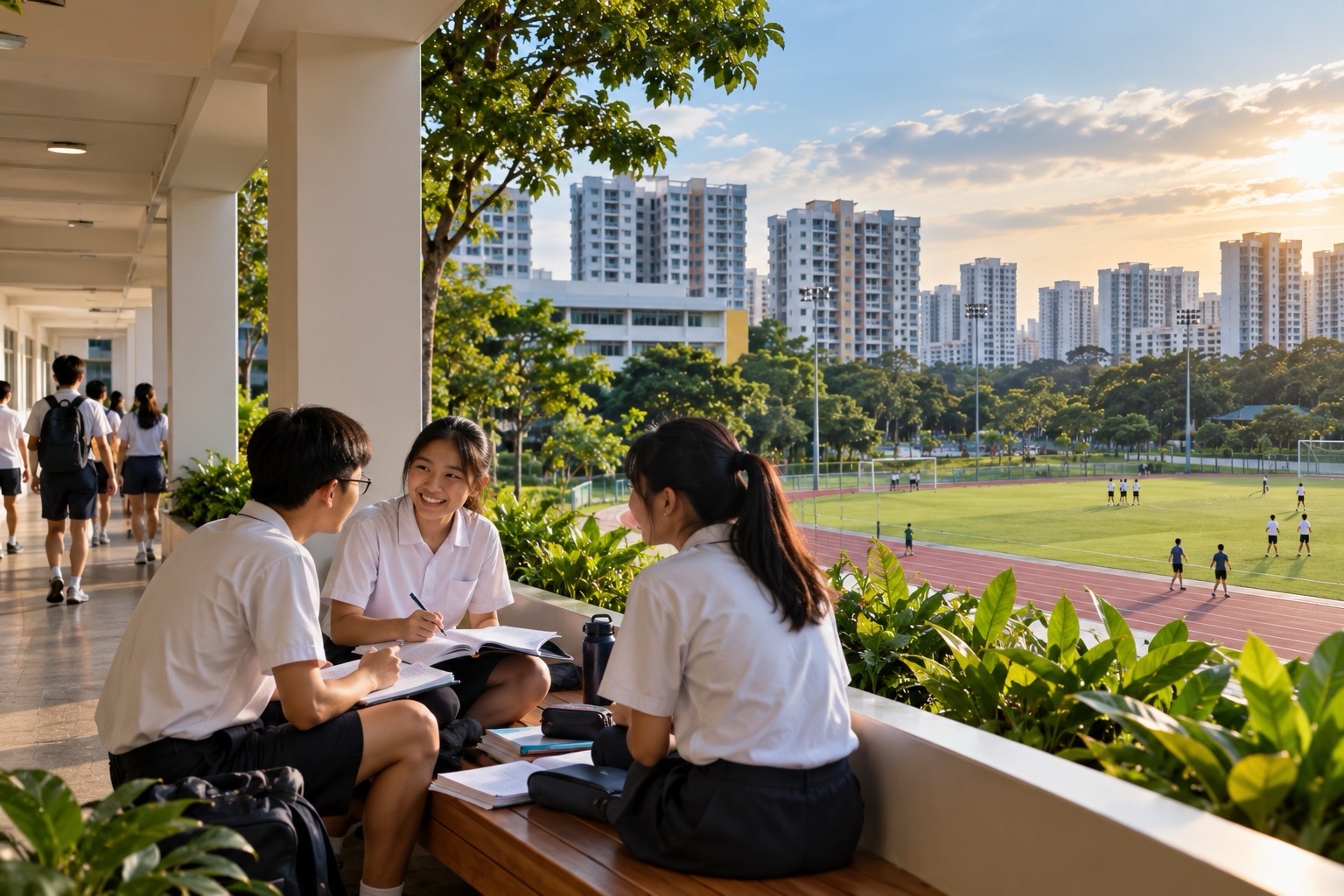
St. Patrick’s School is a government-aided Catholic boys’ secondary school at 490 East Coast Road, Singapore 429058. Eligible families in Punggol may consider it through Posting Group 2 (PG2), but the child’s affiliation category is especially important. The completed 2026 Secondary 1 intake had a non-affiliated PG2 range of 21–22 and an affiliated PG2 range of 21–25. Four primary schools have a formal Lasallian affiliation relationship: St. Stephen’s School, St. Joseph’s Institution Junior, St. Anthony’s Primary School and De La Salle School. Parents must verify which priority category actually applies under MOE rules. These are historical results, not guaranteed 2027 cut-offs, and the journey to East Coast Road should be tested before ranking the school.
The school’s current Applied Learning Programme focuses on STEM Emerging Technologies, including introductory flight principles, gliders, drones, coding and opportunities to explore game design and computational thinking. Its distinctive Learning for Life Programme is Music and Music Technology, with school-wide exposure to ukulele, keyboard, creative arrangements and performance, plus selected Rock Band, visual and performing arts and student-led showcase opportunities. The Lasallian heritage emphasises Faith, Service and Community, while leadership and Values in Action provide wider ways for pupils to develop. A PG2 student may explore science and the arts while actual G2 or eligible G3 academic subjects follow formal Full SBB rules. School-wide experiences and selective CCA or DSA commitments must be kept distinct.
- School: St. Patrick’s School, 490 East Coast Road, Singapore 429058.
- Type: Government-aided Catholic boys’ school in the Lasallian network.
- Completed 2026 PG2 non-affiliated range: 21–22; last admitted 22.
- Completed 2026 PG2 affiliated range: 21–25; last admitted 25.
- Affiliated primary schools: St. Stephen’s, SJI Junior, St. Anthony’s Primary and De La Salle, subject to actual MOE conditions.
- Note: Catholic Junior College belongs to the network but is not an affiliated primary school.
- Full SBB: PG2 is the admission group; G2 is an individual academic subject level.
- STEM ALP: Emerging Technologies, with flight principles, gliders, drones and digital problem-solving.
- Technology extensions: Selected computational-thinking and game-design opportunities.
- School space: An Innovation Hub for design and technology experiences.
- Music LLP: Music appreciation, performance, composition and music technology.
- Tier 1 music: Ukulele, keyboard and music-making with ICT for the broad student body.
- Selected music: SPS Rock Band interest group, performing arts CCAs and lunchtime showcases.
- Lasallian values: Faith, Service and Community, with a strong boys’ school identity.
- Next step: Check affiliation, official subject levels, DSA obligations and commute from Punggol.
Definition lock: Posting Group, subject level and affiliation
Posting Group 2 is used in the Secondary 1 allocation process under Full Subject-Based Banding. G2 describes the curriculum demand of a specific subject. Affiliation is a separate admissions consideration connected with qualifying primary-school attendance and MOE rules. The three concepts cannot be treated as different names for the same thing.
A boy may enter St. Patrick’s through PG2 but have an eligible subject offered at a more demanding level. Another may study all core subjects at the usual starting level but excel at practical engineering, guitar or leadership. The original PSLE total does not reveal all those strengths.
Parents should read the actual school subject-level offer after posting and avoid purchasing every textbook from a generic PG2 list. A talented drummer does not automatically earn a G3 Mathematics offer, and an academic result alone does not secure a selected band or CCA place.
Two historical cut-offs that must not be combined
St. Patrick’s official Secondary 1 registration and AskGov information give a completed 2026 non-affiliated PG2 last admitted score of 22 and an affiliated result of 25. The full previous ranges were 21–22 and 21–25 respectively. This difference is large enough to change a family’s interpretation of the school shortlist.
A non-affiliated boy scoring 25 must not be told that the previous non-affiliated exercise admitted the same result. That 25 belonged to the separate affiliated category. A child from a qualifying affiliated primary school must still meet current conditions, and no last-year result reserves a new place.
The next allocation depends on applicant demand, available places, the formal preference process and relevant tie-breaking. A historical cut-off is evidence about a completed exercise, not a guarantee of what a future cohort will produce.
The four affiliated primary institutions
St. Patrick’s own school information identifies St. Stephen’s School, St. Joseph’s Institution Junior, St. Anthony’s Primary School and De La Salle School as its affiliated primary institutions. The formal affiliation relationships should be verified in MOE SchoolFinder for the child’s case.
The school’s Lasallian network also includes Catholic Junior College, but a junior college cannot be treated as an affiliated primary school for a current PSLE candidate. Distinguishing institutional relationships from the specific Primary 6 admission benefit prevents confusion.
A child from any one of the four primary schools still needs to follow current MOE posting procedures. A family with an older sibling’s experience should not assume the rules, school demand or tie-breaking will remain identical. Affiliation is useful information, but it is not a substitute for choosing a school the boy actually wants to attend.
A 2026 cut-off does not predict the 2027 outcome
The last admitted score is determined by actual applications and the places available in a completed posting exercise. It may change from one year to another. An applicant meeting the historical result may still fail to obtain a place if the next exercise is more competitive or official tie-breaking operates differently.
A family should rank six genuine choices and understand that choosing a school is not the same as booking a seat. The boy’s permitted Posting Group is an essential input. It is misleading to compare a PG2 result with another school’s PG3 figure as if the categories were interchangeable.
The appropriate conversation is neither blind optimism nor excessive fear. It is to use historical evidence accurately, ask what environment suits the teenager and prepare realistic alternatives.
East Coast Road and the Punggol commute
St. Patrick’s School is at 490 East Coast Road, in eastern Singapore near Marine Terrace. The location is not within Punggol. The family needs to test the actual weekday journey from home, using relevant bus and rail connections rather than assume one universal travel time.
Include walking to the stop, transfers, waiting, safe crossings and the right school entrance. Test the late return too. A boy who attends Music LLP enrichment, a band rehearsal or a sports CCA may finish at a different time from an ordinary classroom day.
A distinctive school culture can justify additional travel, but the benefit should outweigh the effect on sleep, homework and family time. A teenager who becomes chronically exhausted may be unable to enjoy the very programmes that attracted the parents.
The Lasallian heritage
St. Patrick’s traces its history to 1933, when it became a school in its own right after beginning as a branch of St. Joseph’s Institution. Its roots lie in the De La Salle Brothers’ educational tradition. The official history identifies Faith, Service and Community as central Lasallian values.
The heritage may matter to families who appreciate a Catholic boys’ school environment and a tradition of service. But an old institution is not automatically a good fit for every child. Parents should ask what teaching, feedback and student support look like now, not choose solely from historical reputation.
A pupil who learns to treat classmates fairly, acknowledge a mistake and take responsibility for a shared project is living out values more clearly than someone who can only recite a motto.
A boys’ school is a specific environment, not a guarantee
St. Patrick’s is a boys’ secondary school. Some families value a single-sex setting, school culture and particular peer experiences. Others prefer co-educational environments. There is no universal rule that every boy will automatically thrive in one model.
Ask the teenager how he feels about the school, its expectations and ordinary classes. A boy who loves music might value the environment, while another may be more attracted to technology or team sports. Personal fit deserves attention alongside adult preferences.
A boys’ school is also not a reason to stereotype how all students learn. Some boys are reflective, others outspoken; some prefer reading, others practical activity. Good teaching should respond to individual needs, not assume every pupil is motivated by competition.
Catholic ethos and respectful inclusion
The school’s official heritage page describes prayers, reflections, Masses and Catholic societies within its faith tradition. Families should understand the school identity without assuming every student has the same personal religion or that particular activities automatically apply to everybody.
When relevant, ask the school to clarify current expectations and arrangements instead of relying on rumours or a previous cohort’s unofficial explanation. A government-aided school operates within Singapore’s national education system while maintaining its institutional character.
Parents should look for how respect is practised during disagreement, friendships and community service. The values should help teenagers treat others with dignity, not divide pupils by background or academic subject level.
Emerging Technologies as the Applied Learning Programme
St. Patrick’s describes its STEM ALP as a way to help boys become future-ready in a digital world. The school exposes pupils to emerging technologies so they can identify interests and develop knowledge for later educational and career choices.
Its Innovation Hub provides a setting for exploration. The presence of technology is useful when lessons ask meaningful questions: what problem does a tool solve, how does it work and what evidence shows the result is reliable?
A student can enjoy a drone demonstration without understanding the engineering. The deeper learning begins when the boy predicts an outcome, tests one change and explains what happened. Parents can ask what the child now understands independently rather than focus only on a polished device.
Lower-secondary drones and gliders
The official ALP page says lower-secondary pupils learn principles of flight and develop design knowledge through gliders and drones. These models can make force, motion, balance and control more visible than a purely abstract explanation.
A pupil might observe that a glider travels differently after a design adjustment. But the cause cannot be identified confidently if the launch method, environment and several parts change together. Students need to recognise which variables matter and how to compare tests appropriately.
School activities involving aircraft or drones operate under relevant supervision and safety requirements. A family should not reproduce flight exercises in a public park without checking applicable rules and approvals. Responsible engineering includes knowing the limits of a demonstration.
A glider model is not a real aircraft
Models are educational because they simplify a system. A small glider can demonstrate certain relationships but does not reproduce every feature of a full-sized aircraft. Students should learn which assumptions are being made, how a measurement is taken and why results might change outside the test environment.
A team can compare two models, record observations and describe a limitation. A model that fails may produce valuable evidence about the original design. A pupil who identifies a weak assumption has made progress, even if another team’s model travelled farther.
Parents can ask the boy what the first design got wrong, what was revised and which scientific principle guided the change. This teaches more than celebrating one successful flight.
Drone programming and computational reasoning
A drone-programming exercise can introduce sequences, conditions, inputs and controlled movement. The child should know what each command is intended to do rather than copy a sequence without understanding it.
When the system fails, pupils can compare expected and actual behaviour, isolate a plausible fault and test a correction. Changing several commands at once may create an apparently successful output without identifying why.
These habits transfer to Mathematics and Science, where students must locate the first incorrect reasoning step. A teenager who understands a simple programme and can modify it independently has demonstrated useful capability even without creating an advanced commercial app.
The Innovation Hub as a learning space
The school describes a fully furnished Innovation Hub for design and exploration. A useful learning environment offers tools, supervision and opportunities to solve problems, but equipment alone does not guarantee strong education.
A pupil may see a device that looks impressive and still need to ask what it measures or controls. Teachers can make reasoning visible by asking students to explain the goal, constraints and test result.
Parents should distinguish broad ALP access from selected technical clubs or competitions. A school can offer a rich foundational experience without promising every boy unrestricted use of every advanced tool. The important question is what the teenager learns to explain and do independently.
Game design and the Unity workshop example
The school’s ALP page describes a student-initiated Unity game-design workshop held in 2024. Pupils learned to create first-person games, including social-responsibility themes. This is a documented example of extension and peer teaching, not a guarantee that every incoming student will attend an identical workshop.
A meaningful game needs rules, interaction, testing and a clear purpose. If the goal is to communicate a social issue, the content should also be accurate and respectful. Attractive graphics do not compensate for a misleading message.
A child who enjoys game design may explore it further, but the family should recognise that sustained work requires debugging, planning and patience rather than only playing games.
Computational Thinking Interest Group
St. Patrick’s STEM page also describes a Computational Thinking Interest Group for boys who have particular passion and aptitude. Students can pursue more demanding technical tasks and represent the school in selected events.
The school’s 2024 examples include participation in a computational-thinking challenge. Those historical achievements show what certain pupils accomplished, not a promised medal or place for every new member.
A parent should ask how beginners are prepared, which skills are assessed and what additional time participation requires. A child not selected for a technical challenge can still develop sound logical reasoning through the broad ALP and formal Mathematics.
The difference between ALP and an examined subject
Emerging Technologies may expose pupils to programming, drones or cloud computing, but this does not automatically mean every PG2 boy will study an examinable Computing subject at a chosen G level.
Formal upper-secondary subject combinations and prerequisites depend on the school’s current offerings and the student’s readiness. An impressive coding project is relevant experience but not an administrative entitlement to G3 Mathematics or Computing.
Parents should use the child’s actual subject-level offer and upper-secondary briefing instead of extrapolating from a school showcase. Applied experiences can motivate interest, while formal subjects require sustained syllabus-specific understanding and assessment.
Music and Music Technology as the LLP
St. Patrick’s uses the aspiration Every Patrician, a lover of music for its Learning for Life Programme. Its official description includes appreciation of different genres, instrumental performance, composition, recording and music technology.
The programme’s intention is broad enough for boys who have never attended private music lessons. A child may learn basic instrumental skills or discover an interest in sound production before deciding whether to pursue a specialist CCA.
Music can develop listening, coordination, confidence and collaboration. But an enjoyable LLP activity is not automatically an examined Music subject, a professional recording qualification or a guarantee of membership in a competitive ensemble.
Tier 1 music exposure is for the broad student body
The school’s LLP distinguishes Tier 1 exposure for all pupils, Tier 2 engagement for those with interest and abilities, and a further Tier 2+ level of excellence for more highly engaged students.
This is important when a school’s website shows impressive performances. A new Secondary 1 boy may participate in basic music lessons without automatically joining Rock Band or appearing on stage at a major school event.
Parents should ask what ordinary lower-secondary students learn and how the school supports different starting abilities. A pupil may become an appreciative audience member without wanting to be a specialist performer, and that can be a meaningful outcome.
The Ukulele Programme
The formal lower-secondary Music curriculum includes a Ukulele Programme introducing basic instrumental techniques, group collaboration and mini performances. A pupil who has never held the instrument may initially struggle with coordination and timing.
The educational outcome is not that every boy performs at professional level. It is that students learn how practice, listening and group responsibilities affect a shared performance.
Parents can ask what changed after a difficult passage was practised. A child who becomes more accurate and confident through feedback is developing habits transferable to academic work as well.
The exact lesson and assessment arrangements are set by the school.
Keyboard and musical structure
The school also describes a Keyboard Programme teaching melody and chords in a contemporary pop style, with both hands used in assessment. The student may need to understand timing, finger movement and how different musical parts fit together.
A pupil who is confident in one hand may need deliberate practice coordinating both. That is a real learning challenge, not evidence of a fixed lack of talent.
Music practice can teach the value of breaking a complex task into manageable steps, testing improvement and gradually removing support. Parents can recognise that progress without turning every lesson into an additional competitive examination.
Creating music with technology
St. Patrick’s Music LLP includes digital tools and software for composing arrangements, emotional cues and other musical work. Such tasks can let pupils explore how sound communicates mood and how technology supports creative decisions.
Students should understand that a finished track may use sampled or borrowed materials with permission requirements. School rules about copyright, use of external tools and public sharing still apply.
A child who can explain why a sound or pattern was selected has shown more thinking than one who merely pressed a preset and exported a file. Parents can ask what the intended listener should understand and how the pupil revised the work after feedback.
The Secondary 1 music enrichment experience
The official LLP describes a music exposure programme during Secondary 1 orientation, including school ensembles such as the Military Band and Guitar Ensemble. Pupils get the chance to encounter performances and try instruments through guided stations.
This can be valuable for a boy who has never experienced a formal ensemble. He may discover an interest or decide that music appreciation is more enjoyable than specialist practice.
The activity should not be understood as an automatic place in the band or a guaranteed audition outcome. The school issues actual orientation arrangements each year, and families should not copy previous dates into the next cohort’s calendar.
The SPS Rock Band Interest Group
St. Patrick’s has a Rock Band Interest Group for interested pupils, with school-guided jam sessions and a recording studio described on the LLP page. This provides deeper engagement for boys who enjoy collaborative performance.
A band needs more than individual technical ability. Members must listen, agree on timing, prepare for rehearsal and respond when a song does not come together. Those are real collaborative skills.
Selection, access and schedule depend on the school. Parents should ask about the actual work rather than promise that every pupil who likes rock music will be able to join or perform publicly. Sustained interest matters more than a glamorous group name.
St. Patrick’s Got Talent and lunchtime showcases
The school’s LLP lists St. Patrick’s Got Talent and lunchtime performance platforms as opportunities for pupils to share musical interests. These can create authentic audiences and build confidence.
Public performance is not the only measure of musical learning. A student can develop skill through careful practice, listening and small group activities without winning a showcase.
Parents can encourage the teenager to consider why a performance was successful and how the audience responded. A selected appearance is an achievement, but absence from a showcase should not be treated as failure. Actual event arrangements are determined by the school.
The difference between making music and managing a performance
A pupil might enjoy composing on a computer while preferring not to stand on stage. Another may be confident performing but need practice organising equipment or communicating with teammates.
Music LLP can help boys recognise these different roles. A recording requires decisions about sound and sequence, while a concert requires planning, rehearsal and cooperation.
The family should let the child’s interests develop without assuming that all boys need identical outcomes. This is particularly important for a PG2 learner whose academic strengths may also vary from one subject to another.
Values in Action and the Lasallian mission
The Lasallian focus on Faith, Service and Community can connect with school Values in Action. A meaningful project begins with understanding actual needs and following school or partner guidance.
Students should not treat beneficiaries as material for publicity or assume that one group wants the same activity as another. Privacy and consent are essential where community members or personal circumstances are involved.
A boy may demonstrate leadership by organising a small task reliably, listening carefully or revising a plan after feedback. Parents can ask what the teenager learned from the people served, rather than simply how many photographs were taken.
Leadership is more than a title
St. Patrick’s publishes student leadership opportunities across school and co-curricular life. Selected leadership roles have formal responsibilities, but every child can practise managing assignments, communicating fairly and completing commitments.
A student who is confident in sport may need to learn patience with less experienced teammates. Another who is quiet may contribute effectively through careful preparation.
Parents should not promise a council post or a particular LEAPS 2.0 score merely because the school promotes leadership. The best educational outcome is a boy who becomes more capable of acting responsibly and supporting others.
DSA-Sec and genuine talent
St. Patrick’s offers DSA-Sec opportunities across several areas, including sport, performing arts, media or journalism, computational thinking and leadership. The relevant 2026 exercise had many named talent domains, but the exact selection list and dates should be confirmed for the applicant’s year.
A DSA Confirmed Offer remains subject to PSLE eligibility for a Posting Group offered by the school. It is not a waiver of the national entry conditions.
The pupil should be able to explain real training, projects or performance experience. A polished portfolio completed mainly by adults cannot substitute for authentic competence, and a successful allocation carries an expected commitment to the school and talent programme.
Full SBB and the actual academic offer
After a boy is posted, the school provides formal subject-level information. Under Full SBB, a pupil may study eligible academic subjects at different G levels while participating in mixed form-class and common programme experiences.
Parents should check the actual booklist before purchasing materials and ask how later subject-level progression is assessed. A successful STEM workshop does not automatically produce a G3 subject upgrade, just as a music performance does not determine English grade.
The goal is suitable challenge supported by real comprehension and sustained learning. Students should learn to record assignments and seek teacher help when the timetable or task is unclear.
G2 Mathematics through flight and programming
Glider design and coding provide practical reasons to learn variables, measurement and graphs. But a pupil must still develop explicit Mathematics foundations.
Suppose the child expands 3(x + 5) as 3x + 5. The multiplier should apply to both terms, giving 3x + 15. A teacher can demonstrate three identical groups of x + 5 and ask the student to solve another expression independently.
A learner who understands this principle but misreads units needs a different response. Good teaching identifies the first incorrect step and checks whether the principle transfers to a changed problem, rather than assigning many worksheets without diagnosing the misconception.
G2 English: explain evidence accurately
Technology and music projects need clear written and spoken communication. A pupil should identify the audience, explain what was done and distinguish a measured result from an opinion.
For formal English comprehension, practise claim, evidence and explanation. A plausible inference without relevant words from the passage may not answer the question. A fluent presentation does not automatically demonstrate strong written comprehension.
Parents can encourage the child to explain a teacher correction in his own words, then try a new passage. Independent accuracy matters more than a polished AI-generated report the pupil cannot explain.
Science: observe first, explain carefully
A flight model may behave differently after a design change, but that does not by itself prove which factor caused the result if several things changed. Students should learn to identify variables, collect appropriate evidence and acknowledge uncertainty.
The same principle applies to a device that works once in a controlled room but might fail elsewhere. A scientific conclusion should match the conditions tested.
St. Patrick’s STEM programme can motivate these habits, but formal G2 or eligible G3 Science retains syllabus-specific concepts and assessments. Parents can ask what evidence would be needed to support a broader claim, not simply whether the demonstration looked successful.
Digital citizenship and responsible technology
Emerging Technologies introduce online research, coding and perhaps AI-assisted tools. A student should be able to explain what a tool does, recognise its limitations and avoid sharing private information without permission.
A game-design project using borrowed images or music can raise copyright questions. A drone project involves safety and control rules. A chatbot may generate code or explanations that sound correct but fail when tested.
Digital literacy means taking responsibility for these risks while making productive use of technology. The goal is not more screen time for its own sake, but stronger judgement and independent problem-solving.
A sustainable CCA and commuting plan
A pupil considering St. Patrick’s may enjoy an extended technology interest group, sports team or music ensemble. Each adds practice, travel and homework demands. The actual timetable is different for each pupil.
Begin with school hours, the journey from Punggol, dinner and sleep. Add required CCA and any selected programme before deciding whether private tutoring is appropriate.
More scheduled lessons are not automatically better when the child is exhausted. A focused review of one academic misunderstanding and sufficient rest can be more useful than several additional hours of mechanical practice.
The first month at St. Patrick’s
If the boy receives a place, the family should follow current 2027 Secondary 1 reporting, uniform, books and device instructions rather than reuse the 2026 orientation calendar.
During the first week, focus on travel, classrooms and basic routines. In the second, build a reliable assignment record. In the third, ask about an emerging technology or music experience the child found meaningful. In the fourth, review any persistent academic or social difficulty with appropriate school support.
This is an illustrative family routine, not an official orientation schedule. The teenager should gradually become more independent while knowing how to ask for help when needed.
Three fictional family decisions
The non-affiliated applicant. A boy receives a PG2-eligible score of 25 and is interested in the school. His family sees that the previous non-affiliated PG2 last admitted score was 22, not the affiliated 25, and plans realistic alternatives.
The affiliated applicant. Another boy attended a qualifying Lasallian primary school. The family verifies current MOE conditions and uses the correct historical category without assuming admission is certain.
The young music maker. A third boy enjoys music technology but struggles with algebra. The family supports both interests, asking about the school’s LLP while repairing the specific mathematical misconception rather than believing one programme solves every academic challenge.
These examples are fictional, not actual offers or forecasts.
Frequently asked questions
Does St. Patrick’s School admit PG2 pupils?
Yes. The completed 2026 intake included non-affiliated and affiliated PG2 pupils.
What were the historical PG2 last admitted scores?
22 for non-affiliated pupils and 25 for affiliated pupils in the completed 2026 intake.
Which primary schools are affiliated?
St. Stephen’s School, SJI Junior, St. Anthony’s Primary and De La Salle School, subject to MOE rules.
Does affiliation guarantee entry?
No. Current conditions and the actual posting outcome determine admission.
Is St. Patrick’s a boys’ school?
Yes, it is a Catholic boys’ secondary school at East Coast Road.
What does its STEM ALP cover?
Emerging Technologies, including gliders, drones, coding and computational thinking opportunities.
What is its music LLP?
Music appreciation, ukulele, keyboard, creative music technology, performance and selected enrichment.
Does every boy join Rock Band?
No. It is a separate interest group under school arrangements.
Can a PG2 pupil offer an eligible subject at G3?
Potentially, subject to formal MOE and school criteria.
Does DSA waive posting-group compatibility?
No. A pupil must qualify for a Posting Group offered by the school.
Is tuition automatic for every PG2 student?
No. Additional teaching should address an identified need rather than the posting label.
Your Next Step
Check the correct historical non-affiliated or affiliated category, verify the child’s MOE eligibility and read the school’s current STEM and Music LLP pages. Discuss whether the boy would enjoy the ordinary school environment as well as a selected technical or musical opportunity, then test the East Coast Road commute from Punggol.
For general choice strategy, read What is PG2 | Choosing Secondary Schools in Punggol.
Official sources and further reading
- St. Patrick’s official 2026 Secondary 1 posting cut-off information
- St. Patrick’s AskGov affiliation information
- STEM Emerging Technologies Applied Learning Programme
- Music and Music Technology Learning for Life Programme
- School history and Lasallian ethos
- School admissions and current DSA
- MOE SchoolFinder
- 2026 affiliated and non-affiliated PG2 score ranges


