
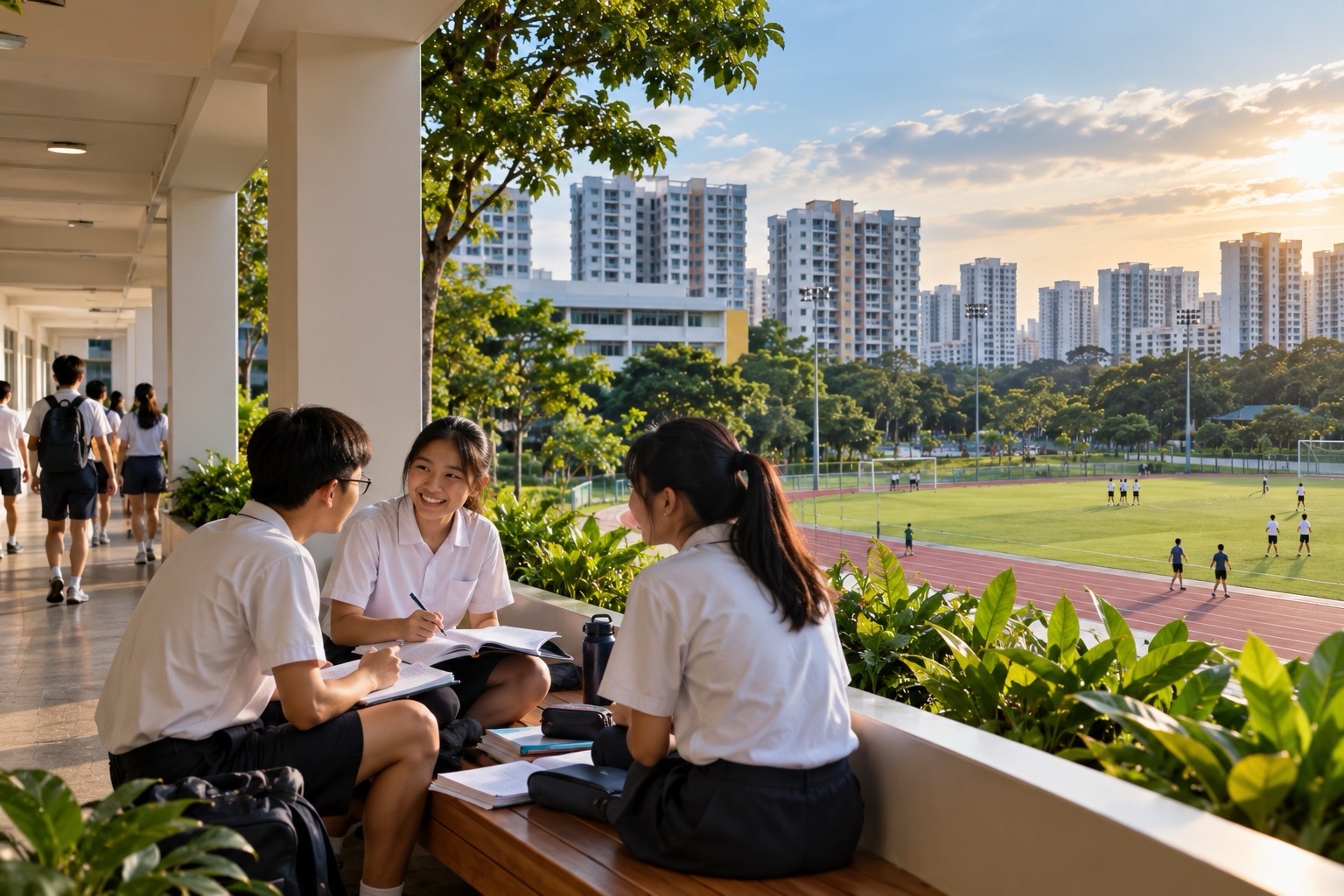
Damai Secondary School at 4800 Bedok Reservoir Road, Singapore 479229, is a government co-educational school that eligible Punggol pupils may consider through Posting Group 2 (PG2). Its completed 2026 Secondary 1 intake recorded a historical PG2 PSLE Score range of 21–25, with 25 the last admitted result. That score is not a guaranteed admission threshold for 2027: the next result depends on actual applicants, preferences, places and MOE’s allocation rules. Families should check the child’s formal Posting Group and current SchoolFinder reference, then assess the real commute from Punggol to Bedok Reservoir Road before ranking Damai.
Damai’s distinctive education connects environmental science with outdoor character development. Its Environmental Sciences and Sustainability Applied Learning Programme builds from Secondary 1 water conservation to Secondary 2 recycling and urban farming, then Secondary 3 climate and food-waste inquiry. The school uses a Curriculum, Campus, Culture and Community approach and describes activities such as Kayak n Klean, ComCrop rooftop farming, design-thinking upcycling and microgreens cultivation. Its Learning for Life Programme uses Water and Adventure Sports, with lower-secondary camps, Secondary 3 dragon-boating and Outward Bound experiences, and Secondary 4 water-sports electives where appropriate. These programmes can help a PG2 learner grow through practical experience, but are not automatic guarantees of specialist sports selection, G3 subjects or later admissions outcomes.
- School: Damai Secondary School, 4800 Bedok Reservoir Road, Singapore 479229.
- 2026 historical PG2 PSLE Score range: 21–25, with last admitted 25; not a fixed 2027 cut-off.
- Full SBB: PG2 is the entry group; individual subjects may be offered at eligible G1/G2/G3 levels.
- ALP: Environmental Sciences and Sustainability, linked to school-wide environmental education.
- Four Cs framework: Curriculum, Campus, Culture and Community.
- Sec 1 ALP: sustainable water use, marine ecosystems, water recycling and conservation.
- Sec 1 VIA: Kayak n Klean waterway clean-up, under approved school safety arrangements.
- Sec 1 learning journey: ComCrop rooftop urban farm, examining space, energy and water.
- Sec 2 ALP: resource management, reuse, upcycling and design thinking.
- Sec 2 VIA: eco-crafting with older people using appropriate reused materials.
- Sec 2 learning journey: Agritisan at Agape Village and microgreens cultivation.
- Sec 3: climate-change discussions, composting and food-waste inquiry.
- Whole school: Earth Day and World Water Day education and stewardship.
- LLP: Character Development through Water and Adventure Sports.
- Lower secondary: Water and Adventure Sports Camp, hiking and climbing electives.
- Sec 3: OBS or cohort camp and Dragonboat Orientation, with emphasis on teamwork.
- Sec 4: appropriate water-sports electives including stand-up paddling or surfing; school controls safety and selection.
- Water-sports CCA: Canoeing for girls and Dragonboat for boys under published school arrangements.
- 2026 DSA: Canoeing, Netball, Rugby, Girl Guides, Choir and Concert Band.
- Parent next action: check current 2027 academic, safety, CCA and journey information.
Definition lock: PG2 admission is not a G2 Science diagnosis
Posting Group 2 is one route into Secondary 1 under Full Subject-Based Banding. G2 describes a curriculum level for a particular academic subject. A pupil who enters Damai through PG2 may offer subjects at different eligible levels according to school and MOE criteria. Water-sports participation and environmental interest are separate capabilities again. A child could be a careful observer yet need help with algebra, or be an excellent swimmer while struggling to organise English explanations. Those are specific learning needs, not a permanent whole-student label. Parents should read the actual subject-level timetable and programme participation arrangements rather than assume that a broad posting category determines academic ability, sport readiness or future career opportunities.
Why a historic PG2 cut-off cannot guarantee a seat
The completed 2026 intake recorded PG2 PSLE Scores from 21 to 25. Lower totals are stronger overall PSLE results, and 25 was the score of the last student admitted to this group in that particular exercise. A new applicant cohort can prefer different schools or create different competition for available places, so the next cut-off may move. MOE’s tie-break rules can also affect pupils at a boundary. The family should not treat the historical number as a reservation. Keep the year and Posting Group beside the score and understand the child’s actual permitted choices. A sensible list includes schools the teenager genuinely wants to attend, rather than only those with a reassuring previous last admitted figure.
4800 Bedok Reservoir Road: the real school location
Damai is at 4800 Bedok Reservoir Road, Singapore 479229, not in Punggol itself. The official contact page lists bus services 5, 21, 59, 65 and 228, together with Bedok Reservoir MRT on the Downtown Line and other rail references. The best journey from a particular Punggol home still depends on where the family begins, connections, traffic and walking. Test a normal morning route and a return after late CCA rather than assume one fixed travel duration. The pupil should learn the correct entrance, safe crossings and a sensible backup route. School fit must account for rest, homework, meals and independent travel, particularly when outdoor activities can be physically demanding.
The school approach: environment as a lived responsibility
Damai’s current ALP integrates environmental topics into teaching and co-curricular experiences. This is useful because environmental problems cannot be understood through one subject alone. A claim about water conservation may require Science, Mathematics and responsible communication. A resource-management design might involve user preferences, costs and safe handling. Pupils should learn to separate a well-intentioned slogan from evidence that a chosen action actually helps. Parents can ask how the school turns classroom ideas into authentic tasks and how pupils reflect after completing them. A school programme becomes meaningful when the child can explain the problem, method and uncertainty, not simply list the environmental activities shown on a website.
Curriculum: the first of Damai’s four Cs
The environmental ALP uses a four-Cs approach: Curriculum, Campus, Culture and Community. Curriculum means that pupils encounter environmental questions in different subjects rather than a single isolated enrichment lesson. A Science class may investigate water, Geography may consider resource distribution, Mathematics may interpret patterns, and language lessons may ask students to communicate an evidence-based recommendation. The school should still maintain the standards of each subject. A visually attractive eco-poster is not a substitute for correct ratios or scientific concepts. Parents can ask which school subject helped the pupil answer a particular question. Being able to transfer knowledge between contexts is one of the aims of applied learning.
Campus: make a green system practical
The Campus component involves activities such as waste management and water conservation on school grounds. A campus provides a manageable environment for observing practices and trying small improvements. Pupils may discover that a proposed solution creates extra work for staff or needs ongoing maintenance. A student should be willing to ask those questions before announcing success. Measurements may also matter: a one-day reduction in visible waste does not automatically demonstrate a sustained school-wide effect. The family can discuss why a plan that appears environmentally friendly may have costs, practical constraints or uncertain outcomes. An applied project is strongest when its claims remain proportional to the available evidence.
Culture: repeat a habit rather than one ceremonial act
The Culture component is about daily choices, not only environmental commemorations. Students might learn to use shared resources responsibly, reduce unnecessary waste or check whether an action has a genuine benefit. A poster produced for one event can attract attention, but the habit matters only if it continues. Parents can ask which behaviour the teenager tried to change and whether it was sustainable alongside ordinary life. A classroom should not shame pupils whose households face different financial or practical constraints. Good environmental education develops understanding and agency, not competition over who can display the most impressive green slogan. Reasonable actions grounded in evidence are more valuable than exaggerated personal promises.
Community: the responsibility to other people
Community involvement can extend environmental learning beyond the school. A class may work with residents, conservation partners or older people under approved arrangements. Service should begin by understanding the actual need and seeking appropriate feedback. Pupils must respect privacy and consent, especially when recording photographs or personal stories. A project designed to reduce waste can be technically clever and still unsuitable for the people expected to use it. The student should learn to ask who benefits, who maintains the solution and which evidence would demonstrate impact. Parents can encourage the child to explain what was learned from participants, not only what the school team gave them.
Secondary 1: the sustainable use of water
Damai’s official August 2026 ALP description identifies sustainable water use as the Secondary 1 focus. Pupils explore sources, human impact on water and marine ecosystems, recycling and reuse technologies. These ideas are important in a city where water security depends on infrastructure and responsible consumption. A child may initially assume that all clear water is safe or that any filtering method provides the same result. Good teaching distinguishes different processes and their purposes. Students should learn to explain what a particular technology can do and what remains uncertain, rather than imitate a demonstration and announce it has solved a national challenge. The school controls the actual experiments and supervision.
Water sources and the scale of a claim
A pupil learning about water may encounter reservoirs, rainfall, water treatment and reuse. These are connected systems, but one classroom observation cannot describe the entire national supply. Students should distinguish a local quantity from a wider trend and recognise that infrastructure and demand affect the outcome. A water-conservation discussion can include households, industry and public systems without assuming every family has the same usage pattern. Parents may encourage the teenager to check official water information and describe how the school concept relates to an everyday choice. Learning to keep the scope of a conclusion accurate is a valuable scientific and civic habit.
Why a water footprint needs correct units
The official ALP says Secondary 1 pupils use Mathematics to analyse water-usage patterns. A water-footprint chart can be persuasive, but quantities must use suitable units and meaningful comparisons. If one household has more residents, comparing total use without considering household size may be misleading. A figure recorded over a week cannot automatically be compared with one recorded over a month. Pupils should be able to explain the denominator, time frame and uncertainty. A graph’s scale may also exaggerate or understate a difference. Parents can ask the teenager to describe what a number means in plain language rather than copy a dramatic figure from an online infographic.
Kayak n Klean: environment and responsibility
Damai’s 2026 ALP describes a Secondary 1 Values-in-Action activity called Kayak n Klean, involving local waterway clean-up while pupils develop environmental awareness. This connects stewardship with a supervised water activity. A student may discover that visible litter can affect aquatic environments and shared public spaces. The experience should not be translated into permission for unsupervised kayaking or a claim that one clean-up fully restores an ecosystem. The school determines protective equipment, instructors, weather-related decisions and appropriate participation. Parents should ask what the child learned about responsibility and the limits of the activity. A pupil who reports an unsafe situation or asks for guidance is exercising good judgement.
Waterway clean-ups: what a bag of litter proves
A student may collect waste during an environmental activity and want to claim the problem has been solved. The amount collected, however, describes a particular location, time and effort. It does not establish the amount of litter elsewhere or the long-term condition of a waterway. A good reflection might identify which items were found, what patterns were observed and what preventive measures could be investigated. Pupils should avoid handling hazardous materials without instructions or photographing identifiable members of the public unnecessarily. The educational outcome is more accurate observation and an appreciation of shared responsibility, not an exaggerated statement about permanent ecological change.
ComCrop rooftop urban farming
Damai’s Secondary 1 ALP includes a learning journey to ComCrop, described as a rooftop urban farm. The programme invites pupils to observe how land, water and energy can be managed in a constrained city. This can make sustainability more tangible than a textbook diagram alone. A student may learn that growing food in a compact space involves technical decisions and maintenance. But a visit does not guarantee that rooftop farming is the most efficient solution under every condition, nor does it create a paid internship for each pupil. The school decides actual learning-journey schedules. Parents can ask what measurement or trade-off the child found most surprising and how the observation connects with Science.
Food security as a problem of systems
The link between urban farming and food security involves more than growing plants successfully. Production needs suitable space, water, nutrients, energy, workers, transport and reliable distribution. A school model can illustrate some of these relationships, but not prove a large-scale food solution. The student should learn to recognise that a technology may perform differently when scaled up. The official ALP’s sustainability focus is educationally valuable when pupils can explain trade-offs and identify what data would be needed before recommending one approach. Parents should encourage evidence-based curiosity rather than a confident prediction that a particular farming technique will solve future national food needs.
Secondary 2: recycling, reusing and upcycling
Damai’s Secondary 2 ALP shifts towards sustainable resource management. Pupils explore recycling, reuse and upcycling through design thinking and eco-crafting. These approaches are related but not identical: a reused object serves another purpose without necessarily undergoing industrial recycling, while upcycling may involve creating a product of greater utility. A child should choose a method based on actual material suitability, safety and need, not merely attach the word sustainable to an attractive craft. The educational value lies in defining a problem, generating alternatives and judging whether the resulting design is useful and maintainable. Parents can ask what the pupil rejected after testing and why.
Design thinking: user needs before creative materials
An eco-crafting activity can become less useful if the team begins by choosing a pretty material without knowing the intended user. Design thinking begins with empathy and a clear problem. For example, a recycled-material object might be designed for an older resident, but the pupil must consider whether it is easy to handle or requires unfamiliar maintenance. A model may look attractive on a presentation table while proving awkward in use. Feedback should inform revision. Students should also respect the person providing it, rather than imply that users are wrong for not enjoying the designer’s favourite idea. This is where environmental reasoning and compassionate leadership meet.
Eco-crafting with senior citizens
The August 2026 ALP page describes students teaching older people to create practical household items from recycled materials as part of Secondary 2 VIA. Such an activity can build patience, communication and respect across generations. It should not be based on the assumption that every older adult has the same interests, physical ability or experience with crafting. Pupils can learn to explain a step in accessible language, ask whether help is welcome and adapt the task appropriately. The school and partner organisation control consent and safeguarding. Parents can ask what the teenager learned from the participants rather than merely count the objects produced or photographs taken.
Food waste and ‘ugly food’
Damai’s Secondary 2 Food and Consumer Education lessons consider food waste and the idea of ugly food. An ingredient’s appearance does not necessarily tell the whole story about suitability or quality, though appropriate food-safety standards remain essential. Pupils should learn to distinguish a cosmetic preference from actual safety information and avoid making unverified claims about what can be eaten. A useful school task may compare how consumers respond to different appearances, but a small survey is not proof of a national trend. Parents can ask which practical decisions might reduce unnecessary waste while respecting budgets, cultural food choices and legitimate dietary needs. The lesson should develop reasoned responsibility, not shame.
Agritisan at Agape Village
The school’s ALP includes a Secondary 2 visit to Agritisan at Agape Village, a local urban-farming operation. Pupils learn about sustainable food production and green career questions, then may participate in appropriate planting and harvesting experiences. This adds a real industry context to classroom discussions of resources and agriculture. The visit is educational exposure, not an automatic employment placement or formal food-science qualification. Students should learn to observe how a system is maintained and what constraints affect its operation. Parents can ask which role or skill the pupil discovered and whether the visit changed an earlier assumption. Actual partner arrangements and timing are determined by the school.
The Microgreens Workshop
A Secondary 2 microgreens activity can teach pupils how living systems respond to environmental inputs and daily care. Growing a small crop requires suitable conditions, attention to time and willingness to record what happens. A student should avoid attributing differences in growth to one factor if several variables changed. A workshop may also show the practical challenge of producing food consistently within limited space. The child can learn that maintenance and measurement are as important as the original planting. Families should not treat the activity as a universal recipe for home food production or a guarantee of crop yield. The learning outcome is accurate observation and reflection.
Secondary 3: climate change and communication
Damai’s Secondary 3 ALP involves discussions of climate change and environmental impacts through English and Mother Tongue lessons. This is relevant because scientific and civic questions need precise communication. A student may encounter claims about emissions, temperature or waste and must learn to verify the source, date and scope. An alarming statistic with no clear context can mislead even when shared with good intentions. Pupils should distinguish a factual observation from prediction, uncertainty and value judgement. School dialogue should encourage evidence and respect, not punish students for asking how a conclusion was reached. Parents can discuss one credible official source and ask what information would change the learner’s interpretation.
Composting and minimising food waste
The Secondary 3 programme includes a learning journey focusing on composting and food-waste reduction. A pupil may discover that organic materials require suitable conditions and time to break down, and that composting is not the same as making waste disappear without effort. The process may involve practical limits, maintenance, odour or material suitability that must be considered. Students should not invent a precise environmental benefit for a school demonstration without suitable measurement. They should follow school safety guidance rather than conduct unsupervised waste-handling experiments at home. A good reflection explains what was observed, what mechanism is relevant and which further information would be needed for a broader claim.
The historic ’30 by 30′ context and future policies
Damai’s ALP webpage refers to Singapore’s historic 30 by 30 food-production initiative. The phrase is useful background for understanding why local food production became a focus of school sustainability education. However, national policies and targets can be updated, so an article written for families preparing for 2027 should not pretend a past target guarantees an unchanged future programme or that a given school project fulfils a national production percentage. Parents should encourage the child to check the latest official Singapore Food Agency information when making a current policy claim. The educational goal is understanding the systems and evidence, not memorising one slogan as a permanent forecast.
School-wide Earth Day and World Water Day
Damai also runs school-wide environmental education around commemorations such as Earth Day and World Water Day. Such activities can bring the ALP to pupils beyond one particular class, but their value depends on what participants understand and do afterwards. A water-conservation pledge should lead to a realistic habit, not merely a photograph. An environmental presentation should make accurate claims and acknowledge limits. Pupils may contribute through English communication, art, data or leadership. Parents can ask which idea the student found surprising and what action is achievable in ordinary family life. The school determines the actual current calendar and activity arrangements rather than every past event repeating identically.
A 2024 marine-conservation showcase as historical evidence
Damai’s ALP page documents an October 2024 marine-conservation education event where pupils interacted with displays and marine life. This illustrates the school’s interest in environmental awareness and biodiversity, but it is a past event, not a promise that the identical programme will be held for each new cohort. A child might learn that aquatic ecosystems involve interacting organisms and that human actions can affect habitats. The pupil should be able to distinguish a displayed specimen from a conclusion about a whole ecosystem. Parents should ask what the educational question was and how the student interpreted the evidence, rather than assume one showcase confers specialist marine-science expertise.
The Learning for Life Programme: water and adventure
Damai’s LLP is Character Development through Water and Adventure Sports. Its July 2026 page describes using real experiences to develop character, values, communication, resilience and leadership. The approach is not just competitive canoeing. The ordinary foundation helps students build friendships and try activities under supervision, while additional electives and CCAs allow greater depth for those with the appropriate interest and readiness. A teenager may feel excited about water or height challenges while another is cautious. The goal is meaningful learning through suitable participation, not pressure for every child to attempt the same difficulty. Parents should ask how the school prepares beginners, differentiates activities and manages legitimate access or health needs.
Lower secondary: Water and Adventure Sports Camp
The official LLP page says character and leadership development begins in Secondary 1 with a Water and Adventure Sports Camp. Such a camp can help new pupils bond, learn to communicate and practise following instructions in a different environment. An unfamiliar activity can feel challenging, and responsible school arrangements should include appropriate training, supervision and safety procedures. A student who reports uncertainty or a physical problem is not necessarily lacking resilience. The learner may gain confidence through an achievable task and learn to support classmates with different strengths. Parents can ask about specific cohort arrangements, consent, equipment and suitable adjustments rather than assume every child completes every activity identically.
Sports Education Programme electives
In lower secondary, pupils may participate in Sports Education Programme electives such as hiking, rock climbing and other adventure sports. These create opportunities to discover interests beyond traditional school games. An introductory session is different from joining a specialist club or receiving a technical certification. A student should understand safety instructions and avoid reproducing unfamiliar activities independently in public spaces. The purpose may include planning, communication and constructive response to challenges as well as physical skill. Parents can ask what the teenager learned about judgement and teamwork. The school decides which electives are offered, how pupils are assigned and how current weather or safety conditions affect activities.
Rock climbing: safety before proving bravery
A supervised climbing activity may help students learn to prepare equipment, follow instruction and decide when they need assistance. Some pupils will be physically confident and others less experienced. A supportive learning experience allows appropriate challenge rather than ridicule. Resilience does not require the student to ignore pain or take unnecessary risk; choosing a safe response is part of competence. After the activity, a pupil may reflect on which movement or decision improved after feedback. Parents should ask how trained instructors supervise the task and what the current school participation arrangements are. A photograph of a high wall is not evidence that every student must climb it or receive an external qualification.
Hiking and route planning
Hiking can teach navigation, preparation, shared responsibility and sensitivity to environmental conditions. A pupil may need to understand a route, carry appropriate supplies and communicate with teammates. The shortest-looking path is not always the most practical when terrain, weather or participant needs differ. Under approved school arrangements, students can learn to make appropriate decisions and ask for help. This experience also connects with daily independent travel between Punggol and school, where a teenager needs to check directions and choose safe alternatives. Parents should discuss the decision-making rather than focus only on distance completed. School hiking activities are supervised programmes, not invitations to unsupervised adventure.
Secondary 3 Outward Bound or school-based camp
The LLP describes a Secondary 3 Outward Bound Singapore Challenge Programme or a school-based cohort camp experience. This is an opportunity to develop teamwork, resilience and communication during a residential setting, subject to the actual arrangements and student suitability. A pupil may discover that planning, listening and patience matter more than individual speed. A cautious teenager can still contribute strongly through preparation and awareness of risks. The family should read the relevant consent, medical and equipment instructions when issued. A past camp photo does not guarantee the exact 2027 programme or every activity. The educational objective is what the student learns about working responsibly with others.
Dragonboat Orientation in Secondary 3
Damai’s Secondary 3 LLP also includes a Dragonboat Orientation Programme. Dragon boating can teach coordination and cooperation because a crew must work towards a shared rhythm and respond to instructions. A talented athlete who ignores teammates may not help the boat perform well. A less confident student may contribute through careful attention and consistency. The official page notes the sport’s cultural significance in Singapore and the region, inviting learning beyond physical movement. Water safety, equipment and instructor direction remain essential. Parents should not treat orientation as equivalent to a competitive team position or permission for independent paddling on a reservoir or waterway.
The cultural meaning of dragon boating
A sport can be both a physical activity and part of a cultural tradition. Damai’s LLP description explicitly encourages pupils to learn about dragon boating’s significance in Singapore and the region. A child should approach that history with respectful curiosity and avoid assuming one event describes every community’s practice. The pupil can ask how teamwork, ceremony and local participation interact, then compare reliable sources. Understanding context can make an outdoor programme more meaningful and support Humanities and language learning. Parents may ask what the teenager discovered beyond technique. The best reflection combines physical experience with an accurate understanding of the wider human story.
Secondary 4 water-sports electives
The official July 2026 LLP page describes Secondary 4 elective experiences including surfing, stand-up paddling and scuba diving, giving older pupils opportunities to discover different water-sports interests. These are school-organised arrangements with suitability, safety and instruction conditions. The presence of scuba diving on a school webpage does not mean every pupil must dive, automatically qualifies for certification or can attempt the activity without medical or professional screening. Parents should obtain actual current eligibility, consent and alternative arrangements from the school. The educational goal is confident, responsible exploration and lifelong activity where appropriate, not a race to complete the most technically demanding experience.
The two water-sports CCAs
Damai identifies Canoeing for girls and Dragonboat for boys as two water-sports CCAs aligned with its LLP. The current school description says members train under professional coaches and may compete in races. These are deeper, sustained commitments beyond the ordinary camp and elective experiences. Families should check CCA allocation, actual training days, equipment and the journey home from school or training venues. A pupil entering via PG2 should not be told that the posting label guarantees or prevents every sports opportunity; the actual CCA criteria apply. Competition awards and LEAPS 2.0 attainment are not automatically guaranteed by membership. The child should choose an activity they genuinely enjoy and can sustain.
Canoeing is not the same as Kayak n Klean
A school might introduce water activities through a clean-up or LLP camp while also offering a competitive Canoeing CCA. These should not be confused. The environmental exercise focuses on stewardship and supervised participation, while the competitive club involves more sustained skill development and its own training expectations. A pupil can benefit from the first without wanting the second. Parents should ask about water confidence, suitable instruction and the actual school rules rather than assume one introductory activity establishes swimming or paddling competence. Both contexts can teach teamwork and risk awareness, but only within their approved safety arrangements. Knowing the distinction helps families choose realistically.
DSA-Sec talent and responsibility
The 2026 DSA talent list for Damai includes Canoeing, Netball, Rugby, Girl Guides, Choir and Concert Band. A child with authentic talent may investigate the current application and selection process, but a DSA Confirmed Offer remains conditional on PSLE eligibility for a Posting Group offered by the receiving school. Successful allocation also carries an expectation to honour the programme commitment. Parents should ask what training or participation would be required across the secondary years. A purchased portfolio, one private trial or an impressive video is not a guaranteed place. An unsuccessful DSA application does not prevent an eligible pupil from taking part in the ordinary Secondary 1 posting process or exploring other interests.
Learning leadership without a formal title
Damai’s environmental and outdoor programmes provide many occasions for pupils to take responsibility: planning a clean-up, explaining a conservation message, preparing equipment or helping teammates participate safely. These are leadership behaviours even when the teenager is not a prefect or CCA captain. Selected senior roles have additional school criteria and should not be promised to everyone. A child who reports an error honestly and works to correct it is practising integrity. Another who notices a classmate needing help may demonstrate empathy. Parents can ask for a specific example of a decision and its outcome rather than focus solely on badges, ceremonies or certificates. Genuine contribution can be modest and still meaningful.
School-home support for academic and wellbeing needs
A newly admitted PG2 pupil may have uneven academic strengths, adjusting friendships or transport difficulties. The family should understand the actual school support channels and communicate specific observations. A teenager who repeatedly misunderstands algebra needs conceptual teaching; one who feels excluded by peers needs appropriate social or safeguarding support. A child who comes home exhausted after a long commute may need a more realistic routine rather than additional worksheets. PG2 by itself is not a special educational needs diagnosis or evidence that tuition is compulsory. Damai’s school curriculum and student-development pages describe support and expectations, but the actual pupil’s needs should guide any response. Respect privacy when approaching staff.
National Digital Literacy and the school’s iPad programme
Damai’s 2026 curriculum index includes a National Digital Literacy Programme page describing its iPad initiative, related purchase or assistance information and support for parents. The presence of digital tools does not mean every online answer is correct or every device makes learning easier. Pupils need to verify sources, protect account credentials and understand school rules about photographing classmates or using AI assistance. A device can support homework and research, but the student should still be able to explain the concept independently. Families should follow the current school-issued device and funding instructions, not copy a previous year’s price or assume every pupil receives an identical arrangement regardless of eligibility.
G2 English: explain environmental evidence carefully
Environmental projects create real purposes for reading and writing. A pupil may need to describe water-use patterns, report an observation or recommend a behaviour change. The student should separate facts from claims that remain uncertain. In formal G2 English comprehension, a common mistake is giving an inference without identifying the supporting words. Use a short claim–evidence–explanation method and ask the learner to apply it to a changed passage. Another student may understand the interpretation but struggle with paragraph organisation. The correction must match the real error. Parents can encourage age-appropriate reading about science and community life while recognising that a polished AI-generated report is not evidence of independent comprehension.
G2 Mathematics: water data and the distributive law
A water-conservation inquiry may involve ratios, averages, percentages, graphs and different units of measurement. A pupil should check that comparisons use the same time period and denominator before concluding consumption changed. Formal Mathematics also requires symbolic reasoning. If the student expands 4(x + 3) as 4x + 3, the multiplier has not been distributed to both terms; the correct expression is 4x + 12. Explain the structure using four identical groups, then test a different expression independently. A child who knows the algebra but misreads an axis needs a different intervention. Good teaching identifies the first error and checks whether the pupil can use the principle on an unfamiliar question.
G2 Science: what a fair environmental test shows
Environmental Science often begins with observations but needs a suitable method before broad conclusions are drawn. A pupil comparing two growing systems should consider light, water, nutrients and starting conditions. If several factors differ, a change in plant growth cannot be confidently attributed to one. A water-filter model may demonstrate removal of visible particles without proving potable water. Students should explain the relevant mechanism and acknowledge what is untested. This is the habit of scientific integrity that supports formal Science assessments and responsible public communication. Parents can ask which additional measurement would strengthen a conclusion and why an initial result should not be overstated.
The first four weeks after posting
If the pupil receives a place at Damai, follow its actual 2027 Secondary 1 registration, booklist and subject-level instructions. Practise the commute to 4800 Bedok Reservoir Road and check the correct arrival procedure. In the first week, focus on class locations and safe travel. In the second, establish one reliable homework record. In the third, discuss a sustainability or outdoor experience and what was learned. In the fourth, review any recurring academic or wellbeing concern and seek teacher guidance where needed. This is a suggested family routine, not an official school timetable. The child should gradually manage more decisions independently while knowing when it is appropriate to ask for help.
Three hypothetical Punggol family decisions
One child has a PG2-eligible PSLE Score of 25 and notices Damai’s 2026 historical last admitted score was also 25. The family uses it as a reference, not a guarantee, and includes realistic alternative preferences. Another teenager is keen on environmental projects but nervous about kayaking; parents ask about supervision and appropriate participation rather than forcing a specialist water-sports CCA. A third pupil enjoys outdoor teamwork but struggles with written Science explanations; the family uses project experience to strengthen evidence-based answers without assuming the LLP replaces formal subject teaching. These examples are fictional and do not predict individual admissions, current vacancies or selection outcomes.
Frequently asked questions about Damai PG2
Does Damai admit PG2 pupils? The completed 2026 range was 21–25. Is 25 guaranteed in 2027? No. What is the ALP? Environmental Sciences and Sustainability. What are the four Cs? Curriculum, Campus, Culture and Community. What is Kayak n Klean? A supervised Secondary 1 waterway conservation VIA activity. Does every pupil join the Canoeing or Dragonboat CCA? No, those are separate water-sports clubs. What is the LLP? Character Development through Water and Adventure Sports. Is every Secondary 4 pupil guaranteed scuba certification? No, current electives have appropriate eligibility and school arrangements. Can a PG2 pupil offer an eligible G3 subject? Potentially under formal criteria. Does DSA remove Posting Group compatibility? No.
Your Next Step and authoritative sources
Check Damai Environmental Sciences and Sustainability ALP, Water and Adventure Sports LLP, Damai Curriculum and CCA information, Damai Contact and transport, MOE SchoolFinder and 2026 PG2 historical ranges. Ask about the current 2027 subject-level offer, water-activity safety and the actual travel from Punggol. The wider PG2 school-selection guide explains six-school posting strategy.


