
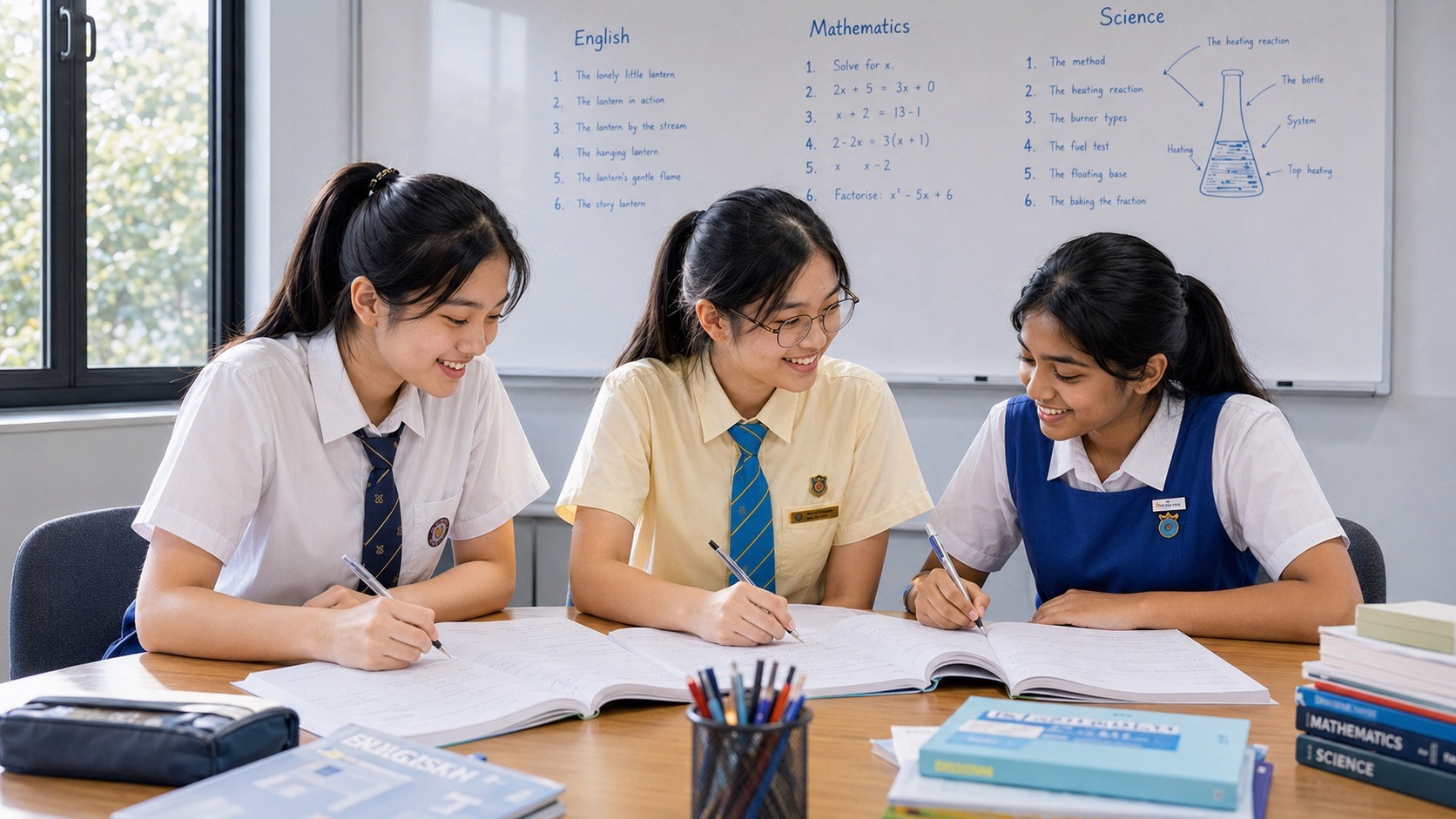
Orchid Park Secondary School is at 10 Yishun Street 81, Singapore 768454, and its historical 2026 Secondary 1 Posting Group 1 (PG1) admitted PSLE Score range was 25–27. The final posted Score 27 belongs to the completed 2026 intake for pupils who took PSLE in 2025; it does not guarantee a school place for students entering in 2027. A Punggol family should verify the child’s official Posting Group, check the current MOE SchoolFinder profile and test travel to the school’s actual Yishun campus. Its June 2026 contact page lists Khatib as the nearest MRT and buses along Yishun Street 81 and Yishun Avenue 4. Orchid Park is a co-educational school, not the same campus as Naval Base Secondary at Yishun Ring Road.
Orchid Park’s signature combination is ARTopIA, an Applied Learning Programme in Art, Music, Dance and Drama, and CORE, a Learning for Life Programme in Community OutReach Education. Its July 2026 arts page describes student performances, creative workshops, school exhibitions, Open Mic sessions and a Secondary 2 Battle of the Bands, together with the MOE Enhanced Art Programme for suitable upper-secondary students. Its June 2026 CORE page sets out three tiers—Engage, Empower and Excite—beginning with sustainability projects in Secondary 1, intergenerational work with seniors in Secondary 2 and longer partnerships or advocacy in upper secondary. Historical projects include energy-waste messages, activities with Sree Narayana Mission Home, anti-scam education and student-led community service. Under Full Subject-Based Banding, PG1 is the school-entry category, while G1, G2 and G3 describe the academic standards of individual subjects. This guide separates core learning, specialist Art and leadership opportunities, official admissions and the realistic daily experience for 2027.
- School: Orchid Park Secondary, 10 Yishun Street 81, Singapore 768454
- Historical 2026 PG1 admitted range: 25–27, final posted Score 27
- 2027 admission depends on current MOE posting; historic results are not guarantees
- Nearest MRT: Khatib; official bus connections include 811 along Yishun Street 81
- School motto: Onward and Persevere; school began in 1999
- ALP: ARTopIA, appreciating and making Art, Music, Dance and Drama
- ALP examples: Open Mic, Secondary 2 Battle of the Bands and theatre experiences
- MOE Enhanced Art Programme offers deeper Art development for eligible upper-secondary pupils
- Specialist arts resources include a Digital Printing Laboratory
- School profile lists lower-secondary Drama-in-Curriculum and personalised digital learning
- LLP CORE stands for Community OutReach Education, supporting civic responsibility
- CORE three tiers: Engage, Empower, Excite; broad cohort service versus selected leadership
- Secondary 1 cohort VIA: sustainability, food-waste reduction, energy conservation and Eco Day
- Secondary 2 VIA: engaging seniors, with a documented Sree Narayana Mission Home partnership
- Secondary 3 and 4: deeper social service agency partnerships and independent initiatives
- Selected student council advocacy includes anti-scam messaging and community collaborations
- STAR talent development is a selected school enrichment pathway, not automatic PG1 admission
- DSA 2026 sports, leadership, arts and visual media have separate school-selection criteria
- Use actual 2027 subject-level, CCA and booklist information after formal posting
Reviewed 6 November 2026. The 2026 PG1 range is historical. The 2027 allocation, specialist Art study, talent development and selected community projects depend on current school and MOE requirements.

Contents: Orchid Park PG1, ARTopIA and CORE
- 1. PG1 entry and G1 academic subjects
- 2. The 2026 PG1 historical 25–27
- 3. Why a cut-off is not an offer letter
- 4. The PSLE Score 25 choice
- 5. The correct Khatib-area campus
- 6. A school founded in 1999
- 7. ARTopIA: the Arts Applied Learning Programme
- 8. What Art Appreciation should include
- 9. Visual Art as a way to express ideas
- 10. Drama-in-Curriculum in lower secondary
- 11. Music as a collaborative art
- 12. Dance and the courage to participate
- 13. Open Mic sessions
- 14. Secondary 2 Battle of the Bands
- 15. Theatre experiences beyond the classroom
- 16. The MOE Enhanced Art Programme
- 17. Digital Printing Laboratory
- 18. Art and design careers are varied
- 19. Performing Arts CCAs and selection
- 20. STAR talent-development pathways
- 21. CORE: Community OutReach Education
- 22. Engage, Empower and Excite
- 23. Tier 1 for every student
- 24. Secondary 1 sustainability and the environment
- 25. Food-waste education at school
- 26. Energy-conservation awareness
- 27. Secondary 2 service with older people
- 28. The terrarium-making example
- 29. Secondary 3 and 4 long-term community links
- 30. Vibrate at Yishun and sports activities
- 31. Community outreach through healthy-living messages
- 32. Anti-scam advocacy in the community
- 33. CCA-based Values-in-Action projects
- 34. Student Council advocacy at Tier 3
- 35. Willing Hearts and appropriate service
- 36. Project Hope and dignity
- 37. The Five Practices of Exemplary Leadership
- 38. Design thinking within service
- 39. Art and CORE can strengthen each other
- 40. School inclusion and peer relationships
- 41. Art, English and explaining meaning
- 42. Mathematics in visual design
- 43. Science and environmental claims
- 44. Mother Tongue and cultural arts
- 45. National Digital Literacy Programme
- 46. DSA, CCA and ordinary admission
- 47. School resource lists and 2027 books
- 48. A fictional pupil discovers the arts
- 49. A fictional group learns to serve seniors
- 50. Comparing Orchid Park, Naval Base and Northland
- 51. Your next step for Orchid Park in 2027
PG1 entry and G1 academic subjects
Posting Group 1 is a national admission category for Secondary 1 after PSLE. G1 is the standard at which one academic subject may be taught under Full Subject-Based Banding, alongside G2 and G3. A pupil entering Orchid Park through PG1 can show different strengths in Art, spoken language, Mathematics and leadership. The entry group does not permanently define every subject or social capability.
Parents should keep the official eligibility notice, formal posting result and the school’s individual subject-level timetable separate. A teenager may enjoy visual design but struggle with a written response, or be comfortable in Mathematics while nervous about performing. Appropriate support addresses the real task and the learner’s readiness rather than treating PG1 as an identity.
The 2026 PG1 historical 25–27
The published 2026 Secondary 1 admitted range at Orchid Park was 25–27 for Posting Group 1. The final posted score was 27 for the cohort that took PSLE in 2025. This is a completed school allocation outcome involving the available places and the preferences entered by that year’s applicants.
A Punggol family should not claim an unconditional 2027 place for a child with the same score. The next cohort’s results, preferences and vacancies may differ. Write the admission year beside any cut-off and follow the current SchoolFinder entry. A realistic shortlist includes schools the pupil would genuinely attend if allocated.
Why a cut-off is not an offer letter
A historical last-admitted score describes the school allocation after an exercise ended. It is not a promise that every eligible applicant with that number will be admitted next year. MOE applies national posting and tie-break rules to the actual group of children submitting their ranked preferences.
Parents should explain uncertainty accurately without frightening the student. A school may be a suitable preference even when its historical cutoff is close to the child’s result, but the family needs alternative eligible choices. No online calculator can issue an official future place.
The PSLE Score 25 choice
The current national framework can make a pupil with PSLE Score 25 eligible to choose between PG1 and PG2. That decision affects the group used for ordinary posting and the general academic demands at the start of secondary school. It should reflect the pupil’s individual strengths and realistic school options, not a prestige contest.
Orchid Park’s historical PG1 score cannot be used as if it were the PG2 cut-off. Follow the official PSLE notice and MOE submission instructions. Where the learner’s subject readiness is uneven, ask for guidance rather than assume that a bigger group number is always the better personal decision.
The correct Khatib-area campus
The school’s official contact page gives 10 Yishun Street 81, Singapore 768454. It identifies Khatib MRT as the nearest station, with buses along Yishun Avenue 2, Street 81 and Avenue 4. Nearby Naval Base Secondary is a different school with its own entrance, booklists and academic programmes.
A Punggol family should test the route at school-morning reporting time and consider the return after CCA. Include train or bus waiting, the final walk and a safe alternative for disruptions. There is no one travel duration appropriate for every home. A school choice must allow the teenager time to eat, study and rest.
A school founded in 1999
Orchid Park’s official history traces its opening in January 1999, initially using Woodlands Ring Secondary School premises before moving to 10 Yishun Street 81 in September that year. The school motto is Onward and Persevere. Its growth included a strong focus on arts, enterprise and wider student development.
History can give students a sense of identity, but it does not guarantee a particular new pupil’s experience. Ask how present teachers encourage learning, respond to difficulty and support healthy relationships. The daily school environment matters more than notable dates from past decades.
ARTopIA: the Arts Applied Learning Programme
ARTopIA is Orchid Park’s ALP exposing pupils to Visual Art, Music, Dance and Drama. Its July 2026 page emphasises hands-on experiences, artistic exploration and 21st Century Competencies. A school arts programme can help pupils appreciate creative forms beyond the hobbies they already know. The purpose is not simply producing a large number of performers.
Parents can ask what ordinary Secondary 1 students actually experience and how beginners learn. A child with little prior art training can still practise observation, expression and reflection. General arts education is distinct from a specialist elective or selected CCA.
What Art Appreciation should include
Art appreciation requires more than stating whether a picture looks attractive. Pupils can consider how material, colour, movement, sound and context shape a message. An unfamiliar work may make a learner curious or uncomfortable, giving the teacher a chance to develop thoughtful interpretation rather than immediate dismissal.
Ask the child what they noticed and which feature supports their opinion. A respectful alternative interpretation may also be reasonable. Critical reflection builds communication and cultural literacy even for a pupil who does not pursue Art as an upper-secondary examination subject.
Visual Art as a way to express ideas
Visual Art can involve drawing, design, materials and decisions about meaning. A pupil may need to think about what a viewer should understand and choose a form that helps communicate the idea. Making art is therefore not simply copying a sample to produce a neat object.
Parents can ask what the student changed after feedback. A small work made independently may demonstrate more learning than an elaborate adult-created piece. The school provides the appropriate tools and safety guidance for specialist activities.
Drama-in-Curriculum in lower secondary
The school’s MOE-derived profile identifies Drama-in-Curriculum for Secondary 1 and 2. Drama can help pupils interpret characters, practise voice and movement and consider how other people understand a situation. This is useful for students developing confidence and language, not only those seeking to become stage performers.
Ask which character motive the teenager considered and what detail supports it. A strong spoken performance does not automatically produce accurate written comprehension, so academic English remains a distinct teaching need. The value lies in connecting activity with independent explanation.
Music as a collaborative art
Music activities can develop rhythm, attentive listening, discipline and the capacity to work with other people. A student may discover that group performance requires coordinated timing and respect for different parts, not simply an impressive solo. The arts programme offers suitable experiences for pupils with varied starting confidence.
Ask how the group improved and whether the child enjoyed the process of practice. A beginner need not have an expensive instrument before attending a school music activity. The school determines equipment, learning goals and any selected performance opportunities.
Dance and the courage to participate
Dance can help students explore movement, expression and shared space. A pupil who has not danced before may feel hesitant, while another who is already confident can learn the value of listening to group timing. Appropriate teaching should encourage growth through feedback without body comparison or ridicule.
Parents can recognise a specific improvement in coordination or willingness to participate. A general arts experience is not automatically a competitive dance audition. The educational aim is confidence, appreciation and teamwork.
Open Mic sessions
Orchid Park’s published ALP features Open Mic sessions that create opportunities for students to share creative expression. Such a platform can make public performance feel more accessible than an elite national competition, while still demanding preparation and respect for the audience.
Parents should ask whether the pupil genuinely wishes to perform and what support is available for beginners. The school decides who participates and when sessions occur. A student can benefit as an attentive listener or backstage helper even without becoming a featured performer.
Secondary 2 Battle of the Bands
The official July 2026 ARTopIA page includes photographs of a Secondary 2 Battle of the Bands, with students performing in a school setting. This illustrates collaboration across instruments and vocals and the discipline required to rehearse. It is a documented programme example, not a promise of an identical event or guaranteed band position in 2028.
Ask the teenager what makes a musical group work together and how members handle mistakes. A student who helps others practise may show valuable responsibility even without winning. Performance recognition is distinct from learning through ordinary arts lessons.
Theatre experiences beyond the classroom
Orchid Park also shows Secondary 3 pupils attending a theatre experience. Watching professional stagecraft can deepen understanding of movement, light, sound, writing and audience interpretation. Such a visit can inspire a pupil without automatically leading to a performing-arts qualification.
Parents can ask what the child learned about how a story was told and why certain staging choices mattered. Past images do not establish the future theatre venue, dates or participant selection. Actual school arrangements determine opportunities.
The MOE Enhanced Art Programme
Orchid Park has been an Enhanced Art Programme school since 2016, according to the official student portal. EAP provides a more intensive Art learning environment for suitable upper-secondary pupils with aptitude and interest. It is distinct from the broad ARTopIA exposure and has relevant academic and school selection criteria.
A new PG1 student entering in 2027 would make later subject decisions when eligible. Parents should not promise EAP entry before the pupil demonstrates sustained interest and readiness. A child can enjoy the ALP without joining the specialist course.
Digital Printing Laboratory
The official school profile mentions a Digital Printing Laboratory supporting advanced visual-art experiences. Such a facility may help pupils explore media and production methods that are unavailable at home. Its educational value depends on teachers guiding technique, safety and the ability to communicate an idea.
Parents should not assume every Secondary 1 pupil has unrestricted access to specialist equipment. Ask which lessons use it and whether the child is interested in the underlying creative work. A school facility is a means to learn, not a guaranteed personal award.
Art and design careers are varied
Students may encounter artistic careers through workshops, exhibitions or conversations with practitioners. Art can connect to illustration, visual communication, product design, cultural institutions and other fields. A secondary-school programme can broaden understanding of these possibilities without fixing a teenager’s career.
Ask what kind of work the child enjoys practising and which academic foundations support it. A school visit to an arts venue does not guarantee a polytechnic or university place. Later admission follows actual qualifications and course criteria.
Performing Arts CCAs and selection
Orchid Park offers arts CCAs such as Concert Band, English Drama, Guitar Ensemble and Modern Dance, alongside Art and Crafts. These can provide sustained practice beyond introductory ALP experiences. Each has its current training schedule, membership process and possible performance obligations.
A Punggol family should consider the late return journey from Khatib when choosing a CCA. A child who loves visual arts may prefer a sport or uniformed group for balance. A meaningful activity is one the pupil enjoys practising regularly, not only a name on a brochure.
STAR talent-development pathways
The official school profile identifies Student Talents and All Rounders, or STAR, as a talent-development programme. Such enrichment can extend pupils with particular readiness or interests. It is distinct from ARTopIA general exposure, and the specific activities and selection criteria should be checked directly with the school.
Parents should not promise entry simply because the child enjoys an introductory workshop. Additional challenge should help deepen real capability without overwhelming academic work. A student can develop well through ordinary school programmes without belonging to every available extension.
CORE: Community OutReach Education
Orchid Park’s Learning for Life Programme is called Community OutReach Education, abbreviated CORE. Its June 2026 page describes developing empowered learners, compassionate leaders and future-ready Orchidians through community service and leadership. The programme combines the Five Practices of Exemplary Leadership with Design Thinking and civic literacy.
The principle is that pupils should learn from community needs before trying to help. A PG1 entrant can contribute meaningfully through class activities while continuing to develop academic subjects. Service should be respectful and useful, not treated as a contest over the number of publicity photographs.

Engage, Empower and Excite
The CORE programme uses three levels described through Engage, Empower and Excite. All pupils begin with cohort service-learning, selected CCA and council leaders can take greater ownership of projects, and pupils with strong motivation may lead advocacy initiatives. These tiers are part of character education rather than separate admissions categories.
Parents should ask which opportunities apply to the ordinary Secondary 1 class and which require formal roles or selection. A student who is not a council member can still learn empathy and responsibility through the core service experiences.
Tier 1 for every student
The official LLP explains that all pupils take part in cohort service-learning and learn to work together on class projects. Programmes are largely curated by the school at younger levels, with increased autonomy as students progress through Secondary 2 to 5. This gives the teenager experience before expecting independent leadership.
Ask the child what responsibility they had and how the plan responded to a genuine need. A small reliable class contribution may be more valuable than a grand event that the pupils cannot manage safely or sustainably.
Secondary 1 sustainability and the environment
CORE begins with a Secondary 1 theme of championing sustainability and environmental responsibility. Its official examples include pupils raising awareness about food wastage and energy conservation through interactive displays and games. The purpose is understanding how everyday choices affect shared resources and what a school community can reasonably improve.
Parents can ask what evidence pupils used rather than praise a poster solely for its colourful design. A school initiative should explain why a change is useful and how success could be assessed. A small accurate explanation is better than an exaggerated claim that one activity solved environmental problems.
Food-waste education at school
Orchid Park’s LLP photographs show students discussing food-waste reduction and leading an interactive Eco Day game. The educational question is why waste occurs and what practical choices could reduce it without shaming classmates about eating habits. The school setting allows pupils to observe real routines and consider feasible changes.
Ask the child what users said and whether a proposed action would actually be followed. A useful project balances convenience and responsibility. Avoid treating the biggest poster or loudest speech as proof of environmental impact.
Energy-conservation awareness
The school’s Secondary 1 service-learning examples also include messages about reducing energy wastage. Pupils may examine when lights or appliances use resources unnecessarily and how ordinary habits can help. Sustainability education should encourage careful measurement and context rather than unsupported claims of large savings.
Parents can ask which quantity would need to be measured before stating a benefit. Learning to separate evidence from an attractive slogan reinforces Science and Mathematics as well as citizenship.
Secondary 2 service with older people
CORE’s Secondary 2 focus is supporting and engaging elderly people through activities. The school documents visits to Sree Narayana Mission Home, with pupils and residents playing games or making terrariums. These experiences can help teenagers understand that respectful service begins with the interests and needs of the people involved.
A pupil entering Secondary 1 in 2027 would normally reach Secondary 2 later, so exact partners may change. Parents can ask what the child learned from listening and whether the activity was suitable. No class should assume that all seniors enjoy identical games or have identical abilities.
The terrarium-making example
The school’s documented terrarium activity illustrates how a shared creative project can support intergenerational conversation and a sense of contribution. Students need to plan appropriate materials, explain steps clearly and give people room to participate independently where possible.
Ask whether the child adapted the instructions after feedback. A terrarium’s attractiveness is less important than the quality of interaction and the participants’ agency. The school and partner organisation determine health and safety arrangements.
Secondary 3 and 4 long-term community links
The LLP describes Secondary 3 and 4 classes building sustainable relationships with a selected social service agency over two years. This can move service from a one-day visit towards understanding an issue and collaborating with a partner repeatedly. Pupils develop project management, facilitation and teamwork skills.
Parents should ask how a group measures usefulness and whether it respects the partner’s real priorities. A longer relationship can be valuable because pupils have time to learn from mistakes. Specific future organisations should not be promised before the school confirms them.
Vibrate at Yishun and sports activities
The official CORE page documents an activity with Vibrate @ Yishun, involving a mini sports carnival and student guidance of participants. Such programmes can teach pupils to adapt instructions and make activities inclusive. Different participants may need different paces or explanation styles.
Ask the teenager how they checked that the game was understandable and safe. A successful event should be judged by meaningful participation, not only the number of stations prepared.
Community outreach through healthy-living messages
Orchid Park’s photographs also describe students sharing healthy-living information with participants at a student-care programme. Explaining wellbeing ideas requires accurate, age-appropriate language and an understanding of the audience. A school activity does not make pupils qualified to provide individual medical advice.
Parents can ask which reliable information was used and whether the audience understood the message. When a health claim is uncertain, students should acknowledge that rather than invent a statistic. Responsible communication strengthens civic literacy.
Anti-scam advocacy in the community
The LLP includes Secondary 4 students advocating against e-commerce scams at Khatib Square, as well as NPCC cadets working with Yishun South neighbourhood police to explain phishing and phone scams. These examples show how school leadership can support practical public awareness and safety.
Ask how the pupils verified their advice and how they spoke respectfully to residents. A teenager should never attempt to investigate scammers personally or share private contact details with strangers. Awareness work requires school and partner supervision.
CCA-based Values-in-Action projects
At CORE Tier 2, CCA and council leaders can organise Values-in-Action activities that use their actual talents. The school documents a Guitar Ensemble visit to Rainbow Centre and a football clinic involving Naval Base Primary pupils. These illustrate that music and sport can be useful community contributions when activities are designed with partner needs.
Parents can ask what the young people prepared and whether participants benefited. A CCA performance is not automatically service unless it responds respectfully to a real context. Selected leadership responsibilities differ from ordinary CCA participation.
Student Council advocacy at Tier 3
CORE Tier 3 is for Community Youth Leaders who want to initiate or support advocacy projects. The school describes pupils leading projects with partners such as Willing Hearts or Project Hope. These may involve food preparation and other supervised forms of practical service.
A new PG1 entrant should not be promised a Tier 3 role immediately. The relevant school selection, preparation and partner arrangements apply. The educational aim is a young person who can mobilise peers responsibly after understanding a genuine cause.
Willing Hearts and appropriate service
The school’s CORE page shows students helping Willing Hearts with food preparation tasks such as packing meals and washing utensils. This demonstrates that useful community service often involves ordinary reliable work, not only speaking on stage. Food safety, supervision and the partner’s operational rules are essential.
Ask what the student learned about responsibility and whether they followed instructions carefully. Avoid posting photographs of beneficiaries without permission. A meaningful contribution is measured by practical usefulness and respectful treatment.
Project Hope and dignity
Orchid Park also documents students working with Project Hope in efforts to maintain homes identified by volunteers. Such service can involve personal spaces and sensitive circumstances. Students must protect participants’ dignity and avoid treating someone’s home as a publicity opportunity.
Parents can discuss why consent, appropriate supervision and quiet reliable work matter. The school and authorised partners determine the actual tasks. An impressive portfolio should never take priority over another person’s privacy.
The Five Practices of Exemplary Leadership
CORE uses the leadership framework including Model the Way, Inspire a Shared Vision, Challenge the Process, Enable Others to Act and Encourage the Heart. These practices help pupils reflect on how their decisions influence classmates and beneficiaries. A student can apply one through a small class task long before becoming a councillor.
Ask the child for a concrete action: did they listen, organise or help someone finish a task? Repeating the framework’s names without understanding does not establish leadership competence. Responsible behaviour is the educational result.
Design thinking within service
A project can fail ethically if students decide what a community needs before speaking to it. CORE uses Design Thinking so pupils can learn about stakeholders, define a problem, test a response and revise after feedback. This approach connects empathy with practical problem-solving.
Parents can ask what assumption changed as the class worked. A proposal that becomes smaller and simpler after listening may be more useful. Successful service does not require a technically elaborate intervention.
Art and CORE can strengthen each other
The combination of ARTopIA and CORE offers possible connections between artistic expression and community needs. A pupil might communicate an environmental message visually or use performance to bring people together. These are educational opportunities only when the school approves the actual activity and the content is accurate.
Ask whom the artwork serves and how the audience understands it. Artistic quality should not be used as a substitute for verified information or respectful representation. A creative approach can be powerful when it reflects genuine user needs.
School inclusion and peer relationships
A new Secondary 1 pupil will meet classmates from different primary schools and academic subject profiles. Shared ARTopIA and CORE activities may provide chances to form friendships beyond subject classes. A pupil who is not confident at speaking may participate through preparing materials or careful listening.
Parents can ask whether the child knows a trusted teacher and feels included in the class. An academic Posting Group should not be a reason for teasing. If an actual safety or bullying concern arises, use authorised school channels and protect minors’ privacy.
Art, English and explaining meaning
A pupil studying G1 English may have a thoughtful idea for a visual artwork but struggle to explain it in sentences. ARTopIA can give a real reason to practise choosing words, describing features and connecting evidence to interpretation. Formal comprehension and writing still need targeted teaching.
Ask the student to name one feature and describe what it contributes to the work’s meaning. If the explanation is vague, repair the connection rather than write the entire critique on the child’s behalf. Independent communication matters more than impressive vocabulary the learner cannot defend.
Mathematics in visual design
Design, photography or printmaking can use dimensions, proportions, angles and scale. These give G1 Mathematics foundations practical significance. A poster may have a good message but become unreadable if its size or layout is wrong. Careful measurement supports effective creative work.
Parents can ask what was measured and how the pupil checked the numbers. If a fraction or ratio is misunderstood, practise that concept at the appropriate level. A successful arts showcase does not automatically change a child’s Maths subject standard.
Science and environmental claims
CORE sustainability projects can involve statements about energy or waste. Pupils should distinguish what they observed from what a broader conclusion would require. A single classroom recycling exercise does not establish an exact impact across a city. Responsible environmental learning needs evidence and an understanding of limitations.
Ask what quantity would need to be measured and whether another factor might affect the result. Avoid turning a creative presentation into an unsupported scientific claim. Accurate reasoning is useful across all subject levels.
Mother Tongue and cultural arts
An ARTopIA activity may expose pupils to arts from different cultural traditions, encouraging appreciation and discussion. A student can have stronger Mother Tongue capabilities than in English or Mathematics, or vice versa. Full Subject-Based Banding can reflect individual readiness where formal eligibility permits.
Parents can support meaningful home reading and conversation while asking teachers about examination writing needs. A higher language level should match sustained readiness and a manageable timetable, not family concerns over the entry label.
National Digital Literacy Programme
The official school profile identifies personalised digital learning and media-production CCA opportunities. Pupils should learn how to use school platforms, protect passwords and evaluate information. Technology is relevant to Art and community advocacy but is useful only when it supports independent understanding.
Ask the child to explain where a source came from and whether they obtained permission before sharing photographs. Do not assume an expensive private subscription is necessary for a school project. The school defines approved devices and assignments.
DSA, CCA and ordinary admission
Orchid Park’s 2026 DSA listing includes sports such as basketball, floorball, football, netball and volleyball, leadership, and performing arts such as Concert Band, Drama, Guitar Ensemble and Modern Dance, along with visual arts opportunities. DSA follows separate annual selection and national academic eligibility rules.
A pupil who attends a regular ARTopIA lesson after posting has not retroactively earned a DSA place. Successful final DSA allocation can require commitment to the chosen school and programme. Families should follow actual results and application dates rather than assume old selection windows remain open.
School resource lists and 2027 books
Orchid Park’s official site and school communications provide information on academics, CCA and administrative arrangements. Incoming Secondary 1 families should wait for the formal 2027 posting and actual G-level subject allocation before buying textbooks or specialised equipment. A historical booklist for another cohort can be unsuitable.
If school costs are difficult, ask about authorised financial assistance. PG1 is not itself an income classification. Budget for correct books, uniform, meals and transport, not an expensive Art kit before school confirms its requirements.
A fictional pupil discovers the arts
Imagine a Punggol child interested in sketching but nervous about speaking in groups. The family researches Orchid Park’s ARTopIA and its 2026 historical PG1 score of 27, but does not assume a 2027 school offer. They also test the trip to Khatib.
If allocated, a suitable introductory Art or Drama task might help the pupil explain a creative idea with more confidence. This is a fictional learning example, not a report about a real student or a guaranteed 2027 session. Academic reading and writing still receive appropriate support.
A fictional group learns to serve seniors
Another imaginary class plans an activity for older people and initially chooses a complicated game. After listening to the partner organisation, the pupils simplify the instructions and allow participants more control. The change makes the experience more suitable and teaches the importance of responsive service.
This invented scenario illustrates the principles of CORE, not a claim about a specific Orchid Park project. A teenager can develop empathy and leadership without a formal position or award. The value is learning to act responsibly.
Comparing Orchid Park, Naval Base and Northland
Orchid Park emphasises arts appreciation and service leadership; Naval Base combines visual Art with sports character education; Northland uses Eldertech and Game for Life. These differences give a Punggol family real educational considerations beyond historical admission scores. A shorter commute to a different school may also affect the student’s wellbeing and ability to participate.
Use the same comparison questions: What experiences are general? What requires selection? What academic support is available? How manageable is the travel? An appropriate school list reflects the teenager’s genuine priorities rather than one website’s prestige ranking.
Your next step for Orchid Park in 2027
Confirm the child’s official PG1 eligibility and current Orchid Park SchoolFinder profile. Read the July 2026 ARTopIA ALP and June 2026 CORE LLP pages, then ask how the new cohort will experience the programmes and which roles require selection. Test the journey to 10 Yishun Street 81.
After formal posting, follow actual subject-level, booklist and registration instructions. Encourage the pupil to explore creative interests, practise independent schoolwork and contribute respectfully to others. PG1 was the admission route; meaningful progress comes from knowledge, expression, responsibility and healthy relationships.
Frequently Asked Questions
Where is Orchid Park Secondary?
10 Yishun Street 81, Singapore 768454, near Khatib MRT.
What was its historical 2026 PG1 score range?
25–27, with the last posted score 27.
Does Score 27 guarantee 2027 admission?
No. Previous cut-offs do not promise a new cohort’s allocation.
What is ARTopIA?
The school’s ALP giving exposure to Art, Music, Dance and Drama.
Does every pupil join Battle of the Bands?
No such guarantee applies; it is a documented school event, with current participation decided by the school.
What is EAP?
The MOE Enhanced Art Programme for suitable upper-secondary Art students, separate from general ARTopIA.
What is the Digital Printing Laboratory?
A specialist visual-art resource identified in the school’s official programme profile.
What does CORE stand for?
Community OutReach Education, the school’s service-learning LLP.
What are the three CORE levels?
Engage, Empower and Excite, from cohort projects to selected advocacy.
What is the Secondary 1 CORE theme?
Environmental sustainability, including food waste and energy conservation.
What does Secondary 2 service involve?
Engaging older people, with historical examples from Sree Narayana Mission Home.
What happens in upper secondary?
Deeper community partnerships and suitable advocacy, subject to actual programme arrangements.
Does everyone become a student councillor?
No. Selected leadership and advocacy are distinct from Tier 1 for all pupils.
Is STAR a guaranteed PG1 programme?
No. STAR is a separate talent-development pathway with school selection and activities.
Does PG1 mean all academic subjects remain G1?
No. Full SBB subject levels depend on individual eligibility and the actual school timetable.
What should Punggol parents check first?
Official eligibility, school programmes, current student support and the complete journey to Khatib.
Official Sources and Related Guides
- Orchid Park official address and Khatib transport
- Orchid Park ARTopIA ALP, July 2026
- Orchid Park CORE service-learning LLP, June 2026
- Orchid Park signature programmes
- Orchid Park history and Onward and Persevere motto
- Official Student Portal: Art, EAP and 2026 admission history
- Orchid Park 2026 PG1 25–27 (independent, verify with MOE)
- MOE SchoolFinder
- MOE Secondary 1 Posting
- Related Naval Base Secondary Art and Sports PG1 Guide
- Related Northland Secondary Eldertech PG1 Guide
Your next step: Check the child’s actual PG1 eligibility, Orchid Park’s current official school information and which ARTopIA and CORE experiences are available to ordinary pupils, then test the Punggol-to-Yishun journey before deciding preferences.


