
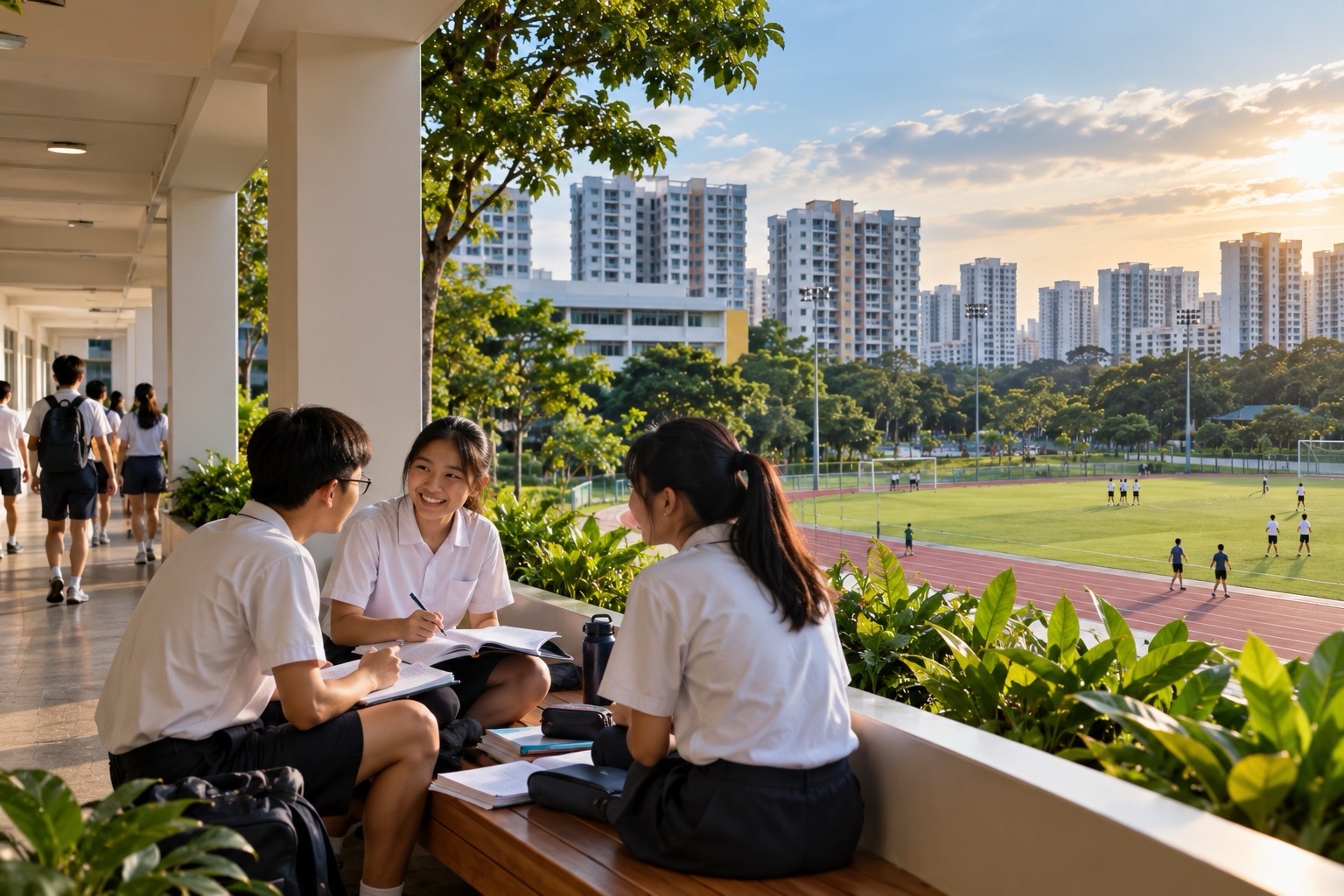
Secondary 1 orientation and Outdoor Adventure Learning (OAL) are related but different parts of a student’s transition into Singapore secondary school. Orientation is usually organised by the receiving school to help newcomers meet teachers, find classrooms, learn routines and build friendships. Outdoor education is a planned part of Physical Education. MOE’s 2024 Physical Education syllabus describes a four-day, three-night Secondary 1 cohort outdoor adventure camp and a five-day, four-night Secondary 3 cohort adventure experience as curriculum milestones. A school’s introductory orientation programme may instead be a shorter on-campus event.
Under Full Subject-Based Banding (Full SBB), the child belongs to a mixed form class and may attend academic subjects at different G1, G2 or G3 levels. Camp and orientation are opportunities to learn with peers outside examination labels. For a Punggol family preparing for Secondary 1 in 2027, the practical tasks are to read the actual school’s programme, check its consent form, disclose relevant health and dietary needs, prepare the correct packing list, understand safety supervision and support a teenager who may be nervous about sleeping away from home.
- Secondary 1 orientation helps students learn school routines, classmates, teachers, locations and expectations; each school sets its own dates and programme.
- MOE’s outdoor education curriculum describes a four-day, three-night OAL cohort camp in Secondary 1 and a five-day, four-night cohort experience in Secondary 3, subject to programme implementation.
- Some schools also run a separate three-day, two-night orientation-style camp; do not confuse it with the later OAL camp without reading the school notice.
- Outdoor learning can involve navigation, outdoor cooking, teamwork, expedition planning, water-based activities or height-based activities, subject to school programme and safety arrangements.
- Camp participation and safety requirements are not determined by the child’s G1, G2 or G3 academic subject label.
- Parents should provide genuine medical, dietary, accessibility and wellbeing information through the school’s official channels.
- Use the school’s current packing list rather than one belonging to a different campus or cohort.
- Camp venues, fees, reporting time, overnight arrangements and whether parents attend an event vary by school.
- Students should follow teacher and instructor safety instructions; no activity should be assumed mandatory for an individual with a relevant safety or support concern without consultation.
Quick information: Check whether your school means January orientation or a separate outdoor cohort camp. Follow its date, approved packing list, safety plan and consent forms.
Contents: orientation, outdoor education, safety and the first camp
- 1. Orientation is not the national examination
- 2. The first school day in January 2027
- 3. Why Full SBB mixed form classes matter
- 4. Meeting form teachers and classmates
- 5. Why outdoor education belongs in PE
- 6. The Secondary 1 four-day, three-night milestone
- 7. The Secondary 3 outdoor experience
- 8. A short January school camp may be different
- 9. Different schools can schedule camps in different terms
- 10. What students may learn about navigation
- 11. What students may learn about outdoor cooking
- 12. Why height-based activities need supervision
- 13. Water-based camp activities
- 14. Weather, lightning and haze
- 15. Packing is a school-specific task
- 16. What not to pack without permission
- 17. Medical declarations should be accurate
- 18. Food allergies and cultural dietary needs
- 19. Menstruation and personal care at camp
- 20. Students with sensory or learning support needs
- 21. Homesickness and the first night away
- 22. Friendships in mixed camp groups
- 23. When a child refuses an activity
- 24. Camp safety and adult supervision
- 25. Medication and emergency contact arrangements
- 26. Camp fees and assistance
- 27. How Parents Gateway is used
- 28. What if a child is ill on departure day
- 29. What happens when camp ends
- 30. From camp confidence to ordinary school routines
- 31. A fictional Punggol student preparing for camp
- 32. A fictional family confused by camp dates
- 33. A four-week orientation and camp preparation plan
1. Orientation is not the national examination
A student entering Secondary 1 often worries about academic demand, new friends and an unfamiliar building. An orientation programme offers a supported introduction to the community. It is not a national assessment of whether the pupil deserves G3 Mathematics or belongs in a particular Posting Group.
Students can learn how to navigate the campus, eat at the canteen, find support contacts and understand expectations. These practical successes matter because the teenager’s ordinary school day will involve independence and possibly different subject groups.
Parent action: Ask the child what they need to feel confident on the first day, then check the receiving school’s instructions.
2. The first school day in January 2027
The MOE secondary-school year begins on Monday, 4 January 2027. Individual schools determine the first day’s report time, locations, uniform, forms and orientation activities. An old 2026 orientation photograph does not establish the 2027 schedule.
For a Punggol family, the morning route may involve walking, LRT, bus or MRT services. The correct entrance gate and reporting point matter more than a speculative estimate of how long all Punggol journeys take.
Parent action: Practise the actual route and follow the school-issued registration and reporting letter.
3. Why Full SBB mixed form classes matter
Under Full SBB, the form class brings together students who may have different subject strengths and G-level combinations. Orientation gives classmates a chance to see one another as people before comparing academic results. Some activities may use orientation groups rather than the final form-class arrangement.
Being assigned to a temporary group does not automatically signal a promotion or downgrade. Schools may finalise student grouping according to their own process, as illustrated by schools that initially use orientation groups and confirm later class or CCA arrangements.
Parent action: Ask teachers which class or group is temporary and when the regular timetable will be confirmed.
4. Meeting form teachers and classmates
Form teachers or equivalent mentors often help new students learn behaviour, routines, safety and whom to contact when something goes wrong. Orientation games can make introductions easier, but friendships do not have to form immediately.
A child may prefer to observe before joining a large group. Parents can teach low-pressure introductions and reassure the student that many peers are also learning new names. The aim is safe participation, not winning a popularity contest.
Parent action: Encourage the teenager to learn one teacher’s name and one classmate’s name each day.
5. Why outdoor education belongs in PE
MOE’s Physical Education curriculum includes Outdoor Education to help students develop skills for exploring natural and urban environments safely and responsibly. It connects physical competence with planning, risk awareness, cooperation and an appreciation of place.
This is a learning experience, not simply a reward trip or entertainment package. A student may learn to read a map, organise group equipment or make careful decisions in unfamiliar conditions. These skills support independence beyond the classroom.
Parent action: Ask what outdoor competency the activity is designed to teach, not just whether it sounds exciting.
6. The Secondary 1 four-day, three-night milestone
The 2024 PE syllabus describes a four-day, three-night residential Secondary 1 Outdoor Adventure Learning cohort camp, including opportunities for students to apply outdoor skills and plan a day trip in a safe supervised setting. Schools implement the curriculum through specific programmes and arrangements.
Parents should not infer an exact campsite, activity list or date from the syllabus. Regent Secondary’s 2026 camp at MOE Changi Coast is an example of one school’s implementation, not the assigned venue for every Singapore pupil.
Parent action: Read the actual school’s 2027 letter for the venue, departure, return and supervision arrangements.
7. The Secondary 3 outdoor experience
The national Physical Education framework also describes a longer Secondary 3 outdoor adventure learning experience. Some schools participate in the MOE–Outward Bound Singapore Challenge Programme, with a five-day, four-night residential experience.
Parents preparing for Secondary 1 should know the pathway exists without worrying about the Secondary 3 packing list years in advance. Participation details, health requirements and implementation can change with capacity and school arrangements.
Parent action: Use the future school’s current programme notice when the pupil reaches Secondary 3.
8. A short January school camp may be different
Some schools hold an introductory camp near the beginning of January. Greenridge Secondary’s 2026 parent information, for example, described a three-day, two-night school-based camp during the first school week, with a parent orientation and campfire.
A shorter on-campus programme and the curriculum’s outdoor cohort camp should not automatically be treated as identical. A school may schedule several different bonding or outdoor activities in a year. Parents should identify the name, objective, dates and location of each.
Parent action: Ask whether the letter refers to orientation, a residential OAL camp or another school activity.
9. Different schools can schedule camps in different terms
Regent Secondary’s 2026 cohort camp occurred in Term 3, while other schools ran early-year outdoor programmes. The national school term calendar does not assign one identical camp date to every secondary school.
A child may be learning foundational outdoor skills in PE before attending the larger camp. Families should avoid booking non-refundable holidays before checking school commitments, particularly if a residential programme may occur near a vacation period.
Parent action: Save the school’s calendar and the particular camp consent notice before finalising travel.
10. What students may learn about navigation
Outdoor education can involve using maps, identifying landmarks, planning routes and making safe decisions in unfamiliar settings. Regent Secondary’s 2026 report describes learning map-reading and navigation in PE before applying those skills at camp.
Navigation is valuable because young people learn to observe, communicate and assess choices rather than follow someone blindly. Yet a camp activity is not permission to leave a supervised group or explore an unfamiliar area independently.
Parent action: Ask the pupil to explain how they would follow group instructions and what to do if they become separated.
11. What students may learn about outdoor cooking
Some cohort camps include preparing or cooking meals under supervised conditions. This can develop planning, food-safety awareness, cooperation and responsibility for cleaning up. The actual methods and ingredients depend on the programme.
Children should not assume they can bring their own camping stove, lighter or sharp equipment. Camp instructors and school staff set safety rules and supply lists. Food allergies and dietary restrictions must be communicated through the school’s official forms.
Parent action: Provide accurate dietary information and follow the school-approved list of permitted items.
12. Why height-based activities need supervision
High-element courses, climbing and abseiling can challenge confidence and coordination when conducted with suitable equipment and qualified supervision. The activity is educational only when the school applies proper risk assessment and safety systems.
A nervous child should not feel pressured by classmates to conceal fear or health concerns. The school must know relevant limitations and discuss appropriate participation. Parents should not promise that every pupil will attempt the same obstacle regardless of the individual’s condition.
Parent action: Ask the supervising teacher how risk and individual support are managed for the actual programme.
13. Water-based camp activities
Some camps include kayaking or other water activities, as illustrated by named schools’ 2026 programmes. Life jackets, instruction, supervision, weather assessment and student health information are important safety considerations.
A family should not assume kayaking is on the itinerary for every OAL camp or that prior swimming lessons automatically remove risks. If the pupil has a water-related fear or a medical issue, contact the school early and explain the specific concern.
Parent action: Check the official activity list and any swimming or health declarations required.
14. Weather, lightning and haze
Outdoor activities in Singapore can be affected by thunderstorms, high temperatures, rain or air quality. Schools and outdoor centres have safety procedures for modifying or stopping activities when conditions require it.
Parents should not try to override teacher or instructor instructions based on a weather application screenshot. Nor should they assume cancellation will automatically result in a rescheduled trip. The school can communicate legitimate changes through its official channels.
Parent action: Check the camp notice for weather preparation and rely on organisers for activity safety decisions.
15. Packing is a school-specific task
Residential camps may require suitable clothes, footwear, toiletries, a water bottle, a small bag and other equipment. But quantities, prohibited items and bags differ with venue and programme. A family’s existing camping gear may not meet school requirements.
Parents sometimes buy expensive items after seeing a social-media photo, only to discover the school supplies them or prohibits personal substitutes. A short accurate packing list avoids both waste and forgotten essentials.
Parent action: Tick the school-issued packing list together with the child and label permitted belongings appropriately.
16. What not to pack without permission
Personal electronic devices, valuables, inappropriate food, medication, knives and camping tools can be subject to strict instructions. A child should not bring an item merely because another pupil used it at a private camping trip.
Schools have different rules for phone use and safeguarding during camp. Parents need to know how urgent messages are handled and whether the child’s prescribed medication requires staff awareness or a particular administration process.
Parent action: Ask about any uncertain item instead of packing it secretly.
17. Medical declarations should be accurate
Asthma, allergies, ongoing medication, mobility issues, sensory concerns or a recent injury can matter during outdoor activities. A completed health declaration should reflect the child’s current condition, not what the family hopes organisers will infer.
Accurate information allows appropriate planning. Parents should not invent a blanket exemption or conclude that a diagnosis automatically excludes their child. School staff can discuss functional needs and the available arrangements for safe involvement.
Parent action: Submit relevant information confidentially by the deadline and update the school if circumstances change.
18. Food allergies and cultural dietary needs
Residential camp meals may differ from those at home, and arrangements need advance planning. Food allergies, dietary restrictions and any medically necessary requirements should be stated in the form and clarified with the organising teacher where needed.
Do not assume a particular camp menu can cater to every requirement without notice. Equally, children should not be embarrassed to ask for a suitable meal. Respect for religious and cultural dietary needs belongs to responsible group planning.
Parent action: Explain the child’s dietary needs precisely and verify the organiser’s confirmed arrangements.
19. Menstruation and personal care at camp
Some students experience their first residential secondary-school camp while navigating menstruation or other personal-care routines. A respectful packing plan can include sanitary products, suitable clothes and knowledge of how to ask for assistance privately.
Parents should not describe a normal personal-care need as a reason for public embarrassment. The student may benefit from knowing where toilets, disposal facilities and responsible staff are located. Any medical issue needing treatment should be communicated appropriately.
Parent action: Prepare essentials discreetly and ask about available support without disclosing sensitive details to the class.
20. Students with sensory or learning support needs
A teenager may struggle with noisy shared spaces, unfamiliar sleeping arrangements or sudden changes of activity. This need is separate from whether they take G1 or G3 academic subjects. The school should consider specific functional difficulties.
Parents can share known triggers, strategies that help and any relevant professional information through appropriate channels. An inclusive camp aims for safe, meaningful participation, not a public demonstration that every child tolerates the same challenge.
Parent action: Contact the school’s designated SEN or camp coordinator before departure.
21. Homesickness and the first night away
Some twelve- or thirteen-year-olds feel excited about sleeping away from home; others are anxious. An unfamiliar bed, noise and social demands can make the first night tiring. Feelings do not necessarily indicate a problem with the school or the child’s maturity.
Families can practise independent packing, simple bedtime routines and how to ask staff for help. Parents should avoid promising unrestricted phone calls if the camp rules do not provide them. The organiser’s wellbeing procedures should guide contact.
Parent action: Teach the child one or two ways to seek reassurance from a teacher rather than feeling they must cope alone.
22. Friendships in mixed camp groups
Camp activities may bring together pupils from different form classes, academic subject groups or CCAs. Shared challenges can make peers appreciate skills in cooperation, navigation and creativity that academic grades do not measure.
Camp does not guarantee close friendships. Some pupils need time to adjust, and group tasks can occasionally expose disagreement. Adults should support respectful behaviour, avoid mockery related to G labels and respond to exclusion or bullying promptly.
Parent action: Ask what the pupil learned about working with someone whose strengths differ from theirs.
23. When a child refuses an activity
A student may refuse an activity because of fear, confusion, injury, illness or a legitimate access issue. These situations require different responses. Teachers and instructors should follow safety and student-support procedures, which may include explaining the task, providing support or adjusting participation where appropriate.
Parents should not tell a child to disregard reasonable safety instructions or conceal medical limitations to appear brave. Equally, ordinary nervousness may be managed through supported participation. The correct response depends on risk and the individual’s circumstances.
Parent action: Ask the school how it handles participation concerns rather than inventing a universal rule.
24. Camp safety and adult supervision
Outdoor adventure learning is a supervised school activity involving planning, staff, instructors, venue rules and safety procedures. Parents need accurate details about the organiser, emergency contact process and the pupils’ reporting arrangements.
An impressive campsite website alone does not establish what the school has booked. Families should follow the school’s written notices and not independently arrive at an outdoor centre assuming it is the correct pickup location. Transport and supervision are part of the actual programme.
Parent action: Confirm who transports pupils, when they return and which school contact handles urgent matters.
25. Medication and emergency contact arrangements
Some students need prescribed medication or a specific health plan while away from home. The school should be informed before the event, along with the permitted administration instructions and current emergency contacts.
Parents should not ask an untrained classmate to manage medication or send it without following school rules. If a health situation changes shortly before camp, notify the organiser promptly and ask how participation should be considered.
Parent action: Keep medical details accurate, private and accessible to authorised staff.
26. Camp fees and assistance
Outdoor programmes can have costs for transport, food, equipment or activities. The published camp notice should explain payment or subsidy arrangements, if any. A family should not assume that every camp is free or that all expense categories are reimbursed.
Eligible families may be able to ask about school-based assistance or financial support. The child’s Posting Group and G levels are not the relevant means-test categories. A parent should raise affordability confidentially rather than making the student feel ashamed.
Parent action: Ask the school which costs are required and whether assistance is available before the deadline.
27. How Parents Gateway is used
Schools commonly use Parents Gateway or another official communication method to distribute consent forms, health declarations and camp notices. Punggol Secondary’s public Parents Gateway page explains how it supports consent for school activities.
A parent who misses an app notification may miss an important reporting or medical form. The student should also know the relevant school instructions. Unofficial parent-chat forwards can help families remember a date but cannot replace the source notice.
Parent action: Check the school’s actual consent request and keep a copy of the confirmed submission.
28. What if a child is ill on departure day
If the child develops fever, injury or another health issue, contact the school rather than sending them to camp without disclosure. The attendance and medical documentation rules belong to the actual school and event.
A parent should not guarantee a makeup camp or immediate refund. Organisers may need to evaluate the student’s condition, safety and options. The right decision prioritises wellbeing and factual communication.
Parent action: Notify the teacher promptly and follow the school’s absence and medical-evidence procedure.
29. What happens when camp ends
Returning pupils may feel tired, proud, emotional or eager to describe experiences. Parents can allow recovery and ask open questions rather than instantly treating camp as a graded performance.
A child might discover confidence in navigation, recognise the value of teamwork or realise they need support with a friendship problem. Reflection helps turn an exciting event into lasting learning.
Parent action: Ask what was hard, what became easier and what the student would do differently next time.
30. From camp confidence to ordinary school routines
The most useful outcomes often appear after camp: a student asks classmates for help, plans their bag independently or speaks up before a problem becomes serious. These habits connect outdoor learning to everyday Full SBB life.
A child who completed a challenging outdoor activity is not automatically ready for a different G level. Academic progression still requires subject evidence. Personal growth and curriculum demand should be respected as distinct dimensions.
Parent action: Notice practical changes in responsibility without translating everything into examination prestige.
31. A fictional Punggol student preparing for camp
Imagine Aisha, a fictional Secondary 1 pupil who worries that she will have no friends and cannot sleep away from home. Her family studies the actual packing list, practises keeping her belongings organised and identifies a teacher she can approach.
During camp she contributes to a group navigation task, but still needs reassurance one evening. Both experiences are part of growing independence. This story is an illustration, not a claim about a named school or camp programme.
Parent action: Teach a teenager to seek help confidently rather than expecting every discomfort to disappear.
32. A fictional family confused by camp dates
Imagine Ryan’s parents see a 2026 school blog about a four-day camp at Changi Coast. They assume Ryan’s 2027 school will use the same centre in January and buy costly equipment based on the article.
After checking the actual school notice, they discover a different programme and venue. They adjust the packing list and avoid unnecessary spending. The important lesson is to separate nationally described curriculum experiences from the school-specific programme.
Parent action: Use dated school notices rather than copying a photograph or itinerary from another campus.
33. A four-week orientation and camp preparation plan
Week one: learn the school route, reporting arrangements, timetable and support contacts. Week two: identify the correct camp or orientation event and its date. Week three: submit accurate health, dietary and consent forms, and check the packing list. Week four: practise independence, sleep routines and safe help-seeking.
If the school’s deadlines fall earlier, complete those steps immediately. The sequence is a flexible checklist, not a guaranteed four-week lead-in. Outdoor programmes can happen in different terms.
Parent action: Keep one folder of confirmed instructions rather than many contradictory forwarded messages.
Before departure: family checklist
- Confirm whether the event is orientation, OAL camp or another programme
- Check the actual school, intake year, date, venue and transport
- Know the assembly and return locations and times
- Complete official consent, dietary and health declarations
- Discuss medical, sensory, mobility and wellbeing support early
- Use the school’s specific packing list and prohibited-item rules
- Know the school emergency contact method, not an unofficial number
- Help the child label possessions and practise independent packing
- Discuss trusted staff contacts and how to seek help during camp
- Leave room after the activity for rest and constructive reflection
Frequently asked questions
Is Secondary 1 orientation the same as the OAL camp?
Not necessarily. Schools may run a short introduction programme and a separate curriculum outdoor adventure camp.
How long is the MOE Secondary 1 outdoor camp?
The 2024 Physical Education syllabus describes a four-day, three-night Secondary 1 cohort camp.
What happens in Secondary 3?
The syllabus describes a longer five-day, four-night outdoor adventure experience, including programme arrangements such as MOE–OBS.
Do all secondary schools camp on the same day?
No. School dates, locations and activity sequences differ.
Does G1 or G3 decide which pupils go to camp?
No general academic G-level grouping determines the outdoor education curriculum.
Does every camp include kayaking?
No. Activities depend on the specific programme and safety arrangements.
What if my child is afraid of heights?
Tell the school about the specific concern and ask how safe, supported participation is managed.
Can a child bring a mobile phone?
Follow the actual school and camp rules; do not assume unrestricted use.
What if my child needs medication?
Provide accurate health information privately and follow the school’s administration rules.
Do parents attend the campfire?
Only when the school’s actual programme invites them; it is not universal.
What if my child has a food allergy?
Disclose the need promptly through the official school health and dietary form.
Can a pupil with SEN participate?
Suitable support depends on the student’s needs and the school’s safe programme arrangements; discuss early.
Is camp free?
Costs and assistance vary; verify the school notice.
What if the child becomes ill?
Inform the school and follow its medical and attendance procedure.
Where do parents obtain the packing list?
Use the receiving school’s current Parents Gateway notice or official webpage, not an old school list.
Official sources and more reading
Official educational framework: MOE Physical Education syllabus 2024 (Outdoor Education, page 148). School examples: Regent Secondary’s 2026 four-day camp; Jurong Secondary cohort outdoor education; Ngee Ann Secondary outdoor education; Bedok Green Secondary’s Secondary 3 MOE–OBS programme; and Punggol Secondary Parents Gateway. Related guide: Full SBB mixed form classes and Secondary 1 timetable.
Editorial review 6 November 2026. Named 2026 school camps are illustrations, not promises of 2027 dates or venues. The actual school’s consent, safety and medical instructions always take precedence.


