
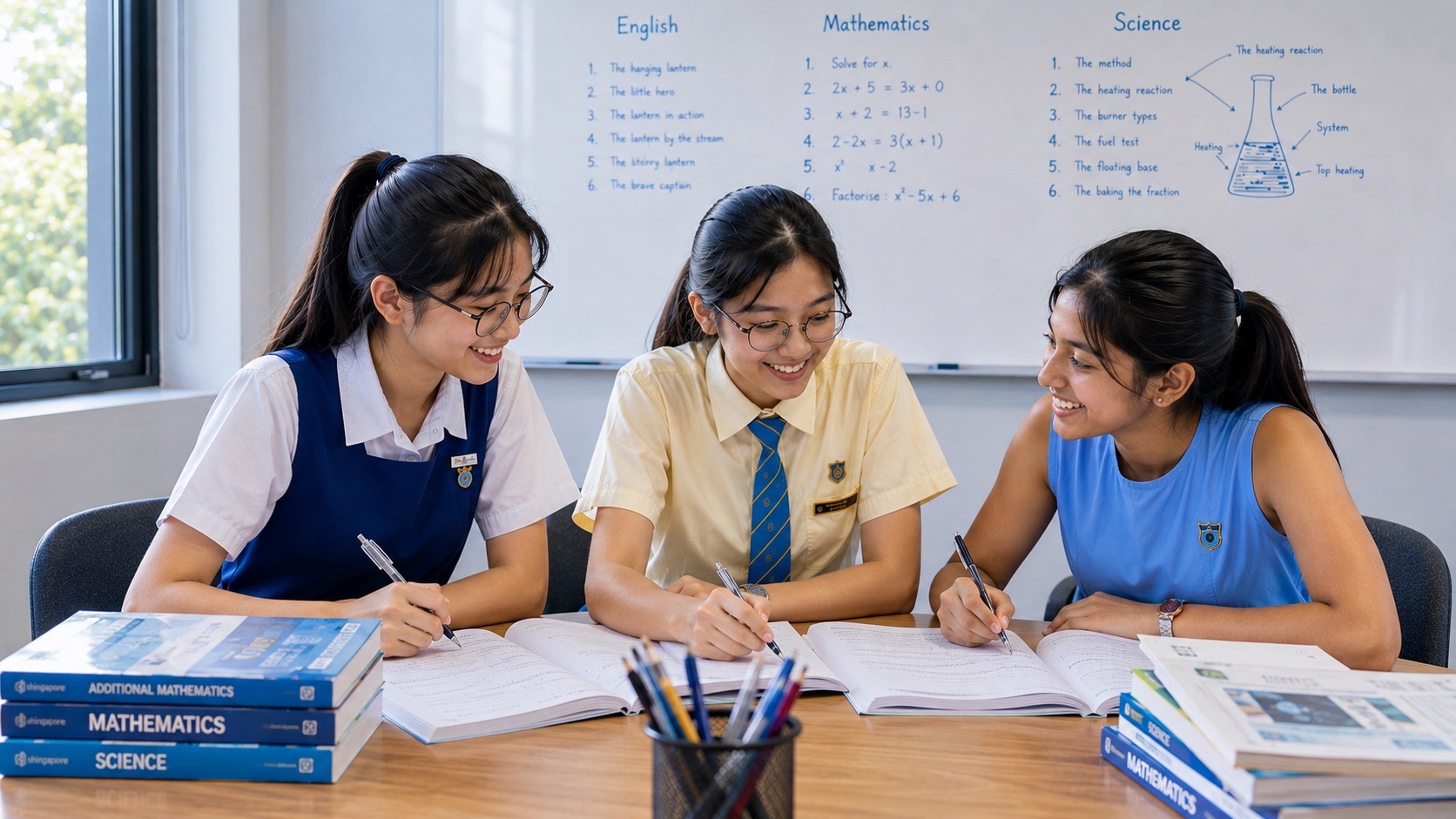
Secondary 2 G2 Mathematics tuition in Punggol should help students join number sense, algebra, graphs, geometry and problem-solving into a coherent way of thinking. eduKatePunggol has small-group Mathematics tutorials of up to three learners, normally lasting 1.5 hours. A useful tutor can inspect the first unsupported step in each pupil’s calculations, explain why it fails and check whether the corrected principle works in a new problem—not just return a familiar worksheet with ticks.
Under Full Subject-Based Banding, G2 Mathematics is the subject level the student actually takes; it should not be inferred solely from their initial Posting Group. The MOE G2 syllabus and SEAB’s 2027 K210 end-of-secondary specification distinguish the G2 progression from G1 and G3. A Secondary 2 student in 2026 is assessed by the school and would ordinarily graduate later than the first SEC cohort; the 2027 document is a reference, not a compulsory Sec 2 school examination pattern.
- The G2 Mathematics curriculum spans Number and Algebra, Geometry and Measurement, and Statistics and Probability, with reasoning and communication alongside routine procedures.
- Secondary 2 G2 work may connect percentages, proportion, algebraic manipulation, linear relationships, geometric rules and interpreting data; school order and depth matter.
- The 2027 SEC K210 G2 final scheme has two two-hour papers worth 70 marks each. It is the end-of-course benchmark, not a current Sec 2 test.
- Paper 2 Section B of the 2027 final examination offers a choice of one of two questions on underlined content, unlike the G3 K310 paper scheme.
- Three learners can compare valid methods, but each child should choose, execute and check a changed problem alone.
Find your answer: MOE / SEAB · Why three pupils · Worked teaching examples · 90-minute lesson · Parent checklist · FAQs · Official sources
The curriculum and examination-year distinction
SEAB’s 2027 G2 Mathematics K210 syllabus is organised into three strands: Number and Algebra, Geometry and Measurement, and Statistics and Probability. It assesses standard techniques (approximately 60% of assessment objectives), problem-solving in context (about 30%), and mathematical reasoning and communication (about 10%). The G2 level has its own scope and content detail, so it is inaccurate to treat it as simply a shorter version of G3. The child’s current school chapter list and actual G2 Mathematics enrolment should determine the weekly tuition task.
For the 2027 SEC G2 K210 graduating cohort, Paper 1 lasts two hours with about 23 short-answer questions worth 70 marks. Paper 2 also lasts two hours and is worth 70 marks. Its Section A includes 9–10 problems, culminating in a real-world application. Section B presents two questions on specifically underlined syllabus content; candidates answer one, from Geometry and Measurement or Statistics and Probability. The two papers are weighted equally, and approved calculators may be used in both. The official document warns that essential working must be shown and gives accuracy guidance. A Secondary 2 student is not currently sitting this national paper, and future cohort rules need verification.
The official national document and the student’s immediate school scheme serve different functions. MOE and SEAB publish the end-of-course expectations for each G level, while the school selects the current term’s teaching sequence and sets internal tasks for Secondary 1 or Secondary 2. Good tuition should make the later destination visible without replacing today’s learning with an unsuitable graduating-year practice paper. An apparently harder worksheet is not automatically a better lesson.
Under Full Subject-Based Banding, pupils may study different subjects at different G levels according to school arrangements and progression rules. G1 or G2 here is the actual subject level, not a judgement on character or potential. Asking the school about the enrolled subject is more accurate than assuming the child’s initial Posting Group permanently determines every subject.
Official references: SEAB 2027 G2 Mathematics K210 syllabus · 2027 SEC subject level index · SEAB SEC overview and cohort information.
2027 G2 Mathematics: two papers and a distinctive Section B
| Paper | Duration | Marks | Weight |
| Paper 1: about 23 short-answer questions | 2 hours | 70 | 50% |
| Paper 2 Section A and choice in Section B | 2 hours | 70 | 50% |
In 2027 Paper 2, Section A includes 9–10 questions, finishing with a real-world application. Section B offers two specified options, and candidates answer one, based on underlined Geometry and Measurement or Statistics and Probability syllabus content. Approved calculators may be used in both papers, but SEAB states that omitting essential working can cost marks. These conditions are specific to the 2027 graduating cohort, not the student’s Secondary 2 classroom assessment.
The educational lesson is to distinguish procedure from method choice. Being able to use a calculator or a formula does not prove the pupil knows which quantity the question asks for. A good tutor checks a ratio’s whole, an equation’s constraints and a diagram’s geometric condition before introducing speed or a larger paper pack.
Why the Secondary 2 transition matters
Secondary 2 is a year when pupils start linking techniques rather than simply performing them. A student may expand brackets successfully but cannot factorise the result, or can calculate a gradient yet not explain what the graph describes. Another may compare two rectangles visually and assume they are similar without checking proportional corresponding sides. A third may know all four operations but select the wrong one in a practical percentage story. The tutor’s most valuable work is to reveal the mathematical relationship beneath the calculation and make the pupil able to select it independently.
The first mark is not always the first learning issue. A response may be wrong because the student missed one condition at the beginning, not because the last line was computed or written poorly. A useful tutor keeps the original attempt available, asks the pupil to explain the choice and identifies the earliest point at which the answer stopped following the task. That diagnosis turns a vague complaint about weak performance into an action the child can practise.
When a student succeeds on a familiar corrected exercise, the next test should change the context or presentation. The tutor should remove the model and let the pupil decide how to respond independently. A delayed return later helps reveal whether the understanding has become durable rather than surviving only within the previous lesson.
Why a maximum-three-student tutorial can be useful
eduKatePunggol offers small-group tutorials in Punggol with up to three learners and a typical 1.5-hour class. The educational opportunity is close observation of three different first attempts while still allowing carefully managed peer explanations. One pupil may notice a text clue or mathematical condition that another missed. The tutor must ask why the observation matters, check individual understanding and make sure the quiet student has time to respond before a peer supplies the answer.
- Every pupil works on the initial question without seeing the teacher’s completed answer.
- The tutor identifies the particular misunderstanding behind each wrong attempt.
- Peer comparison tests evidence, definitions or a valid method rather than rewarding the fastest voice.
- The student revises an original response and completes a new unseen one independently.
- Different error patterns lead to different focused tasks even within one shared topic.
- An earlier issue returns after a delay to check whether the change survived.
- Parents see a concrete independent improvement rather than only a paper count or an optimistic forecast.
A group of three is not automatically superior to a well-run school classroom or one-to-one instruction. Some students need more private pacing, specialist support or fewer extra commitments; others already learn confidently without tuition. A responsible provider should discuss group suitability, actual current fees and availability rather than claim that every pupil needs this format.
Good group management is particularly important when one student works faster than the others. The fast learner can be asked to justify a method or test an alternative, while the other pupils complete their own responses. Otherwise the tutorial may become a small lecture with one active participant. Each member’s unfamiliar retest should be completed personally.
The four-part lesson repair cycle
Observe the uncorrected response
Begin with one representative school task or a short unfamiliar item. Ask the pupil what was given, what the question asked and why the response seemed suitable. Preserve the first attempt. If a child misreads an instruction, reteaching a large grammar or algebra chapter may not address the real problem. Use the evidence of the attempt to choose the focus.
Explain the missing relationship through a close contrast
Select two similar examples that require different decisions because one condition changes. A direct fact and an inference require different evidence; a ratio of two parts differs from a part of a total; a past recount differs from a current instruction. The student should explain which condition controls the answer.
Give a genuinely different independent task
Change wording, numerical values, diagram orientation or intended audience. Remove the example solution. A child who can only repeat the teacher’s original route has begun to learn, but has not yet shown that the skill transfers. The tutor should record the performance on the changed task and adjust support if needed.
Return later and measure independence
At a later tutorial, revisit the principle among other work. A delayed attempt is more demanding than immediate copying and can reveal whether the first repair was secure. If the old error returns, investigate the prerequisite or try a clearer model. If the student now works independently, offer a new challenge or reduce unnecessary prompting.
25 practical teaching problems with independent checks
1. Signed numbers and the direction of an operation
The diagnostic signal. The pupil calculates −4−(−7) as −11 because the two negative signs are treated as decoration rather than an operation.
Focused teaching. Use a number line and the meaning of subtracting a negative. −4−(−7)=−4+7=3, then check the direction of change.
How three learners work. Three pupils explain the line, the symbolic manipulation and a numeric estimate, then each works a changed question.
Unfamiliar transfer check. A new −6−(−2) produces −4 and a reasoned explanation rather than an automatic sign chant.
Important boundary. A check of direction can reveal an invalid rule before the full calculation is done.
2. Prime factors and a useful shared measure
The diagnostic signal. A student can draw a factor tree but confuses common factors with common multiples in a grouping problem.
Focused teaching. For 36=2²×3² and 48=2⁴×3, the HCF is 12 and the LCM is 144. Explain which scenario needs the largest shared divisor and which needs a first common multiple.
How three learners work. Students separately build factorisations, select a relevant method and verify its meaning in the word problem.
Unfamiliar transfer check. For 18 and 30, the pupil identifies HCF 6 and LCM 90 and justifies both.
Important boundary. The HCF/LCM calculation must answer the story, not just appear on a page.
3. Order of operations with algebra
The diagnostic signal. A learner simplifies 3+2(x+4) as 5x+4 by combining unlike terms and ignoring distribution.
Focused teaching. Distribute first: 3+2x+8=2x+11. Substitute x=1: both expressions must equal 13. Use the numerical test to reveal false identities.
How three learners work. Each child explains a different line of the expansion and independently checks an unseen expression.
Unfamiliar transfer check. Simplify 5−3(x−2) to 11−3x, then verify at a chosen value.
Important boundary. Testing one value is a useful check, not a full mathematical proof of every identity.
4. Ratio: part-to-part and part-to-whole
The diagnostic signal. The pupil interprets 3:2 as three halves of the total, forgetting the five equal parts in the whole.
Focused teaching. For 3:2 of 75, there are five units of 15. Shares are 45 and 30. The first share is three-fifths of the total but three-halves of the second share.
How three learners work. One learner draws a bar, another calculates units, and the third explains the relationship; then all solve a new ratio.
Unfamiliar transfer check. Split 96 in ratio 5:3 to obtain 60 and 36, identifying the whole correctly.
Important boundary. A ratio compares named quantities; labels are not optional.
5. Reverse percentage and the original base
The diagnostic signal. A child sees an $80 price after a 20% discount and takes another 20% off, rather than reconstructing the original price.
Focused teaching. The $80 represents 80% of the original. The original is 80÷0.8=$100. Compare original, discount and final price.
How three learners work. Students each show a 100% bar, equation or inverse check and then solve a changed practical example.
Unfamiliar transfer check. If 75% of a value is 60, recover 80 and explain why multiplying by 0.75 is incorrect.
Important boundary. The percentage denominator must refer to the correct base.
6. Direct and inverse proportion
The diagnostic signal. The student assumes doubling every input doubles the output, even if a fixed amount of work is shared among more people.
Focused teaching. At a fixed unit price, doubling items doubles total cost. For fixed work at equal productivity, doubling workers halves time. Identify what stays constant and name the assumption.
How three learners work. The tutor presents three contexts; pupils classify and defend one before trying a fresh scenario.
Unfamiliar transfer check. A constant-length journey takes half the time if the speed doubles under the stated assumptions.
Important boundary. Real-world models require clear conditions, not blind application of a proportion slogan.
7. Rate and average speed
The diagnostic signal. The learner averages 40 km/h and 60 km/h as 50 km/h for a journey with unequal durations.
Focused teaching. Compute each segment’s distance and time, then divide total distance by total time. For one hour at 40 and two at 60, average is 160/3≈53.3 km/h.
How three learners work. Pupils compute the two legs and overall average, then independently solve a changed route.
Unfamiliar transfer check. An unseen two-leg journey is solved with consistent distance and time units.
Important boundary. Average speed is not automatically the arithmetic mean of segment speeds.
8. Algebra notation and substitution
The diagnostic signal. The child claims 3x means x+3, or x² means 2x, treating different operations as synonyms.
Focused teaching. Explain repeated addition, multiplication and exponentiation. At x=4, 3x=12, x+3=7 and x²=16; distinct results reveal the difference.
How three learners work. Each pupil writes an expression for a short story and tests it with an appropriate value.
Unfamiliar transfer check. In a new box-and-pencils problem, three times x is written 3x rather than x+3.
Important boundary. Notation meaning should be secure before complex manipulation.
9. Negative brackets and the distributed sign
The diagnostic signal. A pupil expands −2(3x−5) to −6x−10, forgetting negative times negative is positive.
Focused teaching. Apply distribution separately: −2×3x=−6x and −2×(−5)=+10. Compare original and expanded expressions by substituting x=1.
How three learners work. Three students independently check terms, signs and equivalence before answering a new bracket.
Unfamiliar transfer check. Expand −3(2x−4) to −6x+12 and justify the positive constant.
Important boundary. A mnemonic without distributive meaning often collapses in mixed exercises.
10. Linear equations and the balance principle
The diagnostic signal. The learner moves a positive term to the other side with the wrong sign because ‘move and change’ is the only method remembered.
Focused teaching. For 4x+7=31 subtract seven from both sides, giving 4x=24, then divide by four to obtain x=6. Substitute to verify the original equation.
How three learners work. One pupil states the inverse operation, another works it and a third checks, then roles rotate.
Unfamiliar transfer check. Solve 3(x−2)=12 to obtain x=6 and verify it.
Important boundary. An equation is a condition, not the same task as simplifying an expression.
11. Formula rearrangement and which quantity is unknown
The diagnostic signal. A pupil knows that area A=lw but rearranges for width as w=A×l.
Focused teaching. Divide both sides by l when l≠0: w=A/l. A numerical example such as area 24 and length 6 gives width 4, confirming sense.
How three learners work. Each child identifies known and unknown variables in a different formula and then makes an independent rearrangement.
Unfamiliar transfer check. Rearrange v=u+at for t as (v−u)/a when a≠0.
Important boundary. The model may be a cross-subject example; match assessed details to the actual school chapter.
12. Expansion of paired brackets
The diagnostic signal. A student writes (x+2)(x+3)=x²+6, multiplying only first and last terms.
Focused teaching. Use the distributive law to get x²+3x+2x+6=x²+5x+6. A small multiplication grid helps reveal all four products.
How three learners work. Pupils fill the grid, combine like terms and check a value, then individually expand a changed product.
Unfamiliar transfer check. Expand (x+4)(x−1) as x²+3x−4 and verify by substitution.
Important boundary. For a G2 pupil, confirm when the school has taught quadratic manipulation before treating it as routine.
13. Factorisation as the reverse of expansion
The diagnostic signal. The learner can expand x²+7x+12 but factorises it as (x+7)(x+12), confusing sum and product relationships.
Focused teaching. Find two numbers with sum seven and product twelve: three and four. Hence x²+7x+12=(x+3)(x+4). Expand to check.
How three learners work. One student proposes factors, another tests the required sum and product, and a third expands to verify.
Unfamiliar transfer check. Factorise x²+5x+6 as (x+2)(x+3) with a correct explanation.
Important boundary. Factorisation competence depends on integer operations and recognition of structure.
14. Algebraic fractions and valid cancellation
The diagnostic signal. A pupil ‘cancels x’ from (x+2)/x and announces 2, even though addition is not a factor.
Focused teaching. Cancellation removes common multiplicative factors. 6x²/(3x)=2x for x≠0, but (x+2)/x=1+2/x and cannot be simplified to 2 generally.
How three learners work. Each learner tests an invalid and a valid cancellation, using substitution as a diagnostic check.
Unfamiliar transfer check. Simplify 8x²/(4x)=2x with domain x≠0 while rejecting a term-across-addition cancellation.
Important boundary. A restriction on zero denominators matters; do not ignore the domain.
15. Two constraints and simultaneous equations
The diagnostic signal. The pupil solves x+y=11 but gives a pair that fails x−y=3, treating the two equations independently.
Focused teaching. Add corresponding sides: 2x=14, so x=7 and y=4. Both equations must be satisfied, so substitute into each to check.
How three learners work. The group compares elimination, substitution and a graph, then each answers a changed pair independently.
Unfamiliar transfer check. Solve 2x+y=13 and x−y=2 to obtain x=5 and y=3, verifying both.
Important boundary. Teach only the simultaneous-equation depth that the student is actually studying.
16. Linear graphs and a unit slope
The diagnostic signal. A learner reverses the coordinates of (2,5) or calls the graph’s height its gradient.
Focused teaching. With y=2x+1, the points (0,1) and (2,5) are on the graph; gradient is (5−1)/(2−0)=2. This is vertical change per unit horizontal change.
How three learners work. One student builds a table, another plots and the third explains the gradient before an independent retest.
Unfamiliar transfer check. Find gradient 2 for a new line through (1,3) and (3,7).
Important boundary. Axes, scales and the actual variables need checking before interpretation.
17. Quadratic graphs and a turning point
The diagnostic signal. The child joins points on y=x²−4 with a straight ruler and says the result is linear.
Focused teaching. Use a table to see symmetric values at x=−2 and x=2, both y=0, and a minimum at (0,−4). Explain that a curved quadratic graph differs from a linear graph.
How three learners work. Pupils compare shape, vertex and symmetry with a second function, then independently describe a new parabola.
Unfamiliar transfer check. For y=−(x−1)²+3, the pupil identifies a maximum at (1,3).
Important boundary. Quadratic graphs are an example of later G2 secondary scope; align with school topic order.
18. Geometry angles with a justified relationship
The diagnostic signal. A pupil announces that two angles are equal simply because a diagram looks symmetric, ignoring the condition of parallel lines.
Focused teaching. Identify the actual rule: vertically opposite angles are equal; angles on a straight line total 180°. Parallel-line rules require the relevant lines and a transversal.
How three learners work. Each pupil marks an angle pair, explains the rule and solves a new drawing after rotation.
Unfamiliar transfer check. If an adjacent straight-line angle is 65°, the other is 115° with the correct reason.
Important boundary. A hand-drawn picture cannot prove an angle measure unless the geometric condition is given.
19. Similarity and proportional sides
The diagnostic signal. The learner compares the longest side of one triangle with the shortest of another and assumes the figures are similar.
Focused teaching. Identify corresponding sides and angles. If 4 cm corresponds to 10 cm, the scale factor is 2.5. A corresponding 6 cm side becomes 15 cm.
How three learners work. Three students label correspondence, calculate a factor and test consistency, then solve a new figure alone.
Unfamiliar transfer check. A rotated pair of similar triangles is interpreted by corresponding features, not their orientation.
Important boundary. The same diagram can have different ratios if the wrong sides are paired.
20. Pythagoras and the right-angle requirement
The diagnostic signal. A student applies a²+b²=c² to a triangle without a stated right angle, or identifies a sloping side as hypotenuse regardless of geometry.
Focused teaching. Use the theorem for a right-angled triangle. Legs of 6 cm and 8 cm give a hypotenuse of 10 cm; the hypotenuse is opposite the right angle.
How three learners work. One pupil checks the angle condition, another calculates and a third checks plausibility before new work.
Unfamiliar transfer check. For a right triangle with hypotenuse 13 and a leg 5, the missing leg is 12.
Important boundary. The condition is part of the theorem, not a minor detail to skip.
21. Basic right-triangle trigonometry
The diagnostic signal. The learner uses a ratio without identifying which side is opposite or adjacent to the named angle.
Focused teaching. In a right triangle, define sine, cosine and tangent using the appropriate sides relative to an acute angle. For opposite 3 and adjacent 4, tanθ=3/4.
How three learners work. Students label the same triangle relative to different angles and notice how side roles change.
Unfamiliar transfer check. An unfamiliar rotated right triangle is analysed by the angle and side roles before calculation.
Important boundary. The extent taught in Secondary 2 G2 must follow the school’s syllabus sequence.
22. Surface area and volume units
The diagnostic signal. A pupil writes 60 cm² as a cuboid’s volume after multiplying length, width and height.
Focused teaching. A 4×3×5 cm cuboid has volume 60 cm³. Surface area measures exterior faces in square units, not how many unit cubes fit inside.
How three learners work. The class builds a simple net, counts layers and names units, followed by new independent questions.
Unfamiliar transfer check. For a new 6×2×4 cuboid, volume is 48 cm³ and is distinguished from total surface area.
Important boundary. Geometry units are a useful independent check of method choice.
23. Data displays and fair conclusions
The diagnostic signal. The learner reads the tallest histogram bar without checking the interval width or axis and claims a trend outside the given data.
Focused teaching. Read title, axes, classes and what the diagram counts. Distinguish measured frequency from a causal explanation, and recognise when a grouped display omits individual observations.
How three learners work. Each student interprets one feature of a different display, then all answer an unfamiliar new graph independently.
Unfamiliar transfer check. A changed frequency table or bar chart is read accurately with a conclusion bounded by the data.
Important boundary. School data types and the final SEC statistics syllabus need separate attention as the pupil progresses.
24. Probability and sample space
The diagnostic signal. A child says two outcomes in an unequal sample space are each equally likely just because there are two category labels.
Focused teaching. Define the possible outcomes and assumptions. With a fair six-sided die, probability of an even number is 3/6=1/2; three faces, not two category labels, establish the ratio.
How three learners work. Pupils enumerate outcomes, choose favourable ones and justify whether equiprobability is warranted.
Unfamiliar transfer check. A new fair-coin two-toss experiment is described using the four ordered outcomes before calculating a chance.
Important boundary. Not every real-life uncertainty can be modelled by equally likely outcomes.
25. Selecting a method before touching the calculator
The diagnostic signal. The pupil presses a sequence of buttons immediately and trusts a precise but irrelevant answer without defining the unknown.
Focused teaching. Write the requested quantity and known relationships first, estimate the direction and magnitude, calculate and interpret the result in context.
How three learners work. The group compares a useful and irrelevant calculation, then each writes a method before using a calculator on new work.
Unfamiliar transfer check. A changed percentage or rate problem is solved with correct units and a sensible check.
Important boundary. Approved calculators are allowed in both K210 final papers, but do not validate a wrong model.
Two close-up corrections and why they matter
A familiar question answered with the wrong relationship
A Secondary 2 G2 pupil is asked to split $96 in the ratio 5:3 but uses 5/3 of the total for the first part. The tutor asks how many equal ratio units are present: eight. The pupil draws eight sections, calculates $12 per unit and obtains $60 and $36. Another student checks that the shares add to the original $96. A new ratio story changes the total and the role of each part; the learner must now select the correct denominator independently. This is a teaching illustration, not an actual report of a student result.
An apparently correct method that fails a new condition
Another student expands (x+2)(x+3) and writes x²+6, omitting both middle products. The tutor draws a small multiplication grid and asks what each of the four cells contributes. Peers explain how 3x and 2x combine into 5x. The student then expands a new product containing a negative number and checks by substitution. The lesson fixes the distributive property, not simply the particular answer.
These examples are hypothetical teaching vignettes, not testimonials from identifiable pupils or evidence of a guaranteed grade. The useful parent question is whether a similar process occurred with the child’s real schoolwork: original response, reason for correction, unfamiliar second task and later check. A polished page containing the teacher’s answers is insufficient by itself.
Inside a 90-minute small-group lesson
| Illustrative minutes | Activity and evidence |
| 0–10 | Retrieve an earlier taught principle without cues |
| 10–25 | Inspect authentic schoolwork and find the first error |
| 25–45 | Teach a concise model, counterexample or language contrast |
| 45–65 | Individual practice, feedback and purposeful peer comparison |
| 65–80 | Unseen transfer problem or changed writing/reading task |
| 80–90 | Self-check, error note and suitable home follow-up |
This is an instructional example, not a contractual promise that every class is divided into these exact times. A student needing foundational recovery may spend longer on a concept; a confident learner may need a more unfamiliar application or appropriate timed section. The tutor’s role is to make the time responsive to what the child actually needs, not fill ninety minutes with passive copying.
When one learner needs focused attention, the other two should have meaningful tasks that can be checked independently. In an English class those may be close reading or original messages; in Mathematics they may be model comparisons, justifications or changed calculations. Each pupil should return to the tutor with a personal result that reveals thinking rather than a shared answer copied from a peer.
An eight-week monitoring framework
Weeks one and two can confirm the student’s actual subject level, school term scope and a short baseline on relevant skills. Weeks three and four repair a small number of recurring misunderstandings through contrasts and new individual responses. Weeks five and six connect the skill to the next school chapter and return to it in unfamiliar contexts. Weeks seven and eight include a delayed independent check, review of original schoolwork and a decision about consolidation, extension or whether further tuition is necessary. This is a monitoring example, not a score prediction.
An honest progress record should show what was attempted, which first decision caused difficulty, what was taught and how the pupil did on a different task without hints. A school mark is useful but can vary with task difficulty. A specific, retained skill is more directly attributable to a focused teaching intervention than a vague claim that the student is now stronger. The tutor should also be prepared to identify when a different format is necessary.
Five parent questions beyond the worksheet count
G2 Mathematics has its own mathematical ambition
The G2 curriculum asks pupils to use standard procedures, solve problems in contexts and explain the reasoning behind choices. It should not be sold as merely fewer G3 worksheets. Under Full Subject-Based Banding, the child’s actual Mathematics subject level matters more than assumptions based on an earlier Posting Group. A tutor must read the school work and check what the child is being taught, then choose a problem at the appropriate depth. The official 2027 K210 national syllabus provides a longer-term map, but the current Secondary 2 school chapter determines what should be repaired today.
The practical follow-up is evidence from a new independent task. Ask what the child can now explain or complete without the tutor’s next hint. If the response still depends on copying a model, revise the teaching rather than increasing an unrelated paper quota. If the skill has become reliable after a delay, challenge can increase or external support can be reduced.
Why a correct equation can still answer the wrong question
Students sometimes calculate accurately after choosing an irrelevant relationship. In a word problem, they may find a percentage of the final amount when asked for the original amount, or compute volume when the task asks for surface area. A tutor should ask the child to identify the unknown, given information and physical or mathematical meaning of the quantities before manipulating numbers. Units and estimation can expose a poor choice quickly. The new independent test should change what the question asks so that the learner is forced to select the method rather than repeat a remembered procedure.
The practical follow-up is evidence from a new independent task. Ask what the child can now explain or complete without the tutor’s next hint. If the response still depends on copying a model, revise the teaching rather than increasing an unrelated paper quota. If the skill has become reliable after a delay, challenge can increase or external support can be reduced.
G2 Paper 2 Section B is not identical to the G3 final paper
SEAB’s 2027 G2 K210 specification gives two two-hour papers of 70 marks each and, in Paper 2, a Section B choice between two questions drawn from specific underlined Geometry/Measurement or Statistics/Probability content. The G3 K310 exam uses a different layout and 90 marks per paper, with no identical G2 Section B option. This is a useful reminder that ‘Secondary Mathematics’ is not one national paper. For a present Secondary 2 pupil, however, the immediate school assessments are separate. Do not replace foundational teaching with premature drilling of either graduating paper.
The practical follow-up is evidence from a new independent task. Ask what the child can now explain or complete without the tutor’s next hint. If the response still depends on copying a model, revise the teaching rather than increasing an unrelated paper quota. If the skill has become reliable after a delay, challenge can increase or external support can be reduced.
A three-student class is useful only if each pupil takes the next step
Peer discussion can expose a hidden algebra mistake: one child writes an expression, another substitutes a value and a third identifies which assumption is invalid. The tutor may use that process, but every pupil must then solve a new example unaided. Group agreement is a weaker measure than independent transfer. A delayed return later checks whether the understanding is durable. If one learner repeatedly copies rather than chooses an operation, the teaching method must change. The goal is to reduce dependence, not create a permanent need to see the tutor’s working.
The practical follow-up is evidence from a new independent task. Ask what the child can now explain or complete without the tutor’s next hint. If the response still depends on copying a model, revise the teaching rather than increasing an unrelated paper quota. If the skill has become reliable after a delay, challenge can increase or external support can be reduced.
Why timing should follow understanding
Timed practice may be useful once a student can select and execute a sound method. When a pupil still confuses parts and wholes in ratio or cannot identify a graph’s axes, adding a stopwatch can make the same misconception occur faster. Short deliberate correction followed by an unseen test can be more valuable than another full paper. School assignments, CCAs and sleep also matter. Families can ask the tutor to show how much of the time was spent actually reviewing first errors, not just completing a quota of questions.
The practical follow-up is evidence from a new independent task. Ask what the child can now explain or complete without the tutor’s next hint. If the response still depends on copying a model, revise the teaching rather than increasing an unrelated paper quota. If the skill has become reliable after a delay, challenge can increase or external support can be reduced.
What parents can do at home without a second tuition class
Parents can ask the learner to explain one corrected response, the key instruction or the reason a particular method was chosen. If the explanation depends entirely on viewing the earlier model answer, that is useful information for the tutor. A short, focused conversation is often more revealing than assigning dozens of almost identical exercises after school. Protect reading for enjoyment, independent practice, sleep and the child’s ordinary family schedule.
Some children make excellent progress through school and home routines alone. Others may benefit from a different support arrangement or from speaking with the school about persistent needs. A three-person class should complement the student’s life rather than imply that the most tuition hours automatically produce the best outcomes. A good tutor can recommend changing, reducing or stopping lessons when appropriate.
Checklist before choosing a Punggol tutor
- Confirm the current school subject level and year rather than infer them from Posting Group.
- Bring original schoolwork, teacher feedback and the student’s own explanation of the difficulty.
- Ask how each child receives individual first-attempt observation and focused feedback.
- Find out which unfamiliar task will be used to check the correction.
- Check how the tutor will revisit the skill after a delay and document progress.
- Confirm class matching, current fees, time slots and missed-lesson arrangements with the centre.
- Reassess whether additional tuition is necessary and sustainable after meaningful evidence of progress.
Related Punggol subject guide · Enquire about Mathematics tuition in Punggol
eduKatePunggol provides small-group tuition in Punggol, but this editorial article does not establish that a specific G-level class currently has a vacancy, that a particular fee is unchanged or that the centre is endorsed by MOE or SEAB. Parents should enquire directly about course matching and availability before committing.
Frequently asked questions
Is Secondary 2 G2 Maths a national SEC examination year?
No. Sec 2 is assessed by the school. The 2027 K210 syllabus describes the end-of-secondary SEC for the relevant graduating cohort.
What are the 2027 G2 K210 Mathematics paper durations?
Two hours for Paper 1 and two hours for Paper 2. Each carries 70 marks and 50% of the final assessment.
Does 2027 G2 Paper 2 contain a choice?
Yes. In Section B candidates answer one of two questions from specified underlined content in Geometry/Measurement or Statistics/Probability.
Can calculators be used in 2027 G2 Mathematics?
Approved calculators are allowed in both K210 papers, although the candidate must still show relevant working.
Is G2 Mathematics identical to G3 with easier numbers?
No. The official G2 and G3 syllabuses differ in scope and assessment arrangements. Follow the student’s enrolled level and school programme.
Should a Secondary 2 pupil start Additional Mathematics now?
Not automatically. Secure current algebra and other prerequisites first, then discuss upper-secondary subject options with the school.
Can a group of three help an anxious pupil?
It can create more calm opportunities for explanation when well managed, but class compatibility and respectful feedback are decisive.
Can tuition guarantee a later G2 SEC result?
No. Look for independent mathematical reasoning and improved school work rather than a guaranteed national grade.
The outcome effective class-size tutorials should leave behind
A useful Secondary 2 G2 Mathematics small-group tutor helps a child make decisions without being prompted at every step. The learner recognises which information matters, explains a valid reason and adapts when the next task changes. A carefully managed group of three can provide individual attention and helpful comparison, but class size cannot promise a national grade or a school placement.
Parents should evaluate progress from the child’s own unfamiliar work and willingness to correct a mistake rather than only from completed paper counts. When the student is independent and school support is enough, a reduction in tuition can itself be a positive result.
Explore other Punggol G-level small-group tutor guides
Secondary 1 G1 English | Effective Class Size Tutorials · Secondary 3 G3 English | Effective Class Size Tutorials · Secondary 4 G3 Mathematics | Effective Class Size Tutorials
Choose the child’s actual subject, G level and school year before using the specific 2027 SEC document. Different subject levels and examination cohorts have different syllabus requirements.
Official sources and further local reading
SEAB 2027 G2 Mathematics K210 full syllabus · Official subject list · SEC and Full SBB examination context.
Existing eduKatePunggol syllabus and transition guide · Contact eduKatePunggol for current tuition information.
Editorial verification: 6 November 2026. Where 2027 SEC examination details are discussed, they refer specifically to that cohort and subject code. The current Secondary 1/2 teaching sequence and eventual examination-year requirements may differ. MOE and SEAB do not endorse this private tutoring service.


