
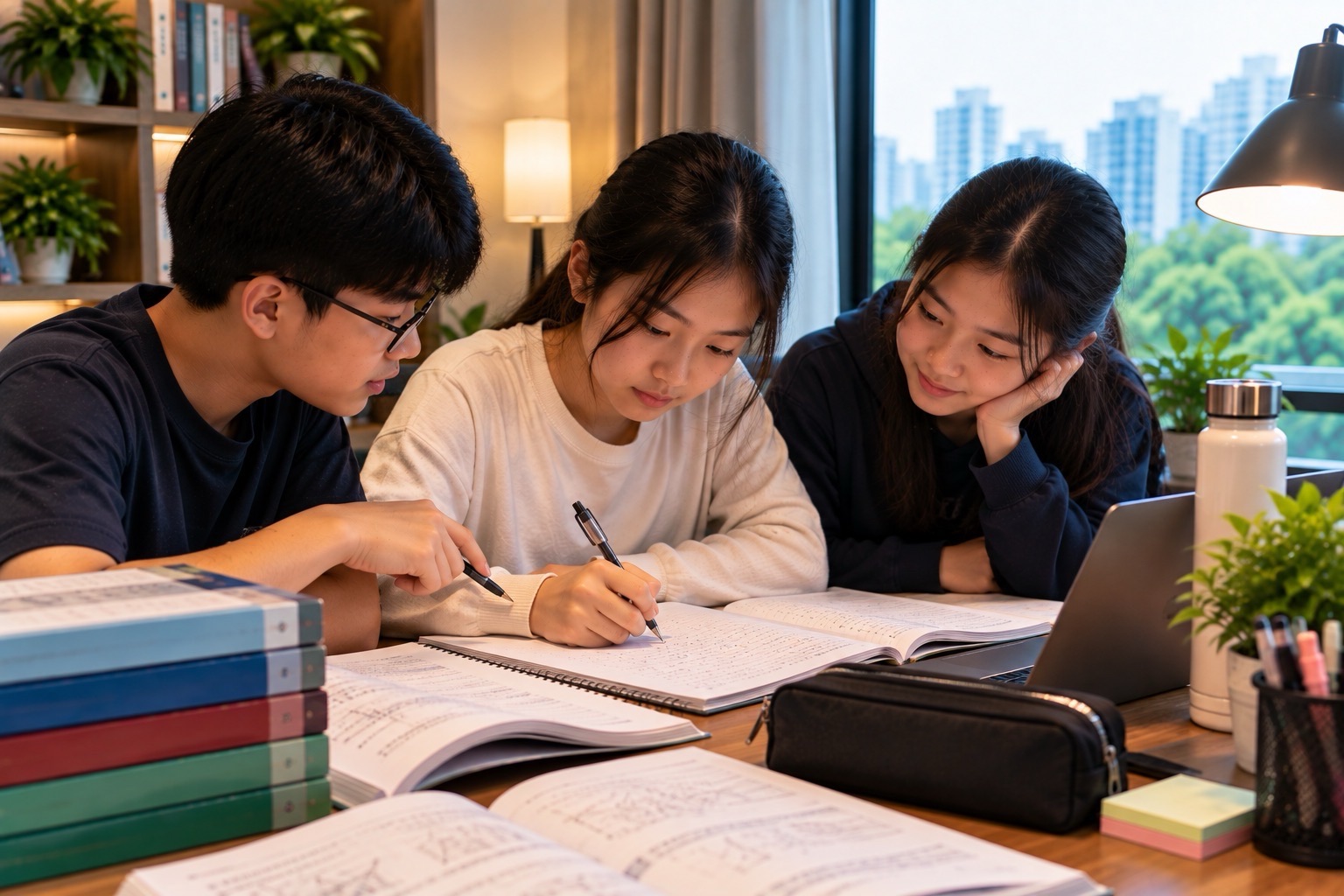
K2 to Primary 1 school readiness in Punggol is not about finishing the Primary 1 textbook early. It is about helping children follow new routines, ask for help, understand stories, make sense of quantities and enjoy learning. eduKatePunggol advertises tutorials with a maximum of three pupils and 1.5-hour sessions. Parents must ask whether a suitable kindergarten or new-P1 group is actually available: the published three-pupil model does not by itself confirm K2 services.
MOE’s 2025-updated Primary Mathematics syllabus assumes no formal Mathematics instruction before P1, although early counting, matching, sorting, comparing and simple patterns can provide a useful foundation. MOE’s preschool-to-primary transition guidance also highlights sleep, packing a bag, buying food at recess and building friendships. Primary 1 and 2 have no weighted examinations. A private tutorial should therefore respond to one genuine learning need without replacing play, preschool, school orientation or family routines.
- **School life:** introduce bag-packing, canteen purchasing, asking for help and making friends through small low-pressure activities.
- **English foundation:** enjoy oral stories, listen for sounds, recognise letters and read early words with meaning.
- **Mathematics foundation:** count and compare objects, notice patterns, understand parts of ten and recognise simple quantities.
- **Tuition decision:** confirm that an age-appropriate small group exists before booking; a K2 lesson is optional.
- **Progress evidence:** a changed, independent story or number task rather than an invented P1 examination result.
Readiness includes social and practical skills
A child who can sound out words may still find it hard to say they are lost, queue at the canteen or pack what is needed for the next day. These are ordinary transition tasks, and families can teach them through supportive practice rather than tuition worksheets.
A parent can choose one small routine each week and let the child try it with less prompting. School staff will also introduce the real environment. Academic and practical independence develop together, but neither should be mistaken for a fixed admission test.
Primary registration is an official process
MOE’s Primary 1 registration has eligibility phases, published dates and balloting rules. The 2026 exercise concerns entry in 2027 and is separate from any private enrichment or tuition programme. No tutoring enrolment creates a right to admission at a particular school.
Families should check the official portal for the current exercise and contact the school about orientation. A tuition provider may explain how learning support works but cannot promise a school placement, secure an application phase or interpret today’s vacancies from an old article.
K2 learning is not a formal P1 syllabus
Preschool activities can develop oral language, curiosity, motor coordination and early mathematics through games, stories and shared experiences. Primary 1 has prescribed language and mathematics learning outcomes, but parents are not expected to complete them during K2.
A good diagnostic therefore begins with what a child already understands and enjoys. It should not make the family feel behind because a neighbour’s child has begun multiplication worksheets. The right next task follows readiness and actual learning needs.
MOE does not require prior formal Maths classes
The 2025-updated MOE Mathematics syllabus explicitly assumes no formal mathematical learning before P1. It identifies early numeracy skills such as matching, counting, sorting, comparing and recognising patterns as helpful. These activities can take place in normal family routines.
A tutor may support a specific persistent gap in number meaning, but there is no evidence that every preschooler needs a long formal problem-sum class. Parents can ask what skill would be learnt and how the child would demonstrate it independently.
Primary 1 Mathematics starts with number meaning
The P1 syllabus covers whole numbers up to one hundred, tens and ones, addition and subtraction within one hundred and introductory multiplication and division within prescribed limits. Early money, clock, shape and picture-graph work also appear. These are school learning outcomes, not kindergarten entrance requirements.
An age-appropriate preparation activity might involve counting a small set of objects and comparing two groups. It need not ask the pupil to solve a four-digit calculation. If a child can already do it independently, another worksheet may offer little extra value.
Primary 1 English is communication
Language readiness includes understanding an instruction, talking about an event, enjoying a book and beginning to connect speech sounds with print. Some children read simple words before school; others need more practice. Neither case determines the child’s entire future English ability.
A tutor should separate what the child can say, hear, read and write. A child who understands a story aloud but struggles to decode printed words needs different help from one who reads words accurately but cannot explain a sentence’s meaning.
Packing a bag is a learning opportunity
Children can learn to check a simple school timetable, identify a water bottle and pencil case, and put the correct items into a bag. MOE parent guidance recommends involving the child in this process ahead of Primary 1.
A family can practise with picture labels before moving to written labels. The child becomes better at a real school task rather than merely reciting school-supply vocabulary. Forgetting an item occasionally is an opportunity to learn a routine, not proof of an academic problem.
Regular bedtime helps the first school weeks
Primary school may require a different wake-up time from preschool. MOE suggests establishing appropriate bedtime habits and gradually preparing children for the school-day rhythm. Families should respond to the child’s actual needs and schedule.
A tuition class placed late in the evening can compete with that adjustment. Parents should compare the full commitment, including travel, against the benefit of the specific skill taught. Sleep and wellbeing are part of a sensible readiness plan.
Buying food combines language and money
A pretend canteen activity can let children practise asking for an item, stating an amount and receiving change. It builds everyday communication and number awareness while preparing for a new school routine.
Use play money and a short conversation rather than turning the task into a difficult commercial arithmetic test. A child may first practise making a request politely and later practise recognising common denominations. These are independent but related skills.
Friends and turn-taking are practical skills
A child may want to join another pupil’s game but be unsure what to say. Role-playing a short introduction, asking to join and taking turns can prepare for common recess situations. MOE includes making new friends among its transition suggestions.
A tutoring group can offer safe turn-taking where appropriate, but preschool and school interactions are also important. A quiet child does not need a forced personality transformation, and adults should avoid comparing the number of spoken words between learners.
Asking for help is more useful than pretending to know
A pupil might not understand where to line up or whom to tell about a lost item. Practising ‘Could you help me find my classroom?’ gives a simple, usable communication tool.
The adult can introduce a changed situation and allow the child to choose an appropriate request. A new-school learner should know that asking a teacher for help is acceptable. Fluency in this situation may matter more immediately than memorising complex spelling words.
Counting and one-to-one correspondence
Reciting ‘one, two, three’ does not prove that each number word is matched to one counted object. A child may skip or double-count a counter. The final number should represent the collection’s size.
A tutor can let the child count ten counters, rearrange them and count again. If no objects were added or removed, the total remains ten. A changed set tests whether the idea is learnt rather than simply repeating the first sequence.
More or fewer depends on quantity, not spacing
Seven counters spread across a long table can look more numerous than nine counters placed close together. The child must learn that arranging a set does not alter its number of objects.
Matching counters pair by pair can show which set contains the extra two. A tutor may then switch to a different collection and ask the child to justify the comparison. The goal is quantity conservation, not a timed visual guessing game.
Parts of ten support early addition
Ten can be formed from six and four, seven and three, or nine and one. Those are relationships between a whole and its parts. Knowing that six plus four gives ten also supports understanding ten minus six.
A tutor can use a ten-frame or counters, then remove them and ask for another combination. The child should state what the pieces represent. An answer remembered from one card is less informative than a new correct combination.
Simple patterns teach an explainable rule
A sequence of circle, square, circle, square has a repeating unit. A pupil can predict the next item, but a clearer explanation identifies the two-shape pattern.
Changing the shapes or switching to a colour sequence checks whether the child follows the rule rather than merely memorises the first objects. This is useful early reasoning, not an IQ examination.
Shapes have properties when they are rotated
A square does not stop being a square when tilted. Its equal sides and right angles remain. The same is true of basic shape identity when a figure moves around the page.
A child can sort shapes in different orientations, then explain which features matter. A tutor should not demand formal proof from a preschooler, but can help build accurate language about sides, corners and shapes.
Early graphs can begin with sorting toys
Before formal picture graphs, children can sort play animals into categories and compare how many belong in each. A simple display makes quantity differences visible.
A tutor can ask which group has more and by how many, then change the categories. A child who chooses the tallest-looking pile without counting may need a clearer representation. Such activities connect play with mathematical communication.
Hearing spoken sounds is not the same as letter naming
Phonemic awareness concerns individual speech sounds; phonics links those sounds to written letters or patterns. A child can recognise letter names without successfully blending printed words, or hear rhymes without knowing the letters.
A suitable tutor checks the process before teaching. Simple sound games may help one learner, while another needs explicit sound–print instruction. The child’s enjoyment and understanding matter as well as accuracy.
Blending a word is different from guessing an illustration
A child who sees a cat picture may guess cat even when the printed word is cap. Pictures help story comprehension but can hide whether the child is using letters and sounds to read.
The tutor can cover the picture briefly, guide blending and then return to meaning. A changed short word and sentence test independent decoding. Pressuring children to read too rapidly can conceal uncertainty rather than repair it.
Story comprehension begins with meaningful questions
A short story says that Mei took an umbrella because it was raining. The child may identify umbrella correctly but not yet understand the reason. Ask what happened first and why the item was needed.
A different everyday story then tests whether the learner can connect cause and action. Early reading should not be reduced to sounding out every word while ignoring what those words communicate.
Oral retelling prepares writing
A child can describe a lost toy through gestures and speech before writing several complete sentences independently. An adult can ask what happened first, what changed and how it ended.
The pupil may then write or dictate one age-appropriate sentence and attempt a changed picture. The purpose is to build communication in stages, not demand a long Primary 6-style composition in kindergarten.
A complete idea has an action
‘The blue ball’ names an object but does not say what happened. ‘The blue ball rolled away’ communicates a simple event. The child can learn this distinction through original pictures and spoken sentences.
A tutor should ask for one clear new sentence rather than add several difficult adjectives. A brief independent response can demonstrate progress without turning early writing into a competition.
Everyday vocabulary is learned through context
Words such as worried, relieved and grateful become easier to understand when connected to events. A child who finds a lost toy may feel relieved; someone receiving unexpected help may feel grateful.
The tutor can compare two situations and invite the learner to use the word appropriately in a changed story. Memorising a large dictionary list is not evidence that the meaning can be used independently.
A calm group gives all three children time
In a three-pupil setting, the quickest child might answer before the others think. A tutor can ask everyone to point, select or write a first response, then rotate short explanations.
A quiet pupil may know the answer but need preparation time. A correct independent attempt should be valued regardless of speaking volume. The advertised group size creates opportunities for attention only when participation is managed well.
A first diagnostic should not label the child
A brief counting, blending or story task can reveal a teachable next step, but it cannot diagnose intelligence, dyslexia or future school success. Observations should describe what happened in the task rather than assign an identity.
If a difficulty persists despite age-appropriate teaching, parents can consult preschool educators and the primary school about relevant support. A private tutor should be clear about limits and avoid unsupported medical claims.
Not every K2 child needs tuition
A child progressing comfortably through preschool, shared reading and ordinary counting may have no identified gap requiring extra instruction. Enrolling only because peers attend can add cost and fatigue without a clear educational target.
A responsible consultation may recommend continuing existing routines rather than booking a private class. The right outcome is growing readiness and independence, not a permanent weekly tuition commitment.
A four-week review should be small and realistic
Week one can observe one skill, such as matching numbers to objects. Week two teaches the missing relationship. Week three changes the collection and gradually removes hints. Week four asks whether the child can apply the idea independently.
This review does not promise a reading level or school grade in a month. It helps parents understand whether the particular practice was useful and whether the child remains comfortable with the learning environment.
Home and school support should work together
The child’s preschool and new primary school can advise families on routines, current learning and school-based support. Private tuition should not contradict those instructions or assume that the family must purchase every recommended workbook.
A clear parent enquiry includes actual school information and a short example of the repeated difficulty. The tutor should explain what additional skill is being taught beyond ordinary classroom and home learning.
Travel and time can outweigh a marginal benefit
A ninety-minute class takes more than ninety minutes once commuting and follow-up work are included. For some K2 pupils, the time may reduce play, family meals or sleep. That matters when deciding whether optional learning support is worthwhile.
Check the actual programme’s age range, lesson duration and current availability. A class that cannot be attended without an exhausting schedule may be less appropriate than a brief family reading or counting routine.
School readiness is not a race to finish primary school
Reading a difficult book or answering a later-year Mathematics question can be enjoyable for a child who is ready, but it is not a standard to impose on all new P1 learners. Genuine readiness includes curiosity, communication and the capacity to learn with others.
Parents can ask what the child understands and can explain independently. The goal of any support is to make the first school year manageable while preserving interest in learning, not to maximise curriculum acceleration.
What to ask at the Punggol consultation
Ask whether a genuinely age-appropriate K2-to-P1 small group is offered, which literacy or numeracy skill it teaches and how independence will be checked. Bring one example of a comfortable task and another that regularly confuses the child.
Confirm fees, tutor experience, actual place and session times directly. A general web guide cannot verify a live K2 class. School registration and placement remain MOE processes, and tuition cannot guarantee future outcomes.
Counting after a rearrangement
Nine counters are arranged in a row and then moved into a circle. A child who says the circular arrangement contains more counters may be using shape and spacing instead of quantity. The tutor counts once with the child and asks whether anything was added or removed.
The pupil then counts a changed group of seven objects independently. This tests the relationship while keeping the activity playful and age appropriate.
Making ten with two parts
A child has six counters and needs ten altogether. Four more counters complete the set. The adult can show the parts within a ten frame, then ask whether seven counters would need three more.
The next group uses different amounts and removes the ten frame. A correct independent response is more informative than a memorised count from the first demonstration.
A pretend food-stall purchase
A child buys an item that costs 60 cents using a pretend one-dollar payment. The amount left is 40 cents. If the arithmetic is too demanding, begin by recognising the coin denominations and making a polite request.
The purpose is confidence with a real school routine as well as number sense. A changed play-money amount can reveal what the child understands without formal testing.
Blending a related word
A learner can read cat but cannot read mat. The tutor makes the common ending visible and links the initial sound to the printed letter, then lets the child attempt the new word.
Another simple word and meaningful sentence are introduced without the original picture. This checks whether the child is using sound–print relationships instead of guessing from a memorised illustration.
One sentence from a picture
A picture shows a child carrying a bag. ‘Girl bag’ communicates some relevant words but not an action. ‘The girl carries a bag’ conveys the intended event.
The tutor can show another picture of a child opening a book and ask for a changed sentence. The new attempt tests whether the language has become usable rather than copied.
A new-school friendship role-play
A child is unsure how to join a game. A parent plays the role of a classmate and models a short greeting and invitation. The child can then try a different situation involving asking to sit together.
The activity develops everyday communication without treating quietness as a deficit. Real friendships still grow through ordinary school interactions.
Parent checklist for K2-to-P1 readiness
- Check official MOE registration and the school’s orientation information.
- Practise asking for help and preparing a school bag.
- Try a pretend canteen purchase and simple turn-taking conversations.
- Enjoy stories and brief sound–print activities.
- Use counting, comparing, sorting and patterns during play.
- Confirm any genuine K2 service before assuming a three-student class exists.
- Avoid inventing P1 examinations or promising a reading grade.
- Keep sleep, rest, family time and play in the plan.
Frequently asked questions
Must children read fluently before Primary 1?
There is no general private-tuition reading benchmark for mainstream P1 admission. Support suitable early literacy and speak with preschool educators if a persistent difficulty appears.
Does MOE expect formal K2 Mathematics?
No. Its P1 syllabus assumes no formal earlier Mathematics, though early counting, matching, sorting and patterns are useful.
Are P1 and P2 weighted examinations required?
No. MOE removed weighted assessments and examinations for Primary 1 and 2.
What practical skills help readiness?
Bag packing, canteen purchases, asking for help, making friends and predictable daily routines can make the transition more manageable.
What numbers does P1 teach?
Whole numbers to one hundred, addition, subtraction and introductory multiplication and division within syllabus limits.
Can tuition guarantee P1 registration?
No. Registration phases, eligibility and balloting are official MOE processes.
What if my child is quiet?
Provide low-pressure opportunities to communicate. Quietness alone is not evidence of poor understanding.
How can I help with reading?
Enjoy short books and age-appropriate sound–print activities while paying attention to story meaning.
How can I help with number sense?
Count real objects, compare groups and explore the parts that make a total.
Should children complete PSLE papers in K2?
No. School readiness and age-appropriate foundations take priority over final-year examination practice.
Is eduKatePunggol’s K2 class confirmed?
No K2-specific offering is established here. Ask the centre whether it provides an age-appropriate class, including fees and tutor details.
How do I check progress?
Look for a new independent number, word or story response after instruction, then revisit it after a delay.
What if a difficulty persists?
Speak with preschool and school educators about appropriate support without assuming a diagnosis from a brief tuition session.
Can families choose no tuition?
Yes. Preschool learning, reading and normal family routines may already be sufficient.
Punggol early-learning and official resources
- Primary 1 English: phonics and storytelling
- Primary 1 Mathematics: number bonds and place value
- Primary School small-group learning directory
- First tutorial and diagnostic preparation
- Tuition at eduKatePunggol
- Immutable eduKate teaching reference
- MOE Primary 1 registration portal
- MOE Parent Kit: Preschool to Primary School
- MOE Primary Mathematics syllabus (October 2025 update)
- MOE Primary 1 and 2 assessment policy
A parent case: a child can count but loses track of the collection
A K2 learner counts a set of eleven counters correctly when the objects are neatly arranged in a row, but skips two when they are scattered. The adult may conclude that the pupil has forgotten the number sequence, even though the real problem is matching a number word to each object exactly once. The tutor can invite the child to move each counted counter into a new area. This physical action provides a check that prevents double counting while keeping the task playful.
Once the learner can count a scattered collection reliably, a changed set of nine or twelve objects tests whether the approach transfers. The parent should see a new independent attempt, not simply another repeated chant. This kind of targeted help is worthwhile when a persistent problem exists; it does not require a formal Mathematics workbook or an invented school-readiness grade.
A parent case: stories are understood but printed words are not
A child follows a picture-book story and can explain why a character is worried but cannot blend a simple unfamiliar word on the printed page. The child may have strong oral vocabulary and comprehension but still be developing letter–sound decoding. A useful tutor should not label this as weak English overall. The first diagnostic asks whether the child can hear the sounds in the word, identify the corresponding letters and blend the printed sequence.
A short explicit example can be followed by another related decodable word in a new sentence. The child should attempt that second task before seeing the first model. Enjoyable shared reading can continue at home, because understanding stories and learning print are complementary. If the difficulty remains persistent despite appropriate teaching, parents can discuss school-based literacy support with educators rather than assume a medical diagnosis.
A parent case: school routines are harder than counting
Another child already knows number bonds to ten and can read simple sentences, but becomes anxious when asked to order food or speak to an unfamiliar adult. Rather than assign harder arithmetic, the family can practise a brief pretend canteen transaction using play money and a clear request. The adult plays the stallholder and changes one detail, such as the menu item or whether the child wants water. The learner chooses a suitable sentence instead of memorising one exact response.
Packing a bag from a picture checklist can be practised in the same gentle way. Over time the child takes responsibility for one or two real tasks without repeated prompting. These routines may be more relevant to the transition than another academic class. An age-appropriate tutorial can support communication if genuinely needed, but school orientation, family role-play and ordinary preschool experiences should remain central.
A practical four-week family check that does not become a second school
In week one, the parent chooses one target: counting each object once, blending an unfamiliar short word, or making a canteen request. They record what the child can do independently without providing the answer. In week two, one clear teaching strategy is introduced. In week three, the setting is changed: different counters, a different word or another pretend menu. By week four, the child attempts a fresh example with less prompting and the adult notes what remains difficult.
This is a low-stakes learning review, not a programme with guaranteed results after four weeks. The target should remain small and understandable to the child. If the skill is developing comfortably through preschool, home and school preparation, additional tuition may not be necessary. If the same problem persists, the parent can consult an educator about a more suitable form of support. Adequate sleep, play and family routines are part of a useful plan.
Editorial note (November 2026): This independent Punggol parent guide is not an MOE or SEAB publication. The K2 service availability has not been established and must be confirmed with eduKatePunggol. Examples are invented for teaching. No school place, tuition grade or specific outcome is guaranteed.


