
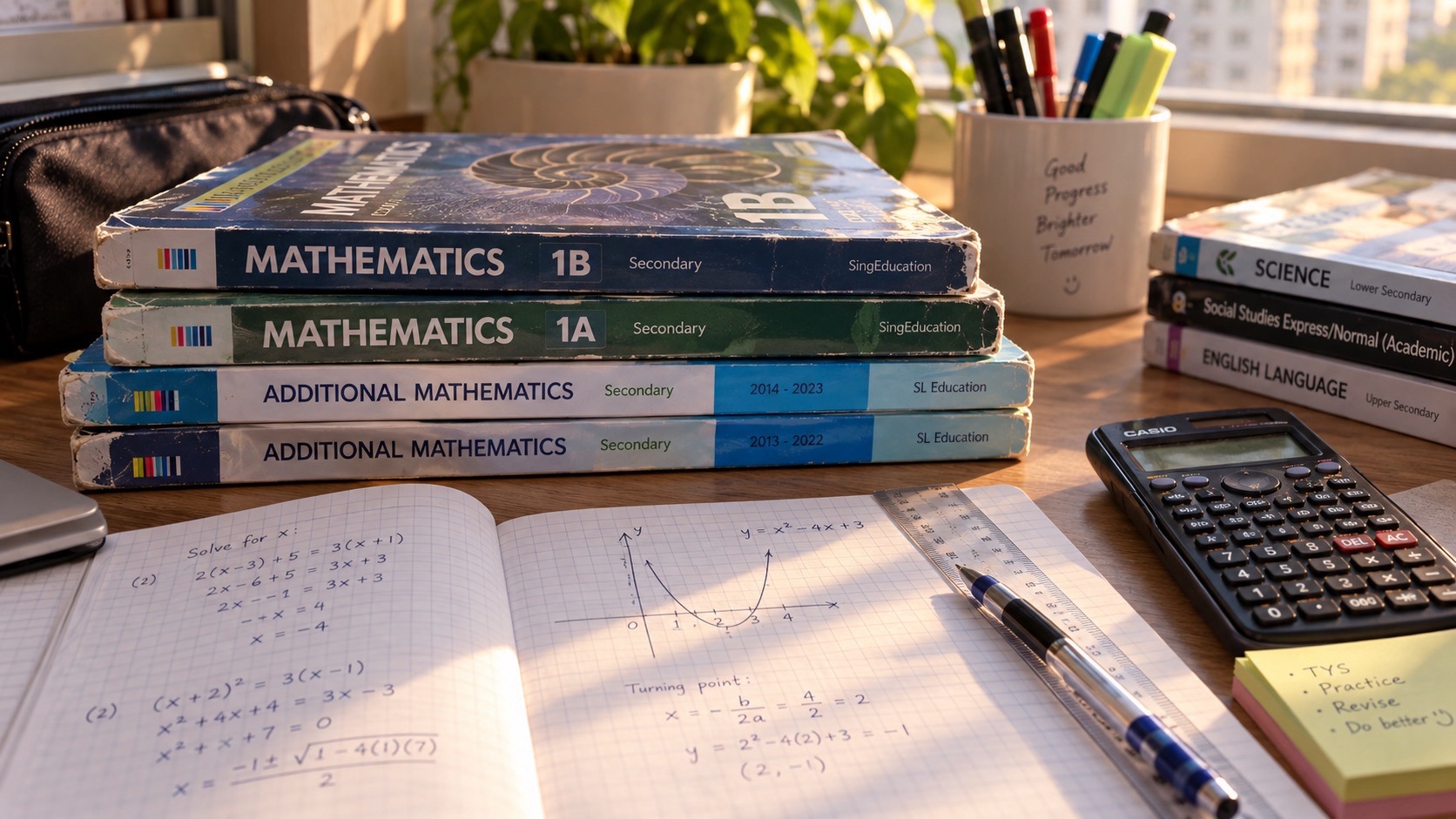
A Punggol student admitted through Posting Group 2 (PG2) can prepare for G2 Mathematics quadratic equations by learning to recognise the squared variable, factorise a quadratic correctly, calculate its possible roots and read the turning point and symmetry of its graph. PG2 is a school-admission group; G2 Mathematics is the level of an individual subject under Full Subject-Based Banding. A quadratic can have two real solutions, one repeated real solution or no real solutions, and the graph helps explain why. The first habit is to identify which expression equals zero and what the unknown represents before applying a method.
SEAB’s 2027 graduating G2 Mathematics syllabus K210 includes quadratic functions y = ax² + bx + c, graph properties including symmetry, maxima and minima, and solution methods involving factorisation, the quadratic formula, completing the square for suitable expressions and graphical interpretation. This is the examination syllabus for candidates graduating in 2027, not a compulsory first-term schedule for students entering Secondary 1 that year. Punggol families at Edgefield, Greendale, Punggol Secondary and Yusof Ishak Secondary should follow their school’s actual sequence. This guide progresses from numerical foundations to accurate worked questions, contrasting solution methods and carefully labelled fictional applications.
- PG2 / G2: admission group and Mathematics subject level are distinct.
- Quadratic equation: an equation containing a second-degree expression in the unknown, often ax²+bx+c=0 with a≠0.
- Roots: values of x that satisfy the quadratic equation; verify them in the original.
- Factorisation: express the quadratic as factors and use the zero-product principle.
- Quadratic formula: x=(-b±√(b²−4ac))/(2a), with appropriate real-number conditions.
- Graph: the parabola can open upwards or downwards; read its symmetry and turning point.
- Intercepts: the y-intercept is c and real x-intercepts are roots of the equation y=0.
- Domain: modelled quantities may have restrictions even where algebra permits more values.
- Next action: solve one quadratic two ways and test both roots by substitution.
Definition lock: PG2 is not a quadratic Maths stream
Posting Group 2 determines a route into Secondary 1. The level of the Mathematics subject is a separate offer under Full Subject-Based Banding and can differ across eligible students. Quadratic algebra is a learning topic, not an admissions category or a guarantee of readiness for more difficult work. The immediate assignment and teacher’s lesson plan matter more than the label on the child’s original posting letter.
A student who cannot multiply two negative values reliably should revise that prerequisite before tackling a quadratic formula. Another may factor expressions correctly but mistakenly discard a negative root. Those errors are distinct. A diagnostic tutor looks at the first step where reasoning stops being valid and teaches that concept, rather than handing the pupil an advanced question simply because they are in secondary school.

A quadratic is different from a linear equation
A linear expression in x has highest power one, such as 3x+2. A quadratic has highest power two when simplified, such as x²−5x+6. This degree difference matters because a linear equation typically has one solution under ordinary nondegenerate conditions, whereas a quadratic can have more than one real solution. A student who always expects one x-value may overlook a valid second root.
Ask which term makes the expression quadratic. The x² term is essential: its coefficient a cannot be zero if the expression is to remain quadratic. The letters a, b and c describe coefficients, not separate unknowns being solved simultaneously. The context and domain may later restrict which mathematical roots are meaningful.
What the form ax²+bx+c means
The standard form y=ax²+bx+c separates the squared term, the linear term and the constant term. For y=2x²−3x+4, a=2, b=−3 and c=4. A common error is to record b as positive three because a student overlooks the sign attached to the term. That can invalidate the quadratic formula and turning-point calculations.
Ask the child to identify coefficients in expressions that have missing terms. For y=x²−9, b=0 and c=−9. For y=−4x²+7x, c=0. Zero coefficients still have a mathematical role even if their terms are not written. Correct coefficient reading is the first checkpoint before solving.
A function and an equation answer different questions
The function y=x²−4 gives a y-value for each allowed x. The equation x²−4=0 asks which x-values make y equal to zero. A child who produces a table of values when asked to solve the equation may not understand the task. Conversely, listing only roots is not a complete description of the entire graph.
Ask whether the question requests an output at x=3, all solutions to y=0, or properties of the graph. For x=3 the function value is five; for y=0 the roots are x=−2 and x=2. The same algebraic expression serves different purposes depending on what the question asks.
Square numbers provide the first visual model
The function y=x² can be pictured through squares. At x=1, the output is one; at x=2, the output is four; at x=3, it is nine. For negative inputs, squaring also gives nonnegative outputs: (−2)²=4. Students sometimes say a negative x must produce a negative y because they have not considered the full square operation.
Use a table containing x=−3, −2, −1, 0, 1, 2, 3. Its values are 9, 4, 1, 0, 1, 4, 9. The repeated values at opposite x positions reveal symmetry, while the differences between outputs show why the graph is curved rather than an ordinary straight line.
The zero-product principle explains factor solutions
If two real factors multiply to zero, at least one factor must be zero. This principle allows a factorised quadratic equation such as (x−2)(x−3)=0 to be solved as x−2=0 or x−3=0, yielding x=2 and x=3. It does not mean that both factors must simultaneously equal zero in every solution.
Ask the teenager to multiply the factors and verify the original expression. Then substitute each root separately. A student who writes only x=2 because it appears first has not completed the equation. The purpose of factorisation is to transform the product into conditions whose solutions are easy to identify.
Factorise x²−5x+6 accurately
The expression x²−5x+6 can be written (x−2)(x−3) because −2 and −3 multiply to +6 and add to −5. Setting the expression equal to zero gives x=2 or x=3. The sign choices are determined by both the constant product and the linear coefficient, not by the positive number six alone.
Check by expanding: x²−3x−2x+6=x²−5x+6. A learner who proposes (x+2)(x+3) will produce the wrong sign on the x term. Always multiply back when uncertain. This is an algebraic proof that a factorisation is equivalent, not merely a numerical guess.
A difference of squares can solve two roots
The equation x²−25=0 factors as (x−5)(x+5)=0. Therefore x=5 or x=−5. Alternatively, x²=25 gives the same two real solutions. Students often answer only positive five because they confuse the principal square root symbol √25 with solving x²=25.
Ask why both positive and negative five square to twenty-five. Then distinguish the expression √25, which denotes the nonnegative principal root, from the equation x²=25, which has two real solutions. This distinction builds on the earlier indices and negative-numbers articles.
A common factor can appear before binomial factors
Consider 3x²−12x=0. Factor out the common 3x to obtain 3x(x−4)=0. Thus x=0 or x=4. A student might divide the entire equation by x immediately, producing 3x−12=0 and losing the valid solution x=0 because division by zero was never permitted.
The safer method is to keep the product intact and use the zero-product principle. Ask whether a proposed division could exclude a value that actually solves the starting equation. This is a broader lesson about equivalent operations: algebraic shortcuts are valid only under their conditions.
A non-monic quadratic needs careful factors
For 2x²+7x+3=0, the factorisation is (2x+1)(x+3)=0, yielding x=−1/2 or x=−3. The coefficient on x² is two, so the factors cannot simply both begin with x and multiply to the correct leading term. Some students guess (x+1)(x+3), which produces x²+4x+3 instead.
Ask the learner to check both the first and middle terms after expansion. The cross-products 6x and x add to 7x. A successful factorisation must reproduce the entire expression, not just its constant term. If the class is not yet ready for non-monic factorisation, begin with simpler examples.
Completing the square exposes a turning point
The expression x²+6x+5 can be rewritten as (x+3)²−4, since (x+3)²=x²+6x+9. Subtracting four returns the original constant five. This form reveals that y=(x+3)²−4 has its minimum at x=−3, with y=−4. The transformation does not change the function’s values.
Ask why three is half of the coefficient six in the completed square. Then verify by expanding. Completing the square links algebraic manipulation to graph geometry. It is one of the methods specified in the K210 graduating course for appropriate forms, but should follow the school’s current progression.
The quadratic formula handles many equations
For ax²+bx+c=0 with a≠0, the quadratic formula is x=(-b±√(b²−4ac))/(2a). The symbols must be read as a complete numerator divided by the whole denominator. Missing brackets or using the wrong sign for b can create two plausible-looking but incorrect answers. The formula works for real roots when the expression inside the square root is nonnegative.
Before substitution, label a, b and c from the equation set equal to zero. Then calculate the discriminant separately. Writing the working in stages reduces input mistakes. A formula is a tool for reasoning, not a replacement for checking whether the equation is genuinely quadratic.
Use the formula on a worked example
Consider x²−4x+1=0, so a=1, b=−4 and c=1. The discriminant is (−4)²−4(1)(1)=12. Therefore x=(4±√12)/2=2±√3, giving approximately 3.732 and 0.268. Both roots are real and distinct. Neither need be forced into an integer when the mathematics does not support one.
Substitute the exact expressions into the original equation or use sufficient decimal precision to check approximately. For x≈3.732, x²−4x+1 is close to zero. Small residuals caused by rounded values are not proof the algebra is wrong; use exact values when possible.
The discriminant predicts the number of real roots
In ax²+bx+c=0, the discriminant D=b²−4ac tells us about real solutions. When D>0, there are two distinct real roots; when D=0, one repeated real root; when D<0, there are no real roots. This follows from whether the square-root term in the quadratic formula is positive, zero or not real in the ordinary real-number system.
Students should avoid concluding that an equation with negative discriminant has no mathematical solutions in every number system; complex-number solutions are a later topic. For the real-number course, the correct conclusion is no real roots. The sign of D also predicts how the parabola meets the horizontal axis.
A repeated root means the graph touches the axis
The equation (x−3)²=0 has the repeated root x=3. Its graph y=(x−3)² touches the x-axis at the turning point and does not cross through it there. The discriminant is zero, so the two quadratic-formula expressions coincide. Students may count the algebraic multiplicity as two roots while the graph has one distinct intercept.
Ask what happens to the function values on either side of x=3. At x=2 or x=4, y=1; at x=3, y=0. This symmetric behaviour clarifies the repeated root without requiring advanced graph theory.
A quadratic can have no real x-intercepts
The graph y=x²+4 remains above the x-axis for every real x because x² is never negative. The equation x²+4=0 would require x²=−4 and has no real solutions. A student who forces an answer of ±2 has forgotten that (±2)² is positive four, not negative four.
A simple sketch can show the parabola with minimum y=4. The graph’s lack of x-intercepts agrees with its negative discriminant. When graphical and algebraic reasoning support the same conclusion, understanding becomes more secure.
The graph of a quadratic is a parabola
For a quadratic y=ax²+bx+c with a≠0, the graph is a parabola. Its curvature and opening depend on the coefficient a, while b and c influence position and intersections. It is not a straight line even if a short plotted segment looks nearly linear. This distinction is important for interpreting changing rates and estimating outputs.
Ask the child to compare a line y=2x+1 with a parabola y=x²−1 on the same conceptual axes. The line has constant gradient, while the parabola’s gradient changes across x. A student who uses one constant rise-over-run for an entire parabola has mistaken a local measurement for a global property.
Positive a opens upwards
Positive a opens upwards
When a>0, the parabola opens upwards and has a minimum turning point. For y=2x²−4x+5, a=2 is positive. Completing the square gives y=2(x−1)²+3, so the minimum is at (1,3). The curve lies at or above y=3 in the real-number model.
Ask the learner to explain why the squared term is nonnegative, and why multiplying it by positive two preserves that. The completed-square form shows the minimum without needing to plot many points. This is algebra and geometry describing the same structure.
Negative a opens downwards
When a<0, the parabola opens downwards and has a maximum turning point. For y=−(x−2)²+9, the maximum is y=9 at x=2. The graph has symmetry around x=2 and crosses the x-axis where (x−2)²=9, giving x=−1 or x=5.
A student who associates every parabola with a minimum has ignored the sign of the squared coefficient. Compare the two openings directly. A clearly labelled maximum is different from an x-intercept, which has y=0 regardless of the curve’s direction.
The turning point gives a maximum or minimum
The turning point, also called the vertex, is where the direction of the parabola changes. In a school graph it may provide the maximum or minimum function value. A student who reads the rightmost point as the maximum merely because it is farthest to the right has confused position with vertical value.
Ask the child to trace the y-coordinate as x increases. Does the curve decrease then increase, or increase then decrease? The transition identifies the vertex. The type of turning point follows the sign of a. This description can be made accurately before calculating the exact coordinate.
The axis of symmetry passes through the vertex
A parabola of the form y=a(x−h)²+k has a vertical axis of symmetry x=h. For y=(x−3)²−4, the axis is x=3. Points equally far to the left and right of x=3 have the same y-value. For instance, at x=2 and x=4 the output is −3 in both cases.
Ask the pupil to compare equal horizontal distances from the axis. This can help detect a plotting mistake where one point sits out of place. Symmetry provides a reason to check, not merely an instruction to fold paper or draw a line down the middle of a sketch.
The coefficient c is the vertical intercept
For y=ax²+bx+c, the vertical intercept occurs when x=0, so y=c. For y=−2x²+3x+5, the y-intercept is five. This is a direct substitution and does not require solving the quadratic equation. Students sometimes give the roots instead because they see the word intercept and assume all intercepts are the same.
Ask which axis the point lies on. A y-intercept has x=0, while an x-intercept has y=0. The two questions are distinct. Labelling them accurately makes a graph useful for interpreting starting values in mathematical models.
The roots are horizontal-axis intercepts
The roots are horizontal-axis intercepts
To find real x-intercepts of a quadratic graph, set y=0 and solve ax²+bx+c=0. For y=x²−5x+6, the roots are two and three, so the graph crosses the x-axis at (2,0) and (3,0). A student who writes the points merely as x=2 without mentioning coordinates may still give the roots correctly, but a graph question may need the actual plotted points.
The algebra and graph should agree. If a hand-drawn curve appears to cross at one and four, revisit the plotting or factoring. The relationship between equations and graphs is not optional decoration; it is a core idea in K210.
A table of points can reveal a graph’s shape
Consider y=x²−4x+3. For x=0,1,2,3,4, the y-values are 3,0,−1,0,3. Plotting these ordered pairs shows a symmetric U-shaped curve with vertex at (2,−1). The points (1,0) and (3,0) are the roots, while (0,3) is the y-intercept.
Ask the child to calculate the values independently, mark the axis scale clearly and connect points smoothly in the appropriate mathematical representation. A poorly spaced grid can distort visual interpretation. The table is an exact algebraic check of the model’s sampled outputs.
The graph’s scale must be read rather than guessed
An axis may use intervals of two, five or another amount per gridline. Counting squares without reading labels can put points in the wrong place and create a false turning point. A cropped graph may omit parts of the parabola or use a vertical scale that exaggerates its apparent steepness.
Begin every graph task by identifying variable names, units and intervals. Then check whether the necessary roots or turning point lie within the displayed range. Visual appearance can support reasoning only when its axes are correctly understood. A graph that looks dramatic is not necessarily measuring a dramatic real-world effect.
Completing the square and the formula should agree
Take x²−6x+5=0. Factorisation gives (x−1)(x−5)=0, so roots one and five. Completing the square gives (x−3)²−4=0, hence (x−3)²=4 and x=3±2, again one and five. The quadratic formula produces the same results. The methods illuminate different aspects of the equation.
Ask when each method is useful. Factorisation is efficient when simple factors exist, completing the square reveals the turning point, and the quadratic formula handles a wide range of coefficients. Choosing the method deliberately is stronger than insisting that only one formula can ever be used.
A quadratic with a repeated factor requires care
The expression x²−4x+4 factors as (x−2)². Its root x=2 has algebraic multiplicity two but is one distinct real value. A student may write the same root twice and believe there are two different places where the curve meets the axis. The graph instead touches at (2,0).
Ask the learner to distinguish counting factors from counting distinct solutions. Depending on the examination wording, ‘one repeated root’ is the precise description. The concept connects factorisation with the vertex and with discriminant zero. It is a particularly useful example of how graph information clarifies algebra.
Negative numbers and brackets matter in every method
Substituting x=−2 into 3x²−4x+1 requires 3(−2)²−4(−2)+1=12+8+1=21. Writing −2² as though the bracket were implied can produce the wrong square. A calculator may also interpret a missing pair of brackets differently from the intended expression.
Ask the teenager to write the substitution on paper with explicit brackets before using a device. A correct calculator display is meaningful only if the input represents the original equation. This is why numerical foundations remain central even in higher algebra.
An invented area problem may lead to a quadratic
An invented area problem may lead to a quadratic
Imagine a fictional rectangular display with width x metres and length x+3 metres. Its area is 40 m², so x(x+3)=40, giving x²+3x−40=0. Factorisation gives (x+8)(x−5)=0, so x=5 or x=−8. Because a physical width cannot be negative in this simple context, the meaningful solution is x=5 m and length 8 m.
This is a completely imaginary display, not a dimension of any Punggol building or school site. The negative root is a valid solution to the algebraic equation but not to the physical model. This teaches the difference between calculating mathematical possibilities and interpreting the relevant domain.
A fictional price or count model may have restrictions
A school club could model a relationship using a quadratic as part of an invented graph exercise, but the equation’s inputs might represent whole numbers of tickets or participants. A value such as 4.7 participants could satisfy an algebraic relationship without being an acceptable real count. A model also may be valid only for a stated range of x.
Ask what x and y represent before accepting every solution. A continuous graph can be useful for analysis while the actual counted quantities are discrete. Do not present the teaching formula as real ticket pricing at a Punggol venue. Context and domain determine which roots have practical meaning.
A curved graph does not prove the future
A curved graph does not prove the future
A graph of historical values may resemble part of a parabola, but fitting a quadratic does not mean the real process will follow it indefinitely. Economic demand, population change and physical systems often involve changing conditions, boundaries and uncertainties. An elegant equation can describe a mathematical model without establishing the real-world cause of an observed pattern.
Ask what data were used, what range was measured and what assumptions justify extrapolation. A secondary-school algebra question may explicitly provide a quadratic model and ask for its interpretation. In a genuine community report, the model’s validity needs independent evidence. Mathematical accuracy and factual reliability must be assessed separately.
Quadratic equations can arise from fractions
Quadratic equations can arise from fractions
Some graduating K210 questions involve simple fractional equations that reduce to quadratics. The child should first identify excluded denominator values, multiply through by an appropriate common denominator under valid conditions, solve the resulting quadratic and test candidate roots in the original equation. Clearing fractions can create apparent solutions that are invalid for the starting expression.
Consider 6/(x+4)=x+3, with x≠−4. Multiplying by x+4 gives 6=x²+7x+12, so x²+7x+6=0. Factorising yields (x+1)(x+6)=0, giving x=−1 or x=−6, neither excluded. Checking both in the original confirms the result. The restrictions must be established before clearing the denominator.
Completing the square helps interpret an optimisation task
Completing the square helps interpret an optimisation task
Suppose a purely fictional model gives y=−(x−4)²+16 for some stated quantity. The maximum value is 16 at x=4 because the square term is always nonnegative and is being subtracted. No differentiation is required to see the turning point. But if x counts whole people or minutes within a limit, the interpretation must respect the valid domain.
Ask what the maximum represents, and whether the value can occur in the permitted context. It would be inappropriate to announce that a local business maximises revenue at exactly four customers merely because the formula contains a vertex. The model is invented and illustrative.
The discriminant can save unnecessary work
The discriminant can save unnecessary work
If the question asks how many real solutions exist rather than their exact values, the discriminant may be sufficient. For x²+2x+5=0, D=4−20=−16, so there are no real roots. A student can justify this without attempting an invalid square root in the real-number setting.
However, if the question asks to calculate all roots, a statement about the number of roots is not the complete answer when real roots exist. Read the command word. A correct method must satisfy the precise request, not simply demonstrate one familiar calculation.
A fictional pupil discards the negative root
A fictional pupil discards the negative root
Imagine a PG2-entry learner, Kai, solving x²=49. He writes only x=7 because he remembers that √49 is 7. His tutor asks which values satisfy the equation when squared. Kai verifies both seven and negative seven, then distinguishes the principal square-root symbol from an equation with two possible real solutions.
On a new quadratic, he checks roots through substitution rather than guessing the number of answers. This fictional learning scenario illustrates a transferable conceptual repair. The pupil should not be told every quadratic always has two different real solutions; some have repeated or no real roots.
A fictional learner uses the wrong graph intercept
A fictional learner uses the wrong graph intercept
Imagine a student, Mei, given y=x²−4x+3. She calls c=3 an x-intercept because the constant appears at the end of the expression. Her teacher asks which variable equals zero on the vertical axis. Mei calculates y=3 when x=0, so (0,3) is the y-intercept, while the x-intercepts are (1,0) and (3,0).
The changed question uses a negative leading coefficient and different roots. Mei must identify the axis and coordinate meaning independently. This diagnoses a representation error rather than a factorisation problem. Good tutoring corrects the first false idea before increasing question length.
A fictional learner misunderstands a maximum
A fictional learner misunderstands a maximum
Imagine another student, Farah, reading a downward-opening parabola but identifying its leftmost plotted point as the maximum because it has the smallest x-coordinate. Her teacher asks her to compare vertical values and locate the turning point. Farah recognises that a maximum refers to the greatest y-value over the relevant domain, not the smallest or largest horizontal position.
She then studies an upward-opening curve and identifies a minimum. The two examples reveal a useful contrast. This fictional case teaches the meaning of function values, not the ability to memorise one picture orientation. A correct explanation should mention both the vertex and the permitted x range.
A twelve-day learning sequence
A twelve-day learning sequence
Start with squares, negative signs and linear-versus-quadratic expressions. Then factor simple quadratics and apply the zero-product principle. Next introduce non-monic factorisation and the quadratic formula, followed by discriminant cases. In the second week build tables, interpret axes and turning points, then connect factorised and completed-square forms. End with an unfamiliar model where one algebraic root is invalid in context.
This is an optional home routine, not the official school timetable. If the student still struggles with distributive expansion, pause before quadratic factorisation. If the child can solve but cannot explain a graph, focus on representation. A few genuinely varied questions solved independently provide better evidence of progress than many copied examples.
How parents can use teacher feedback
How parents can use teacher feedback
An incorrect quadratic answer may arise from a sign error, misplaced bracket, wrong coefficient, incomplete factorisation, lost root, inappropriate method or misread graph. Each calls for a different teaching response. Asking for a larger worksheet before identifying the cause may repeatedly rehearse the same mistake. The quality of explanation matters more than the number of questions marked.
Ask the pupil to explain why one step is valid and then try a changed problem after feedback. A learner who understands the domain and can verify roots will be better prepared for later algebra than one who has memorised the quadratic formula but cannot read a graph. The goal is independent mathematical reasoning.
Official sources and the next step
Official sources and the next step
SEAB’s 2027 G2 Mathematics syllabus K210 lists quadratic functions, graphs, factorisation, the formula, completing the square and graphical solutions. The official 2027 G2 index confirms that these are graduating-cohort specifications. For subject-level flexibility, consult MOE’s Full Subject-Based Banding guidance.
See the PG2 Number Patterns article for earlier algebraic generalisation and the Algebraic Fractions guide for factoring and domain restrictions. Your next step is to give the student x²−5x+6=0, ask for both roots, and then have them locate the graph’s x-intercepts and turning point with an explanation.
Frequently asked questions about PG2 G2 Mathematics quadratics
Does entering through PG2 automatically mean G2 Maths?
No. The posting group governs admission, while Mathematics is offered at an individual subject level.
What makes an equation quadratic?
A nonzero coefficient on x² makes its degree two after simplification.
How many real solutions can a quadratic have?
Two distinct, one repeated, or no real roots depending on coefficients and the discriminant.
Does x²=25 have one solution?
No. It has x=5 and x=−5 over the reals.
How do I verify a factored answer?
Expand the factors and substitute every proposed root into the original equation.
When is the quadratic formula useful?
When solving ax²+bx+c=0, particularly if simple integer factors are unavailable.
What is a parabola’s vertex?
Its turning point, providing the maximum or minimum under the relevant function and domain.
What does a negative a mean?
The parabola opens downwards and has a maximum turning point.
Is the y-intercept the same as a root?
No. The y-intercept has x=0, while roots correspond to x-intercepts where y=0.
Does every algebraic root work for a real word problem?
Not necessarily. Interpret the domain, units, and physical constraints and check the original conditions.
Editorial note, 6 November 2026: Numerical examples and student stories are invented for teaching. K210’s 2027 requirements are for candidates graduating in 2027, not every PG2 pupil’s immediate Secondary 1 syllabus. Mathematical roots must always be checked against the stated domain.


