
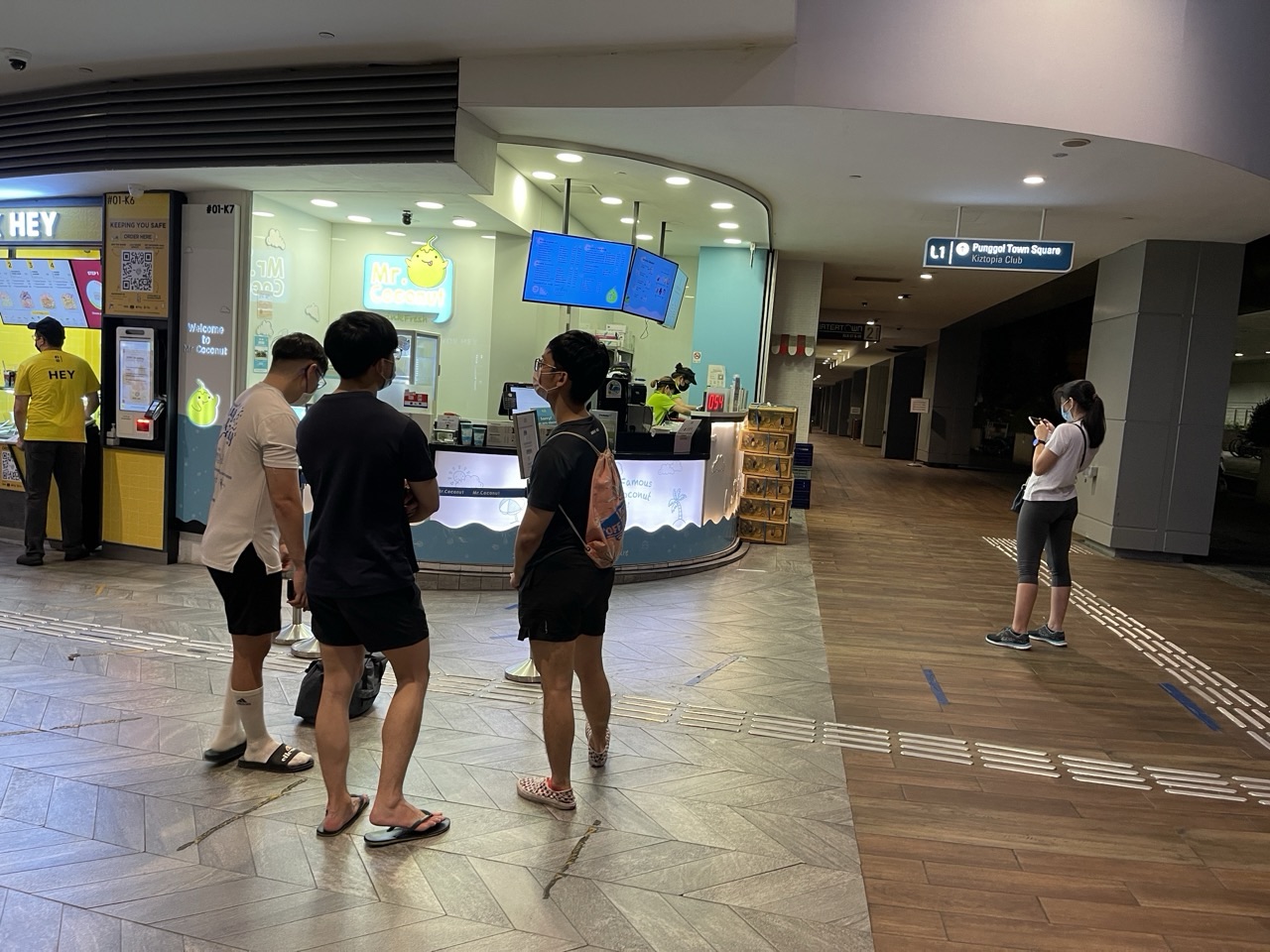
How much do jobs in Punggol pay in 2026 or 2027? There is no single “Punggol salary” for retail, cleaning, customer service, security, healthcare, education, logistics or technology work. Start with the actual occupation, employer and written offer. Singapore’s Progressive Wage Model (PWM) and Occupational Progressive Wages (OPW) set specified minimum wages for covered employees in certain job families, while other salaries are determined by job responsibilities and market conditions. MOM’s latest occupational wage tables available in November 2026 report 2025 national survey figures released on 30 June 2026; they are not Punggol-only pay averages.
The quick answer for several covered local full-time roles in late 2026: MOM lists a $2,435 monthly gross wage floor for retail assistant/cashier, $2,295 monthly gross for quick-service kitchen assistant/counter attendant, $2,170 monthly gross for an Administrative Assistant covered by OPW, and a $2,080 monthly basic wage for a general/indoor cleaner in the relevant Cleaning PWM category. A covered full-time outsourced Security Officer has a $3,090 monthly basic wage floor in 2026, which is not directly comparable with gross wage figures. Coverage, correct job grade, normal hours and employer type matter. These figures are regulatory floors, not guaranteed take-home pay or a survey of current Punggol vacancies.
Find what you need:
- A plain-language comparison of 2026–2027 PWM and OPW wage floors
- Why monthly basic, monthly gross, total compensation and take-home pay are different
- How retail, food service, cleaning, security, administration and driving categories differ
- How to use MOM’s 2025 occupational wage tables without inventing 2026 medians
- What Singapore’s Local Qualifying Salary means—and why it is not a universal minimum wage
- How CPF, part-time hours, variable bonuses, overtime and commute affect an offer
- How to ask an employer fair salary questions before accepting work in Punggol
Independent career and salary guide, checked 6 November 2026. The tables below summarise selected official regulatory floors for specified job categories, not personalised legal advice, job offers or salary surveys. Verify current official regulations and your exact employment status before relying on a number.
At a glance: selected full-time wage floors applying in November 2026
| Covered occupation and grade | 2026 applicable figure | Wage measure | Current schedule ends |
|---|---|---|---|
| Retail assistant / cashier | $2,435/month | Gross excluding overtime | 31 Aug 2027 |
| Quick-service counter attendant / kitchen assistant | $2,295/month | Gross excluding overtime | 30 Jun 2027 |
| Full-service waiter | $2,320/month | Gross excluding overtime | 30 Jun 2027 |
| Administrative Assistant (OPW) | $2,170/month | Gross excluding overtime | 30 Jun 2027 |
| General / indoor cleaner in relevant PWM group | $2,080/month | Basic wage | 30 Jun 2027 |
| Restroom / healthcare cleaner in relevant PWM group | $2,495/month | Basic wage | 30 Jun 2027 |
| Outsourced Security Officer | $3,090/month | Basic wage | 31 Dec 2026 |
| In-house Security Officer | $2,475/month | Gross excluding overtime | 31 Dec 2026 |
| Group A Level 1 Driver (OPW) | $2,370/month | Gross excluding overtime | 30 Jun 2027 |
Every line has coverage conditions, so the table cannot be used as a universal ranking of the best-paying Punggol jobs. Most of the listed full-time PWM/OPW schedules use 35–44 regular working hours per week. Wage measures differ, and some schemes have specific overtime or part-time rules. Use the relevant official source for a particular employment question.
1. Why one number cannot answer “What is the salary in Punggol?”
A shop assistant, systems engineer, primary-school administrator, childcare educator and licensed security officer all contribute different skills and carry different responsibilities. Even when two people work at the same Punggol building, they may have different employers and entirely different salary structures. A Digital District tower can contain professionals, service staff and outsourced contractors with distinct contracts.
Salaries also vary by experience, formal qualifications, professional registration, scope, working hours and the organisation’s pay policy. A job advertised as “manager” may supervise a large team or simply lead a small shift. A title alone is not proof of the relevant PWM grade or a benchmark for private-sector pay.
The correct search begins with the specific job description. Only then should you compare current vacancy salaries, relevant statutory wage floors and official occupational statistics. A figure copied from an old advert is not a current benchmark. A projected employment number, such as JTC’s 28,000-job scale for Punggol Digital District, is not a wage figure or evidence of a hiring boom across every occupation.
2. Basic salary, gross salary and net take-home pay explained
Basic salary generally refers to the contracted wage before additional allowances, commissions or other payments. Gross salary may include basic wages and relevant additional components, depending on the regulatory definition used. Take-home pay is the actual amount after applicable lawful employee deductions, such as CPF where required. Total compensation may include employer contributions, bonus possibilities and non-cash benefits.
These expressions are not interchangeable. A cleaning PWM table based on basic wages should not be compared directly with a retail PWM table based on gross wages as though the figures measured exactly the same thing. Similarly, a job advertisement stating “up to $3,500” could include variable commissions, overtime assumptions or allowances that are not guaranteed.
Ask the employer for a written salary breakdown: basic monthly wage, fixed allowances, variable incentives, overtime where applicable, bonus terms and regular paid hours. If the number is hourly, ask how many hours are guaranteed. The aim is to compare money you can reasonably count on, rather than the maximum figure on a recruitment poster.
3. Singapore’s Local Qualifying Salary is not a nationwide minimum wage
From 1 July 2026, MOM’s Local Qualifying Salary (LQS) is $1,800 monthly gross for full-time local workers under the published conditions, and at least $10.50 hourly gross for covered part-time workers. The LQS is part of the requirements for firms that hire foreign workers and affects how local employees count toward foreign workforce quota calculations.
It is not a universal nationwide minimum salary applying identically to every employer and occupation. A worker covered by an applicable PWM or OPW can have a higher required wage. An employer who meets the LQS does not thereby satisfy a higher PWM rung for a covered cleaner, security officer or retail worker.
A job seeker should not assume every role with a salary below $1,800 is automatically unlawful without checking the employment arrangement, working hours, employer coverage and applicable law. Conversely, the fact that the LQS is $1,800 does not permit a covered employer to pay a PWM worker less than the relevant grade minimum.
4. Retail wages in 2026–2027
MOM’s Retail PWM applies to covered Singapore Citizen and Permanent Resident employees in relevant retail roles, including qualifying part-time work. From 1 September 2026 to 31 August 2027, its full-time monthly gross wage floors excluding overtime include the following:
| Retail PWM level | Sep 2026–Aug 2027 | Sep 2027–Aug 2028 |
|---|---|---|
| Retail assistant / cashier | $2,435 | $2,565 |
| Senior cashier / senior retail assistant | $2,680 | $2,820 |
| Assistant retail supervisor | $2,950 | $3,100 |
| Retail supervisor / manager | Left to market forces under this table | Left to market forces |
These numbers should be matched to actual job duties and coverage. A cashier working at Waterway Point, Northshore Plaza or Punggol Coast Mall may be employed by a retailer operating at several sites. Check who issues the contract and what shift obligations apply. The retail careers guide explains how to find legitimate current postings.
MOM also publishes part-time hourly gross floors for each grade. For the retail assistant/cashier level, the published rate is $12.77 in the 2026–2027 schedule and $13.45 in the subsequent period. A higher hourly rate does not ensure a high monthly income if the contract guarantees very few paid hours.
5. Food service wages are different from retail wages
Restaurant, café and hawker work may fall under the Food Services PWM rather than retail. MOM distinguishes quick-service and full-service categories and the actual duties within them. These are wage floors for covered local workers, not a prediction of what every food business in Punggol will advertise.
From 1 July 2026 to 30 June 2027, the monthly gross minimum excluding overtime is $2,220 for a quick-service food/drink stall assistant, $2,295 for a quick-service kitchen assistant or food service counter attendant and $2,470 for a quick-service cook. In the full-service category, the published figure for a waiter is $2,320. The amounts and classification change with the role.
Do not classify every employee inside a restaurant as a cook or every person who collects dishes as a food-service counter attendant. A cleaner employed by a cleaning business may fall under the Cleaning PWM. A kitchen employee may have SFA food-handler training obligations alongside wage rules. Our F&B careers guide separates the occupations and training.
6. Cleaning wages in 2026–2027 are basic wages
For covered cleaning roles, MOM’s Cleaning PWM publishes monthly basic wages. This is important: a basic-wage floor is not the same measure as the gross figure used in the Retail PWM table.
From July 2026 to June 2027, the general or indoor cleaner level in the relevant office and commercial group has a basic wage floor of $2,080. The outdoor, healthcare or restroom cleaner level is $2,495; multi-skilled cleaner or machine operator is $2,700; and supervisor is $2,870. Different classifications apply for food premises and conservancy, including town council work.
For July 2027 to June 2028, the published basic floor for general/indoor cleaners rises to $2,250, while the specified restroom/outdoor/healthcare level rises to $2,665. The particular worker’s duties and employer coverage still need to be checked. The Punggol cleaning jobs guide explains categories, training and NEA business licensing separately.
7. Security wages: outsourcing changes which wage measure applies
Under MOM’s Security PWM, the covered full-time outsourced Security Officer wage floor in 2026 is $3,090 monthly basic pay, rising to $3,310 in 2027. The covered full-time in-house Security Officer figure is $2,475 monthly gross pay excluding overtime for 2026 and $2,635 for 2027.
These are not contradictory numbers. They relate to different employer arrangements and wage measures. It would be misleading to compare them as though both were the same guaranteed take-home salary. The legal employer, job classification and hours must be confirmed before using the correct table.
Security roles may also require an SPF licence, prescribed training and particular worksite shifts. A larger basic wage does not automatically make a job better when the working schedule, physical demands and commuting situation are unsuitable. Our Punggol security jobs guide explains those conditions.
8. Administrative assistants, executives and supervisors
Singapore’s Occupational Progressive Wages for administrators and drivers covers specified qualifying local workers in relevant roles at firms employing foreign workers. Administrative duties can include records, data entry, appointments, customer communication and other tasks, depending on the grade. Not every manager or customer service title qualifies simply because it sounds administrative.
From July 2026 to June 2027, the full-time monthly gross floors excluding overtime are $2,170 for covered Administrative Assistants, $2,760 for Administrative Executives and $3,340 for Administrative Supervisors. From July 2027, the corresponding floors rise to $2,360, $2,940 and $3,520.
These are not estimates of Punggol office salaries. An assistant at a small firm, an executive managing complex records and a specialist data analyst may have different responsibilities, employer coverage and prevailing salaries. Check the actual posting and classification. The admin and data-entry job guide covers practical role selection.
9. Driver OPW: different licence groups and job levels
MOM’s 2026 updated driver OPW distinguishes Group A drivers with Class 3 or below licences from Group B drivers with Class 4 or above licences, and Level 1 from Level 2 duties. For July 2026 to June 2027, the full-time monthly gross floors excluding overtime are $2,370 and $2,485 for Group A Levels 1 and 2 respectively, and $2,505 and $2,555 for Group B Levels 1 and 2.
A driver assigned to carry out specialised tasks may need particular training or a licence appropriate to the vehicle. The wage grade depends on the actual duties and correct classification. A delivery rider working as a platform worker may have a different legal and CPF framework from a company-employed driver, and cannot automatically be assigned to the OPW employee table.
If you compare a Punggol logistics role with a driving job, consider equipment, physical demands, paid hours, night shifts, vehicle responsibilities and actual legal employer. A job title may not fully describe these conditions. See our warehouse and logistics career guide for the distinction.
10. Are all Singapore jobs covered by a Progressive Wage Model?
No. MOM identifies specific sectoral PWMs and occupational progressive wages, with particular coverage and employer requirements. Some occupations are outside these minimum-wage ladders and rely on market-determined remuneration, employment contracts and other legal protections. Do not take a table from one sector and apply it to every job at the same building.
A software engineer, registered nurse, qualified educator, marketing specialist or bank professional may not have a directly applicable PWM rung. Their salaries depend on the actual role, qualifications, experience and employer conditions. The fact that a job is highly skilled does not guarantee a particular pay range either.
When a vacancy is not covered by a relevant PWM/OPW classification, use current job advertisements and the latest official occupational wage statistics as contextual benchmarks. Avoid inventing an annual Punggol salary median from scattered advertisements. A complete offer comparison also accounts for hours, benefits and long-term career learning.
11. What the latest official occupational wage table can and cannot tell you
MOM’s Occupational Wages 2025 was released on 30 June 2026. It includes median, 25th and 75th percentile basic and gross wages for many occupations, drawn from a representative survey and administrative information. It refers to full-time resident employees in the surveyed national context, not specifically workers living or working in Punggol.
This is useful when assessing whether an actual offer is broadly consistent with a national occupational range. However, different organisations, responsibilities and levels of experience can produce different pay within the same title. Some occupations rely heavily on bonuses excluded from the survey wage measure. Older data should not be labelled “November 2026 actual salary” just because the source page was published during 2026.
MOM also publishes uses and limitations. The right method is to compare a carefully selected occupation, check the year and wage definition, then assess the real offer’s duties. If you lack the survey’s actual figure for an occupation, do not make up one.
12. How to read the median and percentiles without confusing them
A median is the midpoint of a distribution, not a guarantee or an official recommended salary. The 25th percentile indicates that a quarter of recorded values fall at or below that point, while the 75th percentile is higher. These statistics help describe variation but do not tell you what one employer must pay or whether an individual deserves a specific figure.
For a new graduate, a national median across experienced workers can be a poor direct comparison. For a specialist with many years of experience, an entry-level posting may also be misleading. Match experience, actual responsibility, industry and work arrangement as closely as possible. Statistical data supports judgement rather than replacing it.
Do not interpret one year’s increase as a guarantee of the following year’s rise. MOM warns that sample-survey wage changes can fluctuate. A longer-term view and genuine employer offers are more useful than a dramatic claim that every Punggol job should grow at the same percentage.
13. 2026 national wage changes are not 2027 salary promises
MOM’s May 2026 Report on Wage Practices 2025 found that nominal total wages grew 4.9% in 2025 and real wages grew 4.0% among the reported full-time resident employee group. Those are historical national wage-change measures with defined coverage, not a prediction that a particular Punggol employee will receive a 4.9% pay rise in 2027.
Employers can raise wages at different rates, freeze salaries, change allowances or pay bonuses according to business conditions and contracts. Some industries may respond differently to the economy. A district opening new offices also does not automatically increase every salary inside it.
If an employer promises a future pay rise, ask whether it is written into the contract, dependent on performance, tied to a completed training stage or merely an informal expectation. Budget using the guaranteed pay you have, not an uncertain future increment.
14. CPF deductions: the difference between gross and what arrives in your bank
CPF contributions can apply to eligible employees based on citizenship or permanent-resident status, age, monthly wages and other conditions. CPF Board publishes current contribution schedules and calculators. Some older age brackets have different rates, and changes for certain senior workers have been announced for 1 January 2027.
Do not subtract an arbitrary fixed percentage from every Punggol salary. A person’s age, wage band and CPF status can materially change the result. Employer CPF contributions are also not the same as the employee’s contribution deducted from salary. A “total compensation” claim may include amounts that the employee does not receive as monthly cash.
For practical household planning, ask payroll for a sample breakdown based on the actual offer and your eligibility, or use an official CPF calculator. If you are comparing a work-study position, part-time job or freelance arrangement, check whether it is employment under a contract of service and which rules apply.
15. Full-time and part-time wages: compare guaranteed hours
MOM generally describes part-time employment as a contract of service for fewer than 35 weekly hours. Different PWM/OPW schemes publish pro-rated requirements or specific hourly figures for covered part-time workers. A part-time job’s rate should be checked against the correct occupation and wage schedule, not simply divided using an arbitrary full-time month.
For example, an advertisement could promise a high hourly rate but schedule only a few hours each week. A lower hourly rate with stable paid hours might yield more reliable income. The comparison must also include relevant leave, CPF, transport and family obligations. Do not treat overtime or extra shifts as guaranteed until the employer actually commits to them under lawful terms.
A parent looking for school-hours work may value reliable shifts more than a slightly higher advertised wage. A student may need fewer hours during examinations. Financial planning should consider the week the person can sustain, not the maximum number of hours a recruiter says might be available.
16. Commissions, allowances and the meaning of “up to”
Recruitment advertisements sometimes show “up to $4,000” or other figures based on sales commission, shift allowances, variable bonuses or potential overtime. The upper end may not be earned by a typical new employee, and may depend on targets that are not stated in the headline. Ask for a clear distinction between guaranteed basic pay, fixed allowances and performance-dependent elements.
In service or retail work, commission schemes may specify when a sale counts, whether refunds reverse commission and what happens during probation. In other occupations, allowances may depend on shift type, worksite or travel. These amounts should not be assumed when calculating a budget unless the conditions are documented and realistically met.
Similarly, a job offer may provide benefits such as additional leave or training support. These can have genuine value but do not replace predictable cash income. A balanced comparison recognises both without mixing them into one unexplained number.
17. Overtime: do not assume every occupation uses the same rule
Singapore’s Employment Act contains overtime provisions for eligible employees, with coverage and thresholds depending on the kind of work and salary. Some PWM schemes also have additional wage requirements for overtime. Other occupations, including certain covered security arrangements, have their own specific treatment. It is unsafe to state that every extra hour in every occupation is automatically paid at exactly the same multiple.
Ask the employer which ordinary weekly hours are contracted, when additional hours may be requested, how approval works and what pay applies. For a covered role, compare the written terms with MOM’s current employment and sector guidance. A salary headline that assumes continuous overtime can conceal a demanding schedule.
When shifts are late or frequent, also consider sleep, safety, study and family care. A job that looks profitable on an overtime-heavy spreadsheet may be difficult to sustain over several months.
18. A fictional comparison of three Punggol job offers
Imagine a resident comparing three genuine but hypothetical opportunities: a retail assistant near Punggol MRT, a customer operations role at a distant office and a local cleaning role. The jobs carry different duties, salary measures, training and rosters. The resident cannot rank them fairly by copying the largest number from an advert.
They first identify the legal employer and worksite. Next, they compare guaranteed basic pay and fixed gross components. They review the correct PWM/OPW category where applicable, then note regular hours, overtime rules, CPF, leave and travel costs. Finally, they consider work suitability and skills development.
The outcome may not be the highest headline figure. The customer operations job might offer strong long-term learning but require a long commute. The retail role might provide more reliable shifts, while the cleaning role could suit someone seeking defined physical tasks with appropriate training. Different people may choose differently. These are fictional teaching examples, not claims about current Punggol employers.
19. What to ask when an advertised salary looks too low
First, check whether the relevant PWM or OPW applies and whether you are using the correct job level and salary measure. A worker who sees an apparent mismatch should ask the employer for the formal classification, ordinary working hours and written wage components. Preserve the actual job description and contract.
MOM provides a Progressive Wage Portal for eligible employees to review occupation and wage information. The agency also explains where to seek clarification or raise a concern. Avoid making public accusations based on a screenshot that omits the employer’s actual coverage or a worker’s agreed hours.
If the role is not covered by the PWM or OPW, a lower offer may still be worth negotiating or rejecting, but a difference from a national wage median is not automatically a legal violation. Salary negotiation and statutory compliance are different questions.
20. How to negotiate without inventing a market salary
Use evidence from the actual role, your relevant accomplishments and appropriately comparable vacancies. Explain your work, qualifications and value with specific examples. Do not claim that “Punggol pays $5,000 for all graduates” or present an unrelated senior software engineer’s salary as the benchmark for a junior support role.
Ask the recruiter which figure is basic and which is gross. If the package includes commission or variable bonuses, ask how those are calculated and when they become payable. Where the job has a statutory wage floor, confirm its correct classification first.
If an employer cannot increase basic pay, other terms—such as training, working location or shift predictability—may still be relevant, but do not accept a non-cash benefit in place of a legally required wage. Every negotiation should end with a clear written offer that you can review without pressure.
21. The job-offer worksheet worth using before you resign
| Question | What to record | Why it matters |
|---|---|---|
| Who pays me? | Legal employer and contract type | Determines who is accountable for payroll and terms |
| What is the job? | Actual duties, grade and qualifications | Needed to identify appropriate wage rules |
| What is guaranteed? | Basic pay, fixed allowances and paid hours | Foundation of a household budget |
| What is variable? | Commission, bonuses, additional shifts and conditions | Should not be assumed in baseline income |
| What do I take home? | Applicable CPF and lawful deductions | Cash available for monthly commitments |
| What is the complete week? | Shift, overtime, travel and caregiving impact | Checks whether the job is sustainable |
| What do I learn? | Supervision, training and realistic progression | Connects the job to long-term capability |
Mark unconfirmed information honestly. Do not assume the first offer is final or that you must answer immediately without understanding basic terms. If a recruiter pressures you to pay money before receiving a written job, stop and independently verify the employer.
22. Why a near-home job may be worth more than the salary suggests
A Punggol resident may save time by working near Punggol MRT, One Punggol or Punggol Coast. Time has value for rest, family, study and other commitments, although it is not the same as cash salary. Another role farther away may provide stronger mentorship, specialist experience or higher guaranteed pay.
Compare the full journey at the actual reporting time, not just the time shown by a map at midday. Check whether the employer may transfer you between outlets. For an evening or early-morning job, consider transport availability and safe travel. A monthly salary difference can be misleading when the working day consumes more time than expected.
Our guide to whether a job near home is worth it develops this decision in greater depth. The salary guide concentrates on comparing the money correctly.
23. What not to do with a 2027 salary forecast
Some PWM and OPW schedules announce future wage floors with precise dates. Those can be stated as published future requirements. But a forecast that “software salaries at Punggol Digital District will rise 20%” requires evidence and should not be published as fact merely because new offices are opening.
Distinguish announced regulatory wage schedules from predicted private market wages. If a future PWM amount applies to a role only from July or September 2027, say so. Do not label it the current November 2026 wage. The relevant employer might offer more than the floor, but that is a separate employment decision.
When real labour market data becomes available for a newer period, revise the article with the release date, source, population and wage definition. Avoid silently replacing past figures with future estimates. Readers should be able to tell what was known and when.
24. A four-week salary comparison plan
- Week 1: identify one or two occupations and actual job descriptions.
- Week 1: check whether a PWM or OPW category applies and identify the correct wage measure.
- Week 2: review current genuine employer advertisements and the latest official occupational wage data.
- Week 2: distinguish basic, gross, variable and take-home pay.
- Week 3: prepare a truthful CV and interview evidence relevant to the advertised duties.
- Week 3: ask about actual hours, allowances, training, workplace and contract type.
- Week 4: use the written offer worksheet, appropriate CPF guidance and the real commute to compare options.
- Week 4: seek official clarification if a mandatory wage requirement or employment term remains uncertain.
This is a research and decision process, not a guarantee that a higher salary or job offer will follow within four weeks.
25. Frequently asked questions
What is the average salary in Punggol in 2026?
No single reliable Punggol-wide figure covers every occupation. Use the latest national occupational wage survey with its limitations and real employer offers for specific jobs.
Are the PWM numbers average salaries?
No. They are regulatory minimum wage requirements for covered occupations and circumstances, not average market salaries.
What is the 2026 Retail PWM floor for a cashier?
MOM lists $2,435 monthly gross excluding overtime for covered full-time retail assistants/cashiers from September 2026 to August 2027.
What is the quick-service counter attendant wage floor?
For a covered full-time role, MOM lists $2,295 monthly gross excluding overtime from July 2026 to June 2027.
What is the Cleaning PWM floor for a general indoor cleaner?
The relevant covered full-time basic wage floor is $2,080 monthly from July 2026 to June 2027.
Why does a Security Officer salary table show both $3,090 and $2,475?
They relate to different outsourced and in-house frameworks, using basic and gross wage measures respectively. Check the actual employment type.
What is the Local Qualifying Salary in late 2026?
MOM sets the relevant full-time LQS at $1,800 monthly gross from July 2026, with a separate part-time threshold. It is not a universal nationwide minimum wage.
Does the CPF deduction always equal 20%?
No. The applicable contribution depends on age, wages, residency status and other rules. Use CPF Board’s current guidance.
Are bonuses included in the occupational wage survey?
MOM’s Occupational Wages 2025 presents basic and gross wages excluding bonuses under the published methodology.
Are 2027 salary figures confirmed for every occupation?
No. Some PWM/OPW wage floors are officially scheduled. Private-market salary forecasts are a different matter and should not be invented.
Does part-time work have the same monthly wage floor as full-time work?
Not automatically. Applicable schemes use hourly or pro-rated rules; check guaranteed hours and the correct worker category.
Is a job near Punggol MRT always the best paying?
No. Salary, duties, training, working hours and employer terms vary. Compare the full week and genuine offers rather than location alone.
Can I negotiate if the employer pays above PWM?
You can discuss an appropriate salary using relevant role and experience evidence, but the employer controls the offer within applicable law.
How do I report suspected underpayment?
First verify the correct occupation, wage measure and applicable rules. MOM provides the Progressive Wage Portal and official assistance channels for covered employees.
Official sources and further eduKatePunggol guides
- MOM Statistics — Occupational Wages 2025, released June 2026
- MOM Statistics — wage-data uses and limitations
- MOM — what the Progressive Wage Model covers
- MOM — Retail PWM schedules
- MOM — Food Services PWM schedules
- MOM — Cleaning PWM schedules and bonus
- MOM — Security PWM wages and measures
- MOM — Administrative and Driver OPW schedules
- MOM — Local Qualifying Salary
- CPF Board — current contribution rates
- MOM — 2025 wage practices report, released May 2026
- Careers in Punggol — navigation hub
- eduKatePunggol — compare and negotiate job offers
- eduKatePunggol — payslips, CPF and deductions
The practical next move: pick one real job, identify its correct category and wage definition, and compare the written offer with current official guidance. That is a more useful answer to “How much should this Punggol job pay?” than an unsupported salary ranking or an exciting forecast.


