
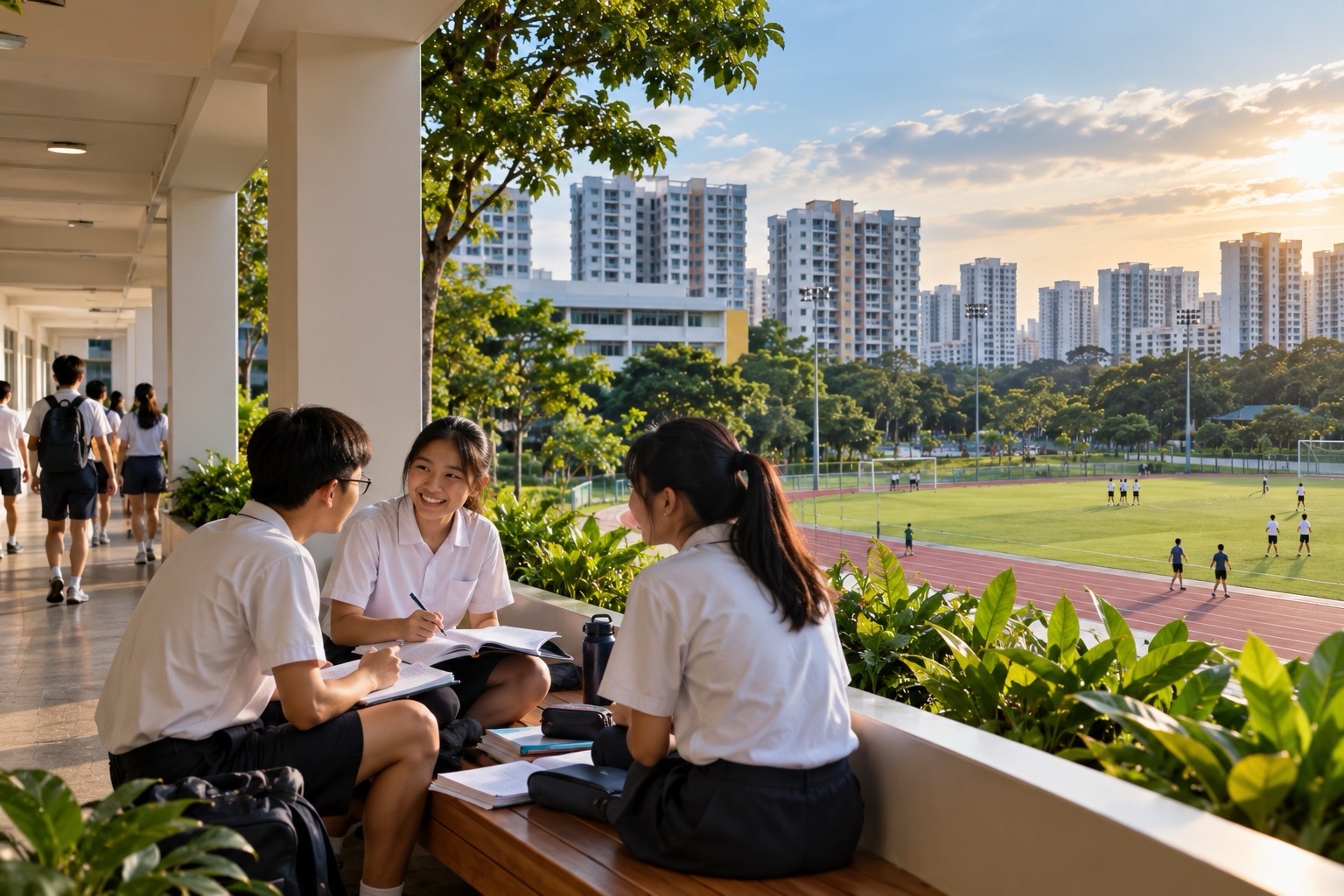
Dunman Secondary School at 21 Tampines Street 45, Singapore 529093, is a government co-educational secondary school that eligible Punggol pupils can consider through Posting Group 2 (PG2). Its completed 2026 Secondary 1 intake recorded a historical PG2 PSLE Score range of 21–23, with 23 the last admitted score. That is not a guaranteed cut-off for the 2027 intake. Parents must check the pupil’s actual posting eligibility, current MOE SchoolFinder information and the ordinary journey to Tampines before ranking the school. Dunman Secondary is a different institution from Dunman High School; their programmes and admission pathways should not be confused.
Dunman Secondary’s signature is STEM for Life, combining STEMviaDT, ELIXiR Science enrichment, digital learning and values-driven action. Its 2026 programme overview describes Secondary 1 Health and Active Ageing challenges, Secondary 2 Sustainability, Secondary 3 Technology’s Impact on Humanity and later student-led projects. The school’s ELIXiR programme offers workshops and choice-based STEM enrichment, while iSTEM Academy connects Infocomm, Green, Media and Makers’ clubs for deeper exploration. The school also emphasises Empathetic Leaders, Impactful Innovators through student leadership and peer support. Its 2026 Open House is Saturday, 14 November, with school tours, STEM workshops and a principal’s talk. These are real opportunities but not automatic selected club places or subject-level upgrades.
- School: Dunman Secondary School, 21 Tampines Street 45, Tampines.
- Not Dunman High School: check the correct school name and posting eligibility.
- 2026 historical PG2: 21–23; last admitted 23, not a 2027 guarantee.
- Full SBB: PG2 admission differs from an individual G2 or G3 subject.
- Signature: STEM for Life, integrating STEM, design thinking and VIA.
- STEMviaDT: Sec 1 Health and Active Ageing; Sec 2 Sustainability; Sec 3 Technology’s Impact; upper-secondary leadership projects.
- ELIXiR: Sec 1 STEM exploration, Sec 2 application, Sec 3 innovation and upper-secondary portfolio/mentorship.
- iSTEM Academy: deeper Infocomm, Green, Media and Makers Club activities, with selection as applicable.
- Apple Distinguished School: the school’s reported current designation and digital-learning approach.
- Student leadership: Student Council and Peer Support Leaders, plus class and CCA responsibilities.
- 2026 Open House: Saturday 14 November, 9 am–noon; principal talk 10.55–11.30 am.
- CCA choice: official information asks Sec 1 pupils to rank five core CCA preferences.
- Next action: verify actual curriculum, academic levels, transport and selection conditions.
Definition lock: Dunman Secondary, PG2, and G2 are different names
Dunman Secondary School is not Dunman High School. They are separate institutions, and parents should not transfer admission data, programme titles or alumni histories between them. Posting Group 2 is the group used for Secondary 1 admission to a mainstream school under Full Subject-Based Banding. G2 refers to the level of a particular academic subject. A pupil may have individual subjects at different General levels where eligible, while participating in common form-class and school-wide activities. The original posting group should not be used to label a child’s character, creativity or lifelong ability. A careful family compares the actual school rather than an imagined reputation attached to a similar name.
The completed 2026 PG2 range
Dunman Secondary’s 2026 Secondary 1 intake showed PG2 pupils admitted with PSLE Scores from 21 to 23. The last admitted result was 23 in that completed exercise. Future cut-offs are determined after the actual applicants rank schools and places are allocated, so a child scoring 23 next year cannot be promised a place automatically. Citizenship and other official tie-breaking conditions may matter at the boundary. Keep the year, school, posting group and range beside each other in the shortlist. A figure from Dunman High or a PG3 column is not a substitute. Honest planning uses historical data as one input, together with genuine preference, educational fit and realistic alternative choices.
Address and commute from Punggol
The school sits at 21 Tampines Street 45. Its official Getting Here page identifies Tampines East MRT and nearby buses as useful reference points. The practical journey from Punggol depends on the family’s home, walking access, services, transfers and timing. Test it on a school morning and after a late CCA. A route that looks short on a quiet-day map may be tiring in rain or during commuter peaks. Include the actual school entrance and safe crossings when practising with a new Secondary 1 pupil. An appealing STEM programme may justify additional travel, but the family should understand the cost in sleep, homework and ordinary life rather than judge solely by a school showcase.
Empathetic Leaders, Impactful Innovators
The current Dunman Secondary homepage identifies its aspiration as Empathetic Leaders, Impactful Innovators. The phrase joins two capabilities that can reinforce each other. Innovation asks whether a proposed solution works and can be improved. Empathy asks whether it serves the people affected. A clever device that users cannot operate may be an unsatisfactory design, even if its coding is impressive. A pupil should practise asking questions, gathering evidence and responding thoughtfully to feedback. School culture matters equally: a student who feels safe admitting an error is more likely to learn than one who hides mistakes for fear of humiliation. Parents should ask for actual examples of these values in everyday teaching.
What STEM for Life actually means
Dunman’s 2026 Open House FAQ describes STEM for Life as an integrated school signature weaving STEM knowledge, design thinking and Values-in-Action across subjects and activities. It is more than a weekly electronics workshop or one selected competition. The idea is that students can recognise how academic knowledge helps solve real human and environmental problems. A meaningful task asks who needs the solution, which constraints apply, what was tested and what remains uncertain. A polished presentation is not evidence that the pupil understands the mechanism. Parents should distinguish ordinary curriculum exposure from selected iSTEM and international opportunities. Both can be valuable, but they have different access and commitments.

STEMviaDT: design thinking and values together
The official STEMviaDT page presents an interdisciplinary approach combining Design Thinking, Values in Action and STEM. Pupils learn to identify a need, propose an appropriate solution and examine evidence. This avoids treating technology as valuable simply because it is new. A student may build a functional prototype that is still inconvenient or expensive for its intended user. The team should test assumptions with appropriate feedback and revise. These steps can connect English explanations, Science observations and mathematical comparisons. A child who learns to change the design after discovering its limits is developing valuable judgement, even if the first product is not chosen for a showcase.
Secondary 1: Health and Active Ageing
The STEMviaDT programme identifies Health and Active Ageing as its Secondary 1 focus. This is especially relevant in Singapore, where students can learn about the needs of older people without making assumptions that all seniors have identical abilities or preferences. A hypothetical design might aim to make a daily activity easier, but pupils should first understand the real barrier. An elaborate app could be inappropriate for the user or require maintenance nobody can provide. Good design begins with empathy, accurate observation and manageable testing. Students should also respect privacy and avoid presenting unverified medical claims. A school science activity is not permission to diagnose or prescribe for community members.
Why active-ageing projects need real users
Pupils may imagine older adults would enjoy one particular technology because the design is familiar to teenagers. That assumption can be wrong. Respectful consultation under school guidance helps students discover different needs, comfort levels and practical constraints. A prototype should be evaluated by ease of use and actual benefit, not solely appearance. If an older participant does not like the design, the student can learn to revise instead of insisting the user is resistant to technology. Such feedback develops both social judgement and engineering skill. Parents can ask the teenager which initial assumption changed after a conversation or test, rather than simply praising the sophistication of a screen or sensor.
A historical project: karaoke and connection
Dunman’s STEMviaDT page shows a student mobile-app example involving karaoke for seniors to support connection during the pandemic. This is a useful historical illustration, not a guarantee that the 2027 class will build the same product. It demonstrates that technology can be explored through a social need instead of a purely technical puzzle. Pupils might investigate whether a shared activity is accessible, enjoyable and easy to organise. They should also consider data privacy, connectivity and whether the intended user prefers a different method of participation. A school project can help students learn these trade-offs even when the prototype is never commercially deployed.
Another historical example: essential services
The same official page shows a student concept for a mobile app providing useful information about essential services for seniors. That idea raises practical questions: Is the information current? Can the user read it? What happens when a service changes location or opening hours? A design that provides outdated information can be harmful even if the interface is attractive. Students should understand verification, maintenance and accessibility before calling a product successful. The lesson connects media literacy with technology design. A teenager who learns to check real-world details and acknowledge limitations is better prepared for responsible engineering than one focused only on completing the coding task.
Secondary 2: Sustainability and measured claims
The second STEMviaDT focus is Sustainability. Pupils can explore resource use, environmental issues and the relationship between a design and its wider consequences. A solution labelled green is not automatically environmentally better; the materials, energy requirements, maintenance and scale may change the outcome. A careful student defines what will be measured and compares relevant quantities under suitable conditions. If only one trial is conducted, the conclusion may need qualification. This process supports Science and Mathematics learning, and it teaches honest communication. Parents can encourage their child to explain both the proposed benefit and one cost or uncertainty that needs more investigation.
Secondary 3: Technology’s impact on humanity
The official design-thinking progression names Technology’s Impact on Humanity in Secondary 3. This expands the discussion from whether a device works to how its use changes people’s experience. AI, automation and digital platforms can create benefits while also raising privacy, access, misinformation and dependency concerns. Pupils should learn to identify stakeholders and compare reasonable alternatives. A clever app may exclude people without the right device or digital skills. The student should also know that technology changes over time, so a present demonstration cannot guarantee a particular future career. The valuable habit is adaptability: learning to ask sound questions when tools, constraints and human needs evolve.
Secondary 4: student-led application and ownership
The school’s 2026 Open House programme description places upper-secondary students in a position to define and lead sustainability-related projects. Such responsibility is meaningful only when students genuinely understand the issue, assign work fairly and report their own contribution accurately. Not every student will select the same project or meet an external partner. A mature team can explain its objective, methods, evidence and next improvement. Parents should distinguish a school-wide aspiration to develop leadership from a guarantee of selected prizes or senior appointments. A student who learns to guide peers and acknowledge a flawed design may be developing more durable capability than someone who merely appears beside a finished prototype.
ELIXiR: Science enrichment rather than a magic qualification
Dunman’s ELIXiR programme is a progressive STEM enrichment framework. The official 2026 page describes a Secondary 1 Explore STEM stage, a Secondary 2 STEM for Life and Society stage, Secondary 3 Innovations in STEM and Secondary 4/5 consolidation. It offers workshops, choices, projects and selected competitions, intended to promote enjoyment of Science. This is not a separate national examination or automatic route to a university degree. A pupil can gain useful skills through ordinary modules without entering a competitive team. Parents should ask what opportunities are given broadly and which are selected, as well as whether the student genuinely enjoys sustained scientific investigation.
Secondary 1 ELIXiR choice enrichment
The ELIXiR page lists Secondary 1 examples such as design-thinking workshops, DNA extraction, forensic science and clean-energy vehicles. Pupils may have choices among enrichment activities, and exact offerings depend on school arrangements. A science activity should teach more than excitement: the learner needs to know which question was investigated and what the result actually supports. A DNA extraction demonstration does not qualify a child to handle hazardous substances independently, and a forensic exercise is not a professional crime investigation. School safety and supervision rules govern every practical task. A parent can ask what the child learned about evidence or mechanism, then connect that understanding to a fresh classroom question.
Secondary 2: STEM for Life and Society
At Secondary 2, ELIXiR extends towards applying scientific concepts and design thinking to problems. The official page mentions progressive activity choices and examples involving electronics. Students should be expected to explain the principles behind a proposed solution rather than merely assemble components. A circuit that lights an LED is useful introductory experience, but a pupil should predict what changes when an input is altered and describe what happened. If the device fails, locating the likely cause builds reasoning. The experience can also reveal interests for future subject and CCA exploration. It does not automatically confer eligibility for an advanced G3 subject or a selected national competition.
Selected STEM competitions and fairness
ELIXiR lists selected competition opportunities including Science challenges and Olympiad-style training. The parent should recognise the distinction between enrichment and competition. An ordinary pupil may learn useful STEM ideas without being selected for an advanced event. A competition entrant still needs preparation and the ability to analyse unfamiliar problems. Historic awards or photographs cannot establish what every future cohort will receive. The school decides selection and event availability. A teenager’s interest in Science should be supported because investigation is meaningful, not only because an award may improve a portfolio. The ability to explain why a conclusion follows from evidence remains valuable regardless of selection.
ELIXiR-plus and deeper talent development
Dunman’s separate STEM Talent Development page identifies ELIXiR+ as a route for students with deeper Science interest and aptitude. Some examples include advanced challenges, mentorship and outreach. The existence of this programme should not be confused with mandatory participation by all PG2 pupils. Ask the school which opportunities are open, how students demonstrate readiness and how the additional load fits formal subjects and CCAs. A learner capable of more demanding work should be challenged appropriately, but additional activities need not be pursued simply to collect prestigious names. Genuine scientific talent involves accurate understanding, curiosity, persistence and ethical reporting of results.
iSTEM Academy and the four clubs
The school’s 2026 Open House FAQ describes iSTEM Academy as connecting Infocomm, Green, Media and Makers’ clubs. This combination reflects the fact that real-world challenges can require multiple kinds of knowledge. A design may need coding, environmental understanding, responsible communication and physical construction. An interested pupil can ask which club matches the preferred kind of work. However, club membership and advanced projects are subject to school allocation and selection. A student who is not in all four clubs is not missing four mandatory subjects. The academy is a platform for deeper interest, not a promise that each student experiences every specialist project.
Asia-Pacific STEM Programme
The same official FAQ refers to an Asia-Pacific STEM Programme in which selected students collaborate with peers from Malaysia and Indonesia on sustainability challenges. This is a meaningful example of cross-cultural learning through applied Science, but the participation model is selective and details can change. Families should not infer a guaranteed overseas trip, partner school or event date for an incoming PG2 pupil. A participant needs to work respectfully across different experiences, communicate clearly and understand that one community’s solution may not transfer unchanged to another. The educational objective is international perspective with evidence, not a prestigious travel photograph or automatic post-secondary entry.
Apple Distinguished School and learning technology
Dunman’s homepage reports its Apple Distinguished School status and highlights digital teaching. This is relevant because the school uses devices and software in curriculum, assessment and creative work. But a brand designation is not a guarantee that every lesson is effective or that pupils learn best by spending more time on screens. Parents should ask how teachers use technology to deepen understanding and how students are supported when a device or account fails. Digital habits should include source verification, privacy, cyber wellness and the ability to explain a concept without relying on a tool. Strong learning remains a relationship between sound instruction, practice and thoughtful feedback.
Media Literacy Programme in Secondary 1
The school’s 2026 ICT page describes a Secondary 1 Media Literacy Programme focused on accessing, analysing, evaluating and creating media. Students can learn that messages are constructed and that chosen images, words or editing can change an audience’s impression. A pupil should check publication date, source and evidence before forwarding a claim. The same caution applies to AI-generated answers, which can be fluent yet inaccurate. Media creation also requires consent and respect for classmates’ private information. A teenager who can explain why a caption is misleading has learned a valuable capability that transfers to English, Humanities and everyday online decisions.
Sec 2 Code for Fun and project work
Dunman’s ICT programme describes Secondary 2 Code for Fun through Scratch and ICT-driven Project Work, including app-making, micro:bit programming and 3D modelling. These are intended to build computational and collaborative thinking. The student should understand how instructions lead to outputs and how to debug a failed process. Copying a working program can be a first step, but the deeper test is whether the child can change it and predict the result. Group projects require honest allocation of tasks so every learner can explain the outcome. A polished app does not establish genuine learning if one teammate or an AI tool completed all the reasoning.
Youth Digital Currency Programme: dated examples
The school’s ICT page describes a collaboration with Temasek Polytechnic on data analytics, AI and dashboards called the Youth Digital Currency Programme, with examples from 2022 to 2024. It has also published earlier Amazon Web Services accelerator cohorts. These are documented historical programmes and should not be advertised as automatically available to every new student in 2027. Parents can nevertheless learn from their educational goals: data interpretation, Python programming, teamwork and real-world problem-solving. A future participant needs current eligibility and school confirmation. The family should not assume a programme name establishes employment or a guaranteed early-admissions offer.
makerspace@library and the value of tinkering
Dunman’s makerspace@library page lists activities such as LEGO making, paper crafting, digital doodling, drone exploration and 3D printing. Tinkering can develop curiosity when students are encouraged to predict, test and revise. A simple paper model may teach useful geometry or design constraints even without an expensive device. The learning should include reflection: what worked, what failed and why? Parents may ask which sessions are open, whether sign-up is necessary and how student safety is managed. A pupil should not assume access to specialist equipment outside the school’s supervised arrangements. Good making promotes understanding, not a competition to accumulate gadgets.
Student leadership and empathy
Dunman’s official Student Leadership page describes the aim of developing empathetic leaders and impactful innovators. It includes student council and peer support roles, with a belief that leadership develops through practice. A child may begin by managing materials, contributing to group work or listening carefully during a disagreement. Senior roles require more responsibility and selection. Parents should ask how pupils are coached and how mistakes become learning opportunities. A leadership title is less valuable than reliable conduct and care for others. A PG2 learner can develop these qualities regardless of the levels of particular academic subjects, while still following any school criteria for formal appointments.
Peer Support Leaders: help within appropriate limits
Peer Support Leaders help create an inclusive environment and may recognise when another pupil is struggling socially or emotionally. Their role is supportive, not a substitute for a counsellor, teacher or qualified clinician. Students should learn when a matter needs an adult and how to protect privacy. Publicly sharing another person’s difficulty to demonstrate care can cause harm. A good school support culture makes help-seeking possible without ridicule. Parents should ask how bullying, serious distress and persistent exclusion are addressed. Full SBB mixed form classes can support friendships across subject levels, but school culture and staff response still matter. Inclusion must be practised, not simply assumed.
The five-choice CCA selection procedure
Dunman’s Open House 2026 FAQ says all Secondary 1 pupils are expected to take a core CCA, and that a student ranks five choices. Sports trials and performing arts auditions can inform allocation, and oversubscribed activities may not offer every applicant their first preference. This is important because a PG2 pupil keen on a specific sport or maker activity should not be promised a place based solely on school admission. Ask the child to investigate several suitable CCAs rather than become attached to one. The family should also examine training time, travel home and the demands of sustained participation. CCA is valuable for friendship and skills even when the first choice is unavailable.
The November 2026 Open House
Dunman’s homepage announces an open house on Saturday 14 November 2026. Its October programme page lists STEM experiential workshops at 9.00–10.15 am, CCA performances at 10.30 am, a principal’s talk at 10.55–11.30 am, and tours or CCA roadshows running until noon. These are current dated event details, not a guaranteed schedule for later years. Families can use the visit to see actual STEM work, ask about individual subject levels and compare ordinary school life with the publicity. A child should choose one authentic question about an activity. The event informs preferences but does not reserve a Secondary 1 place.
G2 English at Dunman: explanation is a core skill
Dunman’s curriculum and open-house FAQ emphasise authentic language experiences and literature for empathy. A PG2 pupil should still focus on formal English reading, evidence-based inference and clear writing. A common mistake is giving an interpretation without showing which words support it. Teach the student to identify the claim, select evidence and explain the connection. A project presentation also requires clear audience awareness and accurate description of results. A confident spoken performance is useful, but it is not a substitute for reading an unfamiliar passage independently. Parents can ask the child to explain one teacher correction and then try a changed question without a model.
G2 Mathematics: first-principles error repair
A STEM project may use scale, measurement, algebra or graphs. The pupil should understand the underlying relationships rather than rely on software to supply every answer. If a learner writes 3(x + 4) = 3x + 4, the multiplier was not distributed to both terms; the correct expression is 3x + 12. Explain why there are three groups of x + 4 and ask the child to solve another example independently. A different student may understand the rule but misread units or a graph axis. These errors require different teaching. The objective is the ability to use mathematical ideas in unfamiliar situations, not the completion of a large pile of repeated worksheets.
G2 Science: a working model is not a proven theory
A prototype can illustrate scientific concepts, but students should distinguish observation from causal explanation. A device working during one test does not demonstrate that every chosen feature caused its success or that it will work under all conditions. A fair comparison requires attention to variables, measurements and uncertainty. The pupil should be able to state which scientific principle is relevant and what the evidence does and does not establish. ELIXiR and STEMviaDT provide motivating contexts for this reasoning, while formal Science retains its own syllabus and assessments. Parents should reward careful explanation and the willingness to revise a claim rather than only the visible success of a demonstration.
A sustainable week for a Punggol commuter
A Dunman pupil may have lessons, projects, CCA and selected STEM activities on different days. The published programme list does not mean every pupil attends each activity weekly. Use the actual school timetable, then account for transport, meals, homework, sleep and family time. A child arriving home late from club training may need a lighter evening rather than additional unrelated tuition. Independent assignment planning can prevent avoidable last-minute stress. If the pupil repeatedly struggles, identify whether the problem is conceptual, organisational or related to fatigue and seek suitable support. More hours do not automatically create better learning when the underlying obstacle has not been identified.
Three fictional PG2 student journeys
One teenager enters through PG2, enjoys ELIXiR workshops but is uncertain about algebra. The family supports the STEM interest while giving targeted mathematical explanation rather than assuming the projects automatically teach formal algebra. A second pupil enjoys making but does not receive the first-choice CCA; the family recognises that the school’s five-choice allocation system has limited places and helps the child explore another genuine interest. A third pupil scores 23 and considers Dunman based on the historical 2026 last admitted score; the parents treat it as reference evidence, test the commute and include realistic alternatives. These cases are invented, not admissions predictions or current vacancies.
Common questions parents should ask
Does Dunman Secondary take PG2 pupils? Yes, the completed 2026 range was 21–23. Does score 23 guarantee the 2027 offer? No. Is Dunman the same as Dunman High? No. Is ELIXiR a national examination subject? No; it is a Science enrichment programme. Are all iSTEM Academy competitions compulsory? No; opportunities and selection differ. Are students guaranteed their first CCA choice? No; the school’s 2026 FAQ describes ranking five preferences. Does Full SBB permit subject-level variation? Yes, where eligible and offered. Does an ALP project guarantee a diploma? No. Does every student need tuition? No; use real learning evidence. The exact current cohort’s formal school instructions remain authoritative.
Your next step and official reading
Review the actual Dunman Secondary school pages, including 2026 Open House FAQ, STEMviaDT, ELIXiR, Student Leadership, ICT Programme and Getting Here. Confirm PG2 historical scores with MOE SchoolFinder and the 2026 range record. Test the journey from Punggol and ask which opportunities are school-wide, selected or conditional. For six-choice strategy, use the PG2 Punggol guide.


